 Скачать презентацию Welcome to EC 382 International Economics By Dr
509c1160164e6522e6be5d94e4676002.ppt
- Количество слайдов: 40



Welcome to EC 382: International Economics By: Dr. Jacqueline Khorassani Week Eleven 1
Week Eleven: Class 1 Tuesday, November 13 n 14: 10 -15: 00 AC 202 n 2
I received a question n Can you please explain again with some examples the open market operations? thank you 3
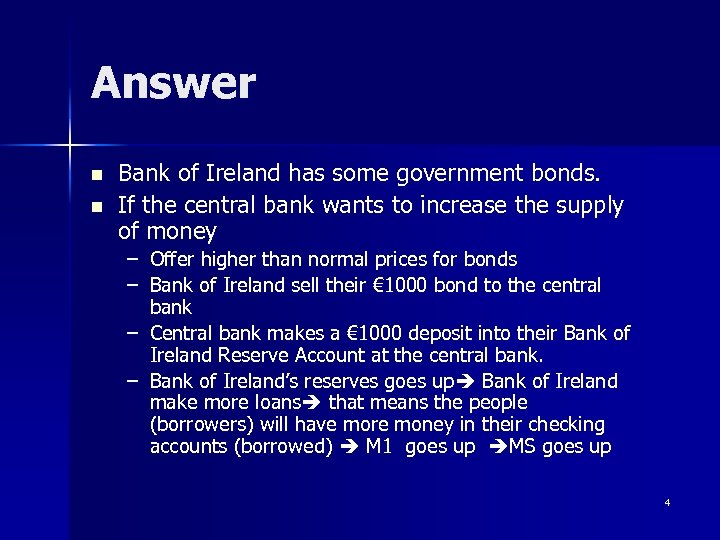
Answer n n Bank of Ireland has some government bonds. If the central bank wants to increase the supply of money – Offer higher than normal prices for bonds – Bank of Ireland sell their € 1000 bond to the central bank – Central bank makes a € 1000 deposit into their Bank of Ireland Reserve Account at the central bank. – Bank of Ireland’s reserves goes up Bank of Ireland make more loans that means the people (borrowers) will have more money in their checking accounts (borrowed) M 1 goes up MS goes up 4
The central bank supplies money. Who demands money? Firms n individuals n 5
Why do we demand money (M 1)? 1) To buy goods and services. n Transactions demand for money Varies directly with nominal GDP 2) In case of emergencies that require purchases above normal spending levels n u Precautionary demand for money 3) As an asset 6
Three motivations for holding money combine to create the aggregate demand for money If interest rates go up, do we demand more or less money? n – Less n interest rate is the opportunity cost of holding money If the price level goes up, do we demand more or less money? n – More n need more money to cover our purchases 7
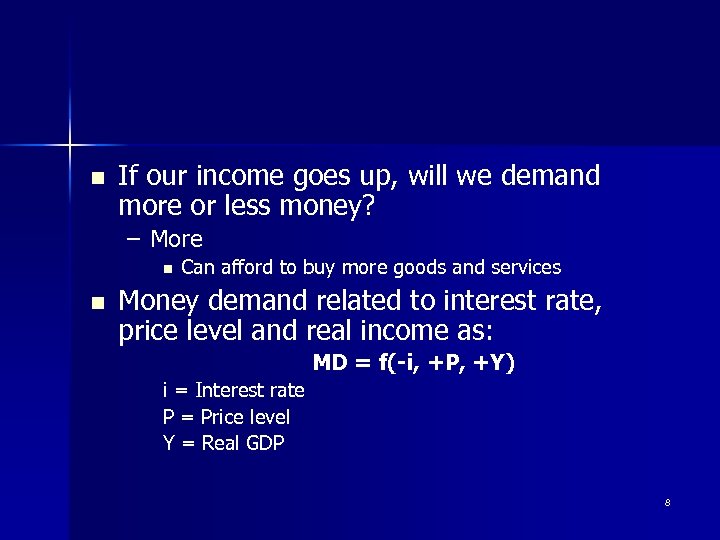
n If our income goes up, will we demand more or less money? – More n n Can afford to buy more goods and services Money demand related to interest rate, price level and real income as: MD = f(-i, +P, +Y) i = Interest rate P = Price level Y = Real GDP 8
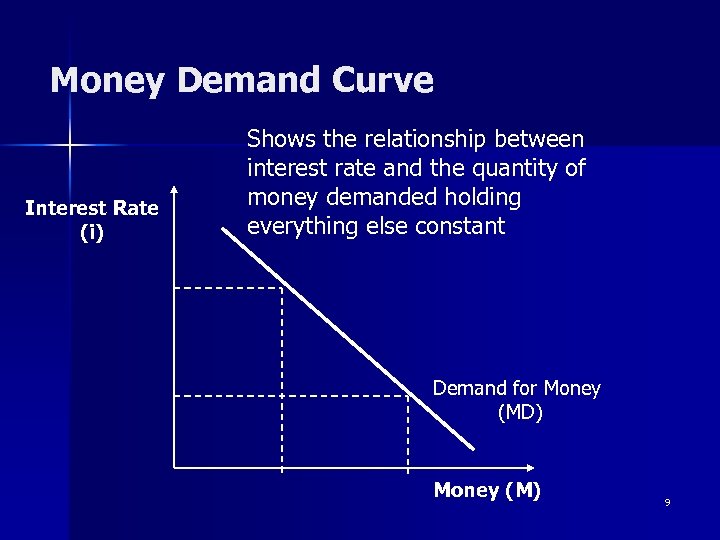
Money Demand Curve Interest Rate (i) Shows the relationship between interest rate and the quantity of money demanded holding everything else constant Demand for Money (MD) Money (M) 9
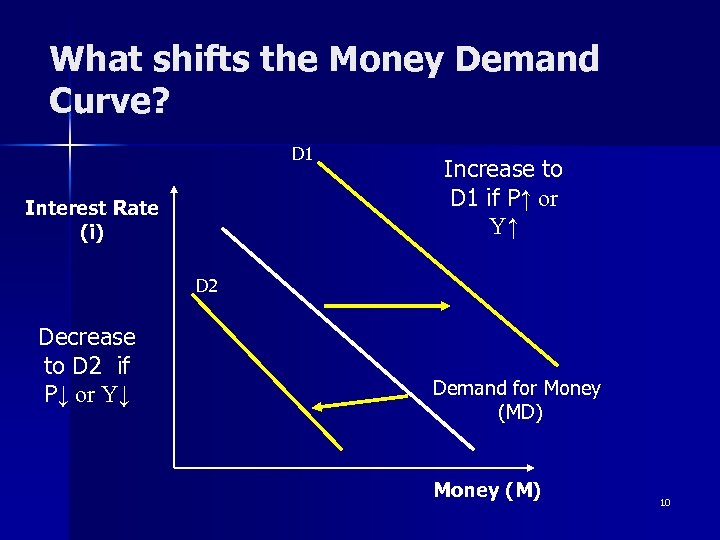
What shifts the Money Demand Curve? D 1 Interest Rate (i) Increase to D 1 if P↑ or Y↑ D 2 Decrease to D 2 if P↓ or Y↓ Demand for Money (MD) Money (M) 10
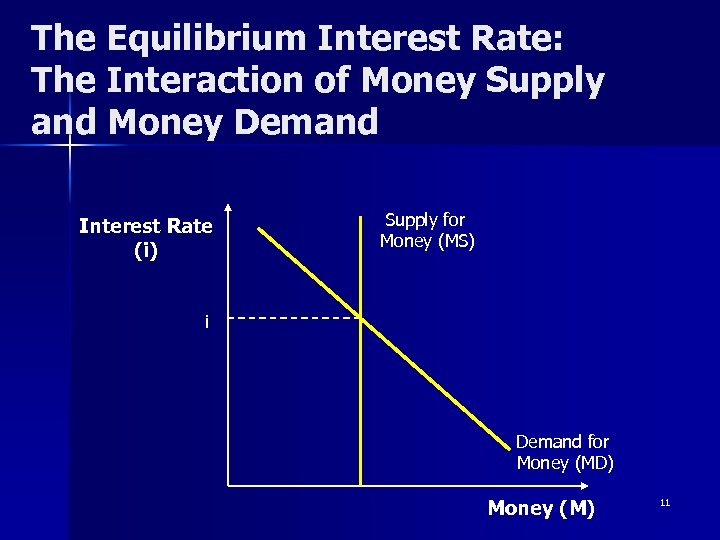
The Equilibrium Interest Rate: The Interaction of Money Supply and Money Demand Interest Rate (i) Supply for Money (MS) i Demand for Money (MD) Money (M) 11
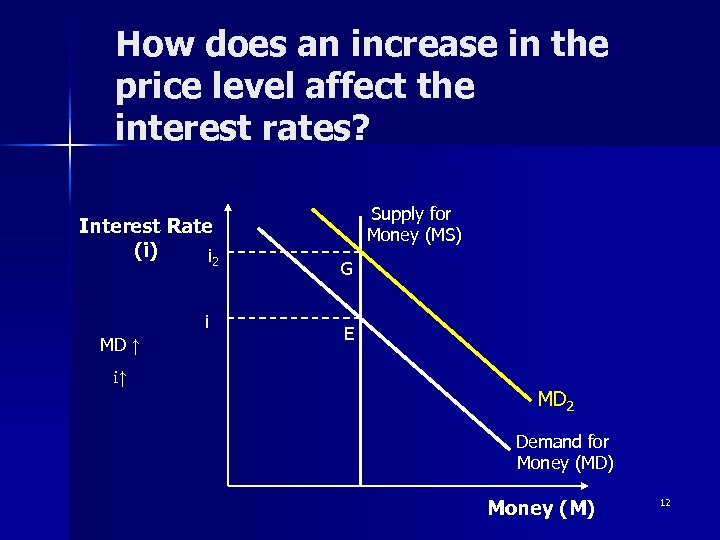
How does an increase in the price level affect the interest rates? Interest Rate (i) i 2 i MD ↑ i↑ Supply for Money (MS) G E MD 2 Demand for Money (MD) Money (M) 12
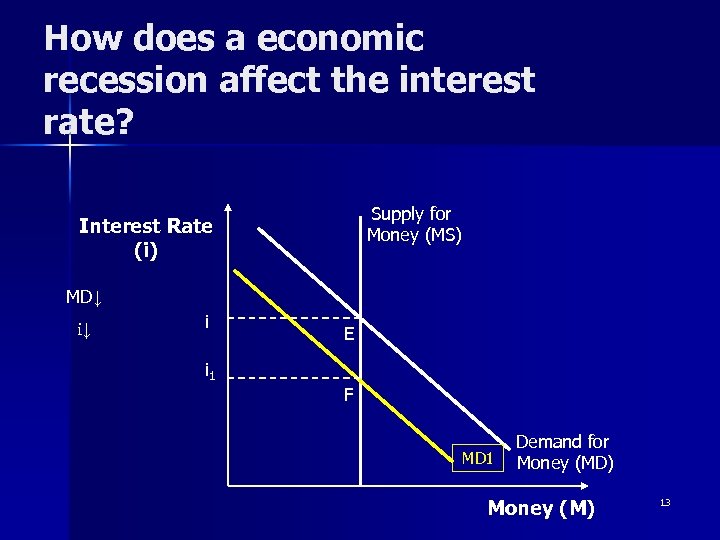
How does a economic recession affect the interest rate? Supply for Money (MS) Interest Rate (i) MD↓ i↓ i E i 1 F MD 1 Demand for Money (MD) Money (M) 13
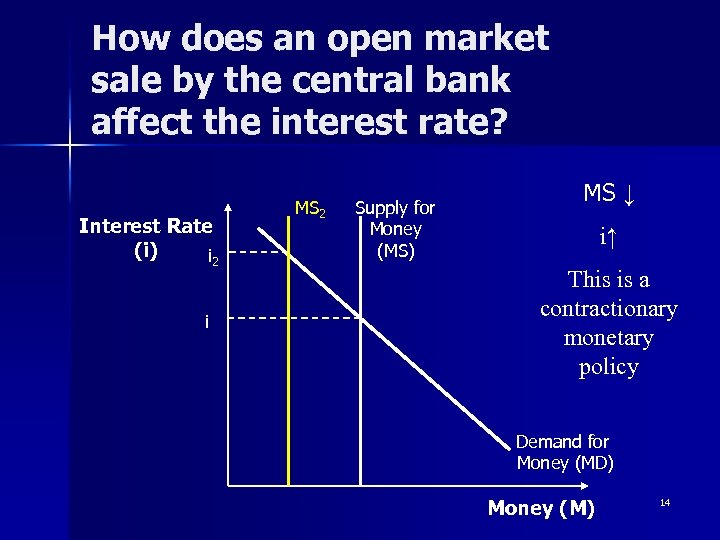
How does an open market sale by the central bank affect the interest rate? Interest Rate (i) i 2 i MS 2 Supply for Money (MS) MS ↓ i↑ This is a contractionary monetary policy Demand for Money (MD) Money (M) 14
Another Question n I'm trying to understand the example in page 329 about appreciation and depreciation but I think there's something wrong in it. Can you do it in class? 15
My answer n Let go over it together 16
How does the interest rate relate to the exchange rate? n Interest Arbitrage: – Relationship between interest rates and the exchange rate in the short run 17
International Economics n Week Eleven –Class 2 – Wednesday, November 14 – 11: 10 -12: 00 – Tyndall 18
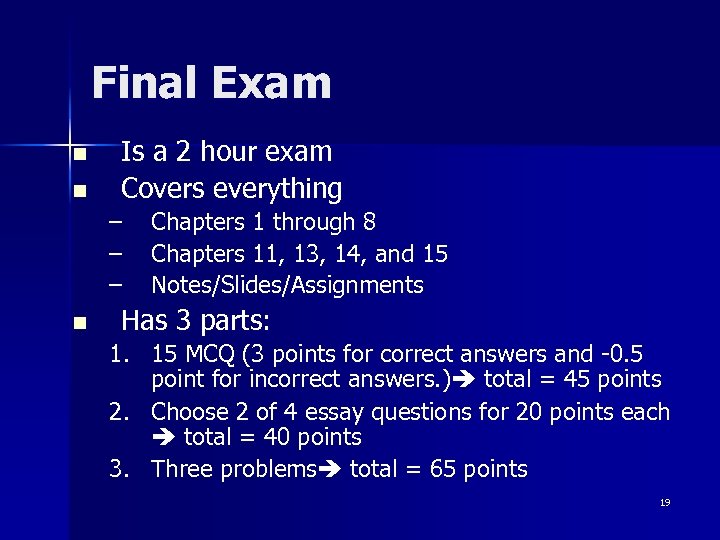
Final Exam n n Is a 2 hour exam Covers everything – – – n Chapters 1 through 8 Chapters 11, 13, 14, and 15 Notes/Slides/Assignments Has 3 parts: 1. 15 MCQ (3 points for correct answers and -0. 5 point for incorrect answers. ) total = 45 points 2. Choose 2 of 4 essay questions for 20 points each total = 40 points 3. Three problems total = 65 points 19
Remember yesterday’s question: n I'm trying to understand the example in page 329 about appreciation and depreciation but I think there's something wrong in it. Can you do it in class? 20
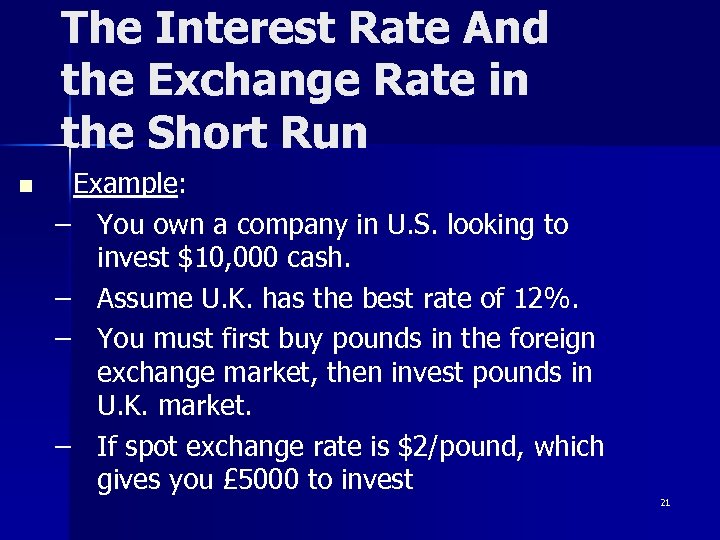
The Interest Rate And the Exchange Rate in the Short Run n Example: – You own a company in U. S. looking to invest $10, 000 cash. – Assume U. K. has the best rate of 12%. – You must first buy pounds in the foreign exchange market, then invest pounds in U. K. market. – If spot exchange rate is $2/pound, which gives you £ 5000 to invest 21
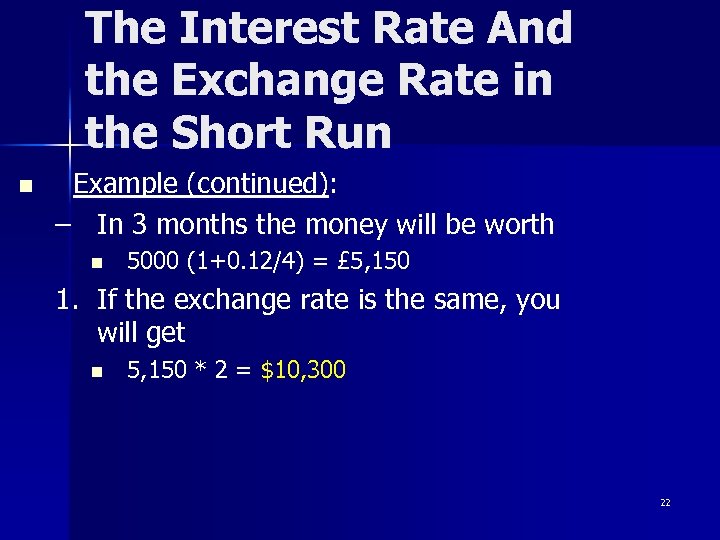
The Interest Rate And the Exchange Rate in the Short Run n Example (continued): – In 3 months the money will be worth n 5000 (1+0. 12/4) = £ 5, 150 1. If the exchange rate is the same, you will get n 5, 150 * 2 = $10, 300 22
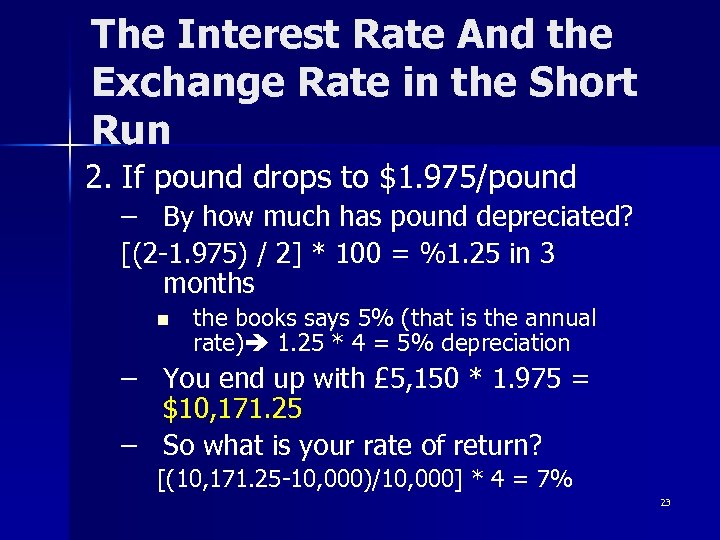
The Interest Rate And the Exchange Rate in the Short Run 2. If pound drops to $1. 975/pound – By how much has pound depreciated? [(2 -1. 975) / 2] * 100 = %1. 25 in 3 months n the books says 5% (that is the annual rate) 1. 25 * 4 = 5% depreciation – You end up with £ 5, 150 * 1. 975 = $10, 171. 25 – So what is your rate of return? [(10, 171. 25 -10, 000)/10, 000] * 4 = 7% 23
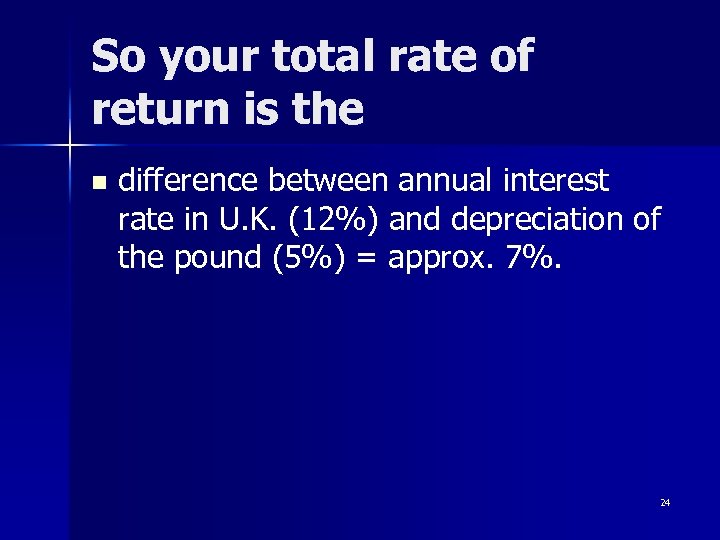
So your total rate of return is the n difference between annual interest rate in U. K. (12%) and depreciation of the pound (5%) = approx. 7%. 24
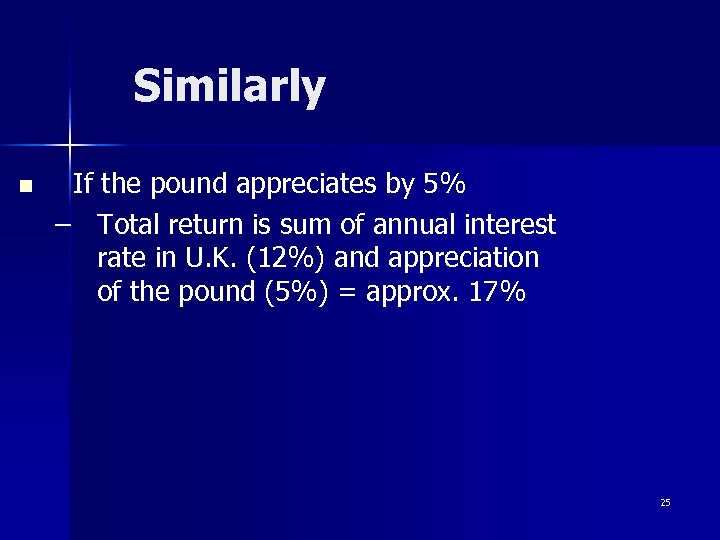
Similarly n If the pound appreciates by 5% – Total return is sum of annual interest rate in U. K. (12%) and appreciation of the pound (5%) = approx. 17% 25
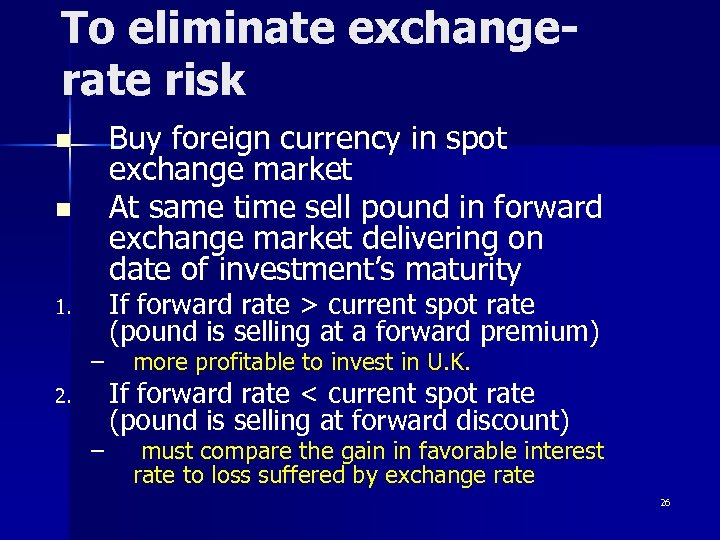
To eliminate exchangerate risk Buy foreign currency in spot exchange market At same time sell pound in forward exchange market delivering on date of investment’s maturity n n 1. – 2. – If forward rate > current spot rate (pound is selling at a forward premium) more profitable to invest in U. K. If forward rate < current spot rate (pound is selling at forward discount) must compare the gain in favorable interest rate to loss suffered by exchange rate 26
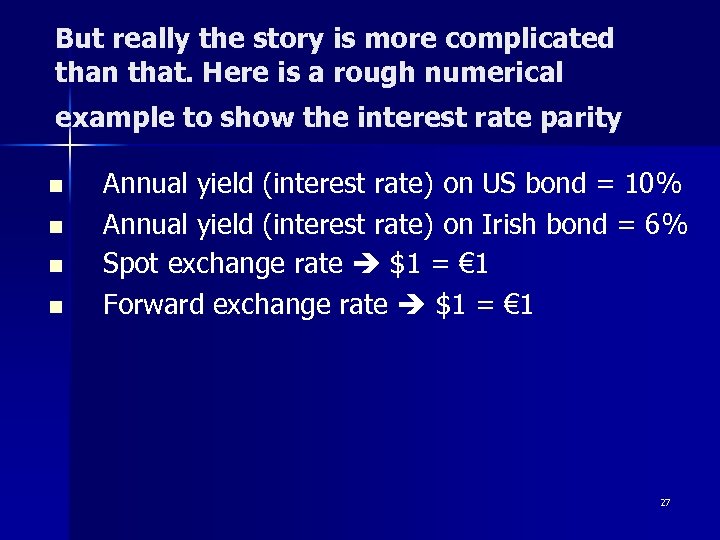
But really the story is more complicated than that. Here is a rough numerical example to show the interest rate parity n n Annual yield (interest rate) on US bond = 10% Annual yield (interest rate) on Irish bond = 6% Spot exchange rate $1 = € 1 Forward exchange rate $1 = € 1 27
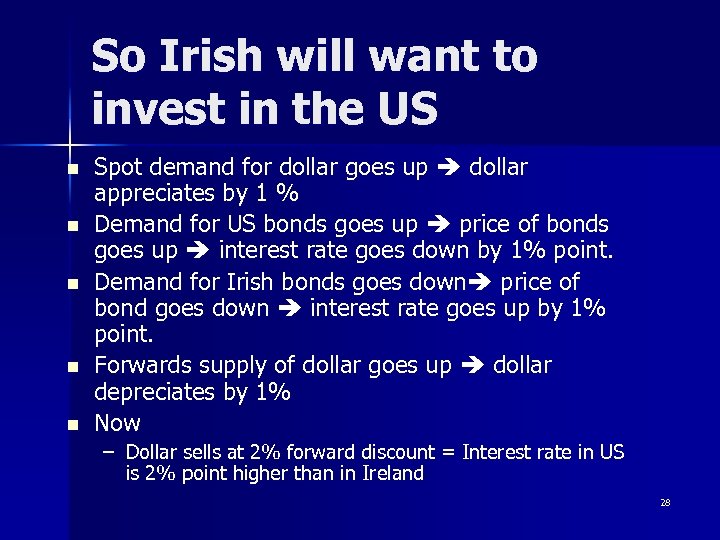
So Irish will want to invest in the US n n n Spot demand for dollar goes up dollar appreciates by 1 % Demand for US bonds goes up price of bonds goes up interest rate goes down by 1% point. Demand for Irish bonds goes down price of bond goes down interest rate goes up by 1% point. Forwards supply of dollar goes up dollar depreciates by 1% Now – Dollar sells at 2% forward discount = Interest rate in US is 2% point higher than in Ireland 28
Interest rate parity n Funds continue moving between the two countries until – forward premium or discount equals the interest rate differential 29
International Economics n Week Eleven - Class 3 – Wednesday, November 14 – 15: 10 -16: 00 – AC 201 Online grades were updated today. n ICA 5 is graded and ready to be picked up n 30
The Interest Rate And the Exchange Rate in the Short Run What does tightening of money in Ireland do to interest rates? n – What does this do in the market for euro? n – – n MS declines interest rates go up Demand goes up euro appreciates Supply goes down euro appreciates This process continues until interest parity is achieved. 31
Interest Rates, the Exchange Rate, and the Balance of Payments Changes in Interest Rates: n – Increasing a country’s interest rate: n n – Decreasing a country’s interest rate: n n – – Causes capital inflow Appreciation of a country’s currency Causes capital outflow Depreciates a country’s currency Movement of capital causes change exchange rates Interest rate volatility exchange rate volatility 32
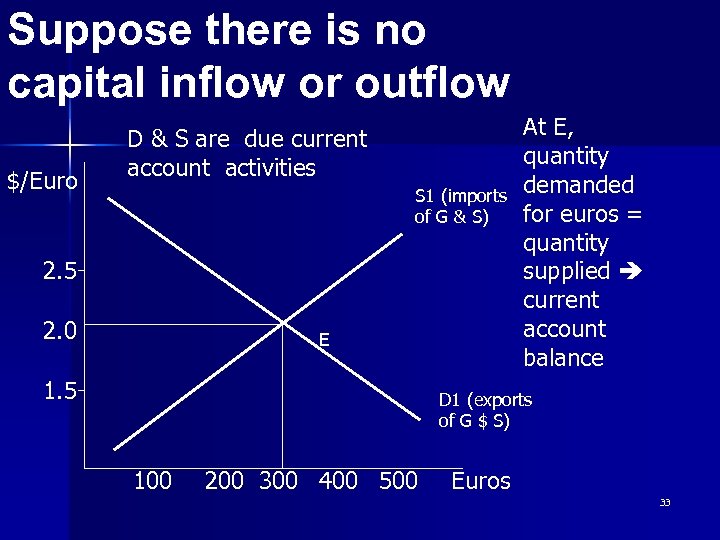
Suppose there is no capital inflow or outflow $/Euro D & S are due current account activities S 1 (imports of G & S) 2. 5 2. 0 E 1. 5 At E, quantity demanded for euros = quantity supplied current account balance D 1 (exports of G $ S) 100 200 300 400 500 Euros 33
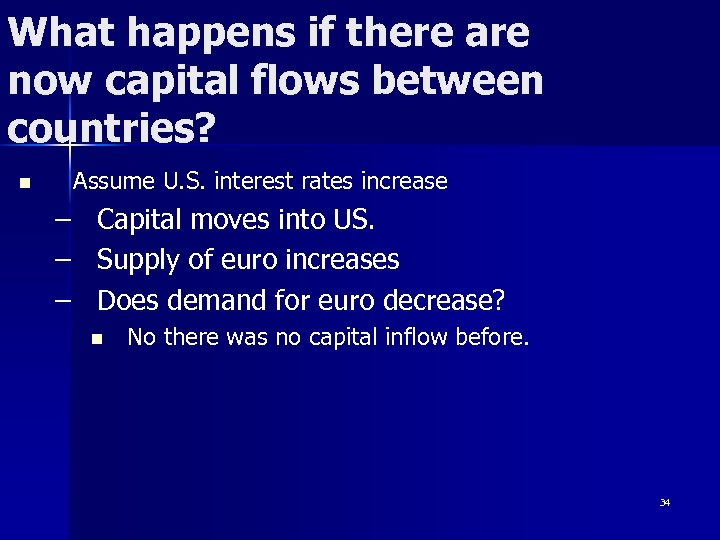
What happens if there are now capital flows between countries? n Assume U. S. interest rates increase – Capital moves into US. – Supply of euro increases – Does demand for euro decrease? n No there was no capital inflow before. 34
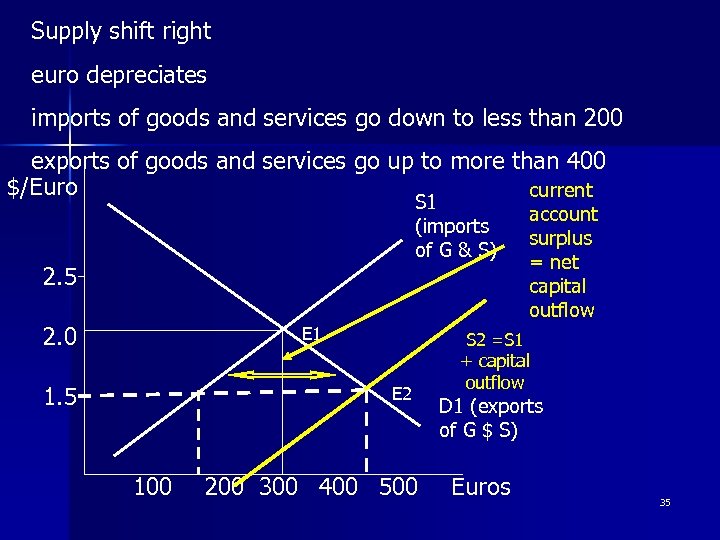
Supply shift right euro depreciates imports of goods and services go down to less than 200 exports of goods and services go up to more than 400 $/Euro current S 1 (imports of G & S) 2. 5 2. 0 E 1 1. 5 E 2 100 200 300 400 500 account surplus = net capital outflow S 2 =S 1 + capital outflow D 1 (exports of G $ S) Euros 35
CHAPTER 15 Price Levels and Exchange Rates in the Long Run 36
The Law of One Price n Law of One Price: – Identical goods sold in competitive markets should cost the same in all countries when prices are expressed in terms of the same currency n Example: – If exchange is 2$/Pound a pair of shoes costs £ 200, then the same pair of shoes should cost $400 in U. S. (same price). 37
What if The Law of One Price does not hold? n It leaves room for arbitrage between the countries. n Example: n Using the pair of shoes from U. K. – Exchange is $2/Pound, PU. K. = £ 200, and PU. S = $400 – If the price in U. S. rose to $500 and the exchange rate did not change, what would happen? 38
what would happen? n Demand for Pounds would increase – U. S. importers need Pounds to buy shoes. – The $/Pound exchange rate would rise. n Demand for UK shoes rise n Supply of shoes in the US will go up n Continues until prices are the same again. – increasing price of shoes in UK – decreasing price of shoes in US 39
But prices in most countries are not usually equal. Why? 1. 2. 3. 4. n Transportation costs Some goods are not tradable Barriers to trade Differences in tax rates and regulations But over time market forces tend to push prices toward equality 40
Скачать презентацию Welcome to EC 382 International Economics By Dr
509c1160164e6522e6be5d94e4676002.ppt