


 Скачать презентацию Welcome to class of World Marketplace Dr Satyendra
0f41090642b66b168bc499c1d496d40f.ppt
- Количество слайдов: 20
 Welcome to class of World Marketplace Dr. Satyendra Singh Professor, Marketing and International Business University of Winnipeg Canada s. singh@uwinnipeg. ca http: //abem. uwinnipeg. ca www. abem. ca/conference
 United Nations – 191 nations peace and global stability – Has functions related to business – General Assembly • each member country has one vote regardless of size, wealth or power
 United Nations – Security Council • Main policy-setting body of the UN, composed of 15 members including 5 permanent members – Permanent: UK, USA, Russia, France and China – Nonpermanent: Africa/Asia (5), Latin America (2), Western Europe (2), Eastern Europe (1) – to be selected by the general assembly for a 2 -yr term. – Economic and Social Council (ECOSOC) • UN body concerned with economic and social issues such as trade, development, education, and human rights
 Economic Integration • Free trade area (FTA) – Area in which tariffs among members have been eliminated, but members keep their external tariffs • No movement of people and services • Customs Union – Collaboration that adds common external tariffs to an FTA • Common Market – Customs union that includes mobility of services, people, and capital within the union • Complete Economic Integration – Integration on both economic and political levels
 World Trade Organization • – A multinational body of 149 members that deals with rules of trade between nations – Outgrowth of General Agreement on Tariffs and Trade (GATT), that functioned to encourage trade liberalization from 1947 to 1995
 WTO Principles – – – Trade without discrimination Trade freer, with trade barriers negotiated downward Trade predictable Trade more competitive Trade more beneficial for less developed countries, encouraging development and economic reform – Trade protects copyrights, trademarks, trade secrets, and other intellectual property matters – Disagreement on agricultural policies • India, Brazil…
 Decision-Making Process • WTO – decision process a bit subtle – Each country has a vote and decision is by consensus – In reality -- US, EU, Canada and Japan – Some countries are in a better position to impose sanctions in case of trade dispute – Primary aim of WTO is to liberalize world trade! – Protest against globalization continues • World Bank and IMF – decision process undemocratic! – Votes are based on shares depends on income so rich nations have more votes – It is reflected on the board of both institutions – US and UK have their own Executive Director (ED) – 2 – Whereas African nations have to share their 2 EDs – Some countries are borrowers and some lenders
 Global Agencies • Organization For Economic Cooperation and Development (OECD) – Group of (mostly) developed countries (35) dedicated to promoting economic expansion in its member-nations • Organization of Petroleum Exporting Countries (OPEC) – Cartel of 12 petroleum exporting countries • Middle East (6): Iran, Iraq, Kuwait, Qatar, Saudi Arabia and UAE • Africa(4): Algeria, Angola, Nigeria, Libya • South America (2): Equator and Venezuela Other non OPEC oil exporting countries: UK, Russia, Mexico, Norway
 Trading Blocks • North America – North America Free Trade Agreement (NAFTA) – European Free Trade Agreement (EFTA) • European Union • Asia – Association of South. East Asian Nations (ASEAN) – Asia Pacific Economic Cooperation (APEC) • Africa – Economic Council of West African States (ECOWAS) – Common Market for Eastern and Southern Africa (COMESA) • South America – Mercosur (Mercosul)
 North American Free Trade Agreement (NAFTA) • NAFTA – Established January 1, 1994 – Agreement creating a free trade area among Canada, Mexico, and the United States
 European Free Trade Agreement (EFTA) • EFTA – Founded in 1960 by seven European countries: • Austria, Denmark, Norway, Portugal, Sweden, Switzerland, Finland, Iceland, Liechtenstein, and the United Kingdom – Today, a 4 -nation non-EU FTA in Europe: Norway, Iceland, Liechtenstein, Switzerland
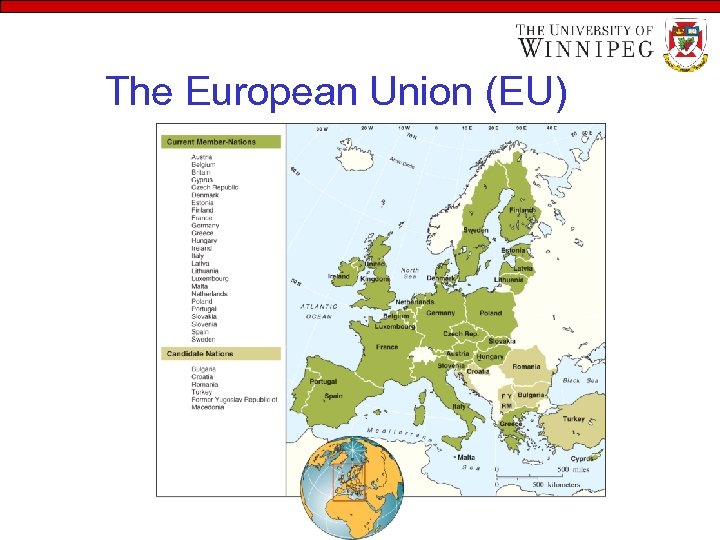 The European Union (EU)
 The European Union (EU)… • European Union – A body of 28 European countries dedicated to economic and political integration – Romania and Bulgaria joined in 2007, to move membership to 27 – Croatia joined in 2013 28 th country
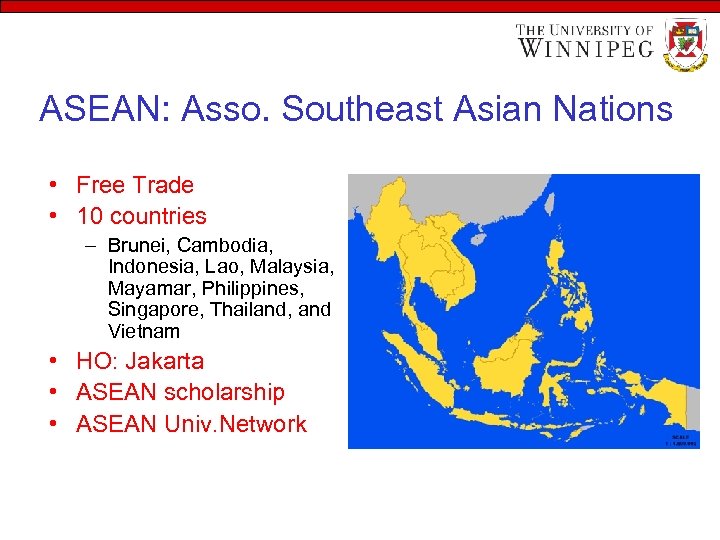 ASEAN: Asso. Southeast Asian Nations • Free Trade • 10 countries – Brunei, Cambodia, Indonesia, Lao, Malaysia, Mayamar, Philippines, Singapore, Thailand, and Vietnam • HO: Jakarta • ASEAN scholarship • ASEAN Univ. Network
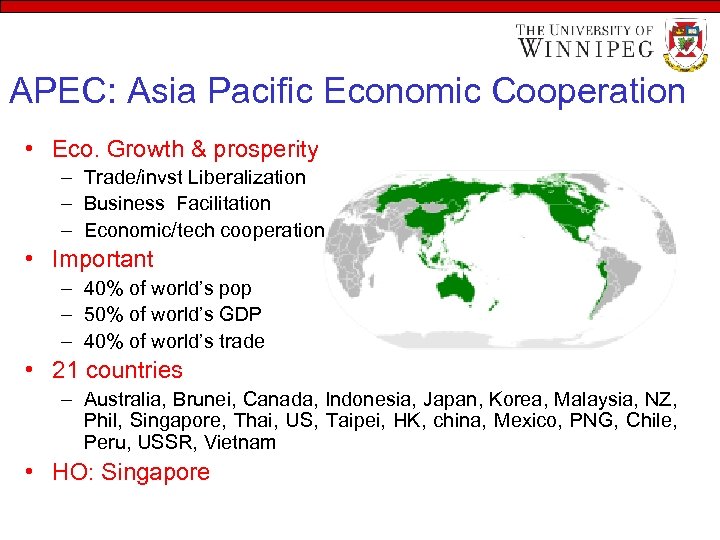 APEC: Asia Pacific Economic Cooperation • Eco. Growth & prosperity – Trade/invst Liberalization – Business Facilitation – Economic/tech cooperation • Important – 40% of world’s pop – 50% of world’s GDP – 40% of world’s trade • 21 countries – Australia, Brunei, Canada, Indonesia, Japan, Korea, Malaysia, NZ, Phil, Singapore, Thai, US, Taipei, HK, china, Mexico, PNG, Chile, Peru, USSR, Vietnam • HO: Singapore
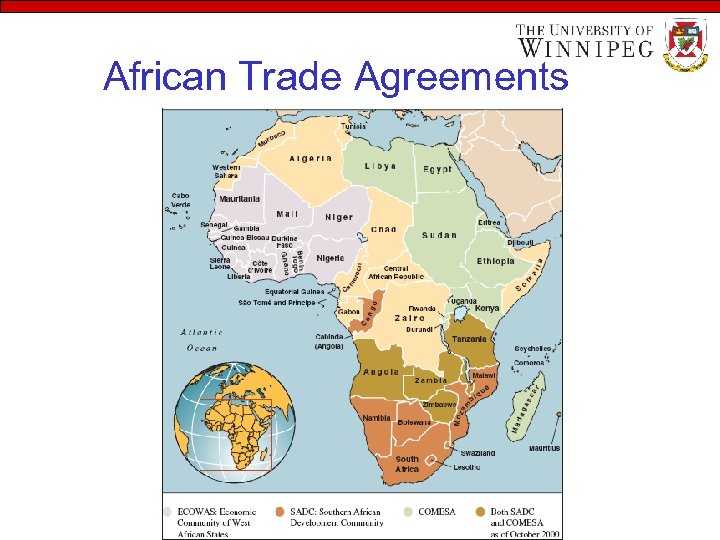 African Trade Agreements
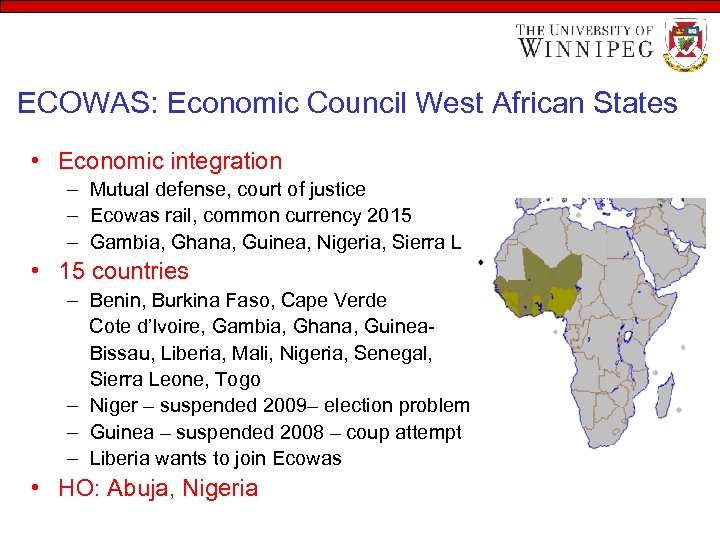 ECOWAS: Economic Council West African States • Economic integration – Mutual defense, court of justice – Ecowas rail, common currency 2015 – Gambia, Ghana, Guinea, Nigeria, Sierra L • 15 countries – Benin, Burkina Faso, Cape Verde Cote d’lvoire, Gambia, Ghana, Guinea. Bissau, Liberia, Mali, Nigeria, Senegal, Sierra Leone, Togo – Niger – suspended 2009– election problem – Guinea – suspended 2008 – coup attempt – Liberia wants to join Ecowas • HO: Abuja, Nigeria
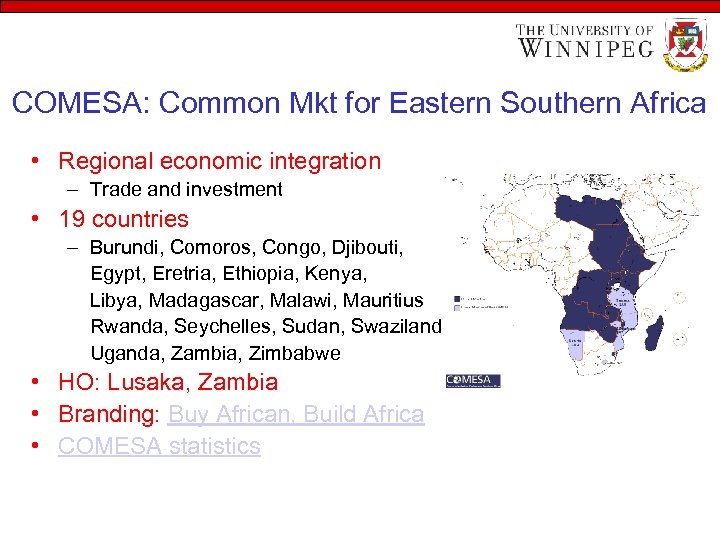 COMESA: Common Mkt for Eastern Southern Africa • Regional economic integration – Trade and investment • 19 countries – Burundi, Comoros, Congo, Djibouti, Egypt, Eretria, Ethiopia, Kenya, Libya, Madagascar, Malawi, Mauritius Rwanda, Seychelles, Sudan, Swaziland Uganda, Zambia, Zimbabwe • HO: Lusaka, Zambia • Branding: Buy African, Build Africa • COMESA statistics
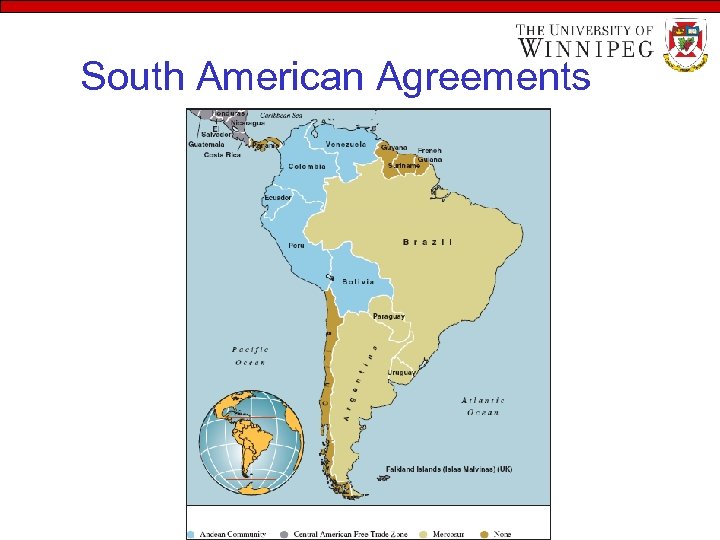 South American Agreements
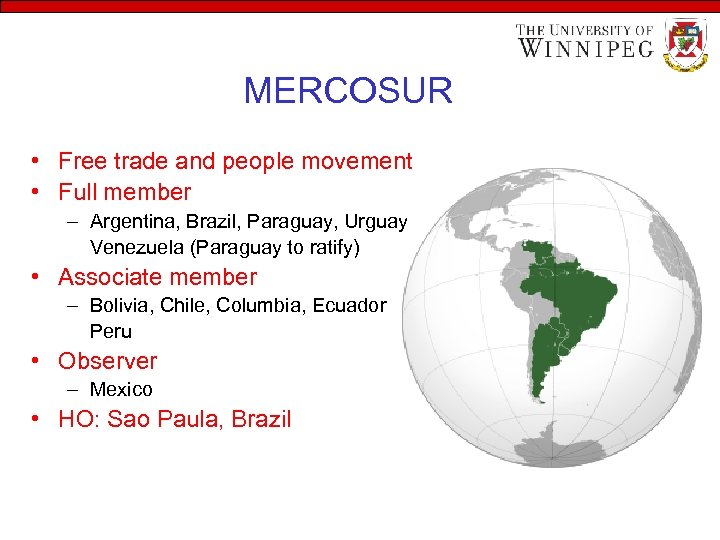 MERCOSUR • Free trade and people movement • Full member – Argentina, Brazil, Paraguay, Urguay Venezuela (Paraguay to ratify) • Associate member – Bolivia, Chile, Columbia, Ecuador Peru • Observer – Mexico • HO: Sao Paula, Brazil