


 Скачать презентацию Welcome to class of International Human Resource Management
9b823de517f770d7a4cb69662ad8c885.ppt
- Количество слайдов: 20
 Welcome to class of International Human Resource Management Dr. Satyendra Singh Professor, Marketing and International Business University of Winnipeg Canada s. singh@uwinnipeg. ca http: //abem. uwinnipeg. ca www. abem. ca/conference
 Learning Objectives: § Creating a company “global mindset” § International HRM approaches § Recruitment selection and training § Expatriates § Compensation § Allowances § Bonus § Challenges
 The Global Mindset § Expatriate § A person living outside citizenship country § Global Mind-set § A mind-set that combines an openness to and an awareness of diversity across markets and cultures with a propensity and ability to synthesize across this diversity
 International HRM Approaches… § Ethnocentric § Hiring and promoting employees on the basis of parent company’s home country frame of reference § Bias of the home country § Top executives get foreign experience § Polycentric § Hiring and promoting employees on the basis of specific local context of the subsidiary § Movement between home and host country uncommon § Must give locals to elevated position revoke permit § Local supplier preferred § Managers unwilling to take promotion § Local managers may have their own agenda
 International HRM Approaches § Regiocentric § Hiring and promoting employees on the basis of the specific regional context of the subsidiary § Hiring can be from both countries– home or host § Problem with third country employees § Geocentric § Hiring and promoting employees on the basis of ability and experience without considering race or citizenship § Best Practices
 Recruitment, Selection and Training… § Parent Country National (PCNs) or Home Country National § Study of language and culture § Host Country National (HCN) § Hired in the host country § Third Country National
 Recruitment, Selection and Training § Third Country National (TCN) § May accept lower wages and benefits than will employees from the home country § May also come from a culture similar to that of the host country § May have worked for another unit of the IC and be familiar with policies, procedures and people § Common approach in developing countries § May not be welcome by host country § May come from an international agency § Greater use as companies take geocentric view
 Expatriates § Family § Nine of ten expatriate failures family-related § Unhappy spouses major reason for early return § Company losing a “million-dollar corporate-training investment” in executive
 Language Training § Language Trap § International business person speaks only home language § English language has become lingua franca § Chinese new “hot” language to know
 Expatriate Services… • Health care programs to assist companies and expatriates with – – – Claims administration Language Translations Currency conversions Service standardization www. Expat. Expert. com
 Expatriate Services § Banking services § Online, 24 -hour assistance § Training § Culture and language § House hunting, utilities hook up, grocery and hardware shopping, long-distance care for relatives, schools, organizations, and cultural items
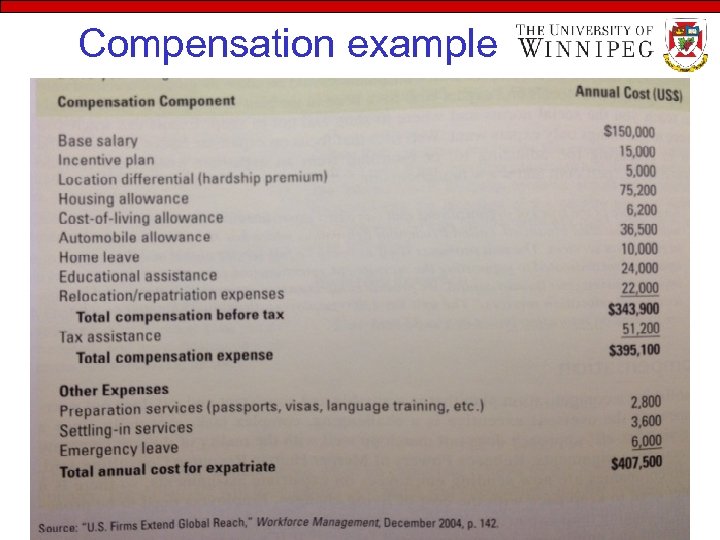 Compensation example
 Compensation § Salaries § Paying home country nationals the same salaries as their domestic counterparts § permits worldwide consistency § bonuses § Increasing use of third country nationals- often treated like PCNs § Trend to pay HCNs same base
 Allowances… § Housing Allowance § Permits executive to live at same standard as at home § Cost-of-Living Allowance § Based on differences in price of food, utilities, transportation, entertainment, clothing, personal services, and medical expenses as compared to home § Allowances for Tax Differentials § Ensures expatriates will not have less after-tax pay at home
 Allowances § Education Allowances § Insures children receive education equal to that at home § Moving and Orientation Allowances § Household effects and language instruction
 Bonuses • Bonuses § Expatriate employee compensation payments in addition to base salary and allowances because of hardship, inconvenience, or danger § Bonuses include § Overseas premiums § Contract termination payments § Home leave reimbursement
 Compensation Packages § For expatriate employees, packages incorporate many types of payments or reimbursements and must take into consideration exchange rates and inflation
 Compensation Packages Can Be Complicated § Allowances and percentage of base salary are usually paid in host country currency § Percentage usually 65 to 75 percent, with remainder banked where employee directs § What Exchange Rate? § Must be chosen § More difficult in countries with exchange controls and nonconvertible currencies
 Compensation of Third Country Nationals § Trend toward applying the same compensation plan to third country nationals as home country expatriates § Problems can arise in § The calculation of income tax differential when American expatriate compared with expatriate from another country § Home leave bonus
 International Status § Entitles expatriate employee to allowances and bonuses applicable to the place of residence and employment § Perks § Compensate executives while minimizing taxes § § § § Private pension plan Retirement payment Life Insurance Hidden slush funds (can be illegal) Club membership Company house Foreign affiliate directorship