Скачать презентацию WELCOME TO CLASS 10 A 3 WARM-UP
44e42bcecf0071f96039c317023329fc.ppt
- Количество слайдов: 17
 WELCOME TO CLASS 10 A 3
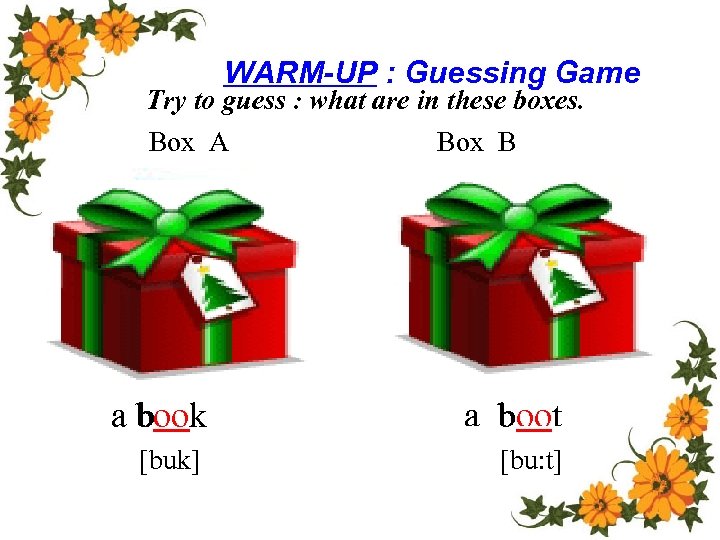 WARM-UP : Guessing Game Try to guess : what are in these boxes. Box B Box A a book b a b boot [buk] [bu: t]
 UNIT 5: Technology and you E: Language Focus
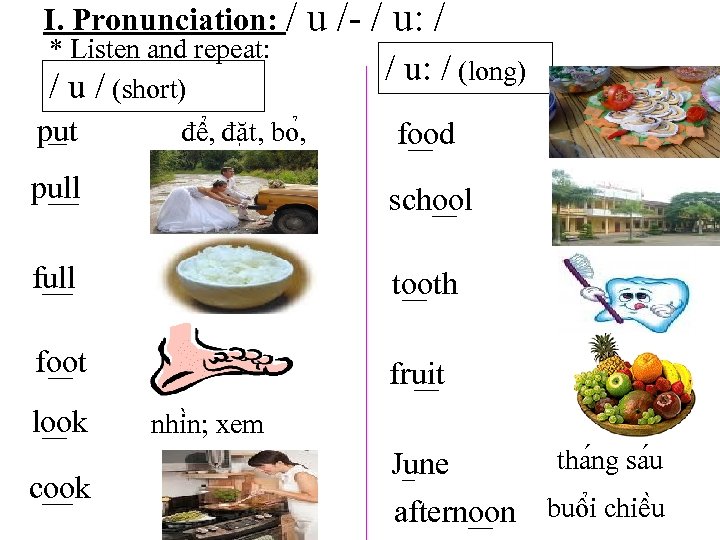 I. Pronunciation: / * Listen and repeat: / u / (short) put đê , đă t, bo , u /- / u: / (long) food pull school full tooth foot fruit look cook nhi n; xem tha ng sa u June afternoon buô i chiê u
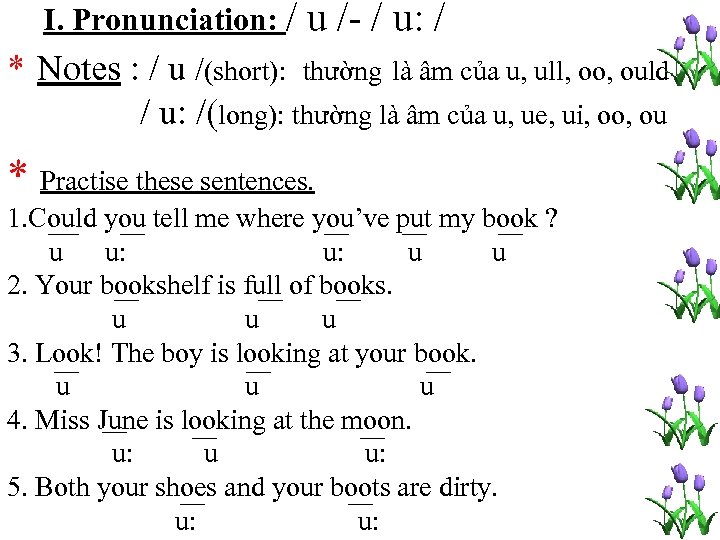 I. Pronunciation: / u /- / u: / * Notes : / u /(short): thường là âm của u, ull, oo, ould / u: /(long): thường là âm của u, ue, ui, oo, ou * Practise these sentences. 1. Could you tell me where you’ve put my book ? u u: u: u u 2. Your bookshelf is full of books. u u u 3. Look! The boy is looking at your book. u u u 4. Miss June is looking at the moon. u: u u: 5. Both your shoes and your boots are dirty. u: u:
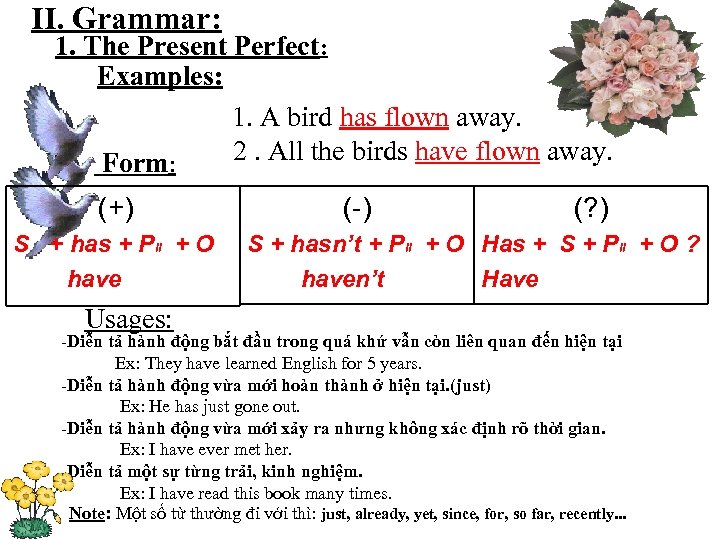 II. Grammar: 1. The Present Perfect: Examples: 1. A bird has flown away. 2. All the birds have flown away. Form: (+) S + has + PII + O have Usages: (-) (? ) S + hasn’t + PII + O Has + S + PII + O ? haven’t Have -Diễn tả hành động bắt đầu trong quá khứ vẫn còn liên quan đến hiện tại Ex: They have learned English for 5 years. -Diễn tả hành động vừa mới hoàn thành ở hiện tại. (just) Ex: He has just gone out. -Diễn tả hành động vừa mới xảy ra nhưng không xác định rõ thời gian. Ex: I have ever met her. -Diễn tả một sự từng trải, kinh nghiệm. Ex: I have read this book many times. Note: Một số từ thường đi với thì: just, already, yet, since, for, so far, recently. . .
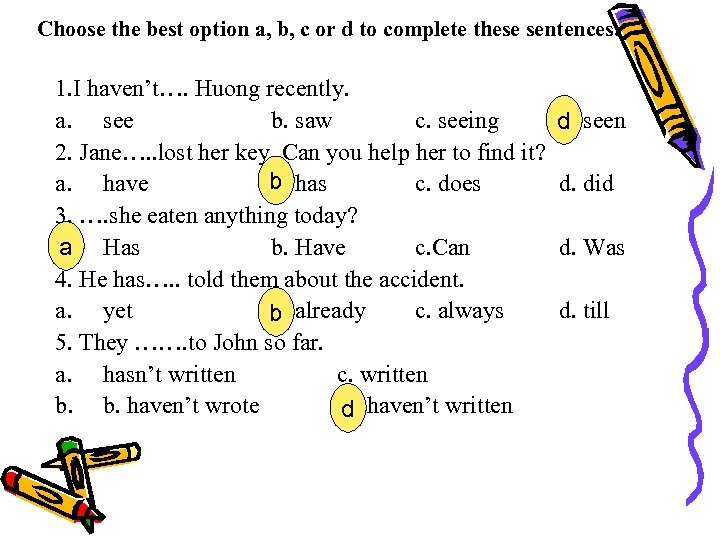 Choose the best option a, b, c or d to complete these sentences. 1. I haven’t…. Huong recently. a. see b. saw c. seeing 2. Jane…. . lost her key. Can you help her to find it? b has a. have b. c. does 3. …. she eaten anything today? a a. Has b. Have c. Can 4. He has…. . told them about the accident. a. yet b. c. always b already 5. They ……. to John so far. a. hasn’t written c. written b. b. haven’t wrote d. d haven’t written d. d seen d. did d. Was d. till
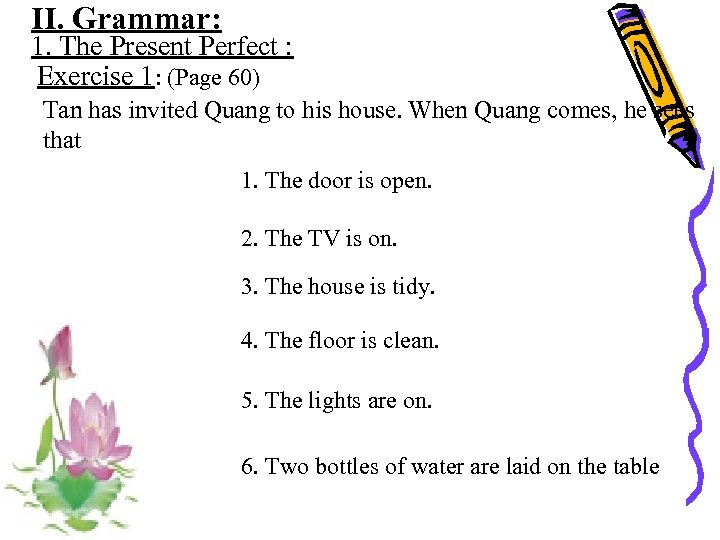 II. Grammar: 1. The Present Perfect : Exercise 1: (Page 60) Tan has invited Quang to his house. When Quang comes, he sees that 1. The door is open. 2. The TV is on. 3. The house is tidy. 4. The floor is clean. 5. The lights are on. 6. Two bottles of water are laid on the table
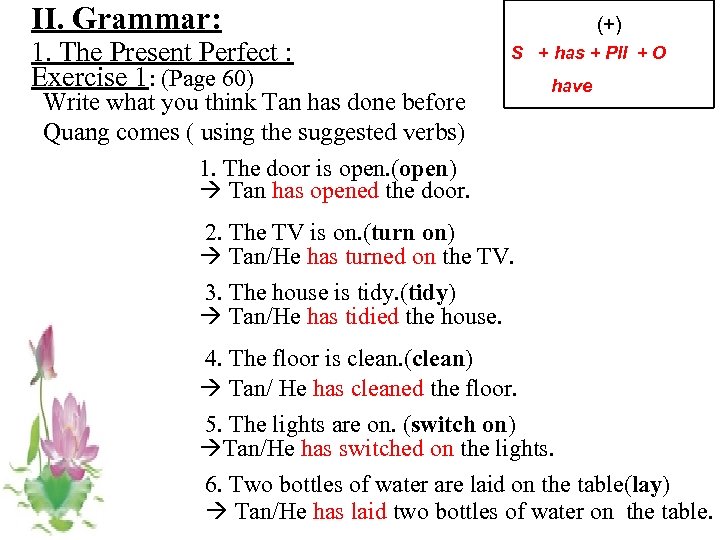 II. Grammar: 1. The Present Perfect : Exercise 1: (Page 60) (+) S + has + PII + O Write what you think Tan has done before Quang comes ( using the suggested verbs) 1. The door is open. (open) Tan has opened the door. have 2. The TV is on. (turn on) Tan/He has turned on the TV. 3. The house is tidy. (tidy) Tan/He has tidied the house. 4. The floor is clean. (clean) Tan/ He has cleaned the floor. 5. The lights are on. (switch on) Tan/He has switched on the lights. 6. Two bottles of water are laid on the table(lay) Tan/He has laid two bottles of water on the table.
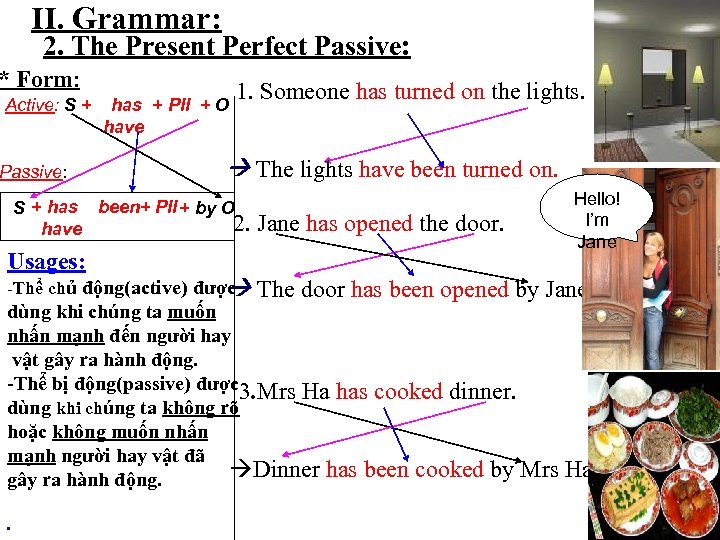 II. Grammar: 2. The Present Perfect Passive: * Form: Active: S + Passive: has + PII + O have 1. Someone has turned on the lights. The lights have been turned on. S + has been+ PII + by O 2. have Jane has opened the door. Usages: -Thể chủ động(active) được The door has been opened by Jane. dùng khi chúng ta muốn nhấn mạnh đến người hay vật gây ra hành động. -Thể bị động(passive) được 3. Mrs Ha has cooked dinner. dùng khi chúng ta không rõ hoặc không muốn nhấn mạnh người hay vật đã Dinner has been cooked by Mrs gây ra hành động. . Hello! I’m Jane Ha.
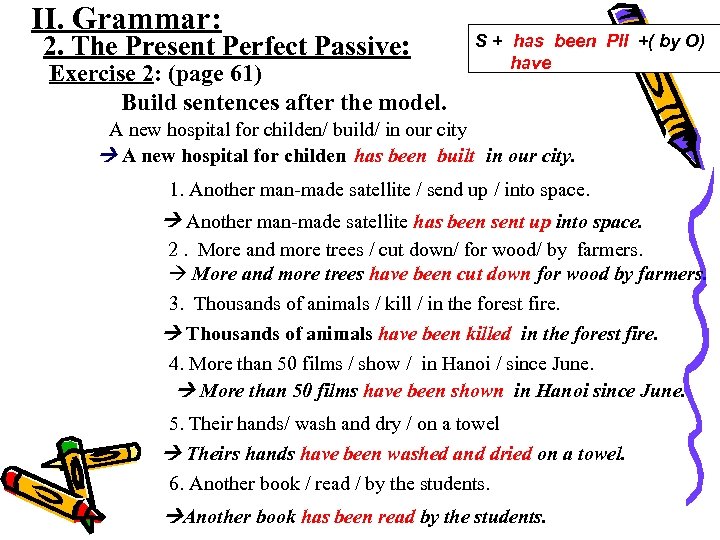 II. Grammar: 2. The Present Perfect Passive: Exercise 2: (page 61) Build sentences after the model. S + has been PII +( by O) have A new hospital for childen/ build/ in our city A new hospital for childen has been built in our city. 1. Another man-made satellite / send up / into space. Another man-made satellite has been sent up into space. 2. More and more trees / cut down/ for wood/ by farmers. More and more trees have been cut down for wood by farmers. 3. Thousands of animals / kill / in the forest fire. Thousands of animals have been killed in the forest fire. 4. More than 50 films / show / in Hanoi / since June. More than 50 films have been shown in Hanoi since June. 5. Their hands/ wash and dry / on a towel Theirs hands have been washed and dried on a towel. 6. Another book / read / by the students. Another book has been read by the students.
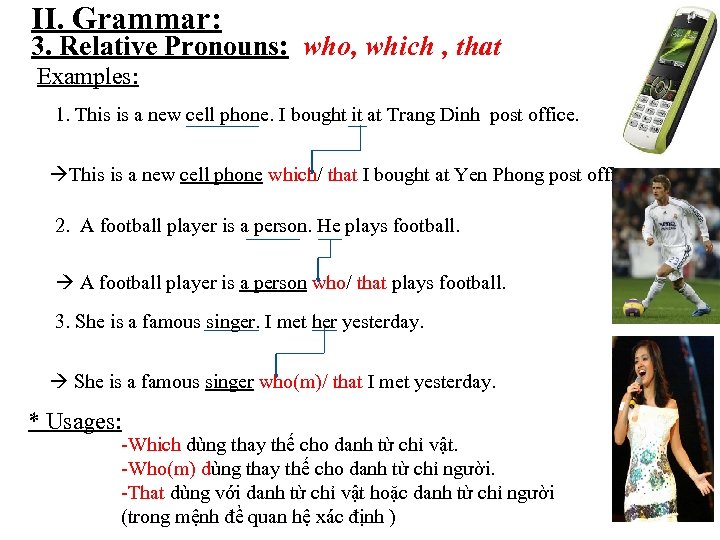 II. Grammar: 3. Relative Pronouns: who, which , that Examples: 1. This is a new cell phone. I bought it at Trang Dinh post office. This is a new cell phone which/ that I bought at Yen Phong post office. 2. A football player is a person. He plays football. A football player is a person who/ that plays football. 3. She is a famous singer. I met her yesterday. She is a famous singer who(m)/ that I met yesterday. * Usages: -Which dùng thay thế cho danh từ chỉ vật. -Who(m) dùng thay thế cho danh từ chỉ người. -That dùng với danh từ chỉ vật hoặc danh từ chỉ người (trong mệnh đề quan hệ xác định )
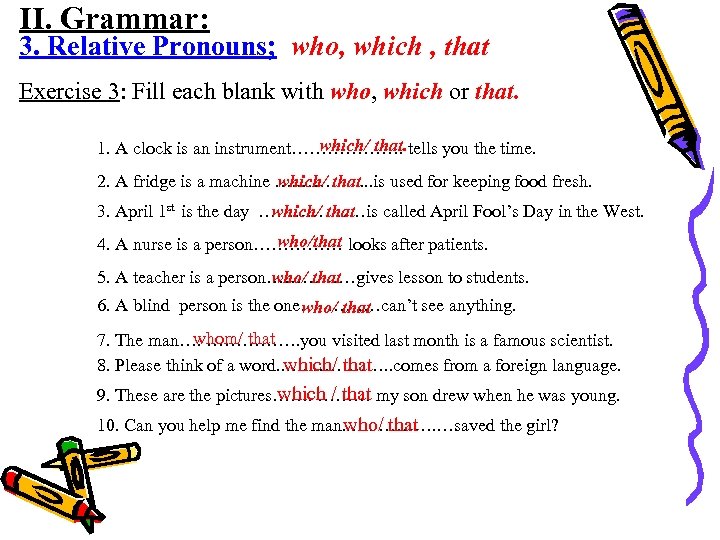 II. Grammar: 3. Relative Pronouns; who, which , that Exercise 3: Fill each blank with who, which or that. which/ that. 1. A clock is an instrument………………. tells you the time. 2. A fridge is a machine …. . ……. . . . is used for keeping food fresh. which/ that 3. April 1 st is the day ………………is called April Fool’s Day in the West. which/ that who/that 4. A nurse is a person…………… looks after patients. 5. A teacher is a person……………gives lesson to students. who/ that 6. A blind person is the one…. ………can’t see anything. who/ that whom/ that 7. The man…. ……………. you visited last month is a famous scientist. 8. Please think of a word. . …. …………. . comes from a foreign language. which/ that which / that 9. These are the pictures……. ……… my son drew when he was young. 10. Can you help me find the man. . …. ………. …saved the girl? who/ that
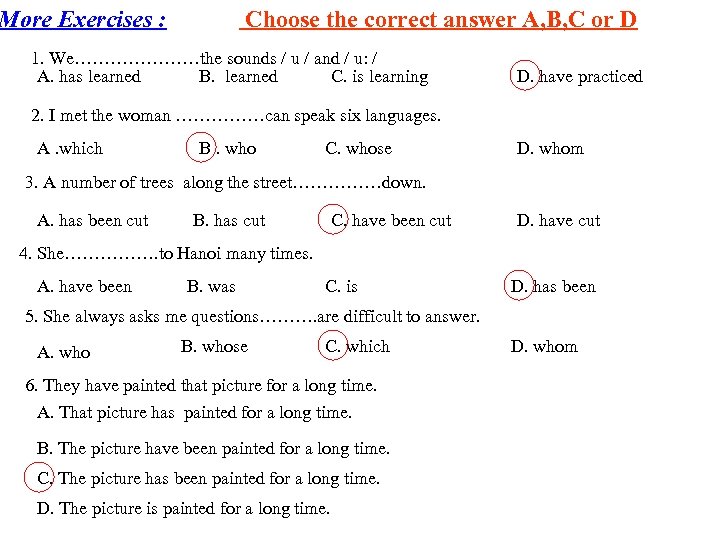 More Exercises : Choose the correct answer A, B, C or D 1. We…………………the sounds / u / and / u: / A. has learned B. learned C. is learning D. have practiced 2. I met the woman ……………can speak six languages. A. which B. who C. whose D. whom 3. A number of trees along the street……………down. A. has been cut B. has cut C. have been cut D. have cut 4. She……………. to Hanoi many times. A. have been B. was C. is D. has been 5. She always asks me questions………. are difficult to answer. A. who B. whose C. which 6. They have painted that picture for a long time. A. That picture has painted for a long time. B. The picture have been painted for a long time. C. The picture has been painted for a long time. D. The picture is painted for a long time. D. whom
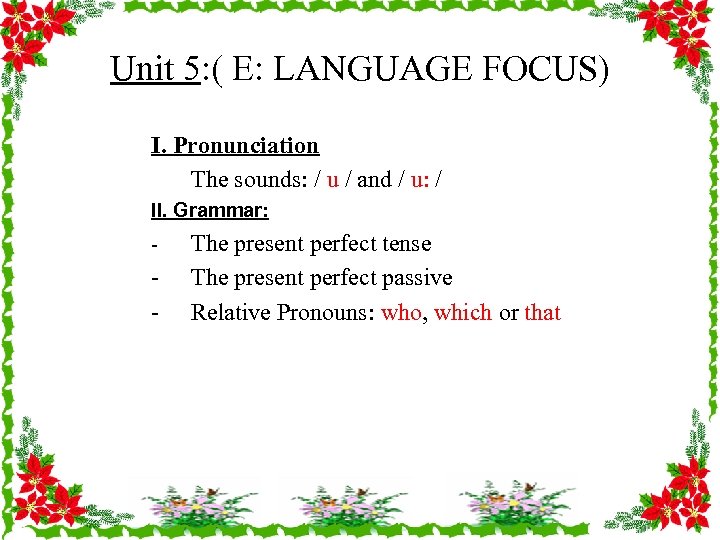 Unit 5: ( E: LANGUAGE FOCUS) I. Pronunciation The sounds: / u / and / u: / II. Grammar: - - The present perfect tense The present perfect passive Relative Pronouns: who, which or that
 Homework 1. Revise language Focus: - The sounds: / u / and / u: / - The present perfect tense - The present perfect passive - Relative Pronouns: who, which or that 2. Prepare for Unit 6 - Reading: