 Скачать презентацию welcome to cape town best practice Institute
f00c7b5abfb0ca8c54780e14b27f1d4a.ppt
- Количество слайдов: 32



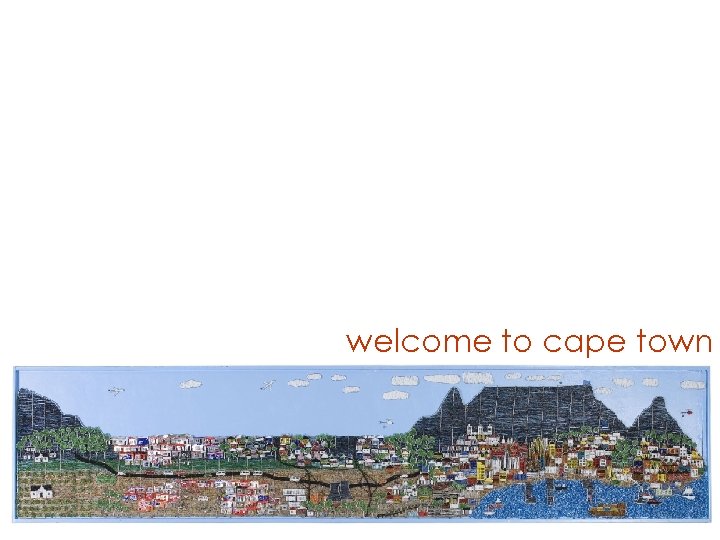
welcome to cape town
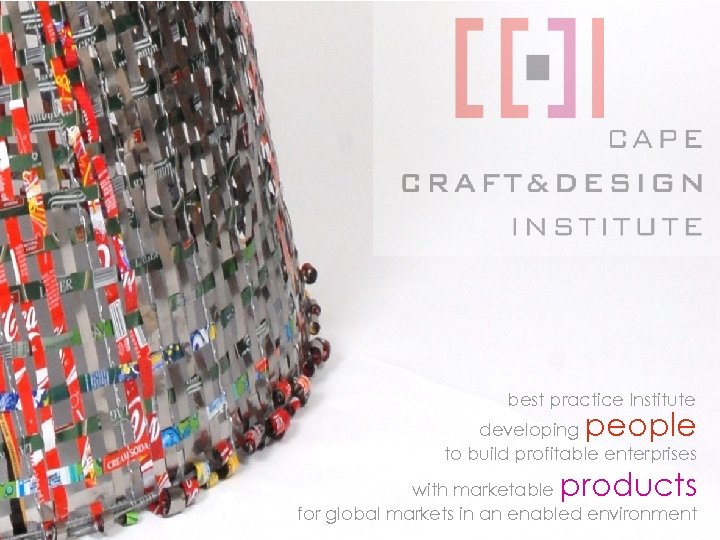
best practice Institute people developing to build profitable enterprises products with marketable for global markets in an enabled environment
where do we ‘work’ X-ing design visual arts tourism trade, industry § economics § social dev § § Craft refers to the creation and production of a broad range of utilitarian and decorative items produced on a small scale with hand processes being a significant part of the value-added content. The production of goods uses a range of natural and synthetic materials. UNESCO Definition, quoted in Arts & Culture Task Group (ACTAG) Report, 1994 CREATIVE INDUSTRIES Areas of social and economic activity that involve: • Individual or collective intellectual or artistic creativity, innovation and originality • The preservation, teaching and celebration of cultural heritage, including language • The capacity to provide work and generate income for the original creator as well as others involved in education, training, production, distribution, documentation and support
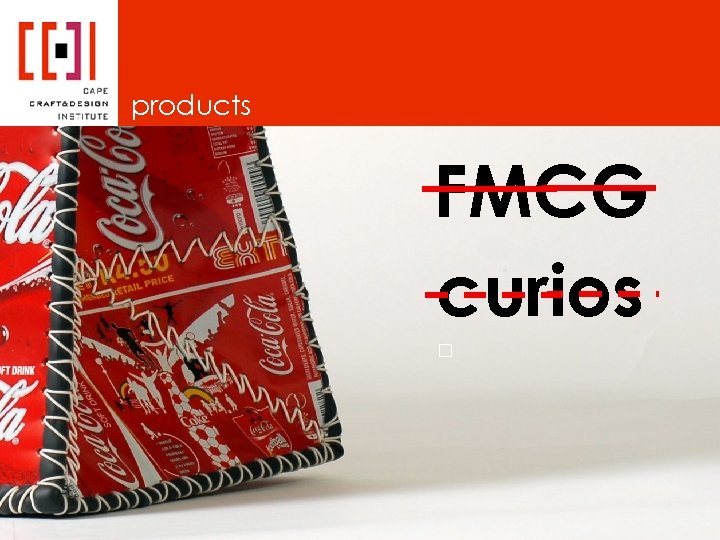
products FMCG curios
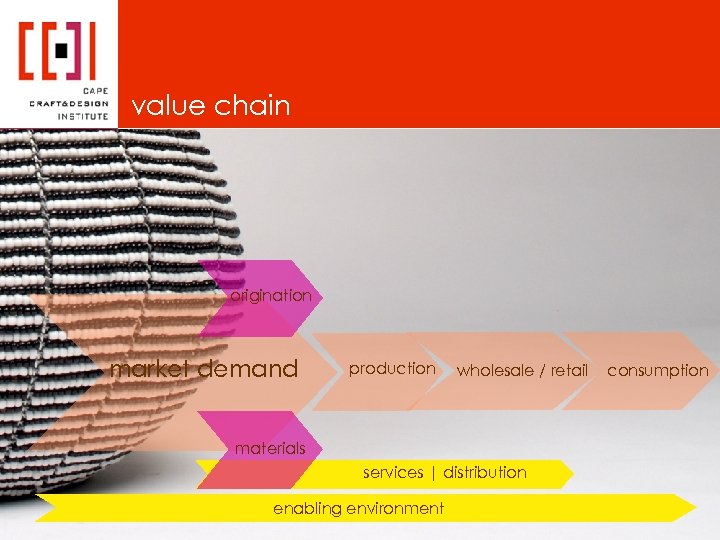
value chain origination market demand production wholesale / retail materials services | distribution enabling environment consumption
we don’t § manufacture products Don’t compete with any players in the value chain § provide finance § establish enterprises § Trade* § technical medium-based training
we do § non-financial support Build social, human, and cultural capital § work with existing enterprises § organic and incremental § competitive / comparative advantage § nature of creative business process
working with enterprises § enterprise development + skills training § market access + development § creativity, design + innovation
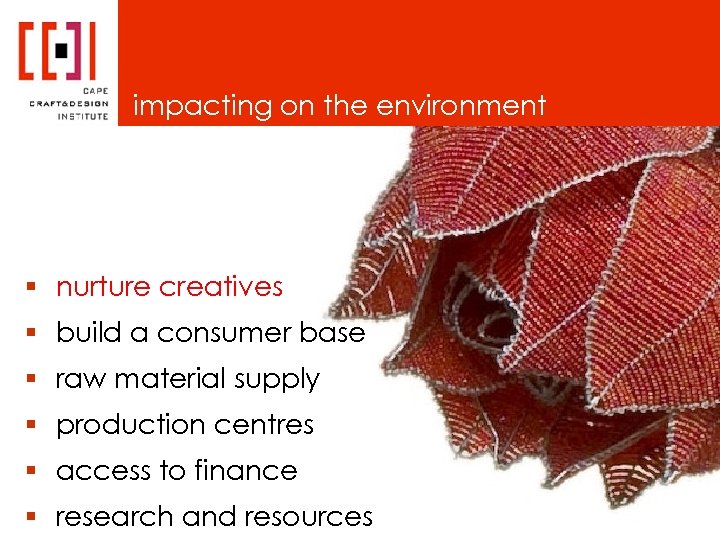
impacting on the environment § nurture creatives § build a consumer base § raw material supply § production centres § access to finance § research and resources
primary client base § Developing enterprises (57% started in last 7 years) § Formal and informal § Survivalist, emerging entrepreneurs, micro enterprises AND established/exporting enterprises Common Product/s Creative Tenacious Social impact § Income § § § Varying skills base § Comfort zone | risk averse | marginal § Rural/Urban | Men/Women | Young/Old | Black/White § Across all media § Diverse markets § Different motivating forces
growth § 2 staff § R 250 k/budget > 20+ > R 11. 5 m/budget > 1100+ § 63 producers [Average turnover growth of 94%] § 376 outlets > 54% products (up from 5%) 50 -100% WC

to do + not to do
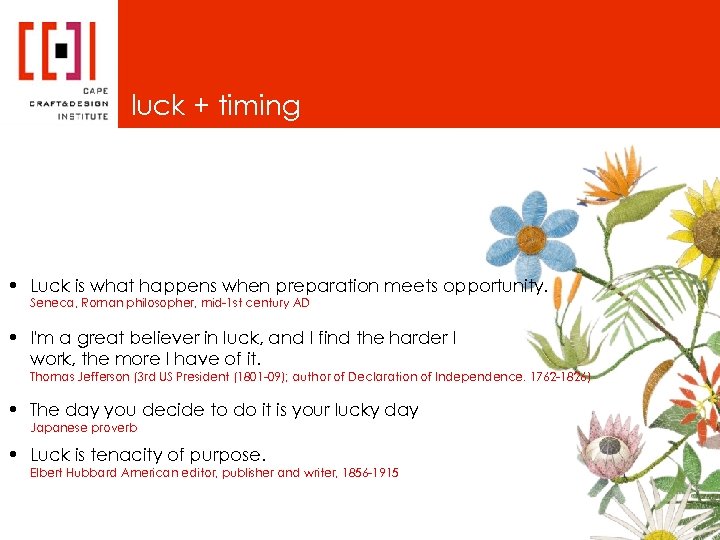
luck + timing • Luck is what happens when preparation meets opportunity. Seneca, Roman philosopher, mid-1 st century AD • I'm a great believer in luck, and I find the harder I work, the more I have of it. Thomas Jefferson (3 rd US President (1801 -09); author of Declaration of Independence. 1762 -1826) • The day you decide to do it is your lucky day Japanese proverb • Luck is tenacity of purpose. Elbert Hubbard American editor, publisher and writer, 1856 -1915
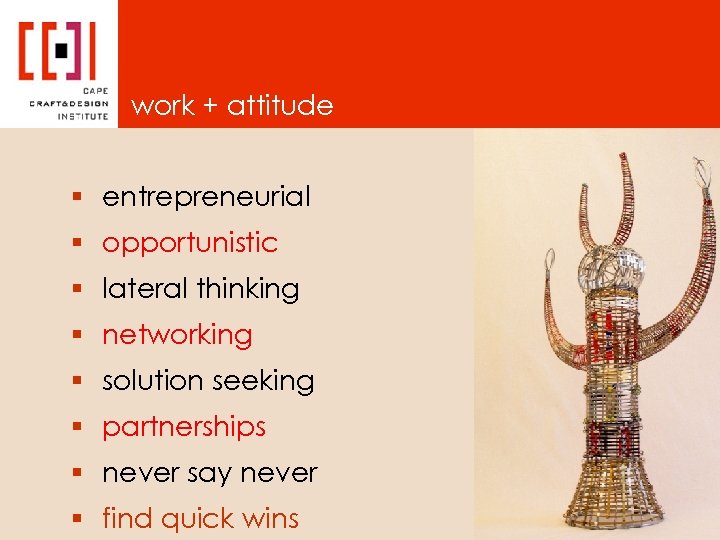
work + attitude § entrepreneurial § opportunistic § lateral thinking § networking § solution seeking § partnerships § never say never § find quick wins
public policy alignment § operate outside of, but in partnership, with government § give + take between public priorities and private sector demands § engage and report honestly § share (information and accolades) § build relationships
tertiary education environment § learning environment aids learning organisation § incubating space supports focus on activities § applied research informs activities § knowledge sharing the modus operandi
institutional arrangements § mature and effective board § clear vision, mission and strategy § well defined job descriptions and hiring appropriately skilled people for the jobs § lean and mean operations § no pressure for sustainability
perspective on the sector § politics and economics of the sector § understand agendas and interests + don’t play into them § play to motivating forces and place for all § critical early decisions (no funding, producing, technical focus, trading, membership) § transparent and inclusive
measuring success § businesses + jobs supported § income + trade generated § transformation [bee] § investment recruitment § intangibles § networks + opportunities § personal growth § perception
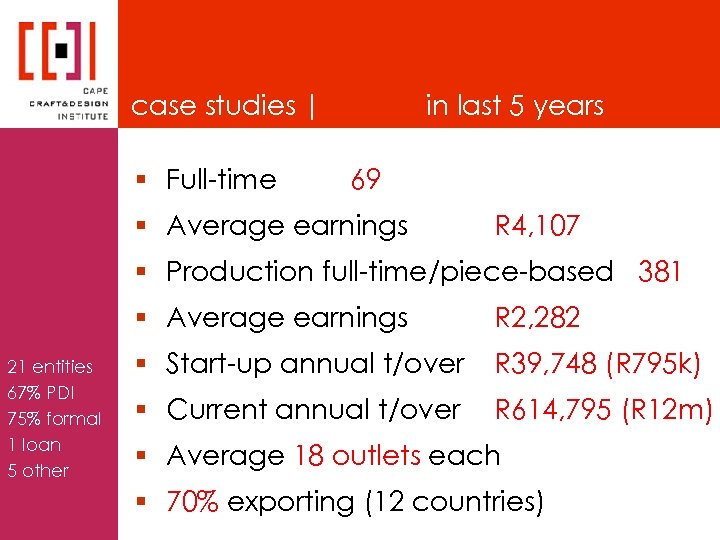
case studies | § Full-time in last 5 years 69 § Average earnings R 4, 107 § Production full-time/piece-based 381 § Average earnings 21 entities 67% PDI 75% formal 1 loan 5 other R 2, 282 § Start-up annual t/over R 39, 748 (R 795 k) § Current annual t/over R 614, 795 (R 12 m) § Average 18 outlets each § 70% exporting (12 countries)
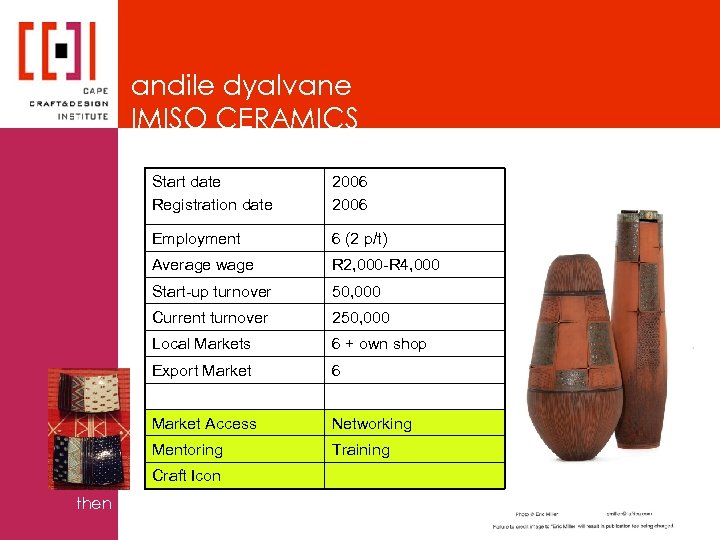
andile dyalvane IMISO CERAMICS Start date Registration date 2006 Employment 6 (2 p/t) Average wage R 2, 000 -R 4, 000 Start-up turnover 50, 000 Current turnover 250, 000 Local Markets 6 + own shop Export Market 6 Market Access Networking Mentoring Training Craft Icon then
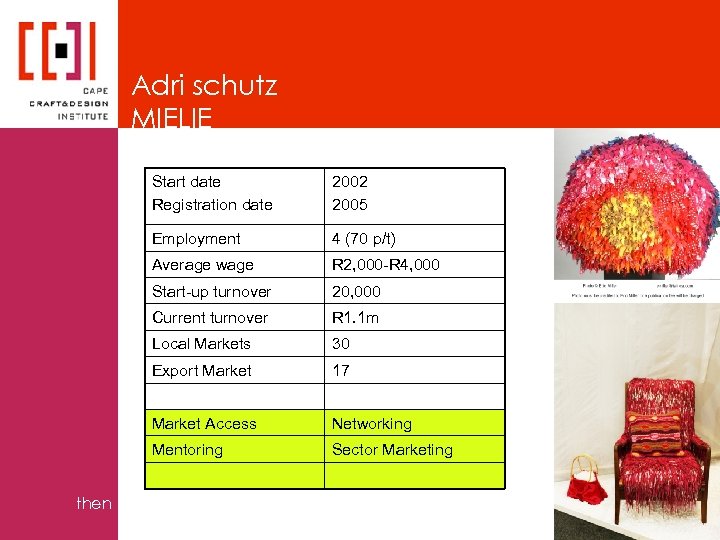
Adri schutz MIELIE Start date Registration date Employment 4 (70 p/t) Average wage R 2, 000 -R 4, 000 Start-up turnover 20, 000 Current turnover R 1. 1 m Local Markets 30 Export Market 17 Market Access Networking Mentoring then 2002 2005 Sector Marketing
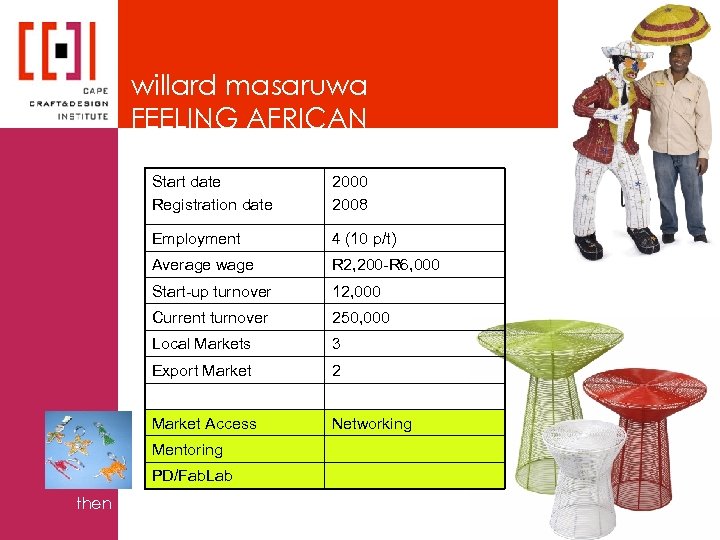
willard masaruwa FEELING AFRICAN Start date Registration date 2000 2008 Employment 4 (10 p/t) Average wage R 2, 200 -R 6, 000 Start-up turnover 12, 000 Current turnover 250, 000 Local Markets 3 Export Market 2 Market Access Networking Mentoring PD/Fab. Lab then
highs + lows § negotiating politics § funding § managing expectations § managing donor agendas § reporting, reporting… § measuring, measuring § justify, justify
skills required § no ego § no life § lots of stamina + passion § a doctorate in philosophy, psychology, social work + economics § entrepreneurial spirit + creative thinking § political suss and a stint in the diplomatic corps

thank you | enkosi | dankie best practice Institute people developing to build profitable enterprises products with marketable for global markets in an enabled environment
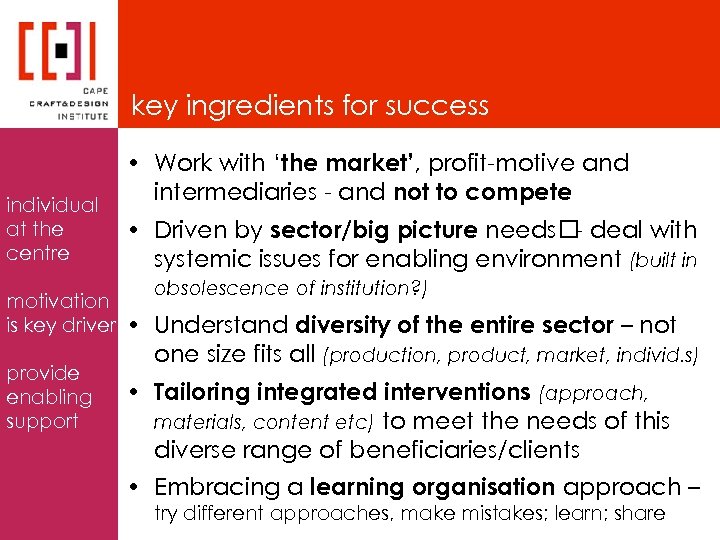
key ingredients for success individual at the centre motivation is key driver provide enabling support • Work with ‘the market’, profit-motive and intermediaries - and not to compete • Driven by sector/big picture needs deal with systemic issues for enabling environment (built in obsolescence of institution? ) • Understand diversity of the entire sector – not one size fits all (production, product, market, individ. s) • Tailoring integrated interventions (approach, materials, content etc) to meet the needs of this diverse range of beneficiaries/clients • Embracing a learning organisation approach – try different approaches, make mistakes; learn; share
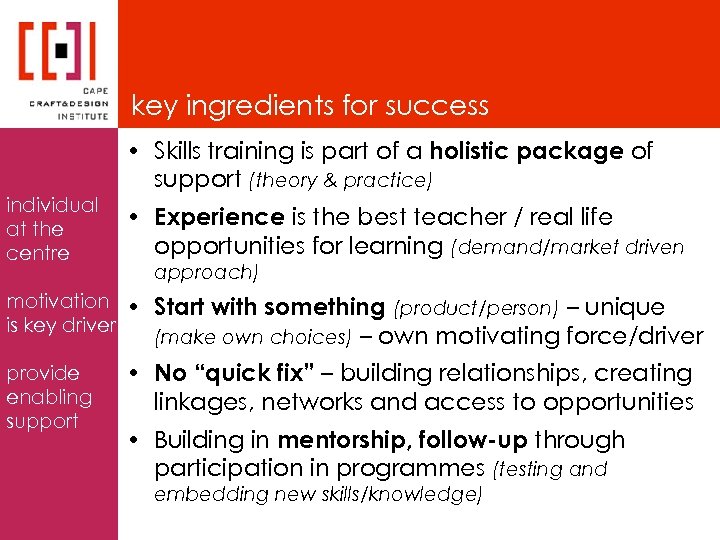
key ingredients for success individual at the centre • Skills training is part of a holistic package of support (theory & practice) • Experience is the best teacher / real life opportunities for learning (demand/market driven approach) motivation is key driver • Start with something (product/person) – unique (make own choices) – own motivating force/driver provide enabling support • No “quick fix” – building relationships, creating linkages, networks and access to opportunities • Building in mentorship, follow-up through participation in programmes (testing and embedding new skills/knowledge)
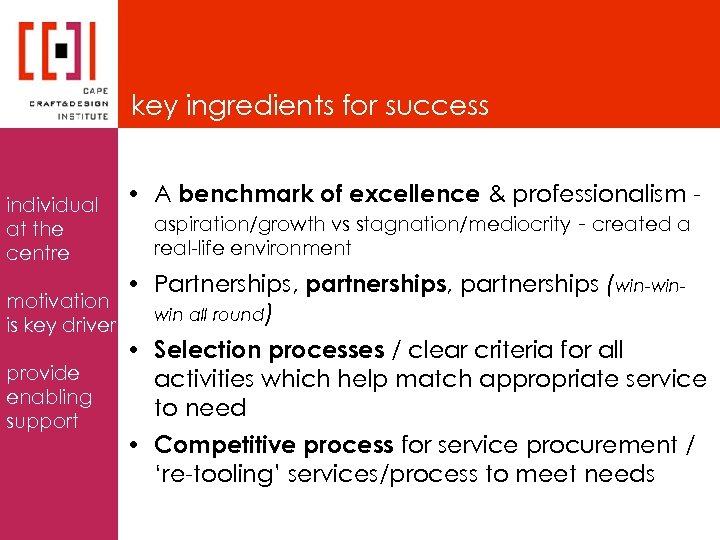
key ingredients for success individual at the centre • A benchmark of excellence & professionalism aspiration/growth vs stagnation/mediocrity - created a real-life environment • Partnerships, partnerships (win-winmotivation win all round) is key driver provide enabling support • Selection processes / clear criteria for all activities which help match appropriate service to need • Competitive process for service procurement / ‘re-tooling’ services/process to meet needs
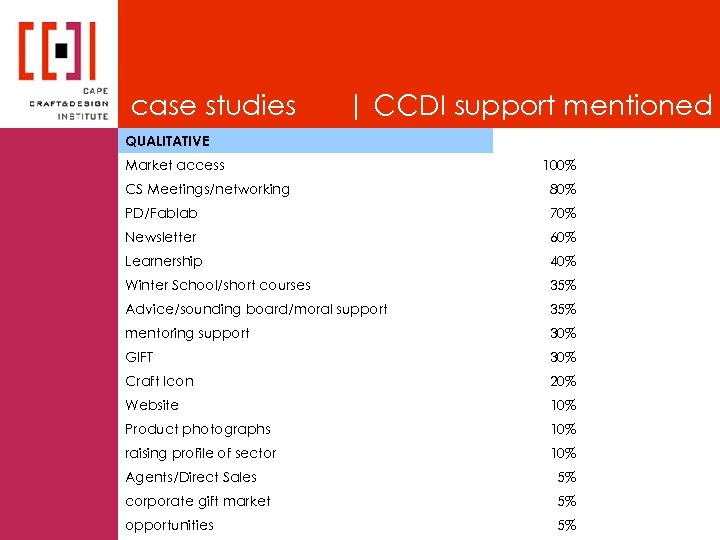
case studies | CCDI support mentioned QUALITATIVE Market access 100% CS Meetings/networking 80% PD/Fablab 70% Newsletter 60% Learnership 40% Winter School/short courses 35% Advice/sounding board/moral support 35% mentoring support 30% GIFT 30% Craft Icon 20% Website 10% Product photographs 10% raising profile of sector 10% Agents/Direct Sales 5% corporate gift market 5% opportunities 5%
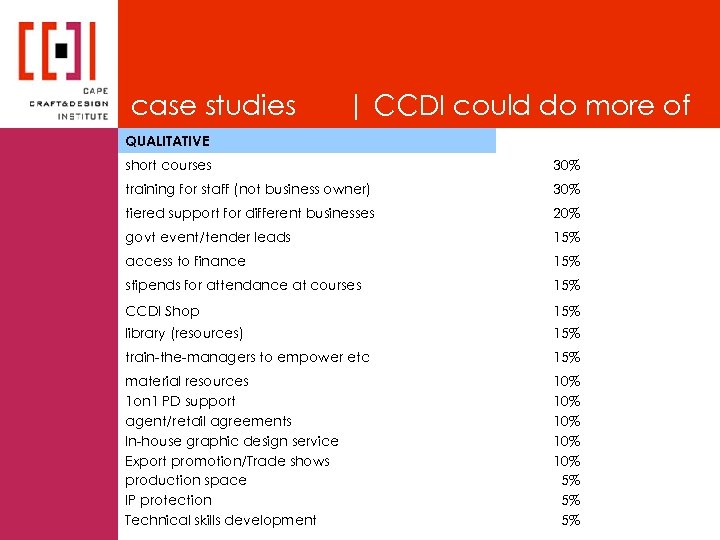
case studies | CCDI could do more of QUALITATIVE short courses 30% training for staff (not business owner) 30% tiered support for different businesses 20% govt event/tender leads 15% access to finance 15% stipends for attendance at courses 15% CCDI Shop 15% library (resources) 15% train-the-managers to empower etc 15% material resources 1 on 1 PD support agent/retail agreements In-house graphic design service Export promotion/Trade shows production space IP protection Technical skills development 10% 10% 10% 5% 5% 5%
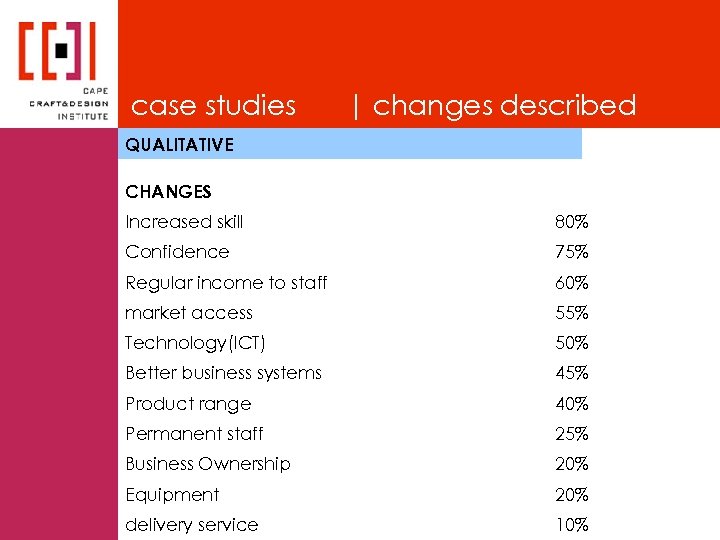
case studies | changes described QUALITATIVE CHANGES Increased skill 80% Confidence 75% Regular income to staff 60% market access 55% Technology(ICT) 50% Better business systems 45% Product range 40% Permanent staff 25% Business Ownership 20% Equipment 20% delivery service 10%
Скачать презентацию welcome to cape town best practice Institute
f00c7b5abfb0ca8c54780e14b27f1d4a.ppt