 Скачать презентацию Welcome The webinar will begin shortly Technical Assistance
ddcd52d5847224e5272dc00658859213.ppt
- Количество слайдов: 73



Welcome! The webinar will begin shortly. Technical Assistance FAQs 1. Why can’t I hear anything? ◦ To hear audio, use your phone to call (toll-free): 1 855 749 4750 ◦ Enter Access code: 668 525 383 ◦ Enter Unique Attendee ID#: This can be found under the “Event Info” tab above ◦ There is NO hold music, so you won’t hear anything until the webinar begins. 2. Can I get the slides for today’s webinar? ◦ Download this presentation from: http: //soarworks. prainc. com/topics/webinars ◦ Or, at top left of this screen, click File: Save: Document 3. Will this webinar be recorded? ◦ Yes, this webinar is being recorded and will be available for viewing within 1 week of this presentation. 4. Who can I call for technical assistance? ◦ Contact Lisa Guerin at lguerin@prainc. com or 518 439 7415 x 5242 if you experience technical difficulties.
What SOAR Providers Need to Know About Representing Immigrants and Non-Citizens with the Social Security Administration PRESENTED BY: SAMHSA SOAR TECHNICAL ASSISTANCE CENTER POLICY RESEARCH ASSOCIATES, INC. UNDER CONTRACT TO: SUBSTANCE ABUSE AND MENTAL HEALTH SERVICES ADMINISTRATION U. S. DEPARTMENT OF HEALTH AND HUMAN SERVICES
Webinar Instructions §Muting §Recording availability §Downloading documents §Evaluation §http: //soarworks. prainc. com/topics/webinars
Agenda Welcome §Kristin Lupfer, Project Director, SAMHSA SOAR TA Center, Delmar, New York SSA Citizen and Residency Eligibility Criteria and Resources §Lee Alviar, Dallas Regional Public Affairs Specialist, Social Security Administration, Texas Understanding Cultural Issues Related to Mental Health Access and Treatment §Sarah Nagy, Special Needs Care Coordinator, International Rescue Committee Baltimore Resettlement Center, Maryland Lessons from the Field: Using the SOAR Process and Other Useful Tips When Working with Immigrant Groups §Gerardo Benavides, Disability Assistance Outreach Specialist, Health Care for the Homeless, Baltimore, Maryland Questions & Answers
Learning Objectives § Understand how immigration, refugee and residency status impacts eligibility for SSA benefits. §Understand the cultural concepts of mental health and how these difference influences access to treatment and other services. §Understand documentation required by SSA, specific to non citizens, and tips on obtaining such evidence. §Learn about available resources to assist your efforts when providing immigrant services.
Welcome KRISTIN LUPFER, LMSW PROJECT DIRECTOR, SAMHSA SOAR TA CENTER POLICY RESEARCH ASSOCIATES, INC.
Poll Question #1 §Is your agency providing SOAR representation as a part of your overall immigrant services? ØYes ØNo ØUnsure
Understanding SSA Eligibility Criteria for Immigrant and Non-Citizen Groups ROSALIE “LEE” ALVIAR SOCIAL SECURITY ADMINISTRATION DALLAS REGIONAL PUBLIC AFFAIRS SPECIALIST DALLAS, TEXAS
Social Security www. socialsecurity. gov
Social Security’s Disability Definition: A medical condition or combination of impairments preventing substantial work for at least 12 months, or expected to result in death. The determination also considers age, education & work experience. 10
Who Can Get Disability Benefits? Worker Ø Must have paid into Social Security five out of last 10 years Ø For younger workers, under age 31 less work is required 11
Who Can Get Disability Benefits? Child Ø Not married under age 18 (under 19 if still in high school) Ø Not married and disabled before age 22 Spouse Ø At age 62 Ø At any age if caring for child under 16 or disabled Ø Divorced spouses may qualify 12
Supplemental Security Income (SSI) Who Can Get SSI? Ø Age 65 or older Ø Blind—any age Ø Disabled—any age Ø Limited income Ø Limited resources Ø Noncitizens must meet special requirements to qualify 13
CITIZEN / NON–CITIZEN STATUS To get SSI, you must be: Ø a citizen or national of the United States; or Ø a non–citizen who meets the alien eligibility criteria under the 1996 legislation and its amendments. 14
WHEN IS A NON-CITIZEN ELIGIBLE FOR SSI? Beginning August 22, 1996, most non–citizens must meet two requirements to be eligible for SSI: Ø the non–citizen must be in a “qualified alien” category, and Ø meet a “condition” that allows qualified aliens to get SSI benefits. A non–citizen must also meet all of the other requirements for SSI eligibility, Øincluding the limits on income, resources, etc. 15
WHO IS A “QUALIFIED ALIEN”? Ø There are seven categories of non–citizens who are qualified aliens. Ø You are a "qualified alien" if the Department of Homeland Security (DHS) says you are in one of these categories: 16
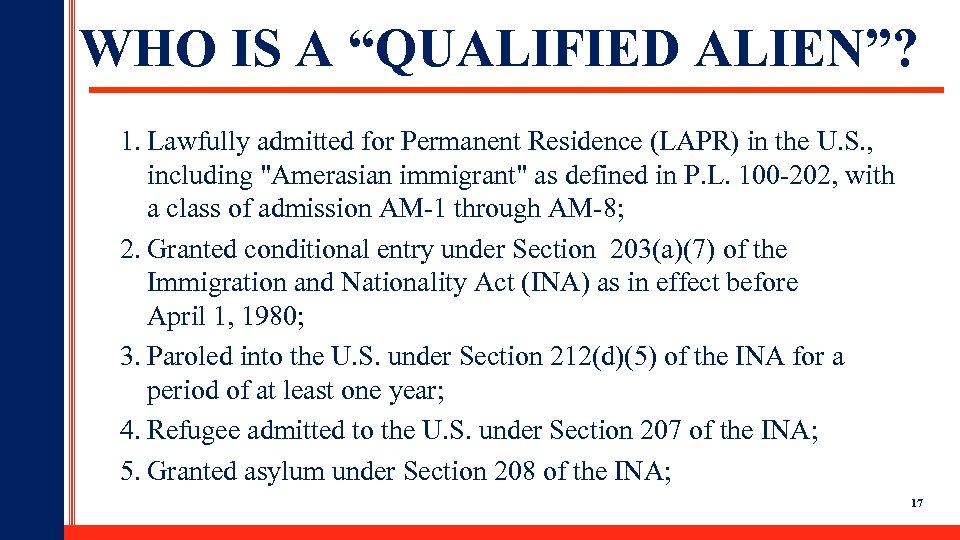
WHO IS A “QUALIFIED ALIEN”? 1. Lawfully admitted for Permanent Residence (LAPR) in the U. S. , including "Amerasian immigrant" as defined in P. L. 100 -202, with a class of admission AM-1 through AM-8; 2. Granted conditional entry under Section 203(a)(7) of the Immigration and Nationality Act (INA) as in effect before April 1, 1980; 3. Paroled into the U. S. under Section 212(d)(5) of the INA for a period of at least one year; 4. Refugee admitted to the U. S. under Section 207 of the INA; 5. Granted asylum under Section 208 of the INA; 17
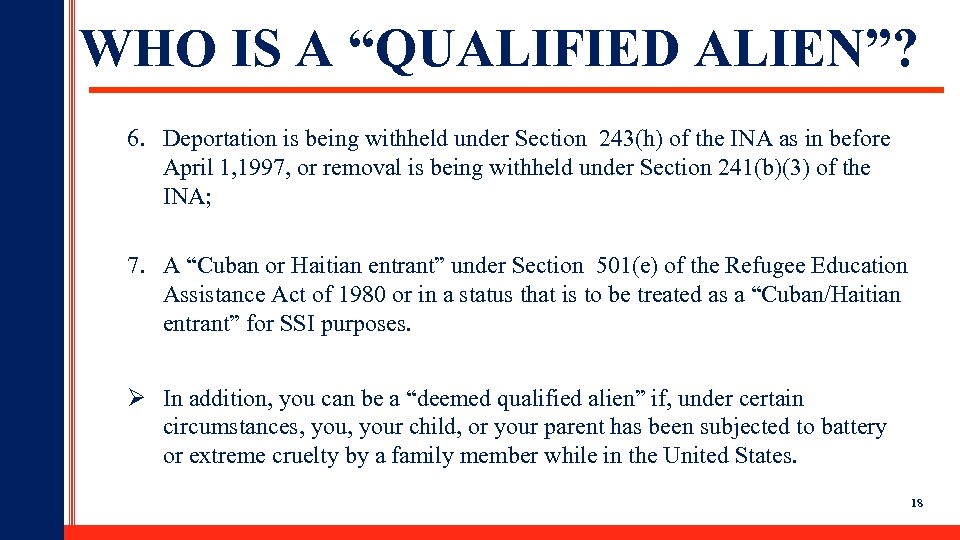
WHO IS A “QUALIFIED ALIEN”? 6. Deportation is being withheld under Section 243(h) of the INA as in before April 1, 1997, or removal is being withheld under Section 241(b)(3) of the INA; 7. A “Cuban or Haitian entrant” under Section 501(e) of the Refugee Education Assistance Act of 1980 or in a status that is to be treated as a “Cuban/Haitian entrant” for SSI purposes. Ø In addition, you can be a “deemed qualified alien” if, under certain circumstances, your child, or your parent has been subjected to battery or extreme cruelty by a family member while in the United States. 18
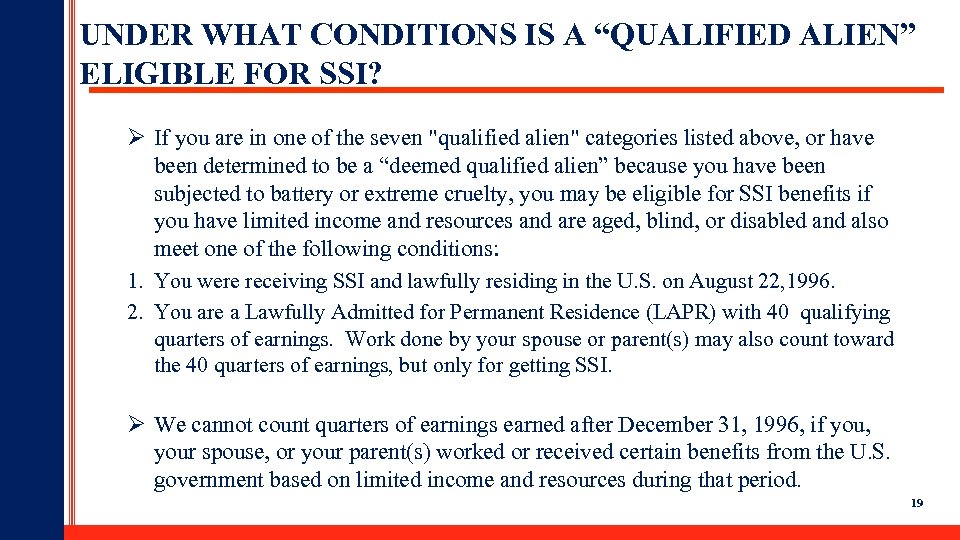
UNDER WHAT CONDITIONS IS A “QUALIFIED ALIEN” ELIGIBLE FOR SSI? Ø If you are in one of the seven "qualified alien" categories listed above, or have been determined to be a “deemed qualified alien” because you have been subjected to battery or extreme cruelty, you may be eligible for SSI benefits if you have limited income and resources and are aged, blind, or disabled and also meet one of the following conditions: 1. You were receiving SSI and lawfully residing in the U. S. on August 22, 1996. 2. You are a Lawfully Admitted for Permanent Residence (LAPR) with 40 qualifying quarters of earnings. Work done by your spouse or parent(s) may also count toward the 40 quarters of earnings, but only for getting SSI. Ø We cannot count quarters of earnings earned after December 31, 1996, if you, your spouse, or your parent(s) worked or received certain benefits from the U. S. government based on limited income and resources during that period. 19
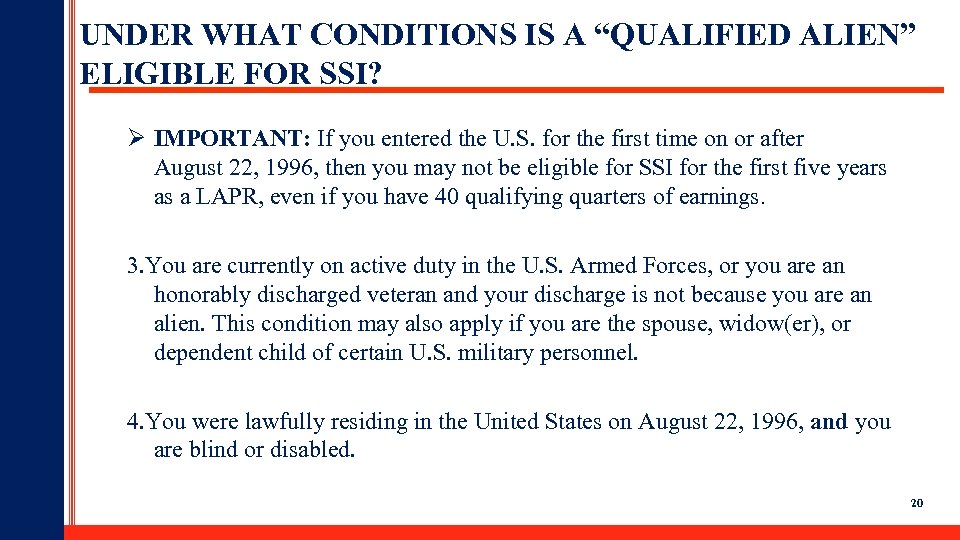
UNDER WHAT CONDITIONS IS A “QUALIFIED ALIEN” ELIGIBLE FOR SSI? Ø IMPORTANT: If you entered the U. S. for the first time on or after August 22, 1996, then you may not be eligible for SSI for the first five years as a LAPR, even if you have 40 qualifying quarters of earnings. 3. You are currently on active duty in the U. S. Armed Forces, or you are an honorably discharged veteran and your discharge is not because you are an alien. This condition may also apply if you are the spouse, widow(er), or dependent child of certain U. S. military personnel. 4. You were lawfully residing in the United States on August 22, 1996, and you are blind or disabled. 20
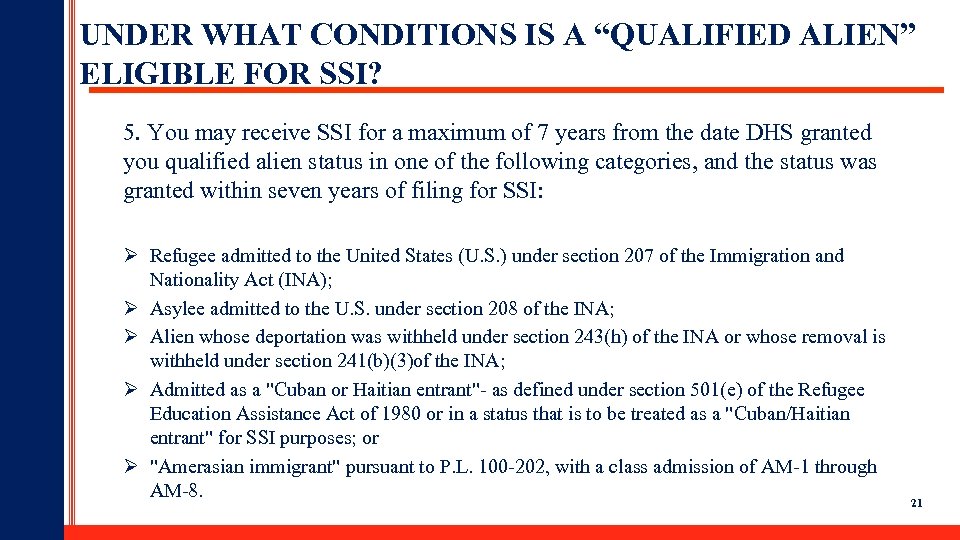
UNDER WHAT CONDITIONS IS A “QUALIFIED ALIEN” ELIGIBLE FOR SSI? 5. You may receive SSI for a maximum of 7 years from the date DHS granted you qualified alien status in one of the following categories, and the status was granted within seven years of filing for SSI: Ø Refugee admitted to the United States (U. S. ) under section 207 of the Immigration and Nationality Act (INA); Ø Asylee admitted to the U. S. under section 208 of the INA; Ø Alien whose deportation was withheld under section 243(h) of the INA or whose removal is withheld under section 241(b)(3)of the INA; Ø Admitted as a "Cuban or Haitian entrant"- as defined under section 501(e) of the Refugee Education Assistance Act of 1980 or in a status that is to be treated as a "Cuban/Haitian entrant" for SSI purposes; or Ø "Amerasian immigrant" pursuant to P. L. 100 -202, with a class admission of AM-1 through AM-8. 21
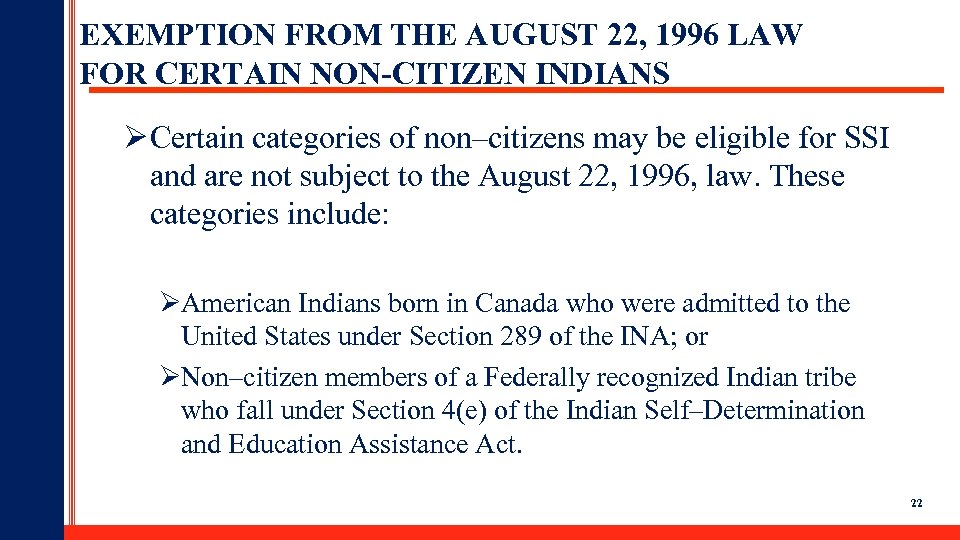
EXEMPTION FROM THE AUGUST 22, 1996 LAW FOR CERTAIN NON-CITIZEN INDIANS Ø Certain categories of non–citizens may be eligible for SSI and are not subject to the August 22, 1996, law. These categories include: ØAmerican Indians born in Canada who were admitted to the United States under Section 289 of the INA; or ØNon–citizen members of a Federally recognized Indian tribe who fall under Section 4(e) of the Indian Self–Determination and Education Assistance Act. 22
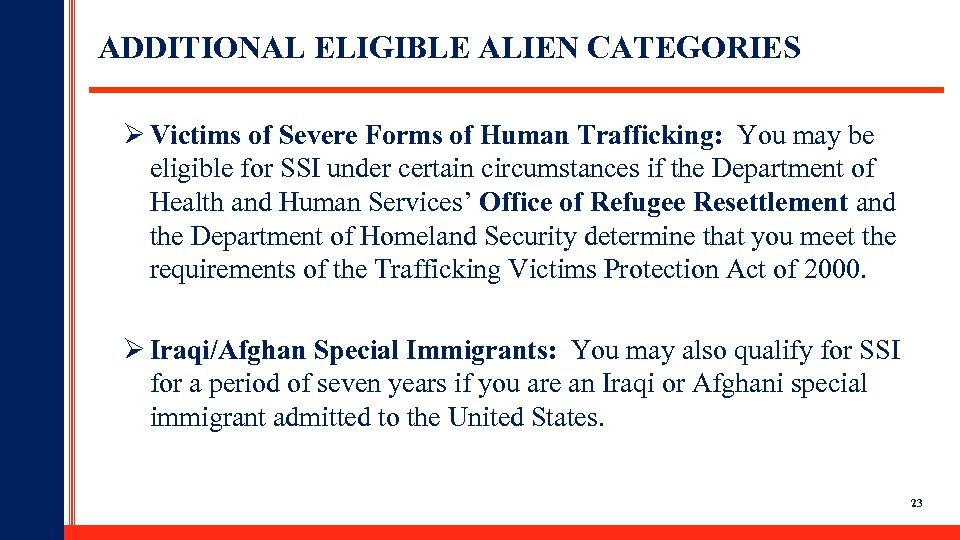
ADDITIONAL ELIGIBLE ALIEN CATEGORIES Ø Victims of Severe Forms of Human Trafficking: You may be eligible for SSI under certain circumstances if the Department of Health and Human Services’ Office of Refugee Resettlement and the Department of Homeland Security determine that you meet the requirements of the Trafficking Victims Protection Act of 2000. Ø Iraqi/Afghan Special Immigrants: You may also qualify for SSI for a period of seven years if you are an Iraqi or Afghani special immigrant admitted to the United States. 23
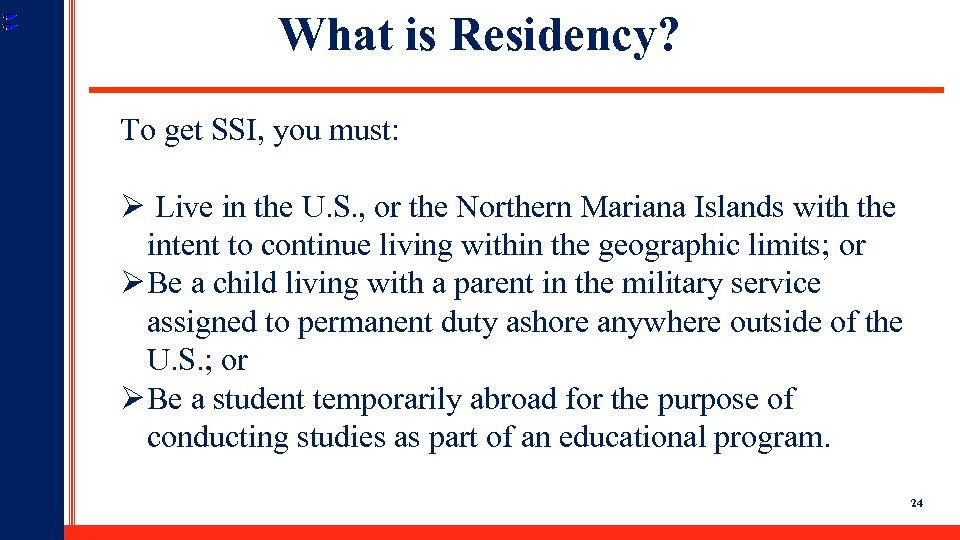
What is Residency? To get SSI, you must: Ø Live in the U. S. , or the Northern Mariana Islands with the intent to continue living within the geographic limits; or Ø Be a child living with a parent in the military service assigned to permanent duty ashore anywhere outside of the U. S. ; or Ø Be a student temporarily abroad for the purpose of conducting studies as part of an educational program. 24
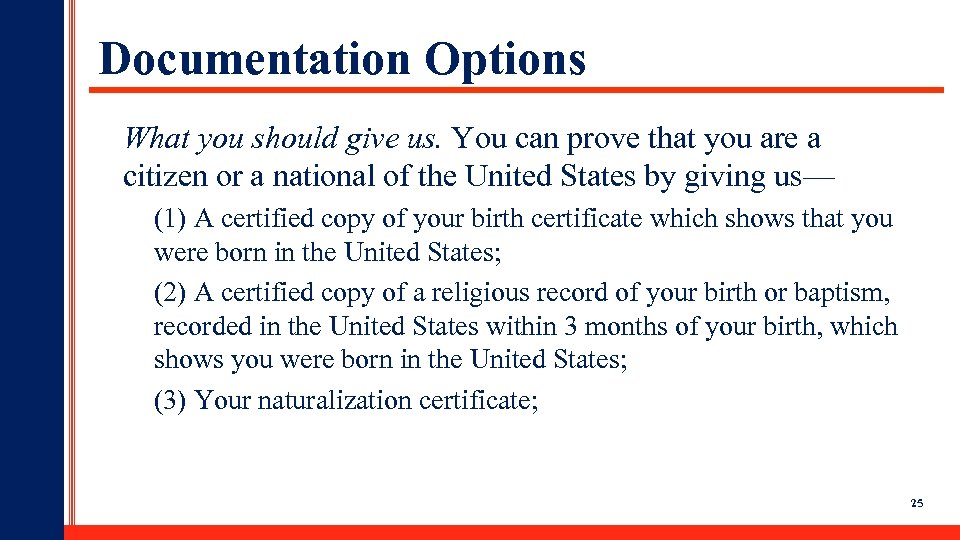
Documentation Options What you should give us. You can prove that you are a citizen or a national of the United States by giving us— (1) A certified copy of your birth certificate which shows that you were born in the United States; (2) A certified copy of a religious record of your birth or baptism, recorded in the United States within 3 months of your birth, which shows you were born in the United States; (3) Your naturalization certificate; 25
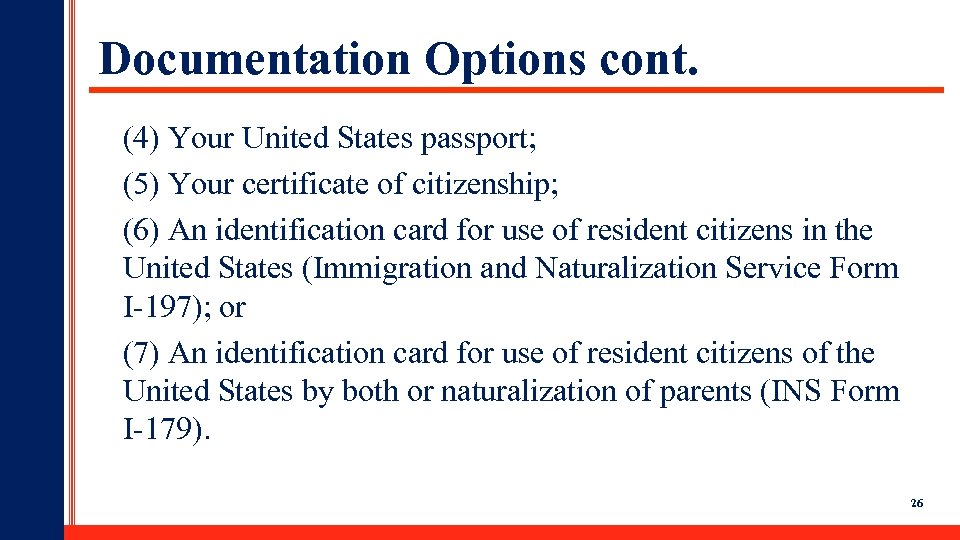
Documentation Options cont. (4) Your United States passport; (5) Your certificate of citizenship; (6) An identification card for use of resident citizens in the United States (Immigration and Naturalization Service Form I-197); or (7) An identification card for use of resident citizens of the United States by both or naturalization of parents (INS Form I-179). 26
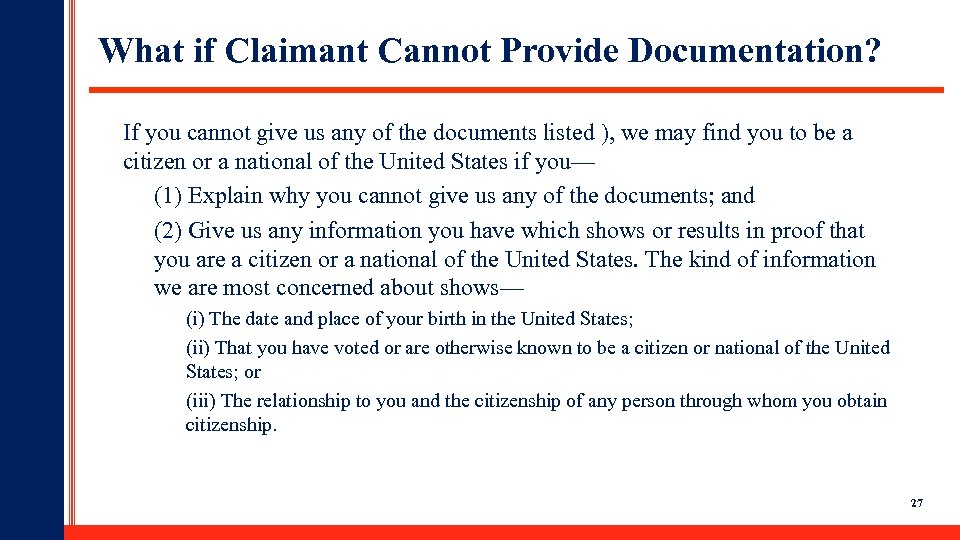
What if Claimant Cannot Provide Documentation? If you cannot give us any of the documents listed ), we may find you to be a citizen or a national of the United States if you— (1) Explain why you cannot give us any of the documents; and (2) Give us any information you have which shows or results in proof that you are a citizen or a national of the United States. The kind of information we are most concerned about shows— (i) The date and place of your birth in the United States; (ii) That you have voted or are otherwise known to be a citizen or national of the United States; or (iii) The relationship to you and the citizenship of any person through whom you obtain citizenship. 27
ADDITIONAL SSA Resources Ø Immigration Ø https: //www. ssa. gov/people/immigrants/ Ø SSA Publication: Supplemental Security Income (SSI) for Non- Citizens Ø https: //www. ssa. gov/pubs/EN-05 -11051. pdf Ø SSI Spotlight on SSI Benefits for Aliens Ø https: //www. ssa. gov/ssi/spotlights/spot-non-citizens. htm 28
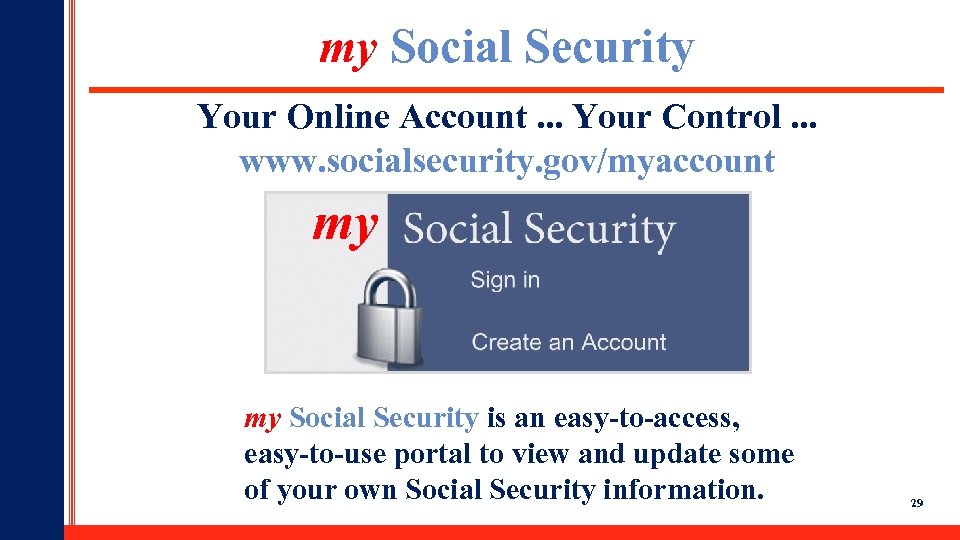
my Social Security Your Online Account. . . Your Control. . . www. socialsecurity. gov/myaccount my my Social Security is an easy-to-access, easy-to-use portal to view and update some of your own Social Security information. 29
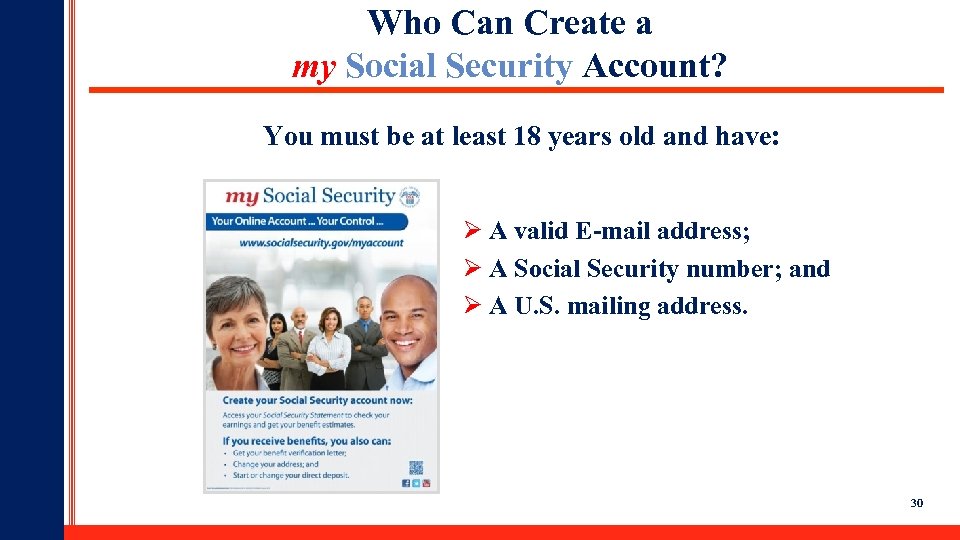
Who Can Create a my Social Security Account? You must be at least 18 years old and have: Ø A valid E-mail address; Ø A Social Security number; and Ø A U. S. mailing address. 30
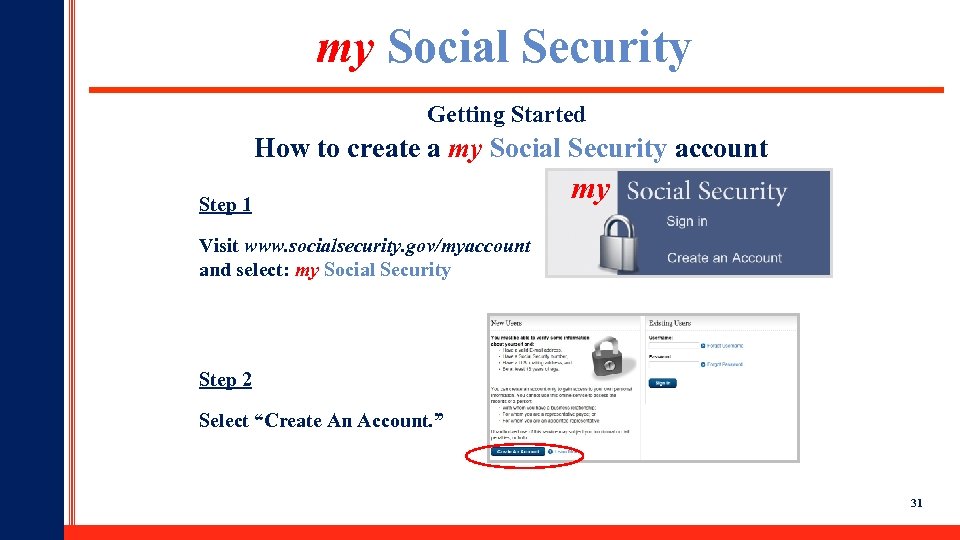
my Social Security Getting Started How to create a my Social Security account Step 1 my Visit www. socialsecurity. gov/myaccount and select: my Social Security Step 2 Select “Create An Account. ” 31
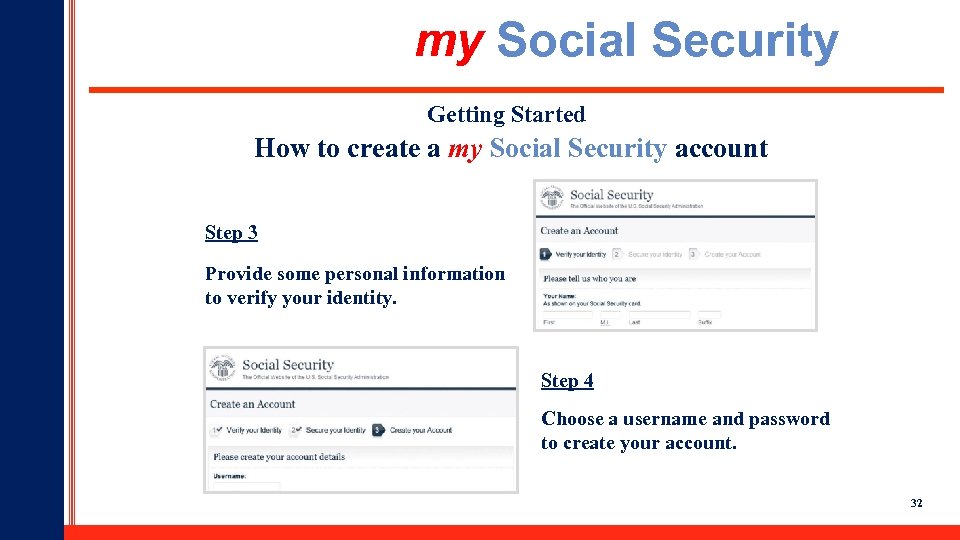
my Social Security Getting Started How to create a my Social Security account Step 3 Provide some personal information to verify your identity. Step 4 Choose a username and password to create your account. 32
Social Security Embraces Social Media • Discover us on Facebook, Twitter, You. Tube, and Pinterest • View popular agency webinar videos at www. socialsecurity. gov/webinars • Sign-up to get E-mails and SMS/Texting when we update popular www. socialsecurity. gov web pages 33
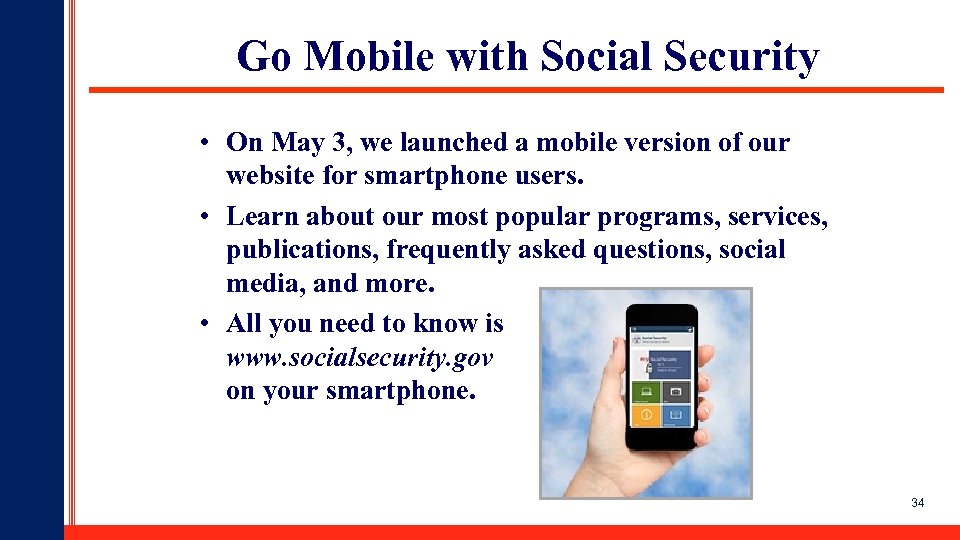
Go Mobile with Social Security • On May 3, we launched a mobile version of our website for smartphone users. • Learn about our most popular programs, services, publications, frequently asked questions, social media, and more. • All you need to know is www. socialsecurity. gov. on your smartphone. 34
Contact Information Rosalie “Lee” Alviar Social Security Administration Dallas Regional Public Affairs Officer Phone: (214) 767 1310 Create your own my Social Security account at www. socialsecurity. gov/myaccount
Poll Question #2 All non citizens cannot receive disability benefits? ØTrue or False
Understanding Cultural Issues Related to Mental Health Access and Treatment SARAH NAGY SPECIAL NEEDS CARE COORDINATOR INTERNATIONAL RESCUE COMMITTEE BALTIMORE RESETTLEMENT CENTER, MARYLAND
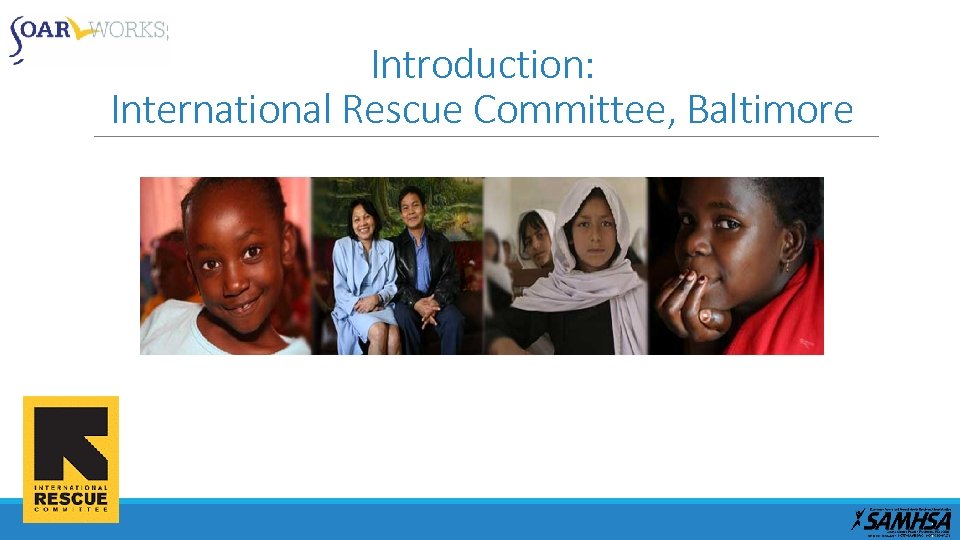
Introduction: International Rescue Committee, Baltimore
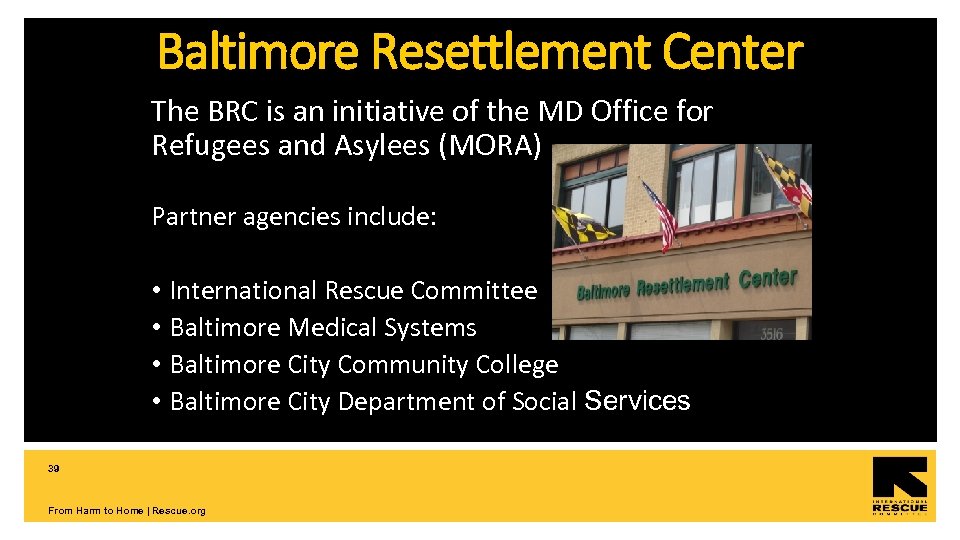
Baltimore Resettlement Center The BRC is an initiative of the MD Office for Refugees and Asylees (MORA) Partner agencies include: • International Rescue Committee • Baltimore Medical Systems • Baltimore City Community College • Baltimore City Department of Social Services 39 From Harm to Home | Rescue. org
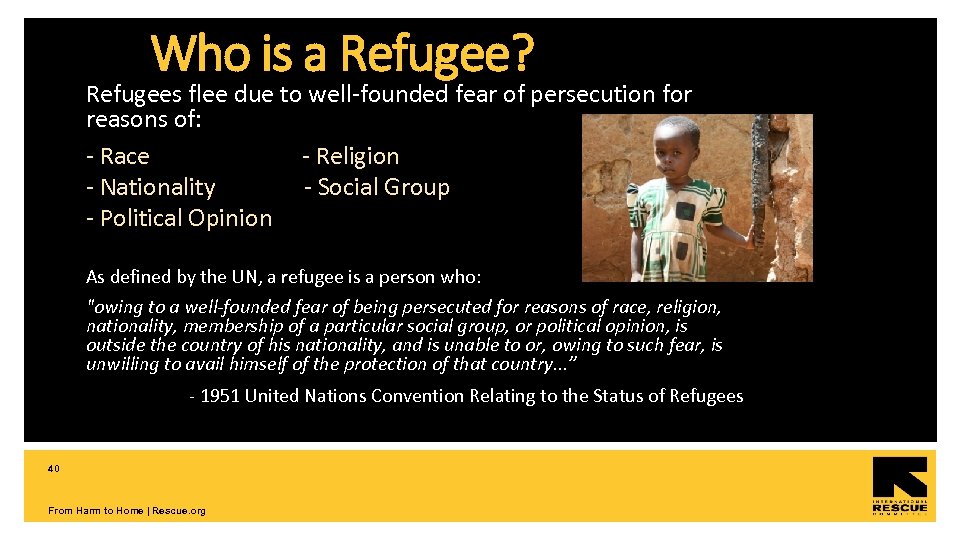
Who is a Refugee? Refugees flee due to well founded fear of persecution for reasons of: Race Religion Nationality Social Group Political Opinion As defined by the UN, a refugee is a person who: "owing to a well-founded fear of being persecuted for reasons of race, religion, nationality, membership of a particular social group, or political opinion, is outside the country of his nationality, and is unable to or, owing to such fear, is unwilling to avail himself of the protection of that country. . . ” 1951 United Nations Convention Relating to the Status of Refugees 40 From Harm to Home | Rescue. org
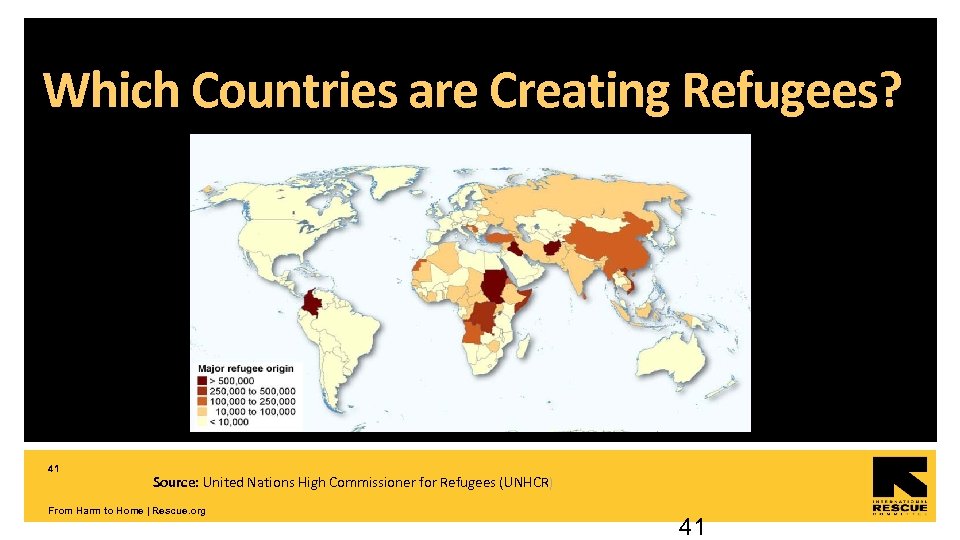
Which Countries are Creating Refugees? 41 Source: United Nations High Commissioner for Refugees (UNHCR) From Harm to Home | Rescue. org 41
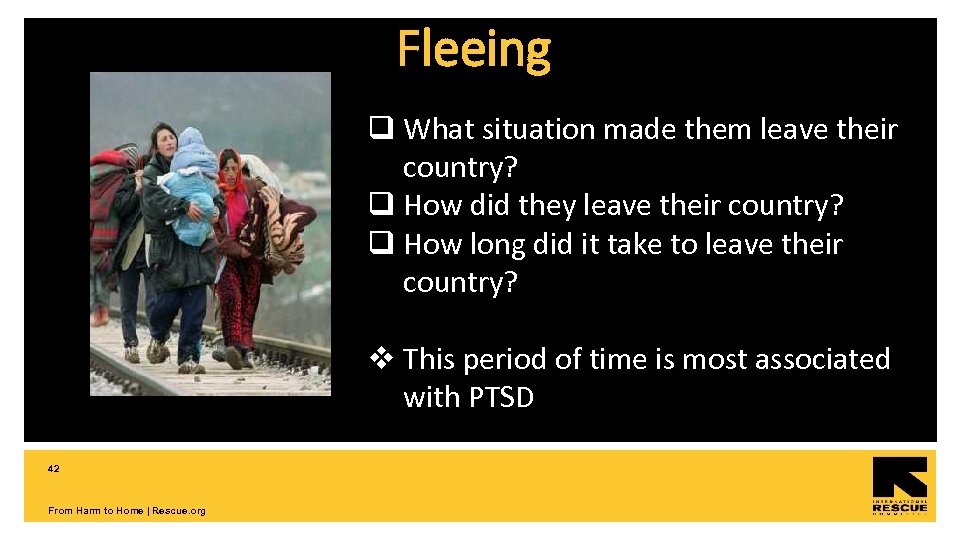
Fleeing q What situation made them leave their country? q How did they leave their country? q How long did it take to leave their country? v This period of time is most associated with PTSD 42 From Harm to Home | Rescue. org
What happens after refugees flee? MAJOR POPULATIONS: • Total, gender and top 5 refugee nationalities resettled in FY 15: 833, F 375: M 458 Burma, Congo, Eritrea, Sudan and Afghanistan. • Other humanitarian immigrants: 284 (multiple nationalities) 43 From Harm to Home | Rescue. org
What happens after refugees flee? • The International Rescue Committee (IRC) in Baltimore helps refugees and other humanitarian immigrants become self sufficient and integrated in communities across central Maryland strengthens the social and economic health of Baltimore City. • We’ve now helped almost 10, 000 refugees and asylees since 1999. 44 From Harm to Home | Rescue. org
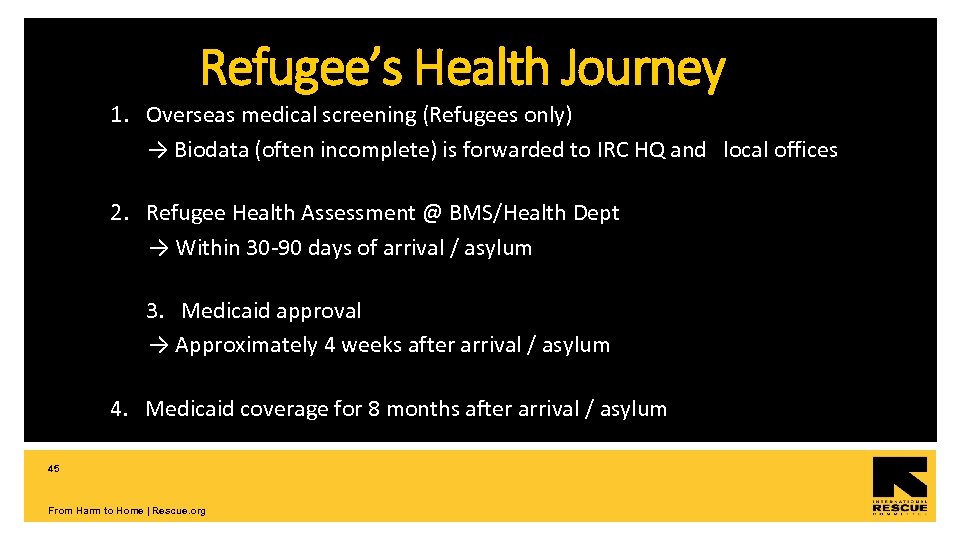
Refugee’s Health Journey 1. Overseas medical screening (Refugees only) → Biodata (often incomplete) is forwarded to IRC HQ and local offices 2. Refugee Health Assessment @ BMS/Health Dept → Within 30 90 days of arrival / asylum 3. Medicaid approval → Approximately 4 weeks after arrival / asylum 4. Medicaid coverage for 8 months after arrival / asylum 45 From Harm to Home | Rescue. org
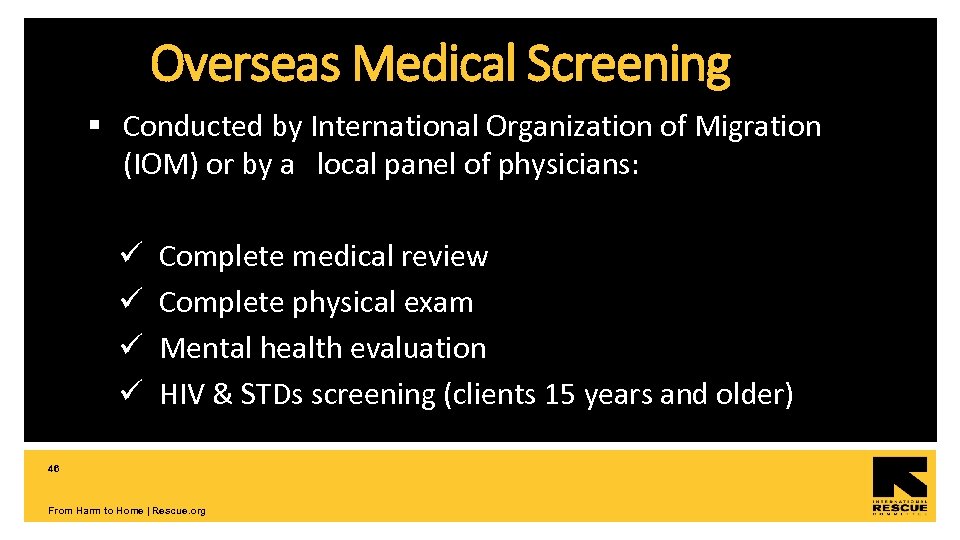
Overseas Medical Screening § Conducted by International Organization of Migration (IOM) or by a local panel of physicians: ü ü Complete medical review Complete physical exam Mental health evaluation HIV & STDs screening (clients 15 years and older) 46 From Harm to Home | Rescue. org
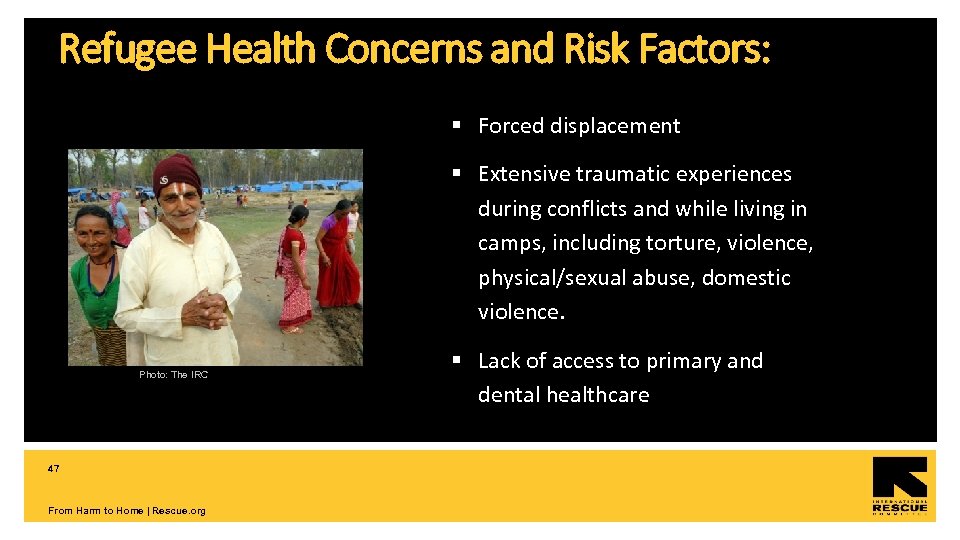
Refugee Health Concerns and Risk Factors: § Forced displacement § Extensive traumatic experiences during conflicts and while living in camps, including torture, violence, physical/sexual abuse, domestic violence. Photo: The IRC 47 From Harm to Home | Rescue. org § Lack of access to primary and dental healthcare
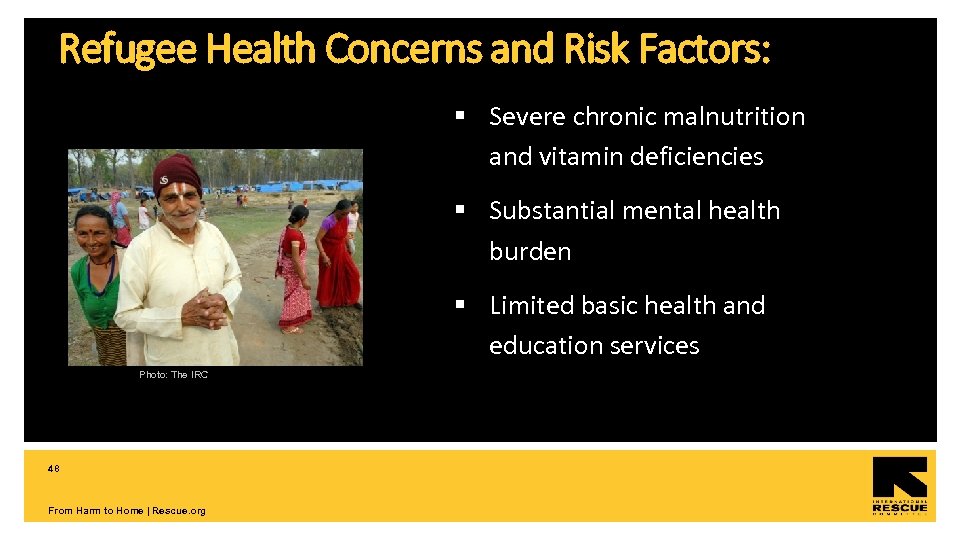
Refugee Health Concerns and Risk Factors: § Severe chronic malnutrition and vitamin deficiencies § Substantial mental health burden § Limited basic health and education services Photo: The IRC 48 From Harm to Home | Rescue. org
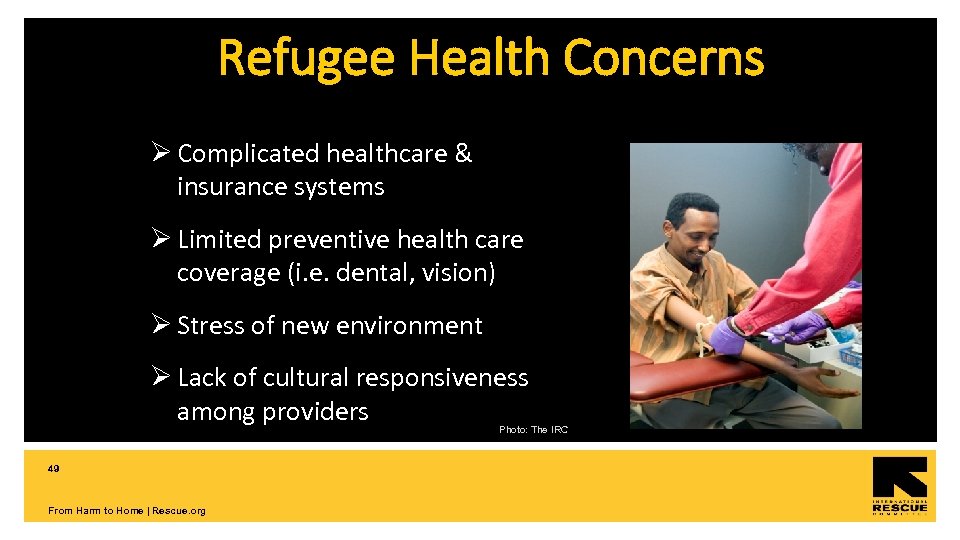
Refugee Health Concerns Ø Complicated healthcare & insurance systems Ø Limited preventive health care coverage (i. e. dental, vision) Ø Stress of new environment Ø Lack of cultural responsiveness among providers Photo: The IRC 49 From Harm to Home | Rescue. org
Refugees Have More Mental Health Issues § Not Mental Illness § Higher rates of depression § Higher rates of anxiety problems, including post-traumatic stress disorder § In some case, like PTSD, 10 x the rate of the average population § Torture has been estimated at 5 to 35% depending on population 50 From Harm to Home | Rescue. org
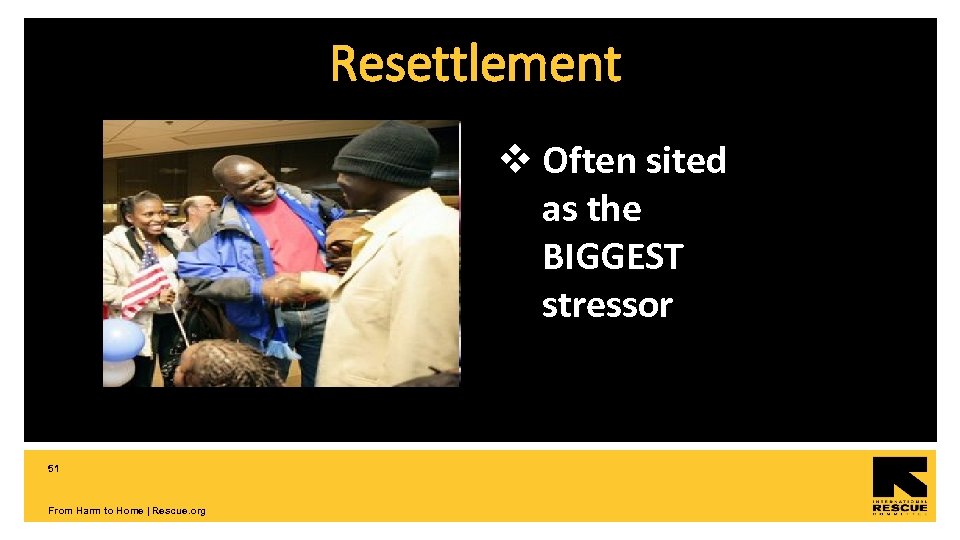
Resettlement v Often sited as the BIGGEST stressor 51 From Harm to Home | Rescue. org
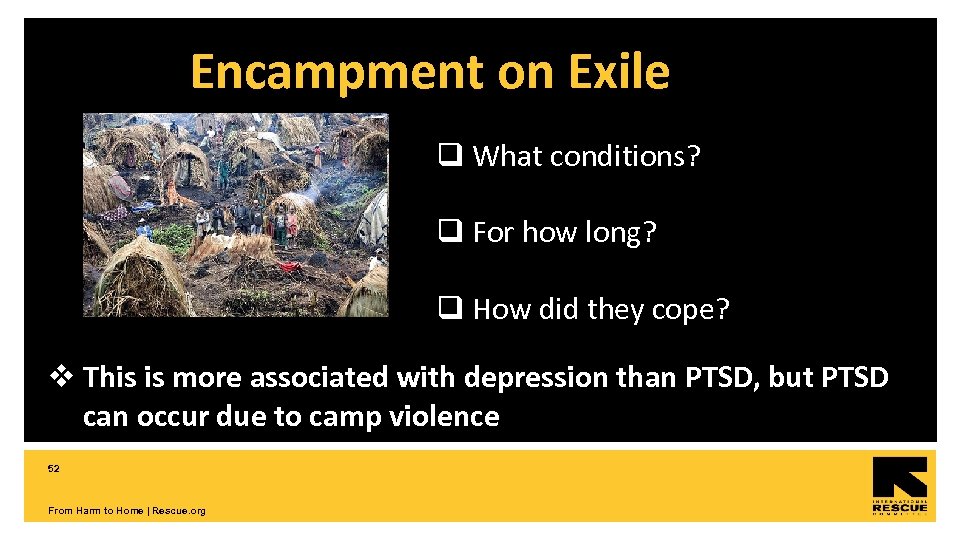
Encampment on Exile q What conditions? q For how long? q How did they cope? v This is more associated with depression than PTSD, but PTSD can occur due to camp violence 52 From Harm to Home | Rescue. org
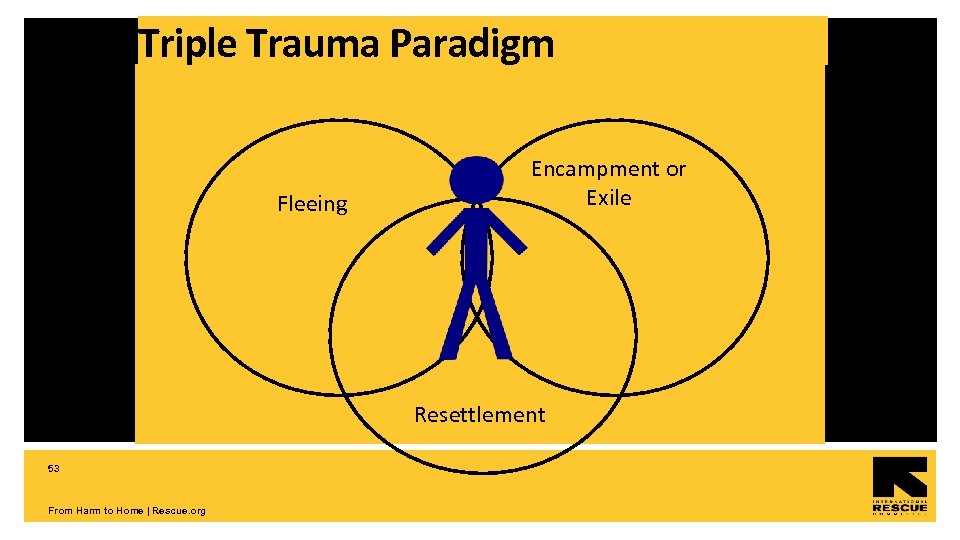
Triple Trauma Paradigm Fleeing Encampment or Exile Resettlement 53 From Harm to Home | Rescue. org
Seeking Treatment: What Mental Health Means in Client Populations § Different experience with the Mental Health system. (psychiatric hospitals, oppressive use of system, etc. ) § Different repercussions of having a “mental health” issue. § No experience with effective treatment. 54 From Harm to Home | Rescue. org
Problems/Obstacles: Language Access § Language barriers are problematic in mental health care because much of mental health diagnosis and treatment relies on direct communication with the client. § While immigrant populations may be likely to seek help for mental health problems from primary care providers, their mental health concerns are likely to go unnoticed. § Language barriers may make it particularly difficult for primary care providers to meet patients’ mental health needs. 55 From Harm to Home | Rescue. org
Title VI of the Civil Rights Act of 1964 § According to Title VI of the Civil Rights Act of 1964, any organization that receives federal funds is obligated to provide an interpreter at no cost to those who cannot communicate effectively in English. § You may not require a non-English speaker to bring his own interpreter. For more information about Title VI, Please call the Department of Justice Office of Civil Rights at 1 800 368 1019. 56 From Harm to Home | Rescue. org
Working With Interpreters: Cultural Bias § If the problem the individual is facing has it’s own implications within the community, the interpreter may sometimes transfer his opinions on the situation in the way he or she interprets. § This sometimes causes the interpreter to offer unsolicited advice to the client that is not understood by the caseworker or provider. 57 From Harm to Home | Rescue. org

Thank You! 58 From Harm to Home | Rescue. org
Contact Information Sarah Nagy Special Needs Care Coordinator International Rescue Committee Baltimore Resettlement Center 3516 Eastern Avenue, Baltimore MD 21224 Phone: (410) 558 3172 Email: Sarah. Nagy@rescue. org
Final Poll Question #3 Which of the following are psychiatric disorders more prevalent in some migrant populations? a) Post Traumatic Stress Dissorder(PTSD), b) Somatic pain c) Depression more prevalent among refugee populations—those who have experienced, war, famine, exile, torture d) Schizophrenia—higher rates in second generation immigrants e) All of the above
Lessons From the Field: Using the SOAR Process with Immigrant Populations GERARDO BENAVIDES DISABILITY BENEFITS OUTREACH SPECIALIST HEALTHCARE FOR THE HOMELESS BALTIMORE, MARYLAND
What keeps immigrants from accessing mental health services? Employment/Priorities: lack of mobility/being able to take time off to address MH issues considering primary focus is on economic stability ØDealing with somatic issues is of primary importance ØAgency requirements Is there the capacity to address MH issues?
What keeps immigrants from accessing mental health services? Language: §Lack of language services/ignorance from the patient or provider concerning what languages are available §Reliability of language line interpreters ØMedical interpretation requires different skill set; does the line provide this? ØCapacity building for in house interpreters due to heavy demand
What keeps immigrants from accessing mental health services? Stigmatization: § Feeling provider will have lack of cultural understanding § Desire to deal with issues on one’s own § Adaptations of the family structure and subsequent intergenerational acculturation/understanding §Cultural Taboos associated with mental illness
What keeps immigrants from accessing mental health services? PROVIDERS NEED GREATER CONTEXT : §Understanding origins/exposures to certain illnesses; PRE MIGRATION/MIGRATION § Culture can affect reaction to symptoms, explanations, coping, adherence to treatment, relationships with family and providers § Somatic symptoms and pain can detract from underlying psychiatric illness §How does assimilation into a new culture and environment affect the mental health of immigrants? POST MIGRATION §Multi faceted treatment options: ask about traditional treatments
Engagement Strategies Work with families and community organizations to: § Increase levels of support for the individual and strip mental health taboo Work with interpreters to: § Be prepared and focused with mental health knowledge § Maintain confidentiality § Maintain rapport with same interpreter over time
Challenges Found While Serving Immigrants Filing for SSA Benefits § Lack of cultural competency from front line staff §“Family” interpreters: conflict of interest, needing to provide own interpreters § Processing of documentation at State Department can be a time consuming process
Internet Resources Ø http: //www. ncbi. nlm. nih. gov/pmc/articles/PMC 3168672/ Ø http: //www. ncbi. nlm. nih. gov/books/NBK 43571/ Ø https: //www. scu. edu/ethics/focus areas/bioethics/resources/culturally competent care for latino patients/
Internet Resources cont. The National Immigration Law Center is a great resources in regards to what federal programs immigrants qualify for and under what circumstances: Øhttps: //www. nilc. org/issues/economic support/overview immeligfedprograms/ Finally, the SOAR website also has highly relevant and pertinent information with regards to working with immigrant populations: Øhttps: //soarworks. prainc. com/article/immigration and residency
Contact Information Gerardo Benavides Disability Assistance Outreach Specialist Health Care for the Homeless 421 Fallsway, Baltimore, Maryland 21202 Phone: (443)703 1118 Email: gbenavides@hchmd. org
Questions and Answers Facilitated By: SAMHSA SOAR Technical Assistance Center Policy Research Associates, Inc. ØPlease type your question into the Q&A panel located underneath the participant tab, or ØTo ask a question by phone, please raise your hand by clicking the hand icon in the participant pod. We will unmute you so you can ask your question.
Keep Up The Great Work! You are transforming lives one application at a time.
Contact Us http: //soarworks. prainc. com SAMHSA SOAR TA Center 345 Delaware Avenue Delmar, New York 12054 (518) 439 – 7415 soar@prainc. com www. facebook. com/soarworks @SOARWorks
Скачать презентацию Welcome The webinar will begin shortly Technical Assistance
ddcd52d5847224e5272dc00658859213.ppt