 Скачать презентацию WELCOME Substance Abuse Prevention and Treatment Block Grant
3e9900baee385890b69fe97b50a5251f.ppt
- Количество слайдов: 106



WELCOME Substance Abuse Prevention and Treatment Block Grant Overview U. S. DEPARTMENT OF HEALTH AND HUMAN SERVICES Substance Abuse and Mental Health Services Administration Center for Substance Abuse Treatment www. samhsa. gov 1
History and Intent of the Substance Abuse Prevention and Treatment Block Grant 2
History and Intent of the Substance Abuse Prevention and Treatment Block Grant Public Law 97 -35 (PL 97 -35) created the Alcohol, Drug Abuse and Mental Health Services (ADMS) Block Grant. PL 97 -35 became effective on October 1, 1981. In addition to funding alcohol and drug services, the ADMS Block Grant included funds for mental health services. 3
History and Intent of the Substance Abuse Prevention and Treatment Block Grant The ADAMHA Reorganization Act (Public Law 102 -321, 102 d Congress) of 1992 created several significant changes in the Block Grant, including the following: ØIt created a distinct block grant for mental health services and a distinct block grant for substance abuse services. ØIt changed the name of the portion of the Block Grant for alcohol and drug services to the Substance Abuse Prevention and Treatment (SAPT) Block Grant. 4
History and Intent of the Substance Abuse Prevention and Treatment Block Grant The current Block Grant regulations were released in the Federal Register in March 1993. The official citation of the current regulations is Title 45 of the Code of Federal Regulations Part 96 (45 CFR Part 96), Substance Abuse Prevention and Treatment Block Grants; Interim Final Rule. The regulations authorize the Secretary of the Department of Health and Human Services (DHHS) to provide Block Grants to States for the purpose of planning, carrying out, and evaluating activities to prevent and treat substance abuse. 5
History and Intent of the Substance Abuse Prevention and Treatment Block Grant The SAPT Block Grant also incorporates provisions from each of the following: ØThe Tobacco Regulation for Substance Abuse Prevention and Treatment Block Grants, otherwise known as the “Synar” regulations, published in the Federal Register in January 1996. ØThe Office of Management and Budget (OMB) Circular A-133. ØThe Charitable Choice final rules published in the Federal Register on September 30, 2003. 6
History and Intent of the Substance Abuse Prevention and Treatment Block Grant The Children’s Health Act of 2000 altered the following SAPT Block Grant requirements: ØStates are no longer required to spend a minimum of 35 percent of their Block Grant funds specifically on drug-related activities and a minimum of 35 percent on alcohol-related activities. ØStates do not have to maintain a $100, 000 revolving loan fund to support homes for persons recovering from substance abuse—this is now optional. 7
History and Intent of the Substance Abuse Prevention and Treatment Block Grant ØStates may allocate Block Grant funds to faith- based treatment programs that maintain their religious character and hire people of their same faith. ØThe Secretary may exempt from maintenance of effort requirements any one-time infusion of funds that are used for a single purpose. The Children’s Health Act also required that by 2002 the Secretary submit to Congress a plan that outlines how the Block Grant program will become a performance-based system. 8
History and Intent of the Substance Abuse Prevention and Treatment Block Grant recipients must adhere to SAMHSA’s National Outcome Measures (NOMs). 9
§ 96. 122 Application Content and Procedures and § 96. 123 Assurances 10
§ 96. 122 Application Content and Procedures and § 96. 123 Assurances Block Grant recipients include each of the 50 States, each U. S. territory, the District of Columbia, and the Red Lake Band of Chippewa Indians of Minnesota. 11
§ 96. 122 Application Content and Procedures and § 96. 123 Assurances The Block Grant application requires States to complete standard forms, tables, and narrative sections, including: ØAn annual report that describes the amounts of Block Grant expenditures and the activities funded by the grant ØA State Plan outlining the intended use of SAPT Block Grant funds, including how the State will comply with the Block Grant requirements ØAssurances that the State will comply with the Block Grant requirements as well as other applicable Federal requirements 12
§ 96. 133 Submission to Secretary of Statewide Assessment of Needs 13
§ 96. 133 Submission to Secretary of Statewide Assessment of Needs States are required to submit an assessment of statewide and locality-specific need for authorized [Block Grant] activities. The needs assessment must include the incidence and prevalence of drug abuse, alcohol abuse, and alcoholism. 14
§ 96. 133 Submission to Secretary of Statewide Assessment of Needs Incidence and prevalence data must be obtained using generally accepted research methods. Ø“Incidence” refers to the number of new cases that emerge with a given period of time. Ø“Prevalence” refers to the total number of cases at a given moment in time. ØSocial indicator studies and household surveys are examples of generally accepted research methods. 15
§ 96. 133 Submission to Secretary of Statewide Assessment of Needs State and sub-State data have to be collected and reported by: ØAge ØSex ØRace/ethnicity 16
§ 96. 133 Submission to Secretary of Statewide Assessment of Needs Data must include five substance abuse problems: ØMarijuana (including hashish) ØCocaine (including crack) ØHallucinogens (including PCP) ØHeroin ØAlcohol 17
§ 96. 133 Submission to Secretary of Statewide Assessment of Needs States should also use common diagnostic criteria (e. g. , DSM criteria) to measure dependence. States must provide detailed descriptions of: ØCurrent prevention and treatment activities ØIntended use of prevention and treatment funds ØTreatment capacity Primary prevention activities must be broken down by strategies used and other characteristics outlined in the Block Grant regulations. 18
§ 96. 133 Submission to Secretary of Statewide Assessment of Needs Primary prevention strategies should be appropriate for each target group and include, but not be limited to, approaches such as: ØInformation dissemination ØEducation ØAlternatives ØProblem identification and referral ØCommunity-based processes ØEnvironmental strategies 19
§ 96. 133 Submission to Secretary of Statewide Assessment of Needs States must identify the entities that provide prevention and treatment services, and they must describe those services. States must submit information on treatment utilization that describes the type of care and utilization by primary diagnoses of: ØAlcohol abuse ØDrug abuse ØA combination of alcohol and drug abuse 20
§ 96. 133 Submission to Secretary of Statewide Assessment of Needs States must describe efforts to improve substance abuse treatment and prevention activities, including: ØStrategies used to improve existing programs ØNew programs created ØActions taken to remove barriers 21
§ 96. 134 Maintenance of Effort Regarding State Expenditures 22
§ 96. 134 Maintenance of Effort Regarding State Expenditures The Principal State Agency for substance abuse prevention and treatment must maintain aggregate State expenditures for authorized activities at a level that is not less than the average level of such expenditures for the preceding 2 State fiscal-year periods. 23
' 96. 124 Certain Allocations 24
' 96. 124 Certain Allocations Special Services for Pregnant Women and Women with Dependent Children States were required to establish a base of expenditures for special treatment services for pregnant women and women with dependent children. Women with dependent children include women who are attempting to regain custody of those children. 25
' 96. 124 Certain Allocations Special Services for Pregnant Women and Women with Dependent Children States must ensure that programs that receive funds set aside for pregnant women and women with dependent children provide or arrange for: ØPrimary medical care, including prenatal care ØPrimary pediatric care for the women=s children, including immunizations ØGender-specific substance abuse treatment ØOtherapeutic interventions for women addressing issues such as relationships, sexual and physical abuse, and parenting 26
' 96. 124 Certain Allocations Special Services for Pregnant Women and Women with Dependent Children ØTherapeutic interventions for children in custody of women in treatment to address, among other things, developmental needs, sexual abuse, physical abuse, and neglect ØChild care while the women are receiving services ØSufficient case management and transportation to ensure that the women and their children have access to the above services States must also require programs that receive this set-aside to treat the family as a unit and therefore admit both women and their children into treatment, when appropriate. 27
' 96. 124 Certain Allocations Special Services for Pregnant Women and Women with Dependent Children The Secretary also strongly encourages States to require programs that receive these setaside funds to provide or arrange for the following additional services: ØCase management to assist in establishing eligibility for public assistance programs provided by Federal, State, or local governments ØEmployment and training programs ØEducation and special education programs ØDrug-free housing for women and their children 28
' 96. 124 Certain Allocations Special Services for Pregnant Women and Women with Dependent Children ØTherapeutic day care, Head Start, and other early childhood programs for children Block Grant-funded programs must use the Block Grant as the “payment of last resort” and only for those who have no other financial means for obtaining services for pregnant women and women with dependent children. 29
' 96. 124 Certain Allocations Calculating the Required Expenditure Level for Services for Pregnant Women and Women with Dependent Children By Federal fiscal year 1994 (October 1, 1993– September 30, 1994), States were required to establish base expenditure levels for services for pregnant women and women with dependent children. 30
§ 96. 131 Treatment Services for Pregnant Women 31
§ 96. 131 Treatment Services for Pregnant Women States must require all Block Grant-funded programs to give pregnant women preference in admissions to treatment. Programs that serve an injecting drug abuse population must give preference to treatment in the following order: ØPregnant injecting drug users first ØOther pregnant substance abusers second ØOther injecting drug users third ØAll others 32
§ 96. 131 Treatment Services for Pregnant Women States must also publicize the availability of services for pregnant women, including the fact that such women receive admissions preference. States must require Block Grant-funded programs to refer pregnant women to the State when such women cannot be admitted due to insufficient capacity. 33
§ 96. 131 Treatment Services for Pregnant Women For women referred to States because of lack of capacity, States must: ØRefer the women to programs with the capacity to admit them or ØEnsure that interim services, including prenatal care, are made available to the women within 48 hours after the women seek treatment 34
§ 96. 131 Treatment Services for Pregnant Women Therefore, States must maintain: ØA continually updated system for identifying treatment capacity for pregnant women who cannot be admitted ØA mechanism for matching such women to treatment programs with sufficient capacity States must also have effective strategies for monitoring programs= compliance with this section. 35
§ 96. 126 Capacity of Treatment for Intravenous Substance Abusers 36
§ 96. 126 Capacity of Treatment for Intravenous Substance Abusers Capacity Management System States must establish capacity management systems that enable and require programs that provide treatment for intravenous drug abuse to: ØReadily report to the State when the programs reach 90 percent of their capacities ØMake such reports within 7 days 37
§ 96. 126 Capacity of Treatment for Intravenous Substance Abusers Capacity Management System The capacity management system should also ensure that the State: ØIs capable of maintaining a continually updated record of reports of programs reaching 90 percent of their capacities ØMakes excess capacity information available to Block Grant-funded programs that treat intravenous substance abuse 38
§ 96. 126 Capacity of Treatment for Intravenous Substance Abusers Capacity Management System States must have a waiting list management system that systematically reports treatment demand requires Block Grant-funded programs that treat intravenous drug abuse to: Ø Establish waiting lists with a unique client identifier for each waiting list client Ø Consult the State=s capacity management system to ensure that waiting list clients are transferred to programs within a reasonable geographic area at the earliest possible time Ø Allow waiting list clients to be removed from the lists only when they cannot be located or the clients refuse treatment 39
§ 96. 126 Capacity of Treatment for Intravenous Substance Abusers Capacity Management System Block Grant-funded programs that treat individuals for intravenous substance abuse must admit each individual who requests and is in need of treatment for intravenous drug abuse not later than 14 days. When programs cannot admit individuals for intravenous substance abuse within 14 days, the program must: ØAdmit these individuals within 120 days ØHave a mechanism for maintaining contact with individuals awaiting admission ØMake interim services available within 48 hours 40
§ 96. 126 Capacity of Treatment for Intravenous Substance Abusers Capacity Management System Interim services must include counseling and education about: ØHIV and TB ØThe risks of needle sharing ØThe risks of transmission to sexual partners and infants ØSteps that can be taken to ensure that HIV transmission does not occur 41
§ 96. 126 Capacity of Treatment for Intravenous Substance Abusers Capacity Management System Interim services must also include referrals for HIV and TB services, if necessary. For pregnant women, interim services should also include referrals for prenatal care and counseling on the effects of alcohol and drug use on the fetus. Interim services may also include federally authorized methadone maintenance. 42
Outreach 43
Outreach States must ensure that entities that receive Block Grant funds to treat intravenous substance abuse conduct outreach activities to encourage individuals in need of such services to undergo treatment. States must use outreach models that are scientifically sound. 44
Outreach The regulations identify three examples of scientifically sound models: ØThe Standard Intervention model ØThe Health Education model ØThe Indigenous Leader model If no models are applicable to the local situation, the State can use an approach which reasonably can be expected to be effective. 45
Outreach States must ensure that outreach efforts: Ø Consist of contacting, communicating with, and following up with high-risk substance abusers, their associates, and neighborhood residents Ø Adhere to Federal and State confidentiality requirements Ø Promote awareness about the relationship between injecting drug abuse and communicable diseases Ø Recommend steps that can be taken to prevent HIV transmission Ø Address the selection, training, and supervision of outreach workers Ø Encourage entry into treatment 46
§ 96. 127 Requirements Regarding Tuberculosis 47
§ 96. 127 Requirements Regarding Tuberculosis Services States must require programs receiving funds to treat substance abuse to routinely make TB services available to each individual receiving treatment for substance abuse. Required TB services include: ØCounseling individuals with respect to TB ØTB testing ØAppropriate medical evaluation and treatment for individuals with TB 48
§ 96. 127 Requirements Regarding Tuberculosis Services Programs can provide the required TB services either directly or through arrangements with other public or nonprofit private entities. The Principal State Agency must also establish linkages with other health providers to ensure that TB services are routinely made available. The Principal State Agency in consultation with the primary State infectious disease authority must have written procedures and protocols to prevent the transmission of TB. 49
§ 96. 127 Requirements Regarding Tuberculosis Services States must also require Block Grant-funded treatment programs to implement infection control procedures that are consistent with those established by the Principal State Agency. The infection control procedures must address how programs: Ø Screen patients and identify individuals who are at high risk of becoming infected Ø Meet all State reporting requirements while adhering to Federal and State confidentiality requirements, including 42 CFR part 2 Ø Provide case management activities to ensure that individuals receive TB services 50
§ 96. 127 Requirements Regarding Tuberculosis Services When clients cannot be admitted to a program due to lack of capacity, the program must refer such clients to other providers of TB services. States must develop effective strategies for monitoring compliance with these requirements, particularly to ensure that required services are being provided. States must also: Ø Use SAPT Block Grant funds as the Apayor of last resort@ for TB services Ø Make reasonable efforts to determine eligibility and bill and collect payment for services 51
§ 96. 127 Requirements Regarding Tuberculosis TB Maintenance of Effort States were required to establish a base expenditure level for State-appropriated funds expended on TB services for individuals receiving substance abuse treatment. The base expenditure calculation is the average of the 2 State fiscal years preceding SFY 93. 52
§ 96. 127 Requirements Regarding Tuberculosis TB Maintenance of Effort Once the base is established, the State must maintain this level of expenditures for each year thereafter. 53
§ 96. 128 Requirements Regarding Human Immunodeficiency Virus 54
§ 96. 128 Requirements Regarding Human Immunodeficiency Virus HIV Services States with 10 or more HIV cases per 100, 000 people are considered HIV Designated States must provide one or more HIV early intervention projects at the sites at which individuals are undergoing treatment for substance abuse. Your State is not currently an HIV Designated State. 55
§ 96. 135 Restrictions on Expenditure of the Grant 56
§ 96. 135 Restrictions on Expenditure of the Grant States cannot expend the Block Grant to: ØProvide inpatient hospital services except under those conditions outlined in the regulations ØMake cash payments to intended recipients of health services ØPurchase or improve land ØPurchase, construct, or permanently improve buildings or other facilities ØPurchase major medical equipment ØSatisfy any requirement for the expenditure of non -Federal funds as a condition for the receipt of Federal funds 57
§ 96. 135 Restrictions on Expenditure of the Grant ØProvide financial assistance to any entity other than a public or nonprofit private entity ØProvide individuals with hypodermic needles or syringes ØExpend more than the amount of Block Grant funds expended in FFY 91 for treatment services provided in penal or correctional institutions of the States cannot expend more than 5 percent of SAPT Block Grant funds to administer the grant. 58
§ 96. 132 Additional Agreements 59
§ 96. 132 Additional Agreements In their funding agreements with Block Grantfunded prevention and treatment programs, States must ensure that such programs make continuing education available to employees who provide those services. Principal State Agency must coordinate with other appropriate services such as health, social, correctional and criminal justice, educational, vocational, and employment service systems. 60
§ 96. 132 Additional Agreements States can use methods such as the following to demonstrate service coordination: ØMemoranda of agreement ØInclusion of service coordination requirements in grants and contracts Principal State Agency and subrecipients of Block Grant funds must have a system to protect patient records from inappropriate disclosure. 61
§ 96. 132 Additional Agreements The systems that States and programs use to protect clients records must: ØComply with all applicable State and Federal laws and regulations, including 42 CFR part 2 ØInclude provisions for employee education on the confidentiality requirements and the fact that disciplinary action may occur upon inappropriate disclosures 62
§ 96. 136 Independent Peer Review 63
§ 96. 136 Independent Peer Review States must have independent peer review systems that assess the quality, appropriateness, and efficacy of Block Grantfunded treatment services. The regulations define Quality as the provision of treatment services that meet accepted standards and practices that will improve patient/client health and safety in the context of recovery. 64
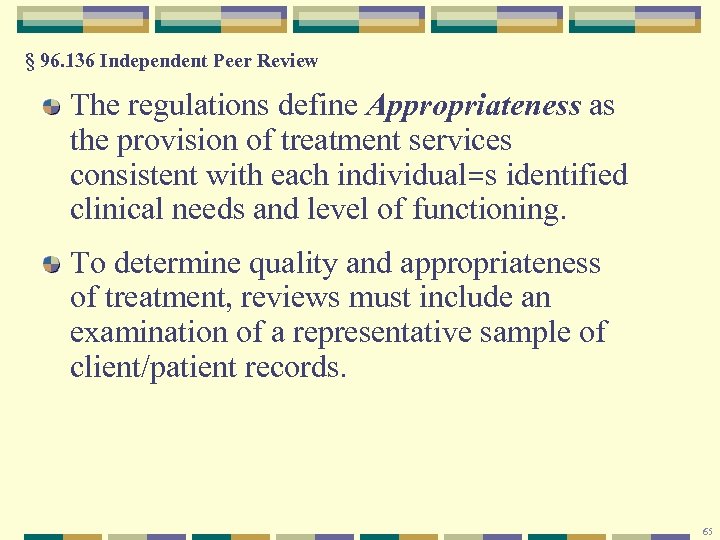
§ 96. 136 Independent Peer Review The regulations define Appropriateness as the provision of treatment services consistent with each individual=s identified clinical needs and level of functioning. To determine quality and appropriateness of treatment, reviews must include an examination of a representative sample of client/patient records. 65
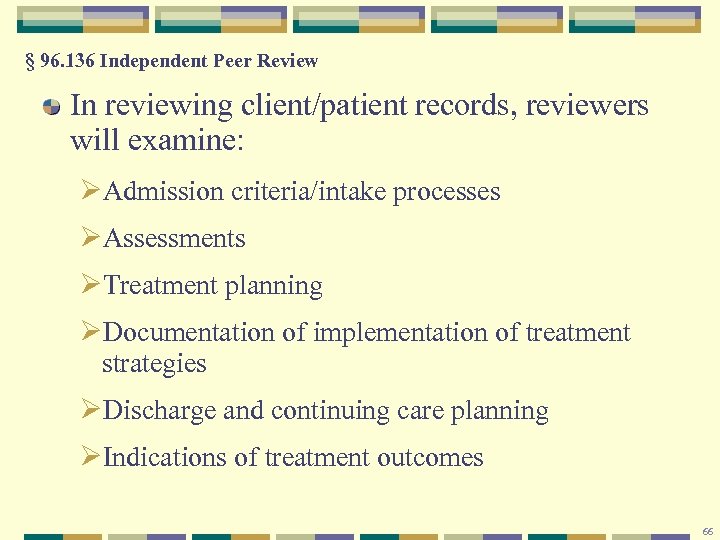
§ 96. 136 Independent Peer Review In reviewing client/patient records, reviewers will examine: ØAdmission criteria/intake processes ØAssessments ØTreatment planning ØDocumentation of implementation of treatment strategies ØDischarge and continuing care planning ØIndications of treatment outcomes 66
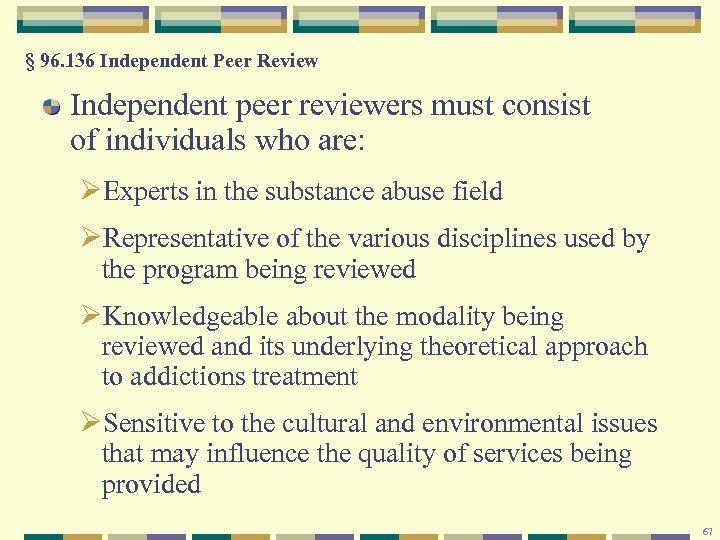
§ 96. 136 Independent Peer Review Independent peer reviewers must consist of individuals who are: ØExperts in the substance abuse field ØRepresentative of the various disciplines used by the program being reviewed ØKnowledgeable about the modality being reviewed and its underlying theoretical approach to addictions treatment ØSensitive to the cultural and environmental issues that may influence the quality of services being provided 67
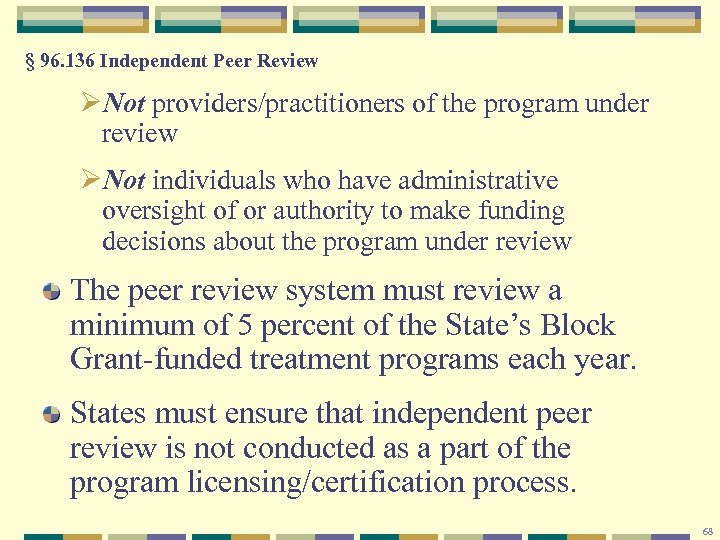
§ 96. 136 Independent Peer Review ØNot providers/practitioners of the program under review ØNot individuals who have administrative oversight of or authority to make funding decisions about the program under review The peer review system must review a minimum of 5 percent of the State’s Block Grant-funded treatment programs each year. States must ensure that independent peer review is not conducted as a part of the program licensing/certification process. 68
§ 96. 129 Revolving Funds for Establishment of Homes in Which Recovering Substance Abusers May Reside 69
§ 96. 129 Revolving Funds for Establishment of Homes in Which Recovering Substance Abusers May Reside Before the Children’s Health Services Act of 2000 was passed, States were required to maintain a $100, 000 revolving fund to support homes for persons recovering from substance abuse. The Children’s Health Services Act makes this provision optional. 70
§ 96. 129 Revolving Funds for Establishment of Homes in Which Recovering Substance Abusers May Reside Each loan: ØMust be for homes of six or more people ØCan only be made to private nonprofit entities ØCannot exceed $4, 000 ØMust be repaid within 2 years ØHas to be repaid in monthly installments 71
§ 96. 129 Revolving Funds for Establishment of Homes in Which Recovering Substance Abusers May Reside ØComes with the condition that alcohol or illegal drug use must be prohibited in the home, and residents who violate the conditions must be expelled ØMust require that residents pay the costs of housing, including fees for rent and utilities ØMust require the majority vote of residents to establish policies governing the house 72
§ 96. 129 Revolving Funds for Establishment of Homes in Which Recovering Substance Abusers May Reside States must also: ØIdentify and define the purposes for which loan funds will be spent ØSet reasonable criteria for determining eligibility of prospective borrowers ØEstablish procedures and a process for applying for a loan ØProvide clear written instructions to applicants concerning what is expected of them 73
§ 96. 129 Revolving Funds for Establishment of Homes in Which Recovering Substance Abusers May Reside Ø Keep a written record of the number and amounts of loans as well as the identities of borrowers and their repayment history Ø Establish reasonable criteria for selecting a fund management group, if the State decides to delegate fund management to a separate organization The State and any entity managing the revolving fund must abide by all Federal, State, and local laws and regulations in managing the revolving fund. 74
Other Applicable Requirements 75
Other Applicable Requirements Single State Audit The Office of Management and Budget (OMB) Circular A-133 prescribes the conditions under which non-Federal entities must have single State and program-specific audits. According to OMB Circular A-133, a non. Federal entity that has $500, 000 or more in Federal expenditures during the entity=s fiscal year must receive a single State audit. 76
Other Applicable Requirements Single State Audit A non-Federal entity with $500, 000 or more in Federal expenditures may elect to have a program-specific audit if: ØThe expenditures are under only one Federal program and ØThe Federal program does not require an A-133 audit 77
Other Applicable Requirements Single State Audit A non-Federal entity that expends less than $500, 000 in Federal awards during the entity=s fiscal year: ØIs exempt from Federal audit requirements for that year ØMust retain records to support expenditures and must make those records available for review or audit by appropriate officials of the Federal agency, the pass-through entity, and the General Accounting Office 78
Other Applicable Requirements OMB A-133 Compliance Supplement The OMB A-133 Compliance Supplement identifies important compliance requirements that the Federal Government expects to be considered for each major program that is audited under the auspices of OMB A-133. 79
Other Applicable Requirements OMB A-133 Compliance Supplement One section of the Supplement specifically addresses the audit requirements associated with the SAPT Block Grant program including: ØObjectives and procedures for conducting an A -133 audit of the Block Grant program ØObjectives and suggested audit procedures for determining compliance with SAPT Block Grant requirements 80
Other Applicable Requirements Subrecipient Monitoring OMB A-133 defines recipients of Federal Awards as “Pass-through Entities” and “Subrecipients. ” A Pass-through Entity is a non-Federal entity that receives a Federal award and passes portions of it on to subrecipients to carry out a Federal program. A Subrecipient is a non-Federal entity that expends Federal awards received from a passthrough entity to carry out a Federal program. 81
Other Applicable Requirements Subrecipient Monitoring For example, when an Principal State Agency subcontracts with programs to provide Block Grant-funded prevention, treatment, and rehabilitation services, the Principal State Agency is the pass-through entity and programs are subrecipients. 82
Other Applicable Requirements Subrecipient Monitoring OMB A-133 requires pass-through entities to: ØInform each subrecipient of Federal awards, including the Catalogue of Federal Domestic Assistance title and number, the award name and number, and the award year ØConvey requirements from Federal laws and regulations, the provisions of contracts or grant agreements, and any supplemental requirements imposed by the pass-through entity 83
Other Applicable Requirements Subrecipient Monitoring ØMonitor subrecipients to ensure that Federal awards are used for authorized purposes in compliance with laws, regulations, and the provisions of contracts or grant agreements and that performance goals are achieved ØEnsure that subrecipients meet applicable OMB A 133 audit requirements ØIssue management decisions on audit findings within 6 months after receiving subrecipients' audit reports ØEnsure that the subrecipients take appropriate and timely corrective action to resolve any audit findings 84
Other Applicable Requirements Subrecipient Monitoring ØDetermine if the subrecipient audits call for adjustments in the pass-through entity's own records ØRequire each subrecipient to permit the pass- through entity and auditors to have access to the records and financial statements 85
Other Applicable Requirements Fiscal Controls States are exempt from the provisions of OMB cost principle circulars; therefore, State cost principle requirements apply to the SAPT Block Grant instead. 86
Other Applicable Requirements Salary Limitation States and subrecipients cannot use the Block Grant to pay salaries in excess of Level I of the Federal Senior Executive Service pay scale (e. g. , no more than $191, 300 in 2008). 87
SAMHSA’s National Outcome Measures (NOMs) All recipients of the following grants must now comply with and report on the NOMs: ØSAPT Block Grant ØCommunity Mental Health Services Block Grant ØCSAT, CSAP, and CMHS discretionary grants 88
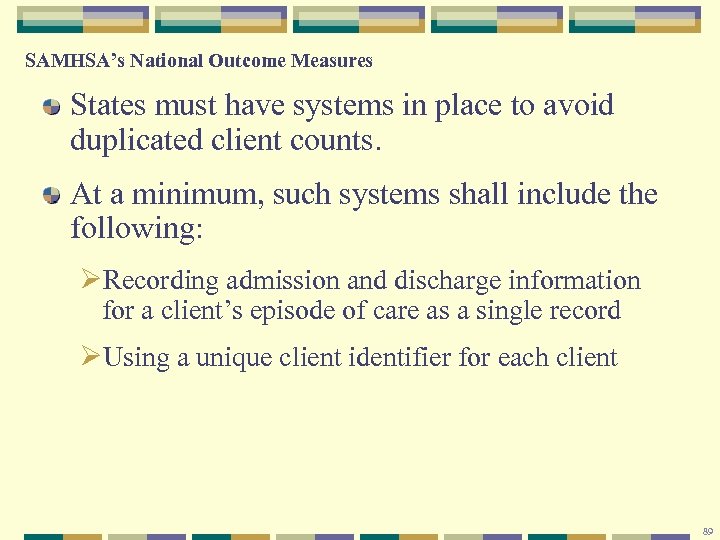
SAMHSA’s National Outcome Measures States must have systems in place to avoid duplicated client counts. At a minimum, such systems shall include the following: ØRecording admission and discharge information for a client’s episode of care as a single record ØUsing a unique client identifier for each client 89
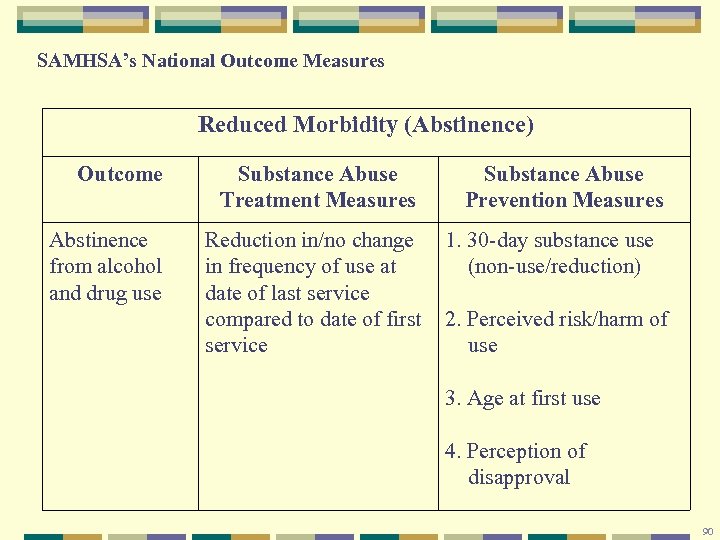
SAMHSA’s National Outcome Measures Reduced Morbidity (Abstinence) Outcome Substance Abuse Treatment Measures Abstinence from alcohol and drug use Reduction in/no change in frequency of use at date of last service compared to date of first service Substance Abuse Prevention Measures 1. 30 -day substance use (non-use/reduction) 2. Perceived risk/harm of use 3. Age at first use 4. Perception of disapproval 90
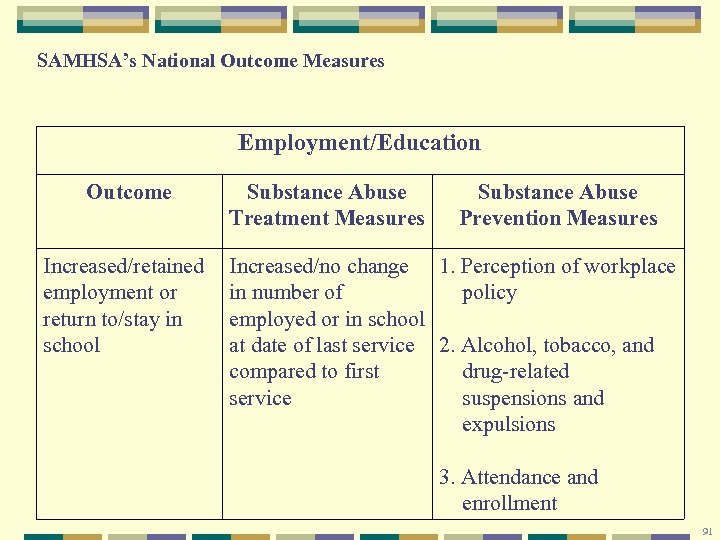
SAMHSA’s National Outcome Measures Employment/Education Outcome Increased/retained employment or return to/stay in school Substance Abuse Treatment Measures Substance Abuse Prevention Measures Increased/no change 1. Perception of workplace in number of policy employed or in school at date of last service 2. Alcohol, tobacco, and compared to first drug-related service suspensions and expulsions 3. Attendance and enrollment 91
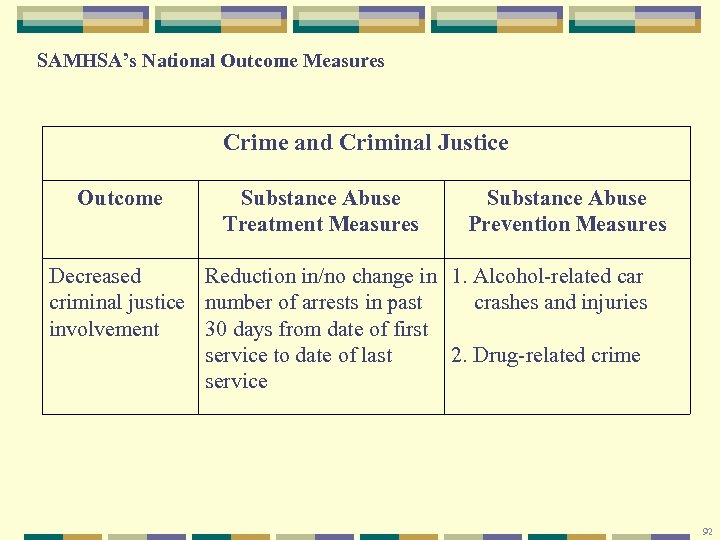
SAMHSA’s National Outcome Measures Crime and Criminal Justice Outcome Substance Abuse Treatment Measures Substance Abuse Prevention Measures Decreased Reduction in/no change in 1. Alcohol-related car criminal justice number of arrests in past crashes and injuries involvement 30 days from date of first service to date of last 2. Drug-related crime service 92
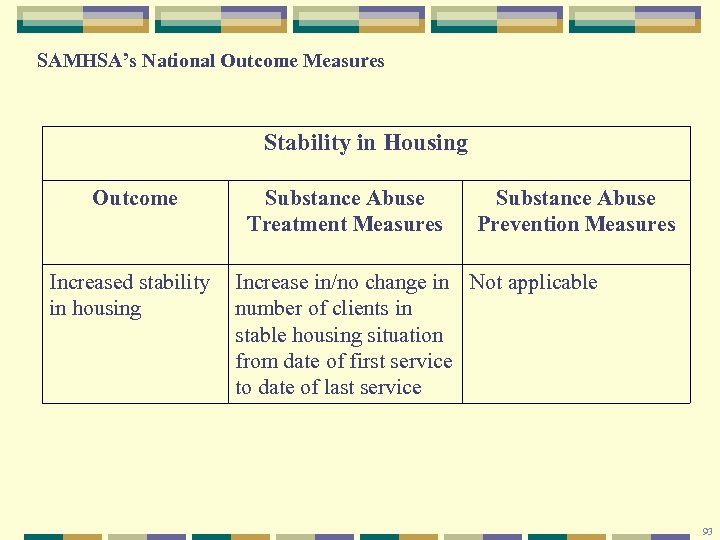
SAMHSA’s National Outcome Measures Stability in Housing Outcome Increased stability in housing Substance Abuse Treatment Measures Substance Abuse Prevention Measures Increase in/no change in Not applicable number of clients in stable housing situation from date of first service to date of last service 93
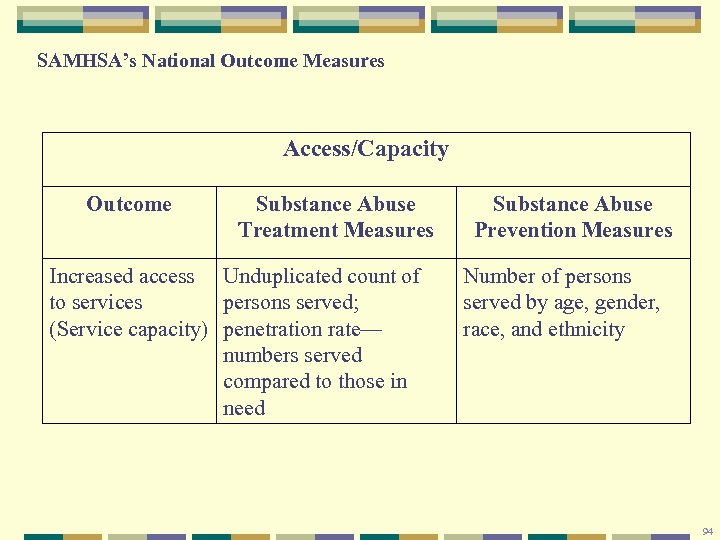
SAMHSA’s National Outcome Measures Access/Capacity Outcome Substance Abuse Treatment Measures Increased access Unduplicated count of to services persons served; (Service capacity) penetration rate— numbers served compared to those in need Substance Abuse Prevention Measures Number of persons served by age, gender, race, and ethnicity 94
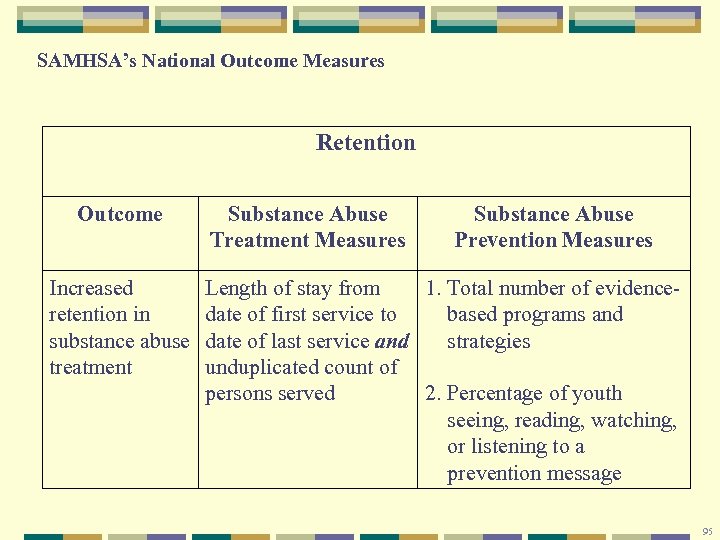
SAMHSA’s National Outcome Measures Retention Outcome Increased retention in substance abuse treatment Substance Abuse Treatment Measures Substance Abuse Prevention Measures Length of stay from 1. Total number of evidencedate of first service to based programs and date of last service and strategies unduplicated count of persons served 2. Percentage of youth seeing, reading, watching, or listening to a prevention message 95
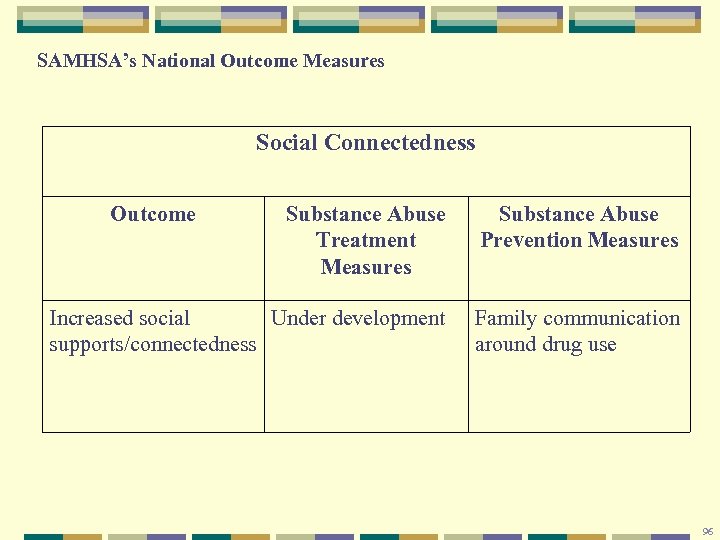
SAMHSA’s National Outcome Measures Social Connectedness Outcome Substance Abuse Treatment Measures Substance Abuse Prevention Measures Increased social Under development supports/connectedness Family communication around drug use 96
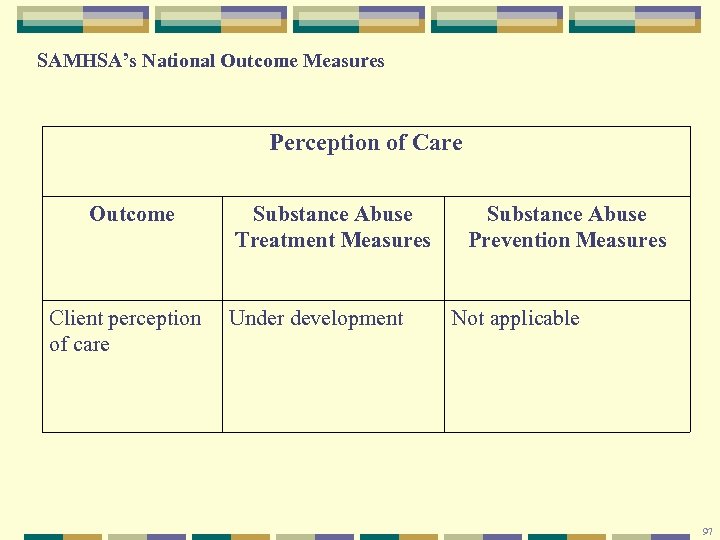
SAMHSA’s National Outcome Measures Perception of Care Outcome Client perception of care Substance Abuse Treatment Measures Under development Substance Abuse Prevention Measures Not applicable 97
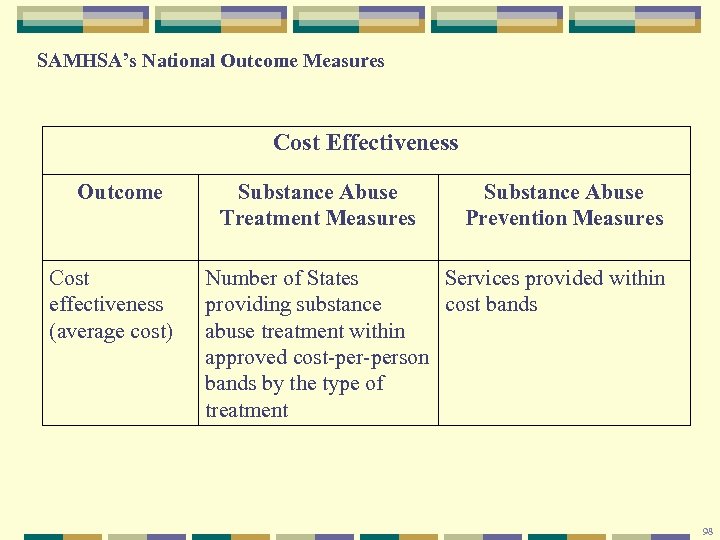
SAMHSA’s National Outcome Measures Cost Effectiveness Outcome Cost effectiveness (average cost) Substance Abuse Treatment Measures Substance Abuse Prevention Measures Number of States Services provided within providing substance cost bands abuse treatment within approved cost-person bands by the type of treatment 98
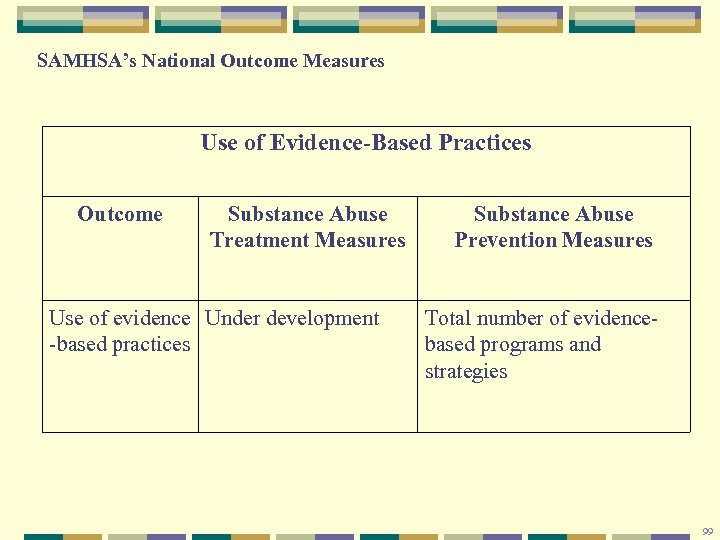
SAMHSA’s National Outcome Measures Use of Evidence-Based Practices Outcome Substance Abuse Treatment Measures Use of evidence Under development -based practices Substance Abuse Prevention Measures Total number of evidencebased programs and strategies 99
Charitable Choice (45 CFR Part 54 a) According to Charitable Choice regulations, Federal, State, and local governments that receive funds under these programs cannot discriminate against an organization that is, or applies to be, a program participant on the basis of the organization’s religious character or affiliation. Applicants for Block Grant funding must certify that they will comply with all the SAMHSA Charitable Choice requirements. 100
Charitable Choice (45 CFR Part 54 a) Under Charitable Choice, Block Grant-funded faith-based organizations: ØRetain the authority over their internal governance ØMay retain religious terms in their organizations’ names ØMay select board members on a religious basis ØMay include religious references in the organizations’ mission statements and other governing documents ØMay use space in their facilities to offer Block Grant-funded activities without removing religious art, icons, scriptures, or other symbols 101
Charitable Choice (45 CFR Part 54 a) Block Grant-funded faith-based organizations cannot use these funds for inherently religious activities such as the following: ØWorship ØReligious instruction ØProselytization Organizations can engage in such religious activities only if: ØThe activities are offered separately, in time or location, from Block Grant-funded activities ØParticipation in the activities is voluntary 102
Charitable Choice (45 CFR Part 54 a) In delivering services, including outreach activities, SAMHSA-funded religious organizations cannot discriminate against current or prospective program participants based on: Ø Religion Ø Religious belief Ø Refusal to hold a religious belief Ø Refusal to actively participate in a religious practice If an otherwise eligible client objects to the religious character of a Block Grant-funded program, the program shall refer the client to an alternative provider within a reasonable period of time of the objection. 103
Charitable Choice (45 CFR Part 54 a) Similar to all other nongovernmental organizations that receive Block Grant funds, religious organizations must use generally accepted auditing and accounting principles to account for Block Grant funds. Religious organizations shall segregate Federal funds from non-Federal funds. Only the Federal funds shall be subject to audit by the government. 104
Charitable Choice (45 CFR Part 54 a) State or local governments that contribute funds to supplement Block Grant-funded activities have the option of keeping the State/local funds separate from the Block Grant funds or commingling State/local funds with Block Grant funds. When a State or local government commingles State/local funds with Block Grant funds, the Charitable Choice requirements will apply to all the commingled funds. 105
Thank you for your participation! U. S. DEPARTMENT OF HEALTH AND HUMAN SERVICES Substance Abuse and Mental Health Services Administration Center for Substance Abuse Treatment www. samhsa. gov 106
Скачать презентацию WELCOME Substance Abuse Prevention and Treatment Block Grant
3e9900baee385890b69fe97b50a5251f.ppt