


 Скачать презентацию WELCOME Purpose The purpose of Fiddlehead School
f0570ff130299345fcb6e3d65b2b29b2.ppt
- Количество слайдов: 29
 WELCOME!
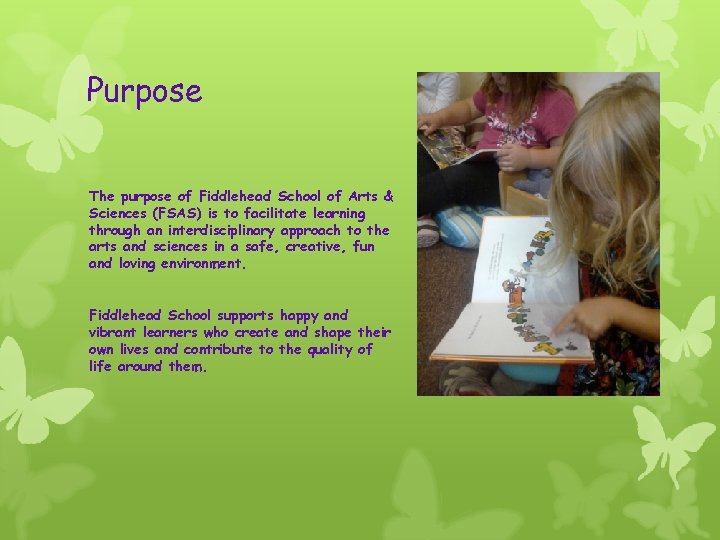 Purpose The purpose of Fiddlehead School of Arts & Sciences (FSAS) is to facilitate learning through an interdisciplinary approach to the arts and sciences in a safe, creative, fun and loving environment. Fiddlehead School supports happy and vibrant learners who create and shape their own lives and contribute to the quality of life around them.
 Vision Fiddlehead School of Arts & Sciences will provide for the foundational needs of growing children in a community where children, teachers, and families learn together in a nurturing environment. We are a school that honors children’s curiosities, interests and uniqueness, and facilitate progressive learning at the highest level. At Fiddlehead, using an inquiry-based model, children will: Facilitate learning at a higher level; to develop the powers of intelligence. To encourage children to strive to realize their fullest potential. Be prepared for problem-solving. Be comfortable with a variety of media and approaches with which they can express themselves. Value who they are and know that they are interconnected with all living things; which will enable them to make mindful and responsible choices. Retain a sense of wonder and curiosity while being able to effectively adapt in an ever changing world.
 Beliefs Children are equal partners in a reciprocal learning and teaching environment. Children learn through active, engaged hands-on learning. A culture of questioning, listening, and reflection supports a strong academic environment. Children are natural scientists – they investigate, observe, question and analyze their world every day. The arts provide a vehicle for expression, communication, understanding and personal growth. Time in nature allows children to develop a relationship with the natural world - a foundation for ecological literacy.
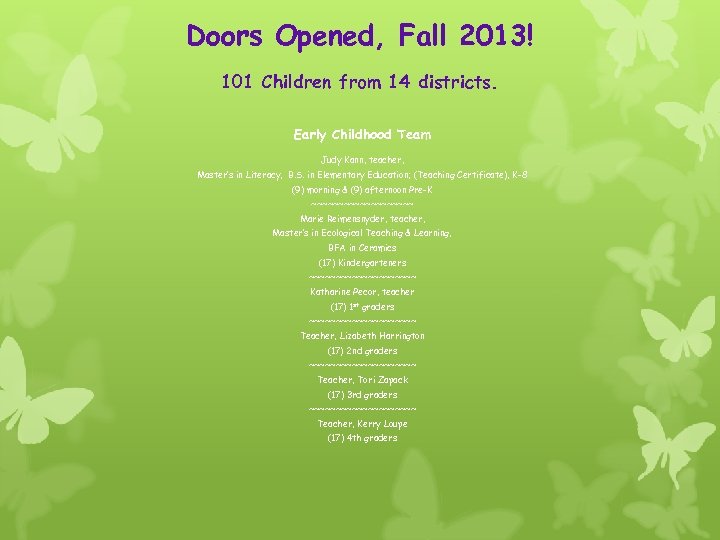 Doors Opened, Fall 2013! 101 Children from 14 districts. Early Childhood Team Judy Kann, teacher, Master’s in Literacy, B. S. in Elementary Education; (Teaching Certificate), K-8 (9) morning & (9) afternoon Pre-K ~~~~~~~~~~ Marie Reimensnyder, teacher, Master’s in Ecological Teaching & Learning, BFA in Ceramics (17) Kindergarteners ~~~~~~~~~~ Katharine Pecor, teacher (17) 1 st graders ~~~~~~~~~~ Teacher, Lizabeth Harrington (17) 2 nd graders ~~~~~~~~~~ Teacher, Tori Zapack (17) 3 rd graders ~~~~~~~~~~ Teacher, Kerry Loupe (17) 4 th graders
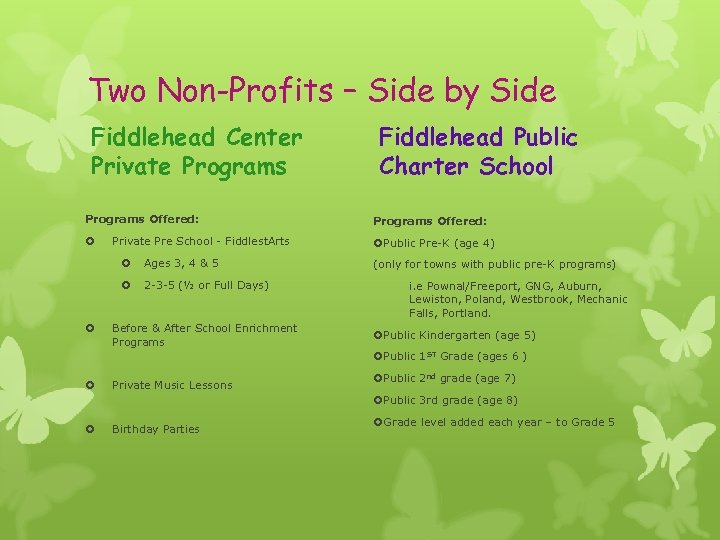 Two Non-Profits – Side by Side Fiddlehead Center Private Programs Offered: Private Pre School - Fiddlest. Arts Ages 3, 4 & 5 2 -3 -5 (½ or Full Days) Before & After School Enrichment Programs Fiddlehead Public Charter School Programs Offered: Public Pre-K (age 4) (only for towns with public pre-K programs) i. e Pownal/Freeport, GNG, Auburn, Lewiston, Poland, Westbrook, Mechanic Falls, Portland. Public Kindergarten (age 5) Public 1 ST Grade (ages 6 ) Private Music Lessons Public 2 nd grade (age 7) Public 3 rd grade (age 8) Birthday Parties Grade level added each year – to Grade 5
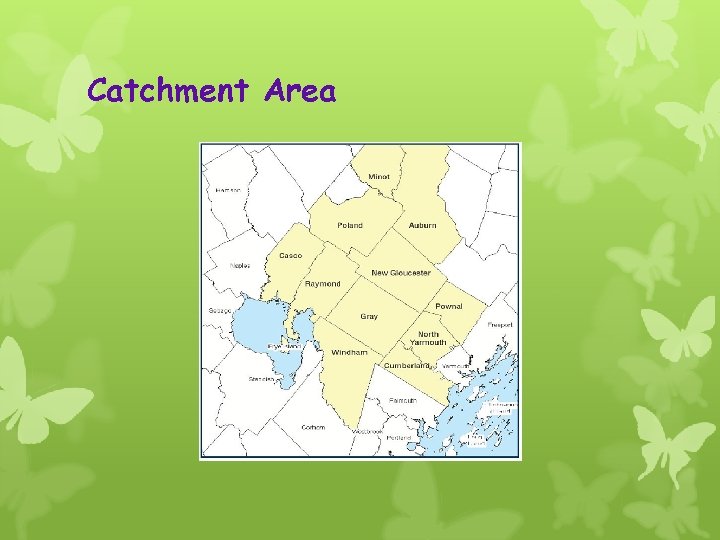 Catchment Area
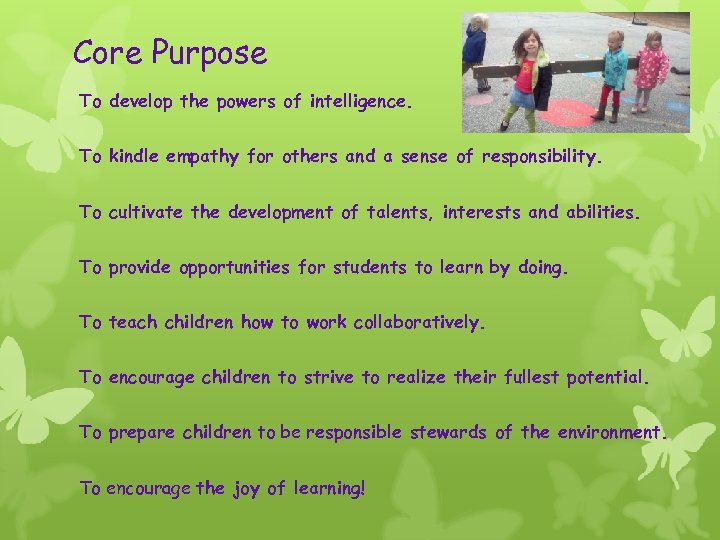 Core Purpose To develop the powers of intelligence. To kindle empathy for others and a sense of responsibility. To cultivate the development of talents, interests and abilities. To provide opportunities for students to learn by doing. To teach children how to work collaboratively. To encourage children to strive to realize their fullest potential. To prepare children to be responsible stewards of the environment. To encourage the joy of learning!
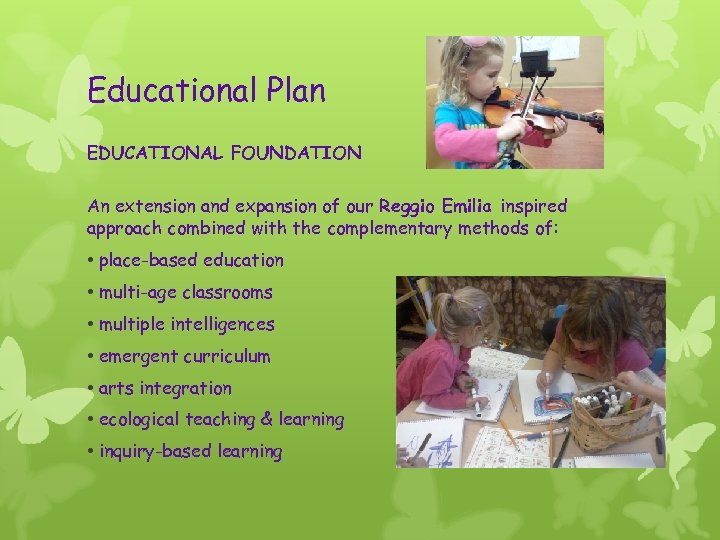 Educational Plan EDUCATIONAL FOUNDATION An extension and expansion of our Reggio Emilia inspired approach combined with the complementary methods of: • place-based education • multi-age classrooms • multiple intelligences • emergent curriculum • arts integration • ecological teaching & learning • inquiry-based learning
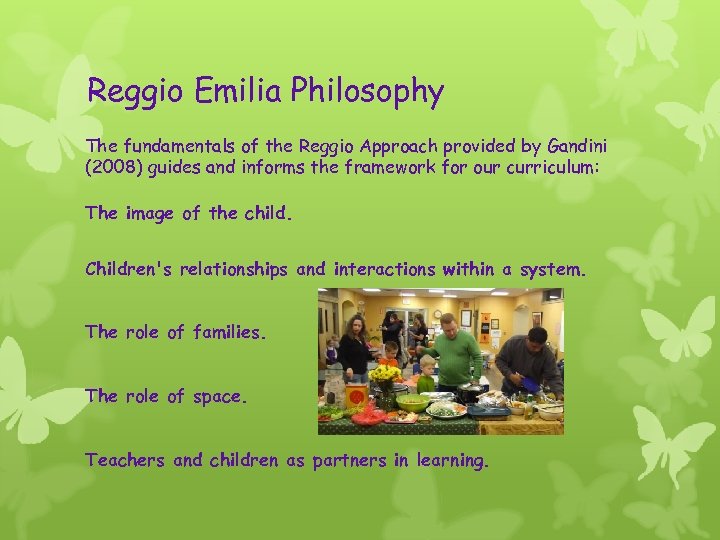 Reggio Emilia Philosophy The fundamentals of the Reggio Approach provided by Gandini (2008) guides and informs the framework for our curriculum: The image of the child. Children's relationships and interactions within a system. The role of families. The role of space. Teachers and children as partners in learning.
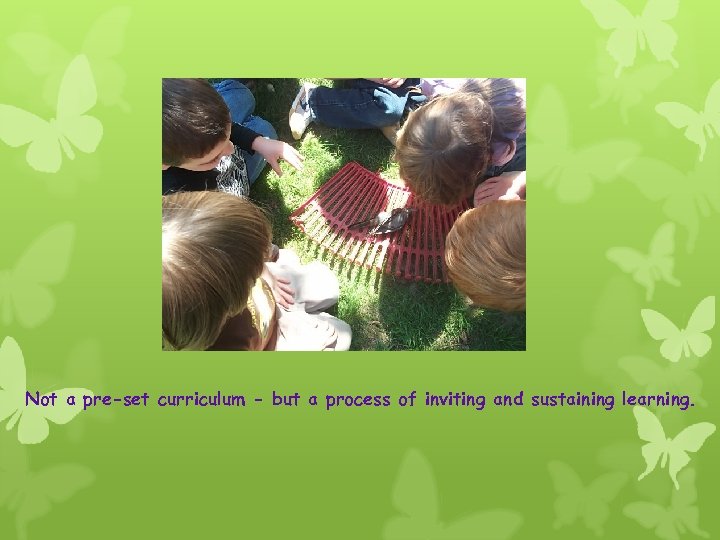 Not a pre-set curriculum - but a process of inviting and sustaining learning.
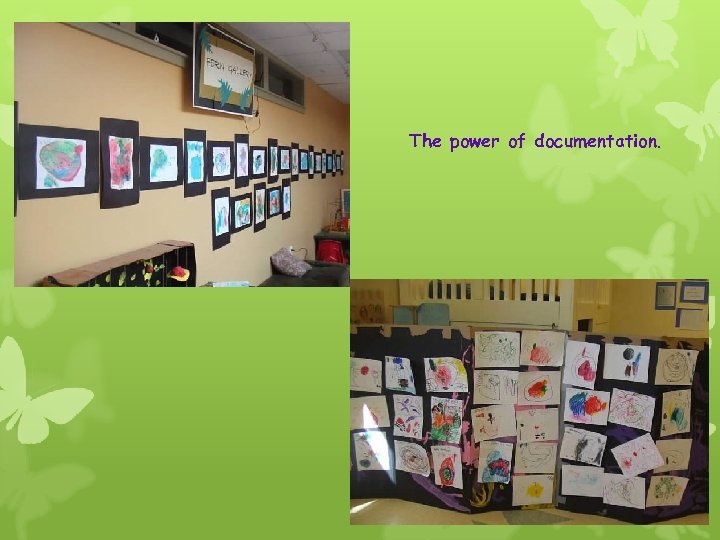 The power of documentation.
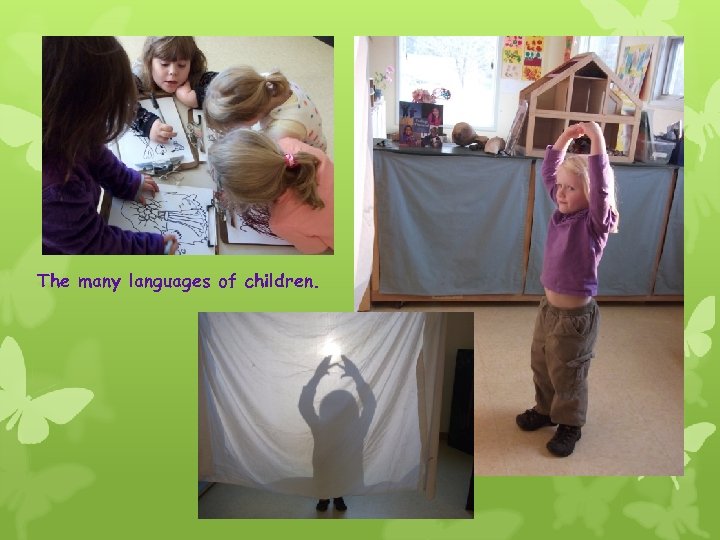 The many languages of children.
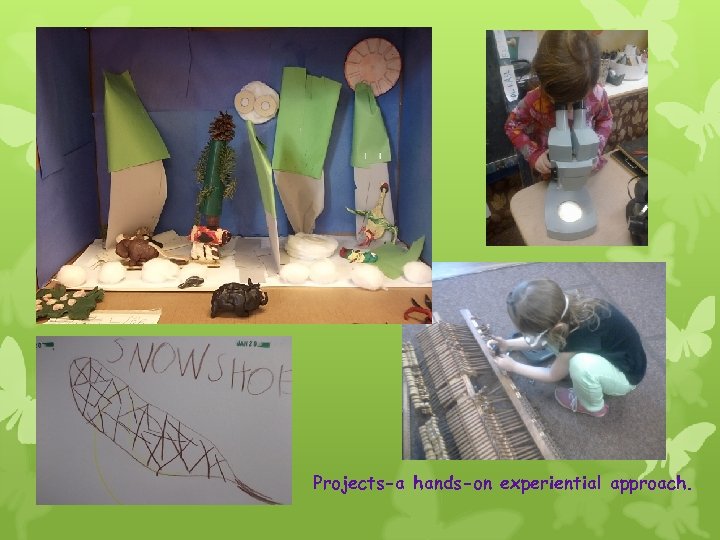 Projects-a hands-on experiential approach.
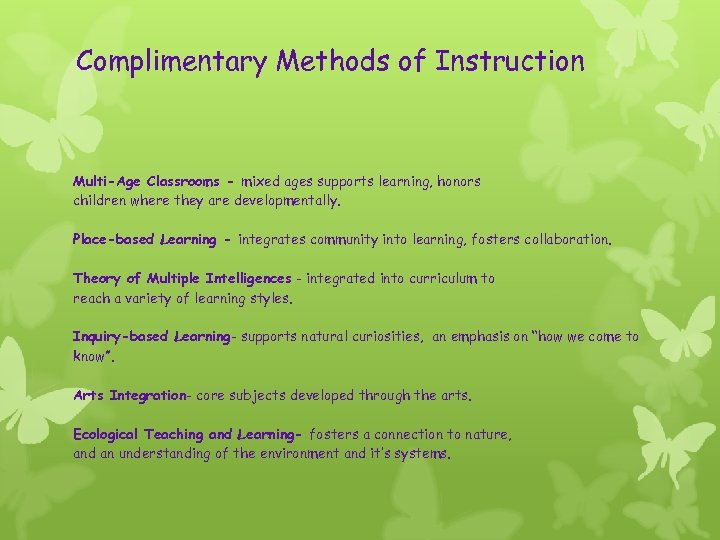 Complimentary Methods of Instruction Multi-Age Classrooms - mixed ages supports learning, honors children where they are developmentally. Place-based Learning - integrates community into learning, fosters collaboration. Theory of Multiple Intelligences - integrated into curriculum to reach a variety of learning styles. Inquiry-based Learning- supports natural curiosities, an emphasis on “how we come to know”. Arts Integration- core subjects developed through the arts. Ecological Teaching and Learning- fosters a connection to nature, and an understanding of the environment and it’s systems.
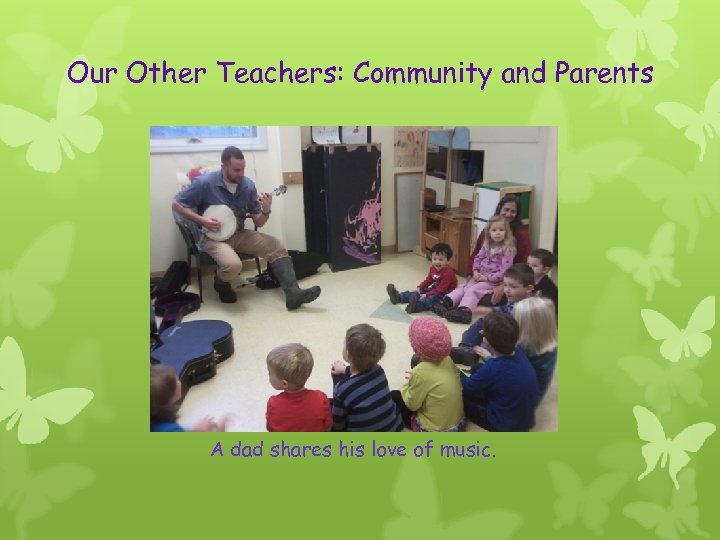 Our Other Teachers: Community and Parents A dad shares his love of music.
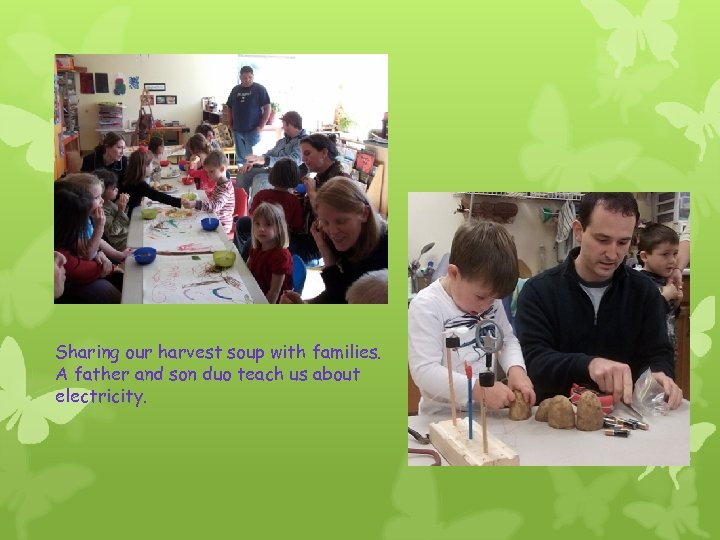 Sharing our harvest soup with families. A father and son duo teach us about electricity.
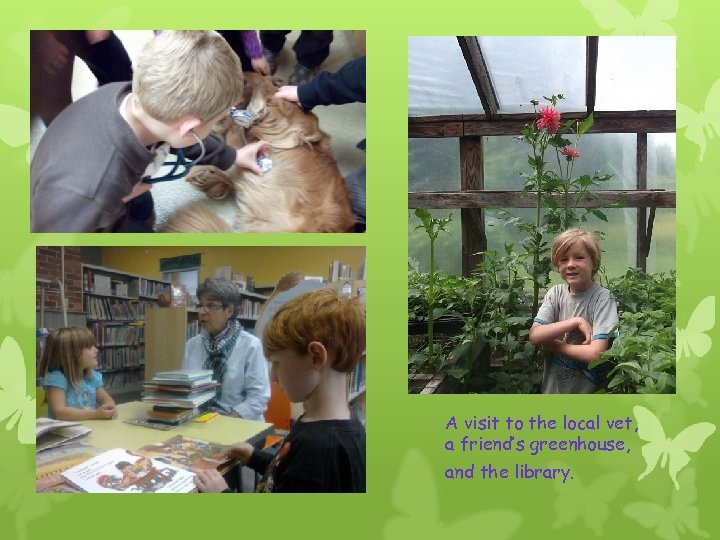 A visit to the local vet, a friend’s greenhouse, and the library.
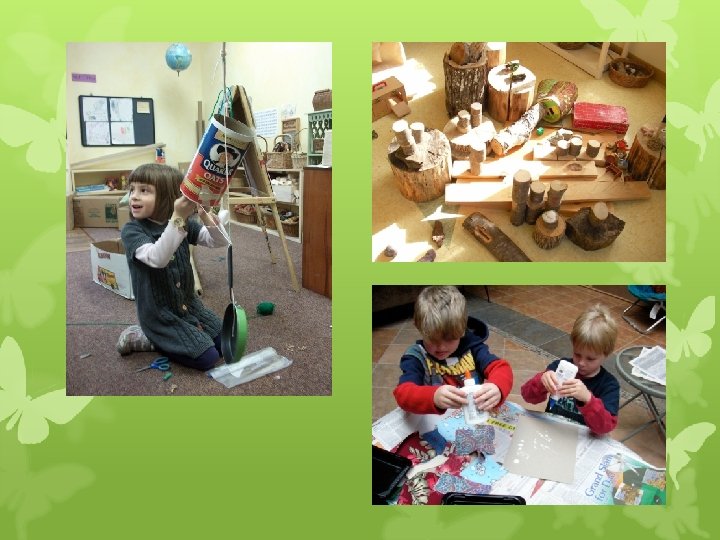
 Learning Environment The learning environment at Fiddlehead School of Arts and Sciences will educate the whole child through systems that support interactions and learning - physical space, time, community, tools, technology, and collaboration. The physical space encompasses both the indoors and outdoors. Extensive periods of time - for in depth investigations, thoughtful observations and reflections. A community of learners - children, teachers, and parents co-construct knowledge. Interactive materials -tools that support development, expression, problem solving and communicate thinking. Technology will enhance the children’s real world experiences.
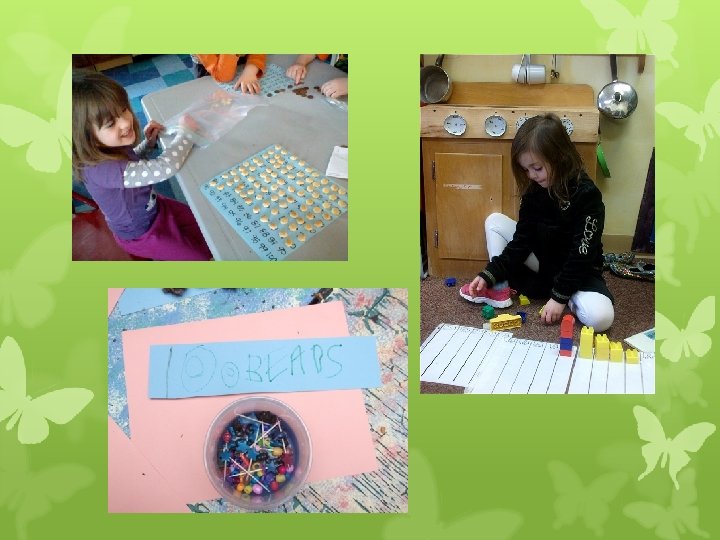
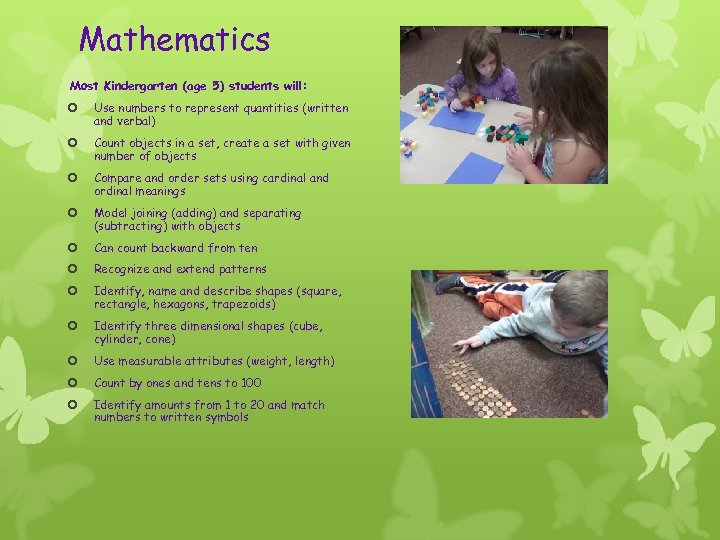 Mathematics Most Kindergarten (age 5) students will: Use numbers to represent quantities (written and verbal) Count objects in a set, create a set with given number of objects Compare and order sets using cardinal and ordinal meanings Model joining (adding) and separating (subtracting) with objects Can count backward from ten Recognize and extend patterns Identify, name and describe shapes (square, rectangle, hexagons, trapezoids) Identify three dimensional shapes (cube, cylinder, cone) Use measurable attributes (weight, length) Count by ones and tens to 100 Identify amounts from 1 to 20 and match numbers to written symbols
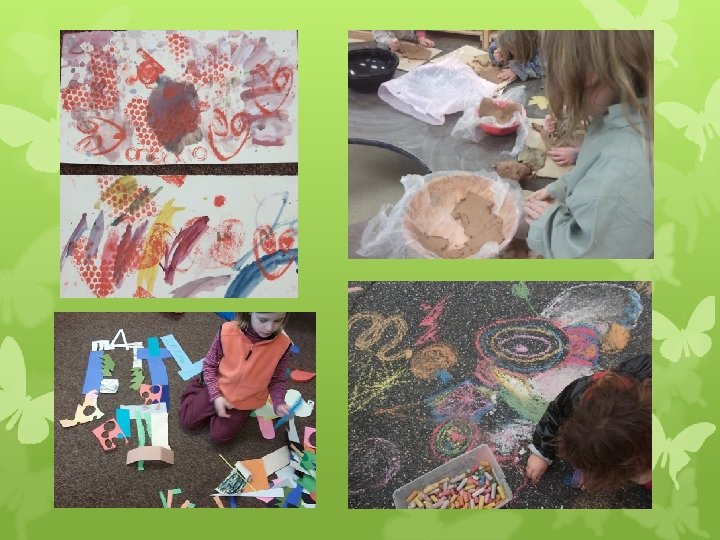
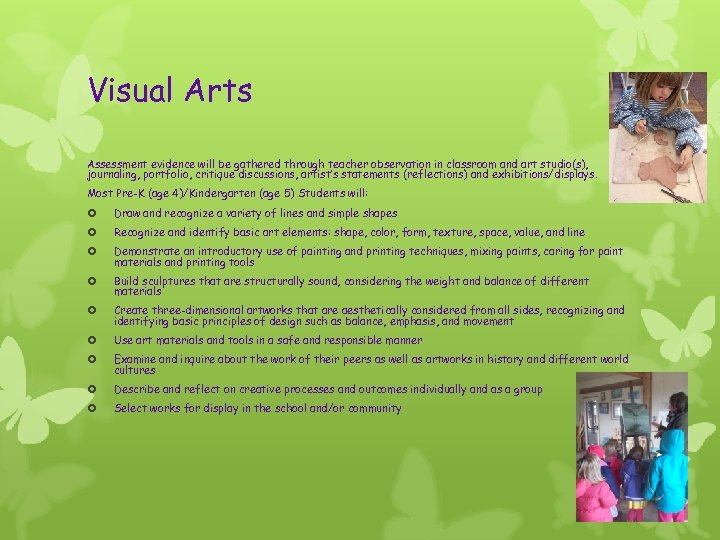 Visual Arts Assessment evidence will be gathered through teacher observation in classroom and art studio(s), journaling, portfolio, critique discussions, artist’s statements (reflections) and exhibitions/displays. Most Pre-K (age 4)/Kindergarten (age 5) Students will: Draw and recognize a variety of lines and simple shapes Recognize and identify basic art elements: shape, color, form, texture, space, value, and line Demonstrate an introductory use of painting and printing techniques, mixing paints, caring for paint materials and printing tools Build sculptures that are structurally sound, considering the weight and balance of different materials Create three-dimensional artworks that are aesthetically considered from all sides, recognizing and identifying basic principles of design such as balance, emphasis, and movement Use art materials and tools in a safe and responsible manner Examine and inquire about the work of their peers as well as artworks in history and different world cultures Describe and reflect on creative processes and outcomes individually and as a group Select works for display in the school and/or community
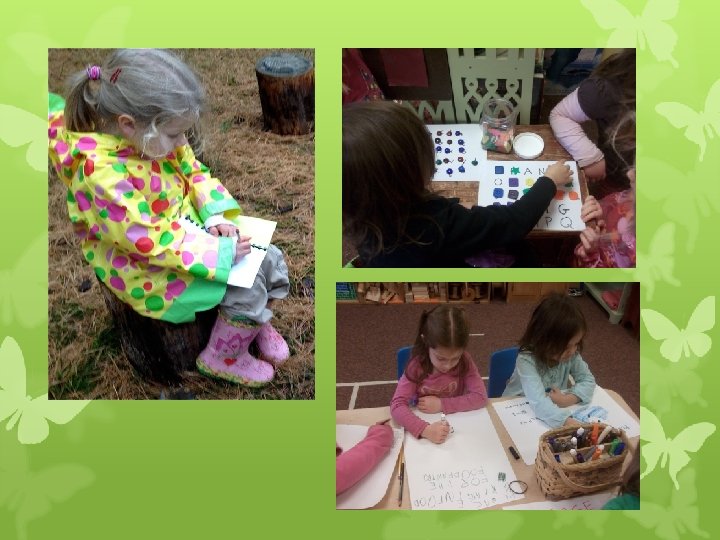
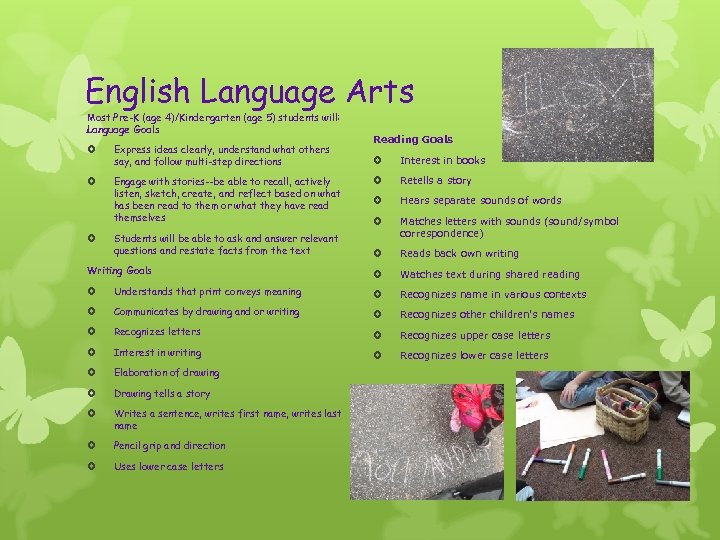 English Language Arts Most Pre-K (age 4)/Kindergarten (age 5) students will: Language Goals Express ideas clearly, understand what others say, and follow multi-step directions Engage with stories--be able to recall, actively listen, sketch, create, and reflect based on what has been read to them or what they have read themselves Students will be able to ask and answer relevant questions and restate facts from the text Writing Goals Reading Goals Interest in books Retells a story Hears separate sounds of words Matches letters with sounds (sound/symbol correspondence) Reads back own writing Watches text during shared reading Understands that print conveys meaning Recognizes name in various contexts Communicates by drawing and or writing Recognizes other children's names Recognizes letters Recognizes upper case letters Interest in writing Recognizes lower case letters Elaboration of drawing Drawing tells a story Writes a sentence, writes first name, writes last name Pencil grip and direction Uses lower case letters
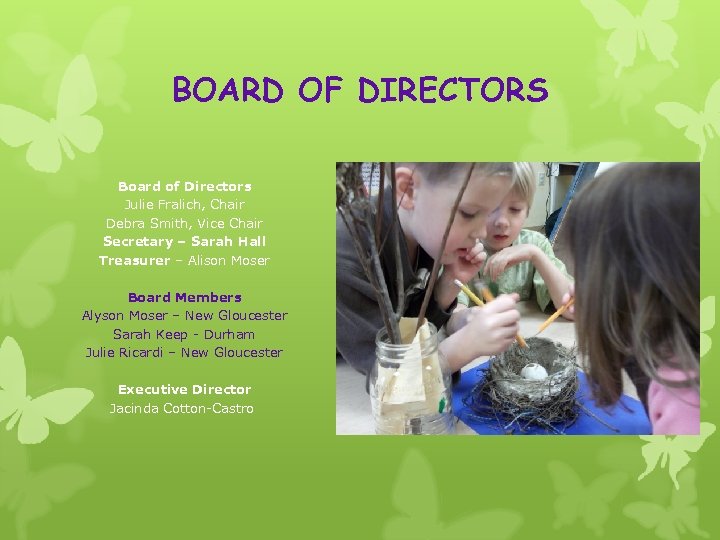 BOARD OF DIRECTORS Board of Directors Julie Fralich, Chair Debra Smith, Vice Chair Secretary – Sarah Hall Treasurer – Alison Moser Board Members Alyson Moser – New Gloucester Sarah Keep - Durham Julie Ricardi – New Gloucester Executive Director Jacinda Cotton-Castro
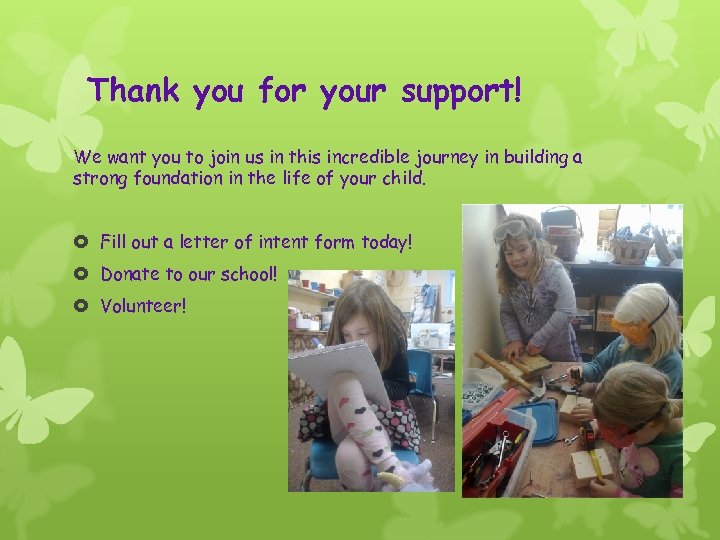 Thank you for your support! We want you to join us in this incredible journey in building a strong foundation in the life of your child. Fill out a letter of intent form today! Donate to our school! Volunteer!
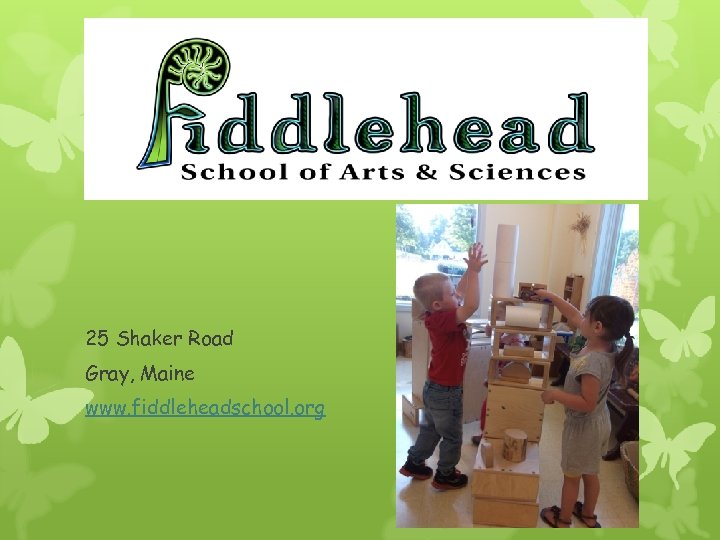 25 Shaker Road Gray, Maine www. fiddleheadschool. org