 Скачать презентацию Welcome Jericho Forum Meeting 21 -22 September 2006
959e514018dc4c760f295696a3a4decb.ppt
- Количество слайдов: 103



Welcome Jericho Forum Meeting 21 -22 September 2006 Hosted by The Boeing Corporation Seattle, WA. , USA www. jerichoforum. org
What we covered on Thursday § Our de-perimeterized environment - responding to the challenge (Stephen Whitlock, Boeing) § Client machines (Chandler Howell, Motorola) § Network controls (Carl Bunje, Boeing) § Application/server (Conrad Kimball, Boeing) § Data/Information Security (Jeremy Hilton, Cardiff University)
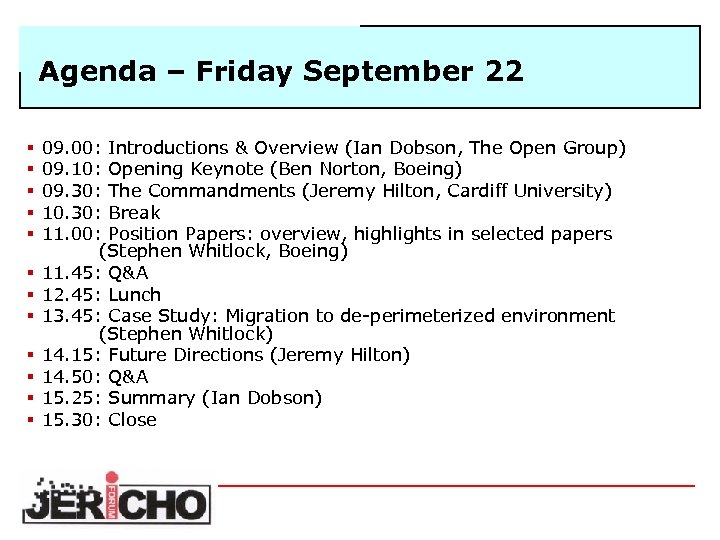
Agenda – Friday September 22 § § § 09. 00: Introductions & Overview (Ian Dobson, The Open Group) 09. 10: Opening Keynote (Ben Norton, Boeing) 09. 30: The Commandments (Jeremy Hilton, Cardiff University) 10. 30: Break 11. 00: Position Papers: overview, highlights in selected papers (Stephen Whitlock, Boeing) 11. 45: Q&A 12. 45: Lunch 13. 45: Case Study: Migration to de-perimeterized environment (Stephen Whitlock) 14. 15: Future Directions (Jeremy Hilton) 14. 50: Q&A 15. 25: Summary (Ian Dobson) 15. 30: Close
Setting the Foundations § The Jericho Forum “Commandments” § Jeremy Hilton Cardiff University

I have ten commandments. The first nine are, thou shalt not bore. The tenth is, thou shalt have right of final cut.
Rationale § Jericho Forum in a nutshell: “Your security perimeters are disappearing: what are you going to do about it? ” § Need to express what / why / how to do it in high level terms (but allowing for detail) § Need to be able to draw distinctions between ‘good’ security (e. g. ‘principle of least privilege’) and ‘de-perimeterisation security’ (e. g. ‘end-to-end principle’)
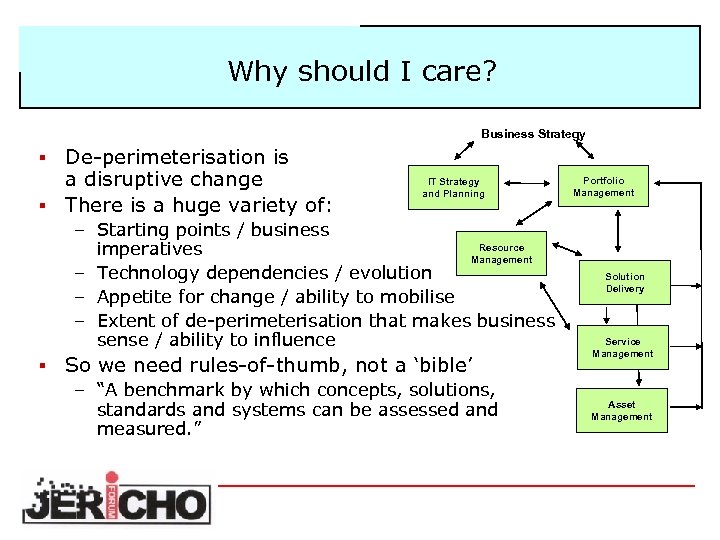
Why should I care? Business Strategy De-perimeterisation is a disruptive change § There is a huge variety of: § IT Strategy and Planning – Starting points / business Resource imperatives Management – Technology dependencies / evolution – Appetite for change / ability to mobilise – Extent of de-perimeterisation that makes business sense / ability to influence § So we need rules-of-thumb, not a ‘bible’ – “A benchmark by which concepts, solutions, standards and systems can be assessed and measured. ” Portfolio Management Solution Delivery Service Management Asset Management
Structure of the Commandments § Fundamentals (3) § Surviving in a hostile world (2) § The need for trust (2) § Identity, management and federation (1) § Access to data (3)
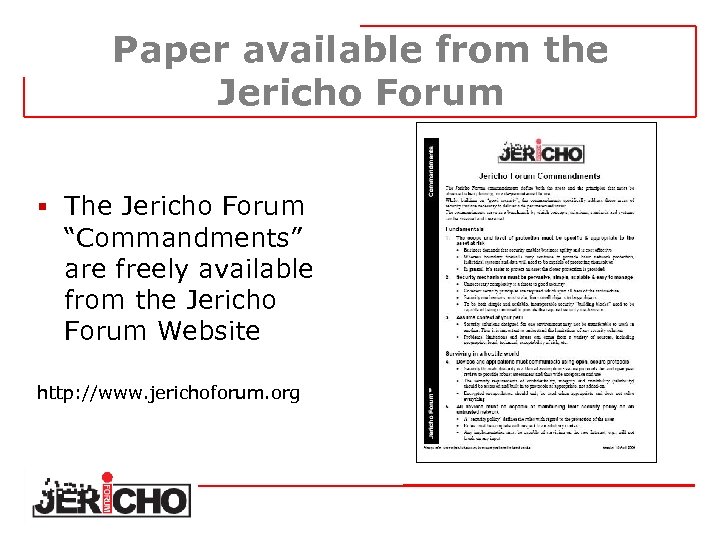
Fundamentals 1. The scope and level of protection must be specific and appropriate to the asset at risk. Business demands that security enables business agility and is cost effective. § Whereas boundary firewalls may continue to provide basic network protection, individual systems and data will need to be capable of protecting themselves. § In general, it’s easier to protect an asset the closer protection is provided. §
Fundamentals 2. Security mechanisms must be pervasive, simple, scalable and easy to manage. Unnecessary complexity is a threat to good security. Coherent security principles are required which span all tiers of the architecture. § Security mechanisms must scale: § § – from small objects to large objects. § To be both simple and scalable, interoperable security “building blocks” need to be capable of being combined to provide the required security mechanisms.
Fundamentals 3. Assume context at your peril. § Security solutions designed for one environment may not be transferable to work in another: – thus it is important to understand the limitations of any security solution. § Problems, limitations and issues can come from a variety of sources, including: – – Geographic Legal Technical Acceptability of risk, etc.
Surviving in a hostile world 4. Devices and applications must communicate using open, secure protocols. § Security through obscurity is a flawed assumption – secure protocols demand open peer review to provide robust assessment and thus wide acceptance and use. The security requirements of confidentiality, integrity and availability (reliability) should be assessed and built in to protocols as appropriate, not added on. § Encrypted encapsulation should only be used when appropriate and does not solve everything. §
Surviving in a hostile world 5. All devices must be capable of maintaining their security policy on an untrusted network. A “security policy” defines the rules with regard to the protection of the asset. § Rules must be complete with respect to an arbitrary context. § Any implementation must be capable of surviving on the raw Internet, e. g. , will not break on any input. §
The need for trust 6. All people, processes, technology must have declared and transparent levels of trust for any transaction to take place. There must be clarity of expectation with all parties understanding the levels of trust. § Trust models must encompass people/organisations and devices/infrastructure. § Trust level may vary by location, transaction type, user role and transactional risk. §
The need for trust 7. Mutual trust assurance levels must be determinable. Devices and users must be capable of appropriate levels of (mutual) authentication for accessing systems and data. § Authentication and authorisation frameworks must support the trust model. §
Identity, Management and Federation 8. Authentication, authorisation and accountability must interoperate/ exchange outside of your locus/ area of control. People/systems must be able to manage permissions of resources they don't control. § There must be capability of trusting an organisation, which can authenticate individuals or groups, thus eliminating the need to create separate identities. § In principle, only one instance of person / system / identity may exist, but privacy necessitates the support for multiple instances, or once instance with multiple facets. § Systems must be able to pass on security credentials/assertions. § § Multiple loci (areas) of control must be supported.
Finally, access to data 9. Access to data should be controlled by security attributes of the data itself. Attributes can be held within the data (DRM/Metadata) or could be a separate system. § Access / security could be implemented by encryption. § Some data may have “public, non-confidential” attributes. § § Access and access rights have a temporal component.
Finally, access to data 10. Data privacy (and security of any asset of sufficiently high value) requires a segregation of duties/privileges § Permissions, keys, privileges etc. must ultimately fall under independent control – or there will always be a weakest link at the top of the chain of trust. § Administrator access must also be subject to these controls.
Finally, access to data 11. By default, data must be appropriately secured both in storage and in transit. Removing the default must be a conscious act. § High security should not be enforced for everything: § – “appropriate” implies varying levels with potentially some data not secured at all.
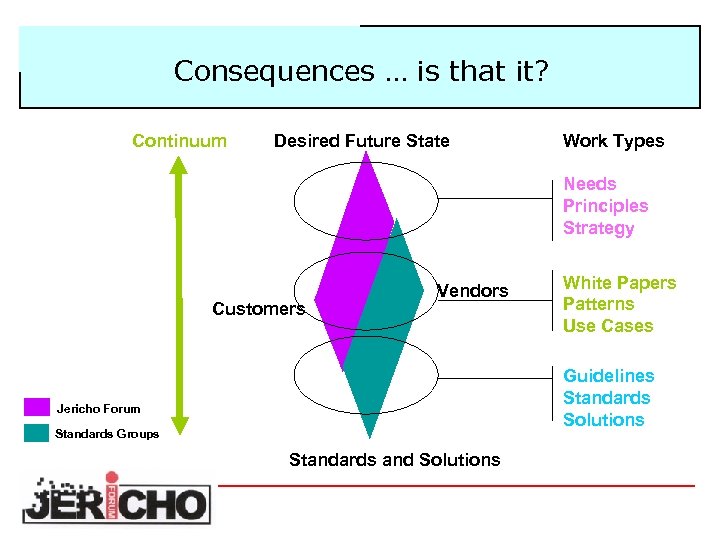
Consequences … is that it? Continuum Desired Future State Work Types Needs Principles Strategy Customers Vendors White Papers Patterns Use Cases Guidelines Standards Solutions Jericho Forum Standards Groups Standards and Solutions
Consequences…is that it? § We may formulate (a few) further Commandments … and refine what we have … based on – – Your feedback (greatly encouraged) Position papers (next level of detail) Taxonomy work Experience § Today’s roadmap session will discuss where we go from here What I have crossed out I didn't like. What I haven't crossed out I'm dissatisfied with. Cecil B. De. Mille 18811959
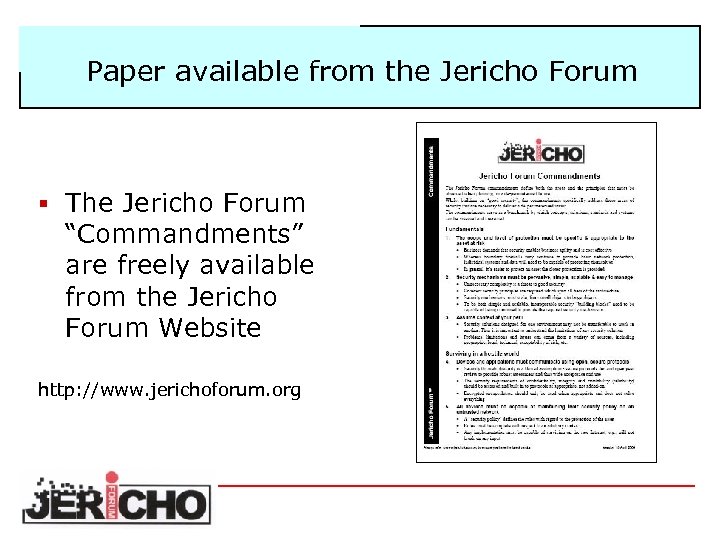
Paper available from the Jericho Forum § The Jericho Forum “Commandments” are freely available from the Jericho Forum Website http: //www. jerichoforum. org
§ Jericho Forum Papers § Steve Whitlock The Jericho Forum Board
Jericho Forum Papers § 2 -4 pages § Sections – Problem statement – Why do I care? – Recommendation / Solution – Background argument / rationale – Example
Published Papers § Commandments § Secure Protocols § Wireless § VOIP § Internet Filtering & Reporting § DRM § Endpoint Security § Architecture
Paper available from the Jericho Forum § The Jericho Forum “Commandments” are freely available from the Jericho Forum Website http: //www. jerichoforum. org
“Commandments” - Rationale § Jericho Forum in a nutshell: “Your security perimeters are disappearing: what are you going to do about it? ” § Need to express what / why / how to do it in high level terms (but allowing for detail) § Need to be able to draw distinctions between ‘good’ security (e. g. ‘principle of least privilege’) and ‘de-perimeterisation security’ (e. g. ‘end-to-end principle’)
Why should I care? § De-perimeterisation is a disruptive change § There is a huge variety of: – Starting points / business imperatives – Technology dependencies / evolution – Appetite for change / ability to mobilise – Extent of de-perimeterisation that makes business sense / ability to influence § So we need rules-of-thumb, not a ‘bible’ – “A benchmark by which concepts, solutions, standards and systems can be assessed and measured. ”
Paper available from the Jericho Forum § The Jericho Forum Position Paper “The need for Inherently Secure Protocols” is freely available from the Jericho Forum website http: //www. jerichoforum. org
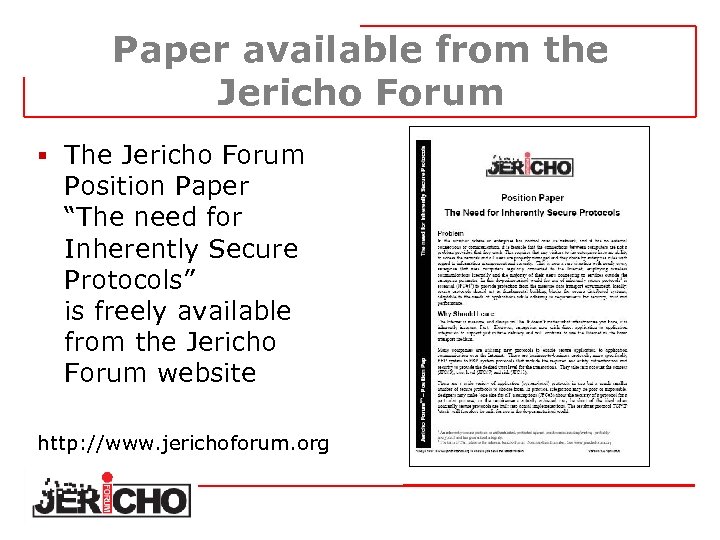
Problem § In the real world nearly every enterprise; – Uses computers regularly connected to the Internet; Web connections, E-mail, IM etc. – Employing wireless communications internally – The majority of their users connecting to services outside the enterprise perimeter § In this de-perimeterised world the use of inherently secure protocols is essential to provide protection from the insecure data transport environment.
Why should I care? § The Internet is insecure, and always will be § It doesn’t matter what infrastructure you have, it is inherently insecure § However, enterprises now wish; – Direct application to application integration – To support just-in-time delivery – To continue to use the Internet as the basic transport medium. § Secure protocols should act as fundamental building blocks for secure distributed systems – Adaptable to the needs of applications – While adhering to requirements for security, trust and performance.
Protocol Security & Attributes § Protocols used should have the appropriate level of data security, and authentication § The use of a protective security wrapper (or shell) around an application protocol may be applicable; § However the use of an encrypted tunnel negates most inspection and protection and should be avoided in the long term.
Secure “out of the box” § An inherently secure protocol is; – Authenticated – Protected against unauthorised reading/writing – Has guaranteed integrity § For inherently secure protocols to be adopted then it is essential that; – Systems start being delivered preferably only supporting inherently secure protocols; or – With the inherently secure protocols as the default option
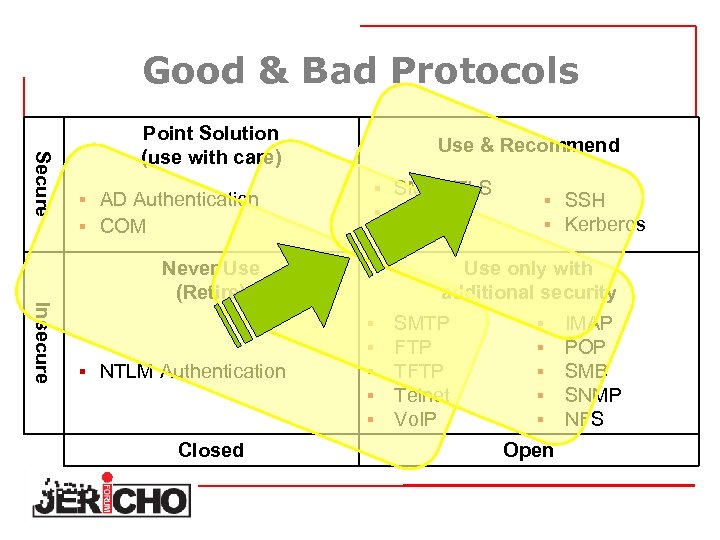
Good & Bad Protocols Secure Point Solution (use with care) § AD Authentication § COM Use & Recommend § SMTP/TLS § AS 2 § HTTPS Insecure Never Use (Retire) § NTLM Authentication Closed § SSH § Kerberos Use only with additional security § § § SMTP FTP Telnet Vo. IP § § § Open IMAP POP SMB SNMP NFS
Paper available from the Jericho Forum § The Jericho Forum Position Paper “Wireless in a deperimeterised world” is freely available from the Jericho Forum website http: //www. jerichoforum. org
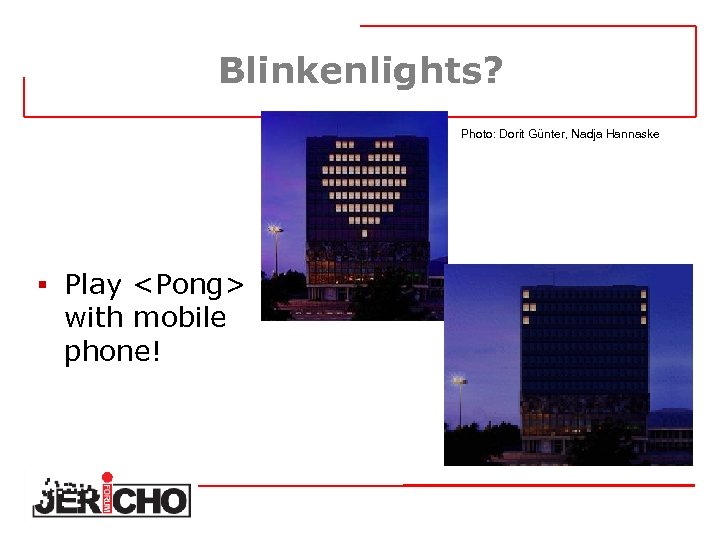
Blinkenlights? Photo: Dorit Günter, Nadja Hannaske § Play <Pong> with mobile phone!
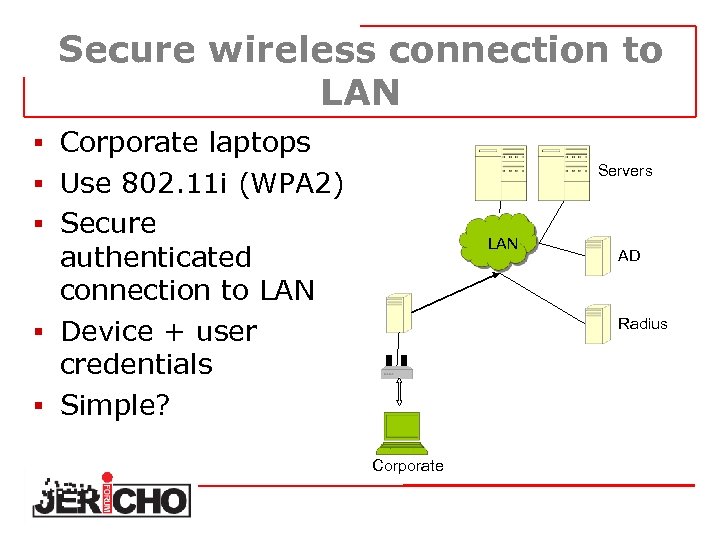
Secure wireless connection to LAN § Corporate laptops Servers § Use 802. 11 i (WPA 2) § Secure LAN authenticated connection to LAN § Device + user credentials § Simple? AD Radius Corporate
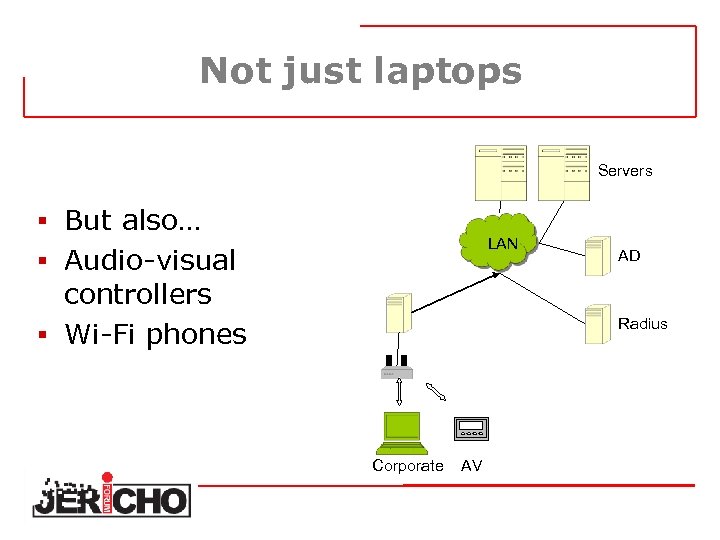
Not just laptops Servers § But also… LAN § Audio-visual controllers § Wi-Fi phones AD Radius Corporate AV
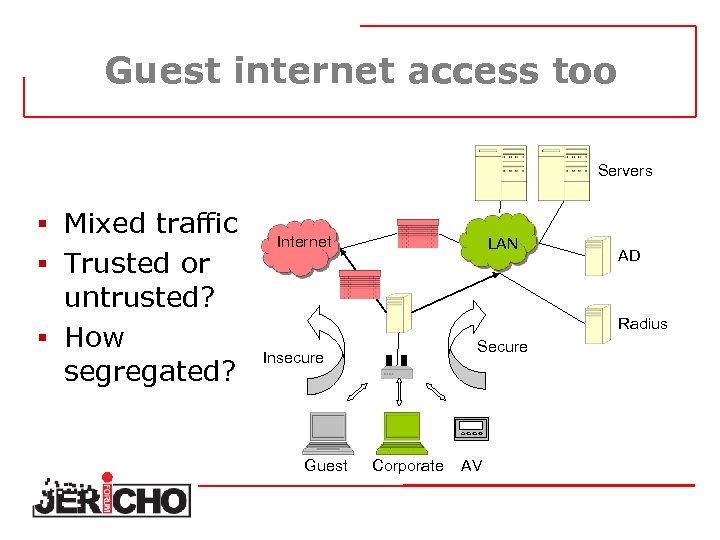
Guest internet access too Servers § Mixed traffic § Trusted or untrusted? § How segregated? Internet LAN AD Radius Secure Insecure Guest Corporate AV
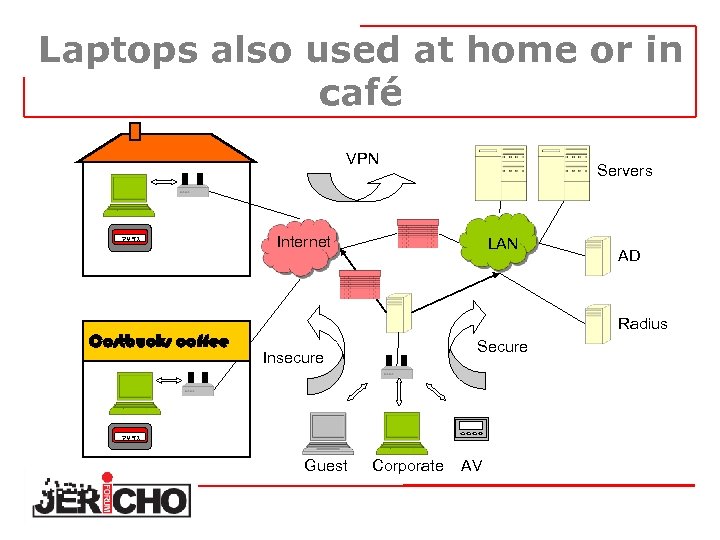
Laptops also used at home or in café VPN 7491 Costbucks coffee Servers Internet LAN AD Radius Secure Insecure 7491 Guest Corporate AV
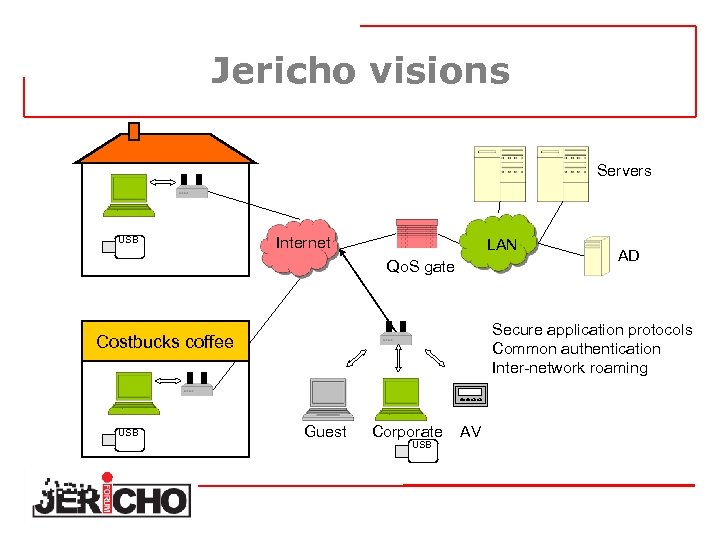
Jericho visions Servers USB Internet LAN Qo. S gate Secure application protocols Common authentication Inter-network roaming Costbucks coffee USB AD Guest Corporate USB AV
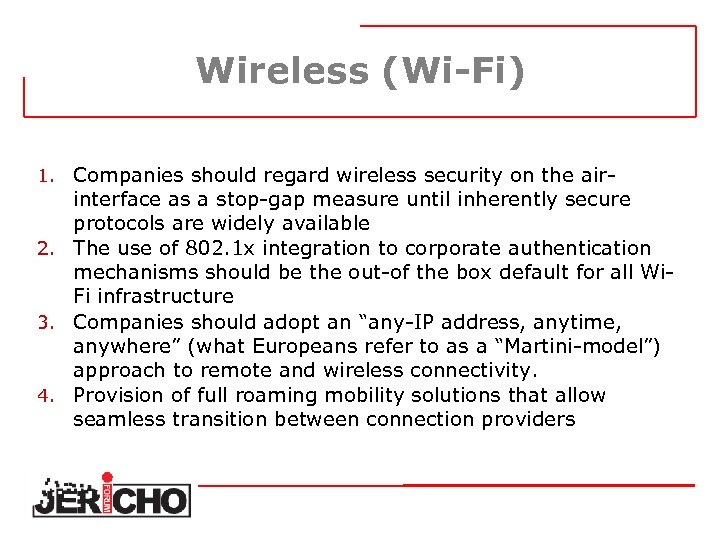
Wireless (Wi-Fi) 1. Companies should regard wireless security on the air- interface as a stop-gap measure until inherently secure protocols are widely available 2. The use of 802. 1 x integration to corporate authentication mechanisms should be the out-of the box default for all Wi. Fi infrastructure 3. Companies should adopt an “any-IP address, anytime, anywhere” (what Europeans refer to as a “Martini-model”) approach to remote and wireless connectivity. 4. Provision of full roaming mobility solutions that allow seamless transition between connection providers
Paper available from the Jericho Forum § The Jericho Forum Position Paper “Vo. IP in a deperimeterised world” is freely available from the Jericho Forum website http: //www. jerichoforum. org
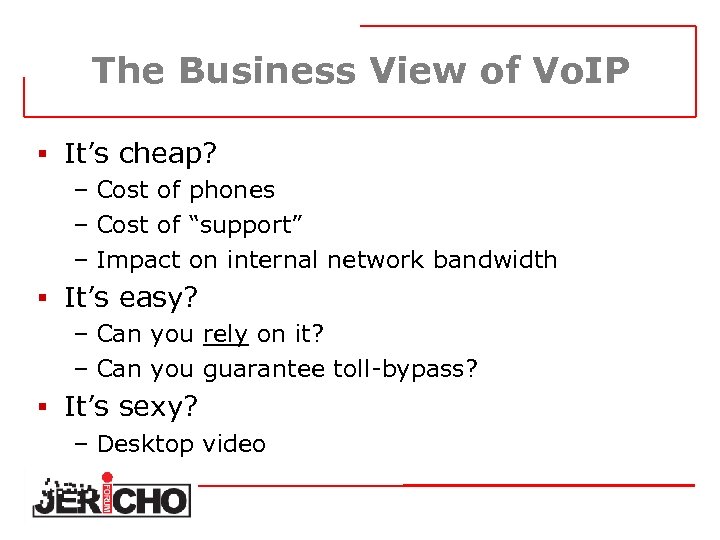
The Business View of Vo. IP § It’s cheap? – Cost of phones – Cost of “support” – Impact on internal network bandwidth § It’s easy? – Can you rely on it? – Can you guarantee toll-bypass? § It’s sexy? – Desktop video
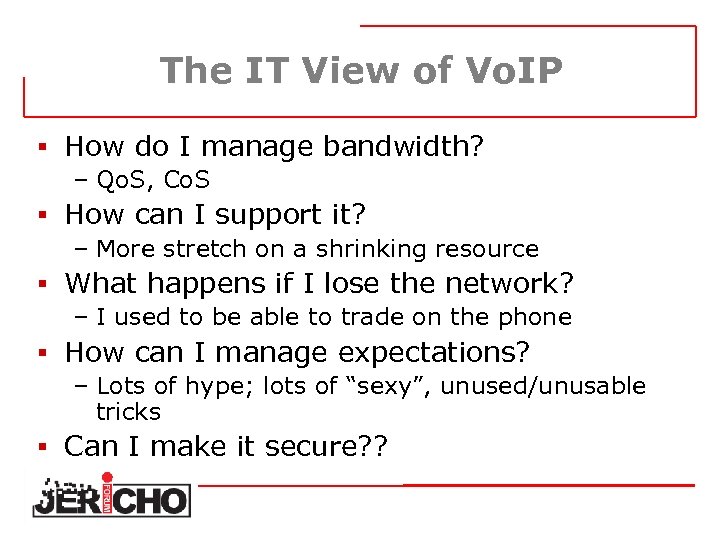
The IT View of Vo. IP § How do I manage bandwidth? – Qo. S, Co. S § How can I support it? – More stretch on a shrinking resource § What happens if I lose the network? – I used to be able to trade on the phone § How can I manage expectations? – Lots of hype; lots of “sexy”, unused/unusable tricks § Can I make it secure? ?
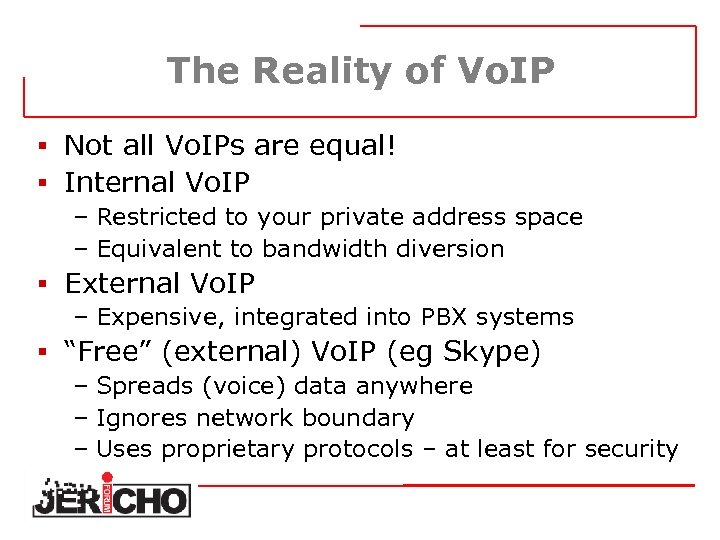
The Reality of Vo. IP § Not all Vo. IPs are equal! § Internal Vo. IP – Restricted to your private address space – Equivalent to bandwidth diversion § External Vo. IP – Expensive, integrated into PBX systems § “Free” (external) Vo. IP (eg Skype) – Spreads (voice) data anywhere – Ignores network boundary – Uses proprietary protocols – at least for security
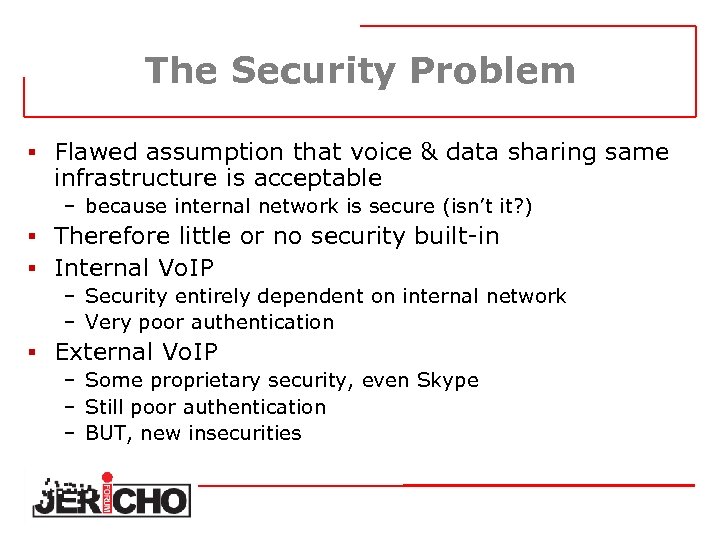
The Security Problem § Flawed assumption that voice & data sharing same infrastructure is acceptable – because internal network is secure (isn’t it? ) § Therefore little or no security built-in § Internal Vo. IP – Security entirely dependent on internal network – Very poor authentication § External Vo. IP – Some proprietary security, even Skype – Still poor authentication – BUT, new insecurities
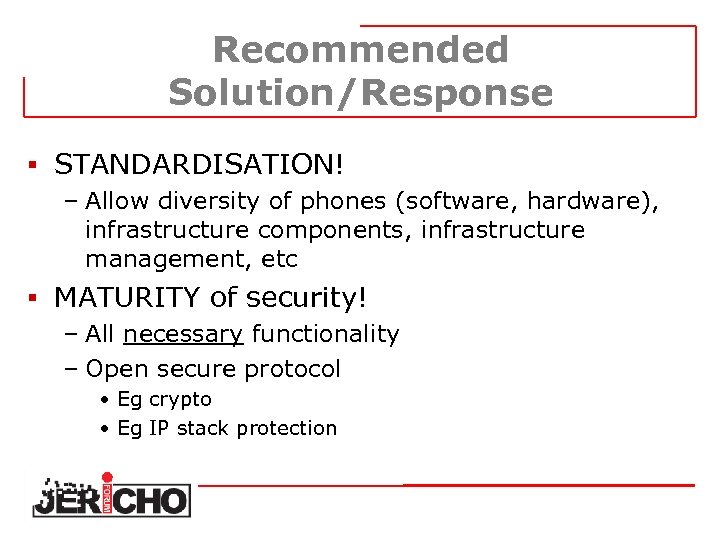
Recommended Solution/Response § STANDARDISATION! – Allow diversity of phones (software, hardware), infrastructure components, infrastructure management, etc § MATURITY of security! – All necessary functionality – Open secure protocol • Eg crypto • Eg IP stack protection
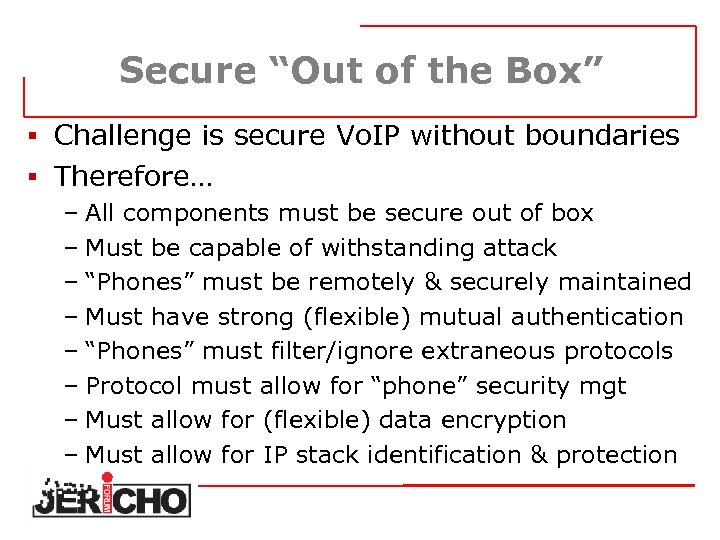
Secure “Out of the Box” § Challenge is secure Vo. IP without boundaries § Therefore… – All components must be secure out of box – Must be capable of withstanding attack – “Phones” must be remotely & securely maintained – Must have strong (flexible) mutual authentication – “Phones” must filter/ignore extraneous protocols – Protocol must allow for “phone” security mgt – Must allow for (flexible) data encryption – Must allow for IP stack identification & protection
Challenges to the industry 1. If inherently secure Vo. IP protocols are to become adopted 2. 3. 4. 5. 6. as standards then they must be open and interoperable The Jericho Forum believes that companies should pledge support for moving from proprietary Vo. IP protocols to fully open, royalty free, and documented standards The secure Vo. IP protocol should be released under a suitable open source or GPL arrangement. The Jericho Forum hopes that all companies will review its products and the protocols and move swiftly to replacing the use of inherently secure Vo. IP protocols. End users should demand that Vo. IP protocols should be inherently secure End users should demand that Vo. IP protocols used should be fully open
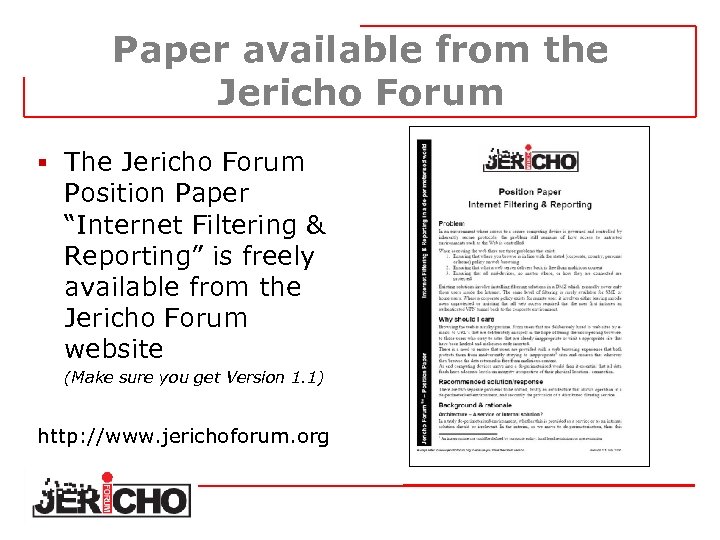
Paper available from the Jericho Forum § The Jericho Forum Position Paper “Internet Filtering & Reporting” is freely available from the Jericho Forum website (Make sure you get Version 1. 1) http: //www. jerichoforum. org
Web Access – The Issues § Single Corporate Access Policy – Regardless of location – Regardless of connectivity method – With multiple egress methods § Need to protect all web access from malicious content – Mobile users especially at risk
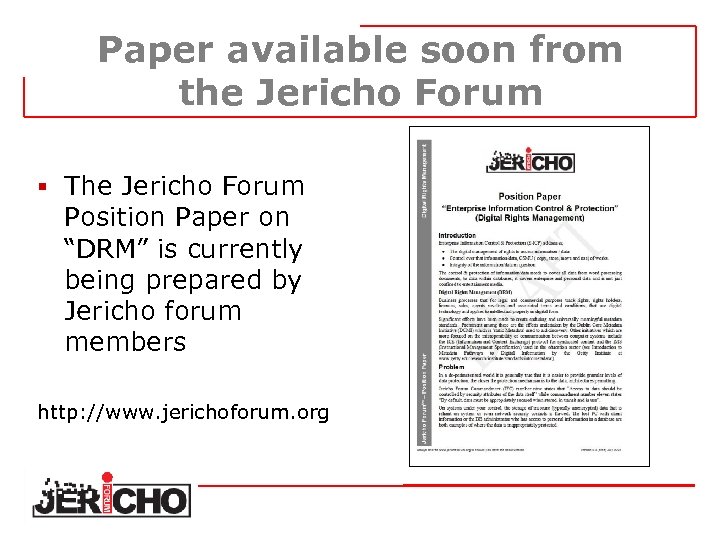
Paper available soon from the Jericho Forum § The Jericho Forum Position Paper on “DRM” is currently being prepared by Jericho forum members http: //www. jerichoforum. org
Data Control & Protection Digital Rights Management has historically focused exclusively on copy protection of entertainment content. § ‘Enterprise’ DRM as an extension of PKI technology now generally available as point solutions. § – Microsoft, Adobe etc. – Copy ‘protection’, non-repudiation, strong authentication & authorisation. – ‘Labelling’ is a traditional computer security preoccupation. § Business problems to solve need articulating. – The wider problem is enforcement of agreements, undertakings and contracts; implies data plus associated ‘intelligence’ should be bound together. § Almost complete absence of standards. – Protocols, APIs
Paper available soon from the Jericho Forum § The Jericho Forum Position Paper on “End Point Security” is currently being prepared by Jericho forum members http: //www. jerichoforum. org
End Point Security § NAC generally relies on a connection – Protocols do not make a connection in the same way as a device § Trust is variable – Trust has a temporal component – Trust has a user integrity (& integrity strength) – Trust has a system integrity § Two approaches; – Truly secure sandbox (system mistrust) – System integrity checking
End Point Security § Standard are required so that agents placed on devices can interoperate, and a device only requires a single agent. – This allows agents to expand onto a wide variety of devices such as phones, PDA’s, network devices and all PC’s not just Win. Tel PC’s. § Standards are required for bi-directionally secure sandboxes. – This probably is a good subject for academic study. § Collaboration is required to develop a secure protocol such that agents can securely be validated by the system with which it is trying to communicate.
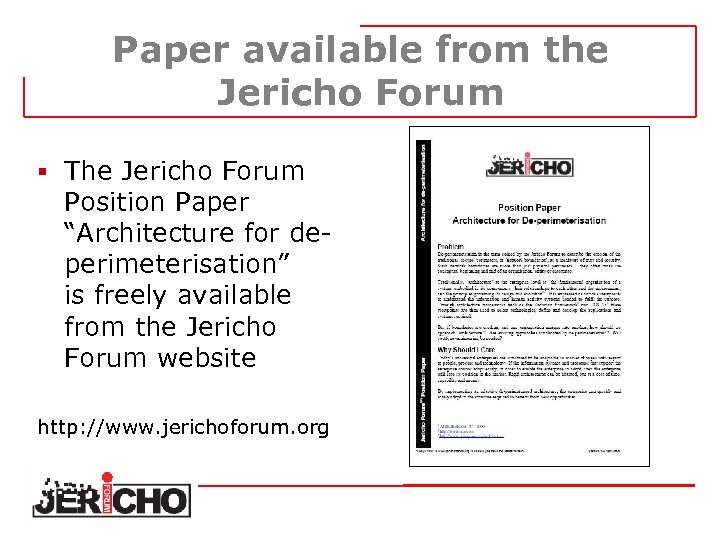
Paper available from the Jericho Forum § The Jericho Forum Position Paper “Architecture for deperimeterisation” is freely available from the Jericho Forum website http: //www. jerichoforum. org
Architectural Security Drivers § Insiders § Outsiders inside § Port 80 and Mail traffic get in anyway § Hibernating or ‘rogue’ devices § Firewall rule chaos § VOIP & P 2 P § Stealth attackers § Black list vs. white list § False sense of security
Architecture Extrapolations § Enterprise-scale systems architecture is inherently domainoriented and perimeterised (despite web and extranet). – – § § Client-server and multi-tier. Service-oriented architecture -> web services. Layer structure optimises for traditional applications Portals are an attempt to hide legacy dependencies. Collaboration and trading increasingly peer-to-peer. Even fundamental applications no longer tied to the bounded ‘enterprise’: – Ubiquitous computing, agent-based algorithms, RFID and smart molecules point to a mobile, cross-domain future. – Grid computing exemplifies an unfulfilled P 2 P vision, encumbered by the perimeter. – See Architecture paper.
Future Position Papers There are position papers in progress on; § Trust & transitivity § Encryption & Encapsulation § Federated Identity § Regulation, Compliance & Certification § Network Security & Qo. S § Audit & Management in a distributed environment § Data/Information Management

Shaping security for tomorrow’s world www. jerichoforum. org
What Hath Vint Wrought: Responding to the Unintended Consequences of Globalization Steve Whitlock Chief Security Architect Information Protection & Assurance The Boeing Company BOEING is a trademark of Boeing Management Company. Copyright © 2005 Boeing. All rights reserved.
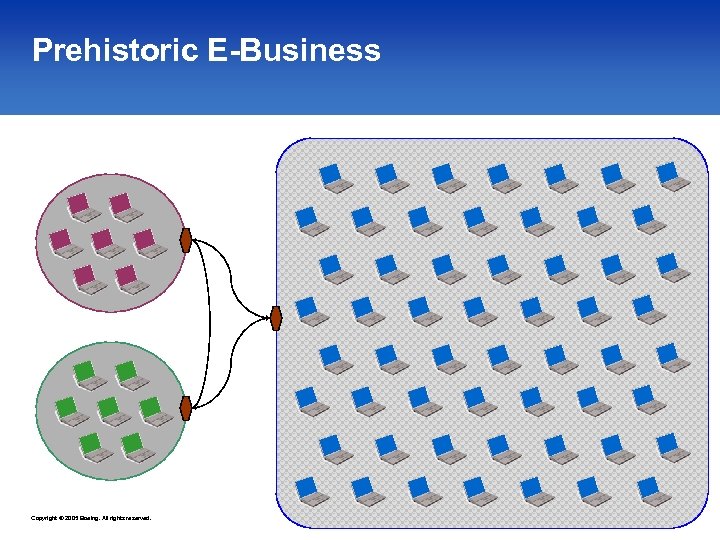
Prehistoric E-Business Copyright © 2005 Boeing. All rights reserved.
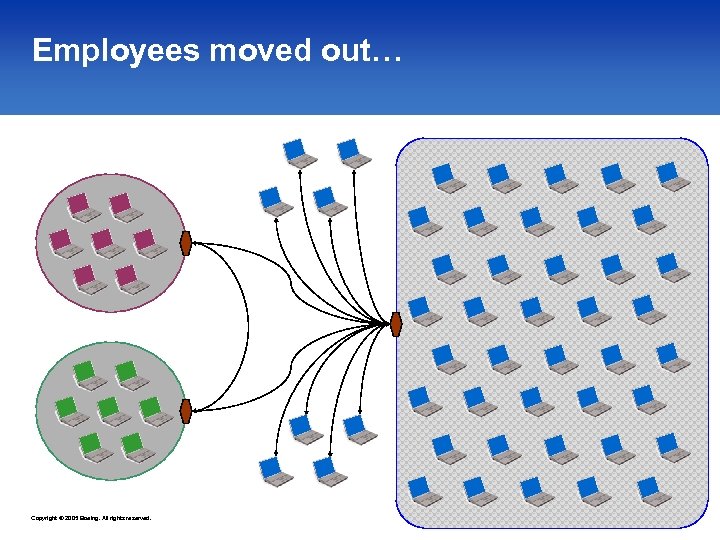
Employees moved out… Copyright © 2005 Boeing. All rights reserved.
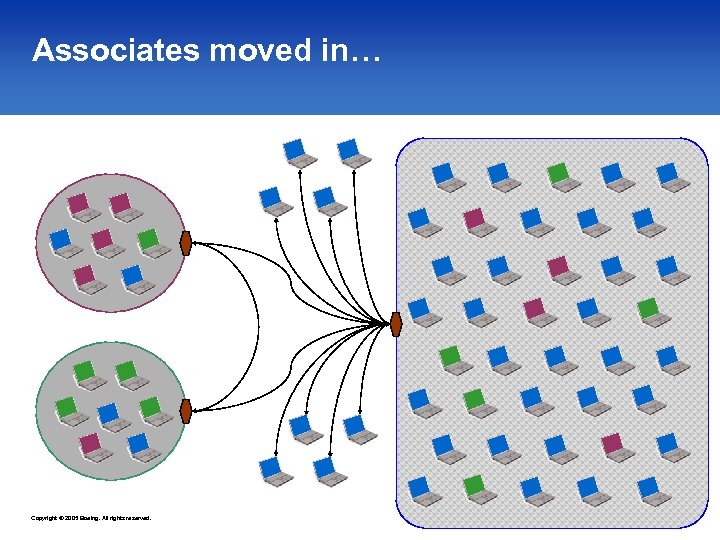
Associates moved in… Copyright © 2005 Boeing. All rights reserved.
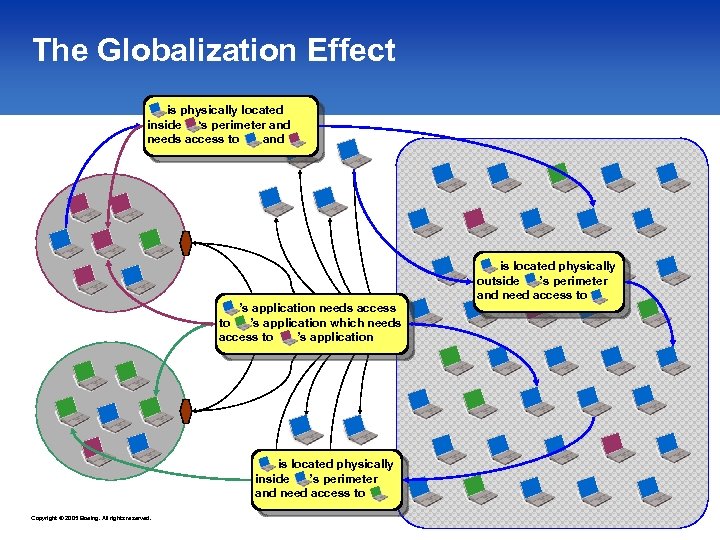
The Globalization Effect is physically located inside ‘s perimeter and needs access to and ’s application needs access to ’s application which needs access to ’s application is located physically inside ’s perimeter and need access to Copyright © 2005 Boeing. All rights reserved. is located physically outside ’s perimeter and need access to
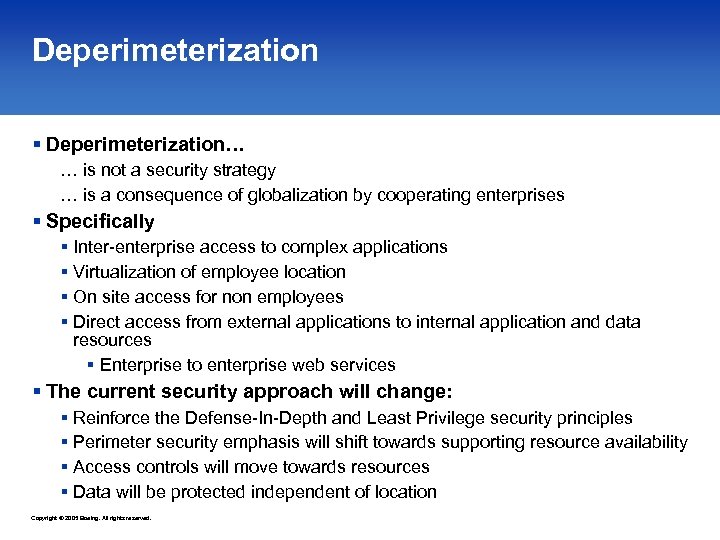
Deperimeterization § Deperimeterization… … is not a security strategy … is a consequence of globalization by cooperating enterprises § Specifically § Inter-enterprise access to complex applications § Virtualization of employee location § On site access for non employees § Direct access from external applications to internal application and data resources § Enterprise to enterprise web services § The current security approach will change: § Reinforce the Defense-In-Depth and Least Privilege security principles § Perimeter security emphasis will shift towards supporting resource availability § Access controls will move towards resources § Data will be protected independent of location Copyright © 2005 Boeing. All rights reserved.
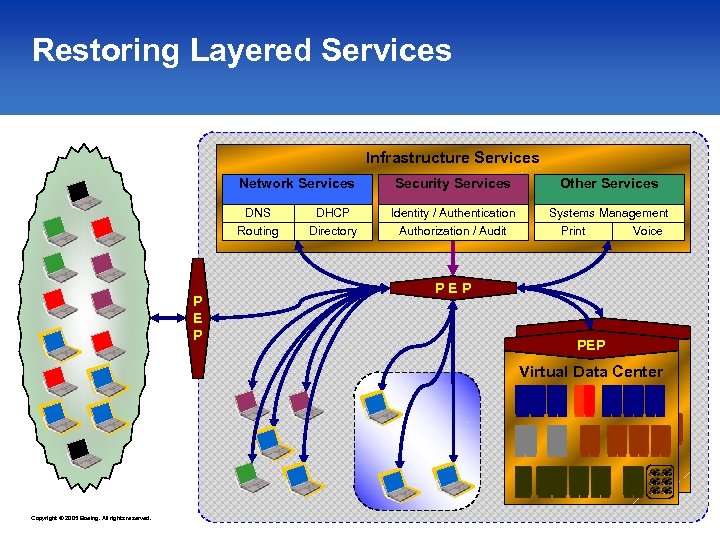
Restoring Layered Services Infrastructure Services Network Services DNS Routing P E P DHCP Directory Security Services Other Services Identity / Authentication Authorization / Audit Systems Management Print Voice PEP Virtual Data Center Copyright © 2005 Boeing. All rights reserved.
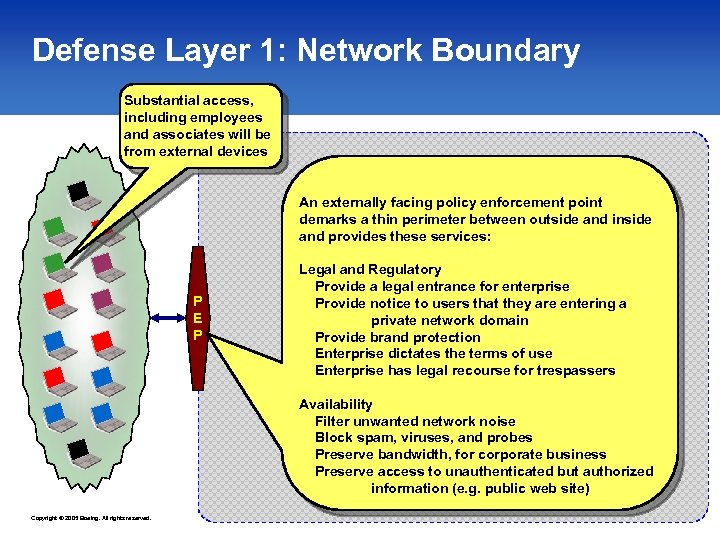
Defense Layer 1: Network Boundary Substantial access, including employees and associates will be from external devices An externally facing policy enforcement point demarks a thin perimeter between outside and inside and provides these services: P E P Legal and Regulatory Provide a legal entrance for enterprise Provide notice to users that they are entering a private network domain Provide brand protection Enterprise dictates the terms of use Enterprise has legal recourse for trespassers Availability Filter unwanted network noise Block spam, viruses, and probes Preserve bandwidth, for corporate business Preserve access to unauthenticated but authorized information (e. g. public web site) Copyright © 2005 Boeing. All rights reserved.
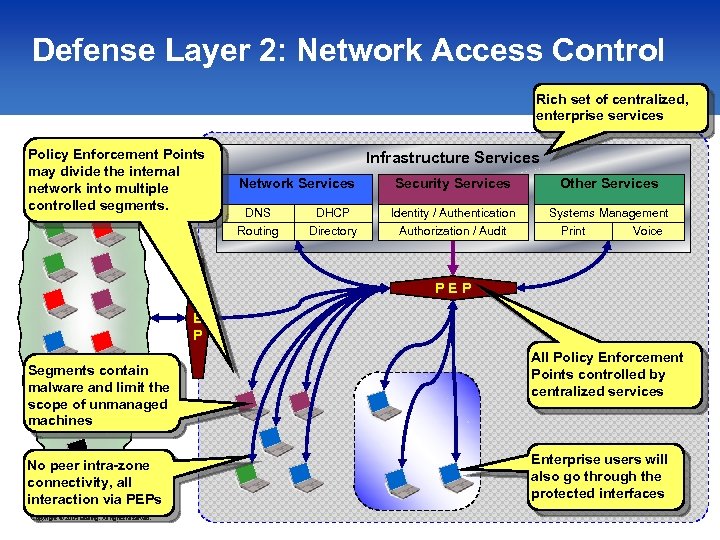
Defense Layer 2: Network Access Control Rich set of centralized, enterprise services Policy Enforcement Points may divide the internal network into multiple controlled segments. P E P Segments contain malware and limit the scope of unmanaged machines No peer intra-zone connectivity, all interaction via PEPs Copyright © 2005 Boeing. All rights reserved. Infrastructure Services Network Services DNS Routing DHCP Directory Security Services Other Services Identity / Authentication Authorization / Audit Systems Management Print Voice PEP All Policy Enforcement Points controlled by centralized services Enterprise users will also go through the protected interfaces
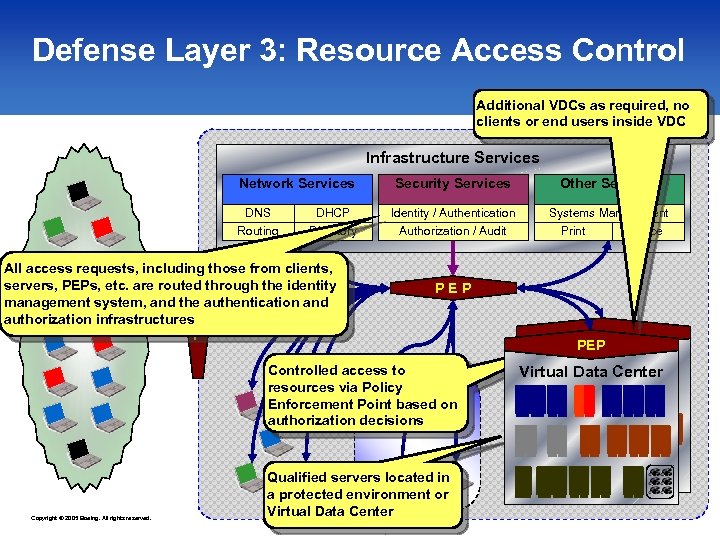
Defense Layer 3: Resource Access Control Additional VDCs as required, no clients or end users inside VDC Infrastructure Services Network Services DNS Routing DHCP Directory All access requests, including those from clients, servers, PEPs, etc. are routed through the identity P management system, and the authentication and authorization infrastructures. E P Security Services Other Services Identity / Authentication Authorization / Audit Systems Management Print Voice PEP Controlled access to resources via Policy Enforcement Point based on authorization decisions Copyright © 2005 Boeing. All rights reserved. Qualified servers located in a protected environment or Virtual Data Center PEP Virtual Data Center
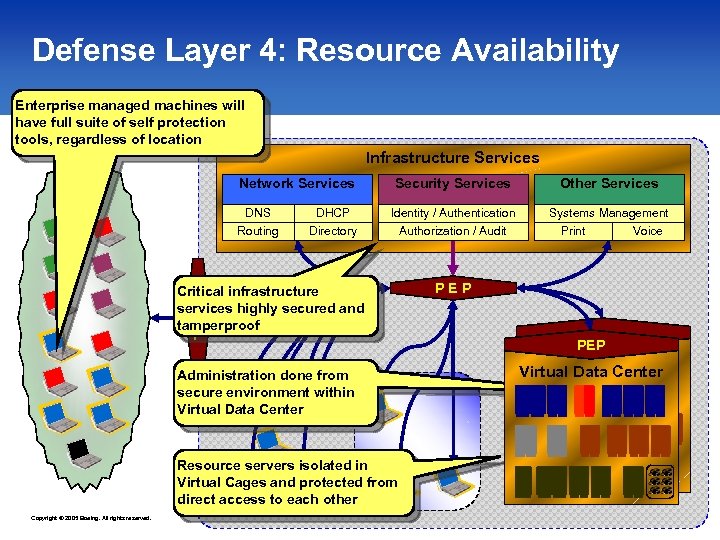
Defense Layer 4: Resource Availability Enterprise managed machines will have full suite of self protection tools, regardless of location Infrastructure Services Network Services DNS Routing DHCP Directory Security Services Other Services Identity / Authentication Authorization / Audit Systems Management Print Voice Critical infrastructure P services highly secured and E tamperproof P Administration done from secure environment within Virtual Data Center Resource servers isolated in Virtual Cages and protected from direct access to each other Copyright © 2005 Boeing. All rights reserved. PEP Virtual Data Center
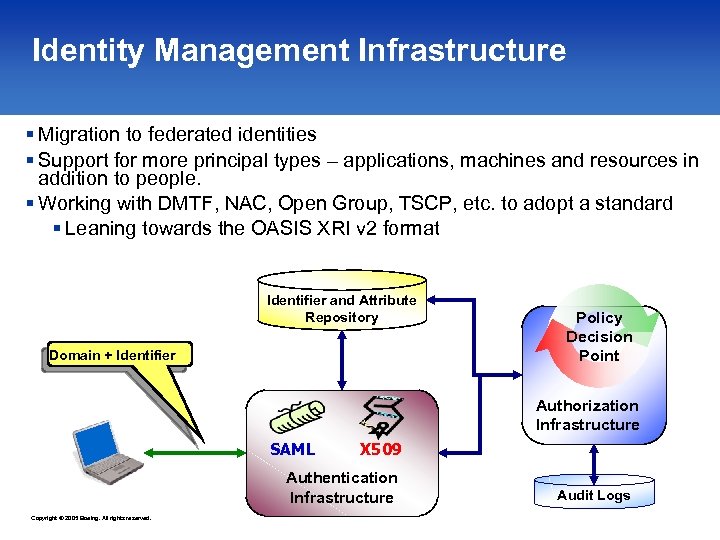
Identity Management Infrastructure § Migration to federated identities § Support for more principal types – applications, machines and resources in addition to people. § Working with DMTF, NAC, Open Group, TSCP, etc. to adopt a standard § Leaning towards the OASIS XRI v 2 format Identifier and Attribute Repository Domain + Identifier Policy Decision Point Authorization Infrastructure SAML X 509 Authentication Infrastructure Copyright © 2005 Boeing. All rights reserved. Audit Logs
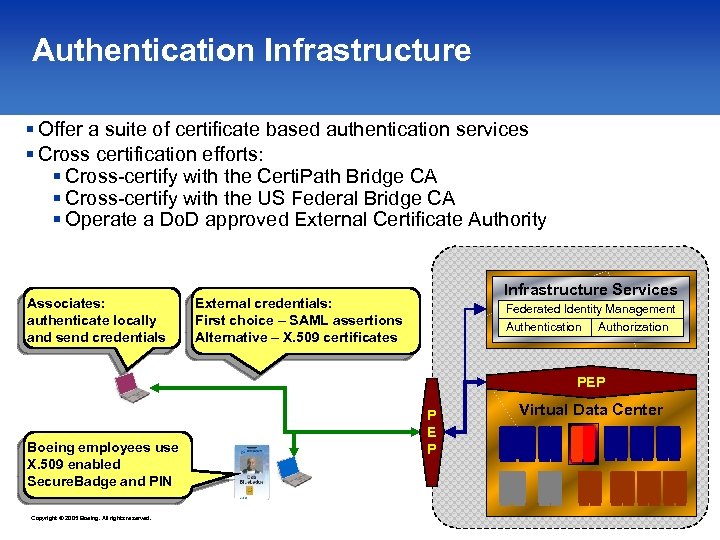
Authentication Infrastructure § Offer a suite of certificate based authentication services § Cross certification efforts: § Cross-certify with the Certi. Path Bridge CA § Cross-certify with the US Federal Bridge CA § Operate a Do. D approved External Certificate Authority Associates: authenticate locally and send credentials Infrastructure Services External credentials: First choice – SAML assertions Alternative – X. 509 certificates Federated Identity Management Authentication Authorization PEP Boeing employees use X. 509 enabled Secure. Badge and PIN Copyright © 2005 Boeing. All rights reserved. P E P Virtual Data Center
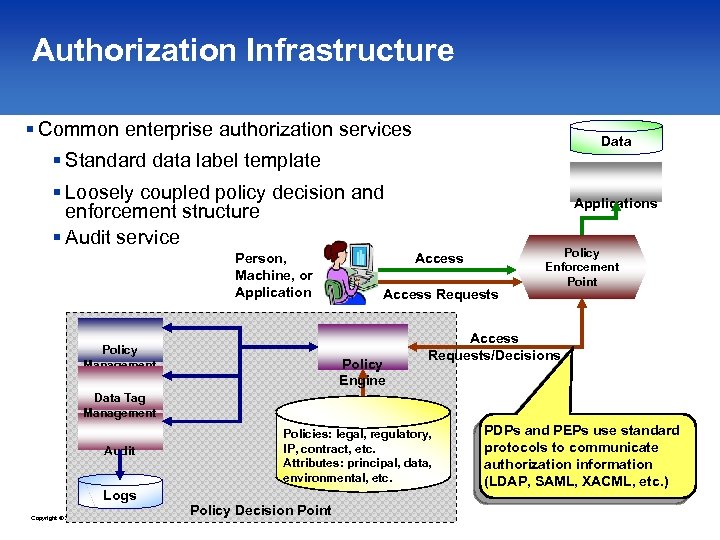
Authorization Infrastructure § Common enterprise authorization services Data § Standard data label template § Loosely coupled policy decision and enforcement structure § Audit service Person, Machine, or Application Policy Management Applications Access Requests Policy Engine Policy Enforcement Point Access Requests/Decisions Data Tag Management Audit Policies: legal, regulatory, IP, contract, etc. Attributes: principal, data, environmental, etc. Logs Copyright © 2005 Boeing. All rights reserved. Policy Decision Point PDPs and PEPs use standard protocols to communicate authorization information (LDAP, SAML, XACML, etc. )
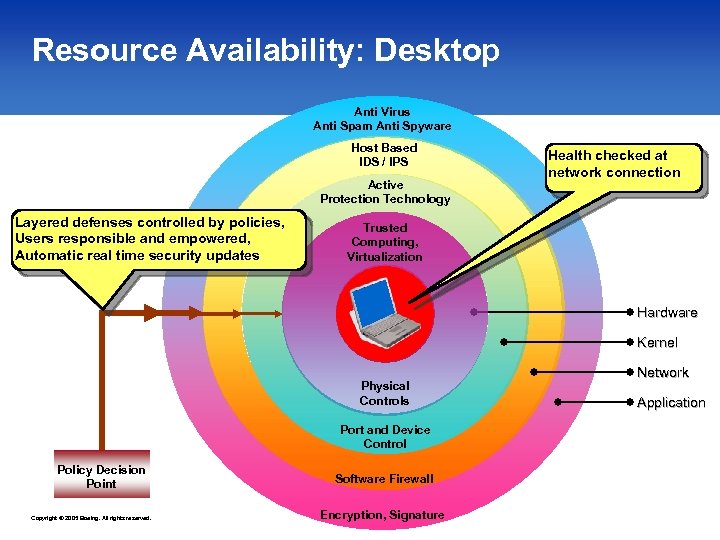
Resource Availability: Desktop Anti Virus Anti Spam Anti Spyware Host Based IDS / IPS Active Protection Technology Layered defenses controlled by policies, Users responsible and empowered, Automatic real time security updates Health checked at network connection Trusted Computing, Virtualization Hardware Kernel Physical Controls Port and Device Control Policy Decision Point Copyright © 2005 Boeing. All rights reserved. Software Firewall Encryption, Signature Network Application
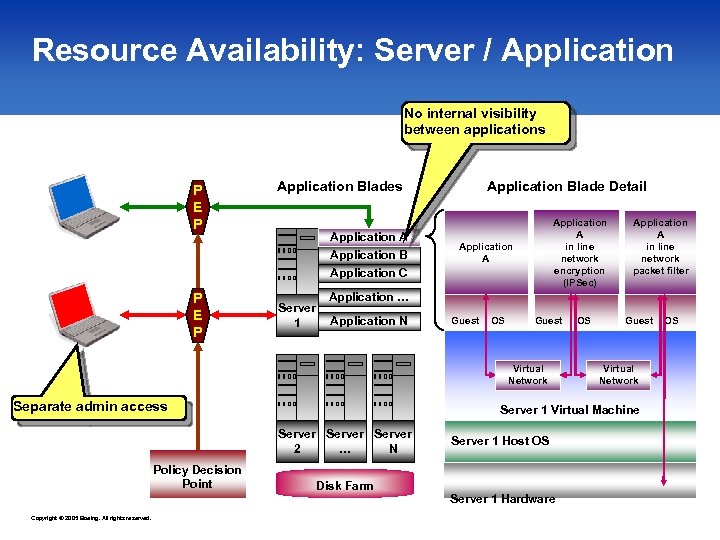
Resource Availability: Server / Application No internal visibility between applications P E P Application Blades Application A Application B Application C P E P Server 1 Application Blade Detail Application In line A network in line encryption network (IPSec) encryption (IPSec) Application A Application … Application N Guest OS Guest Virtual Network Separate admin access Copyright © 2005 Boeing. All rights reserved. OS Guest Virtual Network Server 1 Virtual Machine Server 2 … N Policy Decision Point Application A in line network packet filter Disk Farm Server 1 Host OS Server 1 Hardware OS
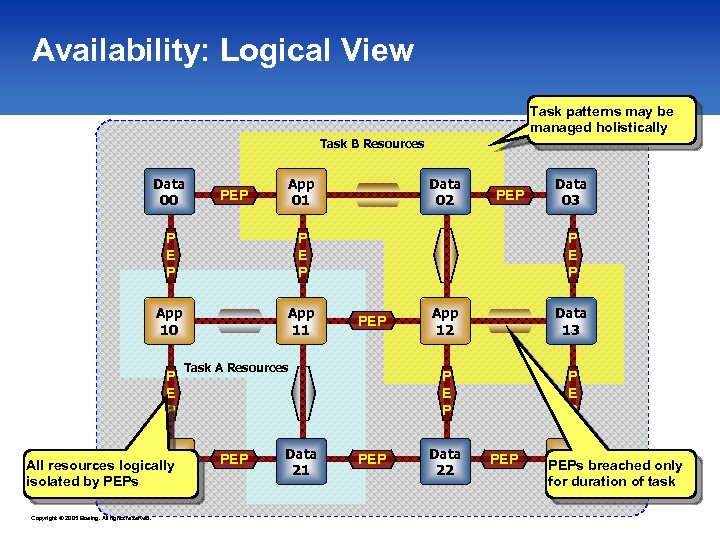
Availability: Logical View Task patterns may be managed holistically Task B Resources Data 00 PEP App 01 P E P App 11 P E P App All resources logically 20 isolated by PEPs Copyright © 2005 Boeing. All rights reserved. PEP P E P App 10 Data 02 P E P Data 21 PEP App 12 Data 13 P E P PEP Task A Resources PEP Data 03 P E P Data 22 PEP App PEPs breached only 23 for duration of task
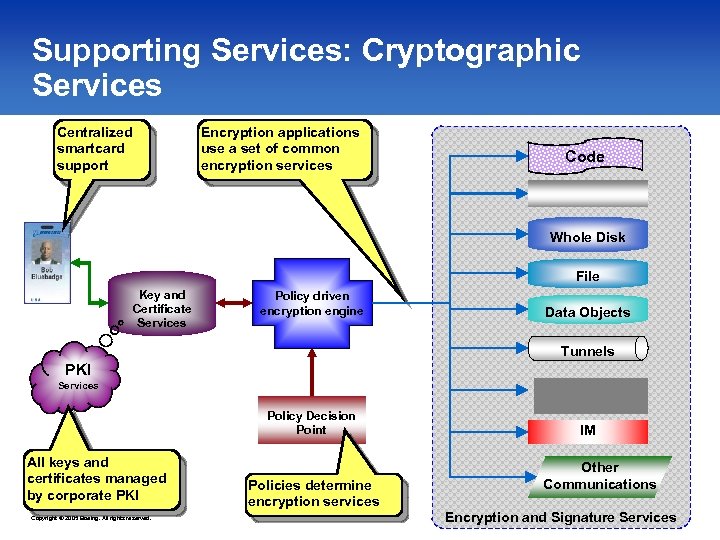
Supporting Services: Cryptographic Services Centralized smartcard support Encryption applications use a set of common encryption services Code Applications Whole Disk File Key and Certificate Services Policy driven encryption engine Data Objects Tunnels PKI Services Policy Decision Point All keys and certificates managed by corporate PKI Copyright © 2005 Boeing. All rights reserved. Policies determine encryption services IM Other Communications Encryption and Signature Services
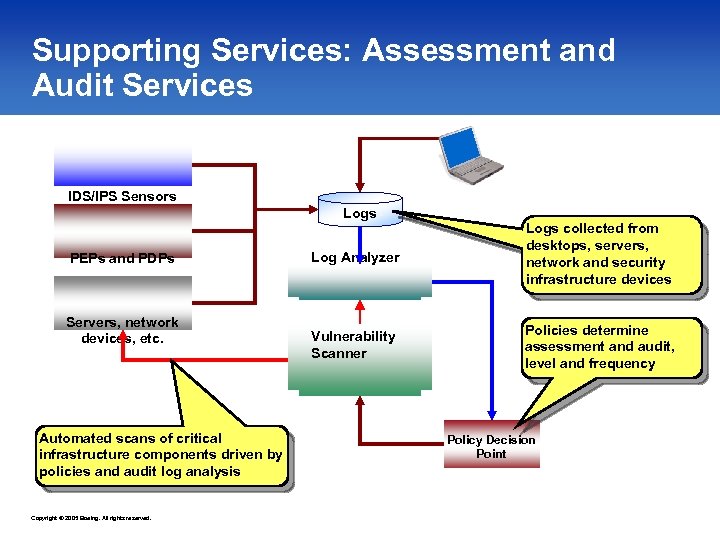
Supporting Services: Assessment and Audit Services IDS/IPS Sensors Logs PEPs and PDPs Servers, network devices, etc. Automated scans of critical infrastructure components driven by policies and audit log analysis Copyright © 2005 Boeing. All rights reserved. Log Analyzer Logs collected from desktops, servers, network and security infrastructure devices Vulnerability Scanner Policies determine assessment and audit, level and frequency Policy Decision Point
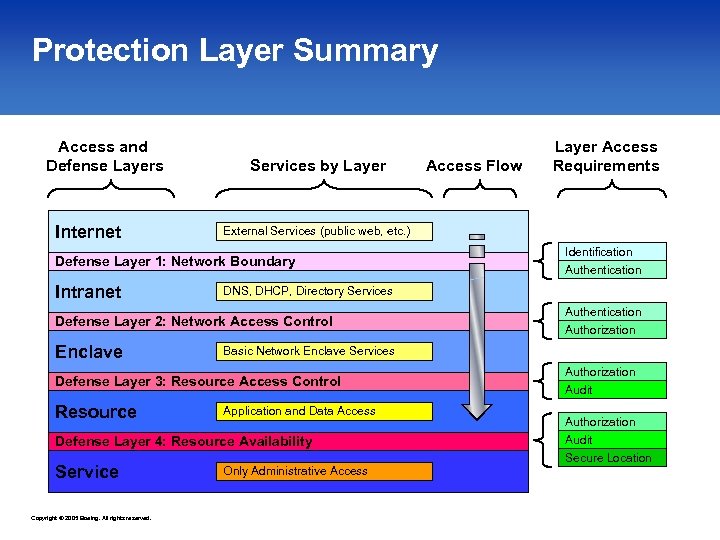
Protection Layer Summary Access and Defense Layers Internet Services by Layer External Services (public web, etc. ) Defense Layer 1: Network Boundary Intranet Application and Data Access Defense Layer 4: Resource Availability Service Copyright © 2005 Boeing. All rights reserved. Authentication Authorization Basic Network Enclave Services Defense Layer 3: Resource Access Control Resource Identification Authentication DNS, DHCP, Directory Services Defense Layer 2: Network Access Control Enclave Access Flow Layer Access Requirements Only Administrative Access Authorization Audit Secure Location

Copyright © 2005 Boeing. All rights reserved.
Prepare for the future § The De-perimerterised Road Warrior, Road-mapping & next steps § Jeremy Hilton Cardiff University
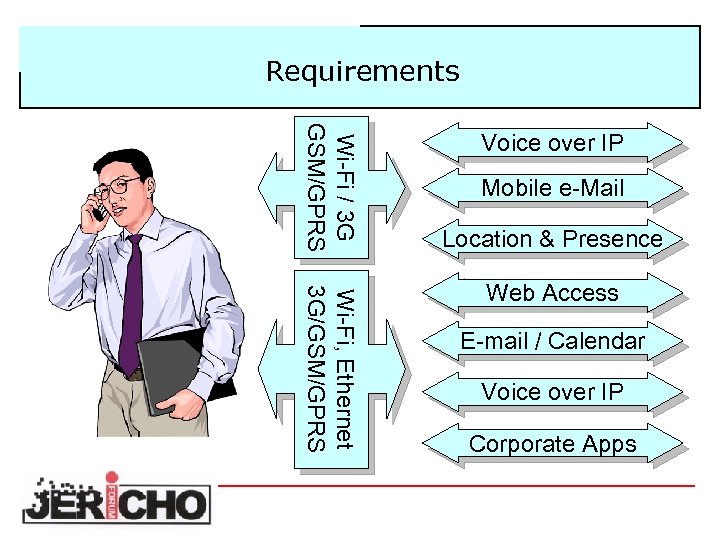
Requirements Wi-Fi / 3 G GSM/GPRS Voice over IP Mobile e-Mail Location & Presence Wi-Fi, Ethernet 3 G/GSM/GPRS Web Access E-mail / Calendar Voice over IP Corporate Apps
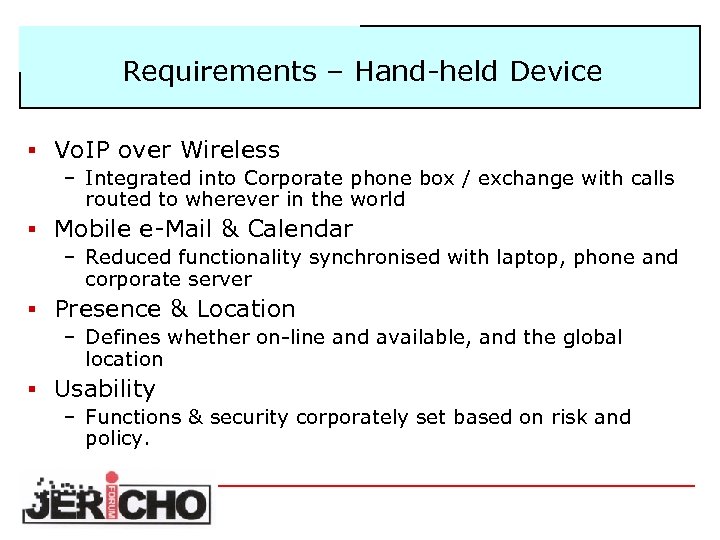
Requirements – Hand-held Device § Vo. IP over Wireless – Integrated into Corporate phone box / exchange with calls routed to wherever in the world § Mobile e-Mail & Calendar – Reduced functionality synchronised with laptop, phone and corporate server § Presence & Location – Defines whether on-line and available, and the global location § Usability – Functions & security corporately set based on risk and policy.
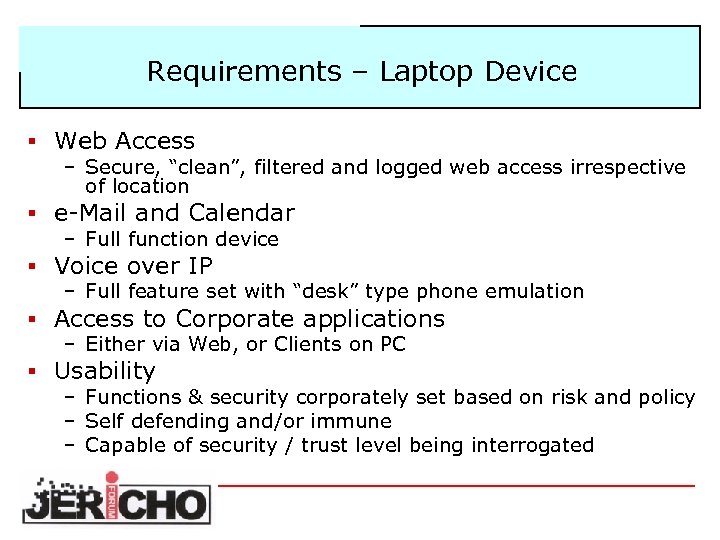
Requirements – Laptop Device § Web Access – Secure, “clean”, filtered and logged web access irrespective of location § e-Mail and Calendar – Full function device § Voice over IP – Full feature set with “desk” type phone emulation § Access to Corporate applications – Either via Web, or Clients on PC § Usability – Functions & security corporately set based on risk and policy – Self defending and/or immune – Capable of security / trust level being interrogated
An inherently secure system § When the only protocols that the system can communicate with are inherently secure; – The system can “black-hole” all other protocols – The system does not need a personal firewall – The system is less prone to malicious code – Operating system patches become less urgent
An inherently secure corporation § When a corporate retains a WAN for Qo. S purposes; – WAN routers only accept inherently secure protocols – The WAN automatically “black-holes” all other protocols – Every site can have an Internet connection as well as a WAN connection for backup – Non-WAN traffic automatically routes to the Internet – The corporate “touchpoints” now extend to every site thus reducing the possibility for DOS or DDOS attack.
Roadmap We want a story that starts out with an earthquake and works its way up to a climax. Samuel Goldwyn 18821974
Two Ways to Look Ahead § Solution/System Roadmaps (both vendor and customer) § Security Themes from the Commandments – Hostile World – Trust and Identity – Architecture – Data protection
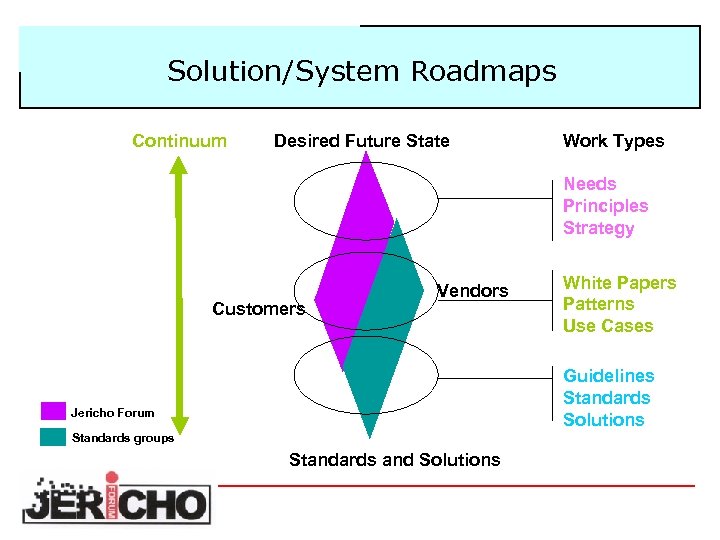
Solution/System Roadmaps Continuum Desired Future State Work Types Needs Principles Strategy Customers Vendors White Papers Patterns Use Cases Guidelines Standards Solutions Jericho Forum Standards groups Standards and Solutions
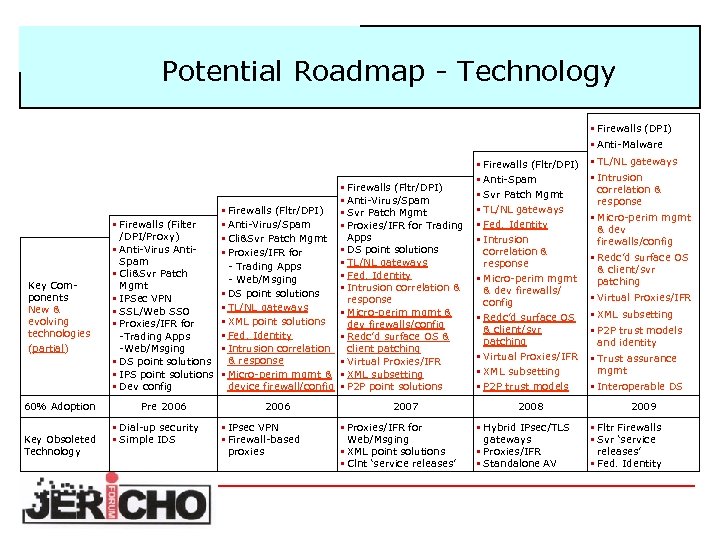
Potential Roadmap - Technology § Firewalls (DPI) § Anti-Malware § Firewalls (Fltr/DPI) § Firewalls (Filter Key Components New & evolving technologies (partial) 60% Adoption Key Obsoleted Technology /DPI/Proxy) § Anti-Virus Anti. Spam § Cli&Svr Patch Mgmt § IPSec VPN § SSL/Web SSO § Proxies/IFR for -Trading Apps -Web/Msging § DS point solutions § IPS point solutions § Dev config § Firewalls (Fltr/DPI) § Anti-Virus/Spam § Cli&Svr Patch Mgmt § Proxies/IFR for Apps § DS point solutions § TL/NL gateways - Trading Apps § Fed. Identity - Web/Msging § Intrusion correlation & § DS point solutions response § TL/NL gateways § Micro-perim mgmt & § XML point solutions dev firewalls/config § Fed. Identity § Redc’d surface OS & § Intrusion correlation client patching & response § Virtual Proxies/IFR § Micro-perim mgmt & § XML subsetting device firewall/config § P 2 P point solutions Pre 2006 § Dial-up security § Simple IDS § Firewalls (Fltr/DPI) § Anti-Virus/Spam § Svr Patch Mgmt § Proxies/IFR for Trading 2006 § IPsec VPN § Firewall-based proxies 2007 § Proxies/IFR for Web/Msging § XML point solutions § Clnt ‘service releases’ § TL/NL gateways § Anti-Spam § Intrusion § Svr Patch Mgmt § TL/NL gateways § Fed. Identity § Intrusion correlation & response § Micro-perim mgmt & dev firewalls/ config § Redc’d surface OS & client/svr patching § Virtual Proxies/IFR § XML subsetting § P 2 P trust models 2008 § Hybrid IPsec/TLS gateways § Proxies/IFR § Standalone AV correlation & response § Micro-perim mgmt & dev firewalls/config § Redc’d surface OS & client/svr patching § Virtual Proxies/IFR § XML subsetting § P 2 P trust models and identity § Trust assurance mgmt § Interoperable DS 2009 § Fltr Firewalls § Svr ‘service releases’ § Fed. Identity
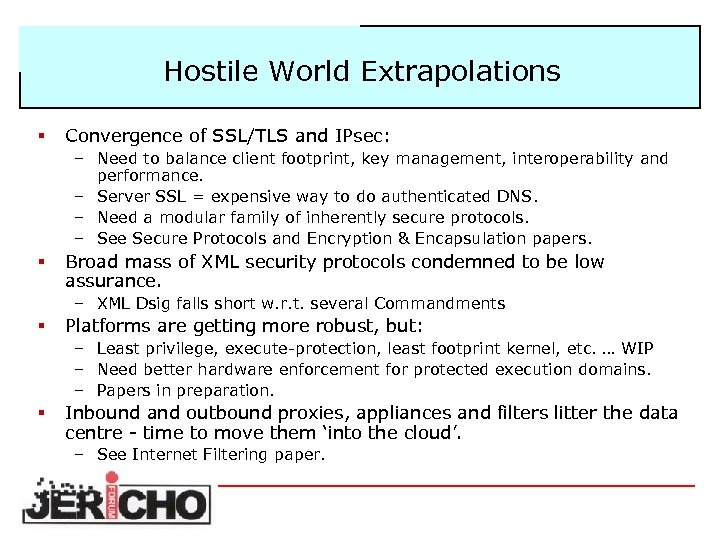
Hostile World Extrapolations § Convergence of SSL/TLS and IPsec: – Need to balance client footprint, key management, interoperability and performance. – Server SSL = expensive way to do authenticated DNS. – Need a modular family of inherently secure protocols. – See Secure Protocols and Encryption & Encapsulation papers. § Broad mass of XML security protocols condemned to be low assurance. – XML Dsig falls short w. r. t. several Commandments § Platforms are getting more robust, but: – Least privilege, execute-protection, least footprint kernel, etc. … WIP – Need better hardware enforcement for protected execution domains. – Papers in preparation. § Inbound and outbound proxies, appliances and filters litter the data centre - time to move them ‘into the cloud’. – See Internet Filtering paper.
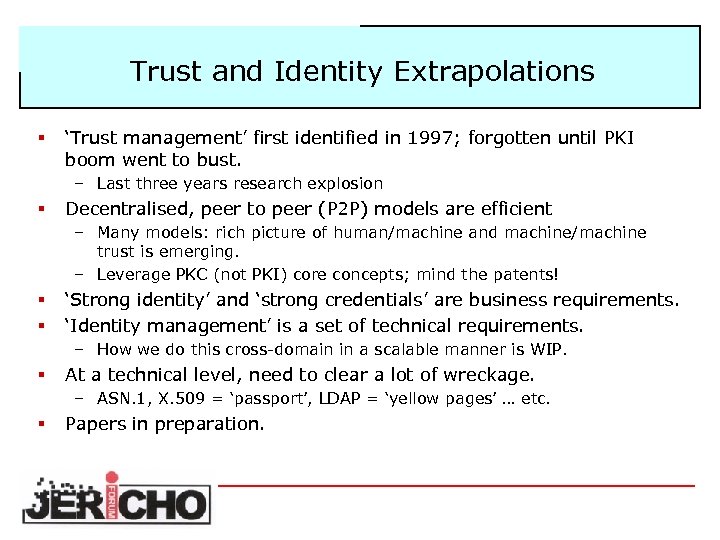
Trust and Identity Extrapolations § ‘Trust management’ first identified in 1997; forgotten until PKI boom went to bust. – Last three years research explosion § Decentralised, peer to peer (P 2 P) models are efficient – Many models: rich picture of human/machine and machine/machine trust is emerging. – Leverage PKC (not PKI) core concepts; mind the patents! § § ‘Strong identity’ and ‘strong credentials’ are business requirements. ‘Identity management’ is a set of technical requirements. – How we do this cross-domain in a scalable manner is WIP. § At a technical level, need to clear a lot of wreckage. – ASN. 1, X. 509 = ‘passport’, LDAP = ‘yellow pages’ … etc. § Papers in preparation.
Architecture Extrapolations § Enterprise-scale systems architecture is inherently domainoriented and perimeterised (despite web and extranet). – – § § Client-server and multi-tier. Service-oriented architecture -> web services. Layer structure optimises for traditional applications Portals are an attempt to hide legacy dependencies. Collaboration and trading increasingly peer-to-peer. Even fundamental applications no longer tied to the bounded ‘enterprise’: – Ubiquitous computing, agent-based algorithms, RFID and smart molecules point to a mobile, cross-domain future. – Grid computing exemplifies an unfulfilled P 2 P vision, encumbered by the perimeter. – See Architecture paper.
Data Protection Extrapolations Digital Rights Management has historically focused exclusively on copy protection of entertainment content. § ‘Corporate’ DRM as an extension of PKI technology now generally available as point solutions. § – Microsoft, Adobe etc. – Copy ‘protection’, non-repudiation, strong authentication & authorisation. – ‘Labelling’ is a traditional computer security preoccupation. § Business problems to solve need articulating. – The wider problem is enforcement of agreements, undertakings and contracts; implies data plus associated ‘intelligence’ should be bound together. § § Almost complete absence of standards. Paper in preparation.
What about ‘People and Process’? Jericho Forum assumes a number of constants: Jurisdictional and geopolitical barriers will continue, and constrain (even reverse) progress § Primary drivers for innovation and technology evolution are: – Perceived competitive advantage / absence of disadvantage. – Self-interest of governments and their agents as key arbiters of demand (a/k/a/ the Cobol syndrome). § IT industry will continue to use standards and patents as proxies for proprietary enforcement. § Closed source vs. open source is a zero sum. §
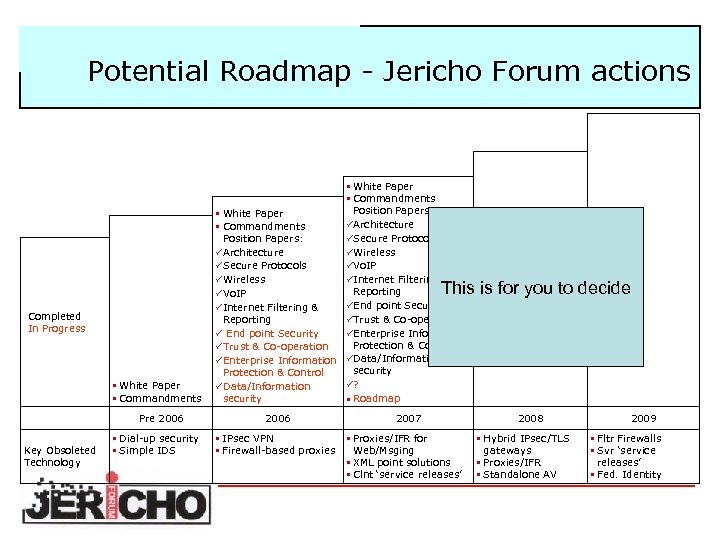
Potential Roadmap - Jericho Forum actions § White Paper § Commandments Position Papers: üArchitecture üSecure Protocols üWireless üVo. IP üInternet Filtering & Completed In Progress § White Paper § Commandments Pre 2006 Key Obsoleted Technology § Dial-up security § Simple IDS Position Papers: üArchitecture üSecure Protocols üWireless üVo. IP üInternet Filtering & This is for you to decide Reporting üEnd point Security üTrust & Co-operation Reporting üEnterprise Information ü End point Security Protection & Control üTrust & Co-operation üData/Information üEnterprise Information security Protection & Control ü? üData/Information • Roadmap security 2006 § IPsec VPN § Firewall-based proxies 2007 § Proxies/IFR for Web/Msging § XML point solutions § Clnt ‘service releases’ 2008 § Hybrid IPsec/TLS gateways § Proxies/IFR § Standalone AV 2009 § Fltr Firewalls § Svr ‘service releases’ § Fed. Identity
How are we engaging? § Stakeholders WG: chair - David Lacey – Corporate and government agendas – Our position in the Information Society § Requirements WG: chair - Nick Bleech – Business Scenarios, planning and roadmapping – Assurance implications § Solutions WG: chair - Andrew Yeomans – Patterns, solutions and standards – Jericho Forum Challenge
Conclusions § A year ago we set ourselves a vision to be realised in 3 -5 years § Today’s roadmap shows plenty of WIP still going on in 2009! § Want this stuff quicker? Join us! I never put on a pair of shoes until I've worn them at least five years. Samuel Goldwyn 18821974
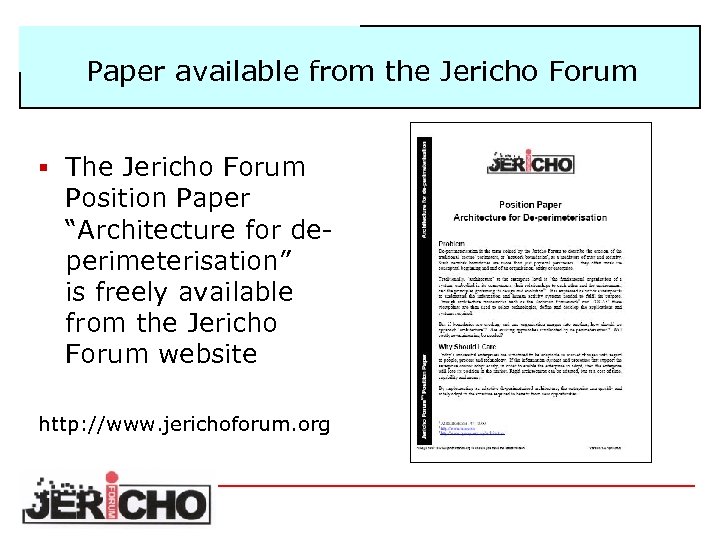
Paper available from the Jericho Forum § The Jericho Forum Position Paper “Architecture for deperimeterisation” is freely available from the Jericho Forum website http: //www. jerichoforum. org
Shaping security for tomorrow’s world www. jerichoforum. org
Скачать презентацию Welcome Jericho Forum Meeting 21 -22 September 2006
959e514018dc4c760f295696a3a4decb.ppt