 Скачать презентацию Welcome Increasing Outcomes For Non-responders Diana Browning Wright
c38e3230fc6ae0fc4c32f44144a58d5f.ppt
- Количество слайдов: 26



Welcome! Increasing Outcomes For Non-responders Diana Browning Wright Clayton R. Cook
Game Plan Review of Tier 2 non responders Review of Tier 3 non responders How do we establish measurable goals for our students who have behavior challenges? How do we as a team problem solve nonresponders? Non-solution cautions Practice with your cases (or mine) Diana Browning Wright, M. S. , L. E. P. 2
Problem-solving Process Aim is to develop a structured process of presenting a case and developing a plan of action that has a chance at remediating the problem or supporting the success of the student Steps Identify and conceptualize the problem Generate solutions Develop a plan that outlines who does what by when Implement the plan Monitor progress and evaluate plan effectiveness Diana Browning Wright, M. S. , L. E. P. 3
Problems w/ Typical Teaming Practices Problem admiration rather than problem solving Non-relevant for decision making reflections: Garbage in – garbage out Mixing theoretical paradigms when developing a plan Unstructured teaming process No agenda, no roles and responsibilities Diana Browning Wright, M. S. , L. E. P. 4
Problem-Solving Non-Responsive Students within Tier 2 Diana Browning Wright, M. S. , L. E. P www. dianabrowningwright. com dbrowningw@gmail. com and Clayton R. Cook, Ph. D University of Washington
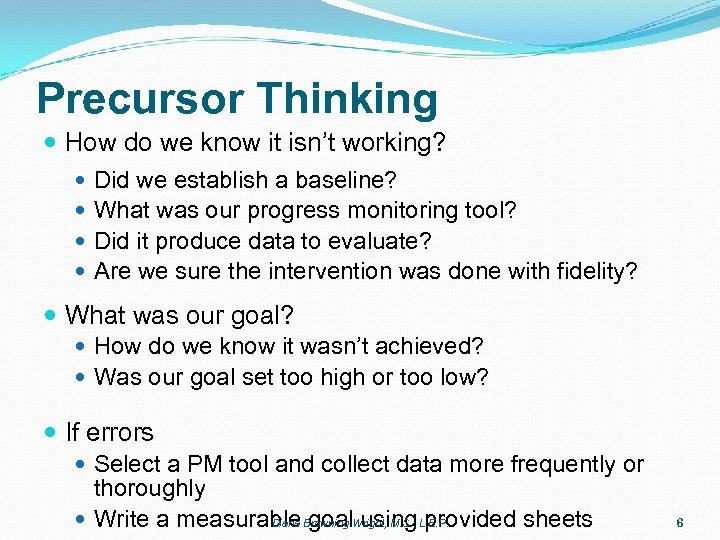
Precursor Thinking How do we know it isn’t working? Did we establish a baseline? What was our progress monitoring tool? Did it produce data to evaluate? Are we sure the intervention was done with fidelity? What was our goal? How do we know it wasn’t achieved? Was our goal set too high or too low? If errors Select a PM tool and collect data more frequently or thoroughly Diana goal using provided sheets Write a measurable Browning Wright, M. S. , L. E. P. 6
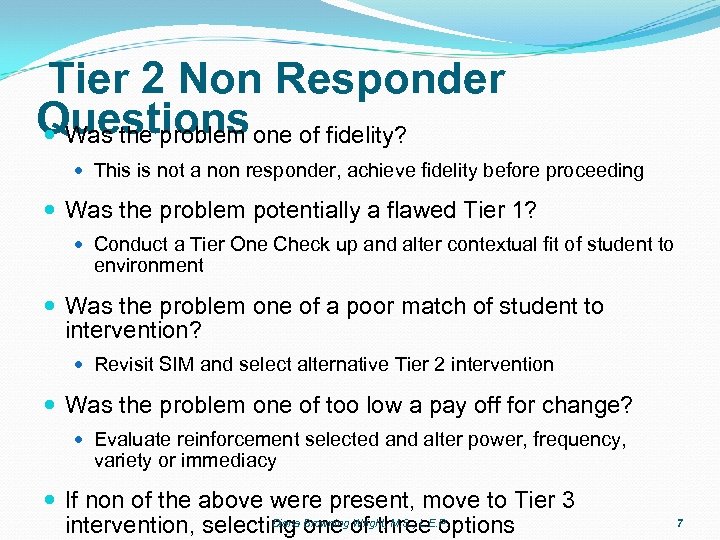
Tier 2 Non Responder Questions one of fidelity? Was the problem This is not a non responder, achieve fidelity before proceeding Was the problem potentially a flawed Tier 1? Conduct a Tier One Check up and alter contextual fit of student to environment Was the problem one of a poor match of student to intervention? Revisit SIM and select alternative Tier 2 intervention Was the problem one of too low a pay off for change? Evaluate reinforcement selected and alter power, frequency, variety or immediacy If non of the above were present, move to Tier 3 Diana intervention, selecting Browning of three options one Wright, M. S. , L. E. P. 7
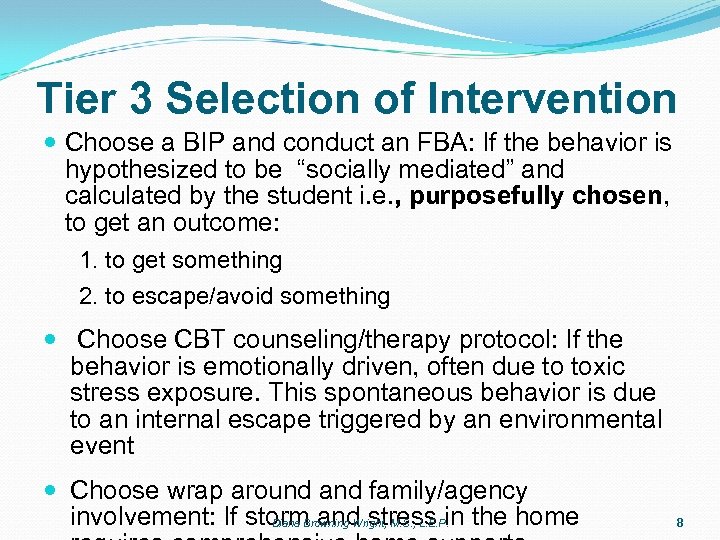
Tier 3 Selection of Intervention Choose a BIP and conduct an FBA: If the behavior is hypothesized to be “socially mediated” and calculated by the student i. e. , purposefully chosen, to get an outcome: 1. to get something 2. to escape/avoid something Choose CBT counseling/therapy protocol: If the behavior is emotionally driven, often due to toxic stress exposure. This spontaneous behavior is due to an internal escape triggered by an environmental event Choose wrap around and family/agency involvement: If storm and stress in the home Diana Browning Wright, M. S. , L. E. P. 8
Problem-Solving Non-Responsive Students within Tier 3 Diana Browning Wright, M. S. , L. E. P www. dianabrowningwright. com dbrowningw@gmail. com and Clayton R. Cook, Ph. D University of Washington
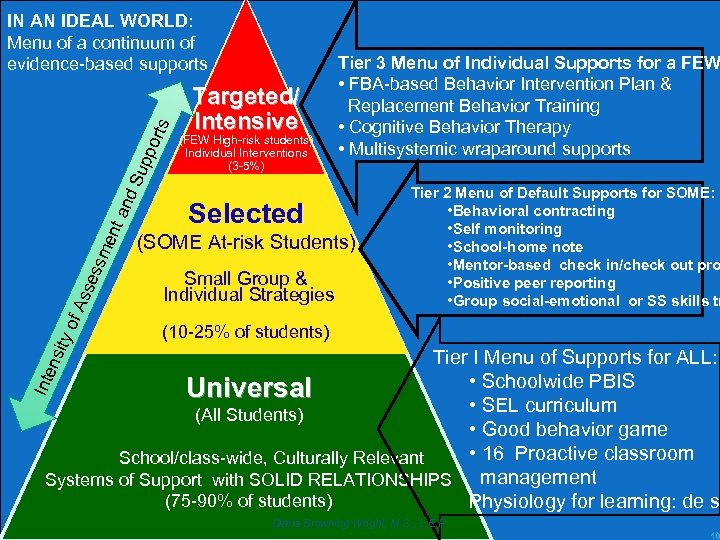
ty o f. A sse ssm ent and Su ppo r ts IN AN IDEAL WORLD: Menu of a continuum of evidence-based supports Targeted/ Intensive (FEW High-risk students) Individual Interventions (3 -5%) Tier 3 Menu of Individual Supports for a FEW • FBA-based Behavior Intervention Plan & Replacement Behavior Training • Cognitive Behavior Therapy • Multisystemic wraparound supports Selected (SOME At-risk Students) Small Group & Individual Strategies Tier 2 Menu of Default Supports for SOME: • Behavioral contracting • Self monitoring • School-home note • Mentor-based check in/check out pro • Positive peer reporting • Group social-emotional or SS skills tr (10 -25% of students) Inte nsi Tier I Menu of Supports for ALL: • Schoolwide PBIS Universal • SEL curriculum (All Students) • Good behavior game • 16 Proactive classroom School/class-wide, Culturally Relevant management Systems of Support with SOLID RELATIONSHIPS (75 -90% of students) Physiology for learning: de s • Diana Browning Wright, M. S. , L. E. P. 10
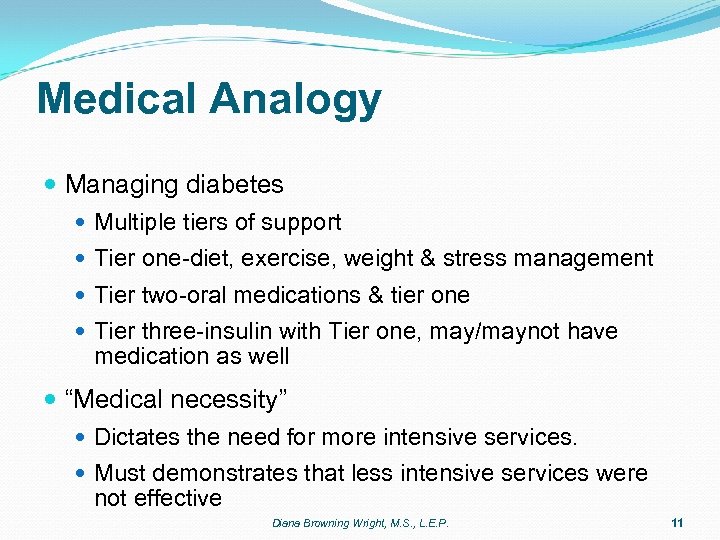
Medical Analogy Managing diabetes Multiple tiers of support Tier one-diet, exercise, weight & stress management Tier two-oral medications & tier one Tier three-insulin with Tier one, may/maynot have medication as well “Medical necessity” Dictates the need for more intensive services. Must demonstrates that less intensive services were not effective Diana Browning Wright, M. S. , L. E. P. 11
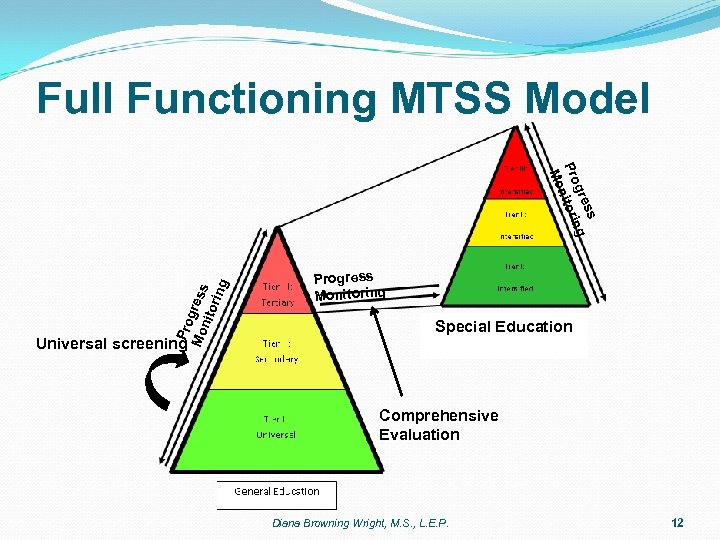
Full Functioning MTSS Model Pro Mo gress nito ring ss gre ng Pro itori n Mo Universal screening Progress Monitoring Special Education Comprehensive Evaluation Diana Browning Wright, M. S. , L. E. P. 12
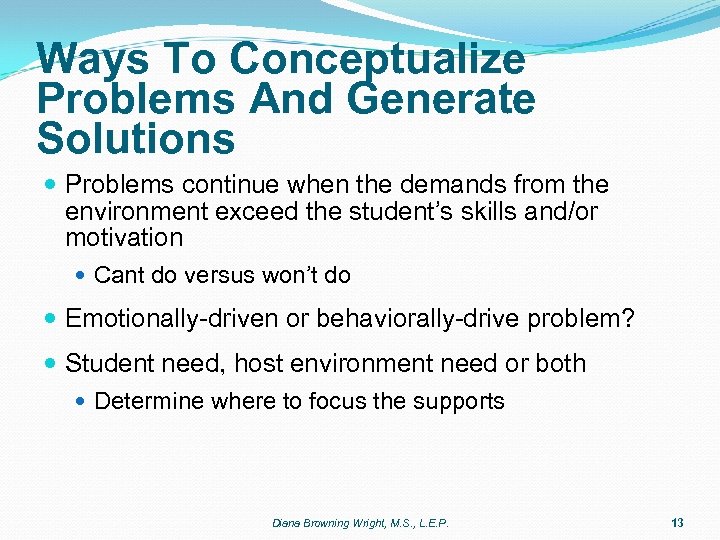
Ways To Conceptualize Problems And Generate Solutions Problems continue when the demands from the environment exceed the student’s skills and/or motivation Cant do versus won’t do Emotionally-driven or behaviorally-drive problem? Student need, host environment need or both Determine where to focus the supports Diana Browning Wright, M. S. , L. E. P. 13
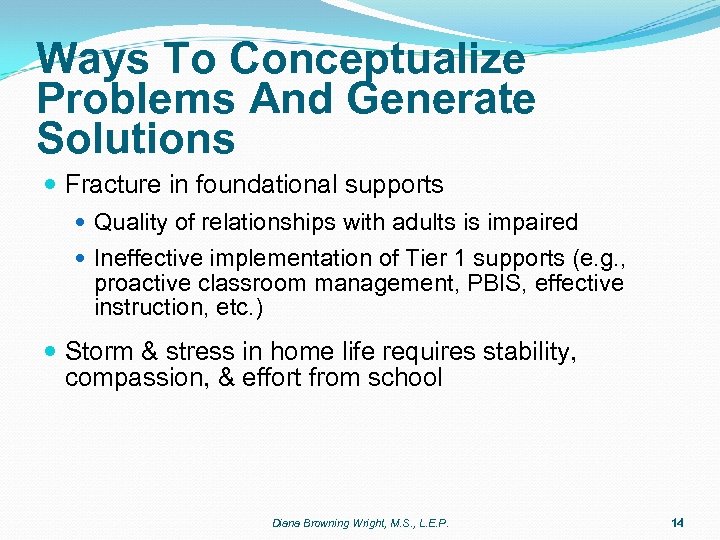
Ways To Conceptualize Problems And Generate Solutions Fracture in foundational supports Quality of relationships with adults is impaired Ineffective implementation of Tier 1 supports (e. g. , proactive classroom management, PBIS, effective instruction, etc. ) Storm & stress in home life requires stability, compassion, & effort from school Diana Browning Wright, M. S. , L. E. P. 14
Creating The Pathway Chart Using The FBA Is the behavior Socially Mediated?
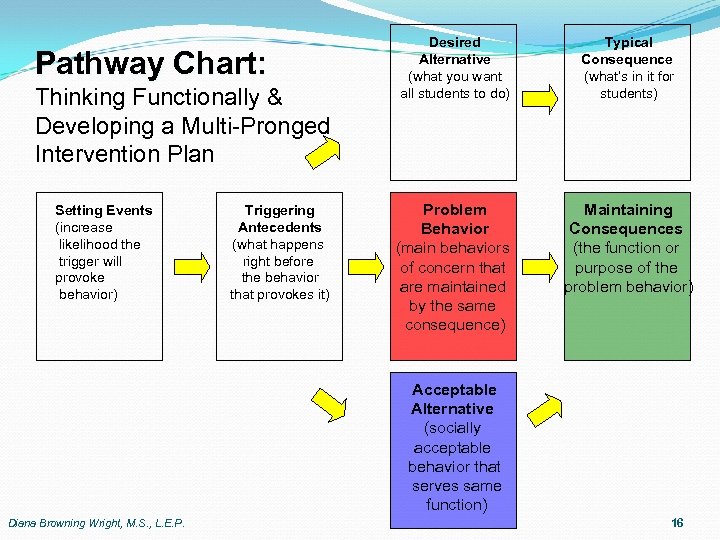
Pathway Chart: Thinking Functionally & Developing a Multi-Pronged Intervention Plan Setting Events (increase likelihood the trigger will provoke behavior) Triggering Antecedents (what happens right before the behavior that provokes it) Desired Alternative (what you want all students to do) Typical Consequence (what’s in it for students) Problem Behavior (main behaviors of concern that are maintained by the same consequence) Maintaining Consequences (the function or purpose of the problem behavior) Acceptable Alternative (socially acceptable behavior that serves same function) Diana Browning Wright, M. S. , L. E. P. 16

Developing Goals
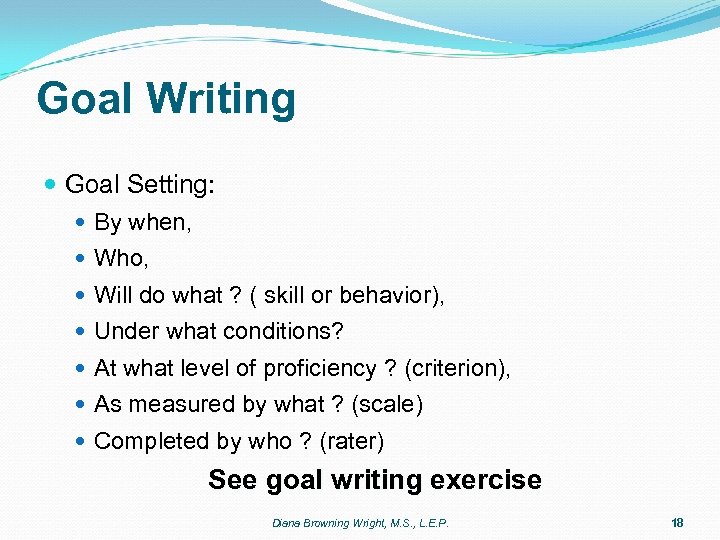
Goal Writing Goal Setting: By when, Who, Will do what ? ( skill or behavior), Under what conditions? At what level of proficiency ? (criterion), As measured by what ? (scale) Completed by who ? (rater) See goal writing exercise Diana Browning Wright, M. S. , L. E. P. 18
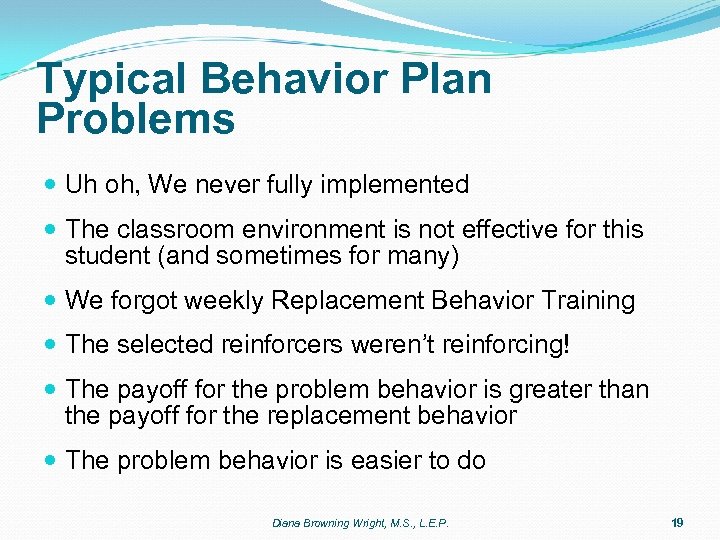
Typical Behavior Plan Problems Uh oh, We never fully implemented The classroom environment is not effective for this student (and sometimes for many) We forgot weekly Replacement Behavior Training The selected reinforcers weren’t reinforcing! The payoff for the problem behavior is greater than the payoff for the replacement behavior The problem behavior is easier to do Diana Browning Wright, M. S. , L. E. P. 19
Examining The Service Is The Behavior Truly An Emotional Response?
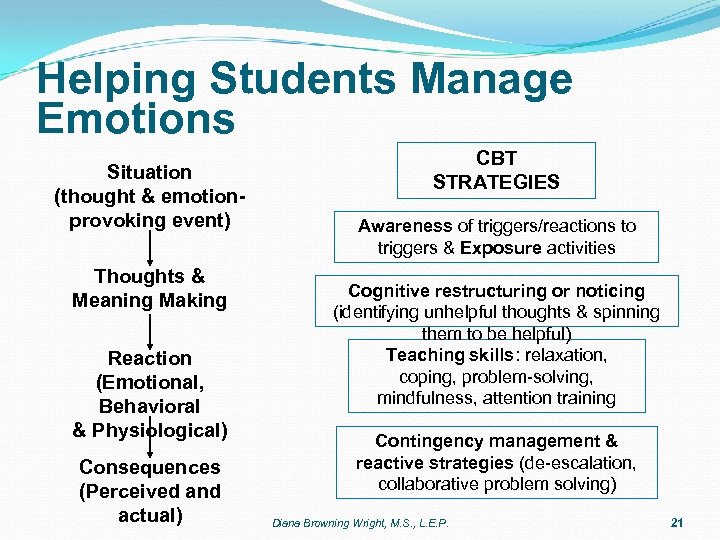
Helping Students Manage Emotions Situation (thought & emotionprovoking event) Thoughts & Meaning Making Reaction (Emotional, Behavioral & Physiological) Consequences (Perceived and actual) CBT STRATEGIES Awareness of triggers/reactions to triggers & Exposure activities Cognitive restructuring or noticing (identifying unhelpful thoughts & spinning them to be helpful) Teaching skills: relaxation, coping, problem-solving, mindfulness, attention training Contingency management & reactive strategies (de-escalation, collaborative problem solving) Diana Browning Wright, M. S. , L. E. P. 21
Problems With Counseling/Therapy Service Treatment selected was not Cognitive Behavioral Therapy Rapport problems with clinician/student match Student buy-in not achieved No skill prompting in environment No partnership with parent Diana Browning Wright, M. S. , L. E. P. 22
Considering “Shortening the Day”? Shortening the Day is full of problems (See attached article on legal issues related to shortened day) This may result in avoidance of “child find” obligations for students with and without IEP Removing an education does not improve outcomes in social emotional development Interventions, services and correct environments (LRE) do improve outcomes for students with social/emotional behavioral challenges Diana Browning Wright, M. S. , L. E. P. 23
Child Find and LRE/FAPE Triggers If no response to tier 3, and student does not have an IEP, lack of response is triggering a need for a comprehensive evaluation to determine if the student has an emotional disturbance per Ed Code If no response and student has an IEP, a need for a comprehensive evaluation to determine LRE and what constitutes FAPE is triggered as well as a child find to assess in “all areas of suspected disability” Diana Browning Wright, M. S. , L. E. P. 24
Case Review Process Practice see data form Identify and conceptualize the problem Generate solutions Develop a plan that outlines who does what by when Later: Later Implement the plan Monitor progress and evaluate plan effectiveness Diana Browning Wright, M. S. , L. E. P. 25
For All You Do! For all the students and staff who struggle with poorly understood behavior, For all your efforts to alter the resilience of students Diana Browning Wright, M. S. , L. E. P. 26
Скачать презентацию Welcome Increasing Outcomes For Non-responders Diana Browning Wright
c38e3230fc6ae0fc4c32f44144a58d5f.ppt