


 Скачать презентацию Welcome External and Internal Quality Assurance
bfbafda84f3a303d8ac24ee767167406.ppt
- Количество слайдов: 30
 Welcome
 External and Internal Quality Assurance Systems in the University Set-up Presenter: Mr. Tom Ochieng Atonga Academic Background • Bachelor of Education -University of Nairobi • Master of Education (Administration)-University of Nairobi • Ongoing Study: Ph. D in Education (Quality Assurance)- University of the Witwatersrand Relevant Experience • Teaching Excellence Manager – BU • Academic Quality Assurance Manager – LUCT • Principal Lecturer – LUCT
 External and Internal Quality Assurance Systems in the University Set-up Objectives of the presentation Learners should be able to: 1. Delineate the concept of a ‘University’ and explain its origins 2. Give contextual meaning to the word ‘quality’ in Higher Education 3. Identify the different external QA systems in the global quality network 4. Describe the national and regional QA frameworks and compare their standards 5. Explain international ranking standards 6. Identify and explain the internal QA systems in the University set up 7. Appreciate the history of Quality in African Universities and the attendant challenges
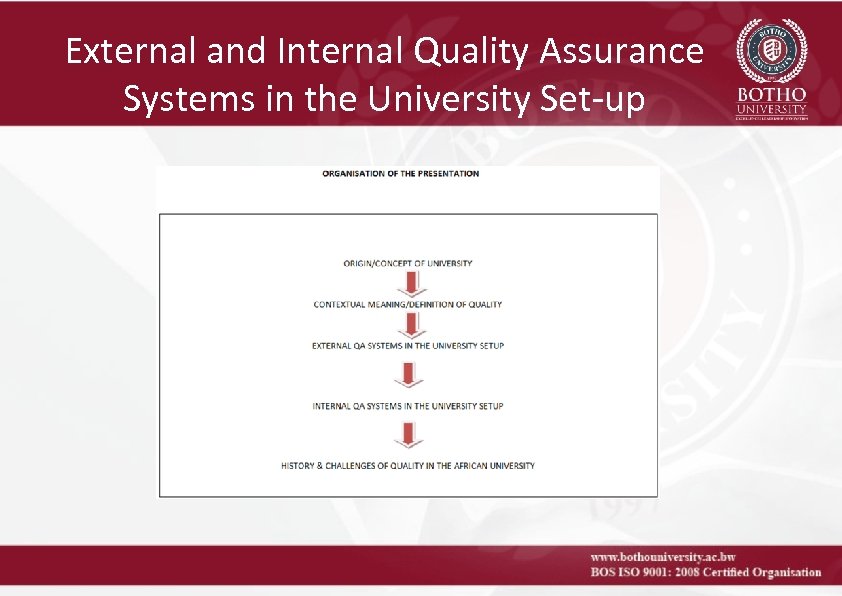 External and Internal Quality Assurance Systems in the University Set-up
 Brief History of the University!
 History of the University • Roots in the medieval Christian setting as early as 6 th Century AD • Due to lack of specialized training of teachers only a few monasteries could claim to have professional clergy (Quality issue? ) • advent of urbanization in the 12 th and 13 th century saw an increased demand for a better trained and more knowledgeable clergy (quality issue? ) • Soon demand for higher learning outstripped the capacity of cathedral schools ((quality issue? ) • • Many centers of learning soon sprung up in Paris and Bologna(Quality issue? ) The term Universitas, a used to refer to any kind of legal associations. Pope Gregory IX I Papal Bull –(ius ubique docendi) (Accreditation? ) Embryonic universities: University of Bologna (1088), University of Paris (1119), University of Oxford (1167), University of Modena (1175), University of Orleans (1235), University of Siena (1240), University of Cambridge (1209), University of Salamanca (1218), and the University of Toulouse (1229) (Barnett, 2006, p. 18). • To date, many of the key characteristics of the medieval university have been retained:
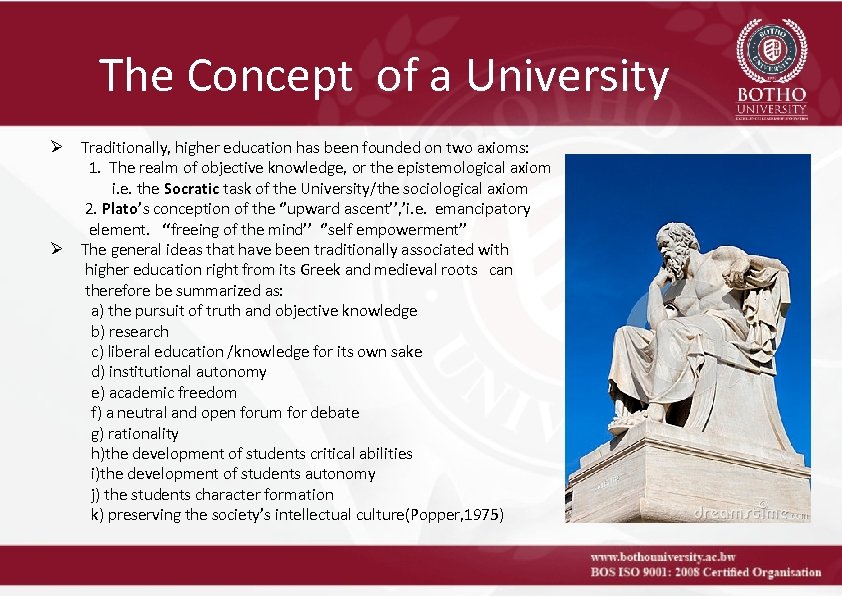 The Concept of a University Ø Traditionally, higher education has been founded on two axioms: 1. The realm of objective knowledge, or the epistemological axiom i. e. the Socratic task of the University/the sociological axiom 2. Plato’s conception of the ‘’upward ascent’’, ’i. e. emancipatory element. ‘‘freeing of the mind’’ ‘’self empowerment’’ Ø The general ideas that have been traditionally associated with higher education right from its Greek and medieval roots can therefore be summarized as: a) the pursuit of truth and objective knowledge b) research c) liberal education /knowledge for its own sake d) institutional autonomy e) academic freedom f) a neutral and open forum for debate g) rationality h)the development of students critical abilities i)the development of students autonomy j) the students character formation k) preserving the society’s intellectual culture(Popper, 1975)
 The New Paradigm Shift Simple functionalist view of higher education.
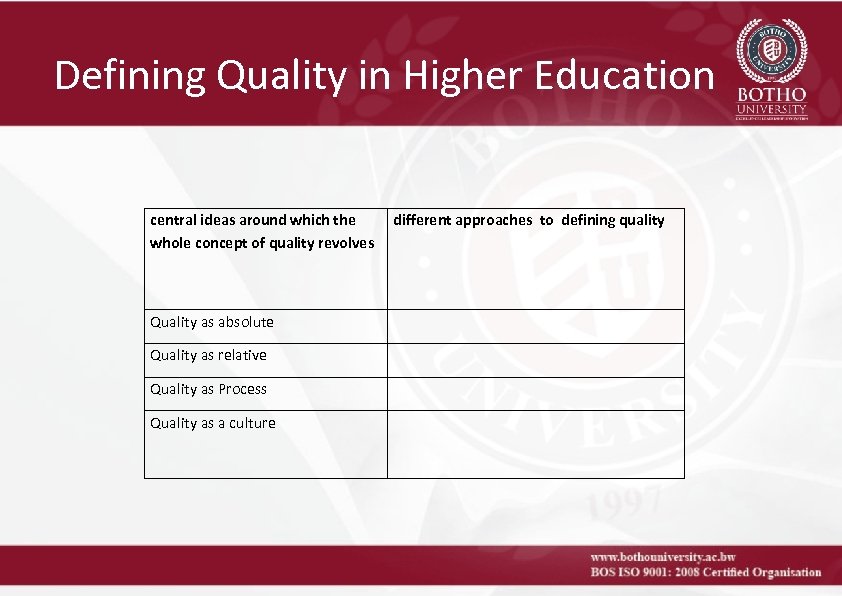
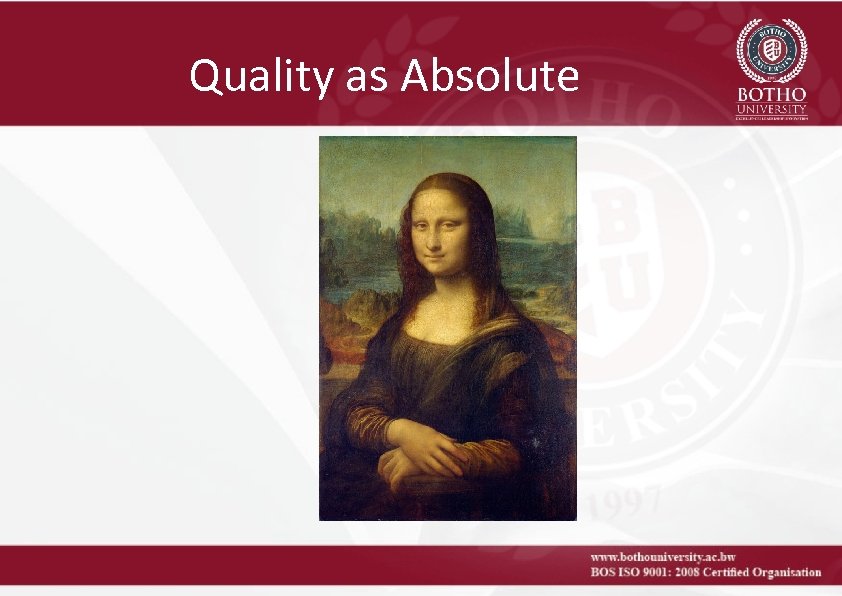
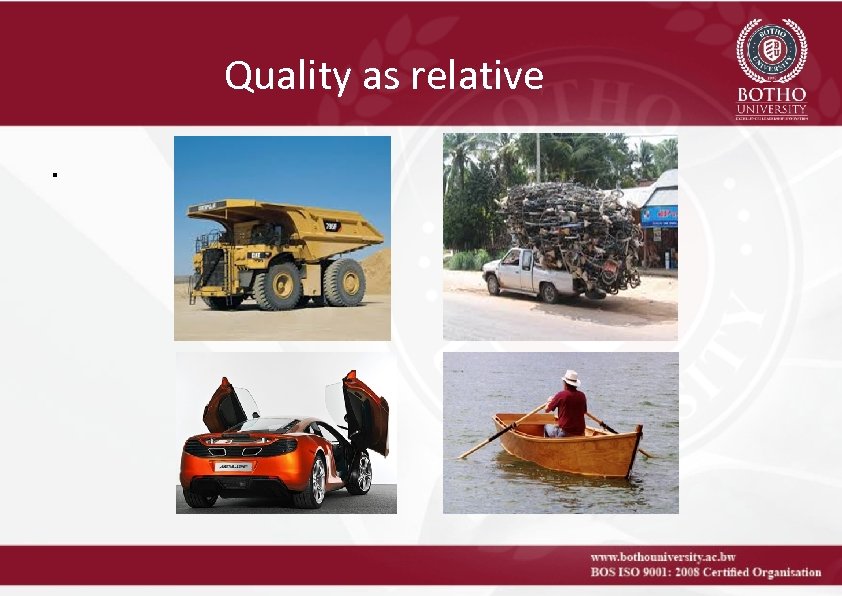
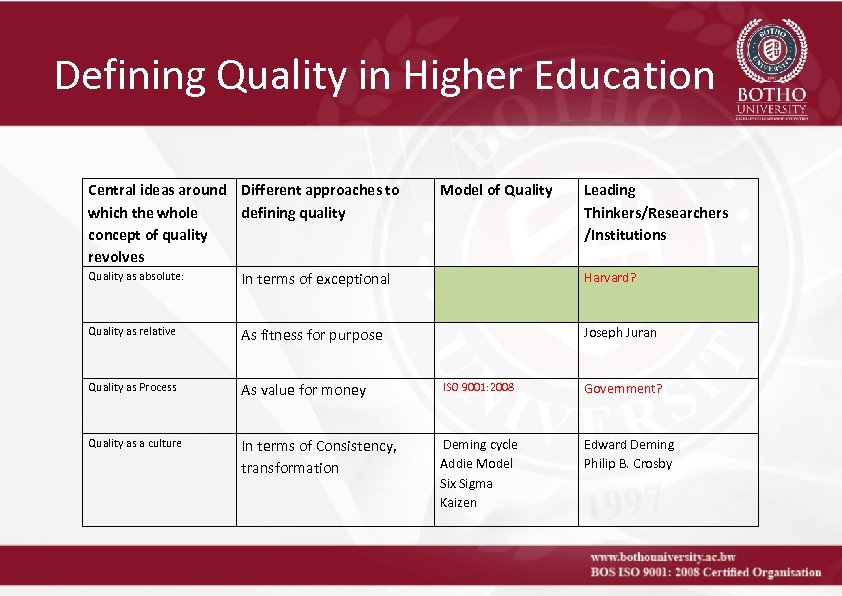
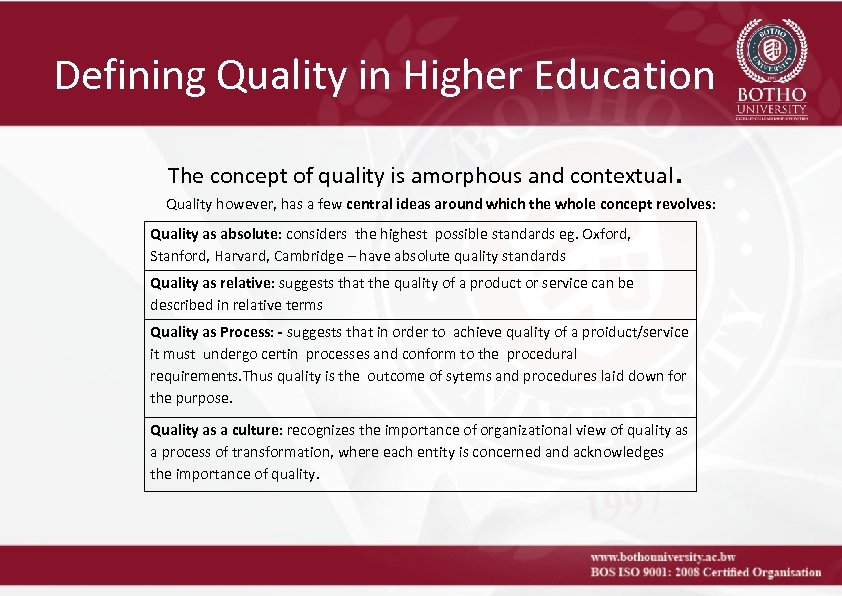 Defining Quality in Higher Education The concept of quality is amorphous and contextual. Quality however, has a few central ideas around which the whole concept revolves: Quality as absolute: considers the highest possible standards eg. Oxford, Stanford, Harvard, Cambridge – have absolute quality standards Quality as relative: suggests that the quality of a product or service can be described in relative terms Quality as Process: - suggests that in order to achieve quality of a proiduct/service it must undergo certin processes and conform to the procedural requirements. Thus quality is the outcome of sytems and procedures laid down for the purpose. Quality as a culture: recognizes the importance of organizational view of quality as a process of transformation, where each entity is concerned and acknowledges the importance of quality.
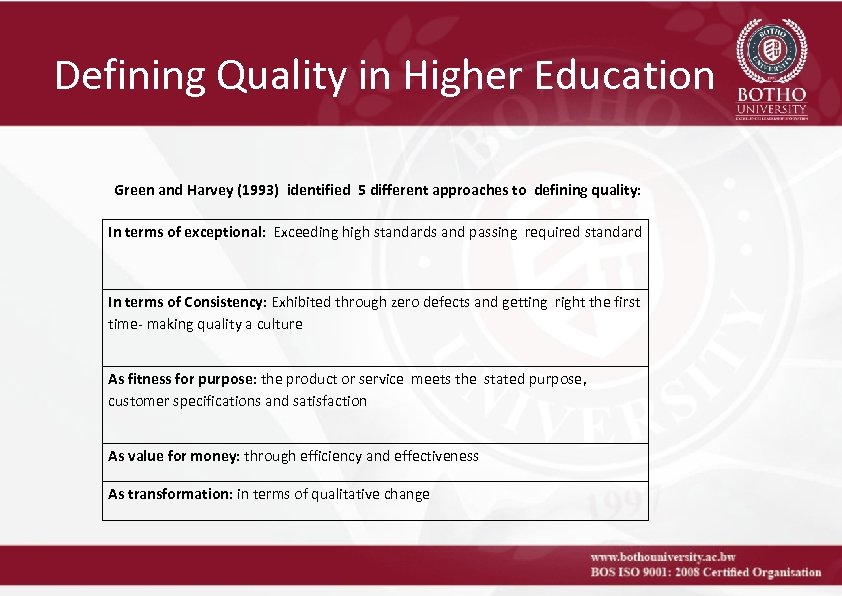 Defining Quality in Higher Education Green and Harvey (1993) identified 5 different approaches to defining quality: In terms of exceptional: Exceeding high standards and passing required standard In terms of Consistency: Exhibited through zero defects and getting right the first time- making quality a culture As fitness for purpose: the product or service meets the stated purpose, customer specifications and satisfaction As value for money: through efficiency and effectiveness As transformation: in terms of qualitative change
 Defining Quality in Higher Education central ideas around which the whole concept of quality revolves Quality as absolute Quality as relative Quality as Process Quality as a culture different approaches to defining quality
 Quality as Absolute
 Quality as relative.
 Defining Quality in Higher Education Central ideas around Different approaches to which the whole defining quality concept of quality revolves Quality as absolute: In terms of exceptional Model of Quality Leading Thinkers/Researchers /Institutions Harvard? Quality as relative As fitness for purpose Joseph Juran Quality as Process As value for money ISO 9001: 2008 Government? Quality as a culture In terms of Consistency, transformation Deming cycle Edward Deming Philip B. Crosby Addie Model Six Sigma Kaizen
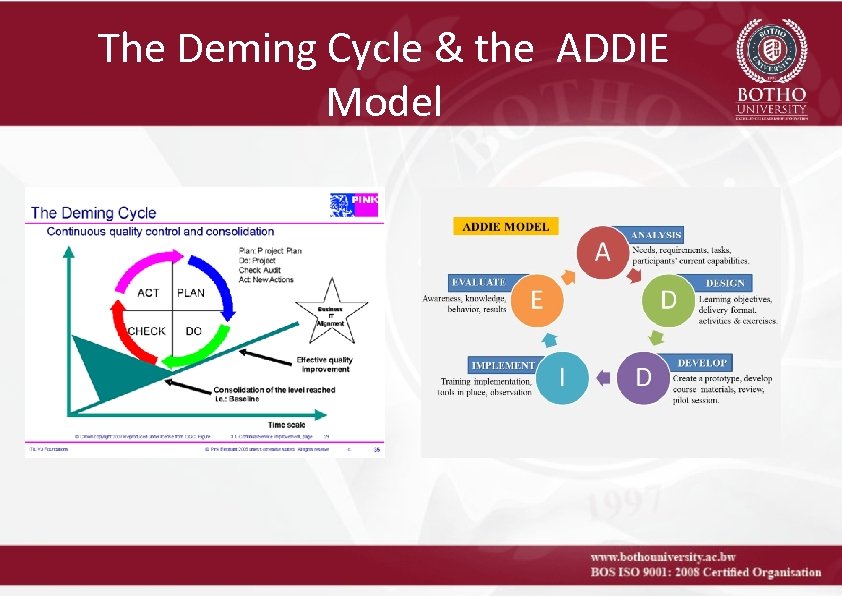 The Deming Cycle & the ADDIE Model
 Some Operational Definitions • The British standard institution (BSI) defines quality as the totality of features and characteristics of a product or service that bear on its ability to satisfy stated or implied needs. • Quality is an assessment in terms of a set of norm-referenced standards • Quality Assurance is the systematic monitoring and evaluation of the various aspects of a project, service or facility to maximize the probability that minimum standards of quality are being attained by the production process (ISO) • Standards –minimum threshold by which performance is judged
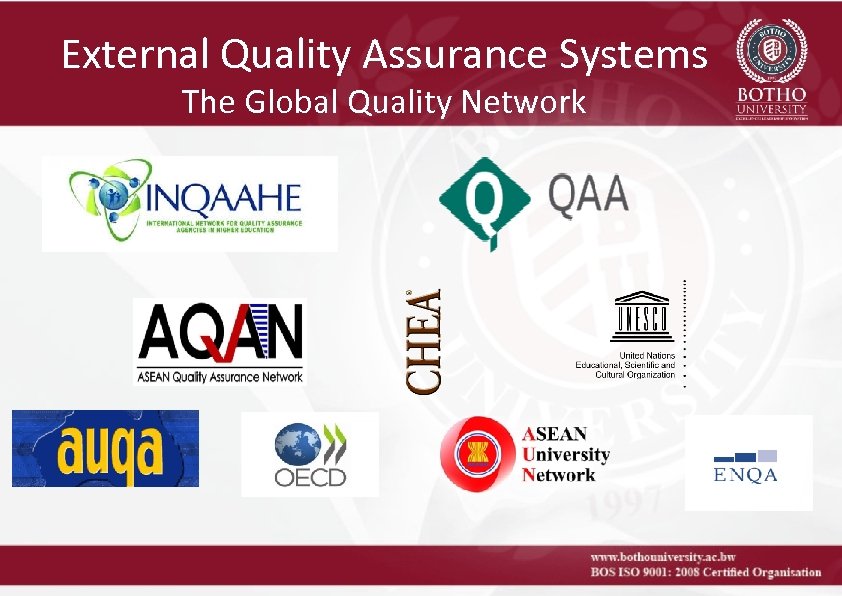 External Quality Assurance Systems The Global Quality Network
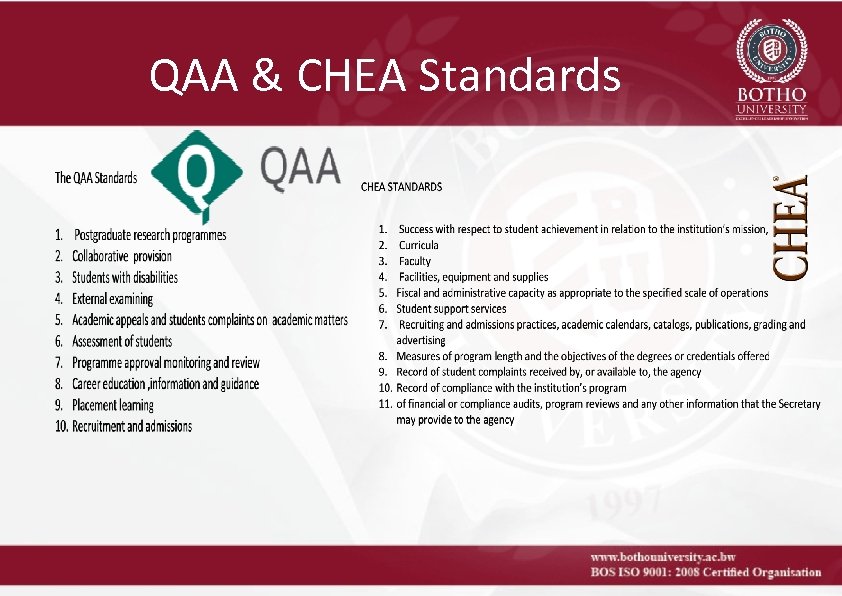 QAA & CHEA Standards
 Regional and National quest for Quality (External QA) AQRM
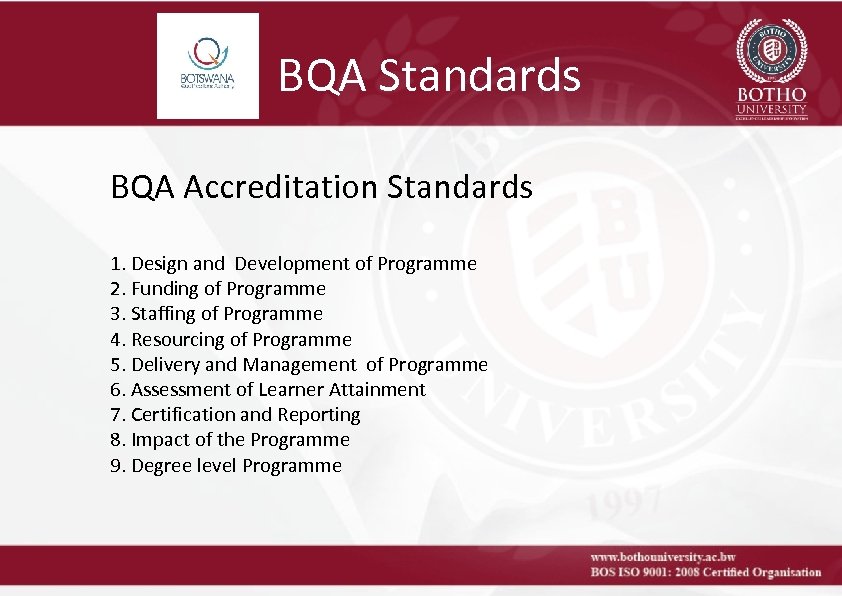 BQA Standards BQA Accreditation Standards 1. Design and Development of Programme 2. Funding of Programme 3. Staffing of Programme 4. Resourcing of Programme 5. Delivery and Management of Programme 6. Assessment of Learner Attainment 7. Certification and Reporting 8. Impact of the Programme 9. Degree level Programme
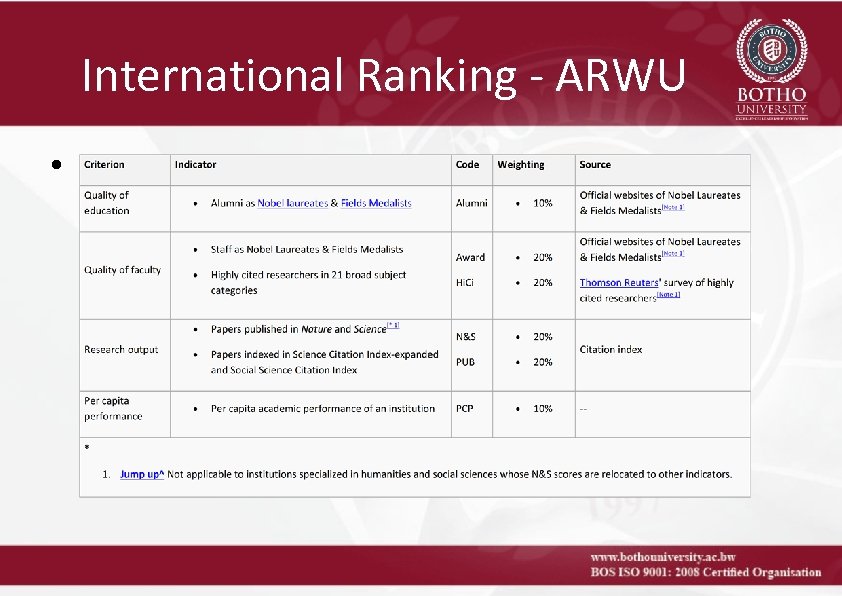 International Ranking - ARWU • .
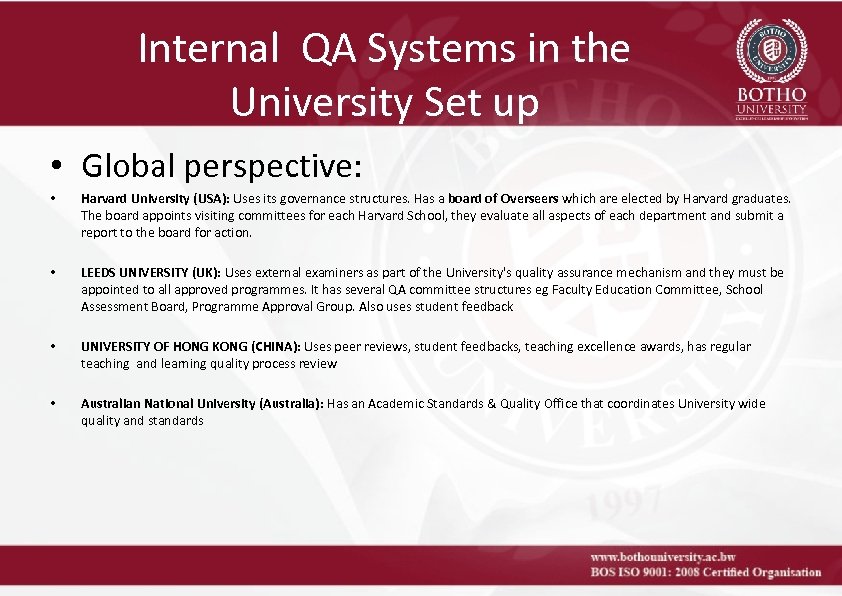 Internal QA Systems in the University Set up • Global perspective: • Harvard University (USA): Uses its governance structures. Has a board of Overseers which are elected by Harvard graduates. The board appoints visiting committees for each Harvard School, they evaluate all aspects of each department and submit a report to the board for action. • LEEDS UNIVERSITY (UK): Uses external examiners as part of the University's quality assurance mechanism and they must be appointed to all approved programmes. It has several QA committee structures eg Faculty Education Committee, School Assessment Board, Programme Approval Group. Also uses student feedback • UNIVERSITY OF HONG KONG (CHINA): Uses peer reviews, student feedbacks, teaching excellence awards, has regular teaching and learning quality process review • Australian National University (Australia): Has an Academic Standards & Quality Office that coordinates University wide quality and standards
 Internal QA Systems in the University Set up • National perspective • University of Botswana- Uses academic programme reviews • Botho University – Uses committee structures, Faculty Management structures, Teaching Excellence Department, IQAD, ISO
 Overview of Quality in African Universities Brief History of quality in African Universities Ø Ø • Ø Ø Ø • Goes back to the founding of the first university in Africa: Fourah Bay College in Sierra Leone - 1827 Liberia College 1852, UCT 1827, Makerere 1922, University of Ghana 1948 Authority over the Quality of education was a function of their governing boards and the affiliating colonial Universities. With affiliation, the Universities became part of British, French, Portuguese or other systems of QA through their affiliated University. These institutions were subjected to the same kind of control as their affiliating institutions At independence in (1960 s) the role of the state authority over HE increased. Most MOE took an interest in the Universities and asserted greater authority over governance and decision making that was not always in support of quality. In many cases the increased role of the state in university education coincided with a decline in quality in HE and a desire for political control of education. Mentoring relationship with European universities ended, the external moderation system weakened, there was tremendous enrollment and the per capita expenditure on education decreased, brain drain, rapid expansion of private HEIs of questionable quality, unemployment grew among graduates Most MOE became the major force for the establishment of new quality assurance structures To make things worse the period of rapid growth was preceded by that of general economic decline and budget cuts First accreditation Nigeria and South Africa in 1985(Technicon) First HE accrediting agency established in Kenya (CHE) in 1985
 Current Challenges in African Higher Education • • Research funding High tuition fees Poor infrastructure Lack of experienced and Qualified Staff, Brain Drain
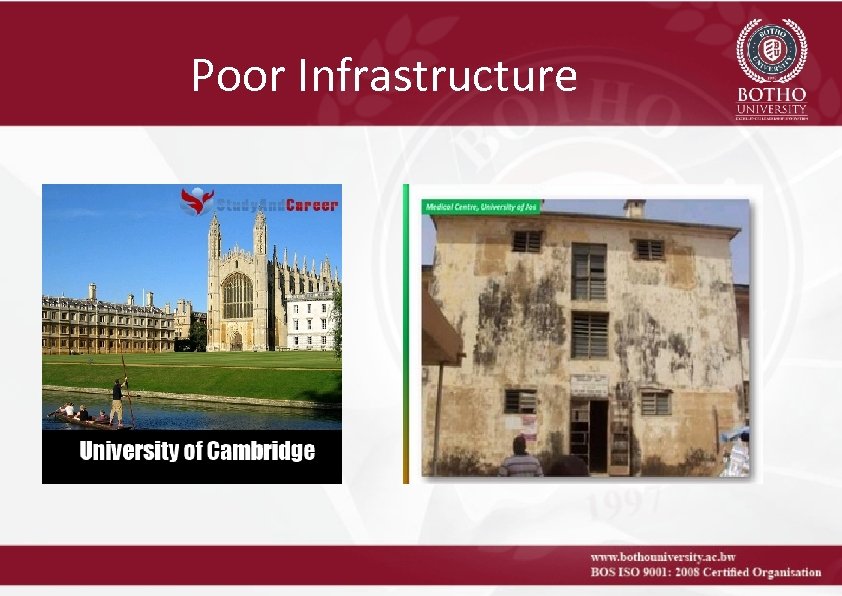 Poor Infrastructure
 Unaffordable/High Tuition Fees
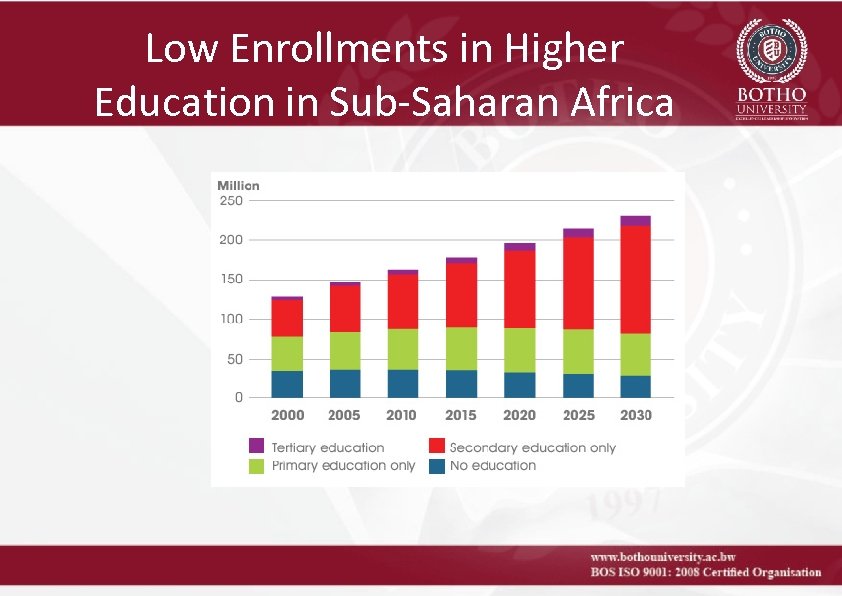 Low Enrollments in Higher Education in Sub-Saharan Africa
 CLOSING ARGUMENTS • The responsibility for quality lies with each one of us/the institution
 Questions /Comments End