


 Скачать презентацию WELCOME CHRM 2480 Inventory Purchasing Agenda
709b1701c9340fa78c7065a9ac062441.ppt
- Количество слайдов: 47
 WELCOME CHRM 2480 Inventory & Purchasing
 Agenda • • • Ground Rules Warm Up Activity Syllabus Review Purchasing Website NRAEF Manage. First Program Chapter One – Introduction to Inventory & Purchasing
 Ground Rules • Be on time – start on time • All cell phones, pagers and IPods should be turned off during class • No Internet use during class, unless part of classroom activity • Appreciate other points of view • Respect others’ desire to learn • End on time
 Information Card • Please fill out the following information on the index card – Side ONE • Name • Phone • Email Address – Side TWO • Business affiliation & current position • Hospitality industry background
 Warm Up Activity • Break into pairs • Interview each other – 2 -3 minutes each person – Name, Occupation, Why are you taking Purchasing Class, etc…… • Introduce each other to the group
 Syllabus Review • Course Information • Course Assessment • Schedule of Assignments – Can Cutting, March 31, 9 am room 108? – Tour of FSA, April 21 st, 9 am? – Physical Inventory , Week of April 6 th • • OCC-April 6 th, 8: 30 am NE Med Center-April 6 th, 1: 30 pm Hilton Omaha-April 13 th, 9 am Stokes Restaurants- April 8 th, 6 am
 Syllabus Review • Projects (Individual & Group) • Attendance Sheets • Website • http: //www. sharepoint. mccneb. edu/culinaryarts
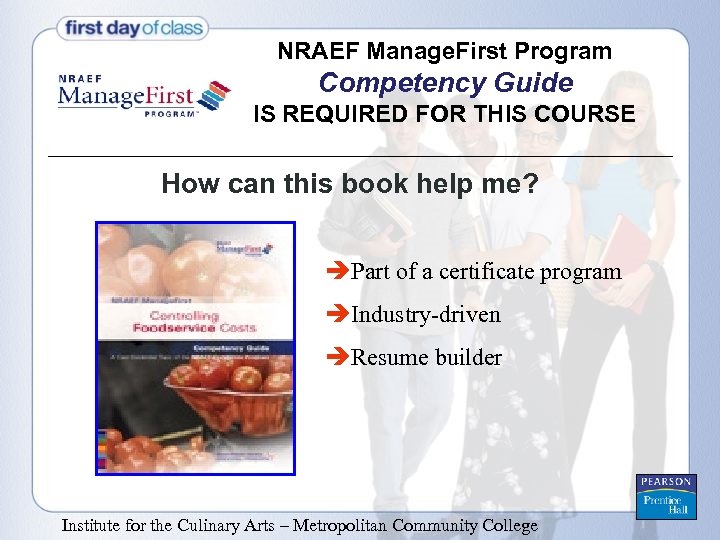 NRAEF Manage. First Program Competency Guide IS REQUIRED FOR THIS COURSE How can this book help me? èPart of a certificate program èIndustry-driven èResume builder Institute for the Culinary Arts – Metropolitan Community College
 NRAEF Manage. First Program Competency Guide IS REQUIRED FOR THIS COURSE Who is the NRAEF? èEducational arm of the National Restaurant Association èBridge between academia and industry èWork with over 60, 000 restaurant, hospitality and foodservice members companies Institute for the Culinary Arts – Metropolitan Community College
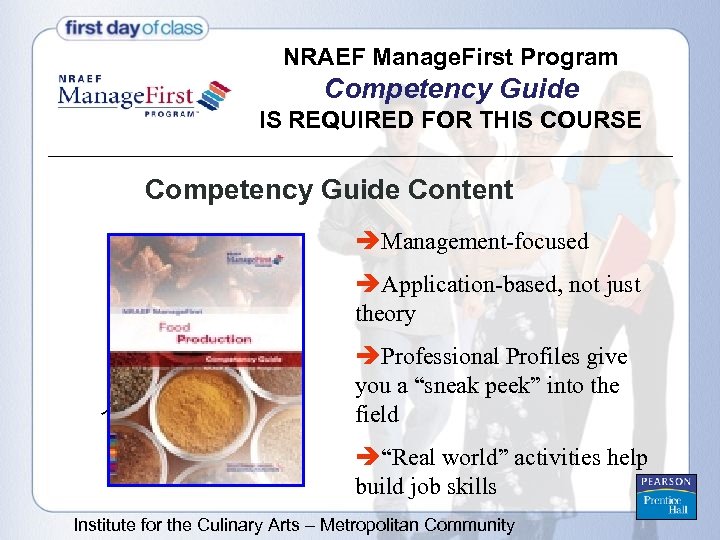 NRAEF Manage. First Program Competency Guide IS REQUIRED FOR THIS COURSE Competency Guide Content èManagement-focused èApplication-based, not just theory èProfessional Profiles give you a “sneak peek” into the field è“Real world” activities help build job skills Institute for the Culinary Arts – Metropolitan Community
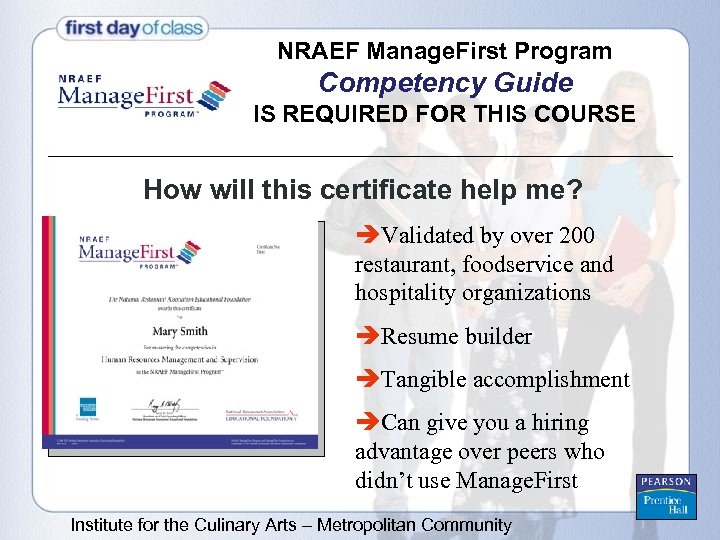 NRAEF Manage. First Program Competency Guide IS REQUIRED FOR THIS COURSE How will this certificate help me? èValidated by over 200 restaurant, foodservice and hospitality organizations èResume builder èTangible accomplishment èCan give you a hiring advantage over peers who didn’t use Manage. First Institute for the Culinary Arts – Metropolitan Community
 Academic Scholarship for NRAEF Manage. First Program® Students • • http: //www. nraef. org/scholarships/managefirst/ Application deadline: March 31, 2009 Award amount: $2, 500 You can apply online at the above link Scholarships are for Undergraduate students enrolled in accredited culinary schools or Manage. First Program students
 Additional Scholarships • Metropolitan Community College Foundation scholarships – due 3/15/09 • Academic Dean scholarships – Spring quarter – due 3/13/09 – Summer quarter – due 6/16/09 – Must be pursuing Culinary Arts degree and have a 3. 0 GPA • Apply online: https: //scholarships. mccneb. edu/stars
 Let’s Take a Break Please be back in 10 minutes
 Agenda • Change in Schedule: – March 24 th will be the Can Cutting – March 31 st Chapter 3 & 4 and Inventory Book Set-up • • • U. S, Foodservices Tour – 9 am Sign-up for Inventory & Group Presentations Tuesday, April 21 st, Tour of U. S Foodservice Chapter One – Introduction to Inventory & Purchasing Chapter Two - The Purchasing Function Work on Group Projects
 1 OH 1 -16 Introduction to Inventory and Purchasing n Test Your Knowledge
 Chapter Learning Objectives n Define purchasing, procurement, and product selection. n Outline the objectives in the purchasing function. n Describe the importance of maintaining an operation’s competitive position. n List the types of goods and services that might be purchased by a foodservice organization. OH 1 -17
 Test Your Knowledge n Chapter One – page 2 Competency Guide OH 1 -18
 Purchasing vs. Procurement n Purchasing – to obtain products and services of a desired quality at a desired price. n Procurement – the entire process by OH 1 -19 which products and services are selected based on quality and cost, to include: what products and services are needed, the quality specifications, when the items will be needed, from which vendors you will purchase, managing the contracts, as well as establishing all the purchasing, receiving storing and
 Franchise vs. Independent n Franchise – a business purchased from a company along with the right to use that company’s name, logo and products. n Provides for purchasing through franchisor’s central commissary n Independent – stand alone operation n Cooperative buying or co-op buying occurs OH 1 -20 when independent operators combine their purchasing power to cooperatively purchase all goods and services as a collective group in order to get lower
 Economies of Scale n Franchise owners may purchase either through their commissaries or through a co-op n Independent owners may purchase through a co-op or independently n Profit is earned after all operating expenses have been paid by either operation OH 1 -21
 Goals of the Purchasing Function 1. Maintain adequate supply. 2. Maintain quality standards. 3. Minimize investment. 4. Maintain an operation’s competitive position. 5. Obtain the lowest possible edible portion (EP) or as served (AS) price. OH 1 -22
 Purchasing Impacts The availability of items for sale: n Too few items means product outages n Too many items means spoilage, waste, and theft OH 1 -23
 Maintain Adequate Supply n Utilize customer count histories. n Sources of data include: n The point-of-sale (POS) system n Guest checks n Physical counts n Count customers by day part. OH 1 -24
 Maintain Adequate Supply continued n Monitor popularity index of items sold. n The popularity index measures the popularity of a specific menu item in relation to other items in its category. n The popularity index also measures the popularity of one menu category relative to other categories. OH 1 -25
 Maintain Adequate Supply continued Additional areas of concern include: n Vendor delivery schedules n Availability of items from vendors n External factors that can influence item sales OH 1 -26
 Maintain Quality Standards Foodservice managers maintain quality by: n Following the operation’s specifications (specs) on each menu item or ingredient purchased n Clearly communicating these standards to current and potential vendors OH 1 -27
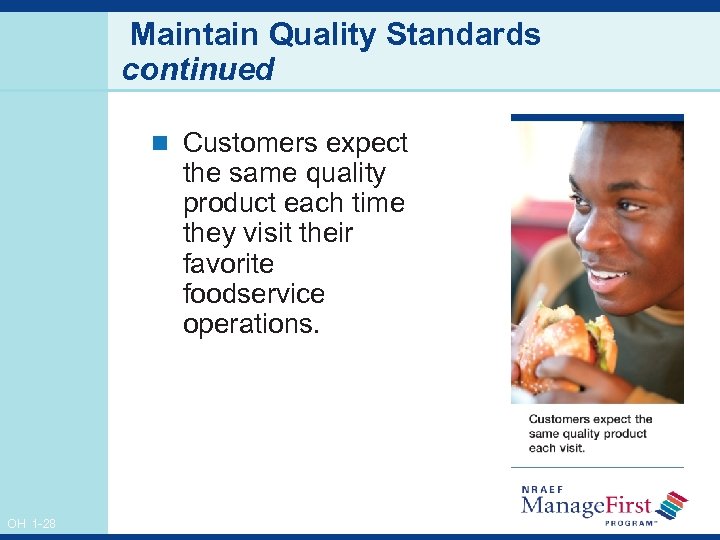 Maintain Quality Standards continued n Customers expect the same quality product each time they visit their favorite foodservice operations. OH 1 -28
 Minimize Investment n Tying up excessive dollars in inventory can damage a foodservice operation by restricting the amount of cash available for bill payment. n Ideal inventory levels are directly related to cash availability and to storage capability. OH 1 -29
 Minimize Investment continued n In most cases, prices increase rather than decrease. As a result, effective foodservice managers: n Minimize investment by purchasing the maximum amount of quality product available at the minimum price possible. n Negotiate reduced prices for large quantity purchases. OH 1 -30
 Maintain an Operation’s Competitive Advantage n Choose vendors who: n Deliver frequently n Deliver at convenient hours n Can deliver in an emergency outage situation n Provide flexible payment options n Deliver consistent quality OH 1 -31
 Obtain the Lowest Possible EP or AS Price n EP = Edible portion price n AS = As served price n EP and AS refer to the price of an item after all trim and waste has been taken into account. Example: peeled, cubed potatoes n AP= As purchased price n AP refers to the price of an item before any trim or waste are considered. Example: unpeeled, whole potatoes OH 1 -32
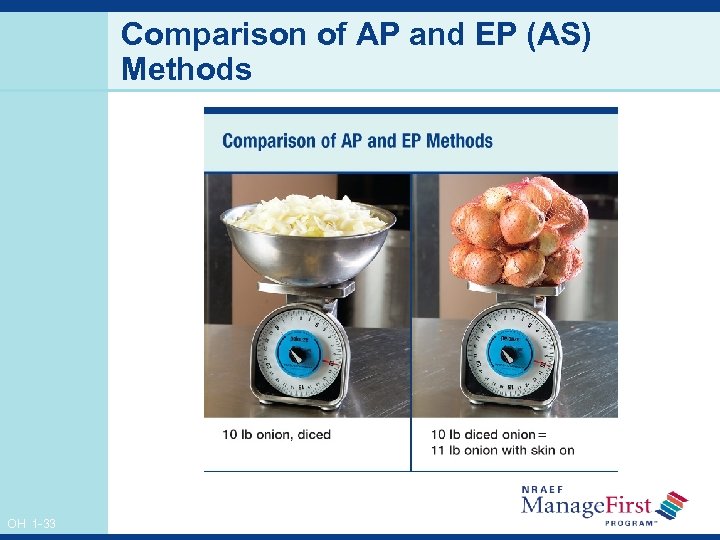 Comparison of AP and EP (AS) Methods OH 1 -33
 Mismanaging the Purchase Function n Leads to product outages n Results in lost sales n Alienates customers n Ties up excessive amounts of cash n Increases operating (food and beverage) costs OH 1 -34
 What to Buy Foodservice managers buy many items including: n Food items n Furniture, fixtures, n Alcoholic beverages n Nonalcoholic beverages n Nonfood items and equipment (FF&E) n Business supplies and services n Support services n Maintenance services n Utilities OH 1 -35
 Buying Food Items n Meat n Poultry n Dairy n Eggs n Produce n Processed foods OH 1 -36 n Fish n Dry and canned goods
 Buying Alcoholic Beverages n Spirits n Beer n Wine OH 1 -37
 Buying Nonalcoholic Beverages n Soda n Coffee n Tea n Juice n Bottled water OH 1 -38
 Buying Nonfood Items n Linens and uniforms n China and n Menus and beverage lists glassware n Candles n Bar supplies n Flowers n Paper goods n Music and n Cleaning supplies entertainment n Kitchen utensils and supplies OH 1 -39
 Buying Furniture, Fixtures, and Equipment n Tables, chairs, and n Refrigeration n Lighting fixtures n Plumbing fixtures n Bars n Heating, ventilation, barstools n Cooking equipment air conditioning (HVAC) n Entertainment pieces OH 1 -40
 Buying Business Supplies and Services n Office equipment n Credit card n Cash registers n Financial and legal and supplies n POS systems n Computers processors services n Insurance n Marketing and advertising OH 1 -41
 Buying Support Services n Linen and uniform rental n Waste removal n Flower services OH 1 -42 n Music services n Pest control n Parking and valet services
 Buying Maintenance Services n Cleaning services n Carpentry n Plumbing repair n Equipment n HVAC repair n Groundskeeping n Painting OH 1 -43 maintenance n Equipment repair n Equipment replacement
 Buying Utilities n Gas n Sewage services n Oil heating n Telephones n Electricity n Internet access n Water OH 1 -44
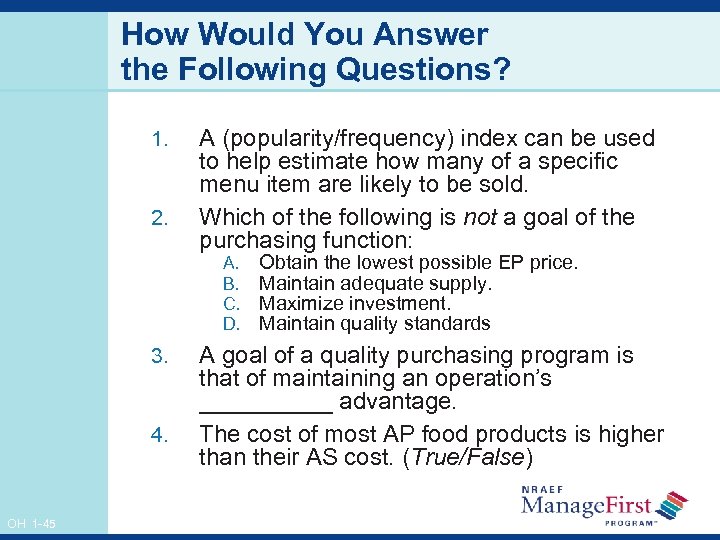 How Would You Answer the Following Questions? 1. 2. A (popularity/frequency) index can be used to help estimate how many of a specific menu item are likely to be sold. Which of the following is not a goal of the purchasing function: A. B. C. D. 3. 4. OH 1 -45 Obtain the lowest possible EP price. Maintain adequate supply. Maximize investment. Maintain quality standards A goal of a quality purchasing program is that of maintaining an operation’s _____ advantage. The cost of most AP food products is higher than their AS cost. (True/False)
 Chapter Learning Objectives— What Did You Learn? n Define purchasing, procurement, and product selection. n Outline the objectives in the purchasing function. n Describe the importance of maintaining an operation’s competitive position. n List the types of goods and services that might be purchased by a foodservice organization. OH 1 -46
 Next Week n Review Your Learning questions from Chapter One n Read Chapter One & Two OH 1 -47