 Скачать презентацию WELCOME Briefing Writeshop on the Strategic Performance
5e1e9aa42b7dad2c51c5f9ea5ec0ee6b.ppt
- Количество слайдов: 168



WELCOME Briefing / Writeshop on the Strategic Performance Management System • UNIVERSITY OF THE PHILIPPINES • NATIONAL COMMISSION ON INDIGENOUS PEOPLES • HOUSING AND LAND USE REGULATORY BOARD JULY 23 / 25 / 26, 2013
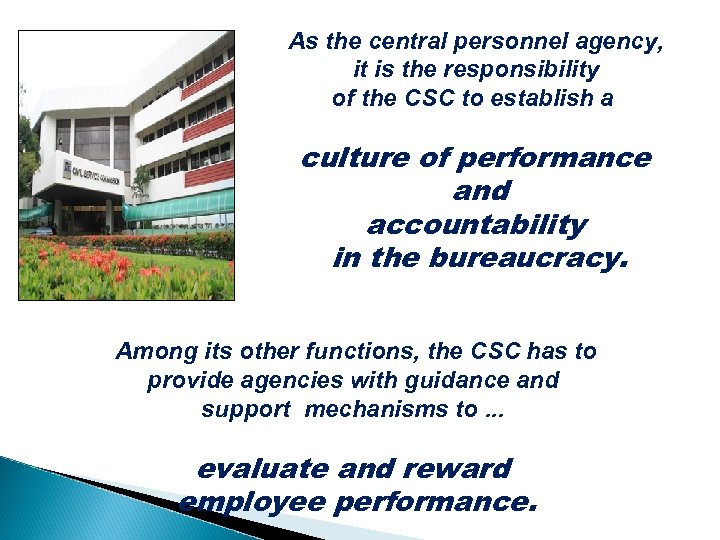
As the central personnel agency, it is the responsibility of the CSC to establish a culture of performance and accountability in the bureaucracy. Among its other functions, the CSC has to provide agencies with guidance and support mechanisms to. . . evaluate and reward employee performance.
CSC Maintains its Vision of a Civil Service Governed by merit and fitness Respected for its efficiency, effectiveness, and integrity Compensated based on rational, realistic and uniform parameters
CSC Maintains its Vision of a Civil Service Recognized for its own identity, autonomy and expertise Motivated by service and committed to a mission marked by transparency and accountability
Why Focus on Performance? • An organization succeeds/fails based on the attainment of GOALS • The most important determinant of success lies in the PERFORMANCE of personnel • When people do not perform, an organization fails: q Private sector : No profit = Bankruptcy q GOVERNMENT : NO SERVICE = NO EFFECT (? )
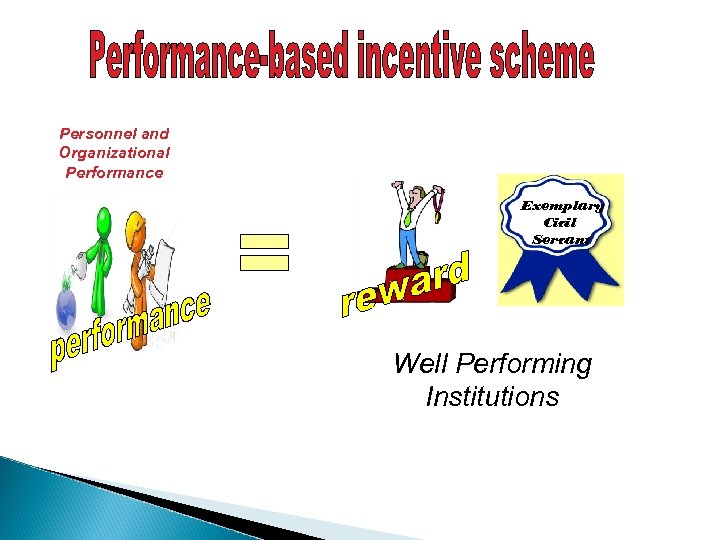
Personnel and Organizational Performance Exemplary Civil Servant Well Performing Institutions
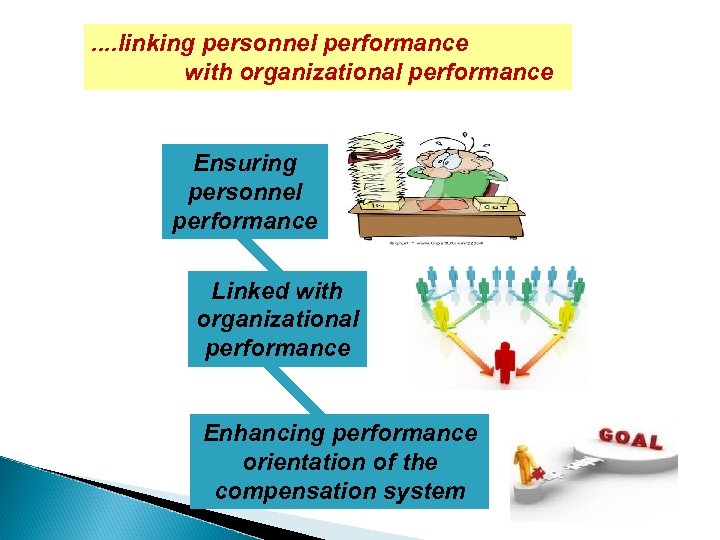
. . linking personnel performance with organizational performance Ensuring personnel performance Linked with organizational performance Enhancing performance orientation of the compensation system
EXECUTIVE ORDER No. 80, s. 2012 (Issued July 20, 2012)
DIRECTING THE ADOPTION OF A PERFORMANCE-BASED INCENTIVE SYSTEM FOR GOVERNMENT EMPLOYEES
WHEREAS, there is a need to rationalize the current incentive system in government which is generally characterized by across-the-board bonuses that are given uniformly to all civil servants;
WHEREAS, there is a need to strengthen performance monitoring and appraisal systems based on existing systems like the Organizational Performance Indicator Framework (OPIF) which is being used by the Department of Budget and Management (DBM) to measure agency performance, the Strategic Performance Management System (SPMS) of the Civil Service Commission (CSC) which links individual performance to organizational performance, and the Results. Based Performance Monitoring System (RBPMS).
WHEREAS, service delivery by the bureaucracy can be improved by linking personnel incentives to the bureau or delivery unit’s performance and recognizing and rewarding exemplary performance in the public sector;
WHEREAS, there is a need to establish and implement a Performance-Based Incentive (PBI) System that will motivate higher performance and greater accountability in the public sector and ensure the accomplishment of commitments and targets under the five (5) Key Result Areas (KRAs) laid down in Executive Order (EO) No. 43 (s. 2011) and the Philippine Development Plan (PDP) 20112016;
WHEREAS, Administrative Order (AO) No. 25 (s. 2011) seeks to establish a unified and integrated RBPMS across all departments and agencies within the Executive Branch of Government, incorporating a common set performance scorecard, and creating an accurate, accessible, and up-todate government-wide, sectoral, and organizational performance information system, which shall be used as basis for determining entitlement to performance-based allowances, incentives, or compensation of government personnel;
WHEREAS, one of the governing principles of the Senate and House of Representatives Joint Resolution (JR) No. 4 (s. 2009), otherwise known as the “Salary Standardization Law (SSL) III, ” is the establishment of a PBI scheme which aligns personnel efforts to organizational performance to reward exemplary civil servants and well-performing institutions; and
WHEREAS, Presidential Decree (PD) No. 985, PD 1597, Republic Act (RA) No. 6758, as amended by Senate and House of Representatives JR Nos. 1 and 4, authorized the President to approve policies and levels of allowances and benefits.
SECTION 1. Adoption of a PBI System. A PBI system consisting of the Productivity Enhancement Incentive (PEI) and the Performance-Based Bonus (PBB) shall be adopted in the national government beginning Fiscal Year (FY) 2012.
a. The PEI, in the amount of P 5, 000, shall continually be granted across-the-board, in accordance with the guidelines to be issued by DBM.
b. The PBB, which is a top-up bonus, shall be given to personnel of bureaus or delivery units in accordance with their contribution to the accomplishment of their Department’s overall targets and commitments, subject to the following criteria:
i. Achievements by the Departments of performance targets under their respective Major Final Outputs (MFOs), and Priority Program/Project commitments as agreed with the President under the 5 KRAs under EO 43; and
ii. Accomplishment of good governance conditions set by the Inter-Agency Task Force (IATF) created under AO 25.
SECTION 2. Guidelines for the PBB. The following guidelines and principles shall govern the PBB scheme:
a. The PBB shall be characterized as a system of ranking units and personnel within an organization according to their performance as measured by verifiable, observable, credible, and sustainable indicators of performance based on the following pillars:
i. Department’s Major Final Outputs; ii. Department’s commitments to the President which are supportive of the priorities under EO 43; and iii. Good governance conditions to be determined by IATF under AO 25.
b. Flexibility shall be provided to the heads of departments and agencies to suit the PBB system to the nature of their operations and to drive peak performers, in terms of the determination of the appropriate delivery units to be rewarded and the performance indicators to be used; and
c. There shall be appropriate communications strategy and publication of performance targets and accomplishments in the department and agency websites and the website for the RBPMS to ensure transparency and accountability in the implementation of the PBB scheme.
SECTION 3. Performance Categories and Rates of Incentives. The amount of the PBB shall be based on the performance of the departments, bureaus or delivery units, and of the individual employees. Department Secretaries or their duly designated officials shall rank the bureaus or delivery units, including attached agencies, according to their performance following a normal distribution.
The PBB shall be distributed according to the following scheme for FY 2012, without prejudice to the revision thereof in succeeding years, as may be approved by the President, upon recommendation of the IATF:
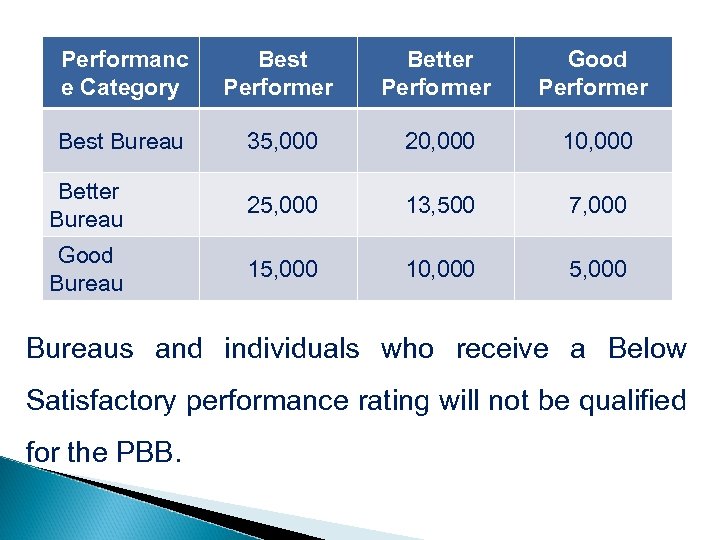
Performanc e Category Best Performer Better Performer Good Performer Best Bureau 35, 000 20, 000 10, 000 Better Bureau 25, 000 13, 500 7, 000 Good Bureau 15, 000 10, 000 5, 000 Bureaus and individuals who receive a Below Satisfactory performance rating will not be qualified for the PBB.
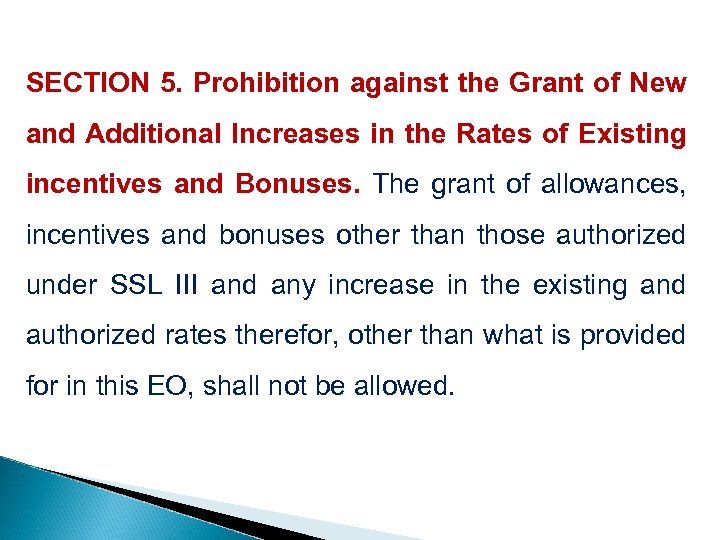
SECTION 5. Prohibition against the Grant of New and Additional Increases in the Rates of Existing incentives and Bonuses. The grant of allowances, incentives and bonuses other than those authorized under SSL III and any increase in the existing and authorized rates therefor, other than what is provided for in this EO, shall not be allowed.
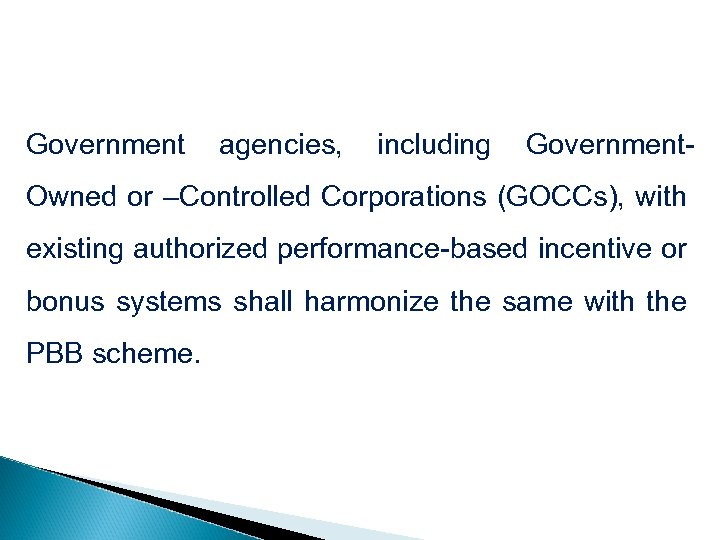
Government agencies, including Government. Owned or –Controlled Corporations (GOCCs), with existing authorized performance-based incentive or bonus systems shall harmonize the same with the PBB scheme.
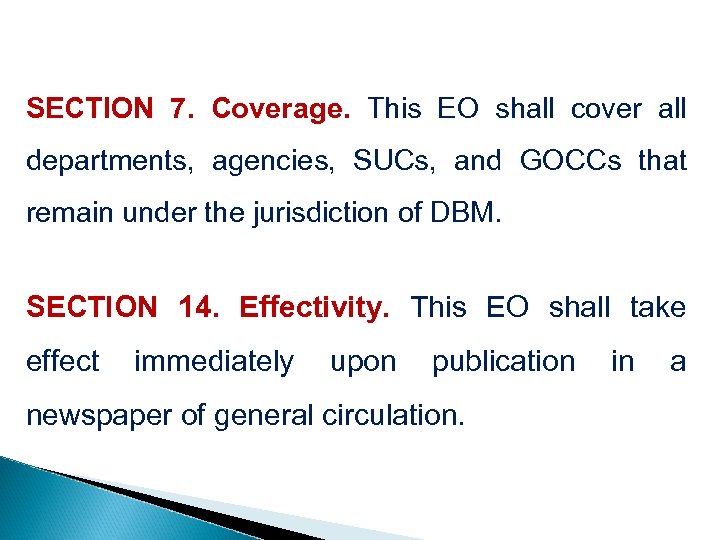
SECTION 7. Coverage. This EO shall cover all departments, agencies, SUCs, and GOCCs that remain under the jurisdiction of DBM. SECTION 14. Effectivity. This EO shall take effect immediately upon publication in a newspaper of general circulation.
DEPARTMENT OF BUDGET AND MANAGEMENT MEMORANDUM CIRCULAR NO. 2012 -02 OCTOBER 16, 2012 GUIDELINES TO CLARIFY THE GOOD GOVERNANCE CONDITIONS FOR FISCAL YEAR 2012 IN LINE WITH THE GRANT OF THE PERFORMANCE-BASED BONUS UNDER EXECUTIVE ORDER (EO) NO. 80
GOOD GOVERNANCE CONDITION 1 TRANSPARENCY SEAL GOOD GOVERNANCE CONDITION 2 Phil. GEPS POSTING
GOOD GOVERNANCE CONDITION 3 CASH ADVANCE (CA) LIQUIDATION GOOD GOVERNANCE CONDITION 4 CITIZEN’S CHARTER OR ITS EQUIVALENT
CSC MC No. 6, s. 2012 The CSC through Resolution No. 1200481 dated March 16, 2012 promulgated the “Guidelines in Implementation the Establishment of Agency and Strategic Performance Management System (SPMS)”
What is a Performance Management System (SPMS)? . . . is a set of processes for establishing a shared understanding of: 1. WHAT WILL BE ACHIEVED (goals) 2. HOW IT WILL BE ACHIEVED 3. and MANAGING PEOPLE in a way that will increase the probability that it will be achieved. It is a mechanism to address the demand to produce tangible results The PMS is a means to professionalize the Civil Service
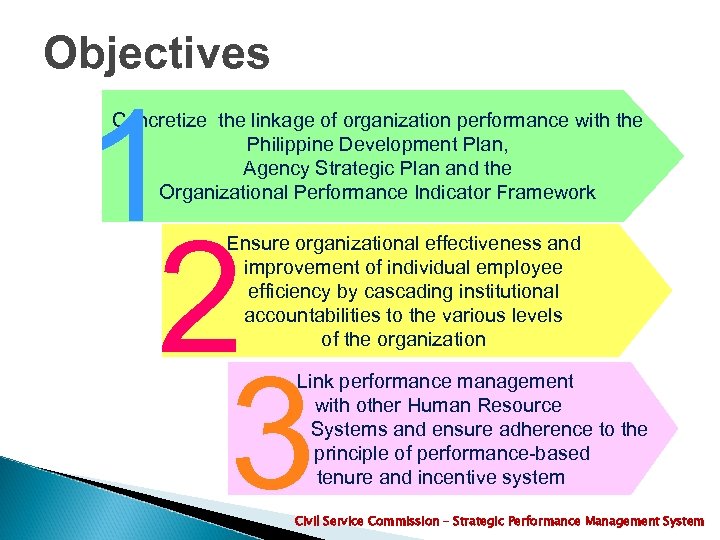
Objectives 1 2 3 Concretize the linkage of organization performance with the Philippine Development Plan, Agency Strategic Plan and the Organizational Performance Indicator Framework Ensure organizational effectiveness and improvement of individual employee efficiency by cascading institutional accountabilities to the various levels of the organization Link performance management with other Human Resource Systems and ensure adherence to the principle of performance-based tenure and incentive system Civil Service Commission – Strategic Performance Management System
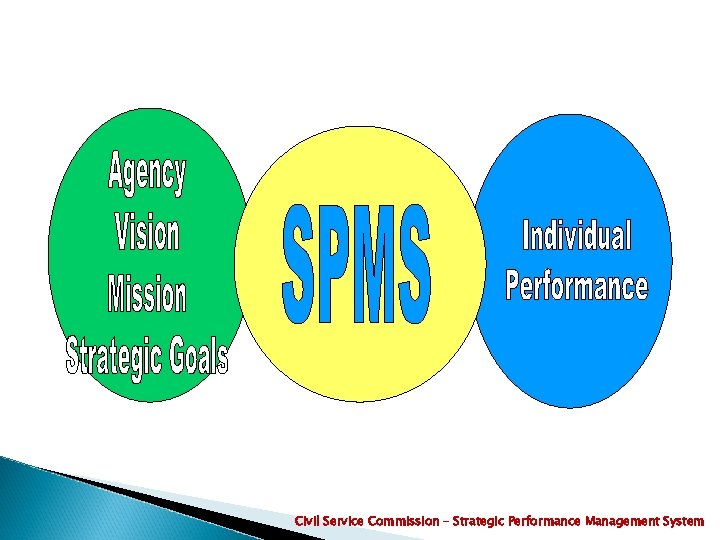
Civil Service Commission – Strategic Performance Management System
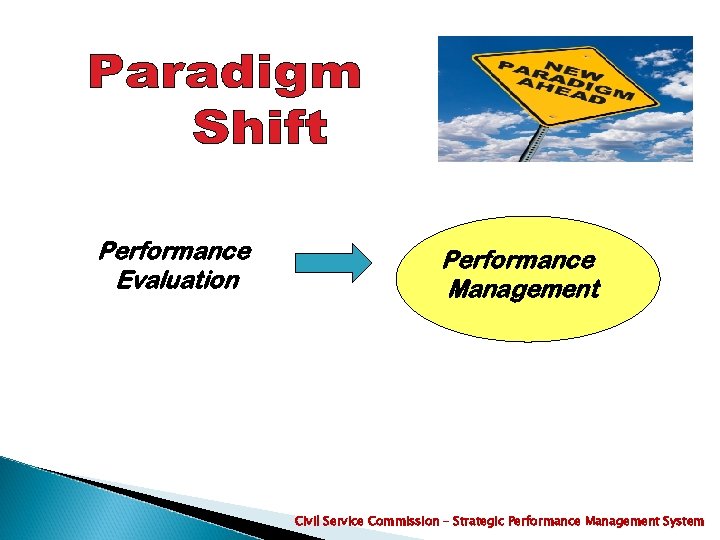
Performance Evaluation Performance Management Civil Service Commission – Strategic Performance Management System
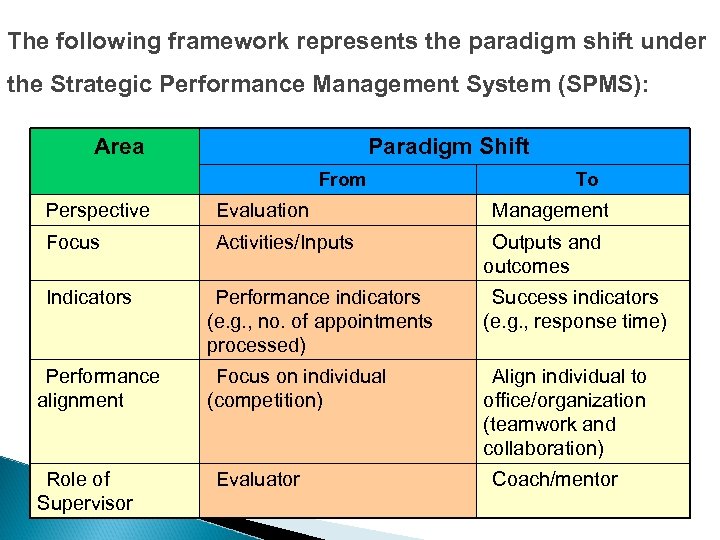
The following framework represents the paradigm shift under the Strategic Performance Management System (SPMS): Area Paradigm Shift From Perspective Evaluation Focus Activities/Inputs Indicators Performance alignment Role of Supervisor To Management Outputs and outcomes Performance indicators (e. g. , no. of appointments processed) Success indicators (e. g. , response time) Focus on individual (competition) Align individual to office/organization (teamwork and collaboration) Evaluator Coach/mentor
Scope and Coverage National Government Agencies Government-Owned & Controlled Corporations Local Government Units State Universities and Colleges Civil Service Commission – Strategic Performance Management System
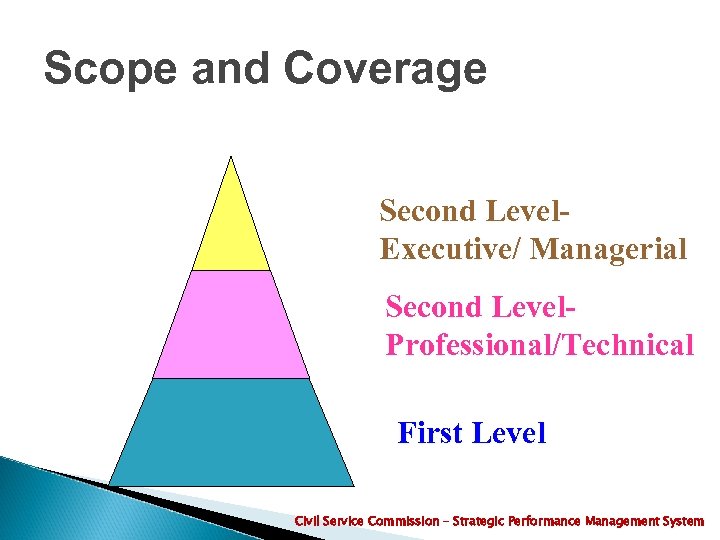
Scope and Coverage Second Level. Executive/ Managerial Second Level. Professional/Technical First Level Civil Service Commission – Strategic Performance Management System
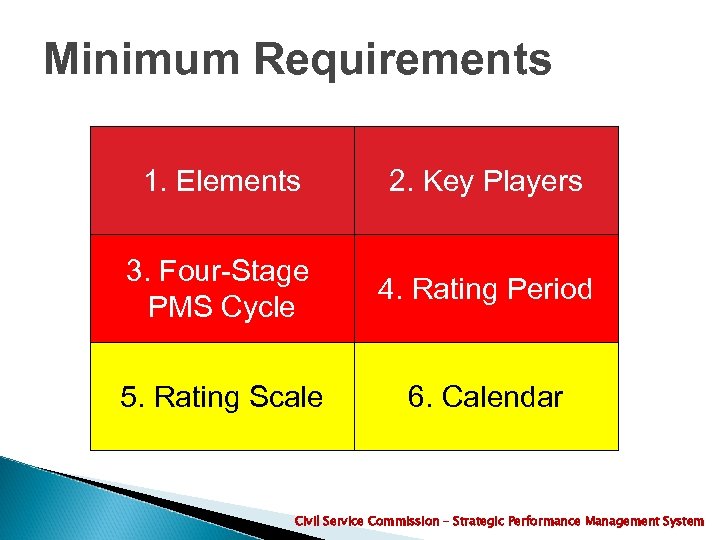
Minimum Requirements 1. Elements 2. Key Players 3. Four-Stage PMS Cycle 4. Rating Period 5. Rating Scale 6. Calendar Civil Service Commission – Strategic Performance Management System
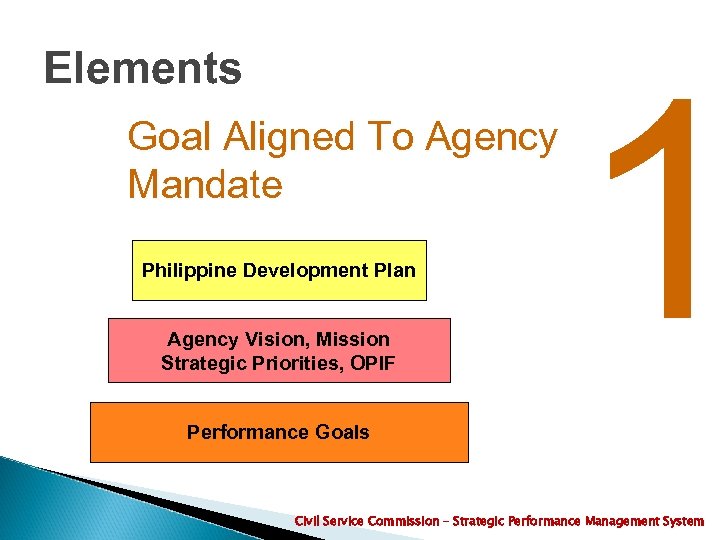
Elements Goal Aligned To Agency Mandate Philippine Development Plan Agency Vision, Mission Strategic Priorities, OPIF 1 Performance Goals Civil Service Commission – Strategic Performance Management System
Elements Outputs/ Outcomes-based 2 Civil Service Commission – Strategic Performance Management System
Elements Team approach 3 Civil Service Commission – Strategic Performance Management System
Elements User-friendly Forms 4 Civil Service Commission – Strategic Performance Management System
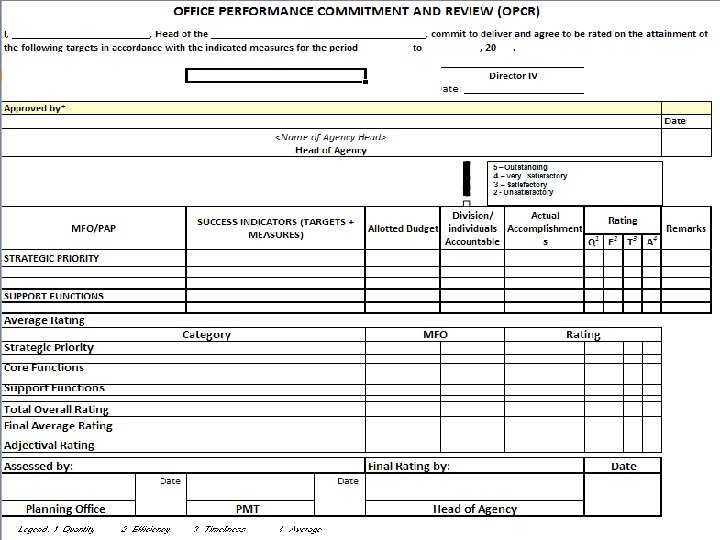
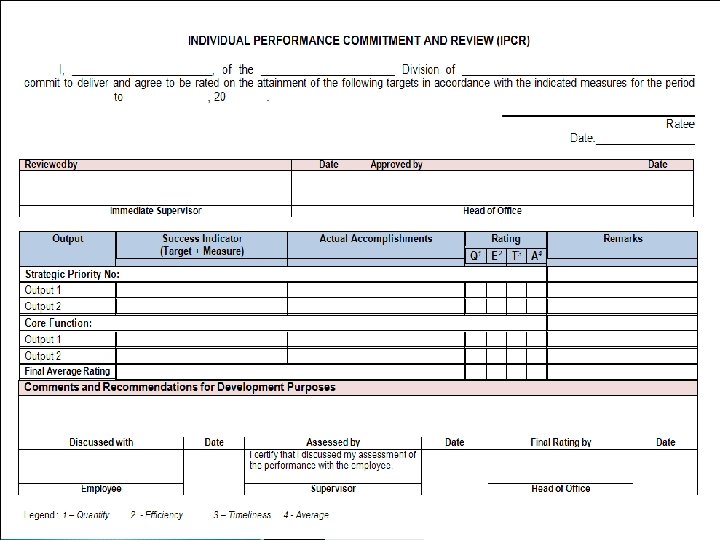
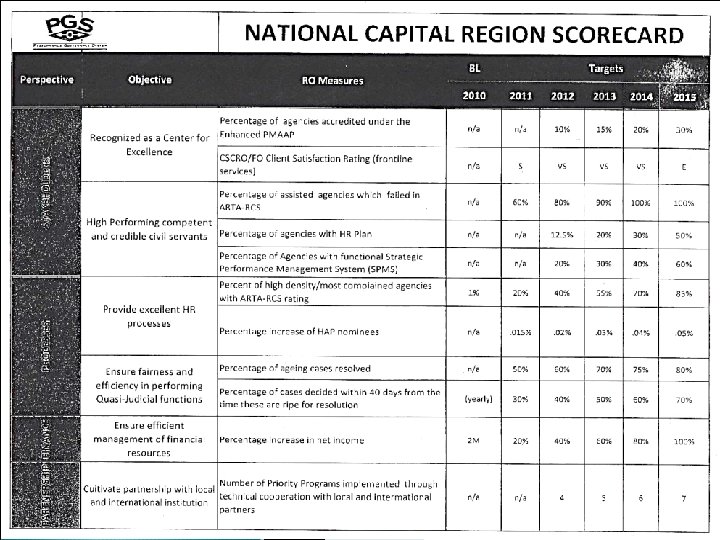
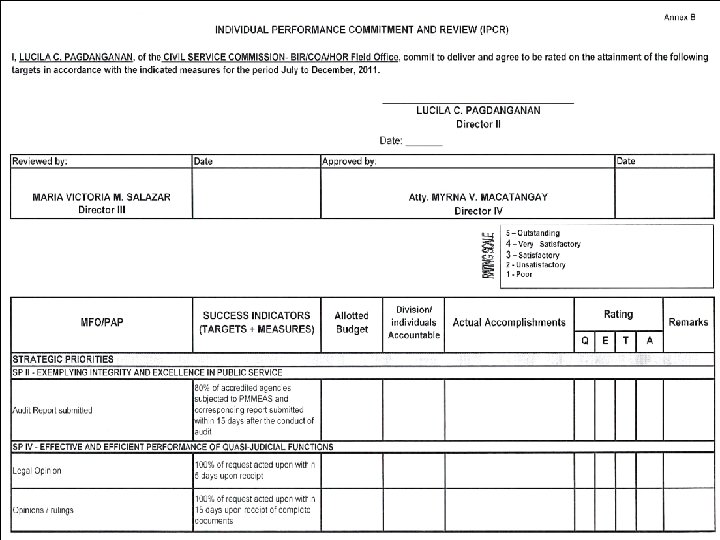
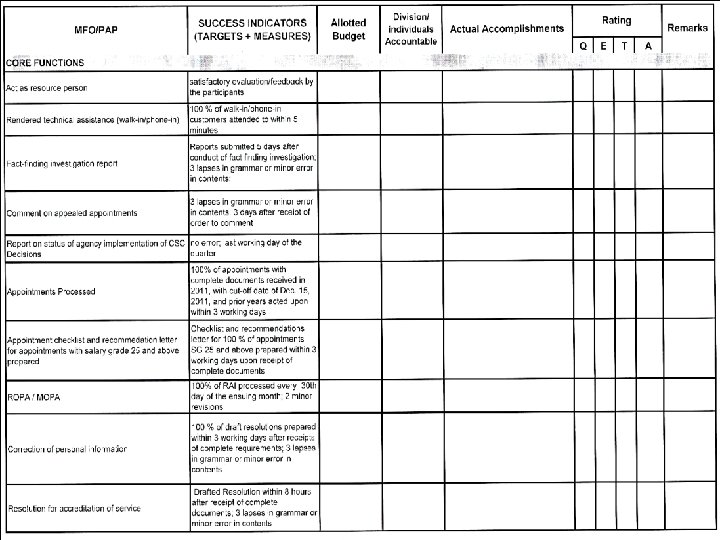
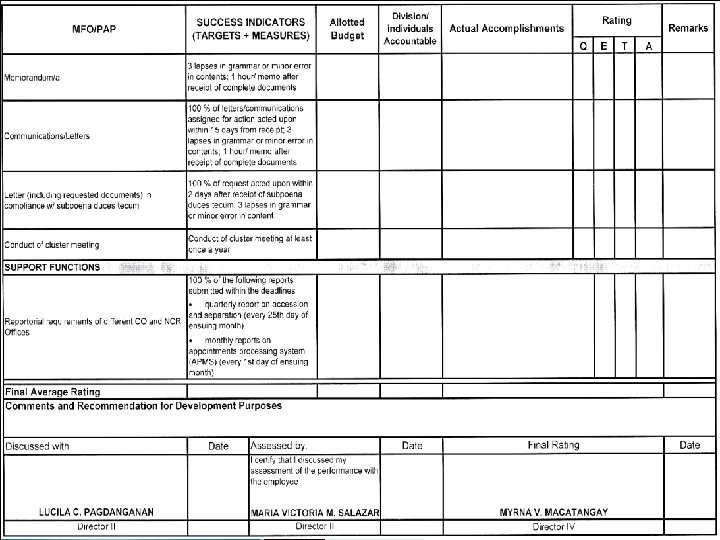
Elements Information System 5 Civil Service Commission – Strategic Performance Management System
Elements Communication Plan 6 Civil Service Commission – Strategic Performance Management System
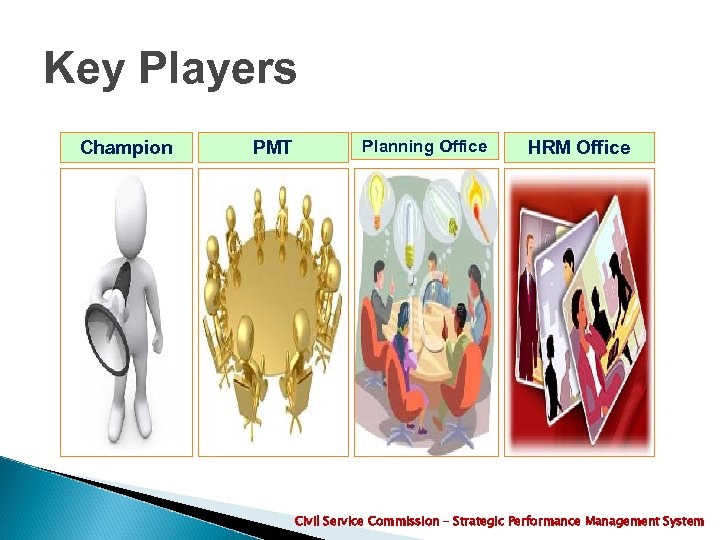
Key Players Champion PMT Planning Office HRM Office Civil Service Commission – Strategic Performance Management System
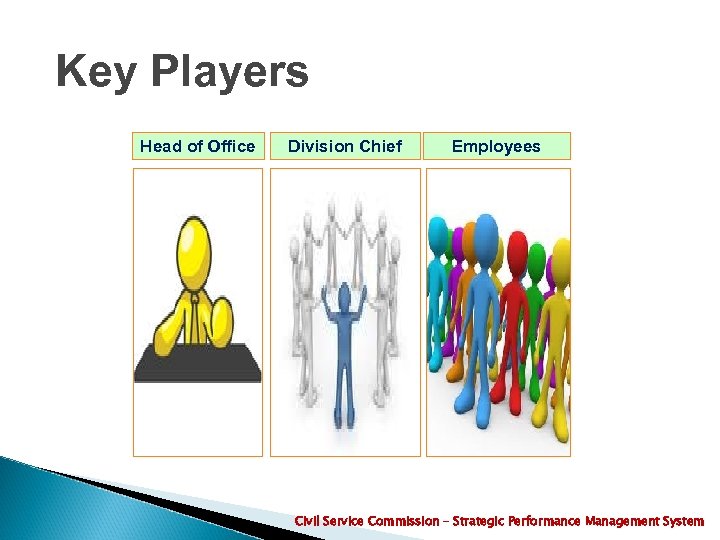
Key Players Head of Office Division Chief Employees Civil Service Commission – Strategic Performance Management System
Key Players & Responsibilities PMT Composition of Performance Management Team (Agency Level) 1. Executive Official designated as Chairperson 2. Highest Human Resource Management Officer 3. Highest Human Resource Development Officer 4. Highest Planning Officer 5. Highest Finance Officer 6. President of the accredited employee association Civil Service Commission – Strategic Performance Management System
Key Players & Responsibilities PMT Composition of Performance Management Team (Regional Level) 1. Executive Official designated by the Regional Head as Chairperson 2. Highest officer in charge of human resource management 3. Highest officer in charge of financial management Civil Service Commission – Strategic Performance Management System
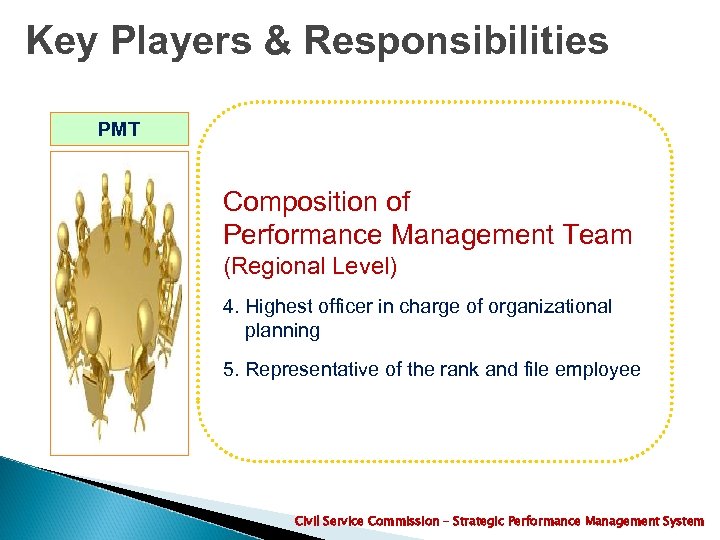
Key Players & Responsibilities PMT Composition of Performance Management Team (Regional Level) 4. Highest officer in charge of organizational planning 5. Representative of the rank and file employee Civil Service Commission – Strategic Performance Management System
Key Players & Responsibilities Champion • Responsible and accountable for the establishment and implementation of SPMS • Sets agency performance goals/ objectives and performance measure • Determines agency target setting period • Approves office performance commitment and rating • Assesses performance of Offices Civil Service Commission – Strategic Performance Management System
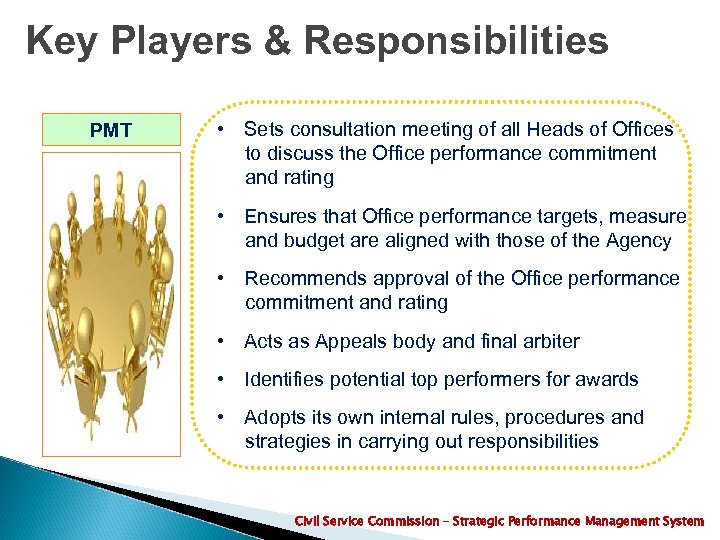
Key Players & Responsibilities PMT • Sets consultation meeting of all Heads of Offices to discuss the Office performance commitment and rating • Ensures that Office performance targets, measure and budget are aligned with those of the Agency • Recommends approval of the Office performance commitment and rating • Acts as Appeals body and final arbiter • Identifies potential top performers for awards • Adopts its own internal rules, procedures and strategies in carrying out responsibilities Civil Service Commission – Strategic Performance Management System
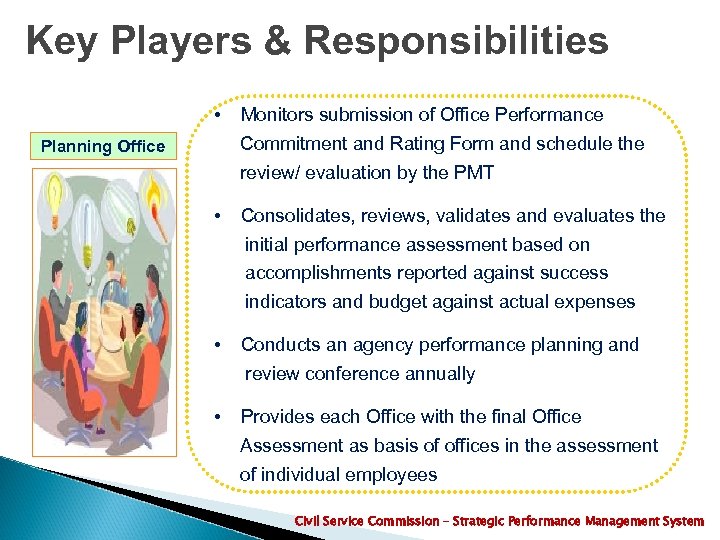
Key Players & Responsibilities Planning Office • Monitors submission of Office Performance Commitment and Rating Form and schedule the review/ evaluation by the PMT • Consolidates, reviews, validates and evaluates the initial performance assessment based on accomplishments reported against success indicators and budget against actual expenses • Conducts an agency performance planning and review conference annually • Provides each Office with the final Office Assessment as basis of offices in the assessment of individual employees Civil Service Commission – Strategic Performance Management System
Key Players & Responsibilities HRM Office • Monitors submission of Individual Performance Commitment and Rating Form • Reviews the Summary List of Individual Performance Rating • Provides analytical data on retention, skill/ competency gaps and talent development plan • Coordinate developmental interventions that will form part of the HR Plan Civil Service Commission – Strategic Performance Management System
Key Players & Responsibilities Head of Office • Assumes primary responsibility for performance management in his/her Office • Conducts strategic planning session with supervisors and staff • Reviews and approves individual performance commitment and rating form • Submits quarterly accomplishment report • Does initial assessment of office’s performance • Determines final assessment of individual employees’ performance level • Informs employees of the final rating and identifies necessary interventions to employees • Provides written notice to subordinates who obtain Unsatisfactory or Poor rating Civil Service Commission – Strategic Performance Management System
Key Players & Responsibilities Division Chief • Assumes joint responsibility with the Head of Office in attaining performance targets • Rationalizes distribution of targets/tasks • Monitors closely the status of performance of subordinates • Assesses individual employees’ performance • Recommends developmental intervention Civil Service Commission – Strategic Performance Management System
Key Players & Responsibilities Employees • Acts as partners of management and co-employees in meeting organizational performance goals Civil Service Commission – Strategic Performance Management System
CSC MC No. 08, s. 2013 (April 02, 2003) RESULT BASED PERFORMANCE MANAGEMENT SYSTEM (RBPMS) IMPLEMENTATION IN AGENCIES
To ensure the institutionalization of the RBPMS, all the government agencies are directed to create a Performance Management Team or PMT that will serve as the counterpart of the IATF in the development of the agency’s internal guidelines in the implementation of performance-based incentive system and in the review of the performance indicators, targets and accomplishments from the department down to the individual level.
In addition to these functions, the PMT shall act as the anchor/link between the agency and the Inter. Agency Task Force on RBPMS. In this connection, the list of the PMT members must be submitted to the Secretariat of the Task Force at ao 25 secretariat@dap. edu. ph.
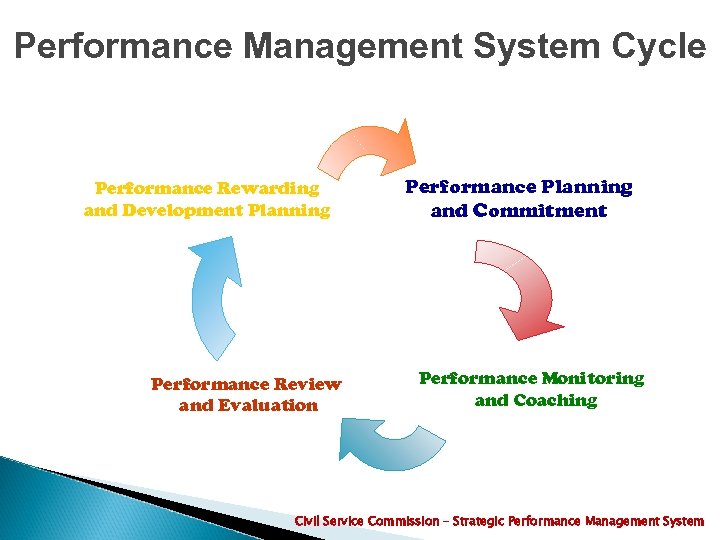
Performance Management System Cycle Performance Rewarding and Development Planning Performance Review and Evaluation Performance Planning and Commitment Performance Monitoring and Coaching Civil Service Commission – Strategic Performance Management System
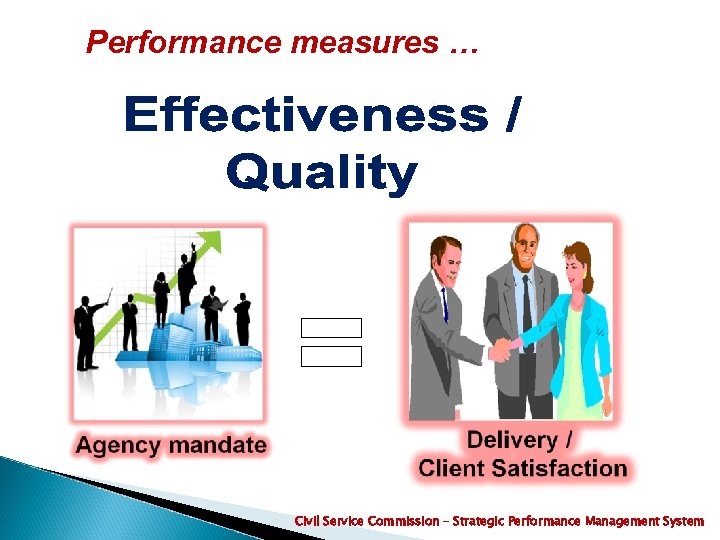
Performance measures … Civil Service Commission – Strategic Performance Management System
Civil Service Commission – Strategic Performance Management System
done on time based on requirements of law and/or clients /stakeholders • project completion deadlines; • time management skills; and • other time sensitive expectations Civil Service Commission – Strategic Performance Management System
PMS Cycle Performance Planning and Commitment Effectiveness /Quality The extent to which actual performance compares with targeted performance. The degree to which objectives are achieved and the extent to which targeted problems are solved. In management, effectiveness relates to getting the right things done. Civil Service Commission – Strategic Performance Management System
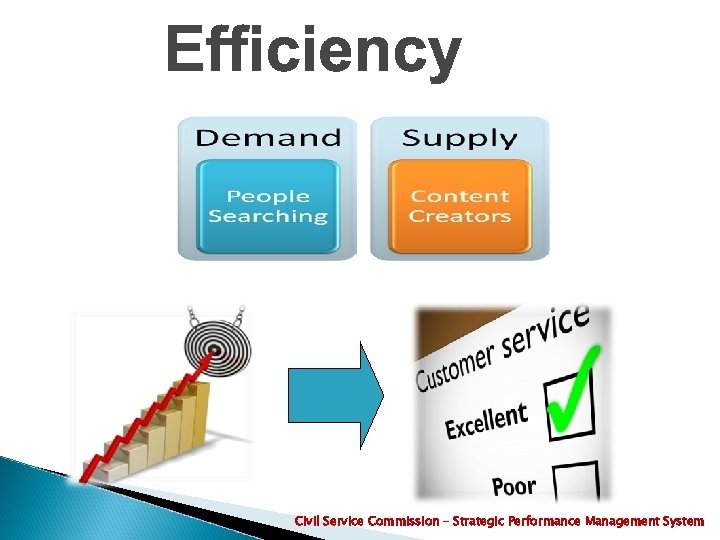
PMS Cycle Performance Planning and Commitment Efficiency The extent to which time or resources is used for the intended task or purpose. Measures whether targets are accomplished with a minimum amount or quantity of waste, expense, or unnecessary effort Civil Service Commission – Strategic Performance Management System
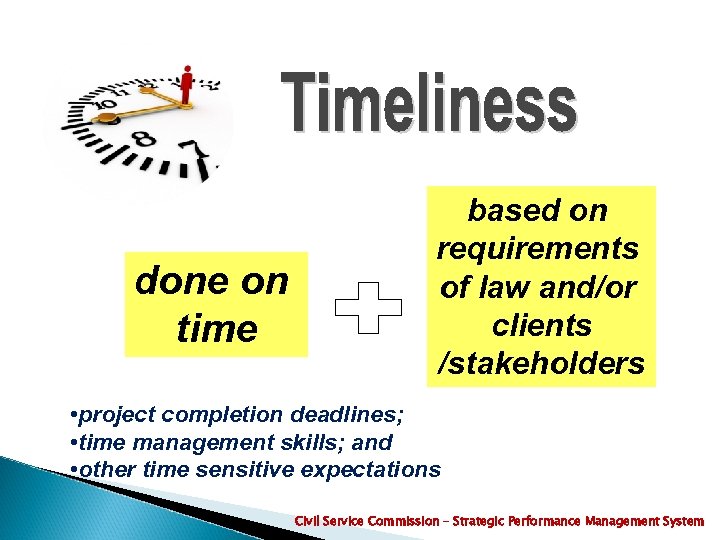
PMS Cycle Performance Planning and Commitment Timeliness Measures whether the deliverable was done on time based on the requirements of the law and/or clients/stakeholders. Time –related performance indicators evaluate such things as project completion deadlines, time management skills and other time- sensitive expectations. Civil Service Commission – Strategic Performance Management System
PMS Cycle Performance Planning and Commitment • Head of Office meeting with supervisors and staff to agree on the outputs that should be accomplished • Success indicators are determined. • Targets shall take into account any combination of, or all of the following: • • • Historical data Benchmarking Client demand OPES Reference Table Top Management instruction Future Trend Civil Service Commission – Strategic Performance Management System
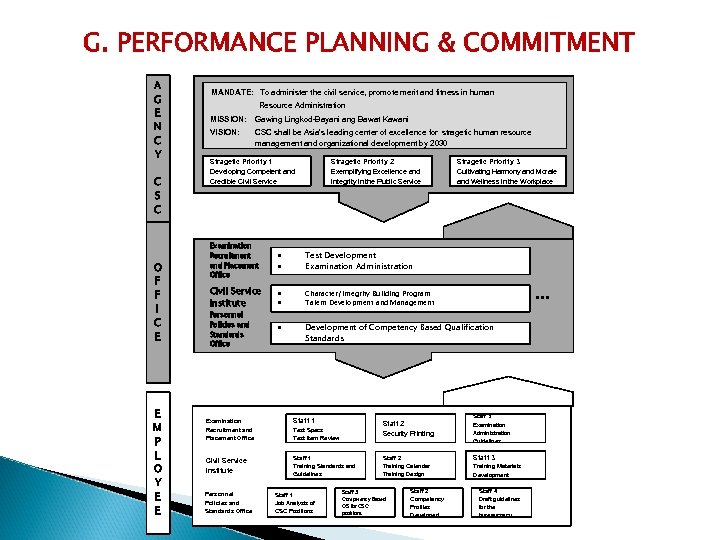
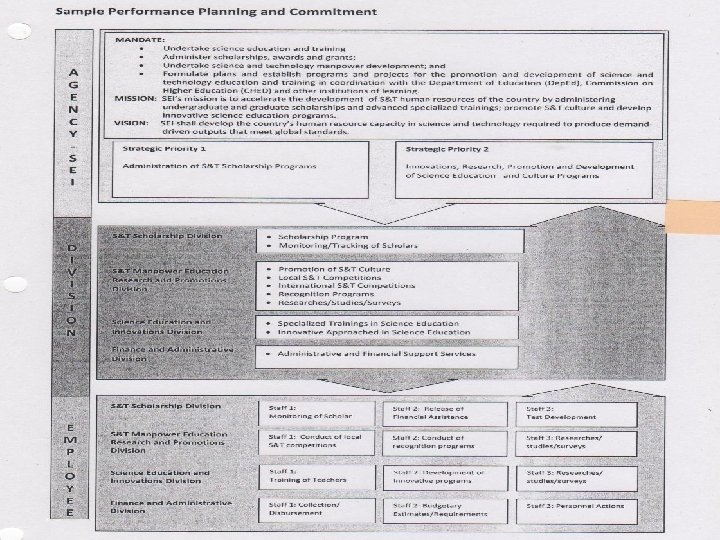
G. PERFORMANCE PLANNING & COMMITMENT A G E N C Y C S C O F F I C E E M P L O Y E E MANDATE: To administer the civil service, promote merit and fitness in human Resource Administration MISSION: Gawing Lingkod-Bayani ang Bawat Kawani VISION: CSC shall be Asia’s leading center of excellence for stragetic human resource management and organizational development by 2030 Stragetic Priority 1 Developing Competent and Credible Civil Service Examination Recruitment and Placement Office Stragetic Priority 2 Exemplifying Excellence and Integrity in the Public Service Stragetic Priority 3 Cultivating Harmony and Morale and Wellness in the Workplace Test Development Examination Administration Civil Service Character/Integrity Building Program Talent Development and Management Personnel Policies and Standards Office Development of Competency Based Qualification Standards Institute Examination Recruitment and Placement Office Staff 1 Civil Service Institute Staff 1 Training Standards and Guidelines Personnel Policies and Standards Office Staff 2 Security Printing Test Specs Test Item Review Staff 1 Job Analysis of CSC Positions Staff 2 Training Calendar Training Design Staff 3 Competency Based QS for CSC positions Staff 2 Competency Profiles Developed … Staff 3 Examination Administration Guidelines Staff 3 Training Materials Development Staff 4 Draft guidelines for the bureaucracy
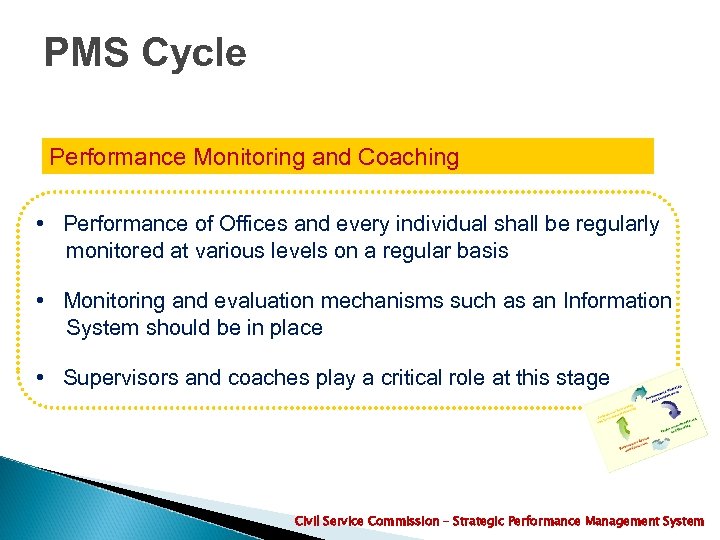
PMS Cycle Performance Monitoring and Coaching • Performance of Offices and every individual shall be regularly monitored at various levels on a regular basis • Monitoring and evaluation mechanisms such as an Information System should be in place • Supervisors and coaches play a critical role at this stage Civil Service Commission – Strategic Performance Management System
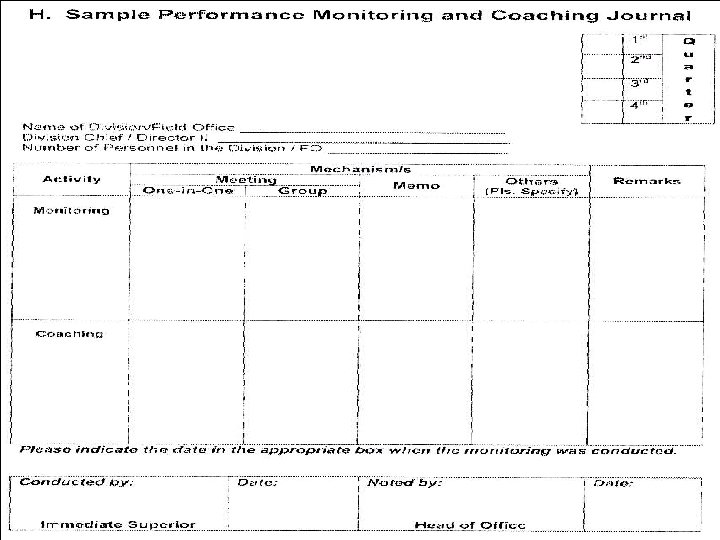
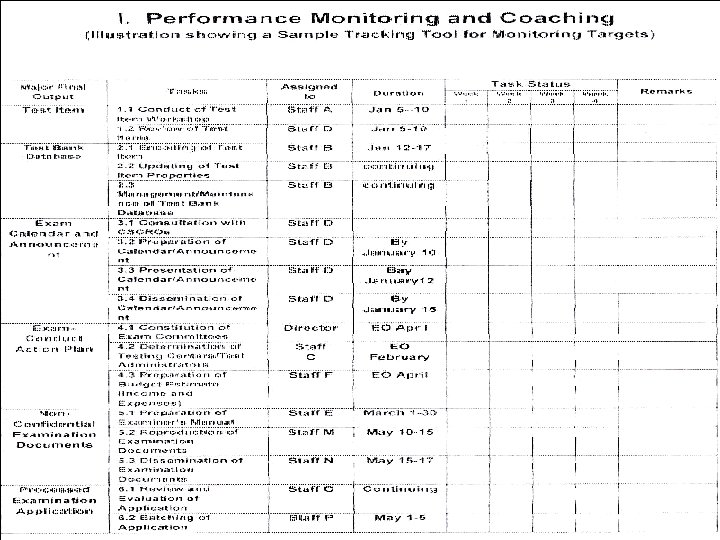
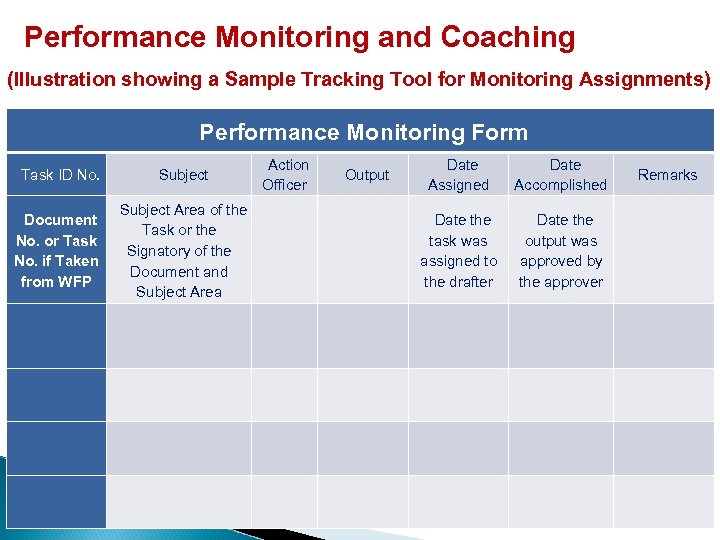
Performance Monitoring and Coaching (Illustration showing a Sample Tracking Tool for Monitoring Assignments) Performance Monitoring Form Task ID No. Subject Document No. or Task No. if Taken from WFP Subject Area of the Task or the Signatory of the Document and Subject Area Action Officer Output Date Assigned Date Accomplished Remarks Date the task was assigned to the drafter Date the output was approved by the approver
PMS Cycle Performance Review and Evaluation • Assesses both Office and individual employee’s performance level based on performance targets and measures as approved • Results of assessment of Office and individual performance shall be impartial Civil Service Commission – Strategic Performance Management System
PMS Cycle Performance Rewarding and Development Planning • Part of the individual employee’s evaluation is the competency assessment vis-à-vis the competency requirements of the job • Results of the assessment shall be discussed by the Head of Office and supervisor with the individual employee at the end of each rating period • Professional development plan must be outlined for employees with Unsatisfactory or Poor ratings Civil Service Commission – Strategic Performance Management System
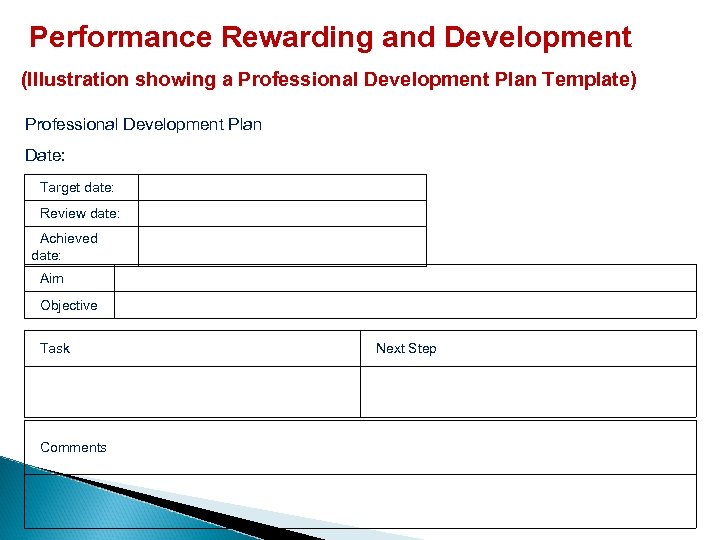
Performance Rewarding and Development (Illustration showing a Professional Development Plan Template) Professional Development Plan Date: Target date: Review date: Achieved date: Aim Objective Task Comments Next Step
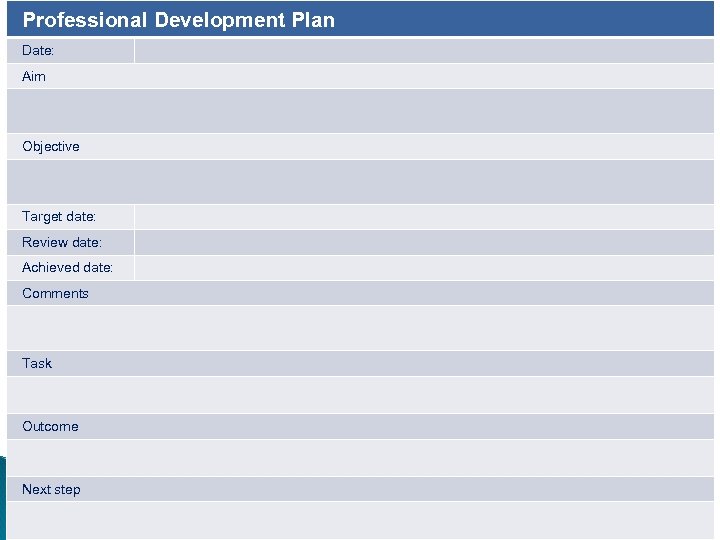
Professional Development Plan Date: Aim Objective Target date: Review date: Achieved date: Comments Task Outcome Next step
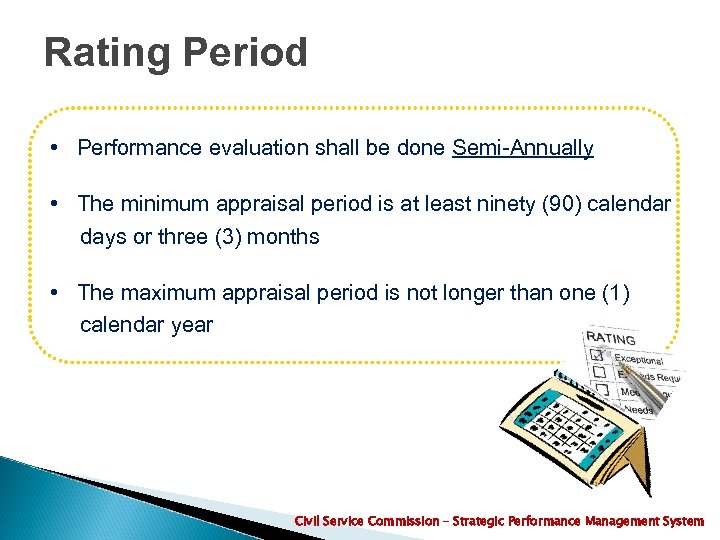
Rating Period • Performance evaluation shall be done Semi-Annually • The minimum appraisal period is at least ninety (90) calendar days or three (3) months • The maximum appraisal period is not longer than one (1) calendar year Civil Service Commission – Strategic Performance Management System
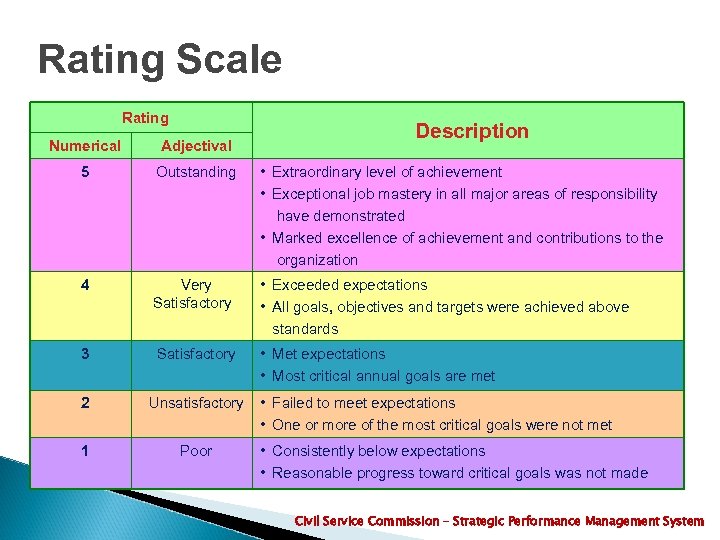
Rating Scale Rating Description Numerical Adjectival 5 Outstanding • Extraordinary level of achievement • Exceptional job mastery in all major areas of responsibility have demonstrated • Marked excellence of achievement and contributions to the organization 4 Very Satisfactory • Exceeded expectations • All goals, objectives and targets were achieved above standards 3 Satisfactory • Met expectations • Most critical annual goals are met 2 Unsatisfactory 1 Poor • Failed to meet expectations • One or more of the most critical goals were not met • Consistently below expectations • Reasonable progress toward critical goals was not made Civil Service Commission – Strategic Performance Management System
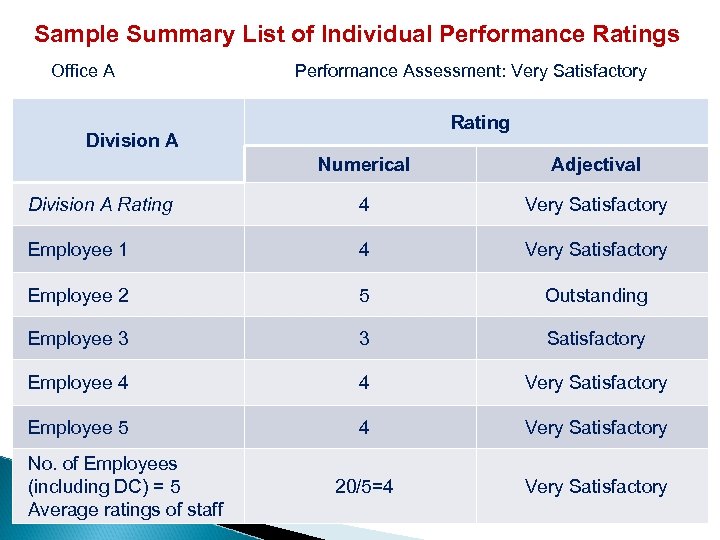
Sample Summary List of Individual Performance Ratings Office A Performance Assessment: Very Satisfactory Rating Division A Numerical Adjectival Division A Rating 4 Very Satisfactory Employee 1 4 Very Satisfactory Employee 2 5 Outstanding Employee 3 3 Satisfactory Employee 4 4 Very Satisfactory Employee 5 4 Very Satisfactory 20/5=4 Very Satisfactory No. of Employees (including DC) = 5 Average ratings of staff
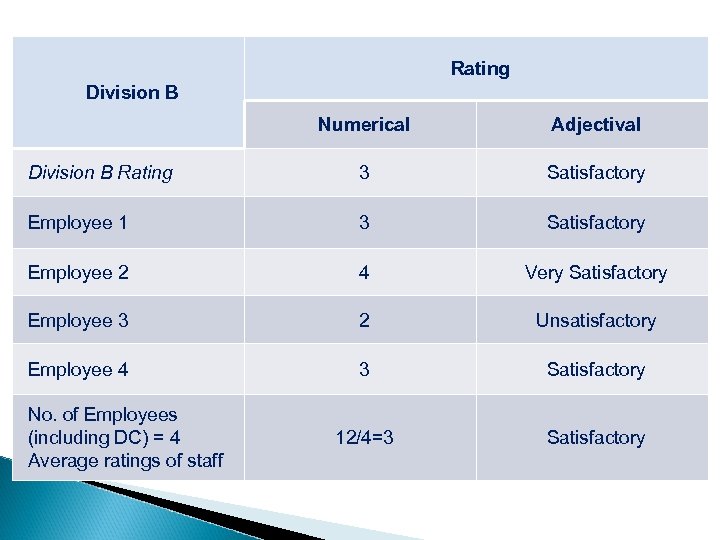
Rating Division B Numerical Adjectival Division B Rating 3 Satisfactory Employee 1 3 Satisfactory Employee 2 4 Very Satisfactory Employee 3 2 Unsatisfactory Employee 4 3 Satisfactory 12/4=3 Satisfactory No. of Employees (including DC) = 4 Average ratings of staff
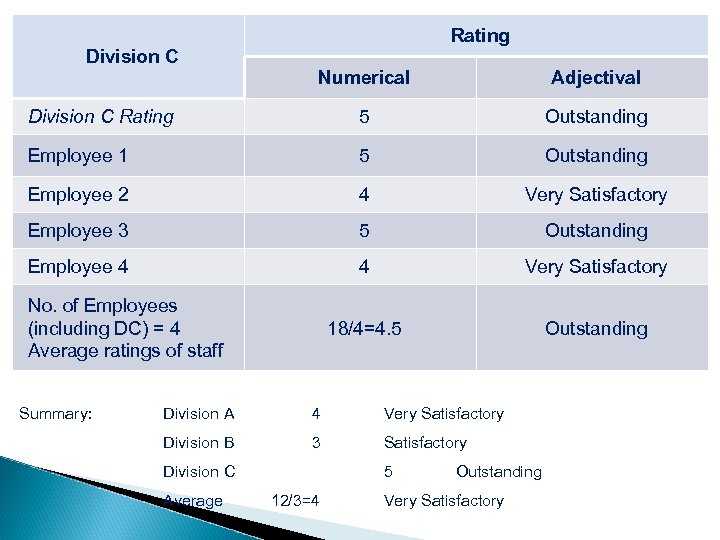
Division C Rating Numerical Adjectival Division C Rating 5 Outstanding Employee 1 5 Outstanding Employee 2 4 Very Satisfactory Employee 3 5 Outstanding Employee 4 4 Very Satisfactory 18/4=4. 5 Outstanding No. of Employees (including DC) = 4 Average ratings of staff Summary: Division A 4 Very Satisfactory Division B 3 Satisfactory Division C 5 Outstanding Average 12/3=4 Very Satisfactory
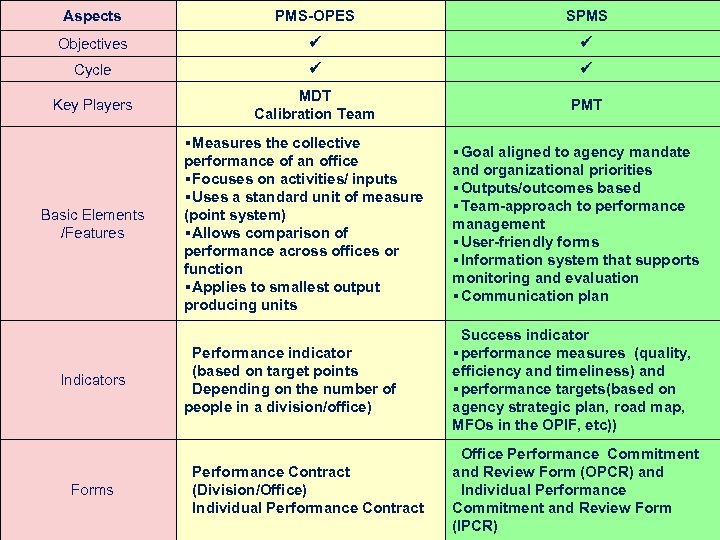
Aspects PMS-OPES SPMS Objectives Cycle Key Players MDT Calibration Team PMT Basic Elements /Features Indicators Forms Measures the collective performance of an office Focuses on activities/ inputs Uses a standard unit of measure (point system) Allows comparison of performance across offices or function Applies to smallest output producing units Goal aligned to agency mandate and organizational priorities Outputs/outcomes based Team-approach to performance management User-friendly forms Information system that supports monitoring and evaluation Communication plan Performance indicator (based on target points Depending on the number of people in a division/office) Success indicator performance measures (quality, efficiency and timeliness) and performance targets(based on agency strategic plan, road map, MFOs in the OPIF, etc)) Performance Contract (Division/Office) Individual Performance Contract Office Performance Commitment and Review Form (OPCR) and Individual Performance Commitment and Review Form (IPCR)
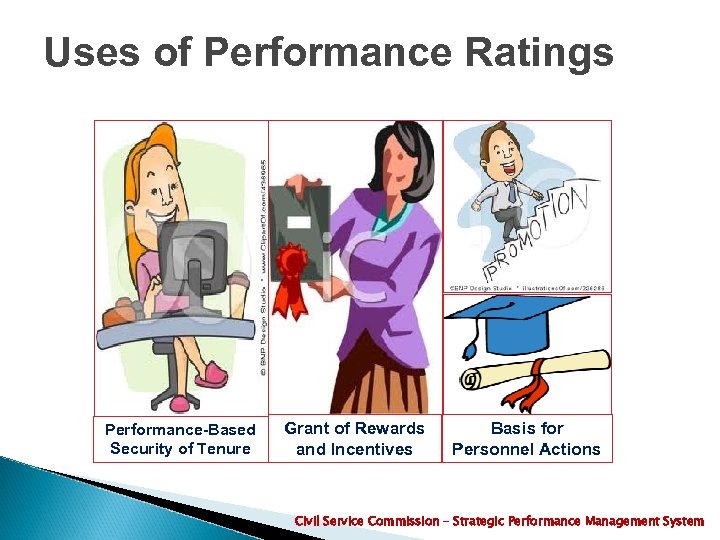
Uses of Performance Ratings Performance-Based Security of Tenure Grant of Rewards and Incentives Basis for Personnel Actions Civil Service Commission – Strategic Performance Management System
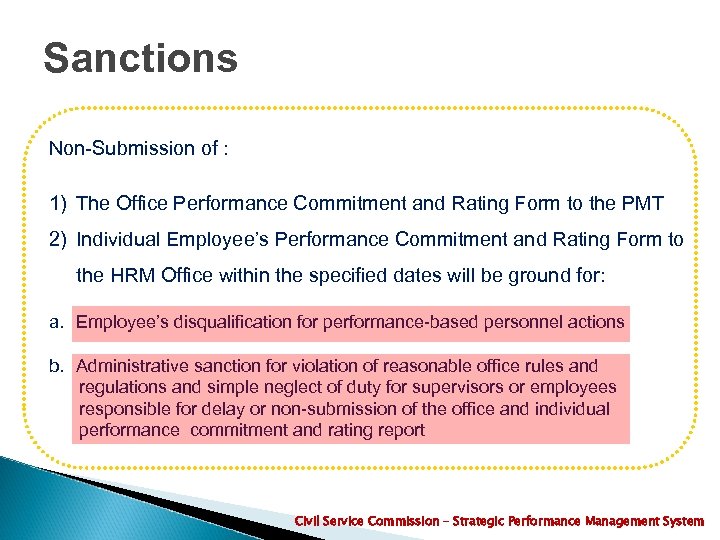
Sanctions Non-Submission of : 1) The Office Performance Commitment and Rating Form to the PMT 2) Individual Employee’s Performance Commitment and Rating Form to the HRM Office within the specified dates will be ground for: a. Employee’s disqualification for performance-based personnel actions b. Administrative sanction for violation of reasonable office rules and regulations and simple neglect of duty for supervisors or employees responsible for delay or non-submission of the office and individual performance commitment and rating report Civil Service Commission – Strategic Performance Management System
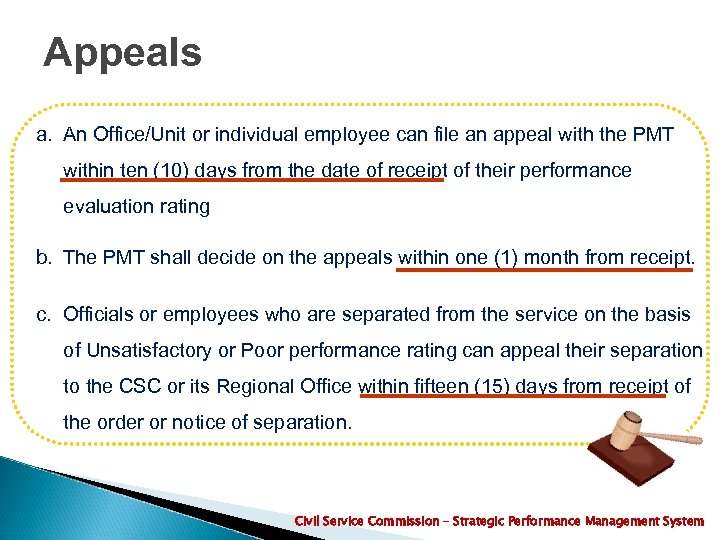
Appeals a. An Office/Unit or individual employee can file an appeal with the PMT within ten (10) days from the date of receipt of their performance evaluation rating b. The PMT shall decide on the appeals within one (1) month from receipt. c. Officials or employees who are separated from the service on the basis of Unsatisfactory or Poor performance rating can appeal their separation to the CSC or its Regional Office within fifteen (15) days from receipt of the order or notice of separation. Civil Service Commission – Strategic Performance Management System
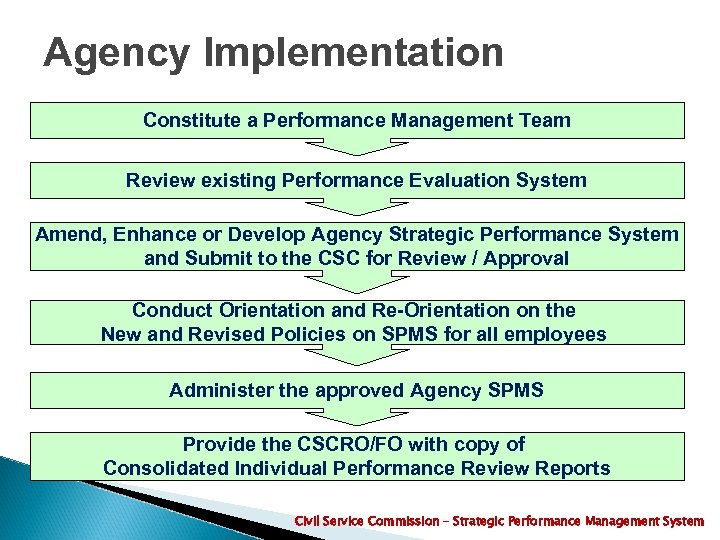
Agency Implementation Constitute a Performance Management Team Review existing Performance Evaluation System Amend, Enhance or Develop Agency Strategic Performance System and Submit to the CSC for Review / Approval Conduct Orientation and Re-Orientation on the New and Revised Policies on SPMS for all employees Administer the approved Agency SPMS Provide the CSCRO/FO with copy of Consolidated Individual Performance Review Reports Civil Service Commission – Strategic Performance Management System
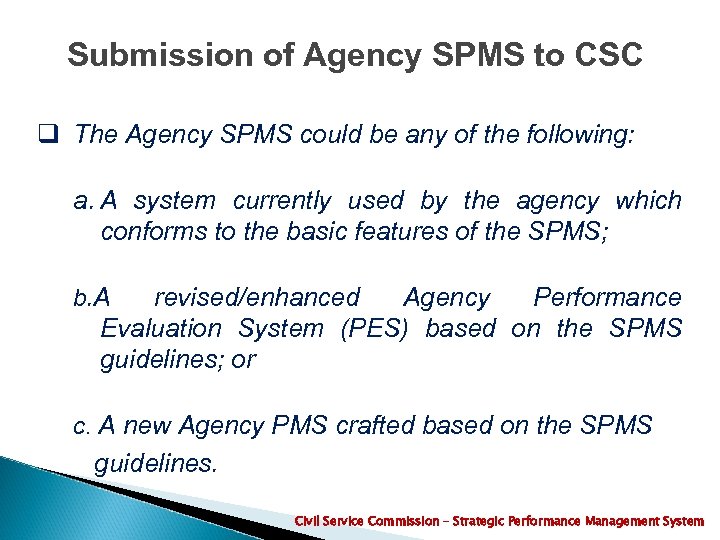
Submission of Agency SPMS to CSC q The Agency SPMS could be any of the following: a. A system currently used by the agency which conforms to the basic features of the SPMS; b. A revised/enhanced Agency Performance Evaluation System (PES) based on the SPMS guidelines; or c. A new Agency PMS crafted based on the SPMS guidelines. Civil Service Commission – Strategic Performance Management System
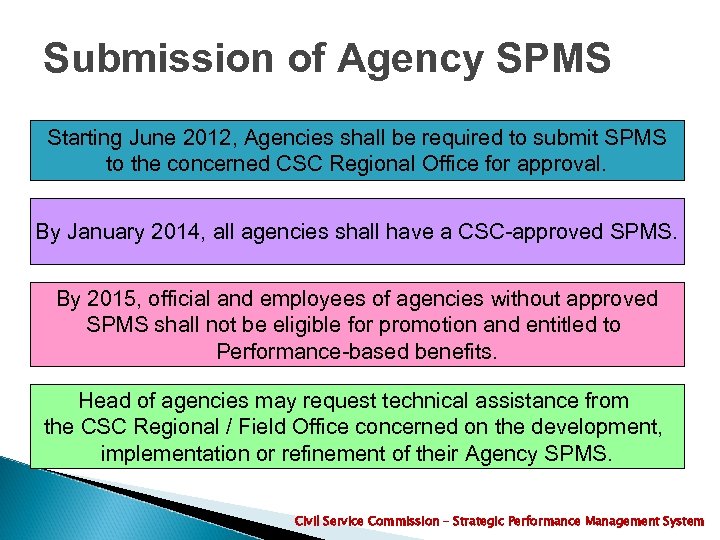
Submission of Agency SPMS Starting June 2012, Agencies shall be required to submit SPMS to the concerned CSC Regional Office for approval. By January 2014, all agencies shall have a CSC-approved SPMS. By 2015, official and employees of agencies without approved SPMS shall not be eligible for promotion and entitled to Performance-based benefits. Head of agencies may request technical assistance from the CSC Regional / Field Office concerned on the development, implementation or refinement of their Agency SPMS. Civil Service Commission – Strategic Performance Management System
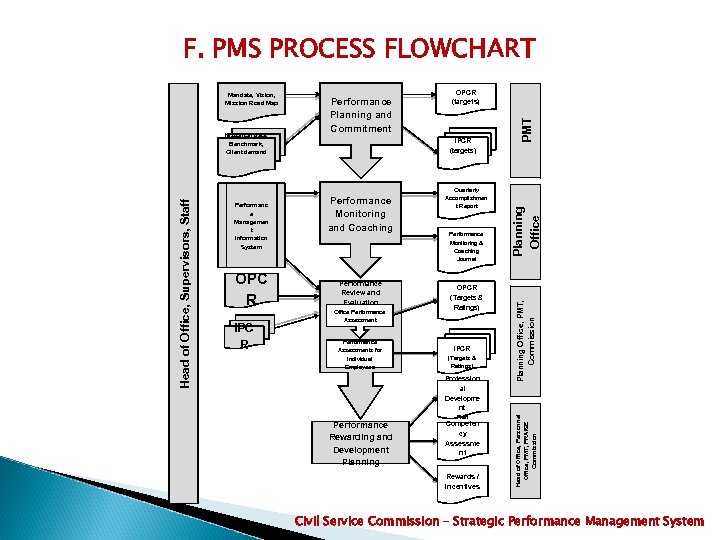
F. PMS PROCESS FLOWCHART Historical data, Benchmark, Client demand Performance Planning and Commitment OPCR (targets) IPCR (targets) PMT Mandate, Vision, Mission Road Map Quarterly Accomplishmen t Report Performance Monitoring & Coaching Journal Planning Office Performanc e Managemen t Information System Performance Monitoring and Coaching OPC R IPC R Performance Review and Evaluation Office Performance Assessment Performance Assessments for Individual Employees Performance Rewarding and Development Planning OPCR (Targets & Ratings) IPCR (Targets & Ratings) Profession al Developme nt Plan Competen cy Assessme nt Rewards / Incentives Planning Office, PMT, Commission Head of Office, Personnel Office, PMT, PRAISE Commission Head of Office, Supervisors, Staff Civil Service Commission – Strategic Performance Management System
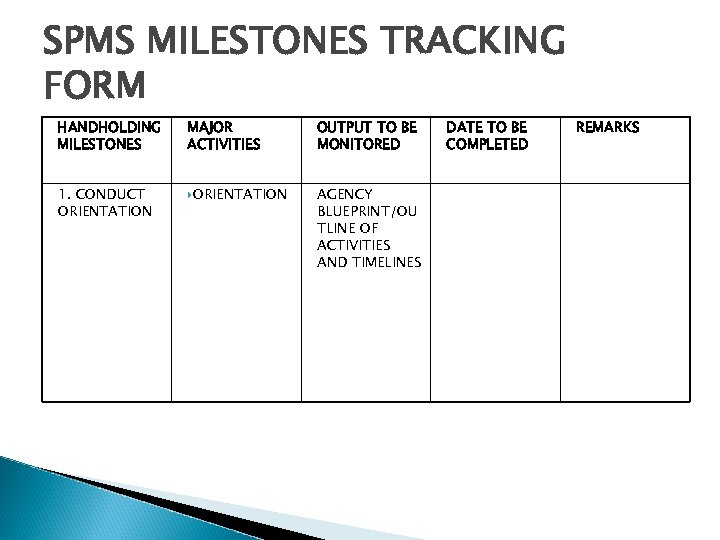
SPMS MILESTONES TRACKING FORM HANDHOLDING MILESTONES MAJOR ACTIVITIES OUTPUT TO BE MONITORED 1. CONDUCT ORIENTATION AGENCY BLUEPRINT/OU TLINE OF ACTIVITIES AND TIMELINES DATE TO BE COMPLETED REMARKS
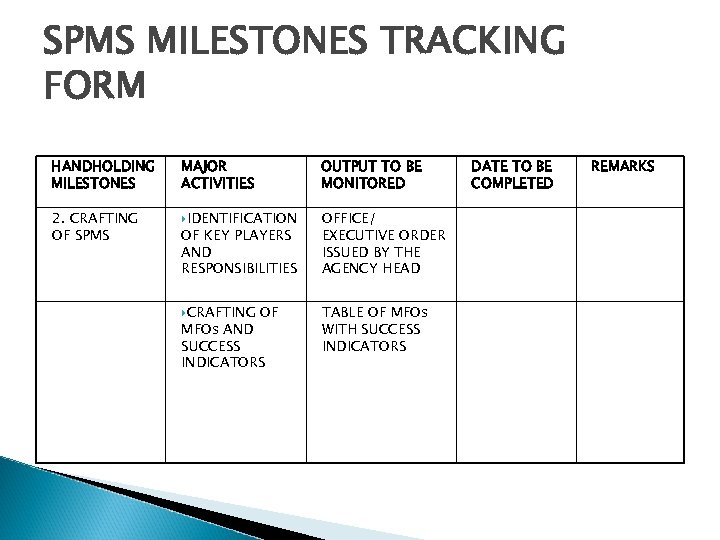
SPMS MILESTONES TRACKING FORM HANDHOLDING MILESTONES MAJOR ACTIVITIES OUTPUT TO BE MONITORED 2. CRAFTING OF SPMS IDENTIFICATION OFFICE/ EXECUTIVE ORDER ISSUED BY THE AGENCY HEAD CRAFTING TABLE OF MFOs WITH SUCCESS INDICATORS OF KEY PLAYERS AND RESPONSIBILITIES OF MFOs AND SUCCESS INDICATORS DATE TO BE COMPLETED REMARKS
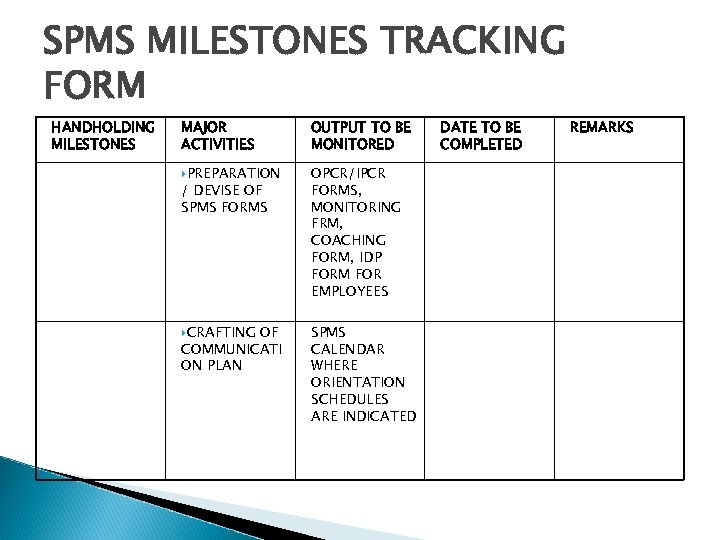
SPMS MILESTONES TRACKING FORM HANDHOLDING MILESTONES MAJOR ACTIVITIES OUTPUT TO BE MONITORED PREPARATION OPCR/IPCR FORMS, MONITORING FRM, COACHING FORM, IDP FORM FOR EMPLOYEES CRAFTING SPMS CALENDAR WHERE ORIENTATION SCHEDULES ARE INDICATED / DEVISE OF SPMS FORMS OF COMMUNICATI ON PLAN DATE TO BE COMPLETED REMARKS
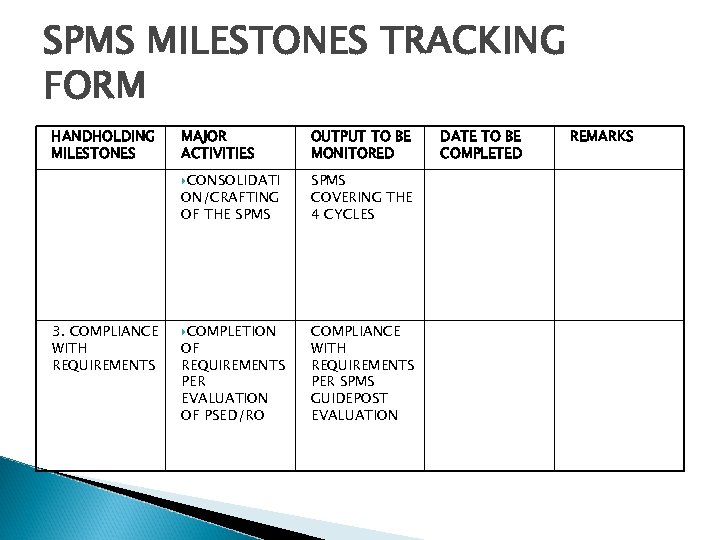
SPMS MILESTONES TRACKING FORM HANDHOLDING MILESTONES MAJOR ACTIVITIES OUTPUT TO BE MONITORED CONSOLIDATI SPMS COVERING THE 4 CYCLES COMPLETION COMPLIANCE WITH REQUIREMENTS PER SPMS GUIDEPOST EVALUATION ON/CRAFTING OF THE SPMS 3. COMPLIANCE WITH REQUIREMENTS OF REQUIREMENTS PER EVALUATION OF PSED/RO DATE TO BE COMPLETED REMARKS
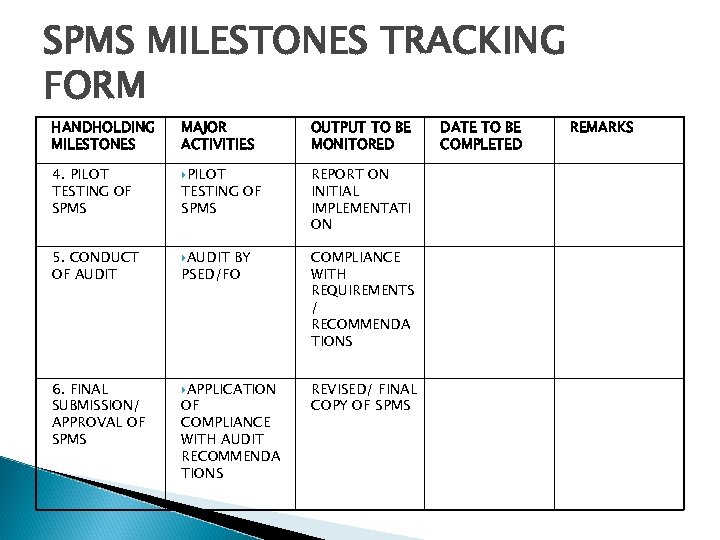
SPMS MILESTONES TRACKING FORM HANDHOLDING MILESTONES MAJOR ACTIVITIES OUTPUT TO BE MONITORED 4. PILOT TESTING OF SPMS PILOT REPORT ON INITIAL IMPLEMENTATI ON 5. CONDUCT OF AUDIT BY PSED/FO COMPLIANCE WITH REQUIREMENTS / RECOMMENDA TIONS 6. FINAL SUBMISSION/ APPROVAL OF SPMS APPLICATION REVISED/ FINAL COPY OF SPMS TESTING OF SPMS OF COMPLIANCE WITH AUDIT RECOMMENDA TIONS DATE TO BE COMPLETED REMARKS
PART II WRITESHOP ON SPMS
STEPS IN CRAFTING STRATEGIC PERFORMANCE MANAGEMENT 1. Form the performance system management team 2. Renew the existing PMS 3. Know and understand your agency’s major final output 4. Identify the success indicators of each major final output
STEPS IN CRAFTING STRATEGIC PERFORMANCE MANAGEMENT 5. Identify the performance goals of your office 6. Identify the performance goals of the division under your office 7. Identify the performance goals of the individuals under each division 8. Develop the rating scale
STEPS IN CRAFTING STRATEGIC PERFORMANCE MANAGEMENT 9. Identify the performance goals of individuals under each division (monitoring and coaching) 10. Develop the performance evaluation tool 11. Use the performance evaluation tools 12. Use the results of the performance evaluation
REVIEW THE EXISTING PERFORMANCE MANAGEMENT SYSTEM
STAGE 1 PERFORMANCE PLANNING AND COMMITMENT
WHEN REVIEWING STAGE 1, ASK YOURSELF THE FOLLOWING QUESTIONS: Does your SPMS calendar show that officials and employees are required to submit their commitments prior to the start of the rating period? Does your SPMS calendar allot time for the PMT to review and make recommendations on the performance commitments?
WHEN REVIEWING STAGE 1, ASK YOURSELF THE FOLLOWING QUESTIONS: Does your SPMS calendar indicate the period for Heads of Agency and Offices to approve the office and individual performance commitments?
STAGE 2 PERFORMANCE MONITORING AND COACHING
WHEN REVIEWING STAGE 2, ASK YOURSELF THE FOLLOWING QUESTIONS: Are feedback sessions to discuss performance of offices, officials and employees provided in your Agency Guidelines and scheduled in your SPMS calendar? Are interventions given to those who are behind work targets? Is space provided in the Employee Feedback Form for recommended interventions
WHEN REVIEWING STAGE 2, ASK YOURSELF THE FOLLOWING QUESTIONS: Is there a form or logbook to record critical incidents, schedule of coaching, and the action plan?
STAGE 3 PERFORMANCE REVIEW AND EVALUATION
WHEN REVIEWING STAGE 3, ASK YOURSELF THE FOLLOWING QUESTIONS: Are office accomplishments assessed against the success indicators and the allotted budget against the actual expenses as indicated in the Performance Commitment and Rating Forms and provided in your Agency Guidelines?
WHEN REVIEWING STAGE 3, ASK YOURSELF THE FOLLOWING QUESTIONS: Does your SPMS calendar schedule and conduct the Annual Agency Performance Review Conference? Is individual employee performance assessment based on the commitments made at the start of the rating period? Does your agency rating scale fall within the range prescribed in Memorandum Circular No. 13, s. 1999 – Revised Policies on the PES?
STAGE 4 PERFORMANCE REWARDING AND DEVELOPMENT PLANNING
WHEN REVIEWING STAGE 4, ASK YOURSELF THE FOLLOWING QUESTIONS: Is there a mechanism for the Head of Office and supervisors to discuss assessment results with the individual employee at the end of the rating period? Is there a provision to draw up a Professional Development Plan to improve or correct performance of employees with Unsatisfactory or Poor performance rating?
WHEN REVIEWING STAGE 4, ASK YOURSELF THE FOLLOWING QUESTIONS: Are recommendations for developmental interventions indicated in the Performance Commitment and Rating Form? Is there a provision on your Agency Guidelines to link the SPMS with your Agency Human Resource Development Plan?
WHEN REVIEWING STAGE 4, ASK YOURSELF THE FOLLOWING QUESTIONS: Is there a provision in your Agency Guidelines to tie up the performance management system with agency rewards and incentives for top performing individuals, units, and offices? Are the results of the performance evaluation used as inputs to the Agency HR Plan and rewards and incentives?
KNOW AND UNDERSTAND YOUR AGENCY’S MAJOR FINAL OUTPUTS
Major Final Outputs refer to the goods and services that your agency is mandated to deliver to external clients through the implementation of programs, projects, and activities (PAPs)
SOURCES OF MFOs/ STRATEGIC POINTS OF YOUR AGENCY The Agency Logical Framework / Organizational Performance Indicator Framework (OPIF) Book of Outputs
OTHER POSSIBLE SOURCES OF INFORMATION For National Government Agencies (NGAs), State Universities and Colleges (SUCs) and Government – owned and Controlled Corporations (GOCCs): • Philippine Development Plan • Agency Charter • Agency Strategic Plan / Road Map • Scorecard
OTHER POSSIBLE SOURCE OF INFORMATION For Local Government Units (LGU’s): • Philippine Development Plan • Local Government Code • Local Development Plan • Road Map • Strategic Plan • Scorecard
MFOs are delivered by core business processes of operating offices/units. However, Offices / units that do not directly deliver goods and services to external clients contribute to the delivery of the agency’s MFO’s through Support to Operations (STO) or General Administration and Support (GAS) activities.
STO’s refer to activities that provide technical and substantive support to the operations and projects of the agency. By themselves, these activities do not produce the MFOs but they contribute or enhance the delivery of goods and services. Examples include program monitoring and evaluation, public information programs, statistical services and information systems development.
GAS refer to activities that deal with the provision of overall administrative management support to the entire agency operation. Examples are legislative liaison services, human resource development, and financial services.
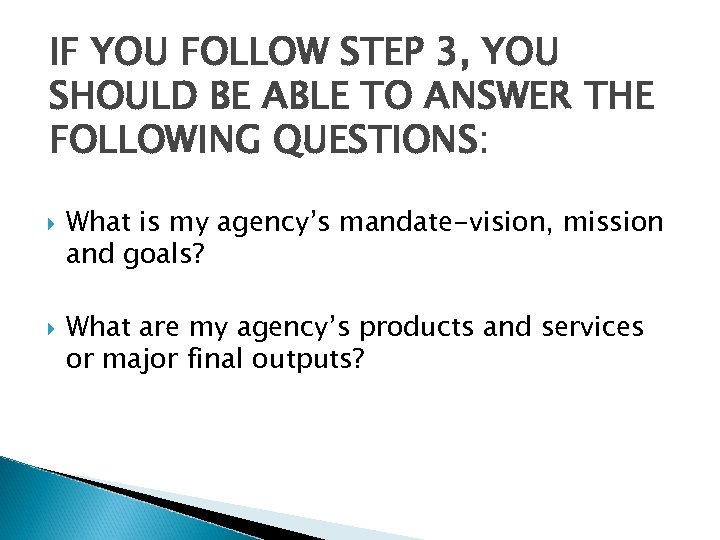
IF YOU FOLLOW STEP 3, YOU SHOULD BE ABLE TO ANSWER THE FOLLOWING QUESTIONS: What is my agency’s mandate-vision, mission and goals? What are my agency’s products and services or major final outputs?
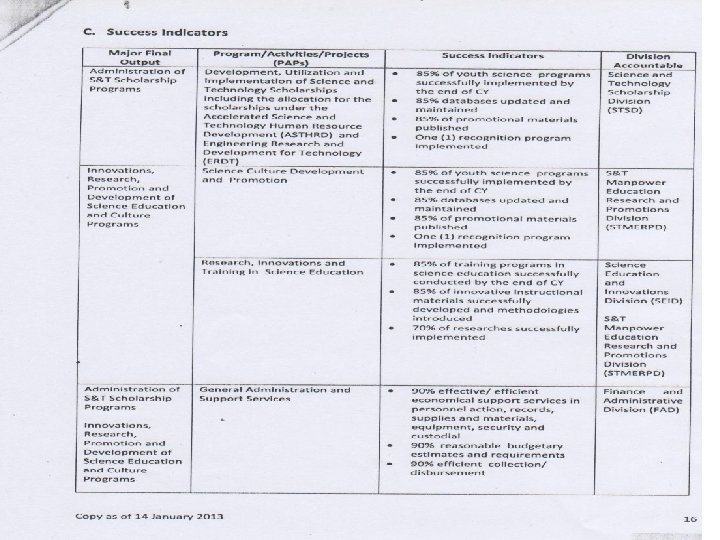
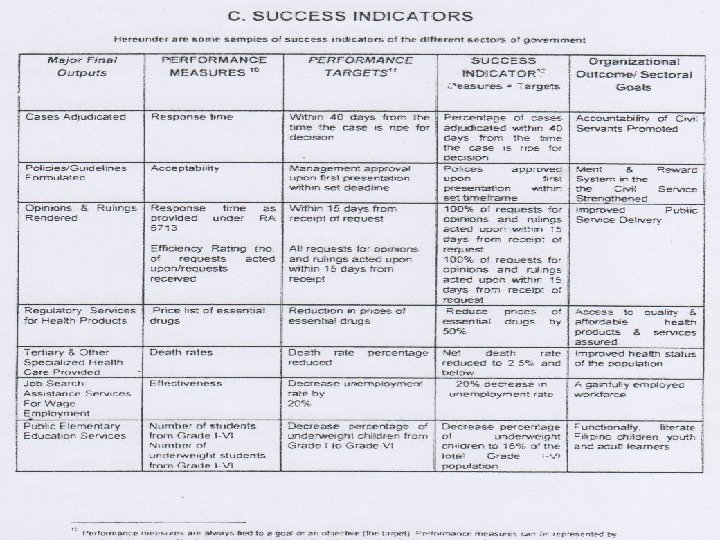
IDENTIFY THE SUCCESS INDICATORS OF EACH MAJOR FINAL OUTPUT
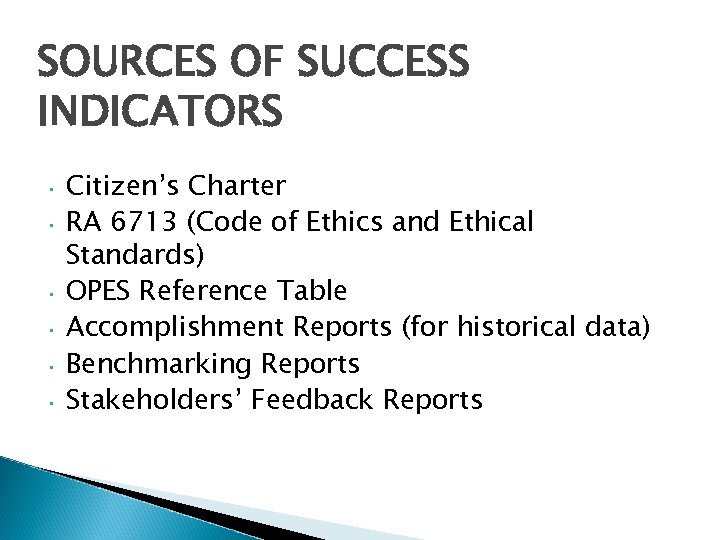
SOURCES OF SUCCESS INDICATORS • • • Citizen’s Charter RA 6713 (Code of Ethics and Ethical Standards) OPES Reference Table Accomplishment Reports (for historical data) Benchmarking Reports Stakeholders’ Feedback Reports
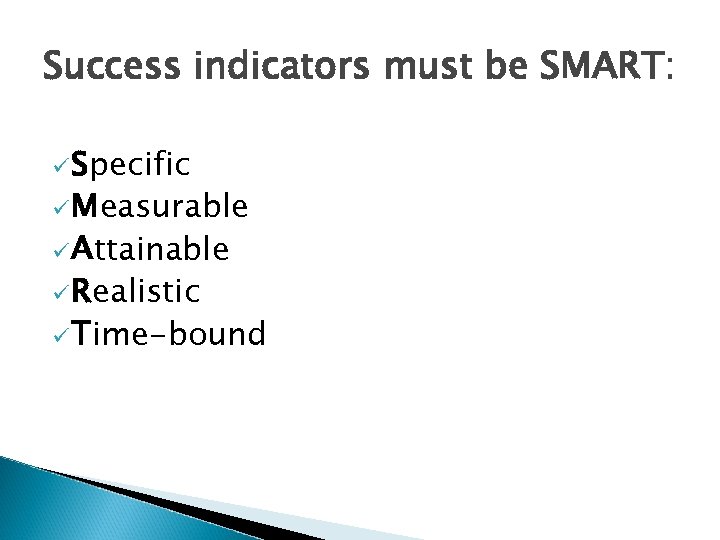
Success indicators must be SMART: ü Specific ü Measurable ü Attainable ü Realistic ü Time-bound
IDENTIFY THE PERFORMANCE GOALS OF YOUR OFFICE
WHICH MFO IS MY OFFICE CONTRIBUTING TO? In most cases, one or several offices will be contributing to one MFO. It is also possible that one office will be contributing to two MFOs.
If your office / unit is not directly delivering goods and services to external clients, your office / unit is either implementing Support to Operations (STO) activities or General Administration and Support (GAS) activities. As such, you should have your own SMART performance targets or success indicators from the office / unit level down to the individual staff level.
IDENTIFY THE PERFORMANCE GOALS OF THE DIVISIONS UNDER YOUR OFFICE
Units under an office must contribute towards achieving a specific MFO through a set of performance goals or success indicators. As such, the performance goals of the different units such as a branch, attached bureaus, or a division must be aligned with the performance goals of the office.
IDENTIFY THE PERFORMANCE GOALS OF THE INDIVIDUALS UNDER EACH DIVISION
Each division will be staffed by at least one individual employee. The performance goals of each individual employee must contribute and align with the performance goals of the division. The success indicators should be SMART.
Like the office level and division level success indicators, individual level success indicators should also be SMART- Specific, Measurable, Attainment, Realistic Time-bound.
DEVELOP THE RATING SCALE
DEVELOPING THE RATING SCALE INVOLVE TWO SUB-STEPS: • • Determining the dimensions on which performance or accomplishments are to be rated. Operationalizing the numerical and adjectival ratings.
THE THREE (3) DIMENSIONS OF PERFORMANCE OR ACCOMPLISHMENTS ARE QUALITY, EFFICIENCY AND TIMELINESS
Quality or Effectiveness means getting the right things done. It refers to the degree to which objectives are achieved as intended and the extent to which issues are addressed with a certain degree of excellence.
Quality or Effective performance involves the following elements: • • Acceptability Meeting standards Client satisfaction with services rendered Accuracy Completeness or comprehensiveness of reports Creativity or innovation Personal initiative
Efficiency is the extent to which targets are accomplished using the minimum amount of time or resources
Efficient performance applies to continuing tasks or frontline services (e. g. , issuances of licences, permits, clearances and certificates). It involves the following elements • • • Standard response time Number of requests / applications acted upon over number of requests / application received Optimum use of resources (e. g. , money, logistics, office supplies)
Timeliness measures if the targeted deliverable was done within the scheduled or expected timeframe.
Timely performance involves: Meeting deadlines as set in the work plan Not all performance accomplishments need to be rated along all three dimensions of quality, efficiency and timeliness. Some accomplishments may only be rated on any combination of two or three dimensions. In other cases, only one dimension may be sufficient. Consider all the elements involved each listed above in each dimension and use them as guides to determine how performance will be rated.
ESTABLISHING THE RATING SCALE On each dimension of quality, efficiency and timeliness, rate performance using a numerical scale ranging from 1 to 5 – with 1 as the lowest and 5 as the highest.
For the rating to be objective, impartial, and verifiable, you need to indicate the operational definition or meaning of each numerical rating under each relevant dimension (i. e. , quality, efficiency, or timeless) performance target or success indicator.
Supervisors and coaches play a critical role at this stage. They can provide an enabling environment, introduce interventions to improve team performance, and develop individual potentials. To reiterate, it is important that you establish an information system as a vital management tool that will support data management to produce timely, accurate, and reliable information for program tracking and performance monitoring and reporting
DEVELOP THE PERFORMANCE EVALUATION TOOLS
To reflect the cascading approach of the SPMS towards achieving organizational goals, three kinds of forms are suggested: Office Performance Commitment and Review (OPCR) Form is accomplished by Agency Directors Division Performance Commitment and Review (DPCR) Form is accomplished by Division Chiefs Individual Performance Commitment and Review (IPCR) Form is accomplished by individual staff in all the units of the organization
Make sure that the performance targets listed in the OPCR, DPCR, IPCR are linked and aligned towards achieving your organization’s Major Final Outputs.
USE THE RESULTS OF THE PERFORMANCE EVALUATION
The focus of discussion of evaluation results must be on strengths, competency – related performance gaps, and the opportunities to address these gaps, career paths, and alternatives. In coordination with the HRM Office, the Heads of Office and supervisors must introduce appropriate developmental interventions based on the results of the performance evaluation especially for employees with Unsatisfactory and Poor performance ratings.
The results of the performance evaluation / assessment shall serve as inputs to the following: 1. 2. Heads of Offices in identifying and providing the kinds of interventions needed based on identified professional development needs. Agency HRM Office in consolidating and coordinating development interventions that will form part of the HR Plan and the basis for rewards and incentives.
3. Performance Management Team in identifying potential PRAISE Awards nominees for various awards categories. 4. PRAISE Committee in determining top performers of the agency who qualify for awards and incentives.

THANK YOU !
Скачать презентацию WELCOME Briefing Writeshop on the Strategic Performance
5e1e9aa42b7dad2c51c5f9ea5ec0ee6b.ppt