 Скачать презентацию Welcome back for Day 2 A workshop for
5301e73ffb843c1a61d4d3c964885c61.ppt
- Количество слайдов: 100



Welcome back for Day 2. A workshop for using some of most powerful, practical tools in documented prevention science By…Penn State University, PAXIS Institute and Johns Hopkins University
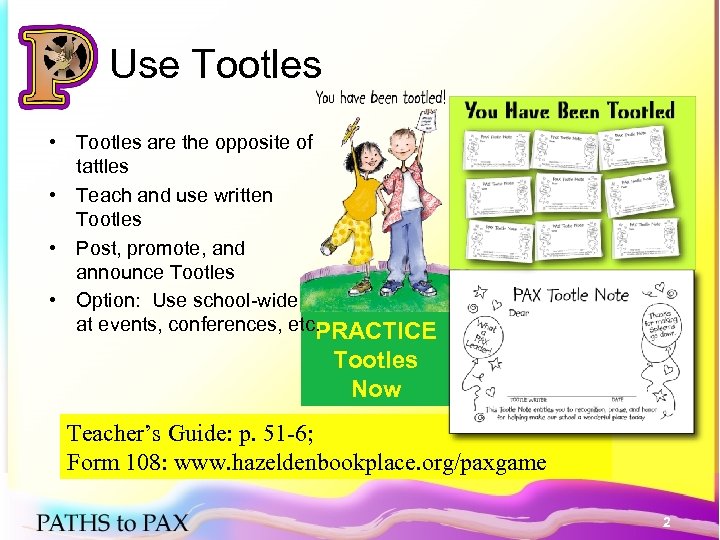
Use Tootles • Tootles are the opposite of tattles • Teach and use written Tootles • Post, promote, and announce Tootles • Option: Use school-wide, at events, conferences, etc. PRACTICE Tootles Now Teacher’s Guide: p. 51 -6; Form 108: www. hazeldenbookplace. org/paxgame 2
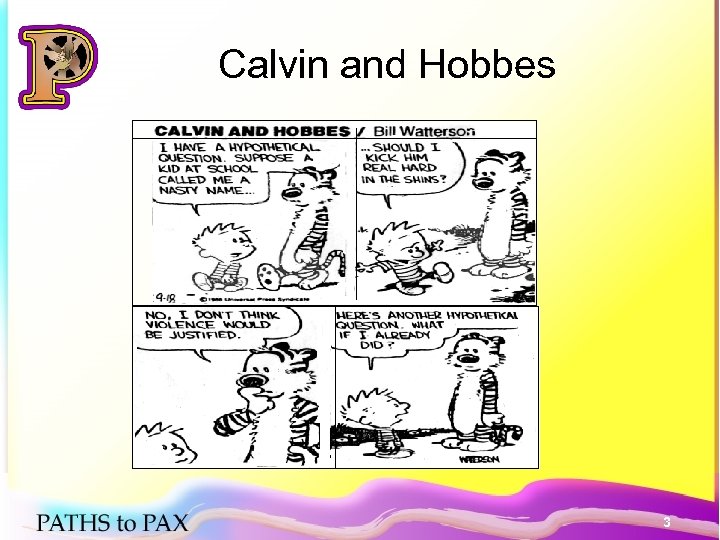
Calvin and Hobbes 3
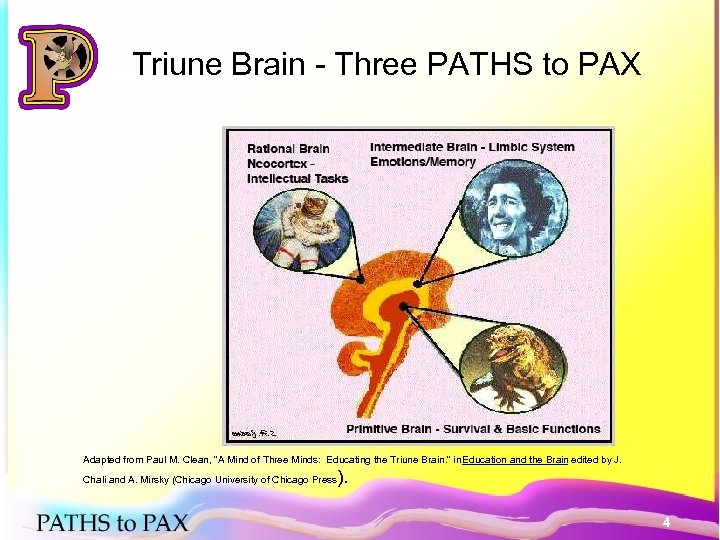
Triune Brain - Three PATHS to PAX Adapted from Paul M. Clean, “A Mind of Three Minds: Educating the Triune Brain. ” in Education and the Brain edited by J. ). Chali and A. Mirsky (Chicago University of Chicago Press 4
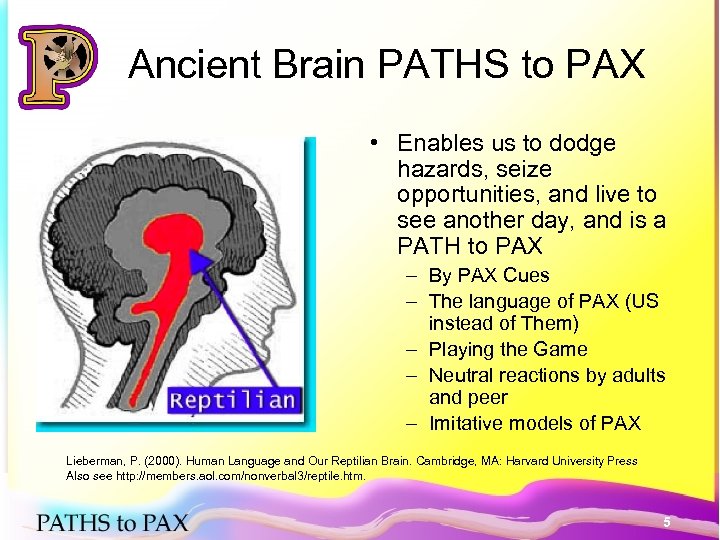
Ancient Brain PATHS to PAX • Enables us to dodge hazards, seize opportunities, and live to see another day, and is a PATH to PAX – By PAX Cues – The language of PAX (US instead of Them) – Playing the Game – Neutral reactions by adults and peer – Imitative models of PAX Lieberman, P. (2000). Human Language and Our Reptilian Brain. Cambridge, MA: Harvard University Press Also see http: //members. aol. com/nonverbal 3/reptile. htm. 5
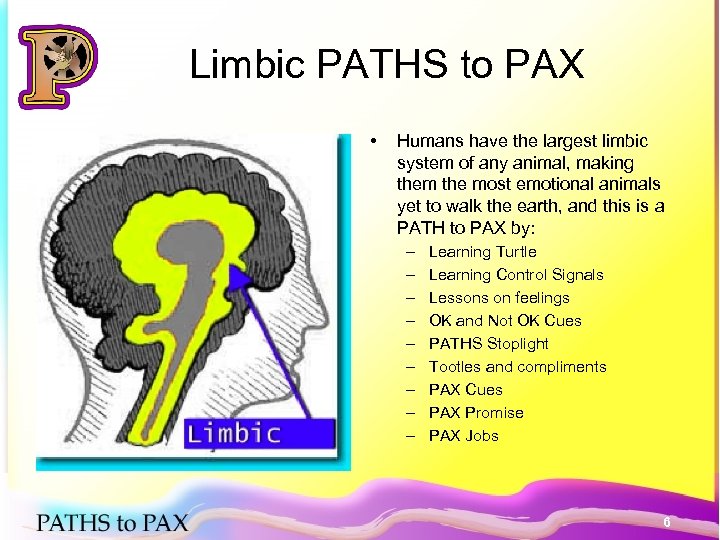
Limbic PATHS to PAX • Humans have the largest limbic system of any animal, making them the most emotional animals yet to walk the earth, and this is a PATH to PAX by: – – – – – Learning Turtle Learning Control Signals Lessons on feelings OK and Not OK Cues PATHS Stoplight Tootles and compliments PAX Cues PAX Promise PAX Jobs 6
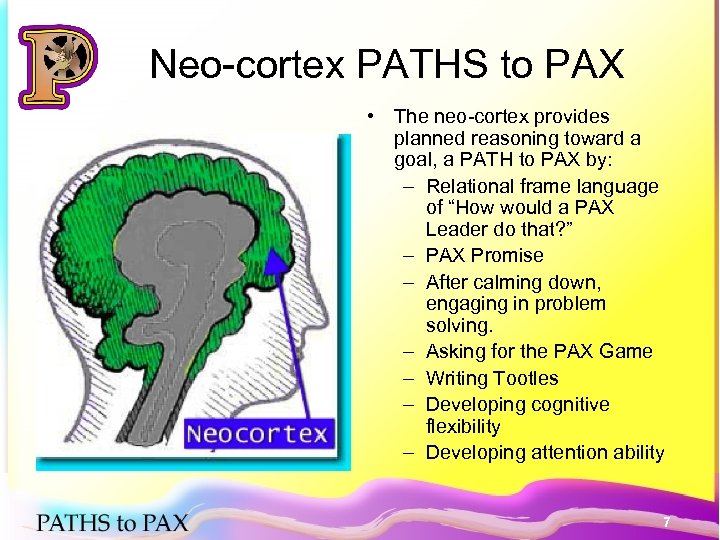
Neo-cortex PATHS to PAX • The neo-cortex provides planned reasoning toward a goal, a PATH to PAX by: – Relational frame language of “How would a PAX Leader do that? ” – PAX Promise – After calming down, engaging in problem solving. – Asking for the PAX Game – Writing Tootles – Developing cognitive flexibility – Developing attention ability 7
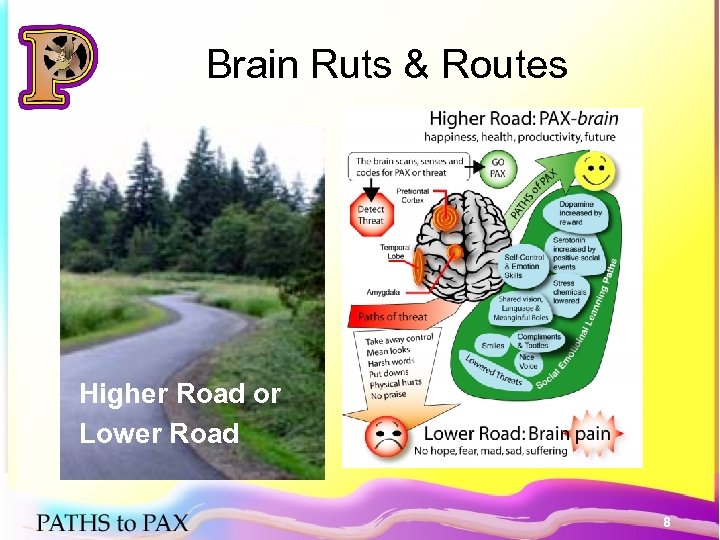
Brain Ruts & Routes Higher Road or Lower Road 8
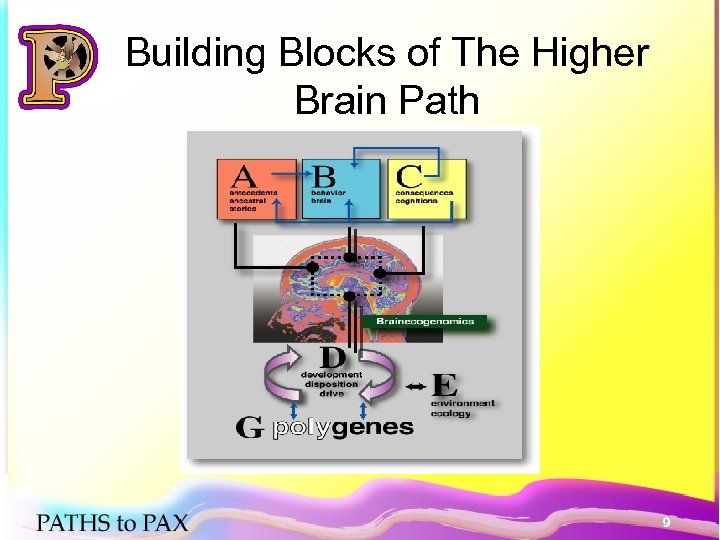
Building Blocks of The Higher Brain Path 9
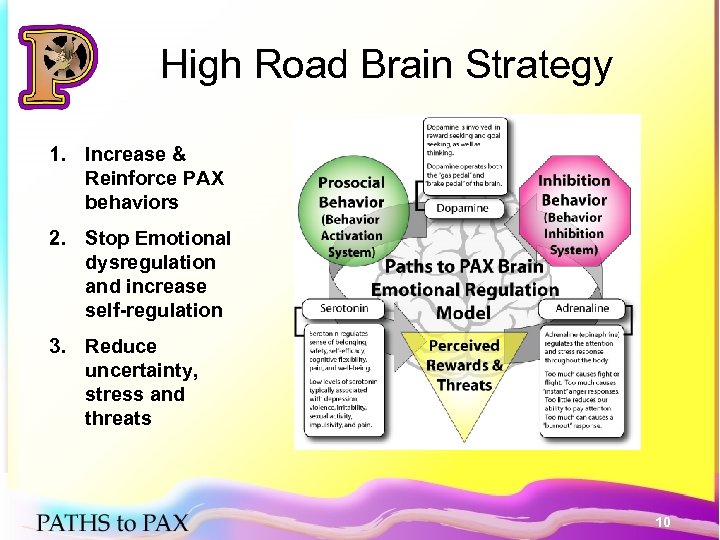
High Road Brain Strategy 1. Increase & Reinforce PAX behaviors 2. Stop Emotional dysregulation and increase self-regulation 3. Reduce uncertainty, stress and threats 10
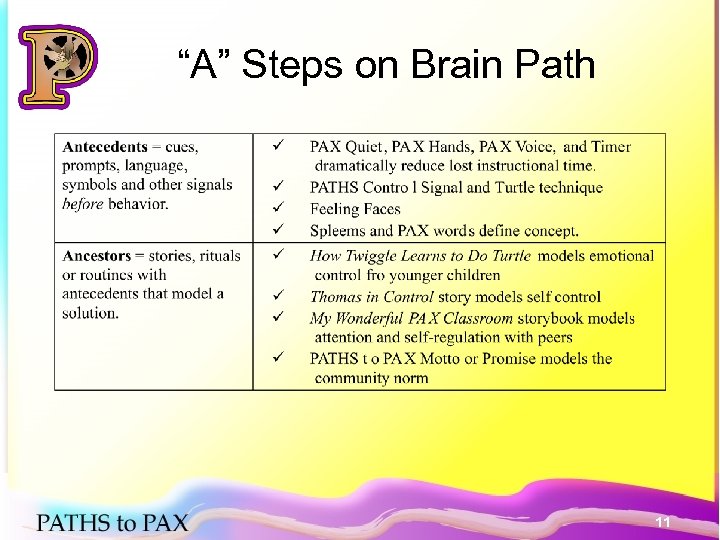
“A” Steps on Brain Path 11
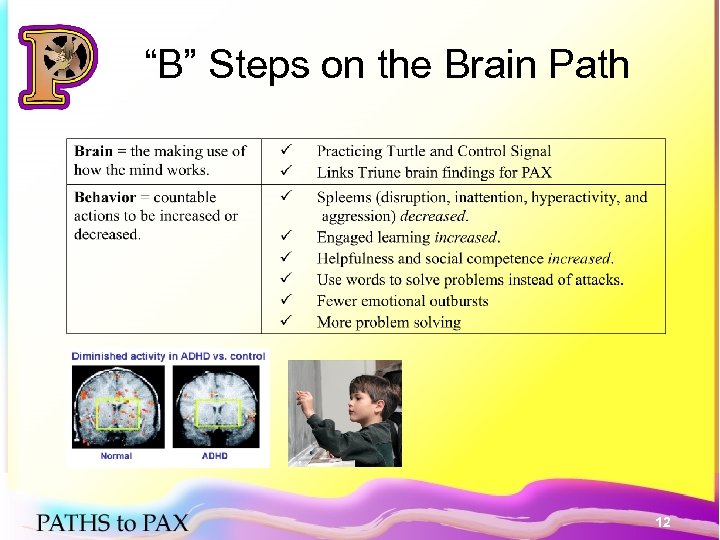
“B” Steps on the Brain Path 12
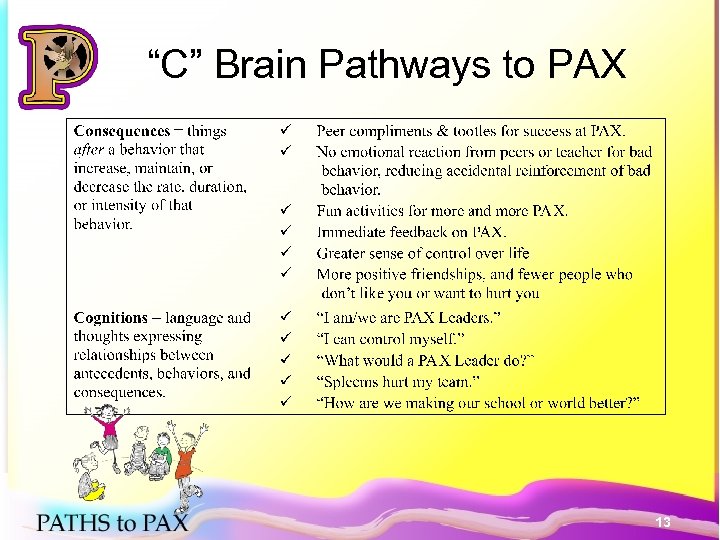
“C” Brain Pathways to PAX 13
“D” Brain Pathways to PAX 14
“E, F & G” Brain Pathways to PAX 15
Practicing PATHS to PAX Game Day 1 Breakout
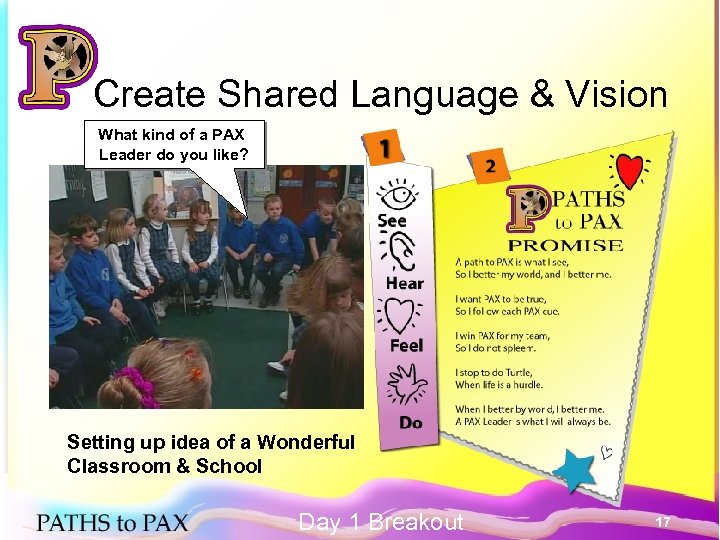
Create Shared Language & Vision What kind of a PAX Leader do you like? Setting up idea of a Wonderful Classroom & School Day 1 Breakout 17
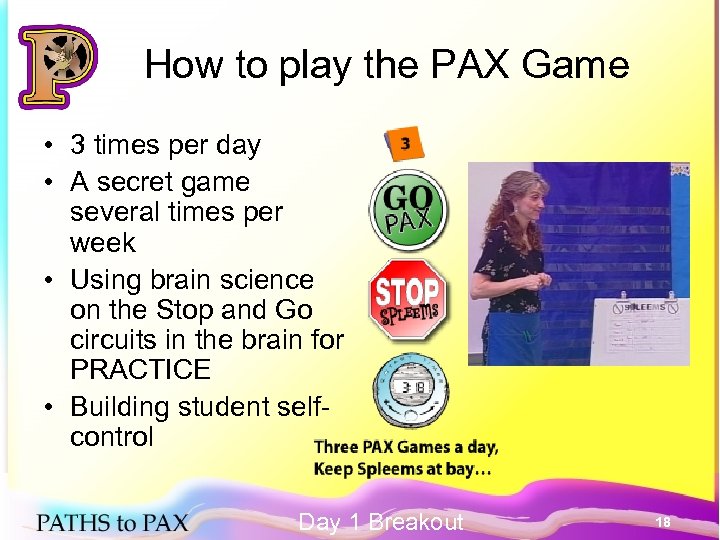
How to play the PAX Game • 3 times per day • A secret game several times per week • Using brain science on the Stop and Go circuits in the brain for PRACTICE • Building student selfcontrol Day 1 Breakout 18
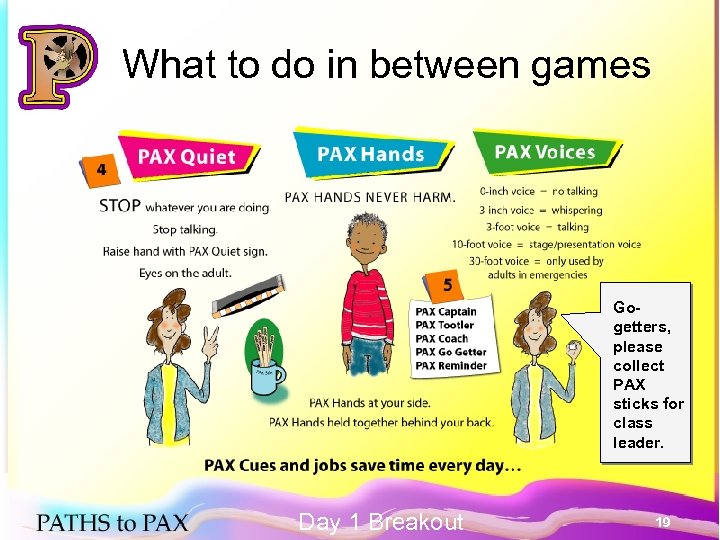
What to do in between games Gogetters, please collect PAX sticks for class leader. Day 1 Breakout 19
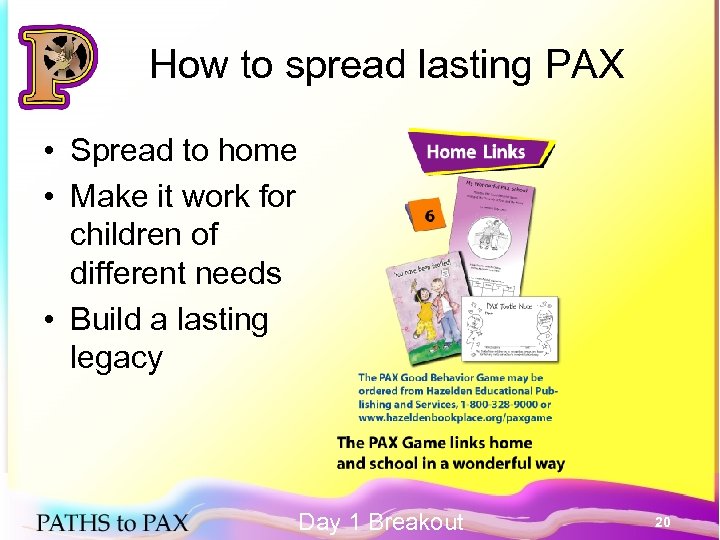
How to spread lasting PAX • Spread to home • Make it work for children of different needs • Build a lasting legacy Day 1 Breakout 20
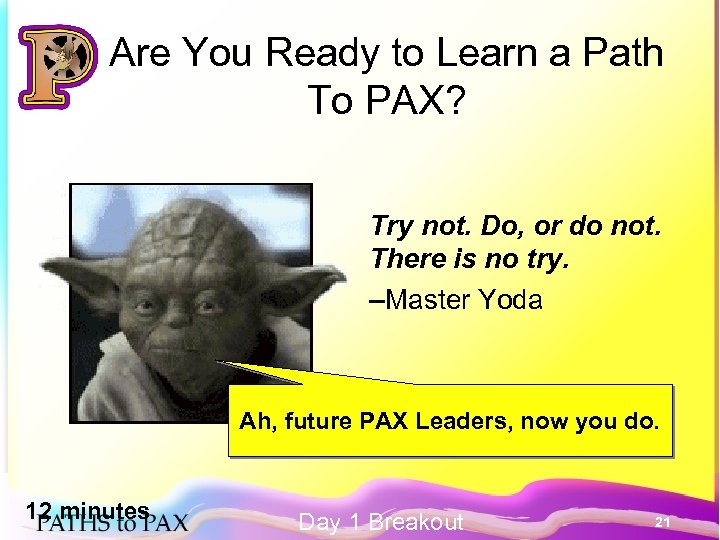
Are You Ready to Learn a Path To PAX? Try not. Do, or do not. There is no try. –Master Yoda Ah, future PAX Leaders, now you do. 12 minutes Day 1 Breakout 21
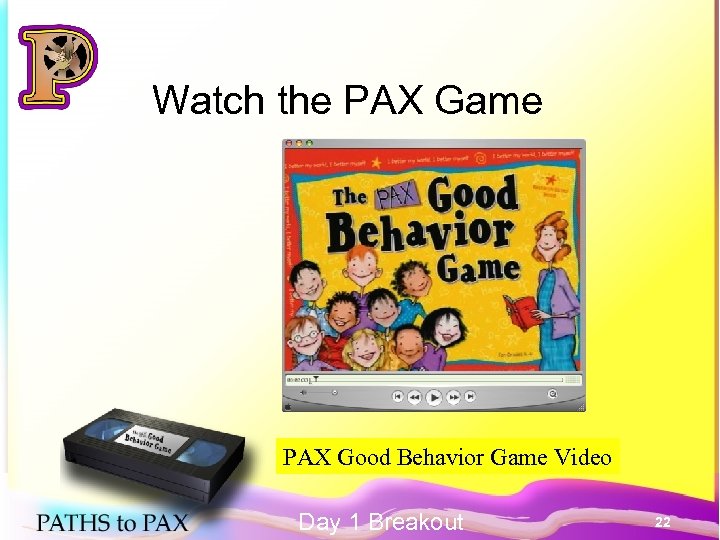
Watch the PAX Game PAX Good Behavior Game Video Day 1 Breakout 22
Summary Activity • In 10 words or less in the next one minute, summarize why the PAX Good Behavior Game works. • If stick is drawn, stand up and give summary for all to hear. Day 1 Breakout 23
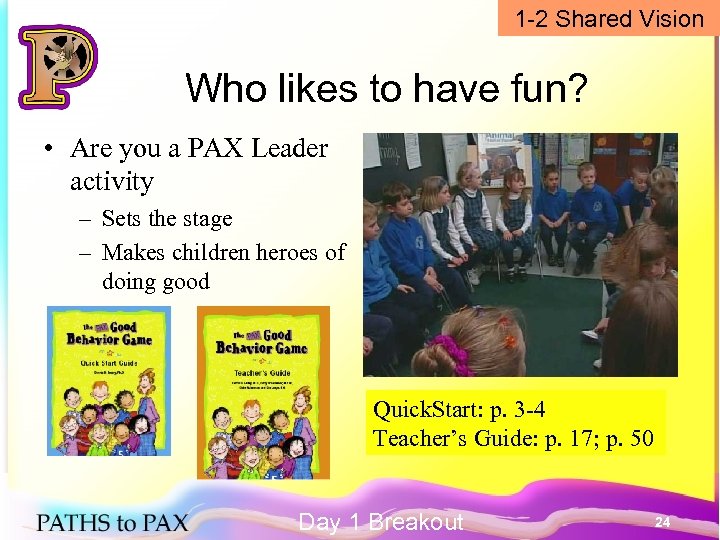
1 -2 Shared Vision Who likes to have fun? • Are you a PAX Leader activity – Sets the stage – Makes children heroes of doing good Quick. Start: p. 3 -4 Teacher’s Guide: p. 17; p. 50 Day 1 Breakout 24

1 -2 Shared Vision My Wonderful School Story Quick. Start: p. 6 -7 Teacher’s Guide: p. 18; p. 121 -128 Day 1 Breakout 25
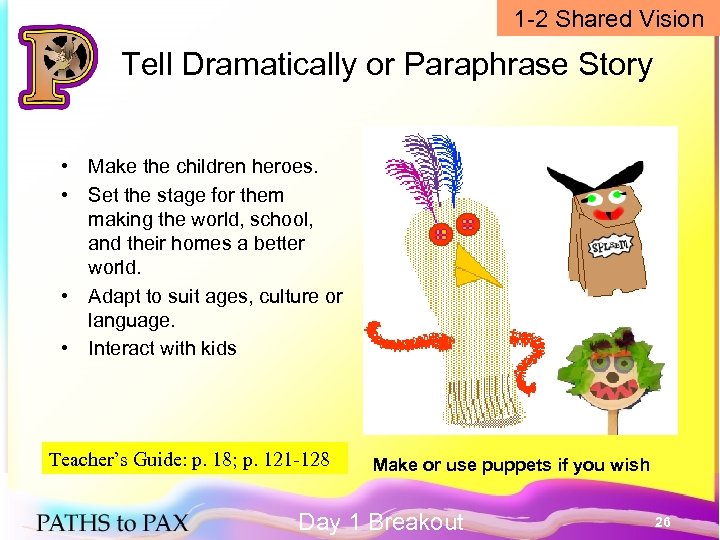
1 -2 Shared Vision Tell Dramatically or Paraphrase Story • Make the children heroes. • Set the stage for them making the world, school, and their homes a better world. • Adapt to suit ages, culture or language. • Interact with kids Teacher’s Guide: p. 18; p. 121 -128 Make or use puppets if you wish Day 1 Breakout 26
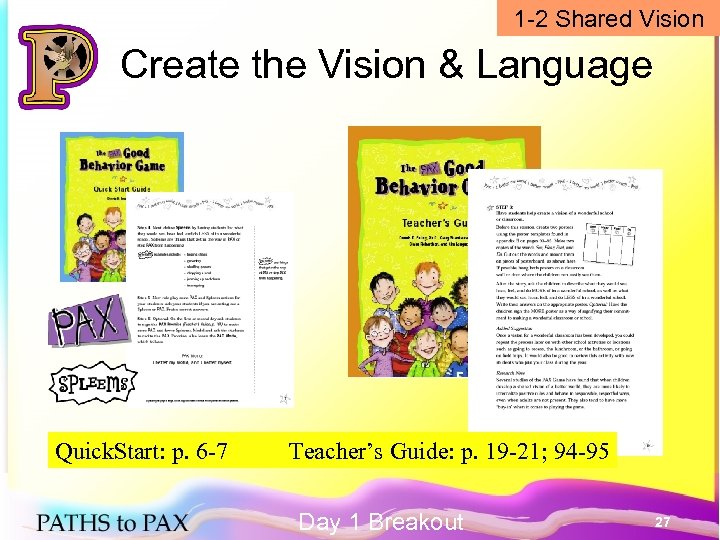
1 -2 Shared Vision Create the Vision & Language Quick. Start: p. 6 -7 Teacher’s Guide: p. 19 -21; 94 -95 Day 1 Breakout 27
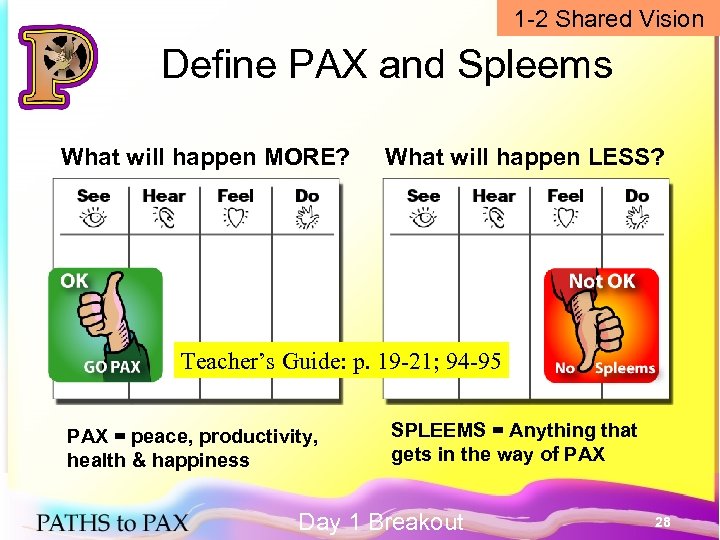
1 -2 Shared Vision Define PAX and Spleems What will happen MORE? What will happen LESS? Teacher’s Guide: p. 19 -21; 94 -95 PAX = peace, productivity, health & happiness SPLEEMS = Anything that gets in the way of PAX Day 1 Breakout 28
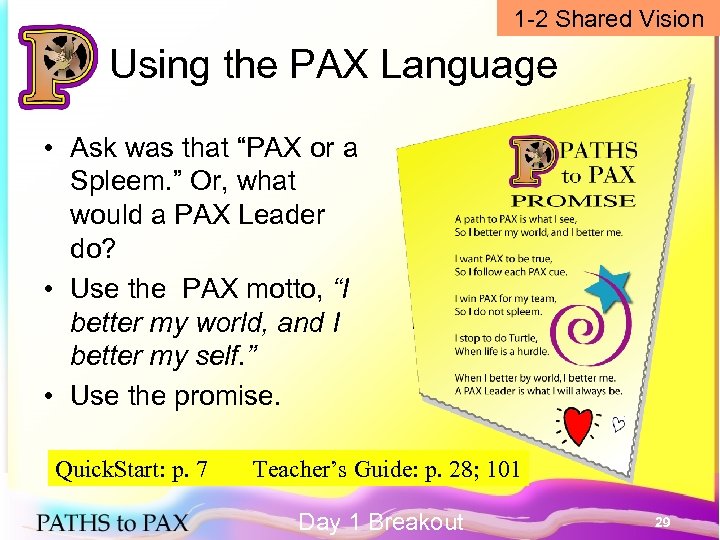
1 -2 Shared Vision Using the PAX Language • Ask was that “PAX or a Spleem. ” Or, what would a PAX Leader do? • Use the PAX motto, “I better my world, and I better my self. ” • Use the promise. Quick. Start: p. 7 Teacher’s Guide: p. 28; 101 Day 1 Breakout 29
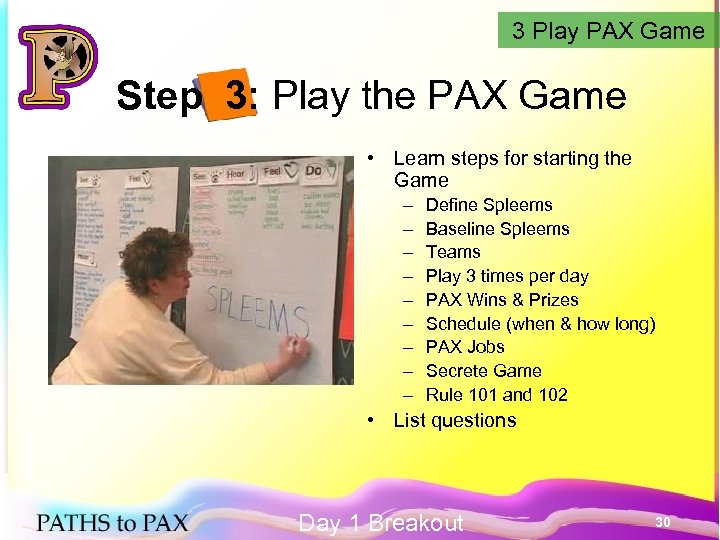
3 Play PAX Game Step 3: Play the PAX Game • Learn steps for starting the Game – – – – – Define Spleems Baseline Spleems Teams Play 3 times per day PAX Wins & Prizes Schedule (when & how long) PAX Jobs Secrete Game Rule 101 and 102 • List questions Day 1 Breakout 30
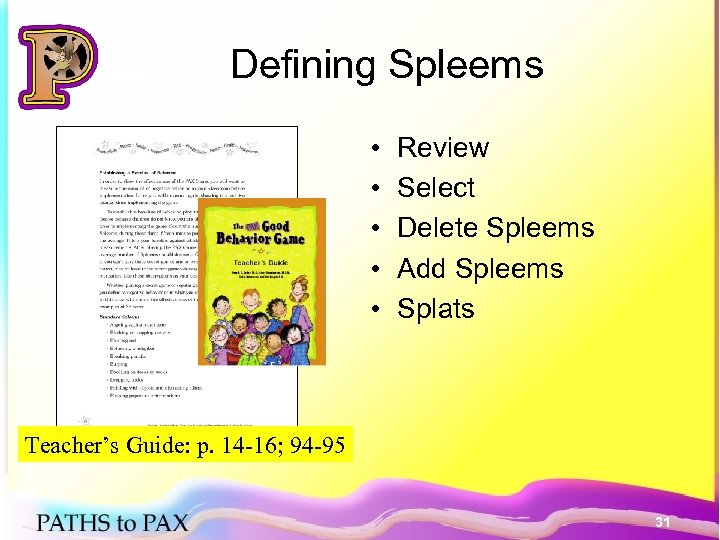
Defining Spleems • • • Review Select Delete Spleems Add Spleems Splats Teacher’s Guide: p. 14 -16; 94 -95 31
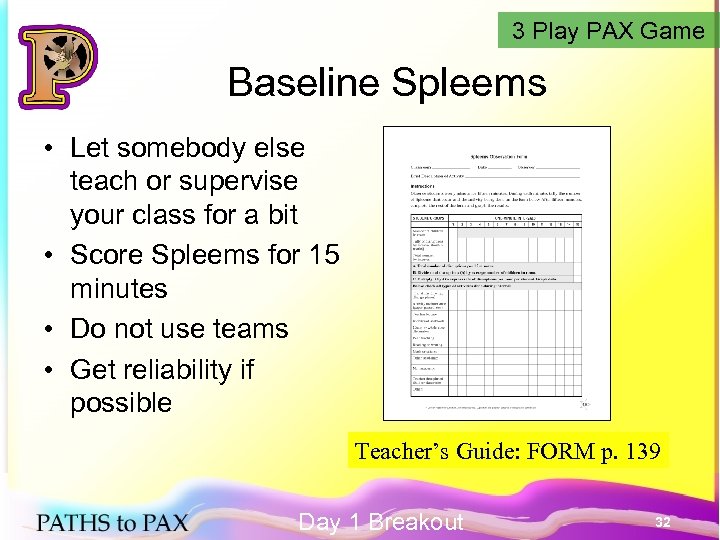
3 Play PAX Game Baseline Spleems • Let somebody else teach or supervise your class for a bit • Score Spleems for 15 minutes • Do not use teams • Get reliability if possible Use Figure 2 in handouts Teacher’s Guide: FORM p. 139 Day 1 Breakout 32
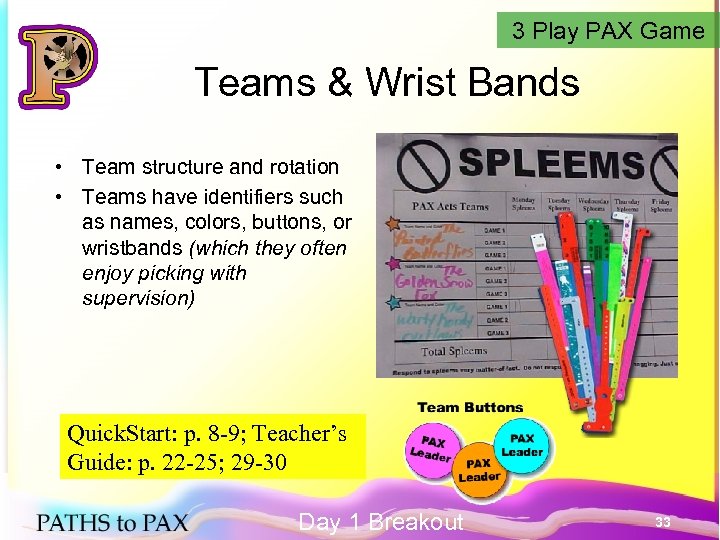
3 Play PAX Game Teams & Wrist Bands • Team structure and rotation • Teams have identifiers such as names, colors, buttons, or wristbands (which they often enjoy picking with supervision) Quick. Start: p. 8 -9; Teacher’s Guide: p. 22 -25; 29 -30 Day 1 Breakout 33
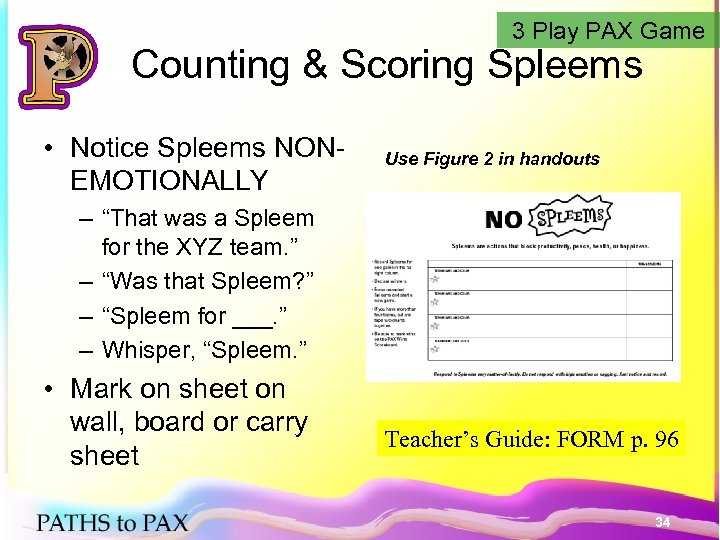
3 Play PAX Game Counting & Scoring Spleems • Notice Spleems NONEMOTIONALLY Use Figure 2 in handouts – “That was a Spleem for the XYZ team. ” – “Was that Spleem? ” – “Spleem for ___. ” – Whisper, “Spleem. ” • Mark on sheet on wall, board or carry sheet Teacher’s Guide: FORM p. 96 34
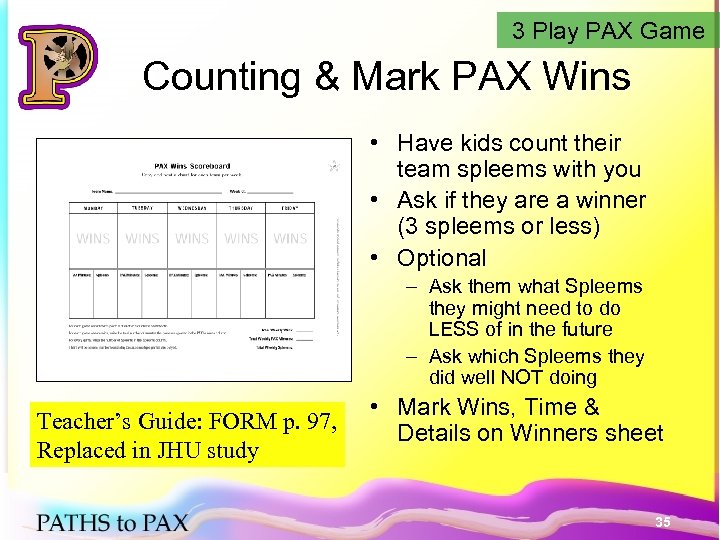
3 Play PAX Game Counting & Mark PAX Wins • Have kids count their team spleems with you • Ask if they are a winner (3 spleems or less) • Optional – Ask them what Spleems they might need to do LESS of in the future – Ask which Spleems they did well NOT doing Teacher’s Guide: FORM p. 97, Replaced in JHU study • Mark Wins, Time & Details on Winners sheet 35
3 Play PAX Game Use PAX Prizes • Granny’s Wacky Prizes • Teacher’s Prize Selection • Student Recommended Prizes • 180 Day of PAX Prizes • Moving up delay of Prizes Teacher’s Guide: p. 26, 34 -38 Day 1 Breakout Have fun with my wacky prizes. See my list of fun things to do that don’t cost any money. P. 36 -37. Use what you want. 36
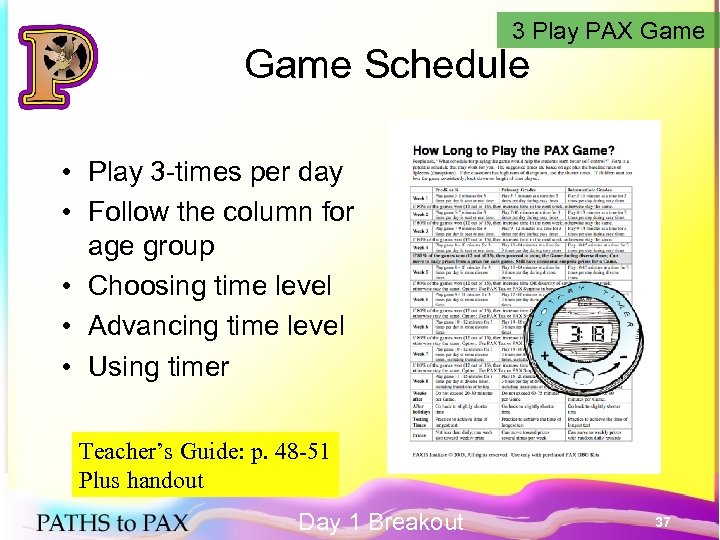
3 Play PAX Game Schedule • Play 3 -times per day • Follow the column for age group • Choosing time level • Advancing time level • Using timer Teacher’s Guide: p. 48 -51 Plus handout Day 1 Breakout 37
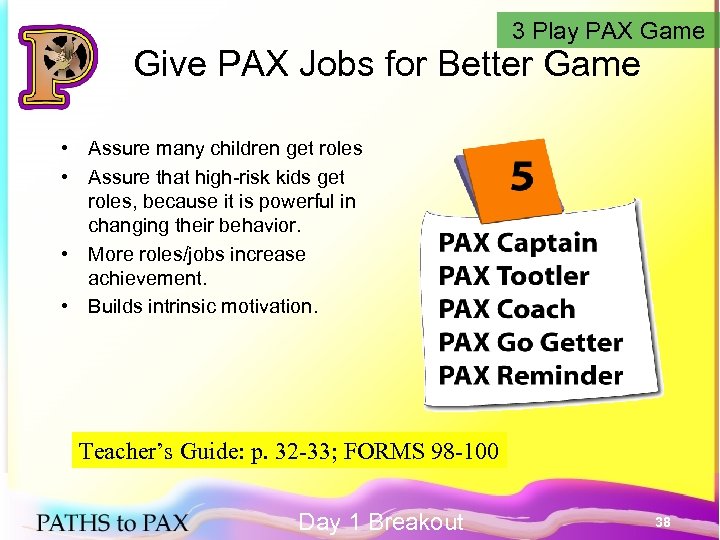
3 Play PAX Game Give PAX Jobs for Better Game • Assure many children get roles • Assure that high-risk kids get roles, because it is powerful in changing their behavior. • More roles/jobs increase achievement. • Builds intrinsic motivation. Teacher’s Guide: p. 32 -33; FORMS 98 -100 Day 1 Breakout 38
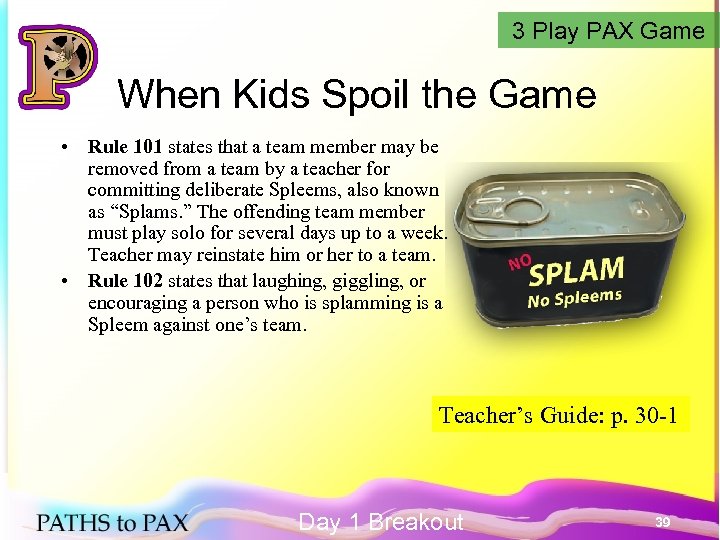
3 Play PAX Game When Kids Spoil the Game • Rule 101 states that a team member may be removed from a team by a teacher for committing deliberate Spleems, also known as “Splams. ” The offending team member must play solo for several days up to a week. Teacher may reinstate him or her to a team. • Rule 102 states that laughing, giggling, or encouraging a person who is splamming is a Spleem against one’s team. Teacher’s Guide: p. 30 -1 Day 1 Breakout 39
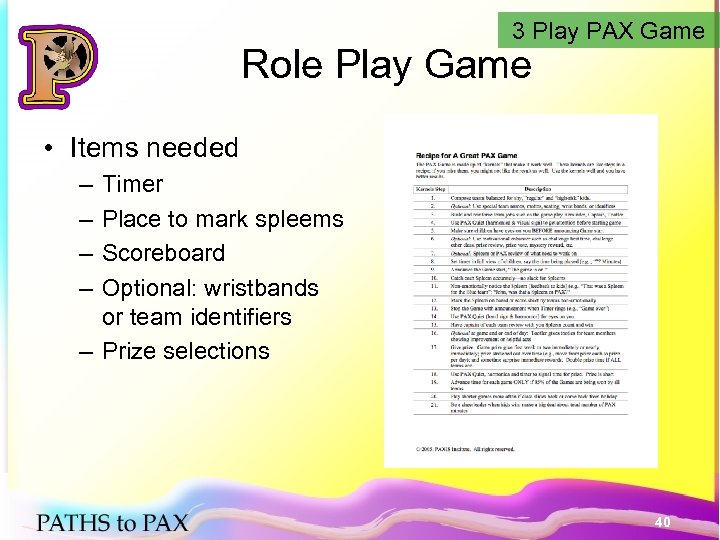
3 Play PAX Game Role Play Game • Items needed – – Timer Place to mark spleems Scoreboard Optional: wristbands or team identifiers – Prize selections 40
Rapid Questions • Take 60 seconds to write down a major question you have about the Game. • Scribe helper takes down rapid questions • Course leader(s) review Day 1 Breakout 41
Sustaining Paths to Pax More on self control, PAX everywhere, integration activities
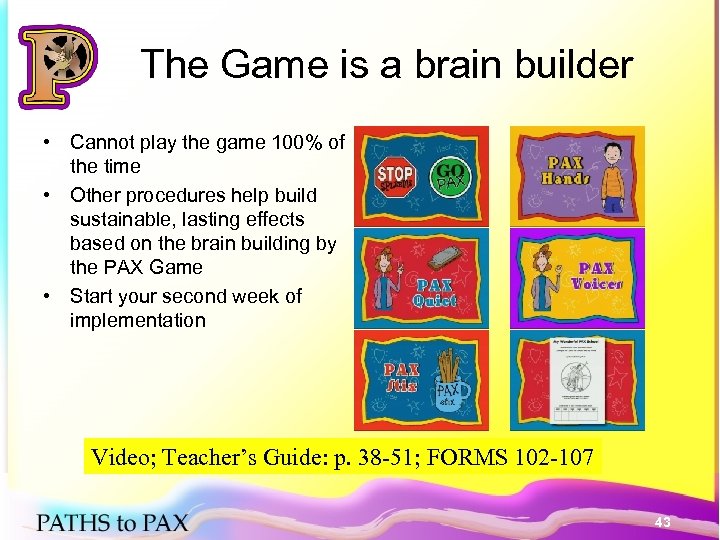
The Game is a brain builder • Cannot play the game 100% of the time • Other procedures help build sustainable, lasting effects based on the brain building by the PAX Game • Start your second week of implementation Video; Teacher’s Guide: p. 38 -51; FORMS 102 -107 43
Secret & Transition Games • Why Secret Game • Playing Game in classroom and hallways, restrooms, lunchroom, playground • Play with Substitutes and Visiting Teachers 44
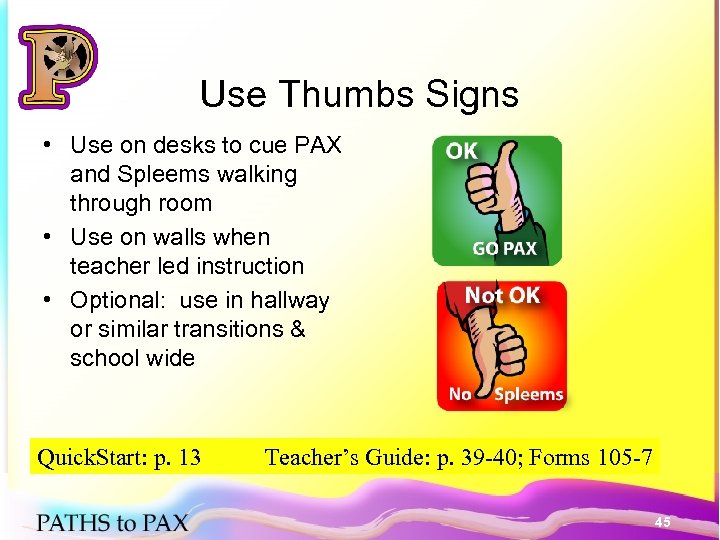
Use Thumbs Signs • Use on desks to cue PAX and Spleems walking through room • Use on walls when teacher led instruction • Optional: use in hallway or similar transitions & school wide Quick. Start: p. 13 Teacher’s Guide: p. 39 -40; Forms 105 -7 45
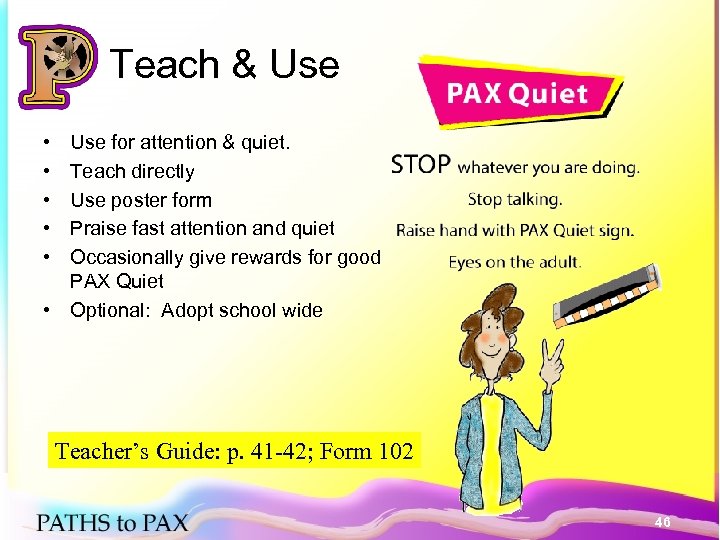
Teach & Use • • • Use for attention & quiet. Teach directly Use poster form Praise fast attention and quiet Occasionally give rewards for good PAX Quiet • Optional: Adopt school wide Teacher’s Guide: p. 41 -42; Form 102 46
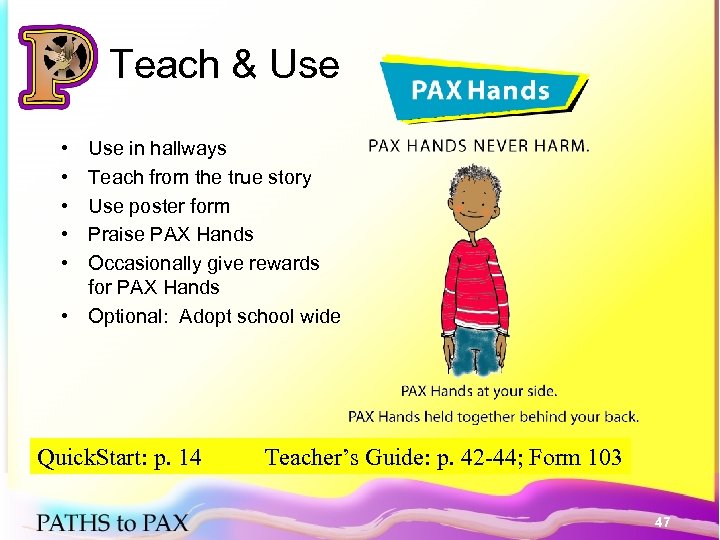
Teach & Use • • • Use in hallways Teach from the true story Use poster form Praise PAX Hands Occasionally give rewards for PAX Hands • Optional: Adopt school wide Quick. Start: p. 14 Teacher’s Guide: p. 42 -44; Form 103 47
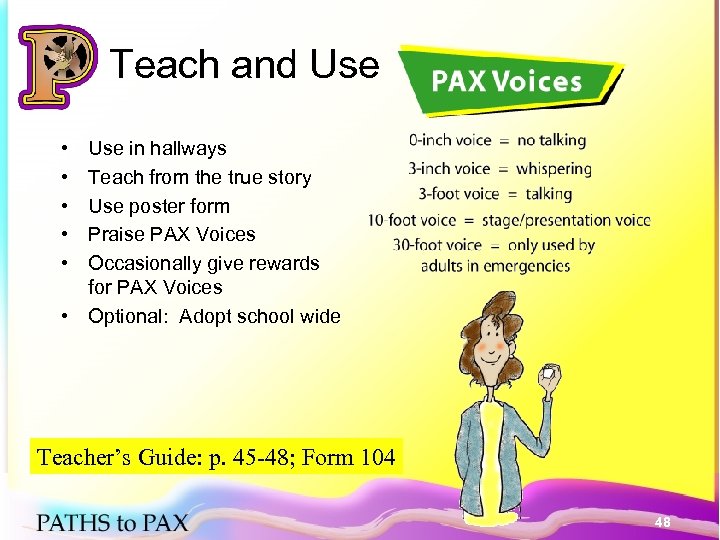
Teach and Use • • • Use in hallways Teach from the true story Use poster form Praise PAX Voices Occasionally give rewards for PAX Voices • Optional: Adopt school wide Teacher’s Guide: p. 45 -48; Form 104 48
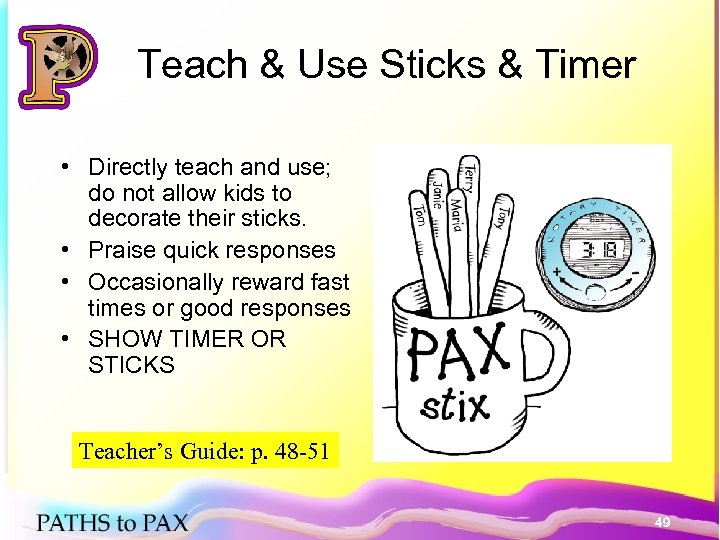
Teach & Use Sticks & Timer • Directly teach and use; do not allow kids to decorate their sticks. • Praise quick responses • Occasionally reward fast times or good responses • SHOW TIMER OR STICKS Teacher’s Guide: p. 48 -51 49
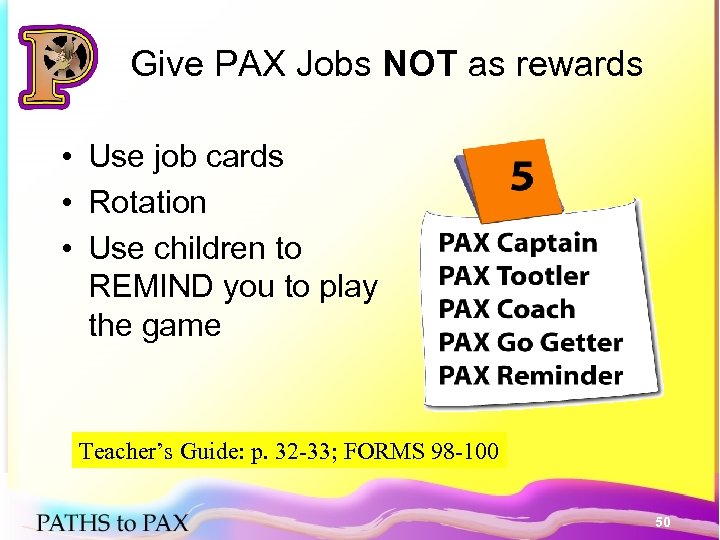
Give PAX Jobs NOT as rewards • Use job cards • Rotation • Use children to REMIND you to play the game Teacher’s Guide: p. 32 -33; FORMS 98 -100 50
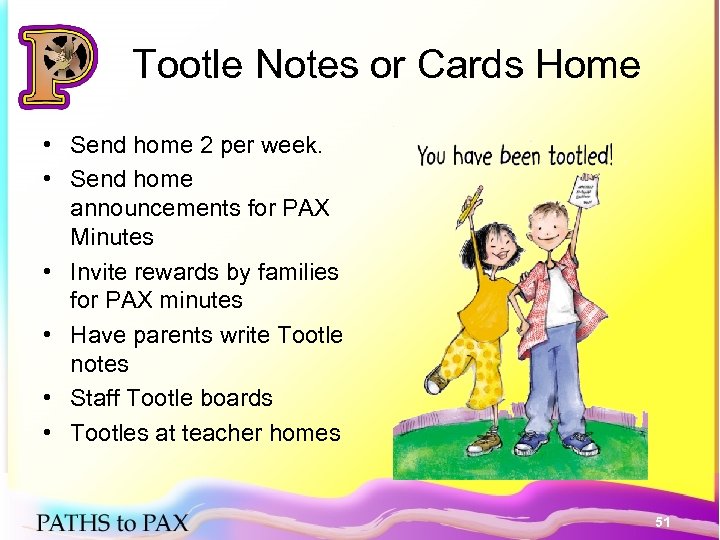
Tootle Notes or Cards Home • Send home 2 per week. • Send home announcements for PAX Minutes • Invite rewards by families for PAX minutes • Have parents write Tootle notes • Staff Tootle boards • Tootles at teacher homes 51
Kid of the Day • Think of Kid of the Day as an engineered opportunity for children to get a vitamin boost of PAX – Tootles – Learning to get attention for good 52
More Special Bridging Strategies • PAX Tax. Three Spleem slips per team member, different color per team. One slip for each team in prize bowl. Spleems are taxed. Unused slips go into daily prize bowl drawing. Each team has at least one chance. • PAX Surprise. Secretly a PAX stick is drawn. Timer set. If designated child is NOT Spleeming when timer goes off, his or her team gets a bonus PAX Win. Teacher’s Guide: p. 73 -74 53
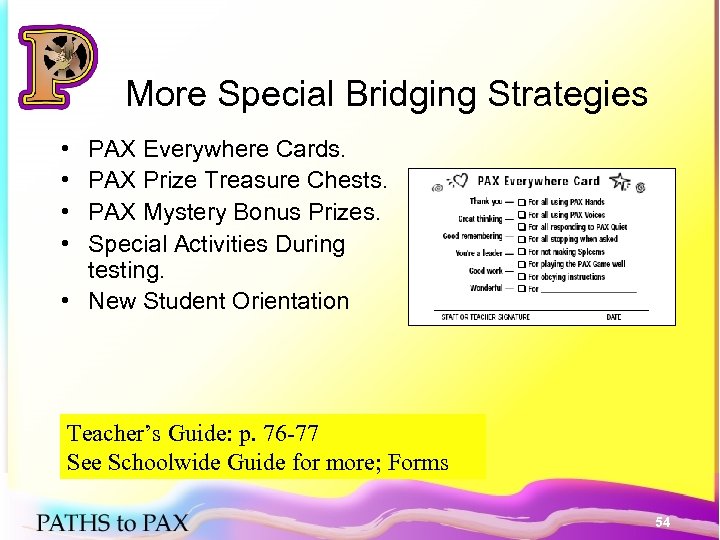
More Special Bridging Strategies • • PAX Everywhere Cards. PAX Prize Treasure Chests. PAX Mystery Bonus Prizes. Special Activities During testing. • New Student Orientation Teacher’s Guide: p. 76 -77 See Schoolwide Guide for more; Forms 54
Other Paths for Sustaining • • Using the PATHS to PAX during testing time Using PATHS to PAX at end of school. Dealing with the boring problem (180 days) New Students Other Staff members PAX Wins contests Practicing with special needs children or adding PAX PATHS to IEPs and 504 plans Teacher’s Guide: p. 65 -77 55
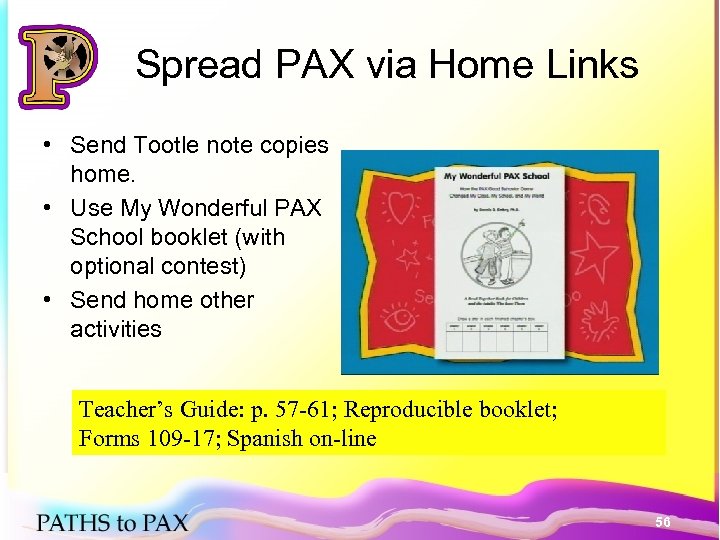
Spread PAX via Home Links • Send Tootle note copies home. • Use My Wonderful PAX School booklet (with optional contest) • Send home other activities Teacher’s Guide: p. 57 -61; Reproducible booklet; Forms 109 -17; Spanish on-line 56
“Yippee, food. Let’s eat. No more talk. ” Lunch 57
Welcome back from Lunch A workshop for using some of most powerful, practical tools in documented prevention science By…Penn State University, PAXIS Institute and Johns Hopkins University
Fast Facts Learning Game • On instruction, please SILENTLY read through the questions quickly. • The peer teacher reads through each question briskly. Without looking at the answers, the learner tries to answer as best as possible. If the answer is correct, the peer teacher scores 5 points for the learner’s answer. If the answer is not correct, the peer teacher coaches the correct answer by saying it and asks the learner to repeat the answer for 3 points • Continue going through the questions and answers, REPEATING questions, until time called. • When signaled, change roles quickly. The learner now becomes the peer teacher. Continue until signaled to stop. • Tally points for each person; then add points for the pair, adding all the five, three and zero answers. 59

What does the research show? What is important to you?
Being a consumer of research • What would you want to know short term? – What could we notice (see or hear) different? • What would you want to know long term? – How would children and staff change? • What what else would be important to you as a consumer of research information? – Real world practice? – So what 61
PATHS Curriculum Research. There have been four controlled studies with randomized control groups: – 2 with regular education, – 1 with special needs children, and – 1 with deaf/hearing-impaired children 62
Key PATHS Findings • Significant reductions in aggressive behavior by both teacher and child reports • Significant reductions in child and teacher report of internalizing (anxiety and depressive symptoms) • Significant improvements in children social competence by teacher’s reports of child behavior • Significant improvement in children’s understanding of emotions and their ability to generate effective, peaceful solutions to everyday peer conflicts 63
Study One of PATHS § § 320 Children in Seattle Public Schools Second and Third Graders Randomized at Level of the Classroom One Year of PATH 64
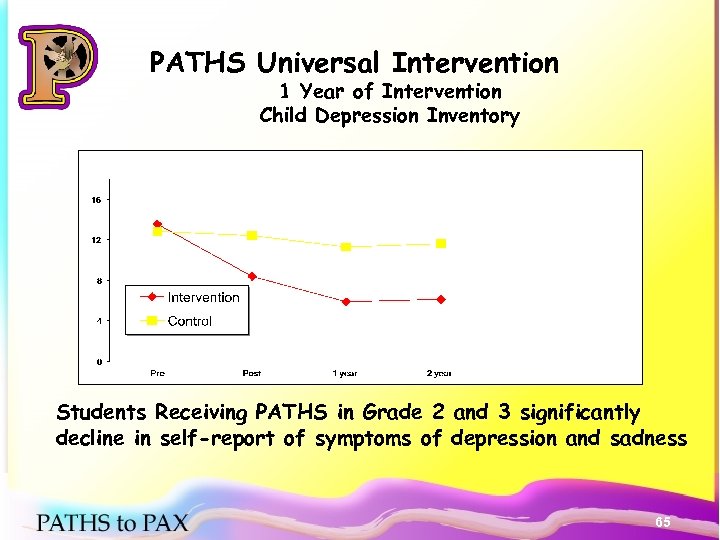
PATHS Universal Intervention 1 Year of Intervention Child Depression Inventory Students Receiving PATHS in Grade 2 and 3 significantly decline in self-report of symptoms of depression and sadness 65
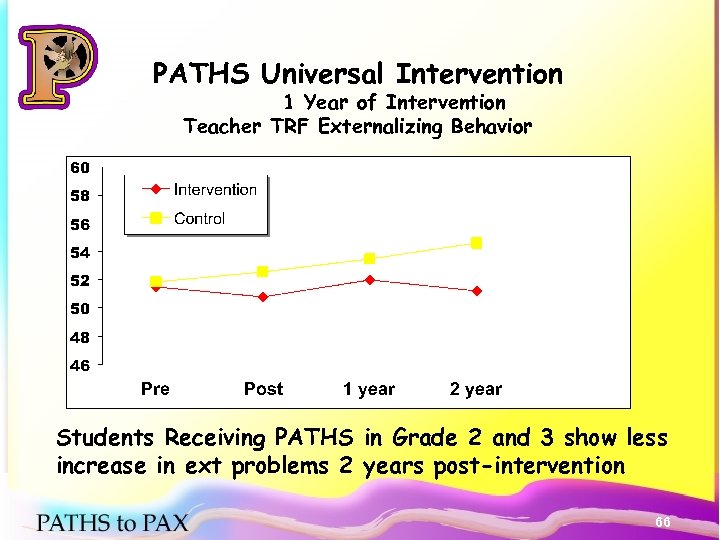
PATHS Universal Intervention 1 Year of Intervention Teacher TRF Externalizing Behavior Students Receiving PATHS in Grade 2 and 3 show less increase in ext problems 2 years post-intervention 66
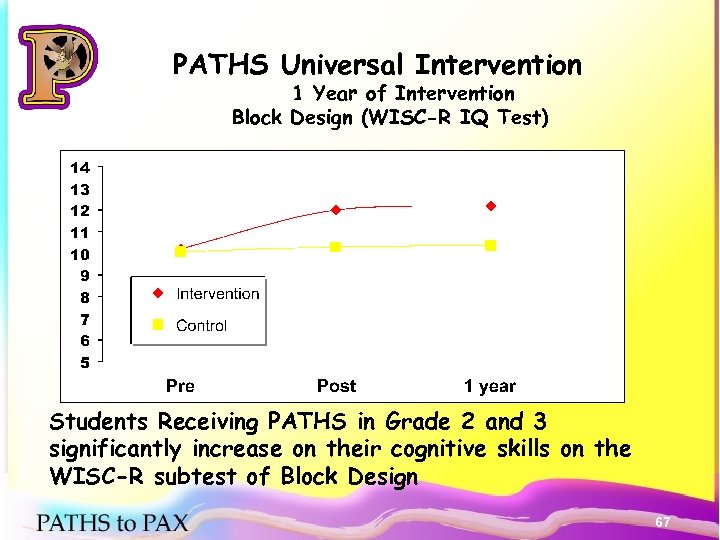
PATHS Universal Intervention 1 Year of Intervention Block Design (WISC-R IQ Test) Students Receiving PATHS in Grade 2 and 3 significantly increase on their cognitive skills on the WISC-R subtest of Block Design 67
Study Two: Fast Track • Efficacy Study Multi-site approximately 50 schools in § Washington State § North Carolina § Tennessee § Pennsylvania 68
Fast Track OUTCOME MEASURES End of First Year of Intervention Ø Universal Program (PATHS) • Peer Sociometric Ratings on Aggression and Disruption and Social Competence • Classroom Atmosphere – (Solomon And Battistich/CDP Observational Measure) • Teacher Ratings on the TOCA-R
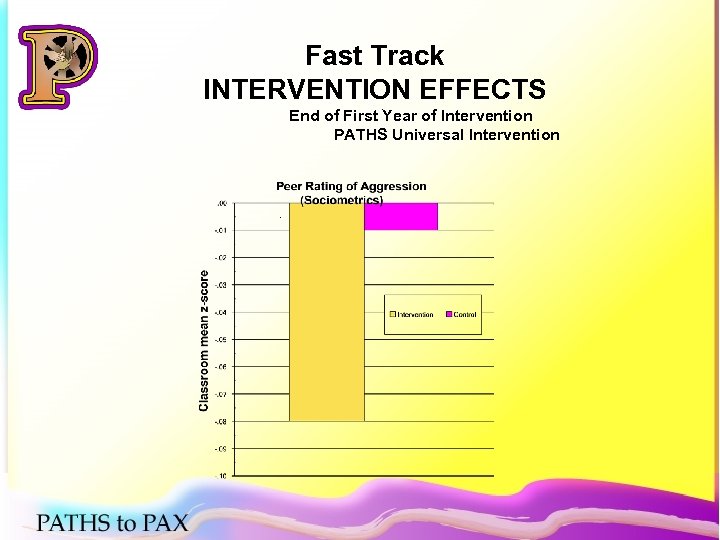
Fast Track INTERVENTION EFFECTS End of First Year of Intervention PATHS Universal Intervention
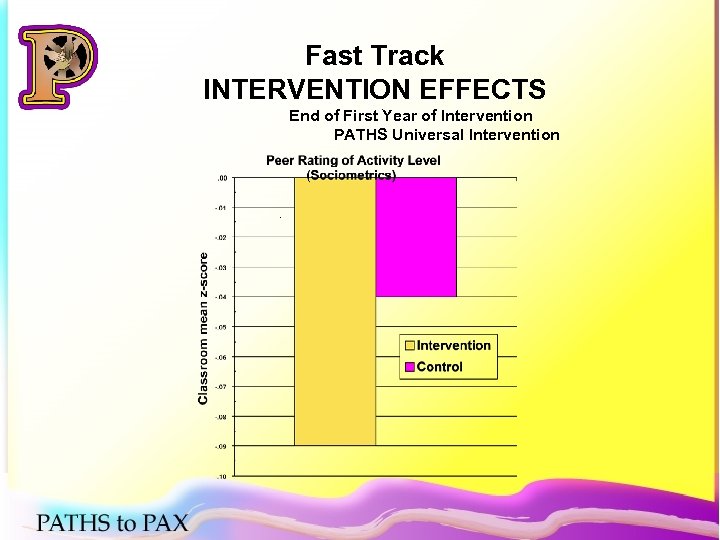
Fast Track INTERVENTION EFFECTS End of First Year of Intervention PATHS Universal Intervention
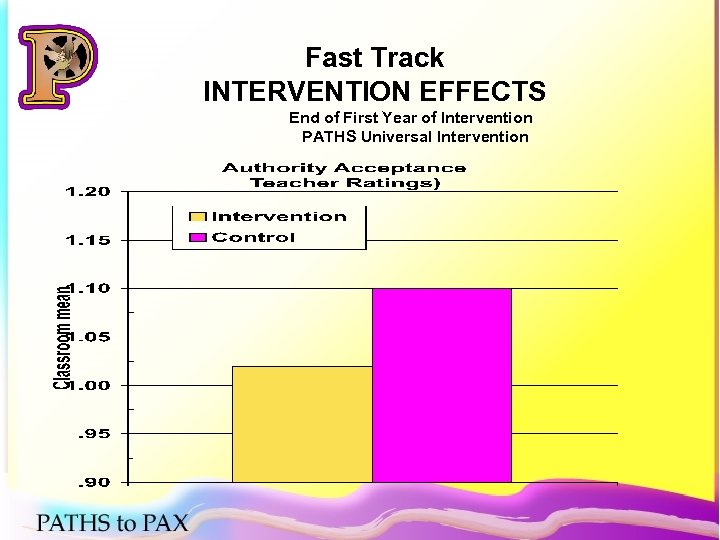
Fast Track INTERVENTION EFFECTS End of First Year of Intervention PATHS Universal Intervention
Fast Track INTERVENTION EFFECTS End of First Year of Intervention PATHS Universal Intervention
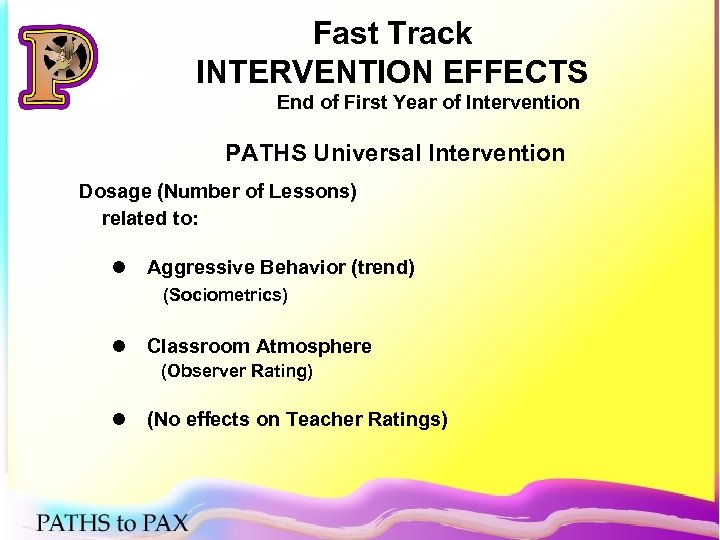
Fast Track INTERVENTION EFFECTS End of First Year of Intervention PATHS Universal Intervention Dosage (Number of Lessons) related to: l Aggressive Behavior (trend) (Sociometrics) l Classroom Atmosphere (Observer Rating) l (No effects on Teacher Ratings)
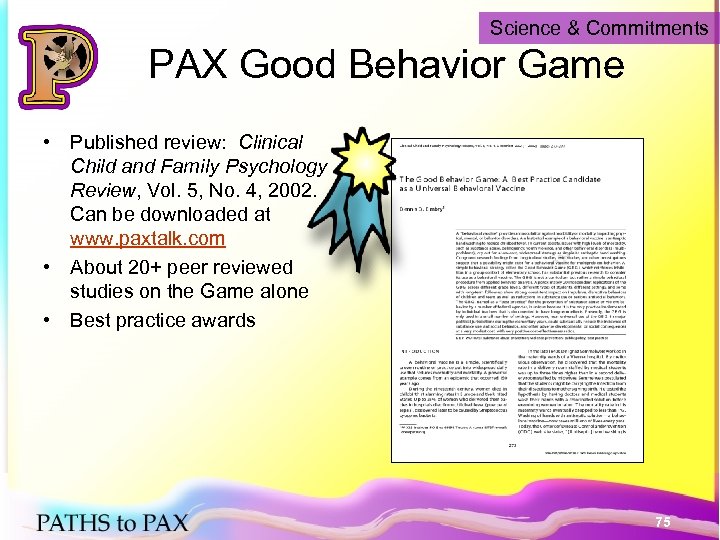
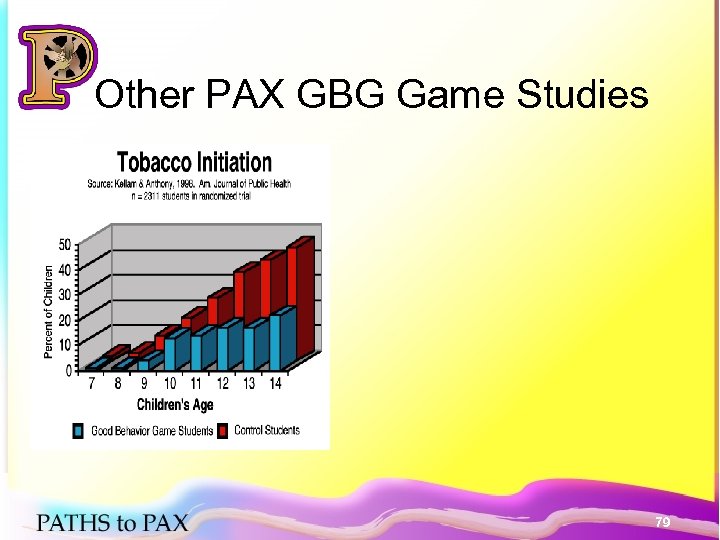
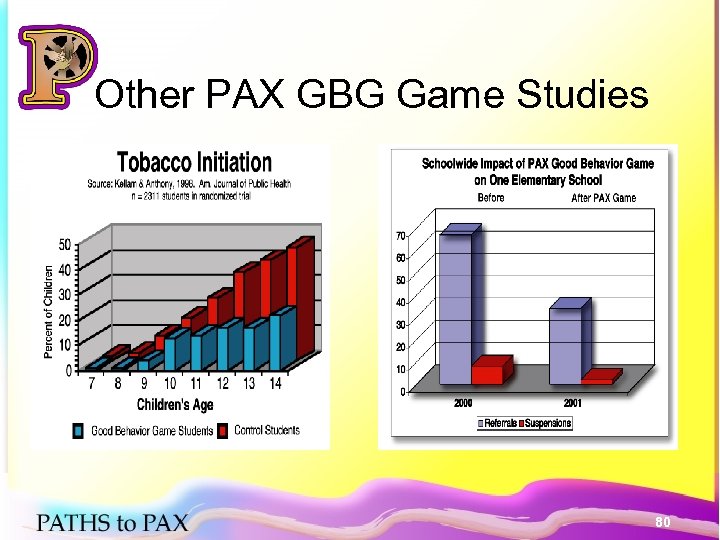
Science & Commitments PAX Good Behavior Game • Published review: Clinical Child and Family Psychology Review, Vol. 5, No. 4, 2002. Can be downloaded at www. paxtalk. com • About 20+ peer reviewed studies on the Game alone • Best practice awards 75
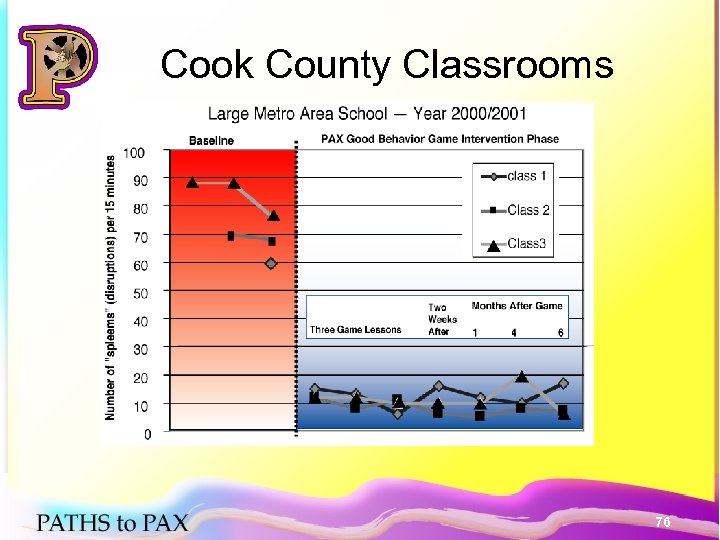
Cook County Classrooms 76
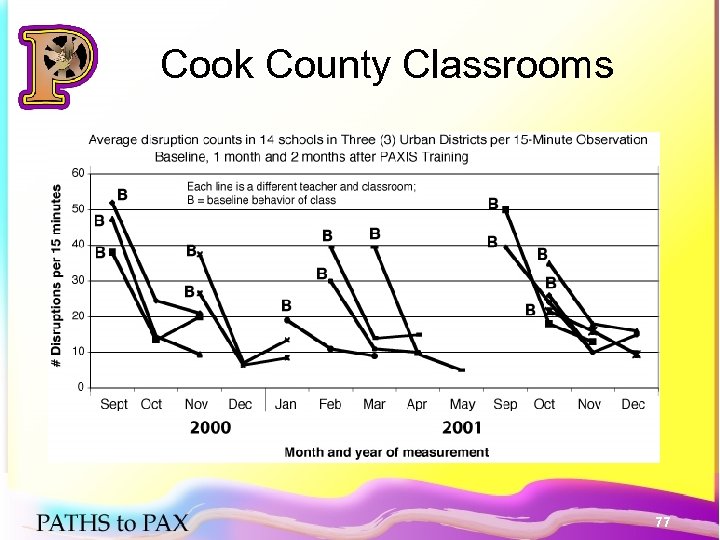
Cook County Classrooms 77
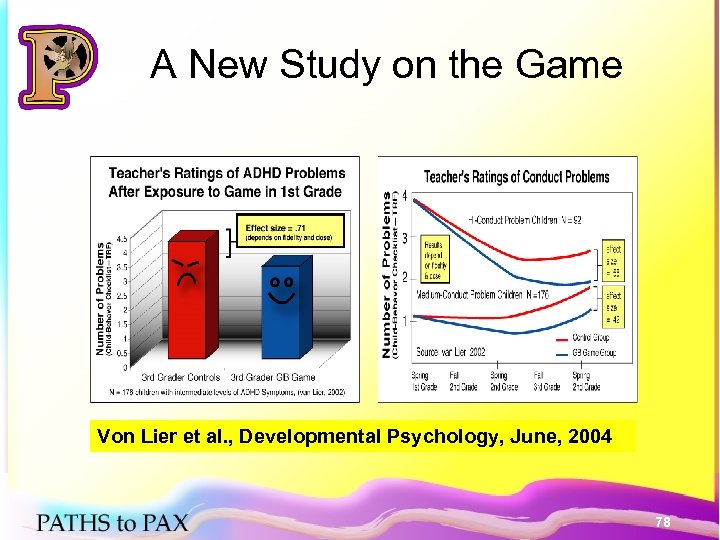
A New Study on the Game Von Lier et al. , Developmental Psychology, June, 2004 78
Other PAX GBG Game Studies 79
Other PAX GBG Game Studies 80
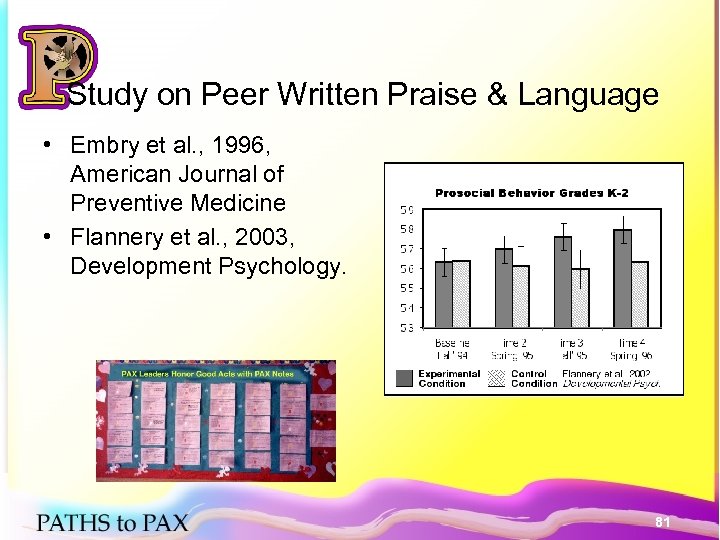
Study on Peer Written Praise & Language • Embry et al. , 1996, American Journal of Preventive Medicine • Flannery et al. , 2003, Development Psychology. 81
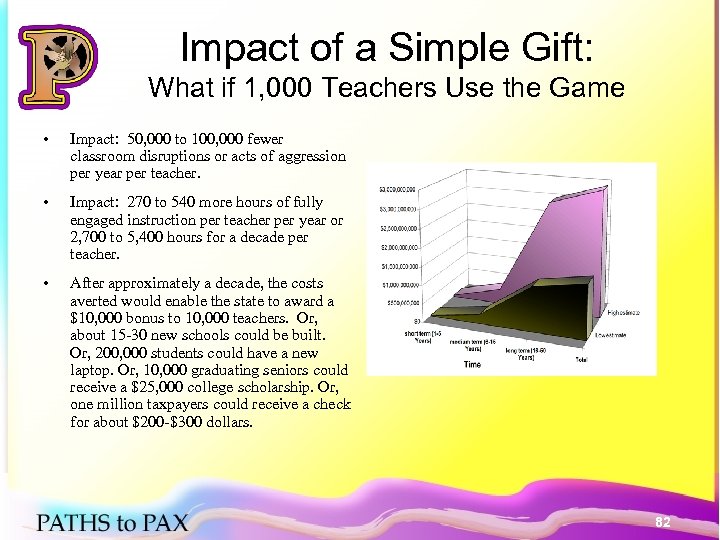
Impact of a Simple Gift: What if 1, 000 Teachers Use the Game • Impact: 50, 000 to 100, 000 fewer classroom disruptions or acts of aggression per year per teacher. • Impact: 270 to 540 more hours of fully engaged instruction per teacher per year or 2, 700 to 5, 400 hours for a decade per teacher. • After approximately a decade, the costs averted would enable the state to award a $10, 000 bonus to 10, 000 teachers. Or, about 15 -30 new schools could be built. Or, 200, 000 students could have a new laptop. Or, 10, 000 graduating seniors could receive a $25, 000 college scholarship. Or, one million taxpayers could receive a check for about $200 -$300 dollars. 82
Evaluating PATHS to PAX Dr. Ialongo
Evaluation of PATHS to PAX Is this comprehensive classroom-wide program feasible for Baltimore City School District teachers to implement? How satisfied were the teachers with the PATHS to PAX intervention? Training Support Curriculum Materials Impact on Students 84
Methods of Data Collection Evaluations from Workshop Attendees Focus groups with Teachers, Staff, Administrators, and Coaches Classroom Observations (i. e. , spleem counts) by Teachers & Coaches Pilot Ratings of Implementation by Teachers and Coaches Dosage – number & type of games, length of time played, number of lessons Perceived Impact on Students & Classroom Climate Satisfaction 85
Practice on Spleems Defining and Observing
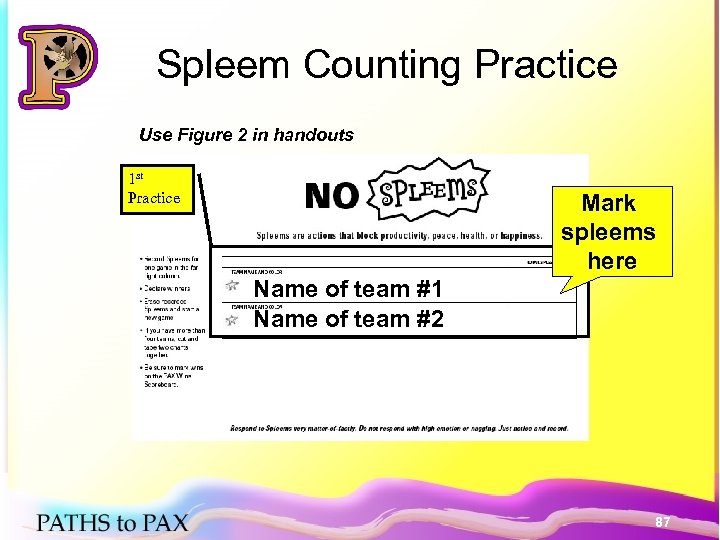
Spleem Counting Practice Use Figure 2 in handouts 1 st Practice Mark spleems here Name of team #1 Name of team #2 87
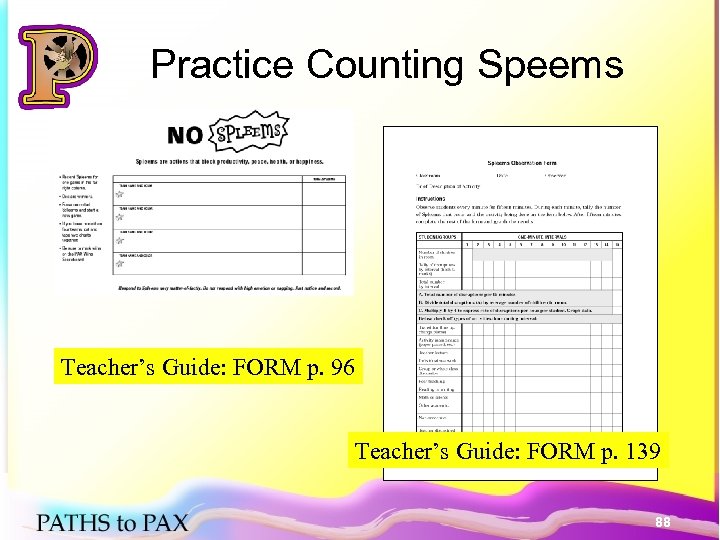
Practice Counting Speems Teacher’s Guide: FORM p. 96 Teacher’s Guide: FORM p. 139 88
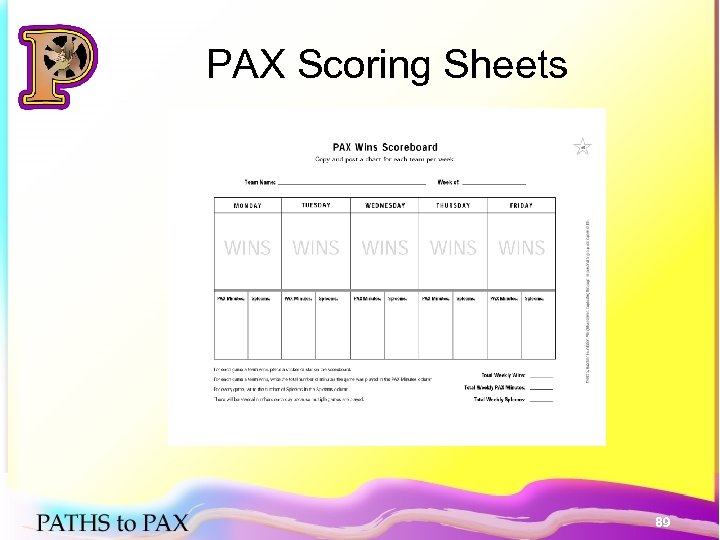
PAX Scoring Sheets 89
Getting Off to Right Foot for First Month And Questions & Answers
Integration with Academics • • • Paths Lessons Literature PAX Principles Use of Cues Use of Game 91
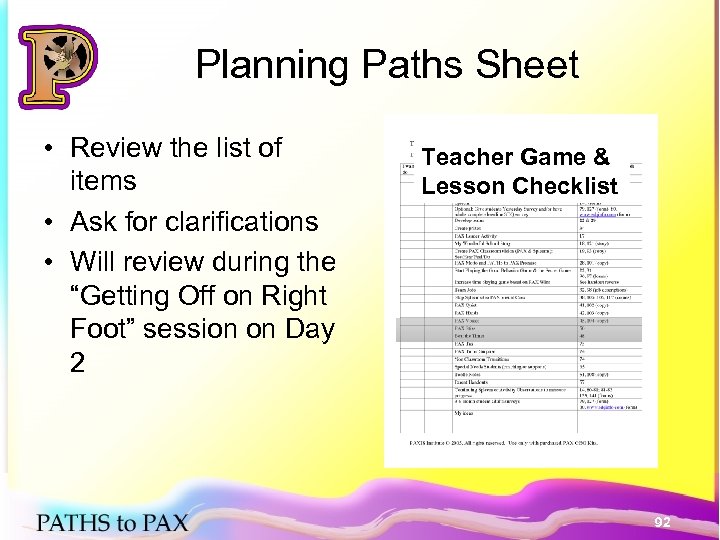
Planning Paths Sheet • Review the list of items • Ask for clarifications • Will review during the “Getting Off on Right Foot” session on Day 2 Teacher Game & Lesson Checklist 92

Recruiting Partners to PAX • Brainstorm: Who are your PATHS TO PAX partners? 93
Partners: What supports? • Brainstorm: What kind of support would you like from each of these partners? 94
Partners • Brainstorm: Strategies to get support 95
Keeping the support going • Tootle notes • Celebrations • Sharing success stories 96
Generative Fluency • What is the purpose of PATHS to PAX? • • Achieving enough dose for effect? The meaning of generative? The meaning of fluency? Learning to be an everyday scientist – – – – Antecedents Stories Behaviors Cognitions Consequences Drive Fun Classroom environment 97
Question and Answers • List the question 98
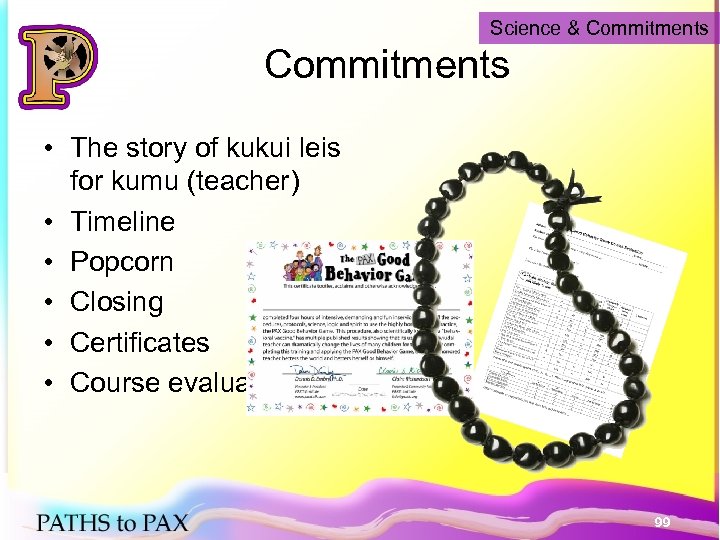
Science & Commitments • The story of kukui leis for kumu (teacher) • Timeline • Popcorn • Closing • Certificates • Course evaluation 99

Thank you… • Visit our web our site: • www. paxtalk. com 100
Скачать презентацию Welcome back for Day 2 A workshop for
5301e73ffb843c1a61d4d3c964885c61.ppt