


 Скачать презентацию Welcome Arts Educators Please sign in tinyurl com arts
ce912b754378b2a28f0d57d19e515a0e.ppt
- Количество слайдов: 63
 Welcome Arts Educators Please sign in! tinyurl. com/arts 14 -15
 Objectives • Logistics - Info Overview • Curriculum – Assessment • System Initiatives – Pieces of Gold/Gifts of Gold – Literacy in the Arts – Cultural Proficiency • Professional Learning – Staff Development Coordinators – PLTs – Early Release
 Central Office Support Liz Droessler, Ed. D. Sr. Administrator egrimes-droessler@wcpss. net 919 -431 -7654 Jim Martz Coordinating Teacher jmartz@wcpss. net 919 -431 -7642
 Logistics - Communication • Google Survey Ø Lotus E-Mail Groups by content area Ø Ø PLEASE DO NOT “REPLY ALL” TO LARGE E-MAILS START A NEW MESSAGE (BCC) PLEASE USE APPROPRIATE SUBJECT WHEN REPLYING TO E-MAILS Remember to check you email Every Day! Please help us find the new staff in your building.
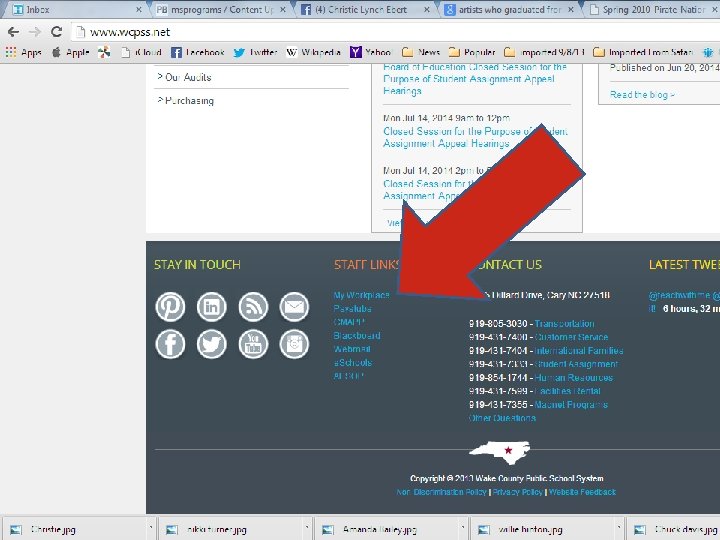
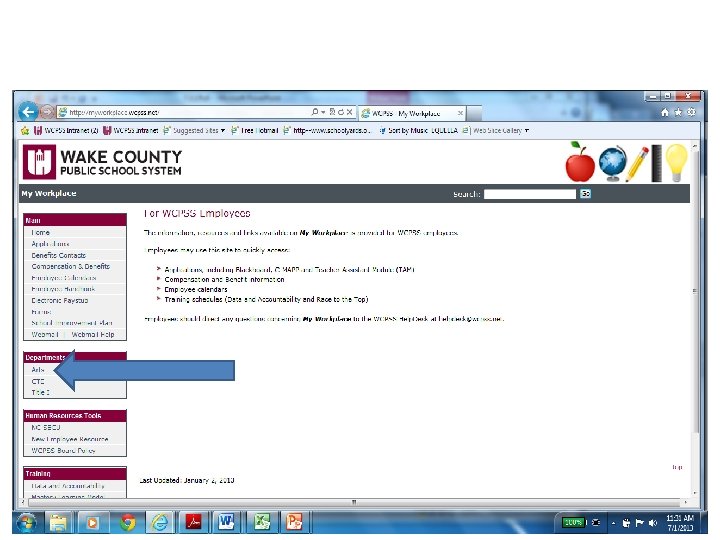
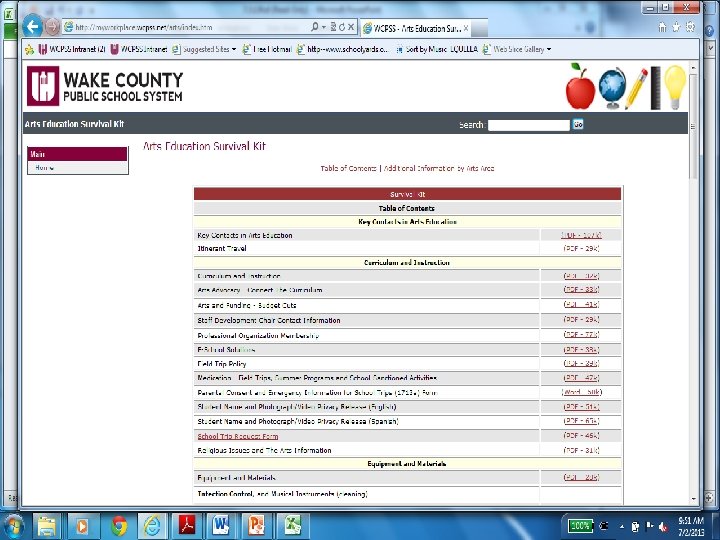
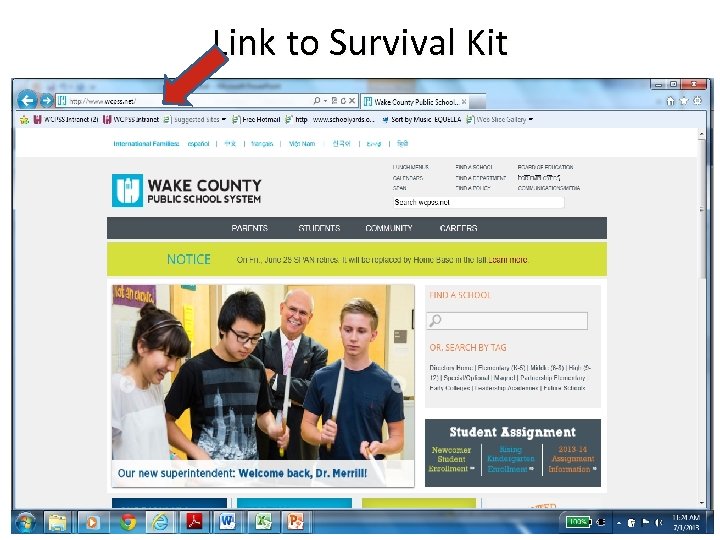 Link to Survival Kit
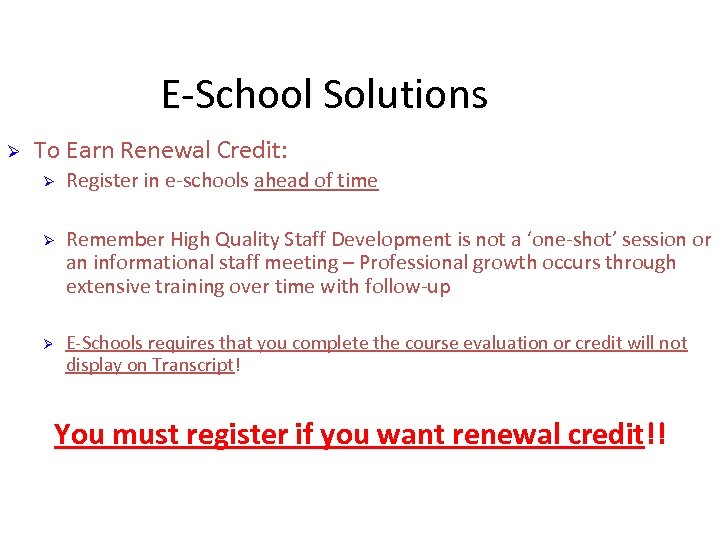 E-School Solutions Ø To Earn Renewal Credit: Ø Ø Ø Register in e-schools ahead of time Remember High Quality Staff Development is not a ‘one-shot’ session or an informational staff meeting – Professional growth occurs through extensive training over time with follow-up E-Schools requires that you complete the course evaluation or credit will not display on Transcript! You must register if you want renewal credit!!
 Who’s Here? ? ? Stand up & be recognized if you teach: … • Music • Visual Art • Dance • Theatre • Young People
 Early Release • Topics – Assessment Practices – Recruitment/Retention – Links to Literacy • With principal approval, we would like to continue to offer designated arts staff development on the October & March Early Release Days.
 Staff Development >> Professional Learning Ø Exemplary & relevant Ø Staff Development Chairs will be your immediate contact Early Release - October 17 th & March 6 th with principal approval Ø Please take advantage of staff development opportunities to support continued professional learning
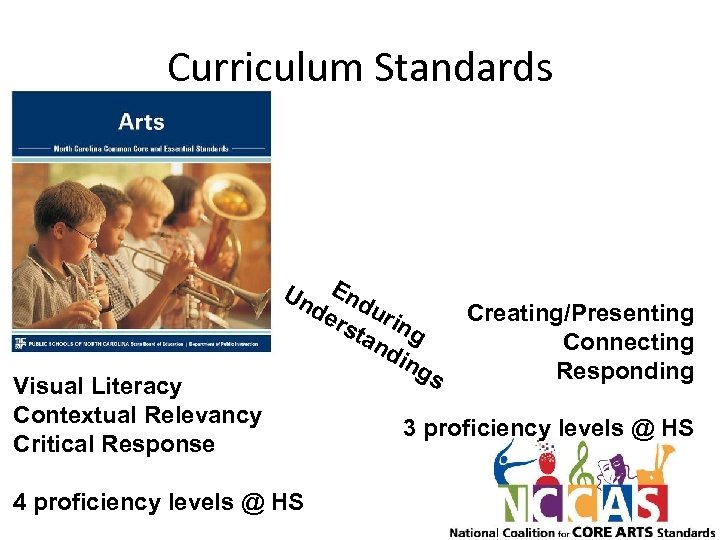 Curriculum Standards Visual Literacy Contextual Relevancy Critical Response Un End de ur rst ing an din g 4 proficiency levels @ HS s Creating/Presenting Connecting Responding 3 proficiency levels @ HS
 It’s a bit like … We Build Planes
 House Rules • Keep a growth mindset – Reflection > Starting Point > Forward Motion • Jot down your Questions • Don’t Shoot the Messenger • Remain Flexible
 ASW Process How do you measure growth?
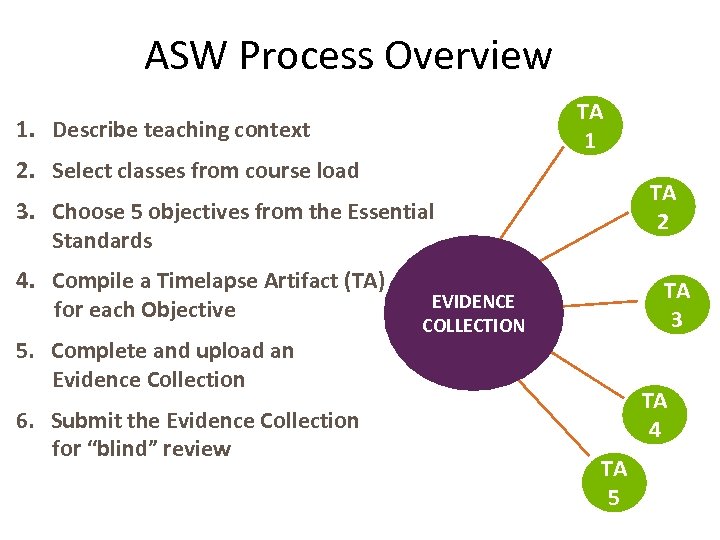 ASW Process Overview TA 1 1. Describe teaching context 2. Select classes from course load TA 2 3. Choose 5 objectives from the Essential Standards 4. Compile a Timelapse Artifact (TA) for each Objective 5. Complete and upload an Evidence Collection 6. Submit the Evidence Collection for “blind” review TA 3 EVIDENCE COLLECTION TA 4 TA 5
 ASW Step #1 Teaching Context The teacher will: Verify Power. School Courses # students Frequency Duration
 ASW Step #2 Class Selection Beginning in 2014 – 2015, Online Platform will the online platform will select the classes from in which your Power. School the teacher must collect Course Listings artifacts.
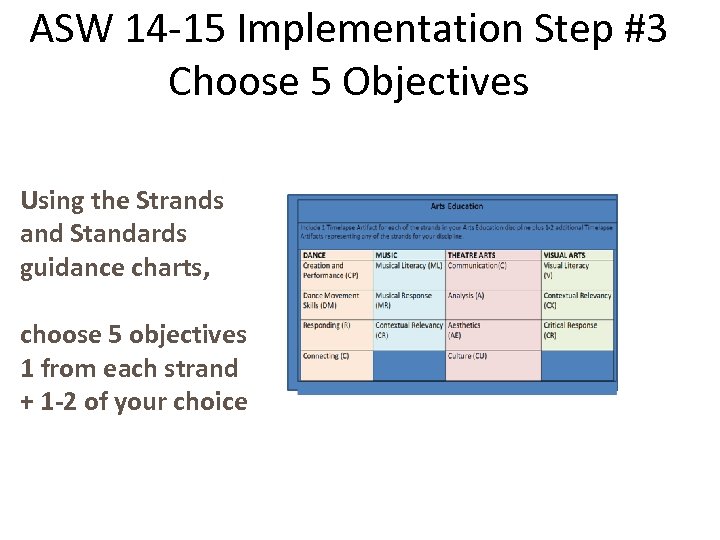 ASW 14 -15 Implementation Step #3 Choose 5 Objectives Using the Strands and Standards guidance charts, choose 5 objectives 1 from each strand + 1 -2 of your choice
 ASW Step #4 Compile Timelapse Artifacts Timelapse Artifact Option 1 – Student Work Samples Collect and keep 2 work samples: • for each class member • for the objective • at 2 separate points in time
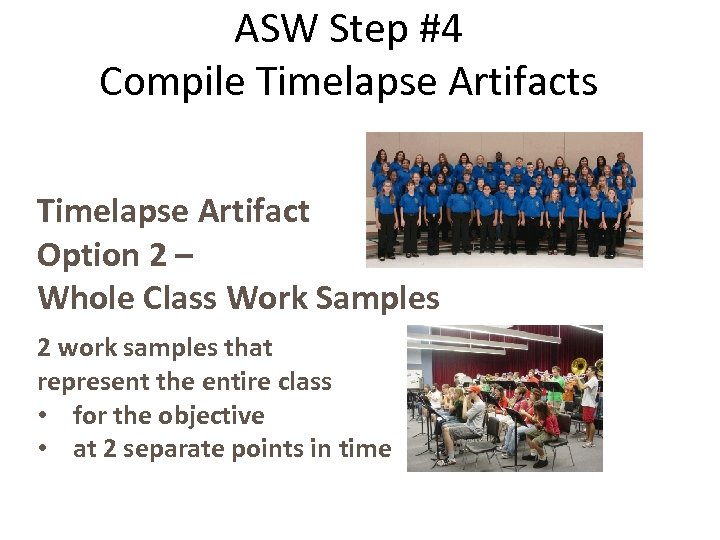 ASW Step #4 Compile Timelapse Artifacts Timelapse Artifact Option 2 – Whole Class Work Samples 2 work samples that represent the entire class • for the objective • at 2 separate points in time
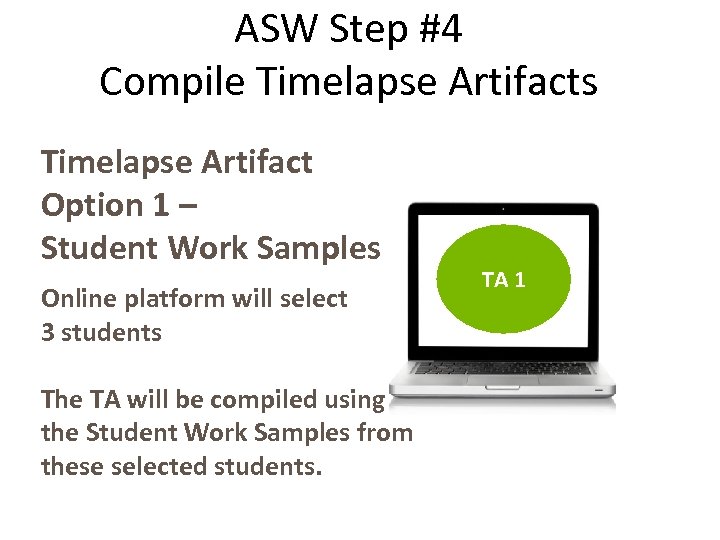 ASW Step #4 Compile Timelapse Artifacts Timelapse Artifact Option 1 – Student Work Samples Online platform will select 3 students The TA will be compiled using the Student Work Samples from these selected students. TA 1
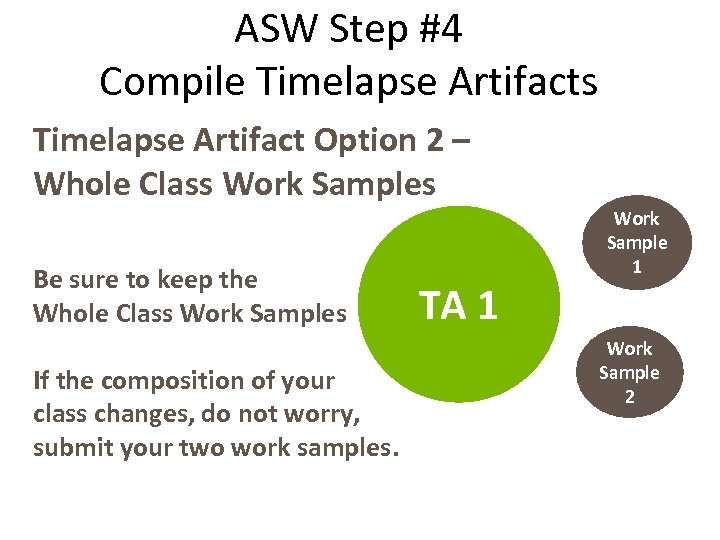 ASW Step #4 Compile Timelapse Artifacts Timelapse Artifact Option 2 – Whole Class Work Samples Be sure to keep the Whole Class Work Samples #2 If the composition of your class changes, do not worry, submit your two work samples. TA 1 Work Sample 2
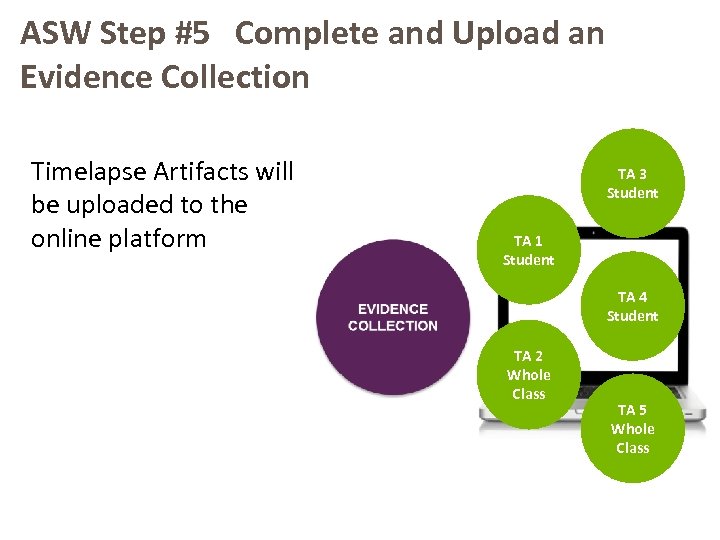 ASW Step #5 Complete and Upload an Evidence Collection Timelapse Artifacts will be uploaded to the online platform TA 3 Student TA 1 Student TA 4 Student TA 2 Whole Class TA 5 Whole Class
 ASW Step #6 Submit the Evidence Collection for “blind” review The Evidence Collection will be reviewed by a 2 content area specialists.
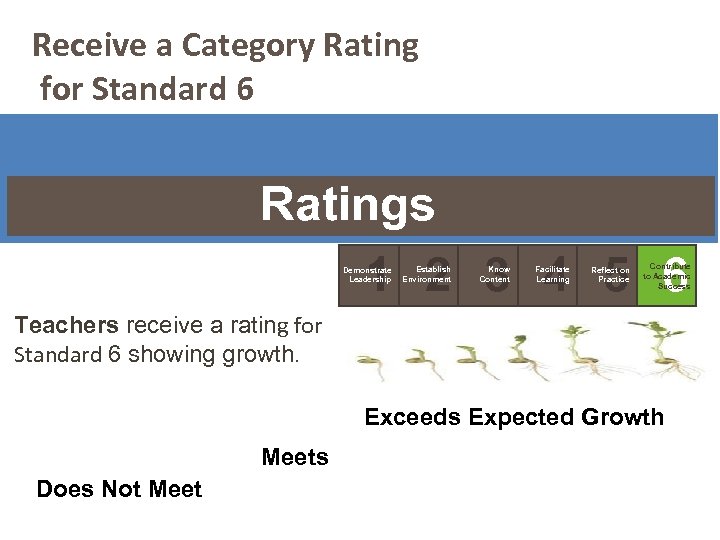 Receive a Category Rating for Standard 6 Ratings 1 2 3 4 5 6 Demonstrate Leadership Establish Environment Know Content Facilitate Learning Reflect on Practice Contribute to Academic Success Teachers receive a rating for Standard 6 showing growth. Exceeds Expected Growth Meets Does Not Meet
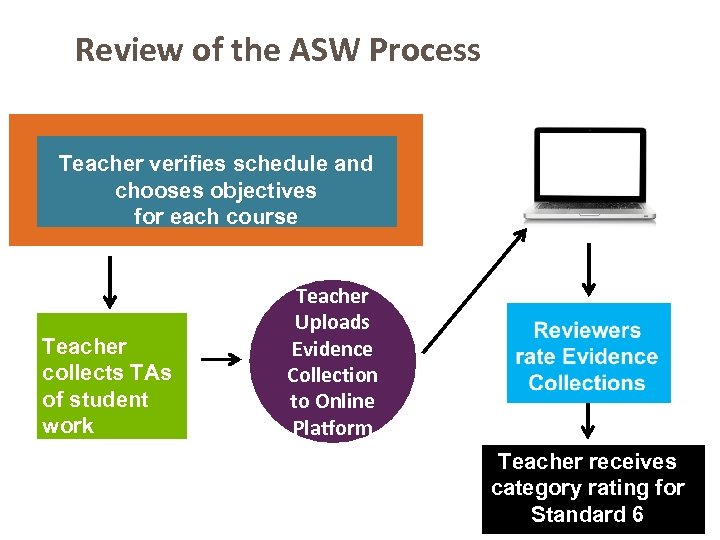 Review of the ASW Process Teacher verifies schedule and chooses objectives for each course Teacher collects TAs of student work Teacher Uploads Evidence Collection to Online Platform Teacher receives category rating for Standard 6
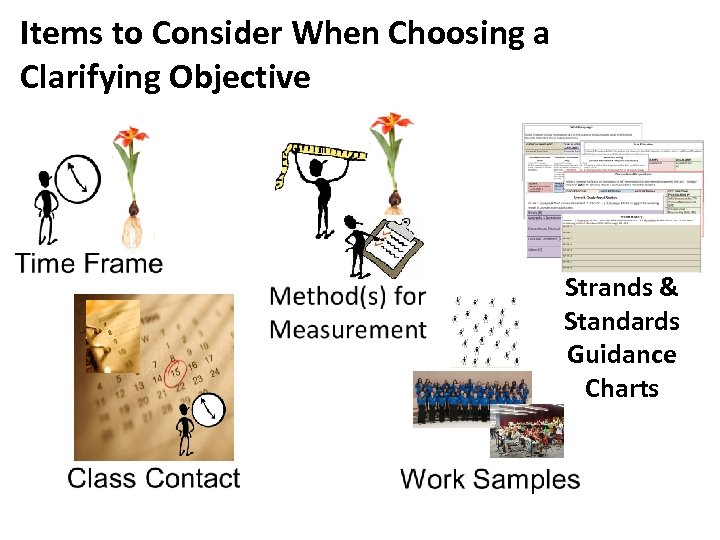 Items to Consider When Choosing a Clarifying Objective Strands & Standards Guidance Charts
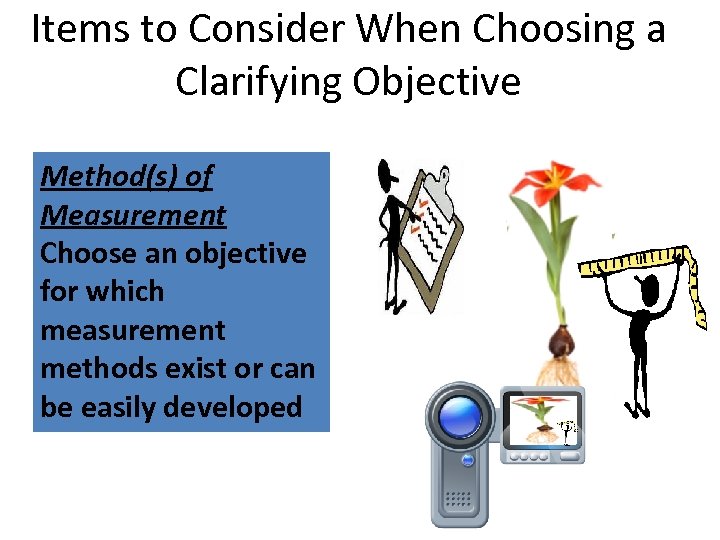 Items to Consider When Choosing a Clarifying Objective Method(s) of Measurement Choose an objective for which measurement methods exist or can be easily developed
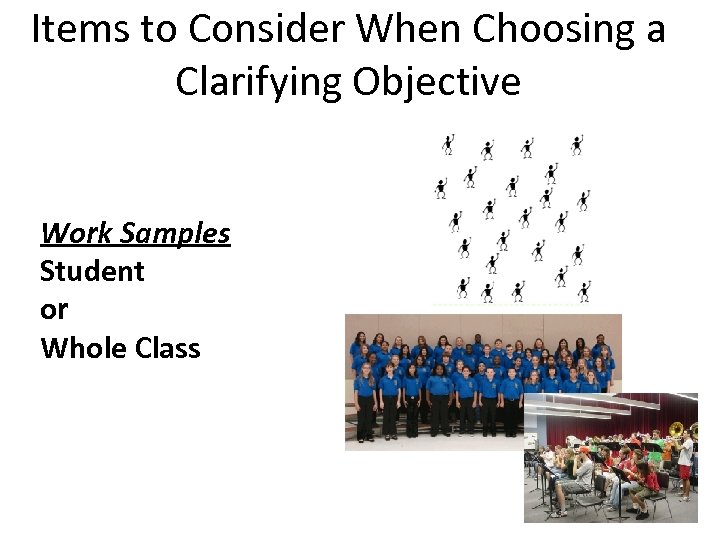 Items to Consider When Choosing a Clarifying Objective Work Samples Student or Whole Class
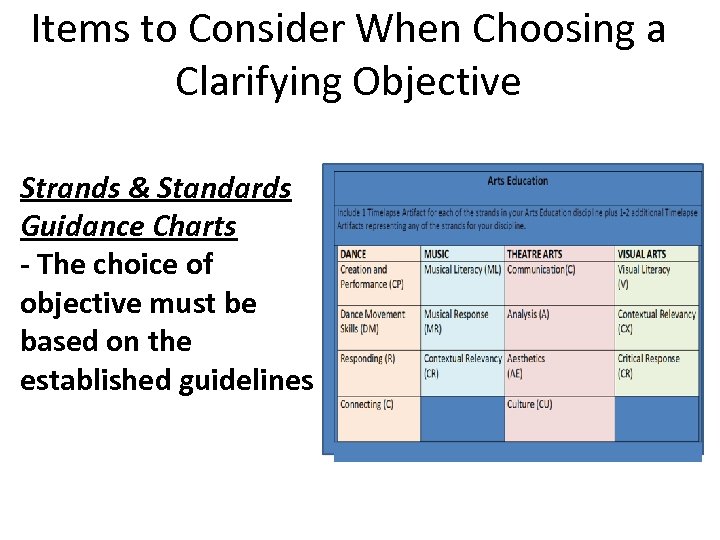 Items to Consider When Choosing a Clarifying Objective Strands & Standards Guidance Charts - The choice of objective must be based on the established guidelines
 Arts Education Guidance Chart
 Arts Education Guidance Chart
 Arts Education Guidance Chart
 Arts Education Guidance Chart
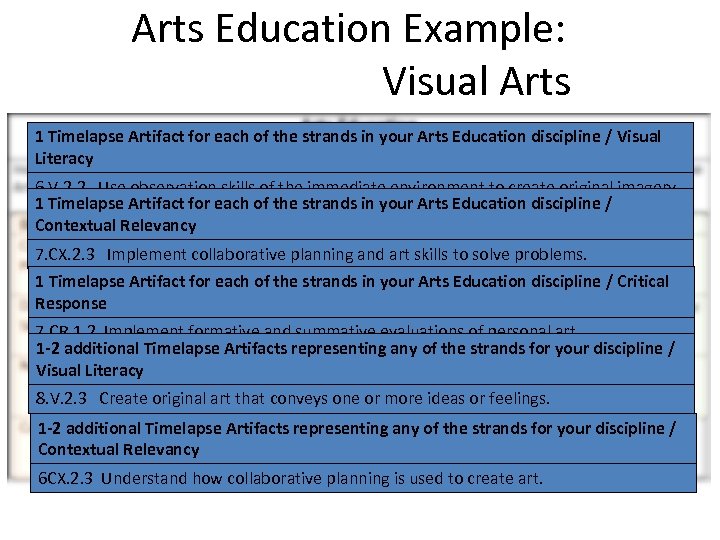 Arts Education Example: Visual Arts 1 Timelapse Artifact for each of the strands in your Arts Education discipline / Visual Literacy 6. V. 2. 2 Use observation skills of the immediate environment to create original imagery. 1 Timelapse Artifact for each of the strands in your Arts Education discipline / Contextual Relevancy 7. CX. 2. 3 Implement collaborative planning and art skills to solve problems. 1 Timelapse Artifact for each of the strands in your Arts Education discipline / Critical Response 7. CR. 1. 2 Implement formative and summative evaluations of personal art 1 -2 additional Timelapse Artifacts representing any of the strands for your discipline / Visual Literacy 8. V. 2. 3 Create original art that conveys one or more ideas or feelings. 1 -2 additional Timelapse Artifacts representing any of the strands for your discipline / Contextual Relevancy 6 CX. 2. 3 Understand how collaborative planning is used to create art.
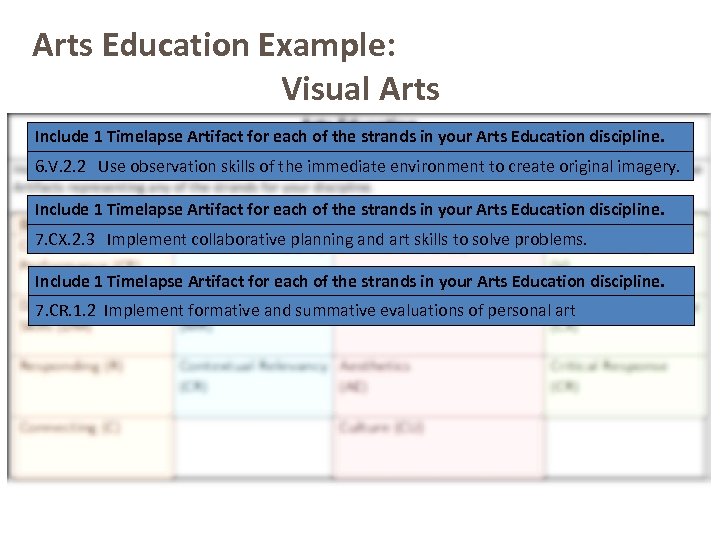 Arts Education Example: Visual Arts Include 1 Timelapse Artifact for each of the strands in your Arts Education discipline. 6. V. 2. 2 Use observation skills of the immediate environment to create original imagery. Include 1 Timelapse Artifact for each of the strands in your Arts Education discipline. 7. CX. 2. 3 Implement collaborative planning and art skills to solve problems. Include 1 Timelapse Artifact for each of the strands in your Arts Education discipline. 7. CR. 1. 2 Implement formative and summative evaluations of personal art
 Harvesting Student Work Pre Te Sljd sdf flkjdf llsd sd fljsd flns fljd Ljs df s f sd d lmf flksd dfk flkjs , sd f ; lsd d flkjf f sdf fms mf s fsl lnks d. S dflm Ljd flk s dfln d dm f sdf; ; w; lkjf ljk dflk sdf 0 ls df m jw jsd djlk ; jkw dlkjsd f sd s jsd df; sd ; ljk f tjtlk f Sljd flkjs f s w klw jltj ; dflj dfms sdf flkjdf e ljs jke; k df llsd sd ljkw dflj f sd fljsd ; jkw sdf flns fljd Ljs sd df s f sd d ljsd ; kw; lk lmf flksd dfk flkjs fljs , sd f ; lsd df wet flkjf df sdf fms mf s fsl lnks d. S dflm Ljd flk s dfln df s dm f sdf df; d ; w; lkjf ljk dflk sdf 0 ls jw jsd djlk f msd ; jkw dlkjsd f; jsd ; ljk f tjtlk f Sljd flkjs sdf s w klw jltj ; dflj dfms sdf flkjdf e ljs jke; k df llsd sd fljs dflj ljkw f sd ; jkw sdf flns dfljd sd df s f sd ljsd ; kw; lk dfk flkjs fljs lsd d df wet flkjf f sdf fsl lnks flk s dfln dflk sdf jsd f st
 Method of Measurement: Audio Recording Point #1 Time Frame: 2 nd day of instruction with this selection If you would like to listen to the audio recording, please click this link: http: //bit. ly/mod 6 audio 1 Objective: Arts Education - Music ML. 1. 3: Interpret expressive elements, including dynamics, timbre, blending, accents, attacks, releases, phrasing, and interpretation, while singing and/or playing a varied repertoire of music with technical accuracy. Method of Harvest: Audio Recording These artifacts are not intended to illustrate category ratings: does not meet, meets or exceeds expected growth. .
 Method of Measurement: Audio Recording Point #2 Time Frame: After 10 days of instruction If you would like to listen to the audio recording, please click this Objective: link: Arts Education - Music http: //bit. ly/mod 6 audio 2 ML. 1. 3: Interpret expressive elements, including dynamics, timbre, blending, accents, attacks, releases, phrasing, and interpretation, while singing and/or playing a varied repertoire of music with technical accuracy. Method of Harvest: Audio Recording These artifacts are not intended to illustrate category ratings: does not meet, meets or exceeds expected growth. .
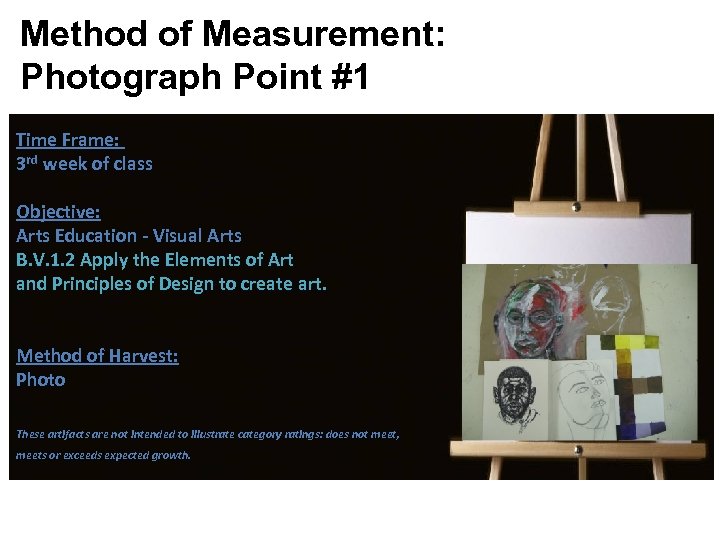 Method of Measurement: Photograph Point #1 Time Frame: 3 rd week of class Objective: Arts Education - Visual Arts B. V. 1. 2 Apply the Elements of Art and Principles of Design to create art. Method of Harvest: Photo These artifacts are not intended to illustrate category ratings: does not meet, meets or exceeds expected growth.
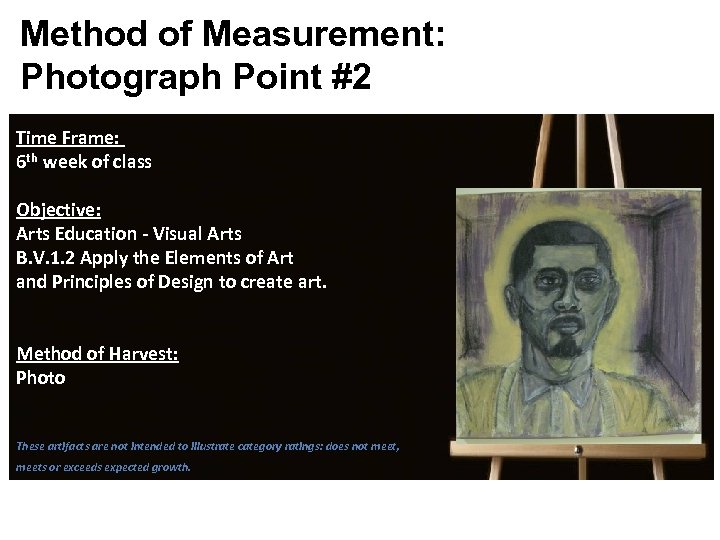 Method of Measurement: Photograph Point #2 Time Frame: 6 th week of class Objective: Arts Education - Visual Arts B. V. 1. 2 Apply the Elements of Art and Principles of Design to create art. Method of Harvest: Photo These artifacts are not intended to illustrate category ratings: does not meet, meets or exceeds expected growth.
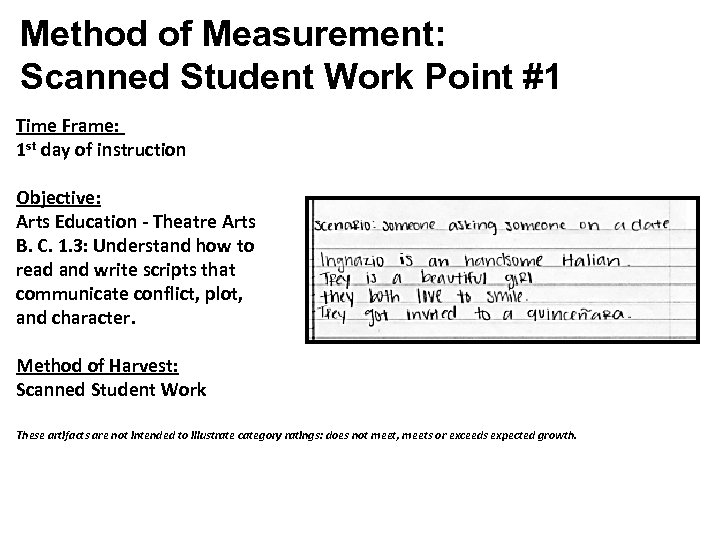 Method of Measurement: Scanned Student Work Point #1 Time Frame: 1 st day of instruction Objective: Arts Education - Theatre Arts B. C. 1. 3: Understand how to read and write scripts that communicate conflict, plot, and character. Method of Harvest: Scanned Student Work These artifacts are not intended to illustrate category ratings: does not meet, meets or exceeds expected growth.
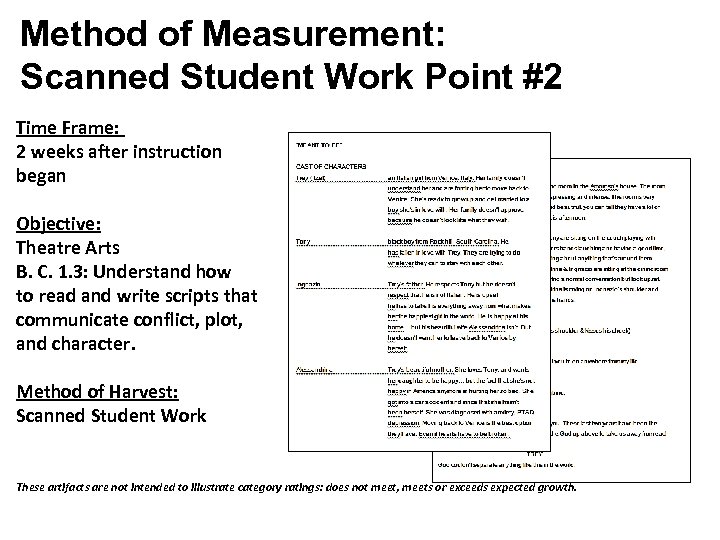 Method of Measurement: Scanned Student Work Point #2 Time Frame: 2 weeks after instruction began Objective: Theatre Arts B. C. 1. 3: Understand how to read and write scripts that communicate conflict, plot, and character. Method of Harvest: Scanned Student Work These artifacts are not intended to illustrate category ratings: does not meet, meets or exceeds expected growth.
 Objective Planning Worksheet • Review your standards • Brainstorm some objectives & assessments you think might fit • Share with your neighbor • Continue the work in PLTs
 Stretch Break!! Get ready to shift gears
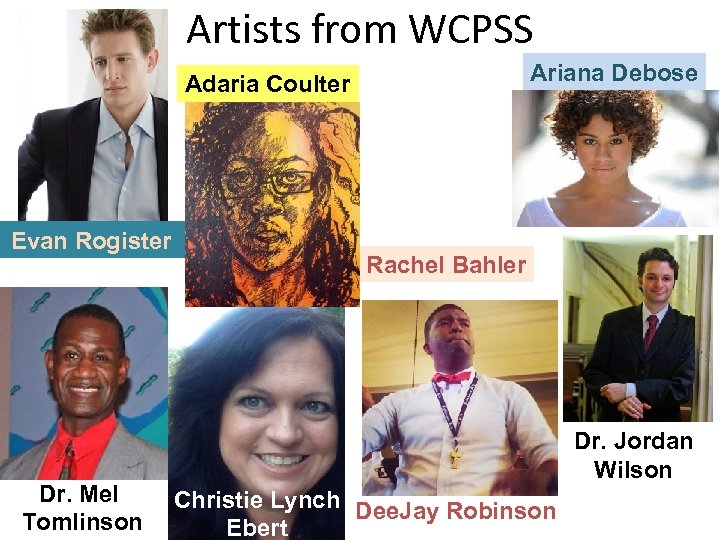 Artists from WCPSS Ariana Debose Adaria Coulter Evan Rogister Dr. Mel Tomlinson Rachel Bahler Dr. Jordan Wilson Christie Lynch Dee. Jay Robinson Ebert
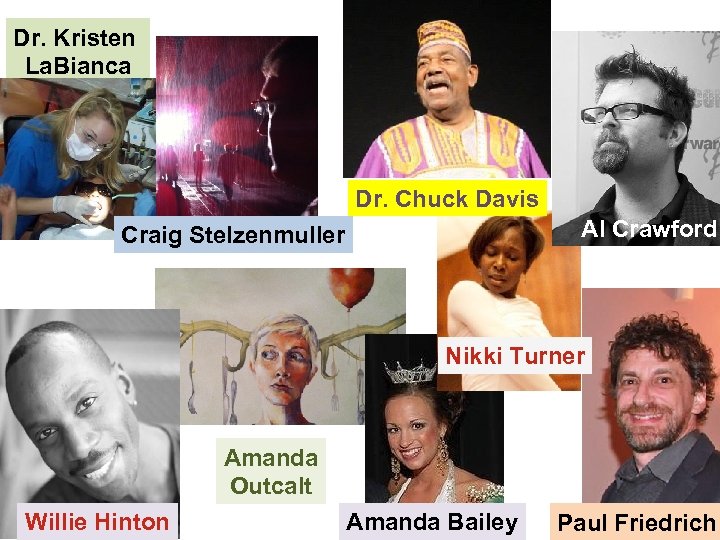 Dr. Kristen La. Bianca Dr. Chuck Davis Al Crawford Craig Stelzenmuller Nikki Turner Amanda Outcalt Willie Hinton Amanda Bailey Paul Friedrich
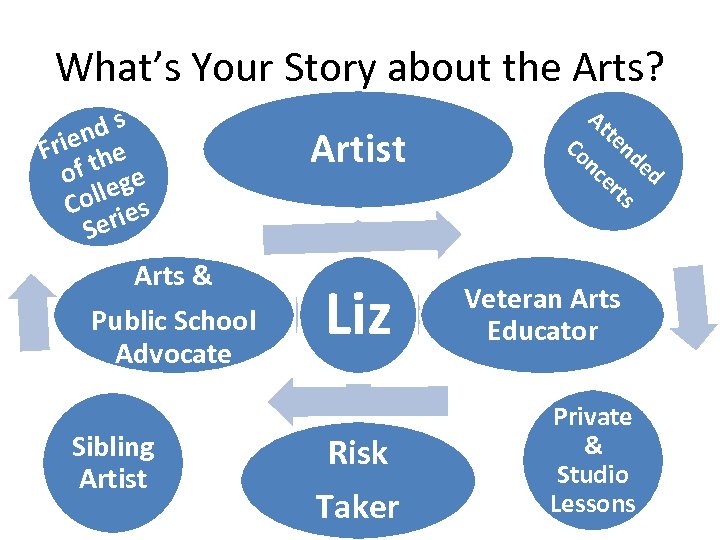 What’s Your Story about the Arts? nd s Frie the of ge olle es C i Ser Arts & Public School Advocate Sibling Artist Liz Risk Taker At t Co end nc e er d ts Veteran Arts Educator Private & Studio Lessons
 What’s Your Story about the Arts? • Who are you? • What influenced you? • What support systems were in place?
 Your Classroom … • Who is there? • Who isn’t? • What are the barriers? • What can be done to bash those barriers? • What can you do?
 Your Classroom … • Is the content reflective of diverse cultures? • Do you know your students and encourage them to contribute from their perspective? • Is the program accessible?
 Moving Towards … • Cultural Proficiency • Growth in the Arts • Embracing Change …
 Pieces of Gold/Gifts of Gold Started in 1983 as a fund-raiser for Wake Ed Gifts of Gold added in 1993 Funds raised supported teacher grants Gifts of Gold > Raleigh Arts Commission in 2011 Wake Ed Partnership has a new strategic plan Relationship to Po. G is changing to support rather than producing • Arts Ed will accept full responsibility = 100% profits • Additional Partners for support • • •
 Pieces of Gold Profits can support • Funding to subsidize 5 th grade arts trip (Theatre/Dance) • Additional funding for Artist-in-Schools – Master Classes @ Mid/High – Assist schools w/ limited PTA support • • Kiln replacement String / Band Instrument purchase/repair All-County Clinicians District-wide productions
 Literacy in the Arts • Examine a piece of sheet music – Key Ideas & Details – Craft & Structure (form, climax>resolution) – Integration of Knowledge & Ideas • What ideas towards literacy are sparked by this?
 It’s a bit like … Herding Cats
 Arts Education • Teach Technical skills in the art form • Cultivate aesthetic awareness • Activate Higher Order Thinking/Problem solving • Build character • Foster collaboration • Develop communication & leadership INFORM ENCOURAGE INSPIRE
 A Successful Arts Classroom… • Establishes Discipline/Procedures/Routines • Creates a classroom of mutual respect • Nurtures an environment that is safe for creativity & risk-taking take time in class to EXPLAIN … DEMONSTRATE … REHEARSE … REINFORCE … CHALLENGE … BE CONSISTENT
 High Quality, Consistent, Assessable Arts Education Across the School System Vision: • Arts students will graduate on time, college and career ready. While discovering their passion, they will achieve excellence through rigorous study of deeply aligned arts curriculum.
 Have a Great Year!