 Скачать презентацию Weighted Student Funding New England Association of Business
ac247c9a1a6da7cdcd8bf4319c59b9fb.ppt
- Количество слайдов: 21



Weighted Student Funding New England Association of Business Officials July 26, Type Date Here 2013 Type Presenter Name/Contact Here
Agenda • December 2010 • Background • New Allocation: Weighted Student Funding • Questions & Discussion 2
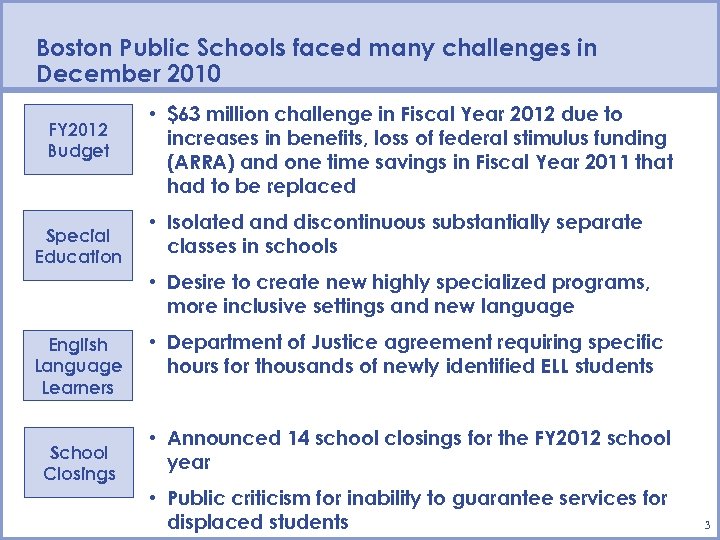
Boston Public Schools faced many challenges in December 2010 FY 2012 Budget Special Education • $63 million challenge in Fiscal Year 2012 due to increases in benefits, loss of federal stimulus funding (ARRA) and one time savings in Fiscal Year 2011 that had to be replaced • Isolated and discontinuous substantially separate classes in schools • Desire to create new highly specialized programs, more inclusive settings and new language English Language Learners School Closings • Department of Justice agreement requiring specific hours for thousands of newly identified ELL students • Announced 14 school closings for the FY 2012 school year • Public criticism for inability to guarantee services for displaced students 3
Agenda • December 2010 • Background • New Allocation: Weighted Student Funding • Questions & Discussion 4
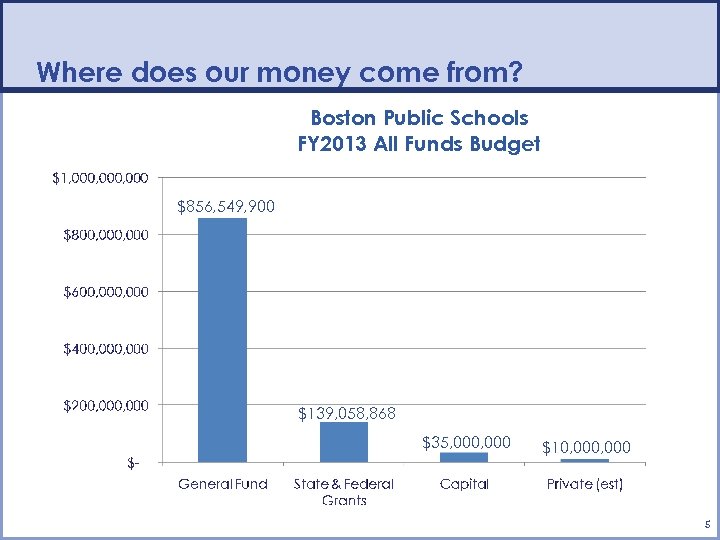
Where does our money come from? Boston Public Schools FY 2013 All Funds Budget $856, 549, 900 $139, 058, 868 $35, 000 $10, 000 5
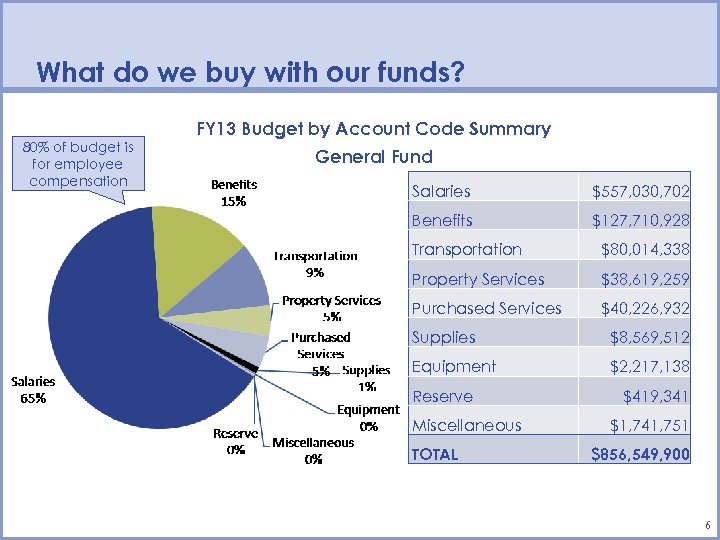
What do we buy with our funds? 80% of budget is for employee compensation FY 13 Budget by Account Code Summary General Fund Salaries $557, 030, 702 Benefits $127, 710, 928 Transportation $80, 014, 338 Property Services $38, 619, 259 Purchased Services $40, 226, 932 Supplies $8, 569, 512 Equipment $2, 217, 138 Reserve Miscellaneous TOTAL $419, 341 $1, 741, 751 $856, 549, 900 6
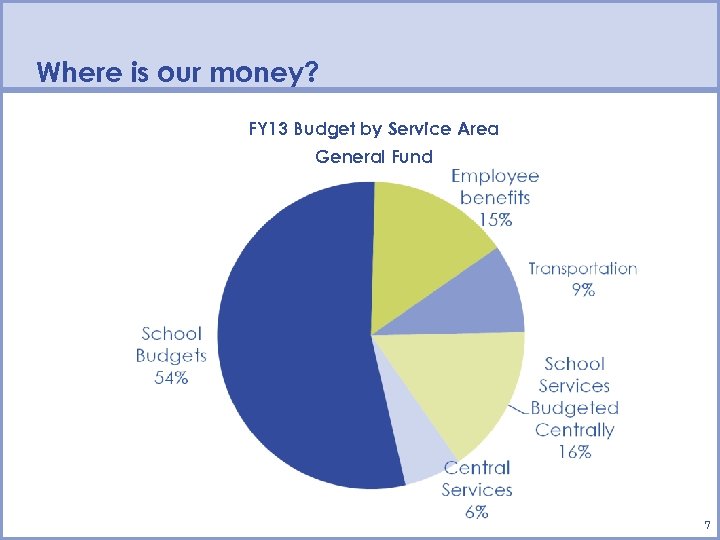
Where is our money? FY 13 Budget by Service Area General Fund 7
BPS Allocation Methodology in 2010 Traditional Schools • Schools are allocated staff and resources based on the number of students in particular programs If a program is located in a school, funding is provided Some of these requirements are contractually required, others are policy driven Ensures that there is funding for staff despite the number of students enrolled in the program Example • 1 teacher for every 22 reg. ed. students in Grade 1 • 1 teacher and 1 para for every 22 students in Kindergarten 1 • 1 teacher for every 20 bilingual/SEI students • 1 principal per school 8
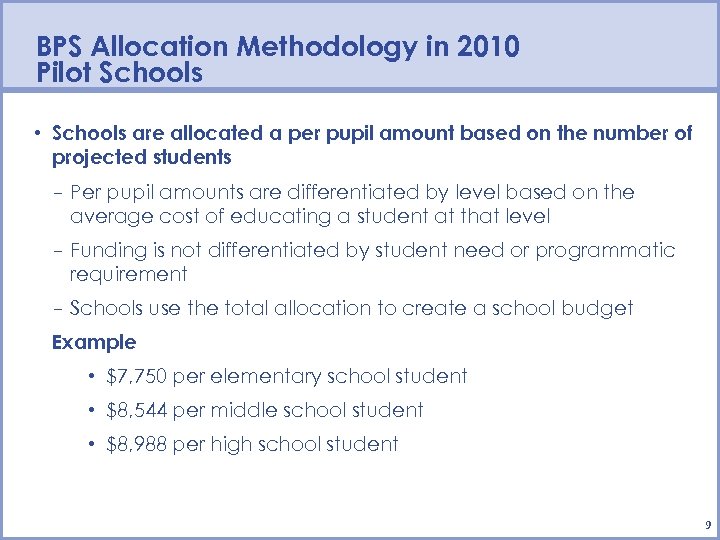
BPS Allocation Methodology in 2010 Pilot Schools • Schools are allocated a per pupil amount based on the number of projected students Per pupil amounts are differentiated by level based on the average cost of educating a student at that level Funding is not differentiated by student need or programmatic requirement Schools use the total allocation to create a school budget Example • $7, 750 per elementary school student • $8, 544 per middle school student • $8, 988 per high school student 9
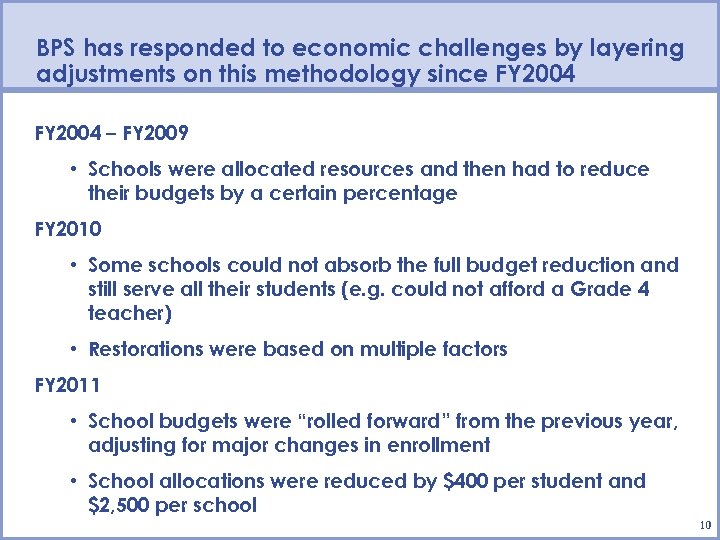
BPS has responded to economic challenges by layering adjustments on this methodology since FY 2004 – FY 2009 • Schools were allocated resources and then had to reduce their budgets by a certain percentage FY 2010 • Some schools could not absorb the full budget reduction and still serve all their students (e. g. could not afford a Grade 4 teacher) • Restorations were based on multiple factors FY 2011 • School budgets were “rolled forward” from the previous year, adjusting for major changes in enrollment • School allocations were reduced by $400 per student and $2, 500 per school 10
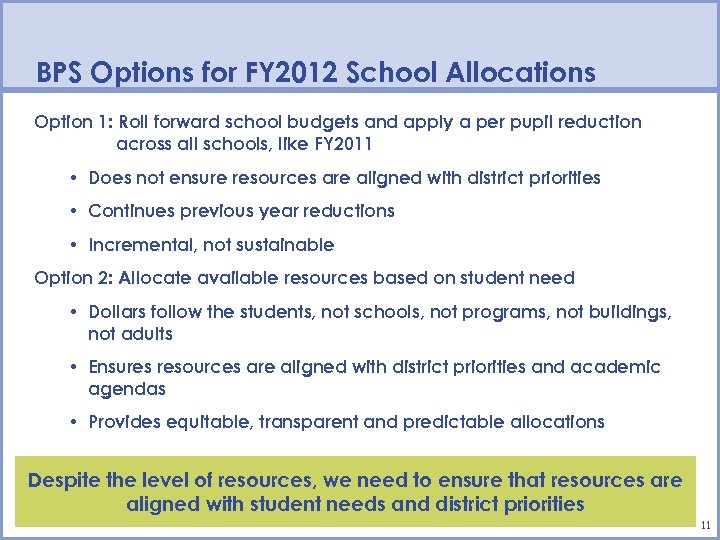
BPS Options for FY 2012 School Allocations Option 1: Roll forward school budgets and apply a per pupil reduction across all schools, like FY 2011 • Does not ensure resources are aligned with district priorities • Continues previous year reductions • Incremental, not sustainable Option 2: Allocate available resources based on student need • Dollars follow the students, not schools, not programs, not buildings, not adults • Ensures resources are aligned with district priorities and academic agendas • Provides equitable, transparent and predictable allocations Despite the level of resources, we need to ensure that resources are aligned with student needs and district priorities 11
Agenda • December 2010 • Background • New Allocation: Weighted Student Funding • Questions & Discussion 12
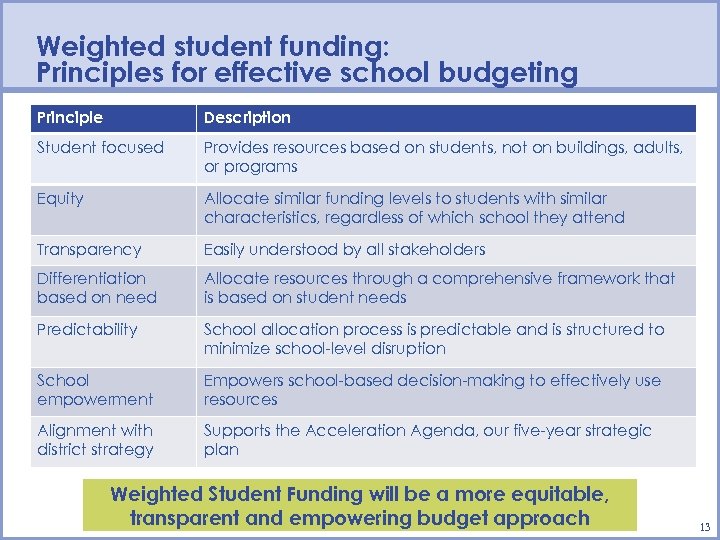
Weighted student funding: Principles for effective school budgeting Principle Description Student focused Provides resources based on students, not on buildings, adults, or programs Equity Allocate similar funding levels to students with similar characteristics, regardless of which school they attend Transparency Easily understood by all stakeholders Differentiation based on need Allocate resources through a comprehensive framework that is based on student needs Predictability School allocation process is predictable and is structured to minimize school-level disruption School empowerment Empowers school-based decision-making to effectively use resources Alignment with district strategy Supports the Acceleration Agenda, our five-year strategic plan Weighted Student Funding will be a more equitable, transparent and empowering budget approach 13
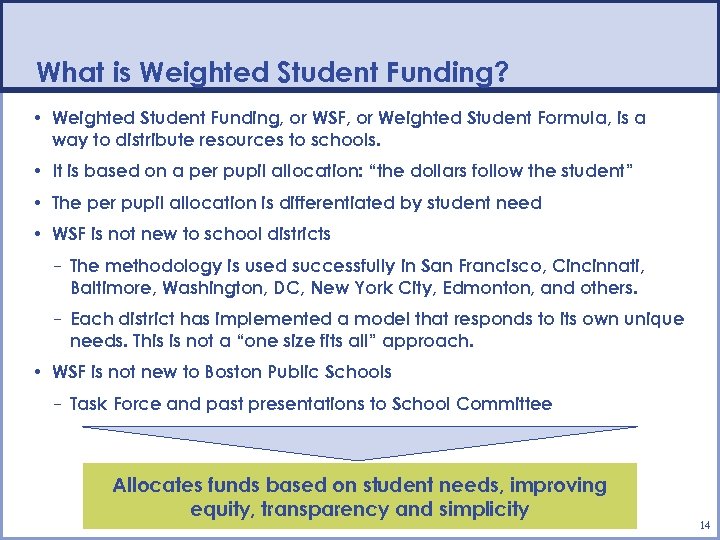
What is Weighted Student Funding? • Weighted Student Funding, or WSF, or Weighted Student Formula, is a way to distribute resources to schools. • It is based on a per pupil allocation: “the dollars follow the student” • The per pupil allocation is differentiated by student need • WSF is not new to school districts The methodology is used successfully in San Francisco, Cincinnati, Baltimore, Washington, DC, New York City, Edmonton, and others. Each district has implemented a model that responds to its own unique needs. This is not a “one size fits all” approach. • WSF is not new to Boston Public Schools Task Force and past presentations to School Committee Allocates funds based on student needs, improving equity, transparency and simplicity 14
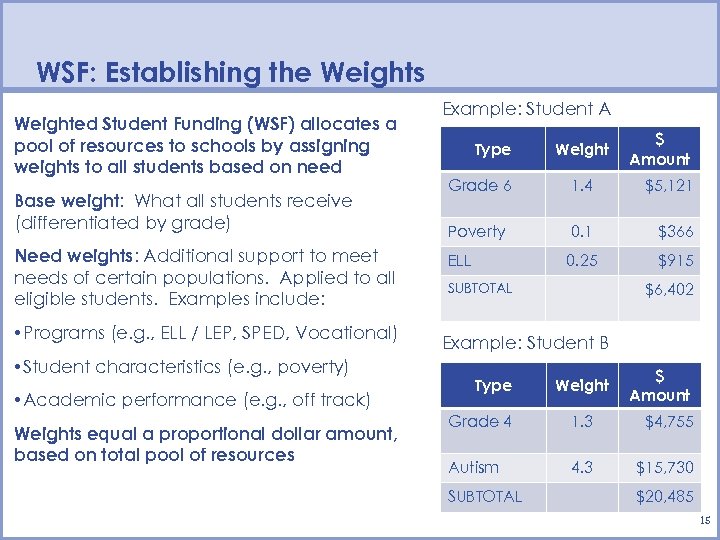
WSF: Establishing the Weights Weighted Student Funding (WSF) allocates a pool of resources to schools by assigning weights to all students based on need Base weight: What all students receive (differentiated by grade) Need weights: Additional support to meet needs of certain populations. Applied to all eligible students. Examples include: • Programs (e. g. , ELL / LEP, SPED, Vocational) • Student characteristics (e. g. , poverty) • Academic performance (e. g. , off track) Weights equal a proportional dollar amount, based on total pool of resources Example: Student A Type Weight $ Amount Grade 6 1. 4 $5, 121 Poverty 0. 1 $366 ELL 0. 25 $915 SUBTOTAL $6, 402 Example: Student B Type Weight $ Amount Grade 4 1. 3 $4, 755 Autism 4. 3 $15, 730 SUBTOTAL $20, 485 15
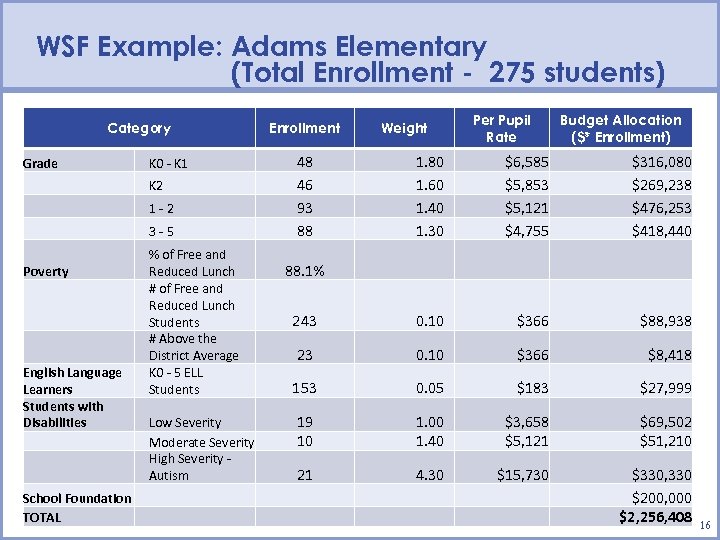
WSF Example: Adams Elementary (Total Enrollment - 275 students) Category Grade K 0 - K 1 K 2 1 - 2 3 - 5 Poverty English Language Learners Students with Disabilities School Foundation TOTAL % of Free and Reduced Lunch # of Free and Reduced Lunch Students # Above the District Average K 0 - 5 ELL Students Low Severity Moderate Severity High Severity - Autism Per Pupil Rate Budget Allocation ($* Enrollment) Enrollment Weight 48 46 93 88 1. 80 1. 60 1. 40 1. 30 $6, 585 $5, 853 $5, 121 $4, 755 $316, 080 $269, 238 $476, 253 $418, 440 243 0. 10 $366 $88, 938 23 0. 10 $366 $8, 418 153 0. 05 $183 $27, 999 19 10 1. 00 1. 40 $3, 658 $5, 121 $69, 502 $51, 210 21 4. 30 $15, 730 $330, 330 $200, 000 $2, 256, 408 88. 1% 16
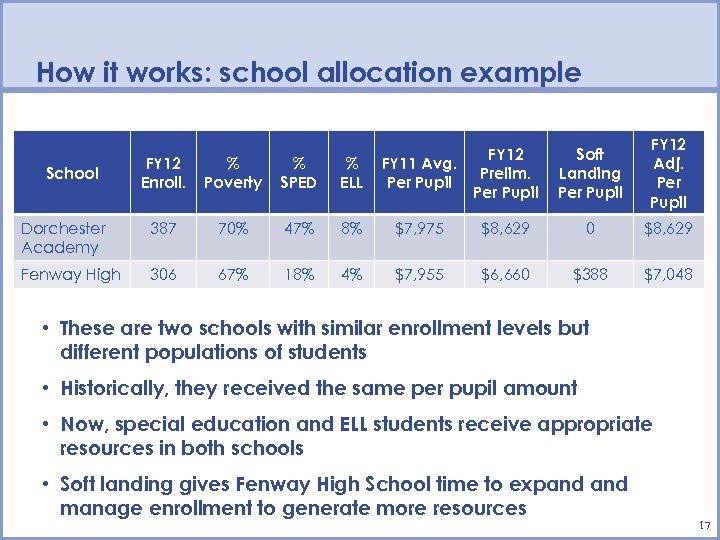
How it works: school allocation example FY 12 FY 11 Avg. Prelim. Per Pupil Soft Landing Per Pupil FY 12 Adj. Per Pupil FY 12 Enroll. % Poverty % SPED % ELL Dorchester Academy 387 70% 47% 8% $7, 975 $8, 629 0 $8, 629 Fenway High 306 67% 18% 4% $7, 955 $6, 660 $388 $7, 048 School • These are two schools with similar enrollment levels but different populations of students • Historically, they received the same per pupil amount • Now, special education and ELL students receive appropriate resources in both schools • Soft landing gives Fenway High School time to expand manage enrollment to generate more resources 17
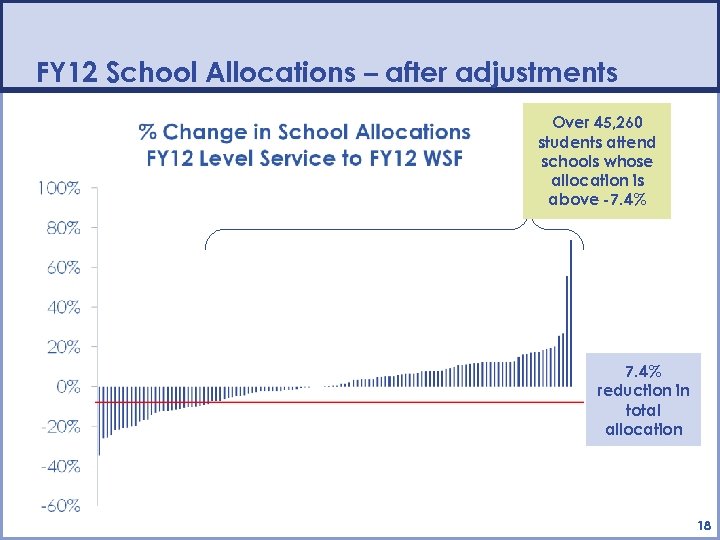
FY 12 School Allocations – after adjustments Over 45, 260 students attend schools whose allocation is above -7. 4% reduction in total allocation 18
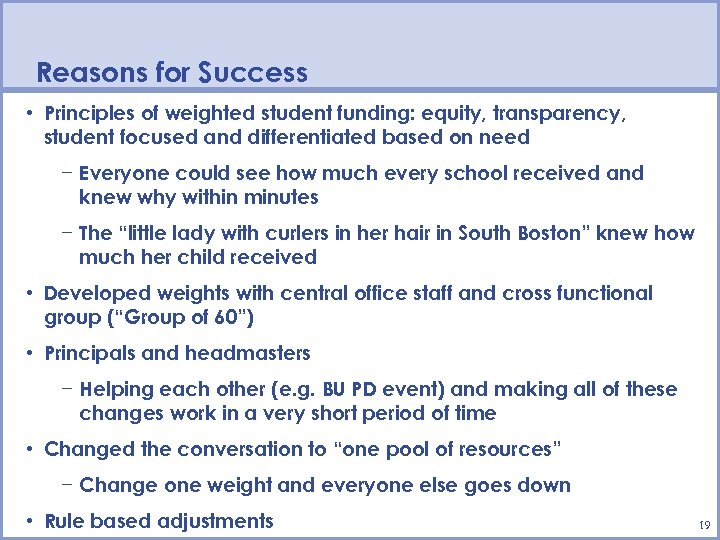
Reasons for Success • Principles of weighted student funding: equity, transparency, student focused and differentiated based on need − Everyone could see how much every school received and knew why within minutes − The “little lady with curlers in her hair in South Boston” knew how much her child received • Developed weights with central office staff and cross functional group (“Group of 60”) • Principals and headmasters − Helping each other (e. g. BU PD event) and making all of these changes work in a very short period of time • Changed the conversation to “one pool of resources” − Change one weight and everyone else goes down • Rule based adjustments 19
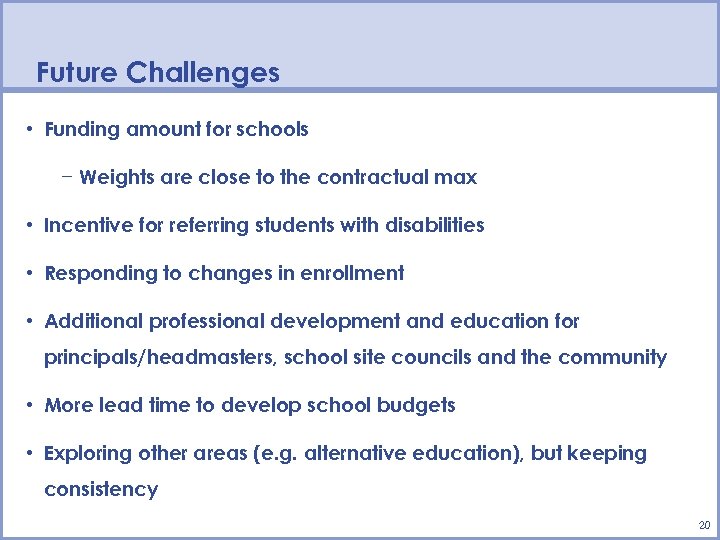
Future Challenges • Funding amount for schools − Weights are close to the contractual max • Incentive for referring students with disabilities • Responding to changes in enrollment • Additional professional development and education for principals/headmasters, school site councils and the community • More lead time to develop school budgets • Exploring other areas (e. g. alternative education), but keeping consistency 20
Agenda • December 2010 • Background • New Allocation: Weighted Student Funding • Questions & Discussion 21
Скачать презентацию Weighted Student Funding New England Association of Business
ac247c9a1a6da7cdcd8bf4319c59b9fb.ppt