


 Скачать презентацию Wei-Jen Lee S 85 -M 85 -SM 97
dde5b01fe5606300c62676239870d35a.ppt
- Количество слайдов: 42
 Wei-Jen Lee (S’ 85 -M’ 85 -SM’ 97 -F’ 07) received the B. S. and M. S. degrees from National Taiwan University, Taipei, Taiwan, R. O. C. , and the Ph. D. degree from the University of Texas, Arlington, in 1978, 1980, and 1985, respectively, all in Electrical Engineering. In 1985, he joined the University of Texas at Arlington, where he is currently a professor of Electrical Engineering and director of the Energy Systems Research Center. Prof. Lee has been involved in the revision of IEEE Std. 141, 339, 551, and 739. He is the Secretary of the IEEE/IAS, Industrial & Commercial Power Systems Department (ICPSD), the Committee Chairman of the Energy Systems Committee at ICPSD, and the associate editor of IEEE/IAS. Currently, he is the project manager of the IEEE/NFPA collaboration on Arc Flash Phenomena Research Project. Prof. Lee has been involved in research on renewable energy, power flow, transient and dynamic stability, voltage stability, short circuits, relay coordination, power quality analysis, demand response, utility deregulation, and on-line equipment protection, monitoring and control systems. He has served as the primary investigator (PI) or Co-PI of more than 70 funded research projects He has published more than 160 journal papers conference proceedings. He has provided on-site training courses for power engineers in Panama, China, Taiwan, Korea, Saudi Arabia, Thailand, and Singapore. He has refereed numerous technical papers for the IEEE, the IEE and other professional organizations. Prof. Lee is a Fellow of IEEE and a registered Professional Engineer in the State of Texas.
 Wind Generation: A Prominent Form of Renewable Energy Wei-Jen Lee, Ph. D. , PE Director and Professor Energy Systems Research Center The University of Texas at Arlington February 4, 2009
 Humanity’s Top Ten Problems for next 50 years 1. Energy 2. Water 3. Food 4. Environment 5. Poverty 6. Terrorism & War 7. Disease 8. Education 9. Democracy 2003: 6. 3 Billion people 10. Population 2050: 9 -10 Billion people Source: Nobel laureate, Richard Smalley
 Introduction n n Though the oil price has dropped recently, the concerns on limited resources of fossil fuel and global warming remain the same. Renewable energy is a hot issue in today competitive market. Solar, wind and hydrogen are among blistering subjects in the last few decades. Wind powered generation is one of the most mature and cost effective resources among different renewable energy technologies. World wind energy capacity has expanded at an annual rate of 25% since the 1990 s.
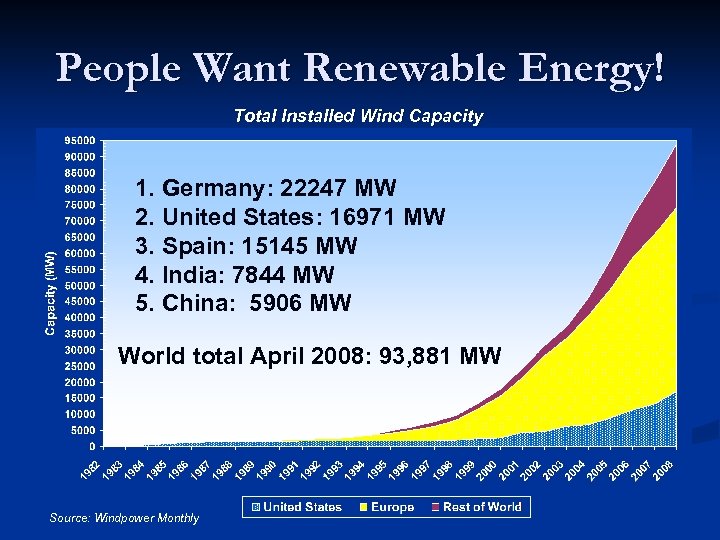 People Want Renewable Energy! Total Installed Wind Capacity 1. Germany: 22247 MW 2. United States: 16971 MW 3. Spain: 15145 MW 4. India: 7844 MW 5. China: 5906 MW World total April 2008: 93, 881 MW Source: Windpower Monthly
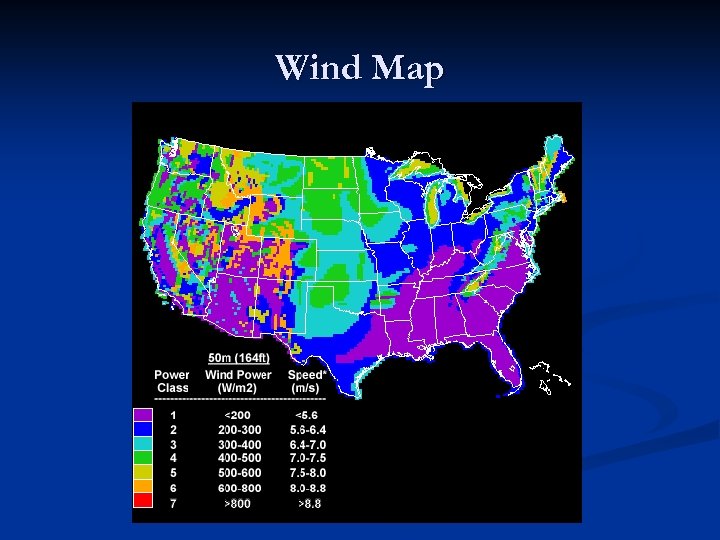 Wind Map
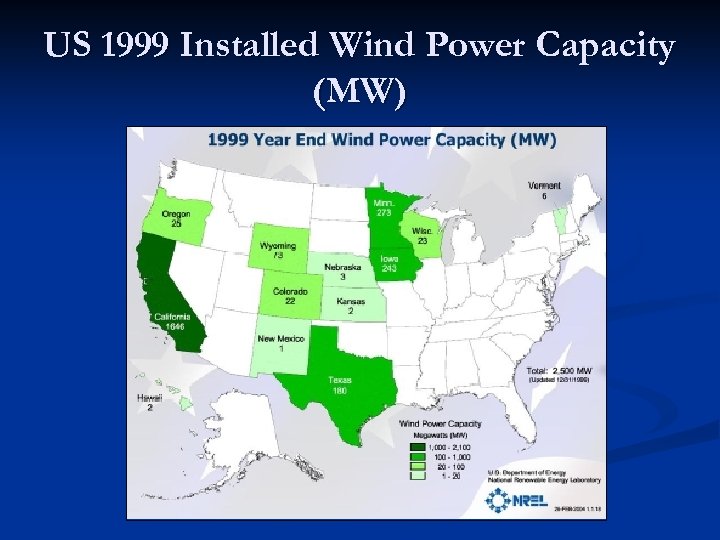 US 1999 Installed Wind Power Capacity (MW)
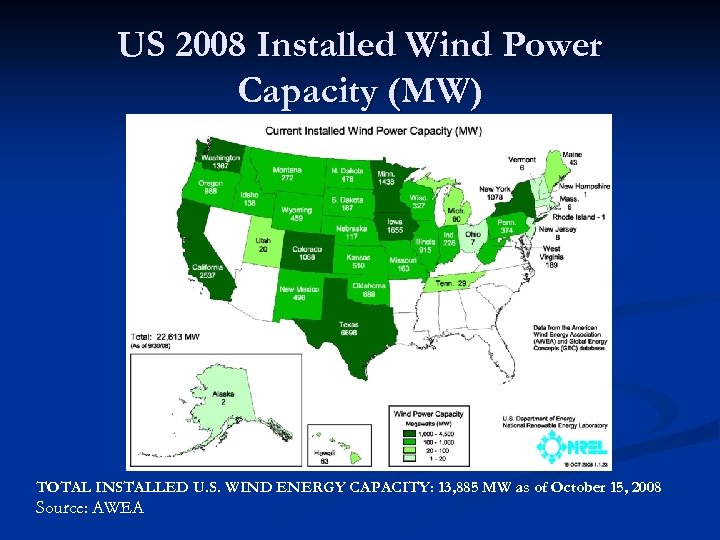 US 2008 Installed Wind Power Capacity (MW) TOTAL INSTALLED U. S. WIND ENERGY CAPACITY: 13, 885 MW as of October 15, 2008 Source: AWEA
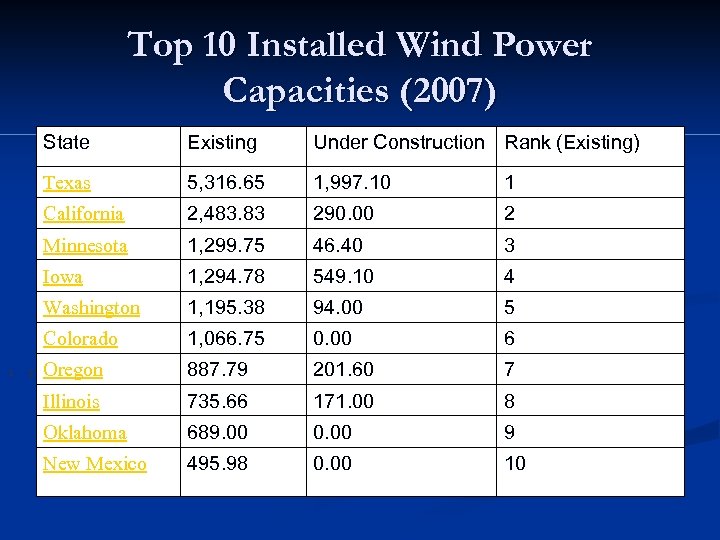 Top 10 Installed Wind Power Capacities (2007) State 5, 316. 65 1, 997. 10 1 California 2, 483. 83 290. 00 2 Minnesota 1, 299. 75 46. 40 3 Iowa 1, 294. 78 549. 10 4 Washington 1, 195. 38 94. 00 5 Colorado 2 Under Construction Rank (Existing) Texas 1 Existing 1, 066. 75 0. 00 6 Oregon 3 4 5 887. 79 201. 60 7 Illinois 735. 66 171. 00 8 Oklahoma 689. 00 0. 00 9 New Mexico 495. 98 0. 00 10
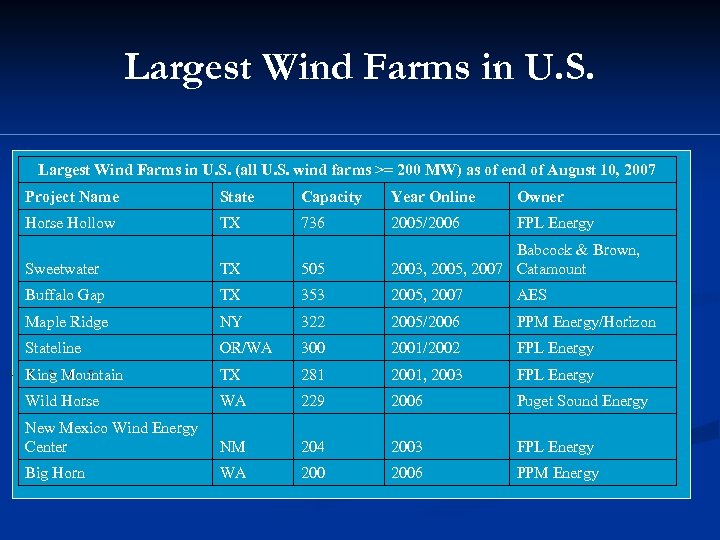 Largest Wind Farms in U. S. (all U. S. wind farms >= 200 MW) as of end of August 10, 2007 Project Name State Capacity Year Online Owner Horse Hollow TX 736 2005/2006 FPL Energy Sweetwater 505 Buffalo Gap TX 353 2005, 2007 AES Maple Ridge NY 322 2005/2006 PPM Energy/Horizon Stateline 1 TX Babcock & Brown, 2003, 2005, 2007 Catamount OR/WA 300 2001/2002 FPL Energy 2 3 4 5 King Mountain TX 281 2001, 2003 FPL Energy Wild Horse WA 229 2006 Puget Sound Energy New Mexico Wind Energy Center NM 204 2003 FPL Energy Big Horn WA 2006 PPM Energy
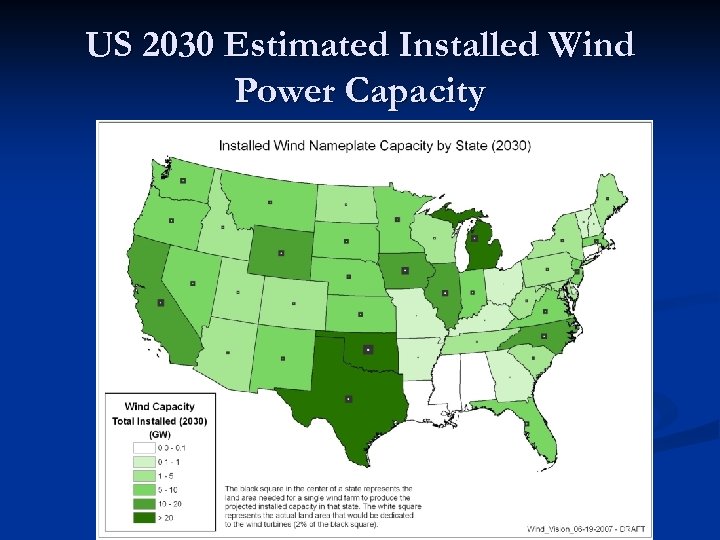 US 2030 Estimated Installed Wind Power Capacity
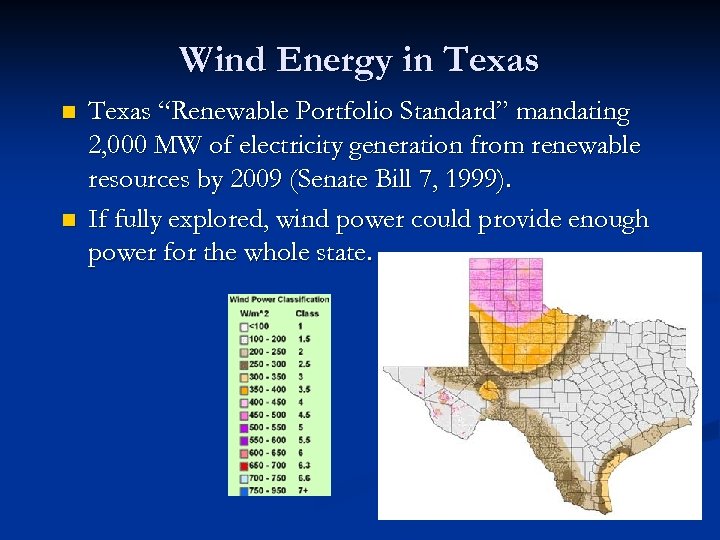 Wind Energy in Texas n n Texas “Renewable Portfolio Standard” mandating 2, 000 MW of electricity generation from renewable resources by 2009 (Senate Bill 7, 1999). If fully explored, wind power could provide enough power for the whole state.
 Wind Energy in Texas n n n In July 2006, Texas exceeded California and became Number One in the US in terms of wind generation installation. To promote renewable energy, ERCOT has identified 25 preliminary areas of interest for Competitive Renewable Energy Zone (CREZ) and proposed infrastructure improvement plans to support power delivery from those areas to the load centers. This development will have significant impact on the reduction of the green house gas (GHS) emissions. Presently, the total installed wind generation in Texas exceeds 6, 000 MW with more than 20, 000 MW in the interconnection queue.
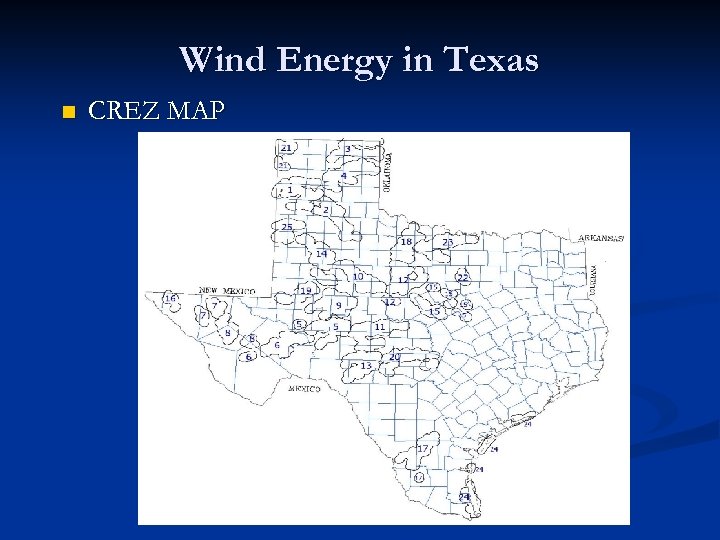 Wind Energy in Texas n CREZ MAP
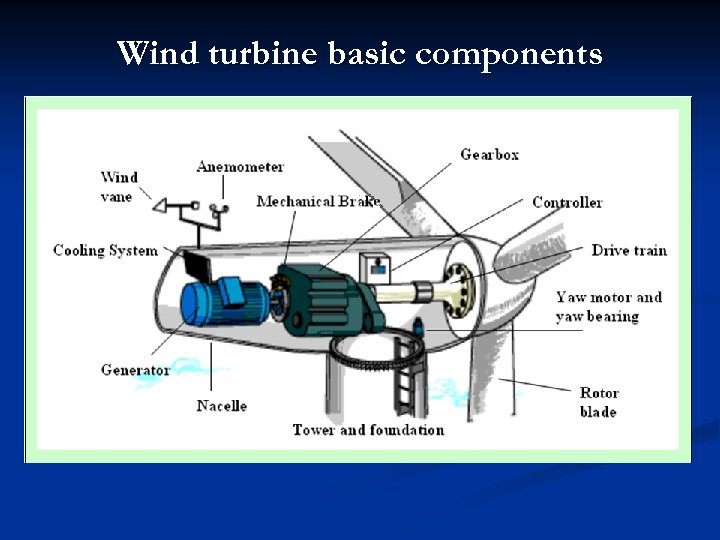 Wind turbine basic components
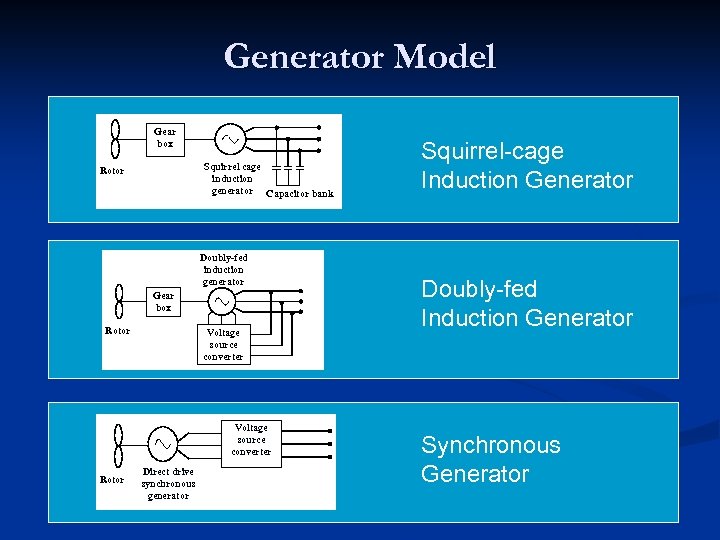 Generator Model Gear box Squirrel cage induction generator Capacitor bank Rotor Doubly-fed induction generator Gear box Rotor Voltage source converter Rotor Direct drive synchronous generator Squirrel-cage Induction Generator Doubly-fed Induction Generator Synchronous Generator
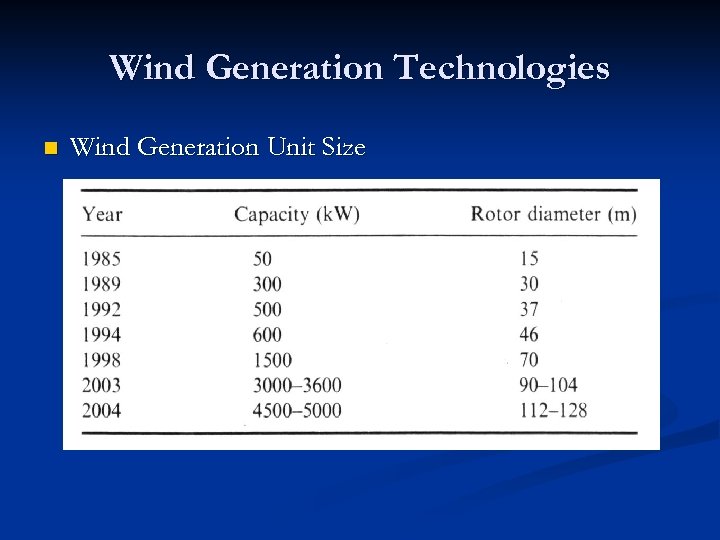 Wind Generation Technologies n Wind Generation Unit Size
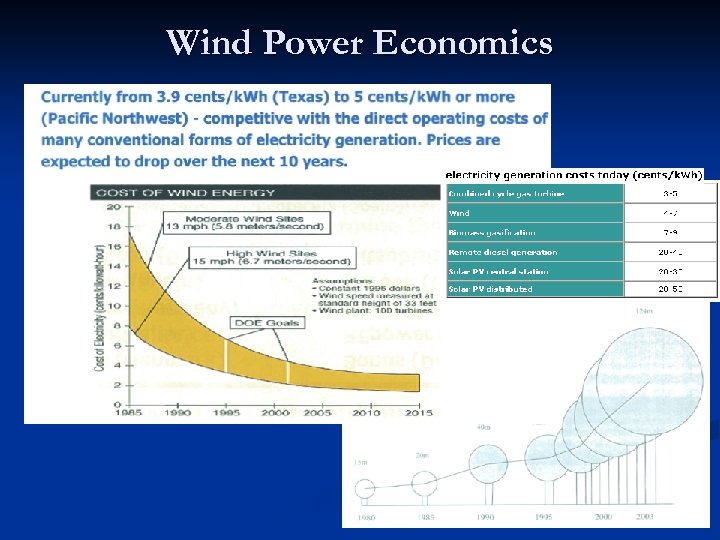 Wind Power Economics
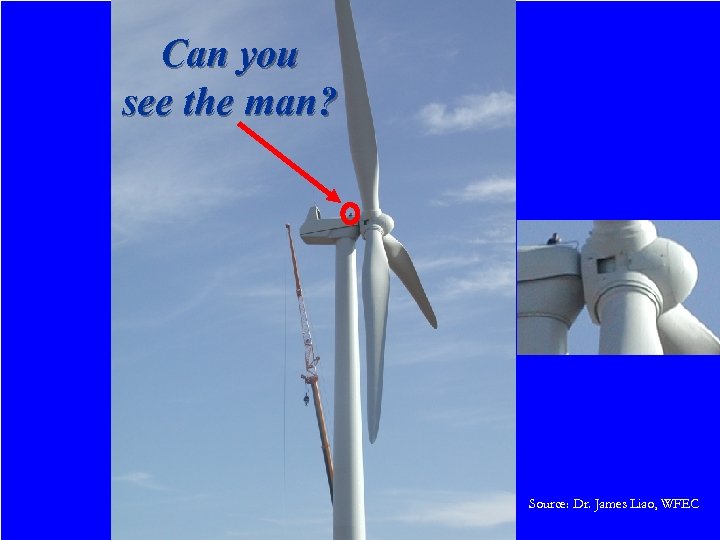 Can you see the man? Source: Dr. James Liao, WFEC
 B E L E I V E I T O R N O T ! Source: Dr. James Liao, WFEC
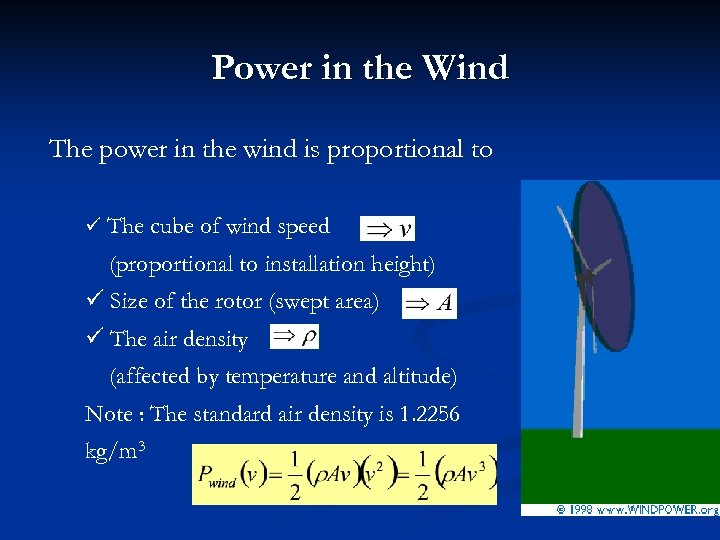 Power in the Wind The power in the wind is proportional to ü The cube of wind speed (proportional to installation height) ü Size of the rotor (swept area) ü The air density (affected by temperature and altitude) Note : The standard air density is 1. 2256 kg/m 3
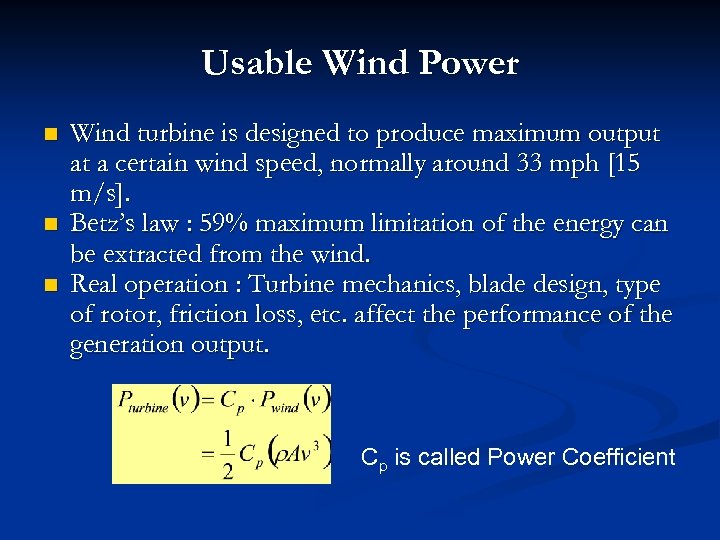 Usable Wind Power n n n Wind turbine is designed to produce maximum output at a certain wind speed, normally around 33 mph [15 m/s]. Betz’s law : 59% maximum limitation of the energy can be extracted from the wind. Real operation : Turbine mechanics, blade design, type of rotor, friction loss, etc. affect the performance of the generation output. Cp is called Power Coefficient
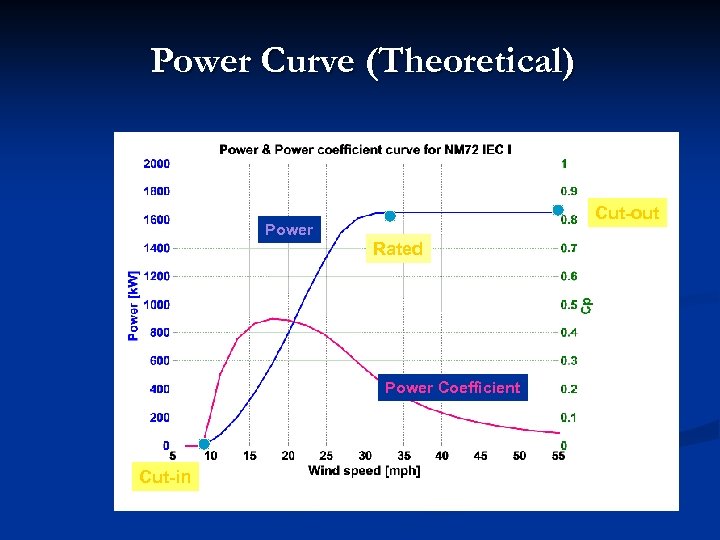 Power Curve (Theoretical) Cut-out Power Rated Power Coefficient Cut-in
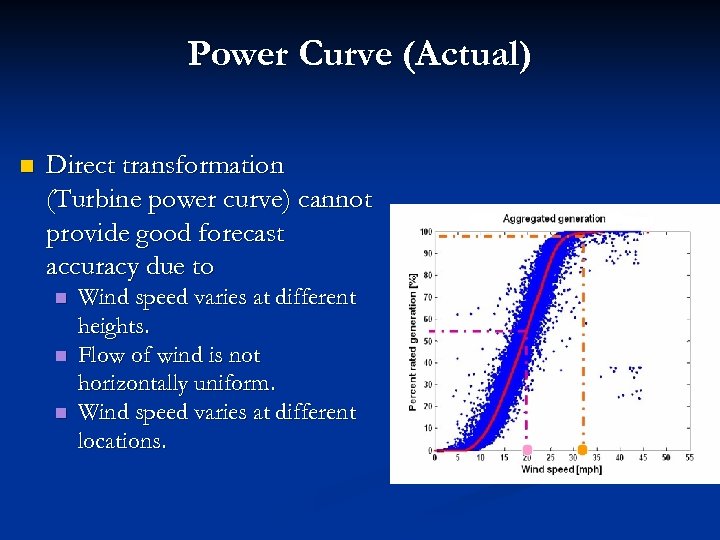 Power Curve (Actual) n Direct transformation (Turbine power curve) cannot provide good forecast accuracy due to n n n Wind speed varies at different heights. Flow of wind is not horizontally uniform. Wind speed varies at different locations.
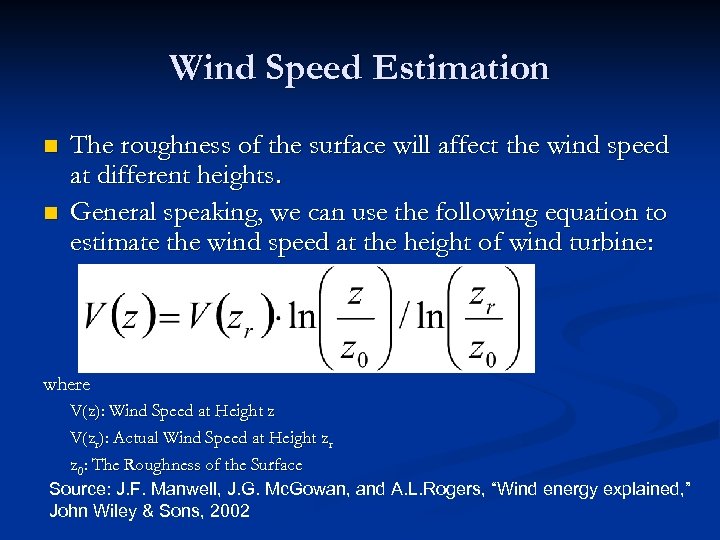 Wind Speed Estimation n n The roughness of the surface will affect the wind speed at different heights. General speaking, we can use the following equation to estimate the wind speed at the height of wind turbine: where V(z): Wind Speed at Height z V(zr): Actual Wind Speed at Height zr z 0: The Roughness of the Surface Source: J. F. Manwell, J. G. Mc. Gowan, and A. L. Rogers, “Wind energy explained, ” John Wiley & Sons, 2002
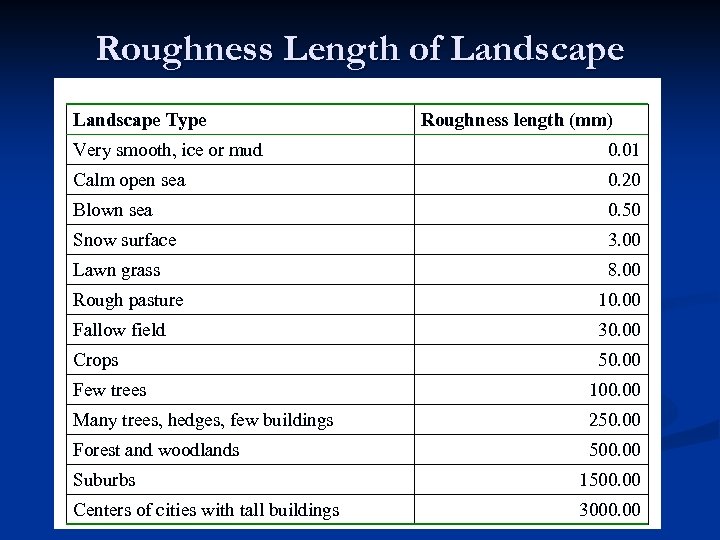 Roughness Length of Landscape Type Roughness length (mm) Very smooth, ice or mud 0. 01 Calm open sea 0. 20 Blown sea 0. 50 Snow surface 3. 00 Lawn grass 8. 00 Rough pasture 10. 00 Fallow field 30. 00 Crops 50. 00 Few trees 100. 00 Many trees, hedges, few buildings 250. 00 Forest and woodlands 500. 00 Suburbs 1500. 00 Centers of cities with tall buildings 3000. 00
 Wind Turbine Characteristics n Availability – a measure of the time a generating unit is capable of providing service. (operation hours/clock hours) n Capacity factor – the ratio of the total energy generated for a specified period to the maximum total energy that could have been generated if operated at maximum capacity for the same period (It is required at least 28% to be economics)
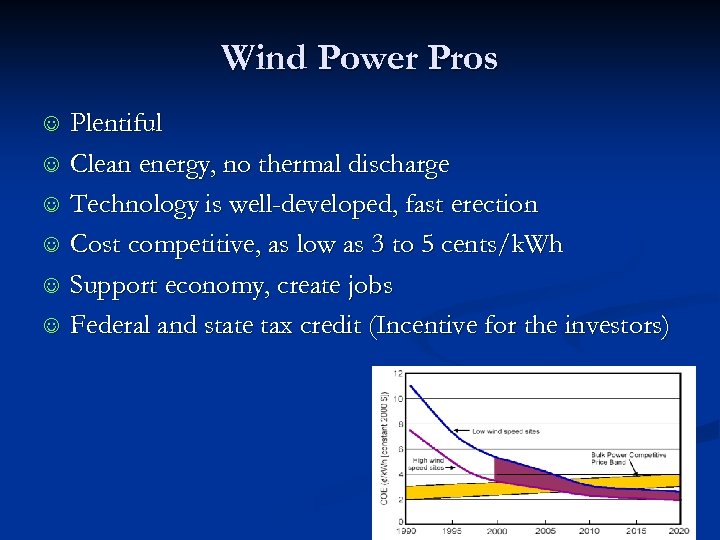 Wind Power Pros J J J Plentiful Clean energy, no thermal discharge Technology is well-developed, fast erection Cost competitive, as low as 3 to 5 cents/k. Wh Support economy, create jobs Federal and state tax credit (Incentive for the investors)
 Wind Power Cons L L L Variation in power production Require infrastructure upgrade for power delivery Produce relatively small power outputs Reactive compensation for induction generator Capital investment
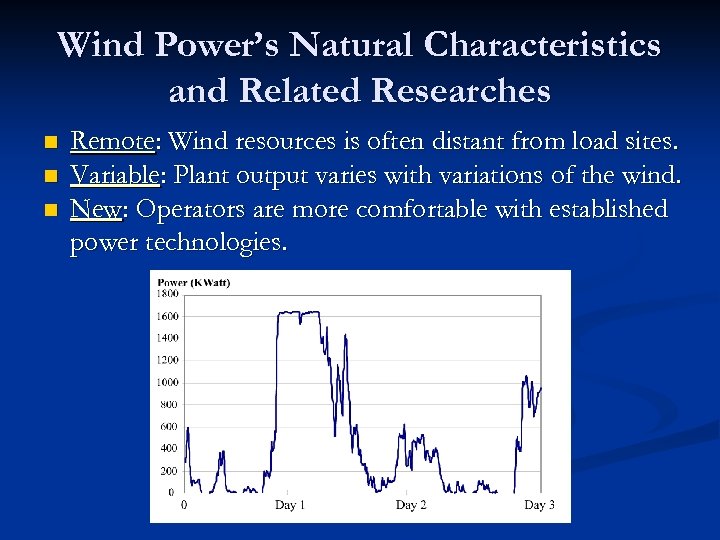 Wind Power’s Natural Characteristics and Related Researches n n n Remote: Wind resources is often distant from load sites. Variable: Plant output varies with variations of the wind. New: Operators are more comfortable with established power technologies.
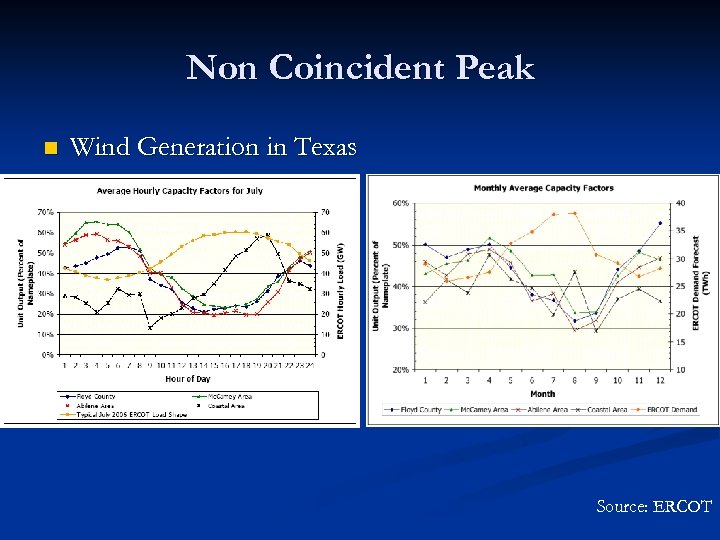 Non Coincident Peak n Wind Generation in Texas Source: ERCOT
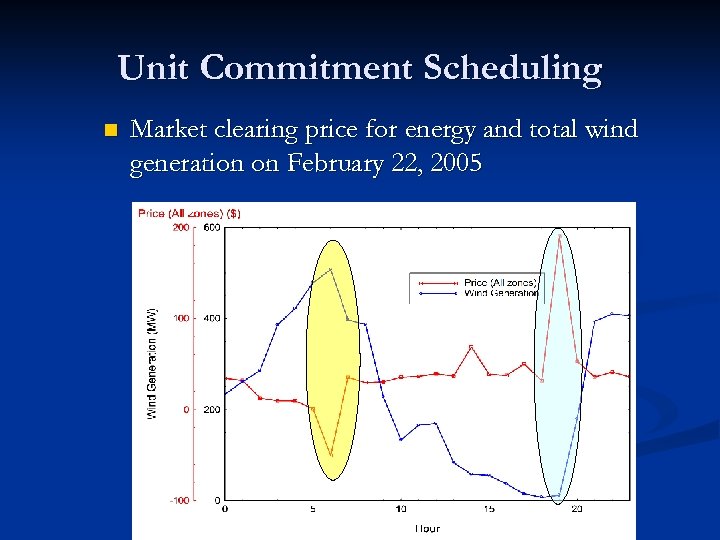 Unit Commitment Scheduling n Market clearing price for energy and total wind generation on February 22, 2005
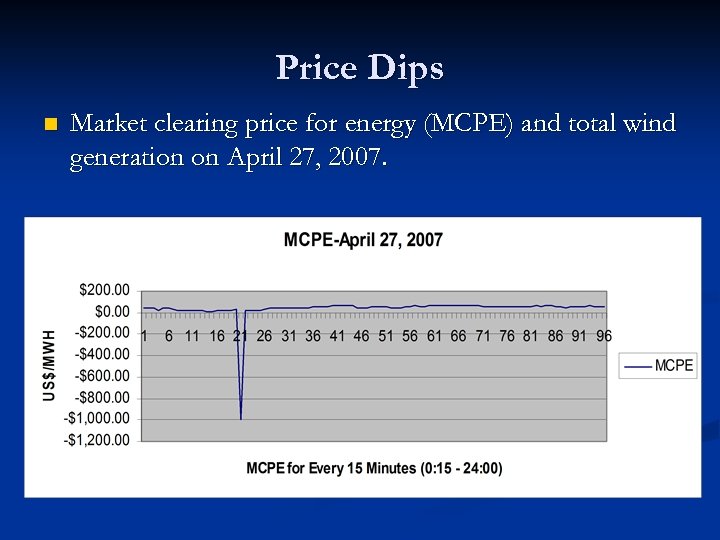 Price Dips n Market clearing price for energy (MCPE) and total wind generation on April 27, 2007.
 Variability Increases Operating Costs n n n Committing unneeded generation Scheduling unneeded generation Allocating extra load-following capability Violation of system performance criteria (For example, spinning reserve) Requirement of reactive power supply for induction-type generator These will increase the Ancillary Service Costs
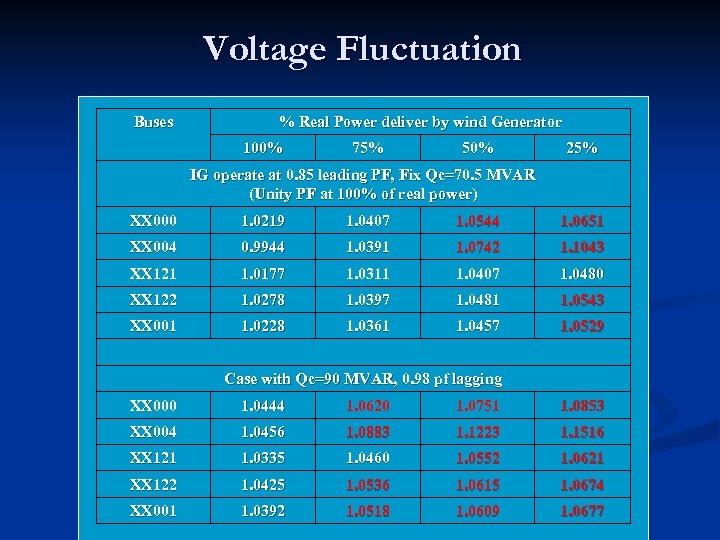 Voltage Fluctuation Buses % Real Power deliver by wind Generator 100% 75% 50% 25% IG operate at 0. 85 leading PF, Fix Qc=70. 5 MVAR (Unity PF at 100% of real power) XX 000 1. 0219 1. 0407 1. 0544 1. 0651 XX 004 0. 9944 1. 0391 1. 0742 1. 1043 XX 121 1. 0177 1. 0311 1. 0407 1. 0480 XX 122 1. 0278 1. 0397 1. 0481 1. 0543 XX 001 1. 0228 1. 0361 1. 0457 1. 0529 Case with Qc=90 MVAR, 0. 98 pf lagging XX 000 1. 0444 1. 0620 1. 0751 1. 0853 XX 004 1. 0456 1. 0883 1. 1223 1. 1516 XX 121 1. 0335 1. 0460 1. 0552 1. 0621 XX 122 1. 0425 1. 0536 1. 0615 1. 0674 XX 001 1. 0392 1. 0518 1. 0609 1. 0677
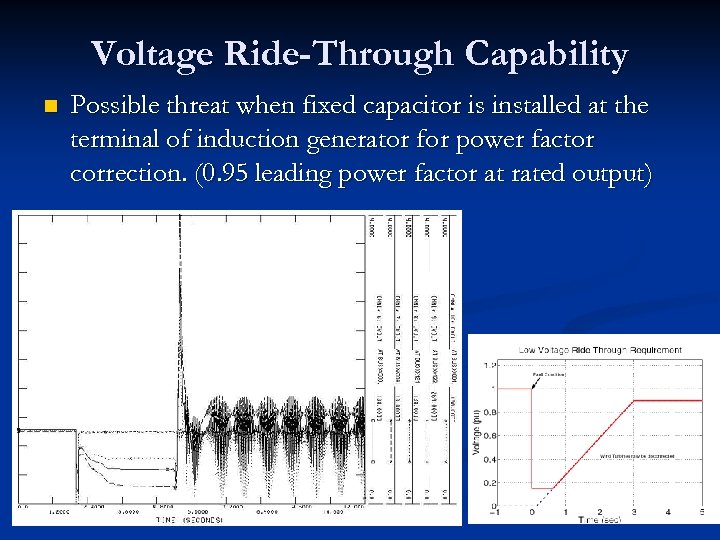 Voltage Ride-Through Capability n Possible threat when fixed capacitor is installed at the terminal of induction generator for power factor correction. (0. 95 leading power factor at rated output)
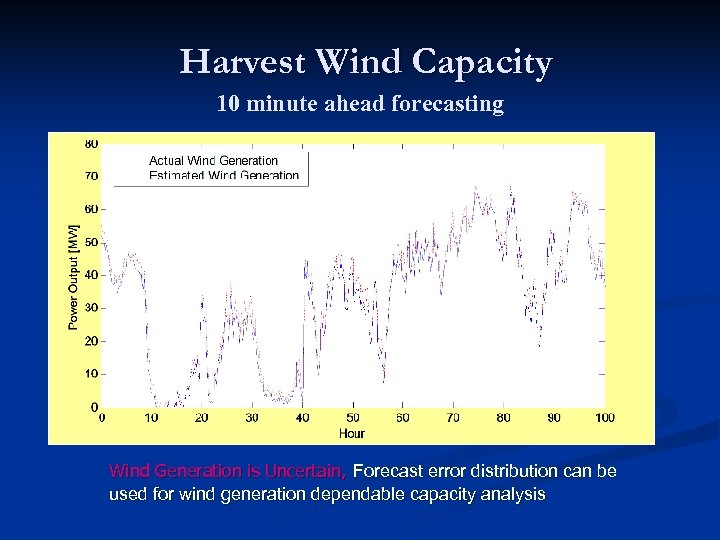 Harvest Wind Capacity 10 minute ahead forecasting Wind Generation is Uncertain, Forecast error distribution can be used for wind generation dependable capacity analysis
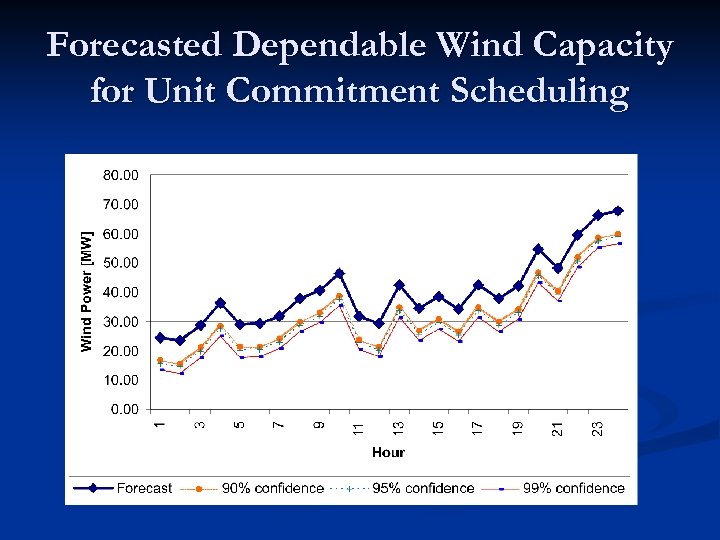 Forecasted Dependable Wind Capacity for Unit Commitment Scheduling
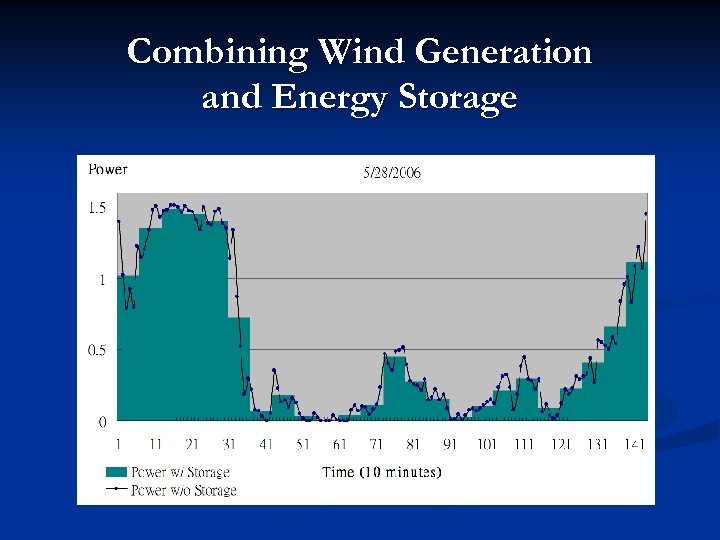 Combining Wind Generation and Energy Storage
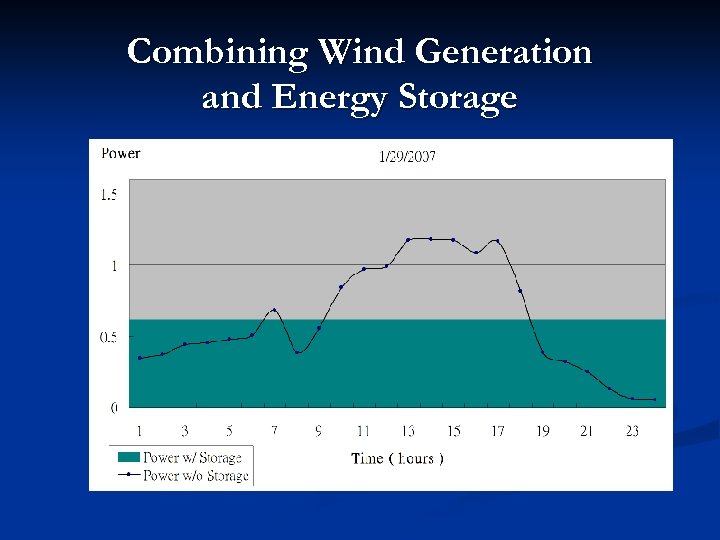 Combining Wind Generation and Energy Storage
 On-Line Real Time Health Monitoring for Wind Generation Source: www. chinatimes. com
 謝謝!
謝謝!