


 Скачать презентацию Week 8 Introduction to macroeconomics The Mc Graw-Hill
2281d79f873079854dfbe1acc16b2cca.ppt
- Количество слайдов: 33
 Week 8 Introduction to macroeconomics ©The Mc. Graw-Hill Companies, 2002
 Macroeconomics is. . . • the study of the economy as a whole • it deals with broad aggregates • but uses the same style of thinking about economic issues as in microeconomics. 1 ©The Mc. Graw-Hill Companies, 2002
 Some key issues in macroeconomics • Inflation – the rate of increase of the general price level • Unemployment – a measure of the number of people looking for work, but who are without jobs • Output – real gross national product (GNP) measures total income of an economy • it is closely related to the economy's total output 2 ©The Mc. Graw-Hill Companies, 2002
 More key issues in macroeconomics • Economic growth – increases in real GNP, an indication of the expansion of the economy’s total output • Macroeconomic policy – a variety of policy measures used by the government to affect the overall performance of the economy 3 ©The Mc. Graw-Hill Companies, 2002
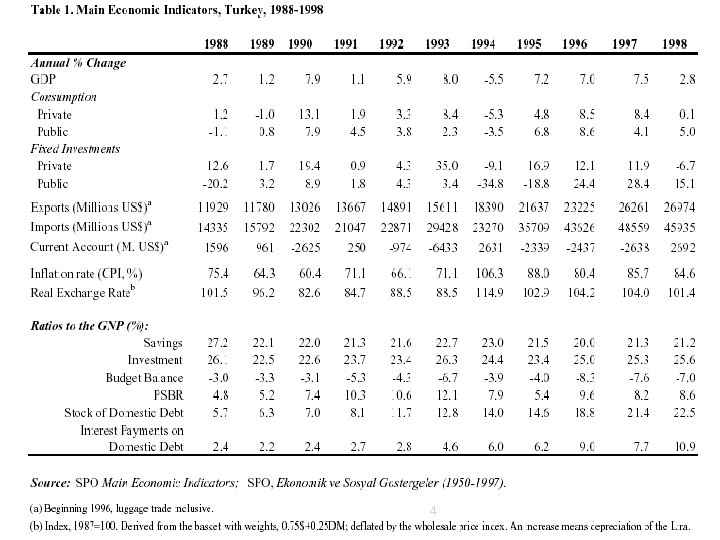 4 ©The Mc. Graw-Hill Companies, 2002
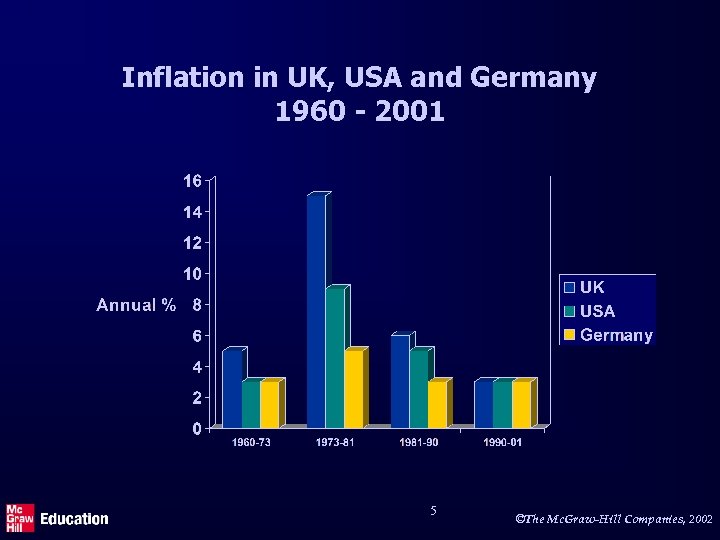 Inflation in UK, USA and Germany 1960 - 2001 5 ©The Mc. Graw-Hill Companies, 2002
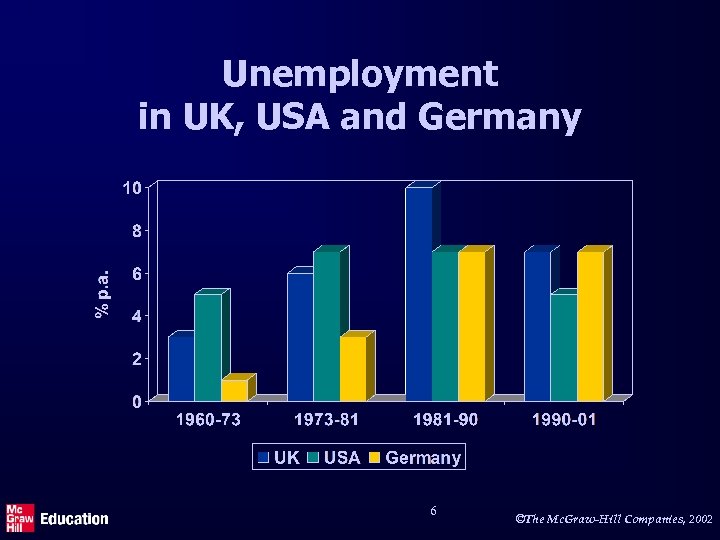 Unemployment in UK, USA and Germany 6 ©The Mc. Graw-Hill Companies, 2002
 Economic growth in UK, USA and Germany 7 ©The Mc. Graw-Hill Companies, 2002
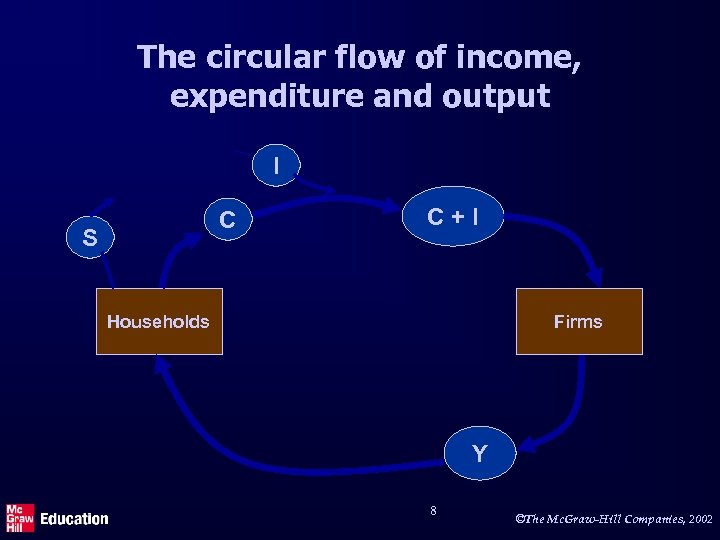 The circular flow of income, expenditure and output I C S C+I Households Firms Y 8 ©The Mc. Graw-Hill Companies, 2002
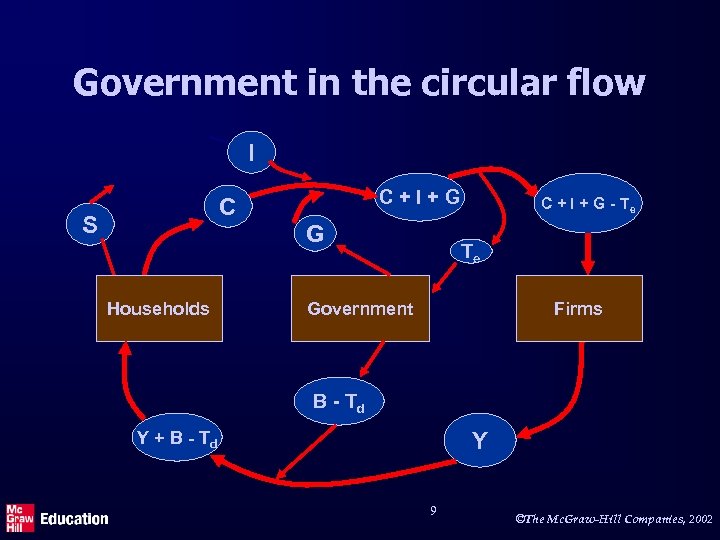 Government in the circular flow I C+I+G C S G Households C + I + G - Te Te Government Firms B - Td Y Y + B - Td 9 ©The Mc. Graw-Hill Companies, 2002
 Adding the foreign sector • To incorporate the foreign sector into the circular flow • we must recognize that residents of a country will buy imports from abroad • and that domestic firms will sell (export) goods and services abroad. 10 ©The Mc. Graw-Hill Companies, 2002
 GDP and GNP • Gross domestic product (GDP) – measures the output produced by factors of production located in the domestic economy • Gross national product (GNP) – measures the total income earned by domestic citizens • GNP = GDP + net income from abroad 11 ©The Mc. Graw-Hill Companies, 2002
 Three measures of national output • Expenditure – the sum of expenditures in the economy –Y=C+I+G+X-Z • Income – the sum of incomes paid for factor services – wages, profits, etc. • Output – the sum of output (value added) produced in the economy 12 ©The Mc. Graw-Hill Companies, 2002
 What GNP does and does not measure • Some care is needed: – to distinguish between real and nominal measurements – to take account of population changes – to remember that GNP is not a comprehensive measure of everything that contributes to economic welfare 13 ©The Mc. Graw-Hill Companies, 2002
 Output and aggregate demand ©The Mc. Graw-Hill Companies, 2002
 Aggregate output in the short run • Potential output – the output the economy would produce if all factors of production were fully employed • Actual output – what is actually produced in a period – which may diverge from the potential level 15 ©The Mc. Graw-Hill Companies, 2002
 Some simplifying assumptions • Prices and wages are fixed • The actual quantity of total output is demand-determined – this will be a “Keynesian” model • For now, also assume: – no government – no foreign trade • Later chapters relax these assumptions 16 ©The Mc. Graw-Hill Companies, 2002
 Aggregate demand • Given no government and no international trade, aggregate demand has two components: – Investment • firms’ desired or planned additions to physical capital & inventories • for now, assume this is autonomous – Consumption • households’ demand for goods and services • so, AD = C + I 17 ©The Mc. Graw-Hill Companies, 2002
 Consumption demand • Households allocate their income between CONSUMPTION and SAVING • Personal Disposable Income – income that households have for spending or saving – income from their supply of factor services (plus transfers less taxes) 18 ©The Mc. Graw-Hill Companies, 2002
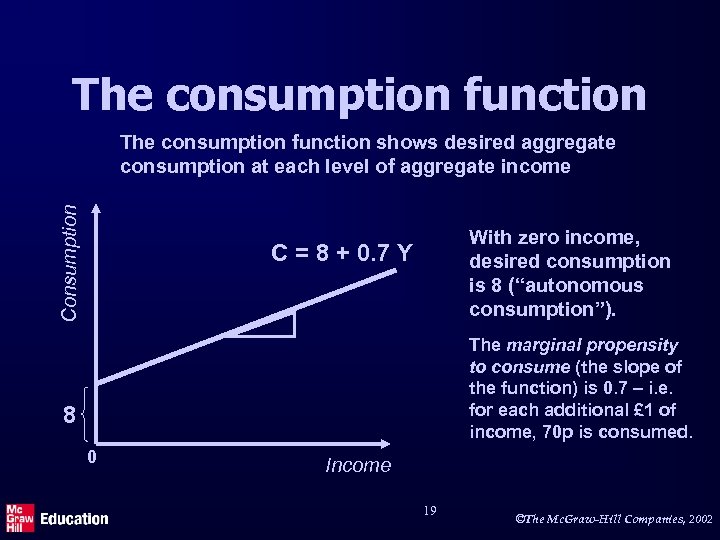 The consumption function Consumption The consumption function shows desired aggregate consumption at each level of aggregate income With zero income, desired consumption is 8 (“autonomous consumption”). C = 8 + 0. 7 Y The marginal propensity to consume (the slope of the function) is 0. 7 – i. e. for each additional £ 1 of income, 70 p is consumed. 8 0 Income 19 ©The Mc. Graw-Hill Companies, 2002
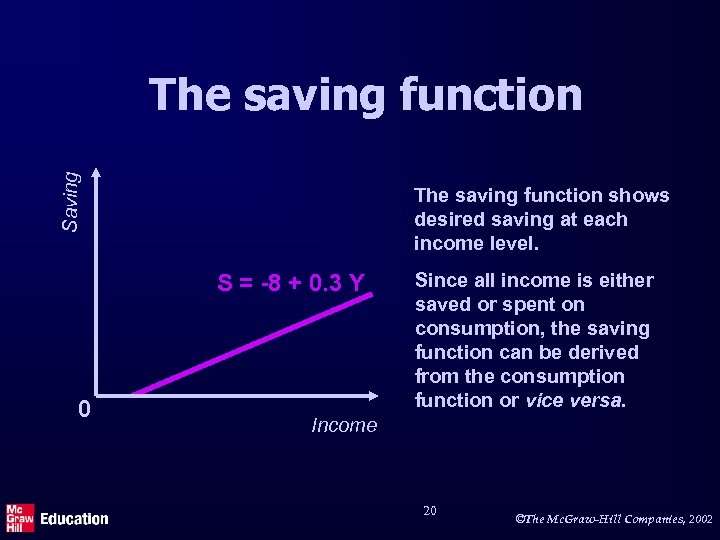 Saving The saving function shows desired saving at each income level. S = -8 + 0. 3 Y 0 Since all income is either saved or spent on consumption, the saving function can be derived from the consumption function or vice versa. Income 20 ©The Mc. Graw-Hill Companies, 2002
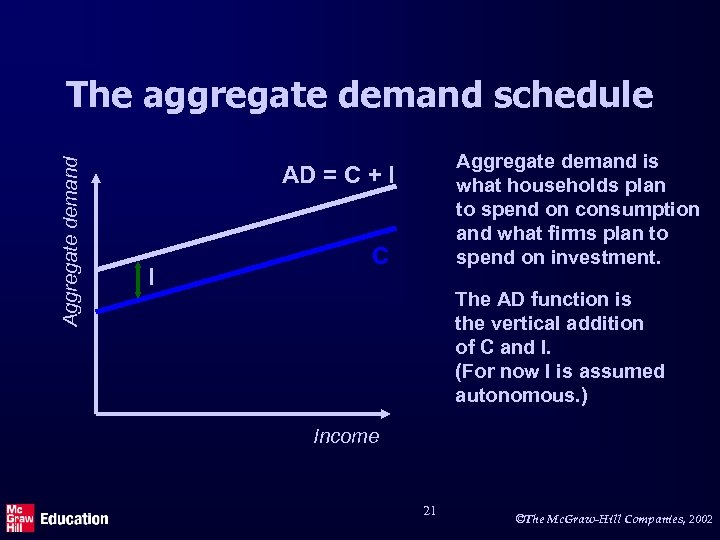 Aggregate demand The aggregate demand schedule Aggregate demand is what households plan to spend on consumption and what firms plan to spend on investment. AD = C + I I C The AD function is the vertical addition of C and I. (For now I is assumed autonomous. ) Income 21 ©The Mc. Graw-Hill Companies, 2002
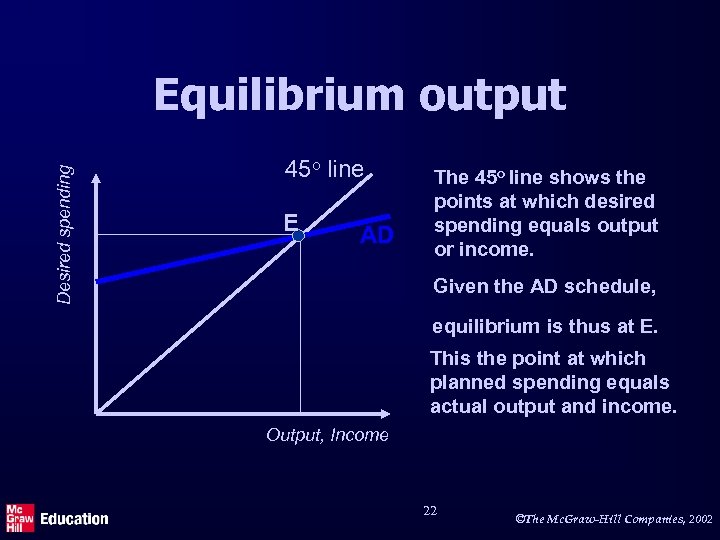 Desired spending Equilibrium output 45 o line E AD The 45 o line shows the points at which desired spending equals output or income. Given the AD schedule, equilibrium is thus at E. This the point at which planned spending equals actual output and income. Output, Income 22 ©The Mc. Graw-Hill Companies, 2002
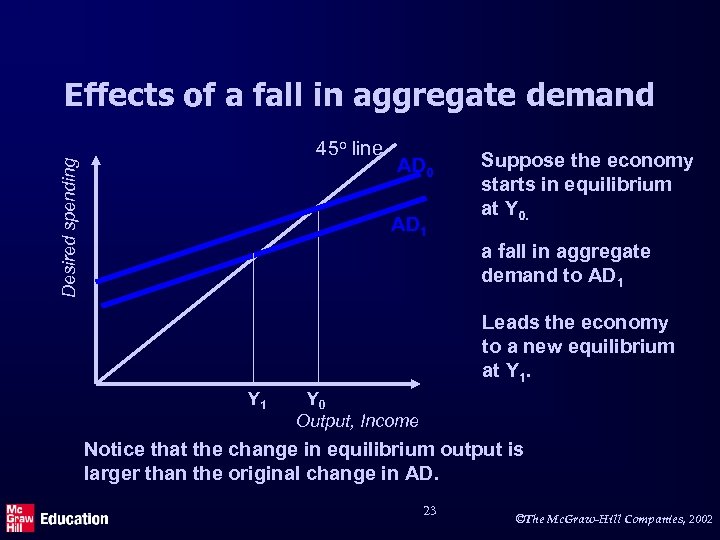 Effects of a fall in aggregate demand Desired spending 45 o line AD 0 AD 1 Suppose the economy starts in equilibrium at Y 0. a fall in aggregate demand to AD 1 Leads the economy to a new equilibrium at Y 1 Y 0 Output, Income Notice that the change in equilibrium output is larger than the original change in AD. 23 ©The Mc. Graw-Hill Companies, 2002
 The multiplier • The multiplier is the ratio of the change in equilibrium output to the change in autonomous spending that causes the change in output. • The larger the marginal propensity to consume, the larger is the multiplier. – The higher is the marginal propensity to save, the more of each extra unit of income “leaks” out of the circular flow. 24 ©The Mc. Graw-Hill Companies, 2002
 Fiscal policy and foreign trade ©The Mc. Graw-Hill Companies, 2002
 Some key terms • Fiscal policy – the government’s decisions about spending and taxes • Stabilization policy – government actions to try to keep output close to its potential level • Budget deficit – the excess of government outlays over government receipts • National debt – the stock of outstanding government debt 26 ©The Mc. Graw-Hill Companies, 2002
 Government in the income-expenditure model • Y=C+I+G (assumption: no foreign trade) • Direct taxes – affect the slope of the consumption function – and hence the slope of the AD schedule. • Government expenditure affects the position of the AD schedule 27 ©The Mc. Graw-Hill Companies, 2002
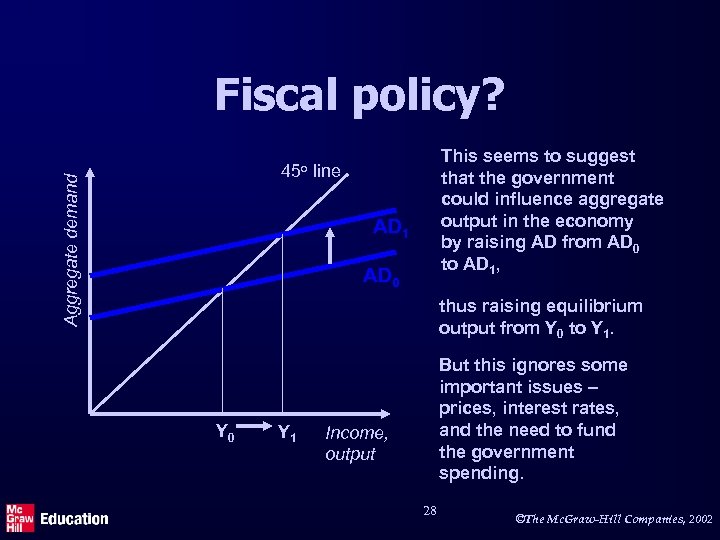 Fiscal policy? Aggregate demand 45 o This seems to suggest that the government could influence aggregate output in the economy by raising AD from AD 0 to AD 1, line AD 1 AD 0 thus raising equilibrium output from Y 0 to Y 1. Y 0 Y 1 But this ignores some important issues – prices, interest rates, and the need to fund the government spending. Income, output 28 ©The Mc. Graw-Hill Companies, 2002
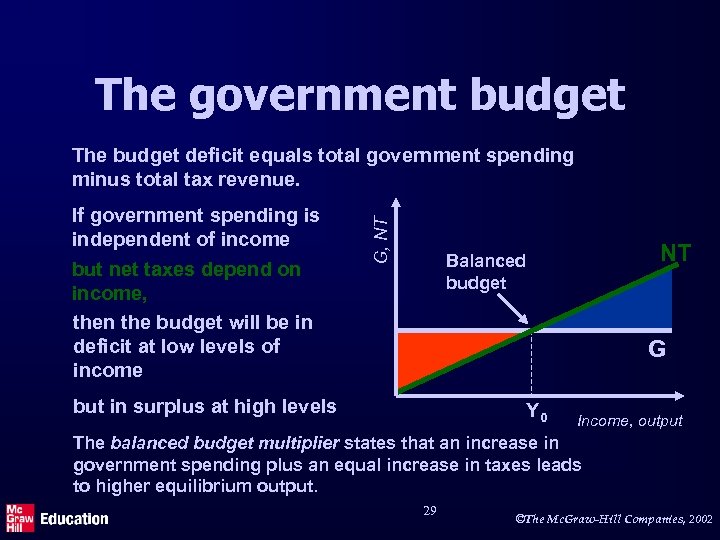 The government budget If government spending is independent of income but net taxes depend on income, then the budget will be in deficit at low levels of income G, NT The budget deficit equals total government spending minus total tax revenue. NT Balanced budget G but in surplus at high levels Y 0 Income, output The balanced budget multiplier states that an increase in government spending plus an equal increase in taxes leads to higher equilibrium output. 29 ©The Mc. Graw-Hill Companies, 2002
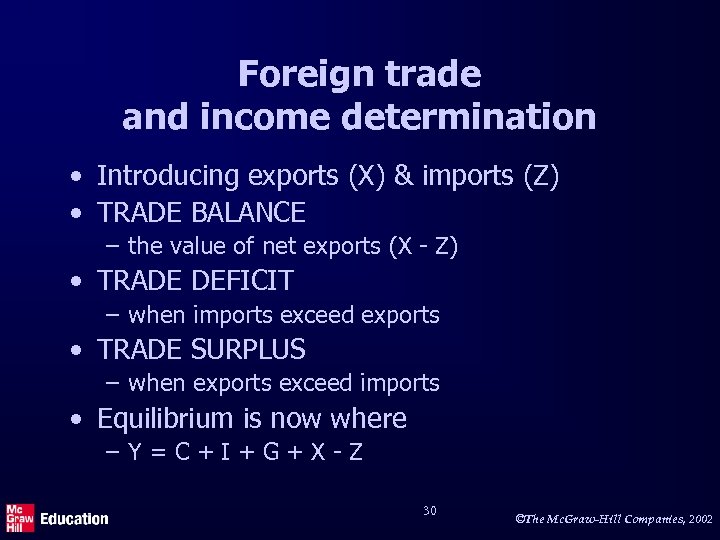 Foreign trade and income determination • Introducing exports (X) & imports (Z) • TRADE BALANCE – the value of net exports (X - Z) • TRADE DEFICIT – when imports exceed exports • TRADE SURPLUS – when exports exceed imports • Equilibrium is now where –Y=C+I+G+X-Z 30 ©The Mc. Graw-Hill Companies, 2002
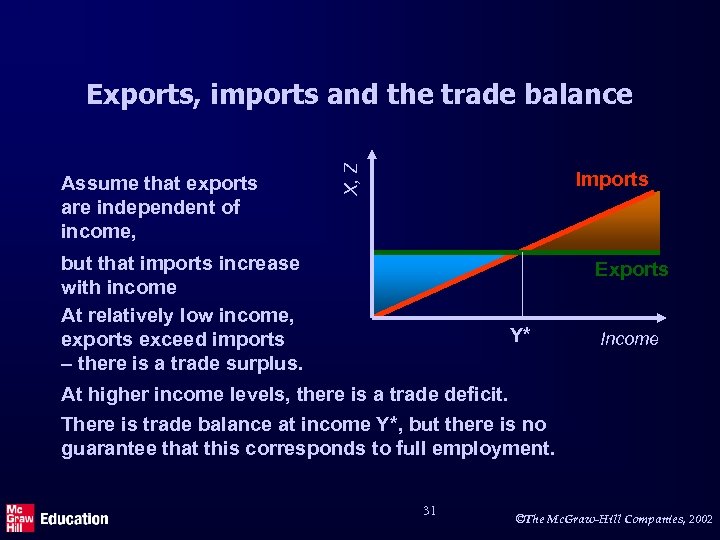 Assume that exports are independent of income, X, Z Exports, imports and the trade balance Imports but that imports increase with income At relatively low income, exports exceed imports – there is a trade surplus. Exports Y* Income At higher income levels, there is a trade deficit. There is trade balance at income Y*, but there is no guarantee that this corresponds to full employment. 31 ©The Mc. Graw-Hill Companies, 2002
 Foreign trade and the multiplier • The marginal propensity to import – is the fraction of additional income that domestic residents wish to spend on additional imports. • The effect of foreign trade is to reduce the size of the multiplier – the higher the value of the marginal propensity to import, the lower the value of the multiplier. 32 ©The Mc. Graw-Hill Companies, 2002