 Скачать презентацию Week 10 Conditional Processing Assembly Language for Intel-Based
9ea29c9256cecd5043743d5dc3609a80.ppt
- Количество слайдов: 52



Week 10: Conditional Processing Assembly Language for Intel-Based Computers, 4 th Edition Slides modified by Dr. Osama Younes
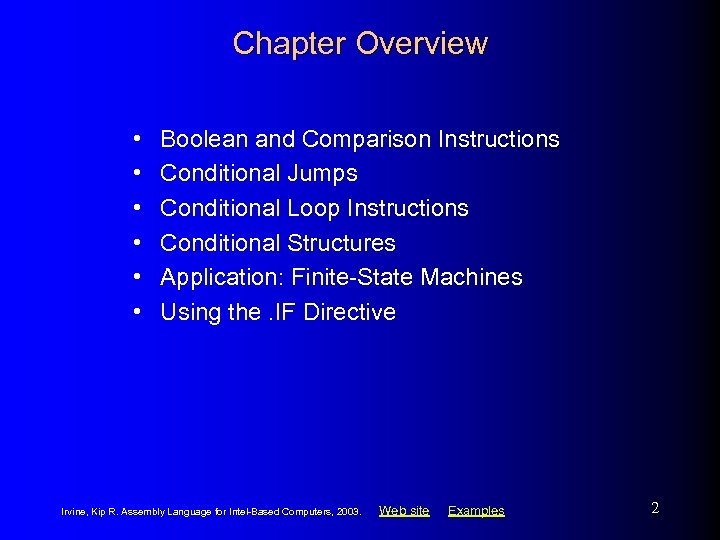
Chapter Overview • • • Boolean and Comparison Instructions Conditional Jumps Conditional Loop Instructions Conditional Structures Application: Finite-State Machines Using the. IF Directive Irvine, Kip R. Assembly Language for Intel-Based Computers, 2003. Web site Examples 2
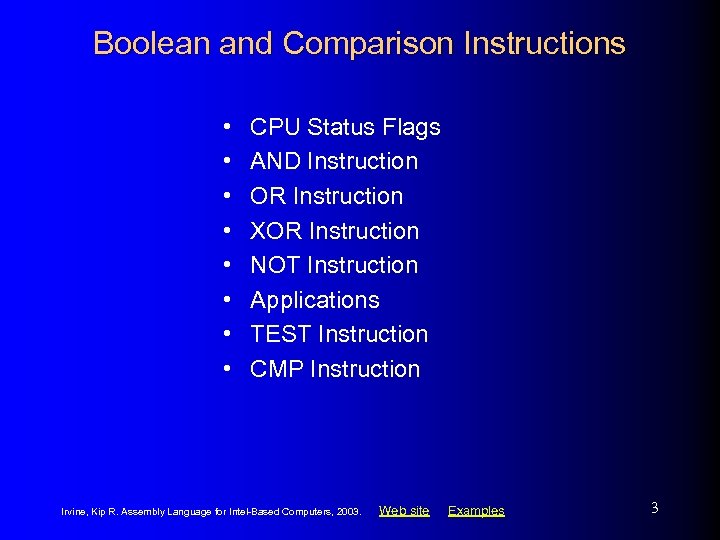
Boolean and Comparison Instructions • • CPU Status Flags AND Instruction OR Instruction XOR Instruction NOT Instruction Applications TEST Instruction CMP Instruction Irvine, Kip R. Assembly Language for Intel-Based Computers, 2003. Web site Examples 3
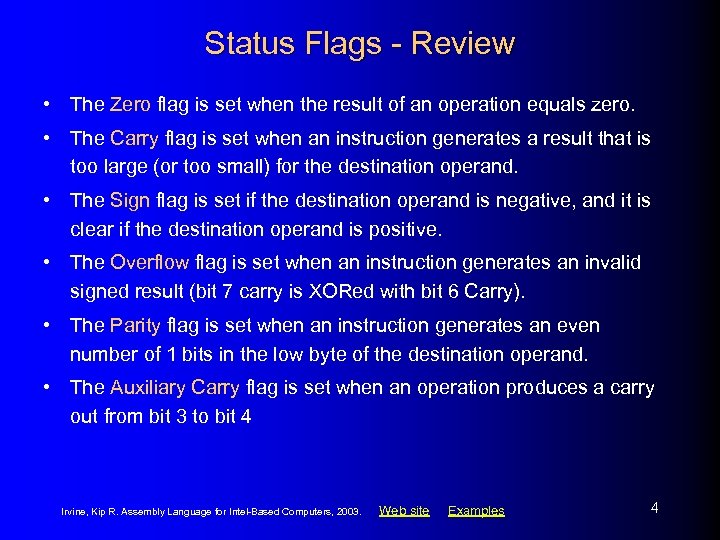
Status Flags - Review • The Zero flag is set when the result of an operation equals zero. • The Carry flag is set when an instruction generates a result that is too large (or too small) for the destination operand. • The Sign flag is set if the destination operand is negative, and it is clear if the destination operand is positive. • The Overflow flag is set when an instruction generates an invalid signed result (bit 7 carry is XORed with bit 6 Carry). • The Parity flag is set when an instruction generates an even number of 1 bits in the low byte of the destination operand. • The Auxiliary Carry flag is set when an operation produces a carry out from bit 3 to bit 4 Irvine, Kip R. Assembly Language for Intel-Based Computers, 2003. Web site Examples 4
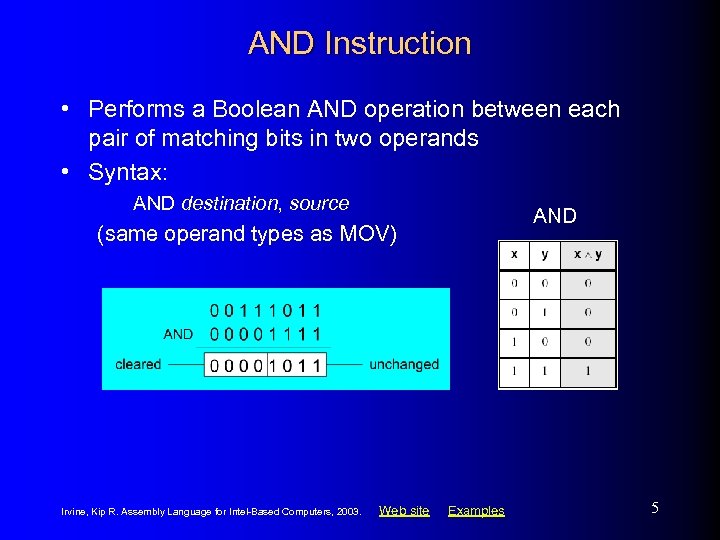
AND Instruction • Performs a Boolean AND operation between each pair of matching bits in two operands • Syntax: AND destination, source AND (same operand types as MOV) Irvine, Kip R. Assembly Language for Intel-Based Computers, 2003. Web site Examples 5
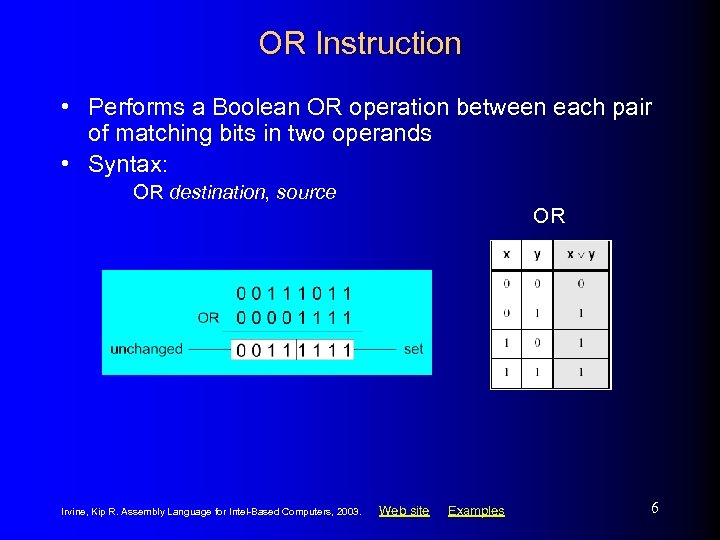
OR Instruction • Performs a Boolean OR operation between each pair of matching bits in two operands • Syntax: OR destination, source OR Irvine, Kip R. Assembly Language for Intel-Based Computers, 2003. Web site Examples 6
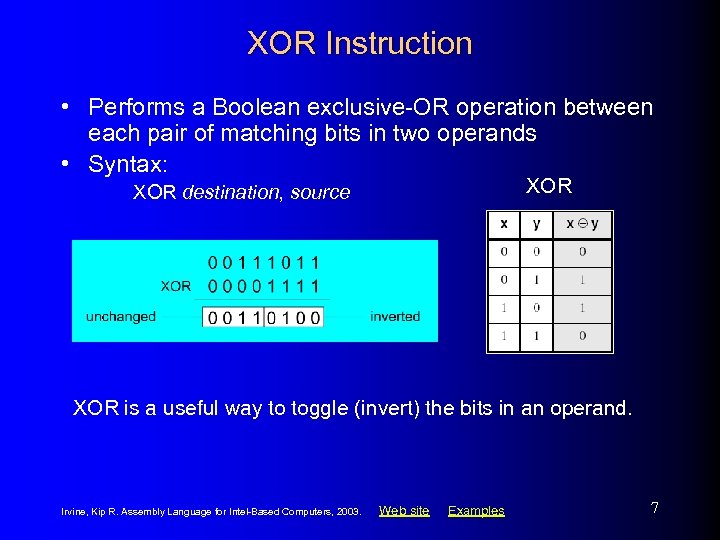
XOR Instruction • Performs a Boolean exclusive-OR operation between each pair of matching bits in two operands • Syntax: XOR destination, source XOR is a useful way to toggle (invert) the bits in an operand. Irvine, Kip R. Assembly Language for Intel-Based Computers, 2003. Web site Examples 7
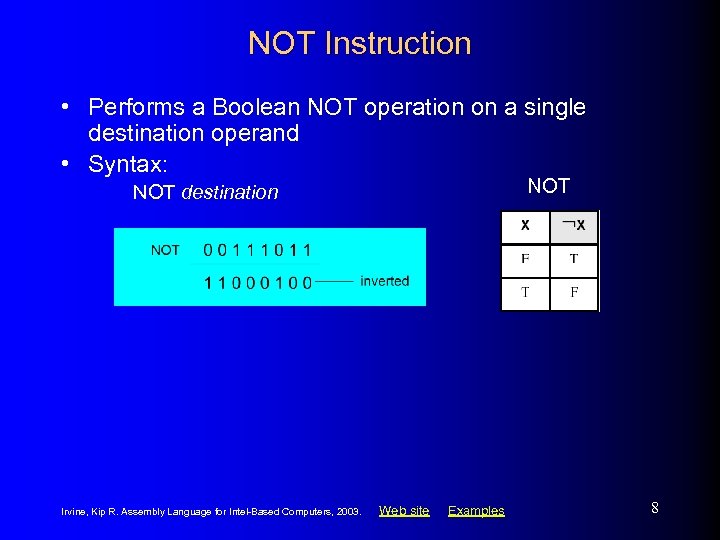
NOT Instruction • Performs a Boolean NOT operation on a single destination operand • Syntax: NOT destination Irvine, Kip R. Assembly Language for Intel-Based Computers, 2003. Web site Examples 8
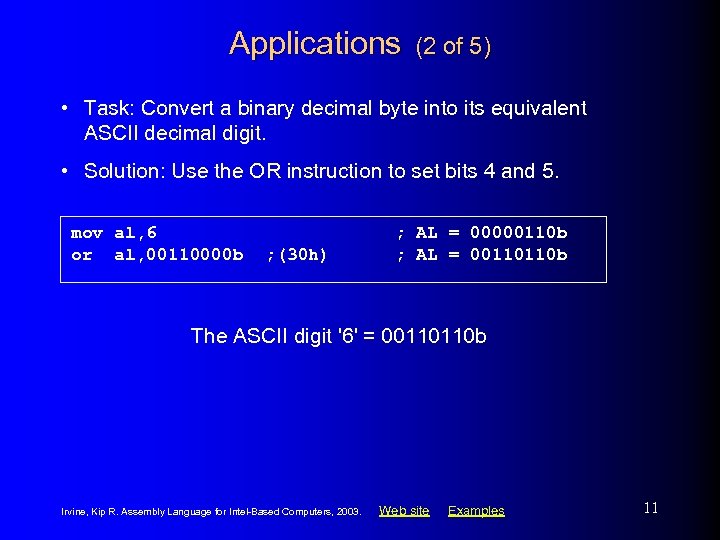
Applications (2 of 5) • Task: Convert a binary decimal byte into its equivalent ASCII decimal digit. • Solution: Use the OR instruction to set bits 4 and 5. mov al, 6 or al, 00110000 b ; (30 h) ; AL = 00000110 b ; AL = 00110110 b The ASCII digit '6' = 00110110 b Irvine, Kip R. Assembly Language for Intel-Based Computers, 2003. Web site Examples 11
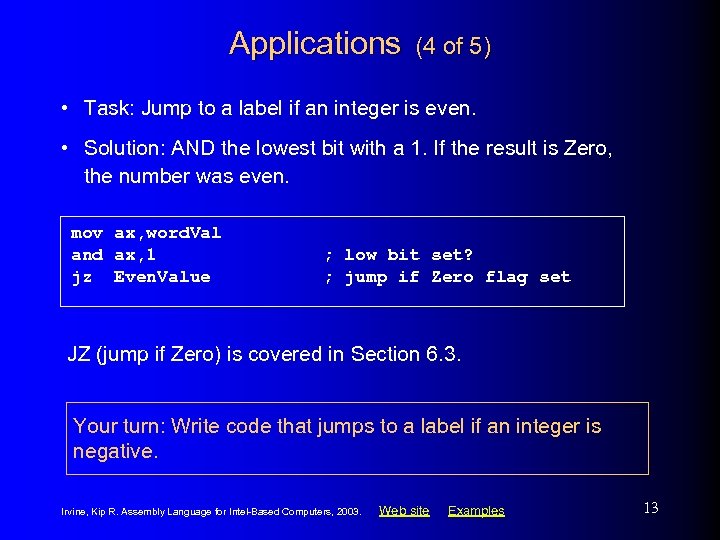
Applications (4 of 5) • Task: Jump to a label if an integer is even. • Solution: AND the lowest bit with a 1. If the result is Zero, the number was even. mov ax, word. Val and ax, 1 jz Even. Value ; low bit set? ; jump if Zero flag set JZ (jump if Zero) is covered in Section 6. 3. Your turn: Write code that jumps to a label if an integer is negative. Irvine, Kip R. Assembly Language for Intel-Based Computers, 2003. Web site Examples 13
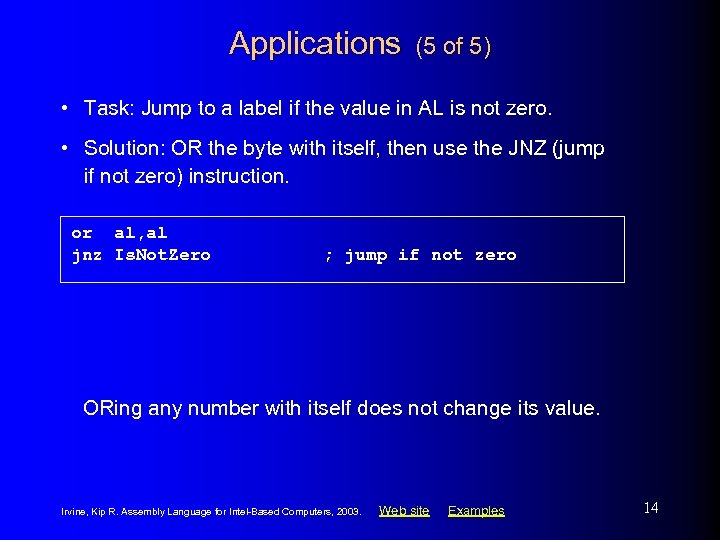
Applications (5 of 5) • Task: Jump to a label if the value in AL is not zero. • Solution: OR the byte with itself, then use the JNZ (jump if not zero) instruction. or al, al jnz Is. Not. Zero ; jump if not zero ORing any number with itself does not change its value. Irvine, Kip R. Assembly Language for Intel-Based Computers, 2003. Web site Examples 14
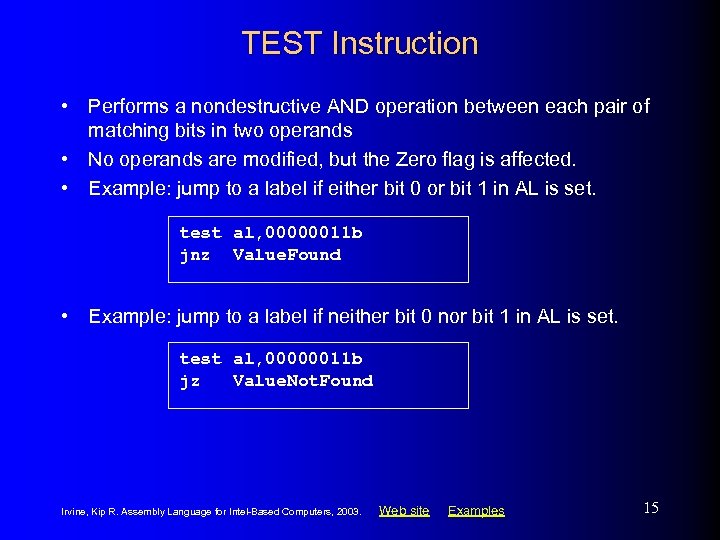
TEST Instruction • Performs a nondestructive AND operation between each pair of matching bits in two operands • No operands are modified, but the Zero flag is affected. • Example: jump to a label if either bit 0 or bit 1 in AL is set. test al, 00000011 b jnz Value. Found • Example: jump to a label if neither bit 0 nor bit 1 in AL is set. test al, 00000011 b jz Value. Not. Found Irvine, Kip R. Assembly Language for Intel-Based Computers, 2003. Web site Examples 15
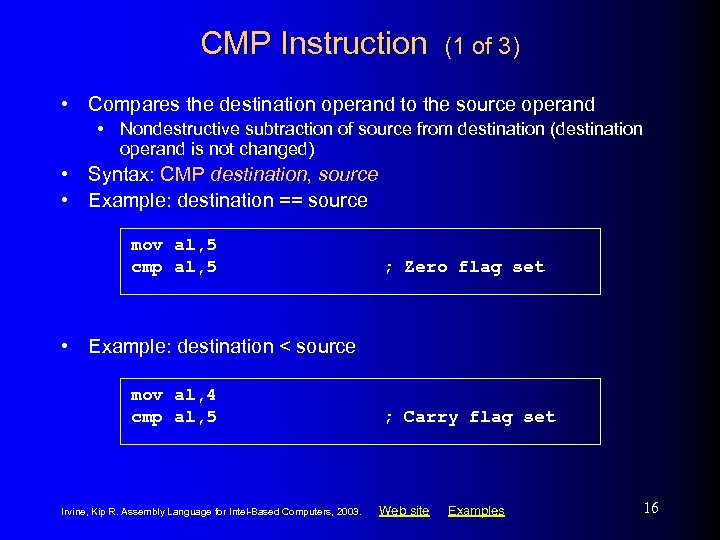
CMP Instruction (1 of 3) • Compares the destination operand to the source operand • Nondestructive subtraction of source from destination (destination operand is not changed) • Syntax: CMP destination, source • Example: destination == source mov al, 5 cmp al, 5 ; Zero flag set • Example: destination < source mov al, 4 cmp al, 5 Irvine, Kip R. Assembly Language for Intel-Based Computers, 2003. ; Carry flag set Web site Examples 16
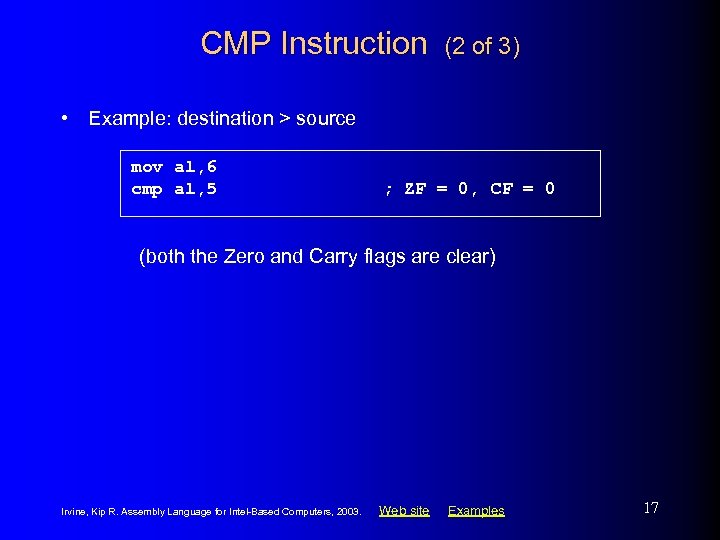
CMP Instruction (2 of 3) • Example: destination > source mov al, 6 cmp al, 5 ; ZF = 0, CF = 0 (both the Zero and Carry flags are clear) Irvine, Kip R. Assembly Language for Intel-Based Computers, 2003. Web site Examples 17
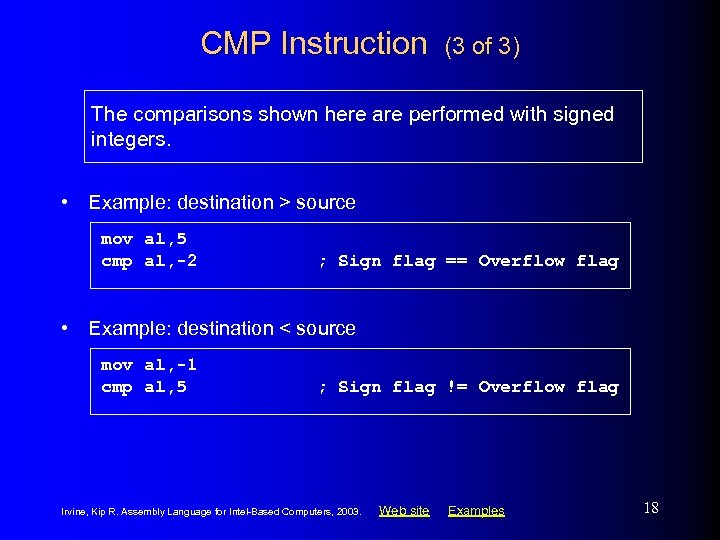
CMP Instruction (3 of 3) The comparisons shown here are performed with signed integers. • Example: destination > source mov al, 5 cmp al, -2 ; Sign flag == Overflow flag • Example: destination < source mov al, -1 cmp al, 5 ; Sign flag != Overflow flag Irvine, Kip R. Assembly Language for Intel-Based Computers, 2003. Web site Examples 18
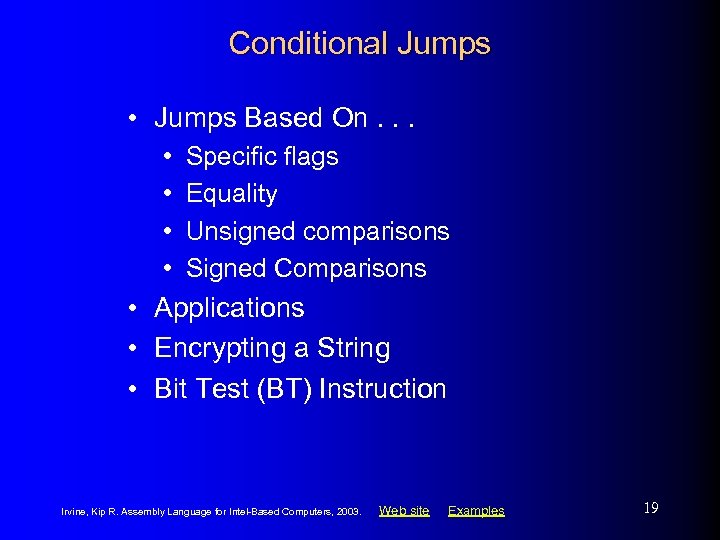
Conditional Jumps • Jumps Based On. . . • • Specific flags Equality Unsigned comparisons Signed Comparisons • Applications • Encrypting a String • Bit Test (BT) Instruction Irvine, Kip R. Assembly Language for Intel-Based Computers, 2003. Web site Examples 19
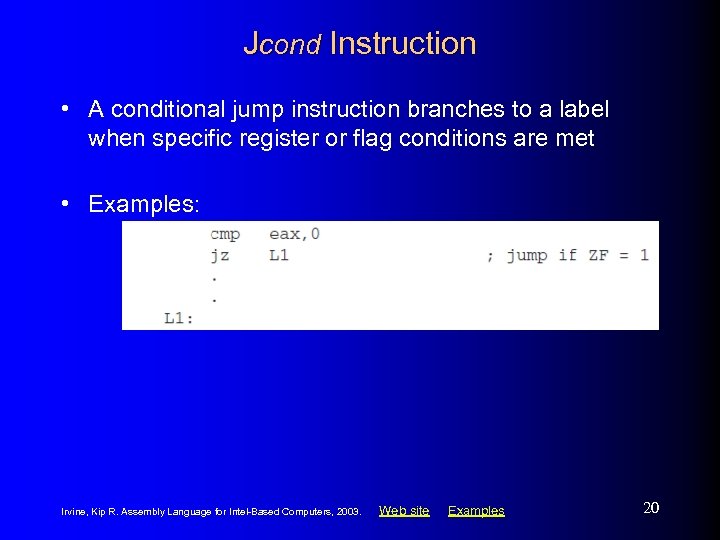
Jcond Instruction • A conditional jump instruction branches to a label when specific register or flag conditions are met • Examples: Irvine, Kip R. Assembly Language for Intel-Based Computers, 2003. Web site Examples 20
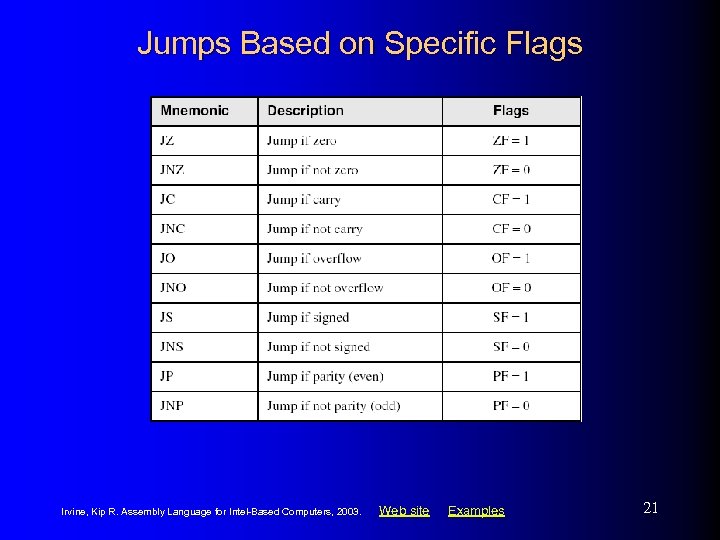
Jumps Based on Specific Flags Irvine, Kip R. Assembly Language for Intel-Based Computers, 2003. Web site Examples 21
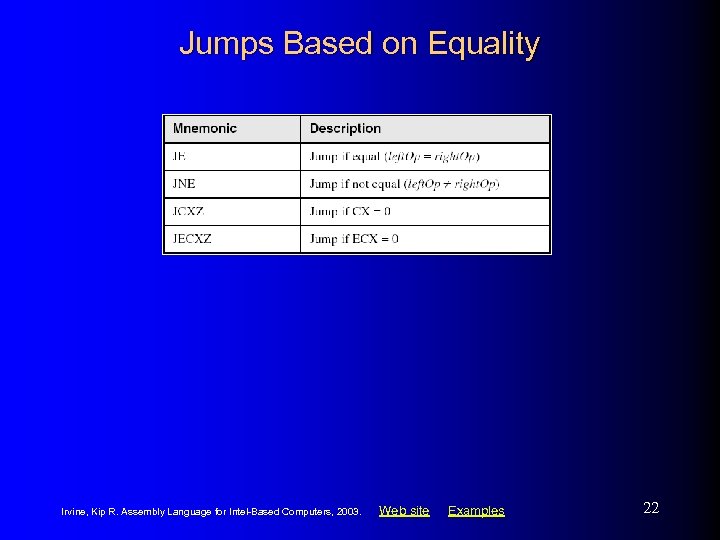
Jumps Based on Equality Irvine, Kip R. Assembly Language for Intel-Based Computers, 2003. Web site Examples 22
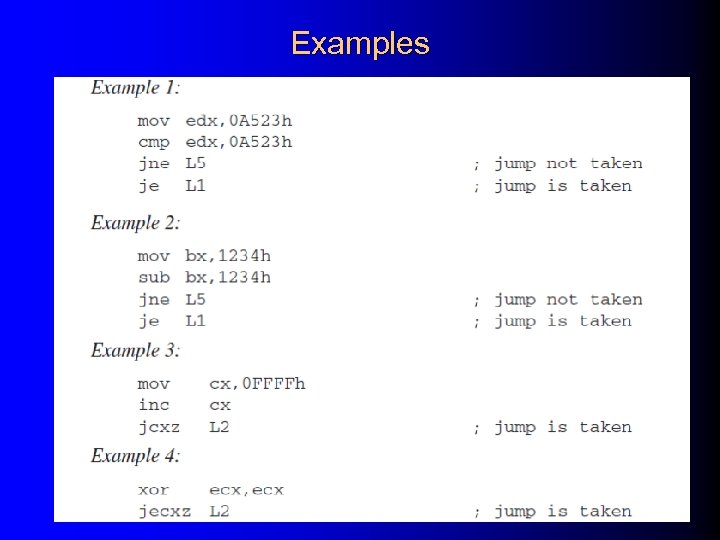
Examples Web site Examples 23
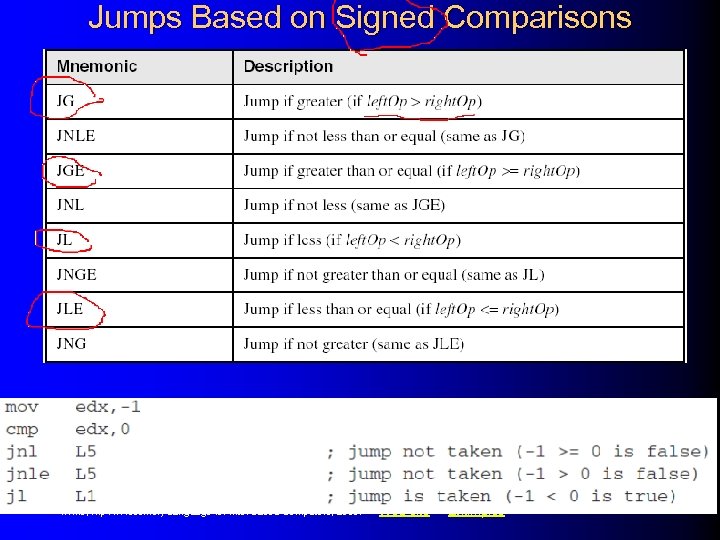
Jumps Based on Signed Comparisons Irvine, Kip R. Assembly Language for Intel-Based Computers, 2003. Web site Examples 24
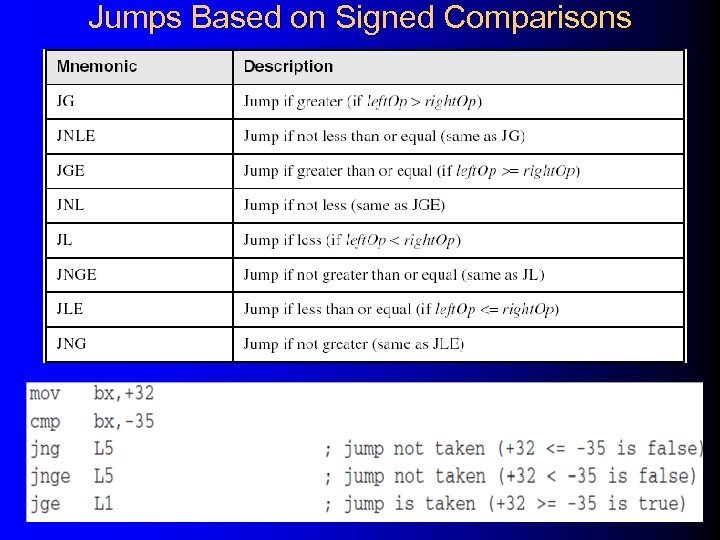
Jumps Based on Signed Comparisons Irvine, Kip R. Assembly Language for Intel-Based Computers, 2003. Web site Examples 25
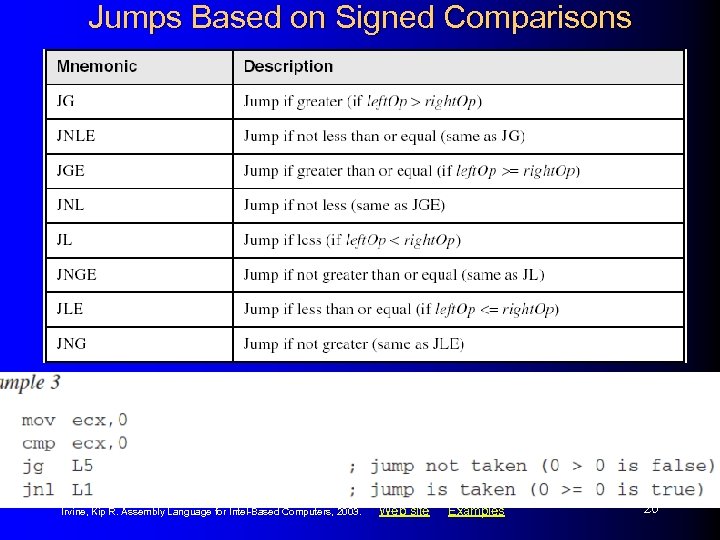
Jumps Based on Signed Comparisons Irvine, Kip R. Assembly Language for Intel-Based Computers, 2003. Web site Examples 26
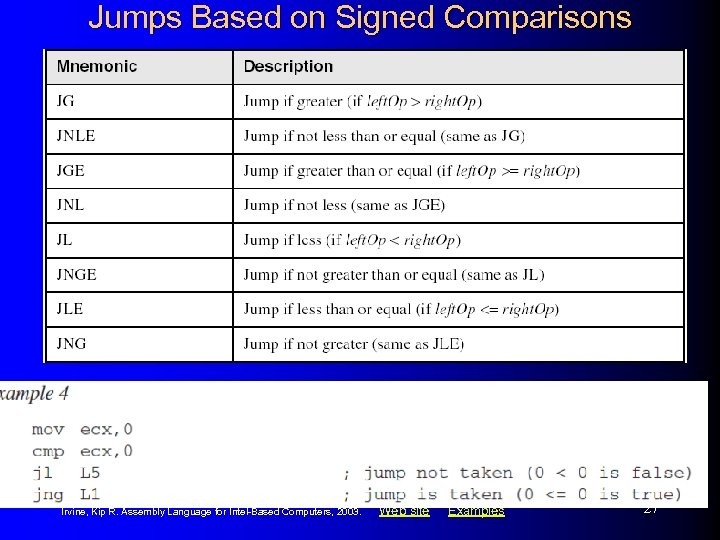
Jumps Based on Signed Comparisons Irvine, Kip R. Assembly Language for Intel-Based Computers, 2003. Web site Examples 27
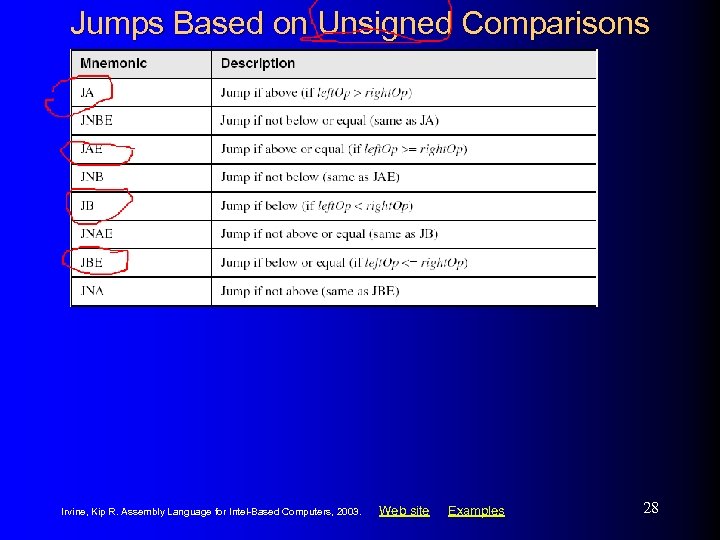
Jumps Based on Unsigned Comparisons Irvine, Kip R. Assembly Language for Intel-Based Computers, 2003. Web site Examples 28
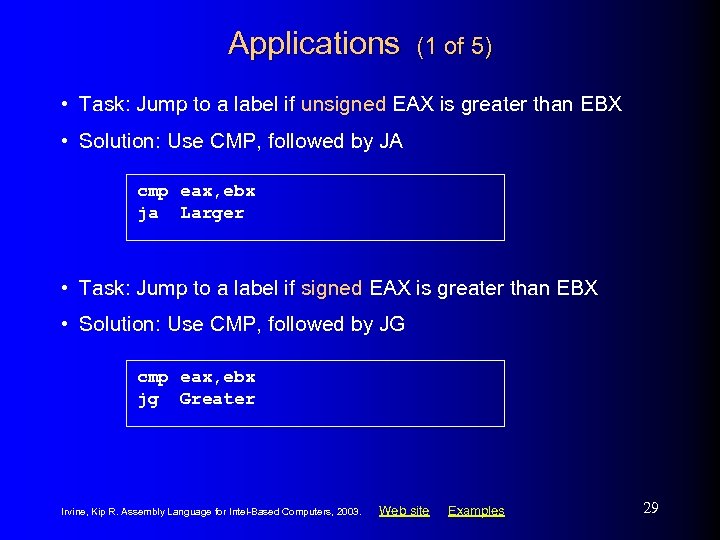
Applications (1 of 5) • Task: Jump to a label if unsigned EAX is greater than EBX • Solution: Use CMP, followed by JA cmp eax, ebx ja Larger • Task: Jump to a label if signed EAX is greater than EBX • Solution: Use CMP, followed by JG cmp eax, ebx jg Greater Irvine, Kip R. Assembly Language for Intel-Based Computers, 2003. Web site Examples 29
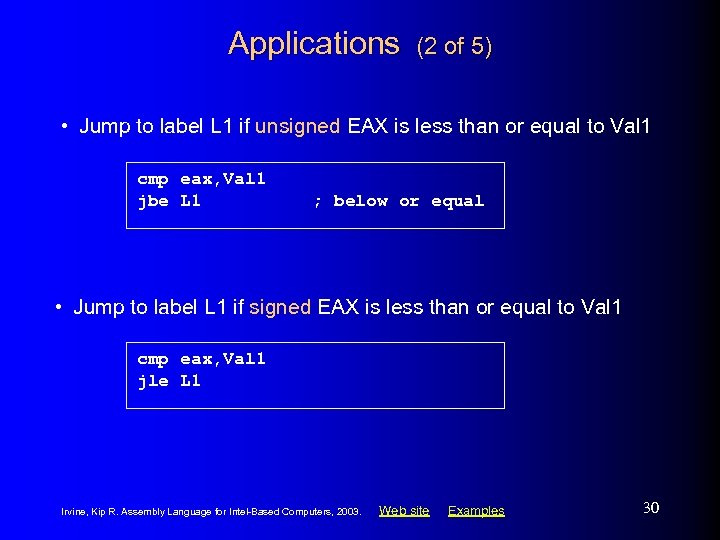
Applications (2 of 5) • Jump to label L 1 if unsigned EAX is less than or equal to Val 1 cmp eax, Val 1 jbe L 1 ; below or equal • Jump to label L 1 if signed EAX is less than or equal to Val 1 cmp eax, Val 1 jle L 1 Irvine, Kip R. Assembly Language for Intel-Based Computers, 2003. Web site Examples 30
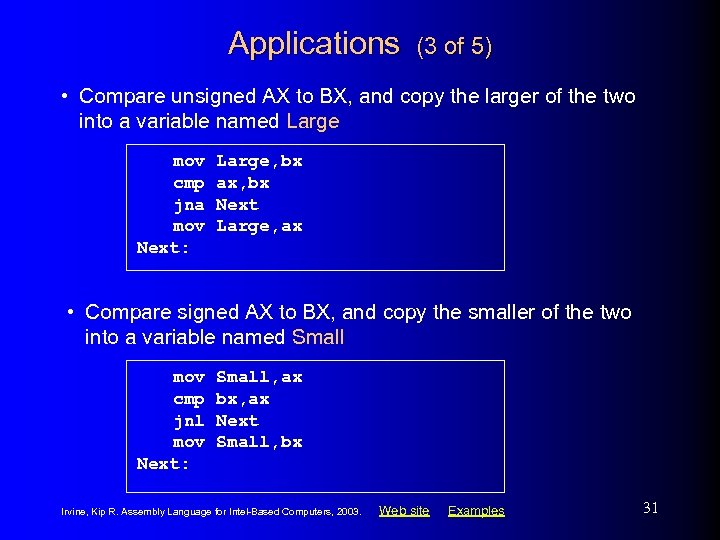
Applications (3 of 5) • Compare unsigned AX to BX, and copy the larger of the two into a variable named Large mov cmp jna mov Next: Large, bx ax, bx Next Large, ax • Compare signed AX to BX, and copy the smaller of the two into a variable named Small mov cmp jnl mov Next: Small, ax bx, ax Next Small, bx Irvine, Kip R. Assembly Language for Intel-Based Computers, 2003. Web site Examples 31
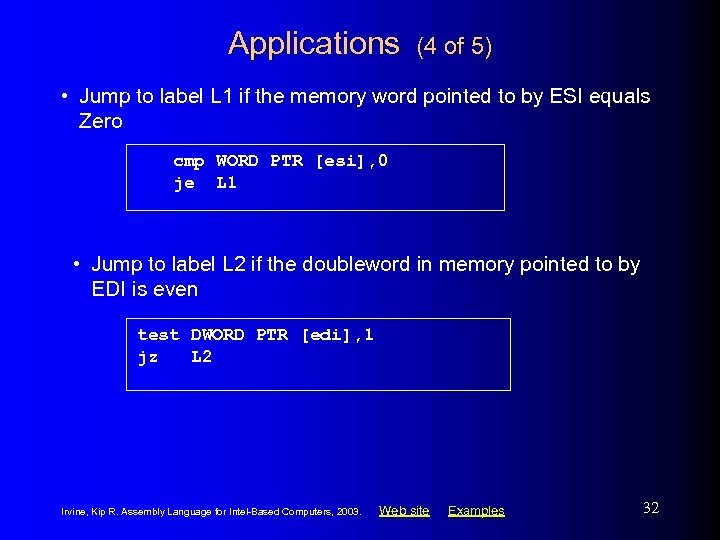
Applications (4 of 5) • Jump to label L 1 if the memory word pointed to by ESI equals Zero cmp WORD PTR [esi], 0 je L 1 • Jump to label L 2 if the doubleword in memory pointed to by EDI is even test DWORD PTR [edi], 1 jz L 2 Irvine, Kip R. Assembly Language for Intel-Based Computers, 2003. Web site Examples 32
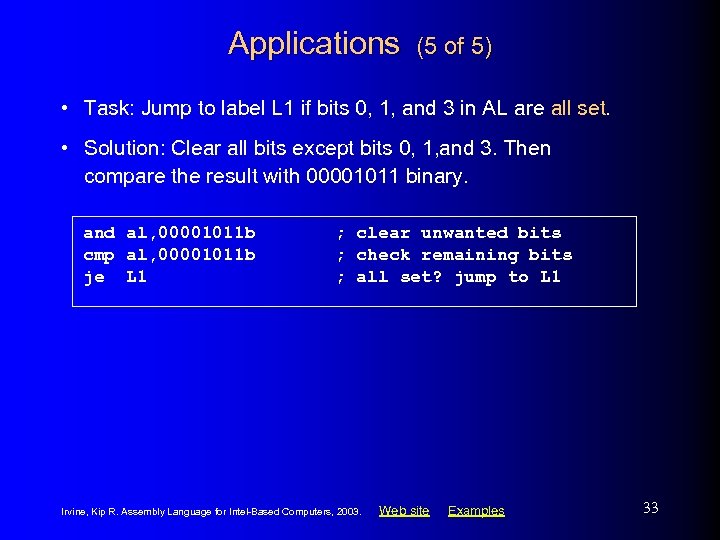
Applications (5 of 5) • Task: Jump to label L 1 if bits 0, 1, and 3 in AL are all set. • Solution: Clear all bits except bits 0, 1, and 3. Then compare the result with 00001011 binary. and al, 00001011 b cmp al, 00001011 b je L 1 ; clear unwanted bits ; check remaining bits ; all set? jump to L 1 Irvine, Kip R. Assembly Language for Intel-Based Computers, 2003. Web site Examples 33
Your turn. . . • Write code that jumps to label L 1 if either bit 4, 5, or 6 is set in the BL register. • Write code that jumps to label L 1 if bits 4, 5, and 6 are all set in the BL register. • Write code that jumps to label L 2 if AL has even parity. • Write code that jumps to label L 3 if EAX is negative. • Write code that jumps to label L 4 if the expression (EBX – ECX) is greater than zero. Answer Irvine, Kip R. Assembly Language for Intel-Based Computers, 2003. Web site Examples 34
Summarization • Basically, CPU implement unsigned comparison with carry flag indicating left. Op < right. Op • Overflow flag is used to help the interpretation of singed comparison where carry flag is not always set when left. Op < right. Op Irvine, Kip R. Assembly Language for Intel-Based Computers, 2003. Web site Examples 35
Conditional Structures • Block-Structured IF Statements • Compound Expressions with AND • Compound Expressions with OR • WHILE Loops • Table-Driven Selection Irvine, Kip R. Assembly Language for Intel-Based Computers, 2003. Web site Examples 36
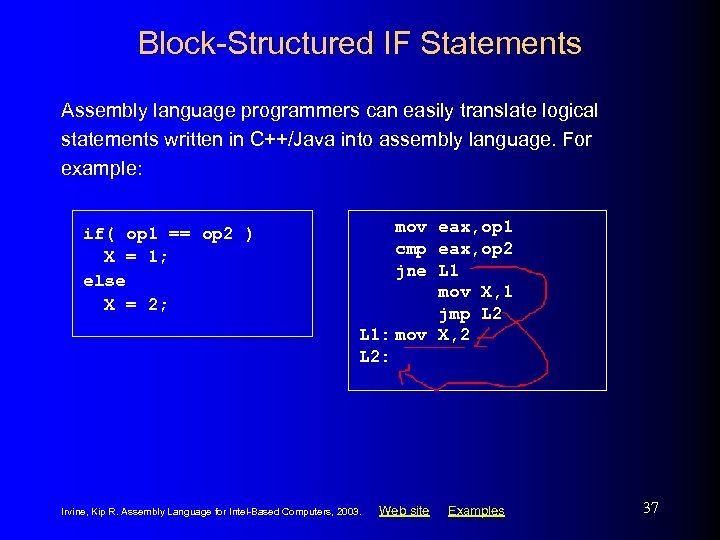
Block-Structured IF Statements Assembly language programmers can easily translate logical statements written in C++/Java into assembly language. For example: if( op 1 == op 2 ) X = 1; else X = 2; mov eax, op 1 cmp eax, op 2 jne L 1 mov X, 1 jmp L 2 L 1: mov X, 2 L 2: Irvine, Kip R. Assembly Language for Intel-Based Computers, 2003. Web site Examples 37
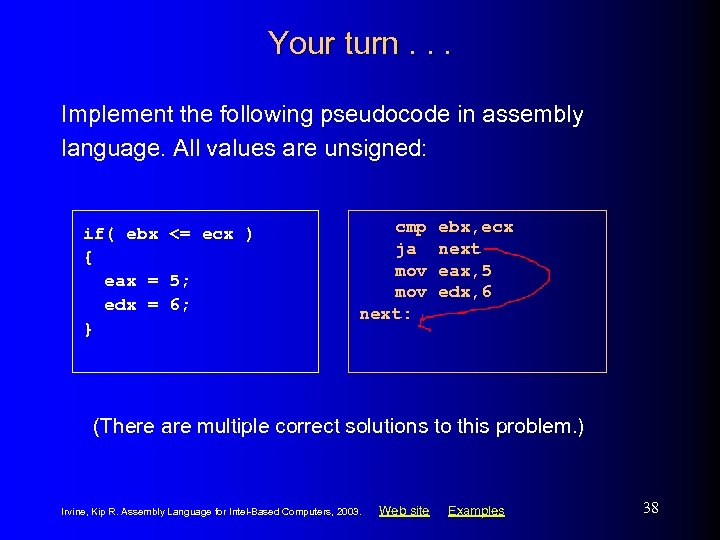
Your turn. . . Implement the following pseudocode in assembly language. All values are unsigned: if( ebx <= ecx ) { eax = 5; edx = 6; } cmp ja mov next: ebx, ecx next eax, 5 edx, 6 (There are multiple correct solutions to this problem. ) Irvine, Kip R. Assembly Language for Intel-Based Computers, 2003. Web site Examples 38
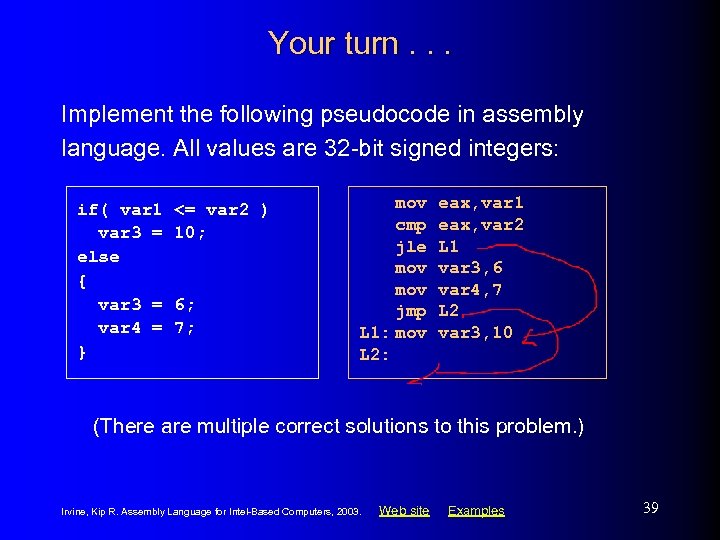
Your turn. . . Implement the following pseudocode in assembly language. All values are 32 -bit signed integers: if( var 1 var 3 = else { var 3 = var 4 = } <= var 2 ) 10; 6; 7; mov cmp jle mov jmp L 1: mov L 2: eax, var 1 eax, var 2 L 1 var 3, 6 var 4, 7 L 2 var 3, 10 (There are multiple correct solutions to this problem. ) Irvine, Kip R. Assembly Language for Intel-Based Computers, 2003. Web site Examples 39
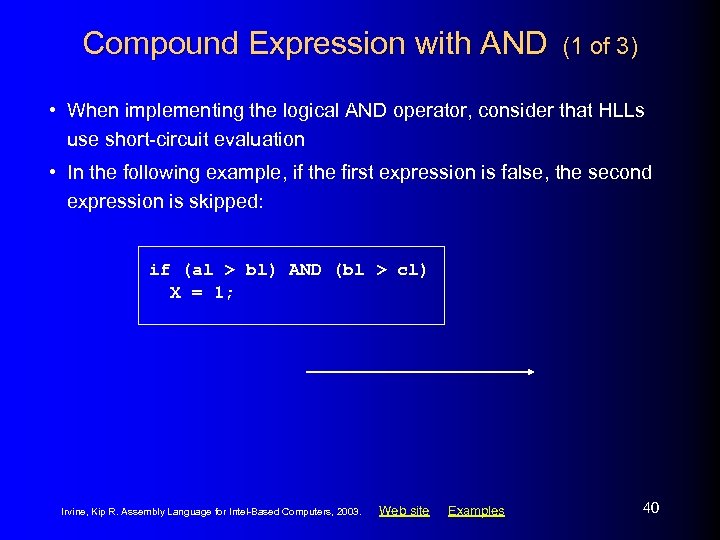
Compound Expression with AND (1 of 3) • When implementing the logical AND operator, consider that HLLs use short-circuit evaluation • In the following example, if the first expression is false, the second expression is skipped: if (al > bl) AND (bl > cl) X = 1; Irvine, Kip R. Assembly Language for Intel-Based Computers, 2003. Web site Examples 40
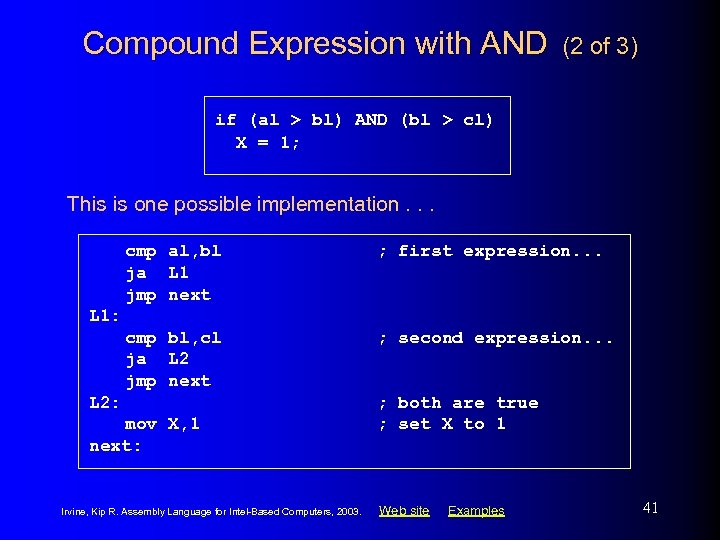
Compound Expression with AND (2 of 3) if (al > bl) AND (bl > cl) X = 1; This is one possible implementation. . . cmp al, bl ja L 1 jmp next ; first expression. . . cmp bl, cl ja L 2 jmp next ; second expression. . . L 1: L 2: mov X, 1 next: Irvine, Kip R. Assembly Language for Intel-Based Computers, 2003. ; both are true ; set X to 1 Web site Examples 41
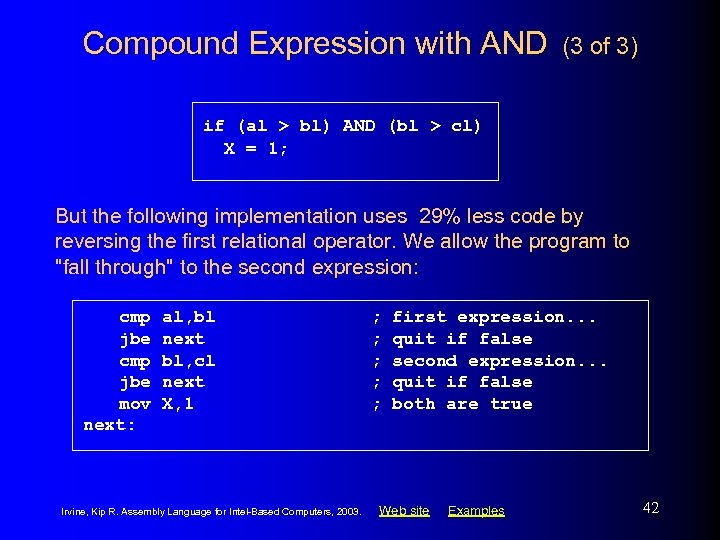
Compound Expression with AND (3 of 3) if (al > bl) AND (bl > cl) X = 1; But the following implementation uses 29% less code by reversing the first relational operator. We allow the program to "fall through" to the second expression: cmp jbe mov next: al, bl next bl, cl next X, 1 Irvine, Kip R. Assembly Language for Intel-Based Computers, 2003. ; ; ; first expression. . . quit if false second expression. . . quit if false both are true Web site Examples 42
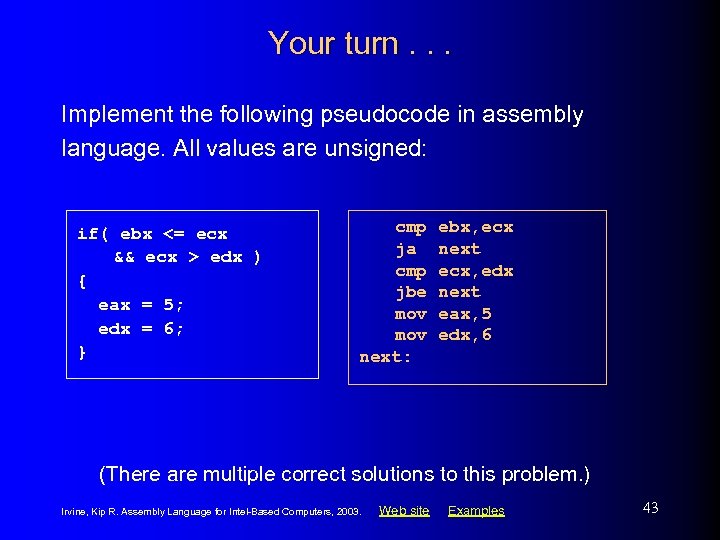
Your turn. . . Implement the following pseudocode in assembly language. All values are unsigned: if( ebx <= ecx && ecx > edx ) { eax = 5; edx = 6; } cmp ja cmp jbe mov next: ebx, ecx next ecx, edx next eax, 5 edx, 6 (There are multiple correct solutions to this problem. ) Irvine, Kip R. Assembly Language for Intel-Based Computers, 2003. Web site Examples 43
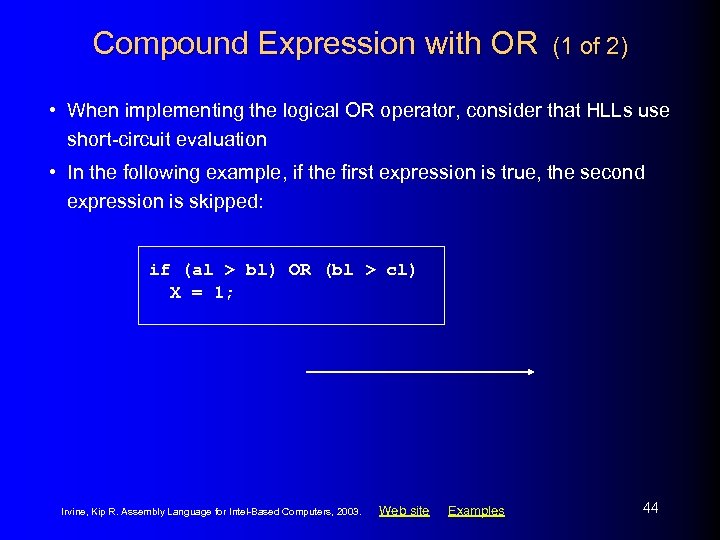
Compound Expression with OR (1 of 2) • When implementing the logical OR operator, consider that HLLs use short-circuit evaluation • In the following example, if the first expression is true, the second expression is skipped: if (al > bl) OR (bl > cl) X = 1; Irvine, Kip R. Assembly Language for Intel-Based Computers, 2003. Web site Examples 44
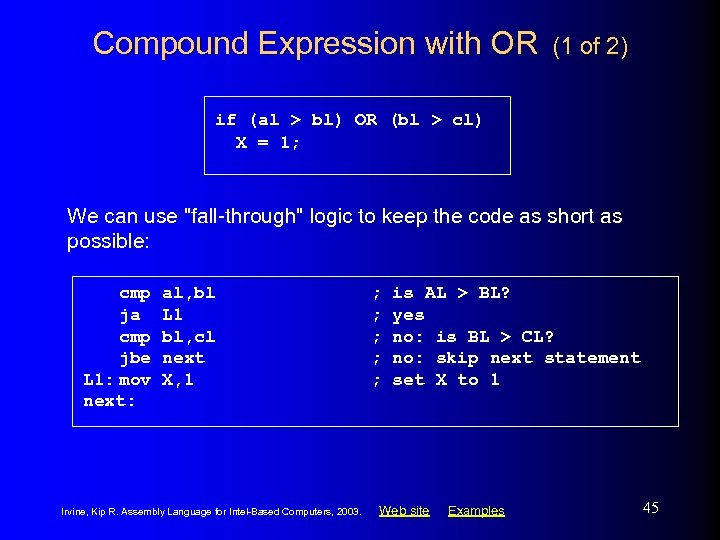
Compound Expression with OR (1 of 2) if (al > bl) OR (bl > cl) X = 1; We can use "fall-through" logic to keep the code as short as possible: cmp ja cmp jbe L 1: mov next: al, bl L 1 bl, cl next X, 1 Irvine, Kip R. Assembly Language for Intel-Based Computers, 2003. ; ; ; is AL > BL? yes no: is BL > CL? no: skip next statement set X to 1 Web site Examples 45
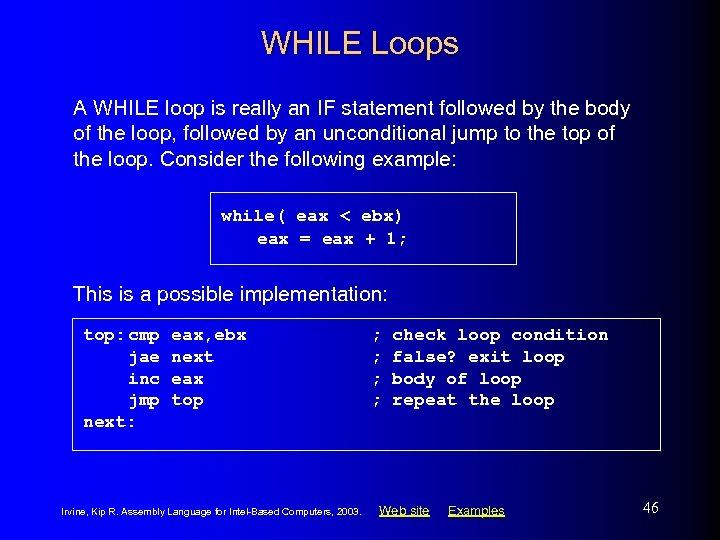
WHILE Loops A WHILE loop is really an IF statement followed by the body of the loop, followed by an unconditional jump to the top of the loop. Consider the following example: while( eax < ebx) eax = eax + 1; This is a possible implementation: top: cmp jae inc jmp next: eax, ebx next eax top Irvine, Kip R. Assembly Language for Intel-Based Computers, 2003. ; ; check loop condition false? exit loop body of loop repeat the loop Web site Examples 46
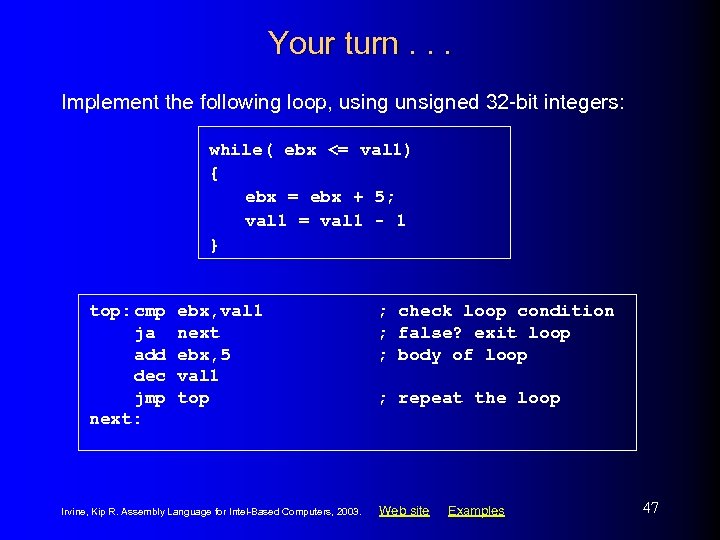
Your turn. . . Implement the following loop, using unsigned 32 -bit integers: while( ebx <= val 1) { ebx = ebx + 5; val 1 = val 1 - 1 } top: cmp ja add dec jmp next: ebx, val 1 next ebx, 5 val 1 top Irvine, Kip R. Assembly Language for Intel-Based Computers, 2003. ; check loop condition ; false? exit loop ; body of loop ; repeat the loop Web site Examples 47
Conditional Loop Instructions • LOOPZ and LOOPE • LOOPNZ and LOOPNE Irvine, Kip R. Assembly Language for Intel-Based Computers, 2003. Web site Examples 48
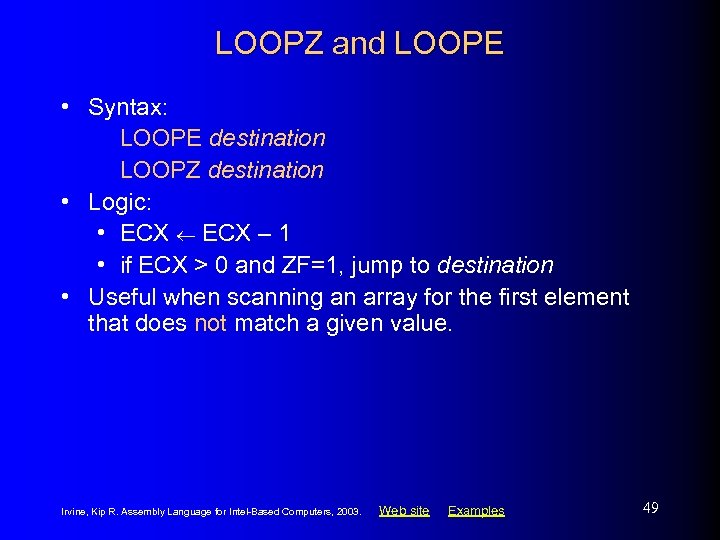
LOOPZ and LOOPE • Syntax: LOOPE destination LOOPZ destination • Logic: • ECX – 1 • if ECX > 0 and ZF=1, jump to destination • Useful when scanning an array for the first element that does not match a given value. Irvine, Kip R. Assembly Language for Intel-Based Computers, 2003. Web site Examples 49
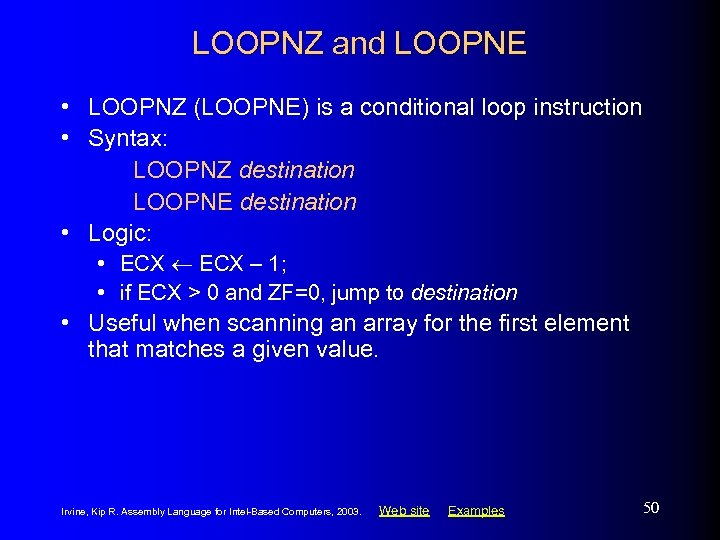
LOOPNZ and LOOPNE • LOOPNZ (LOOPNE) is a conditional loop instruction • Syntax: LOOPNZ destination LOOPNE destination • Logic: • ECX – 1; • if ECX > 0 and ZF=0, jump to destination • Useful when scanning an array for the first element that matches a given value. Irvine, Kip R. Assembly Language for Intel-Based Computers, 2003. Web site Examples 50
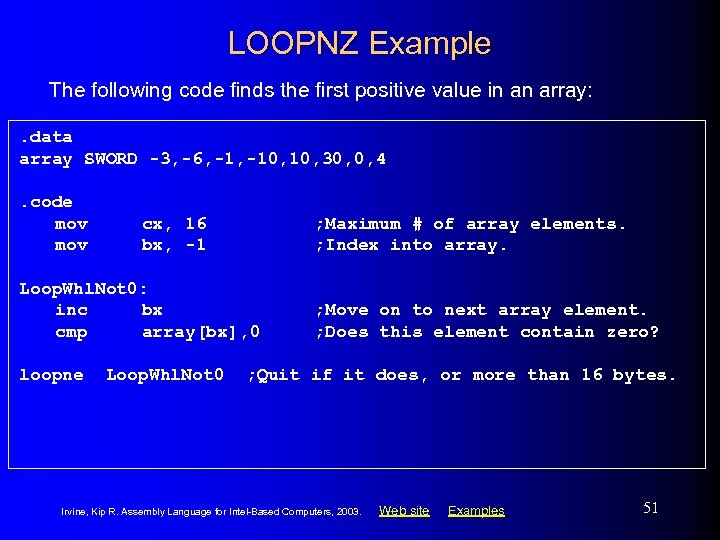
LOOPNZ Example The following code finds the first positive value in an array: . data array SWORD -3, -6, -10, 10, 30, 0, 4. code mov cx, 16 bx, -1 ; Maximum # of array elements. ; Index into array. Loop. Whl. Not 0: inc bx cmp array[bx], 0 loopne Loop. Whl. Not 0 ; Move on to next array element. ; Does this element contain zero? ; Quit if it does, or more than 16 bytes. Irvine, Kip R. Assembly Language for Intel-Based Computers, 2003. Web site Examples 51
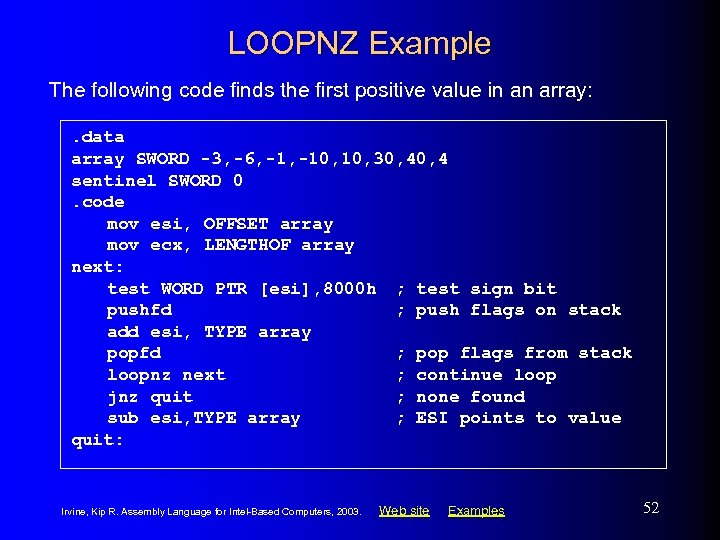
LOOPNZ Example The following code finds the first positive value in an array: . data array SWORD -3, -6, -10, 10, 30, 4 sentinel SWORD 0. code mov esi, OFFSET array mov ecx, LENGTHOF array next: test WORD PTR [esi], 8000 h ; test sign bit pushfd ; push flags on stack add esi, TYPE array popfd ; pop flags from stack loopnz next ; continue loop jnz quit ; none found sub esi, TYPE array ; ESI points to value quit: Irvine, Kip R. Assembly Language for Intel-Based Computers, 2003. Web site Examples 52
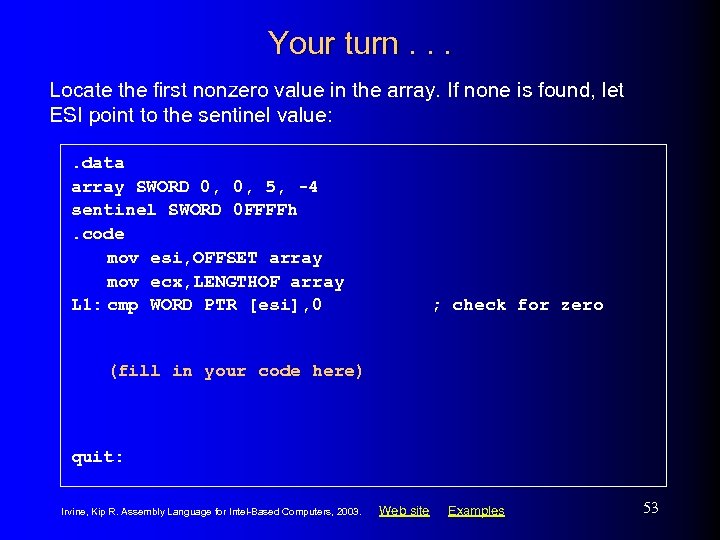
Your turn. . . Locate the first nonzero value in the array. If none is found, let ESI point to the sentinel value: . data array SWORD 0, 0, 5, -4 sentinel SWORD 0 FFFFh. code mov esi, OFFSET array mov ecx, LENGTHOF array L 1: cmp WORD PTR [esi], 0 ; check for zero (fill in your code here) quit: Irvine, Kip R. Assembly Language for Intel-Based Computers, 2003. Web site Examples 53
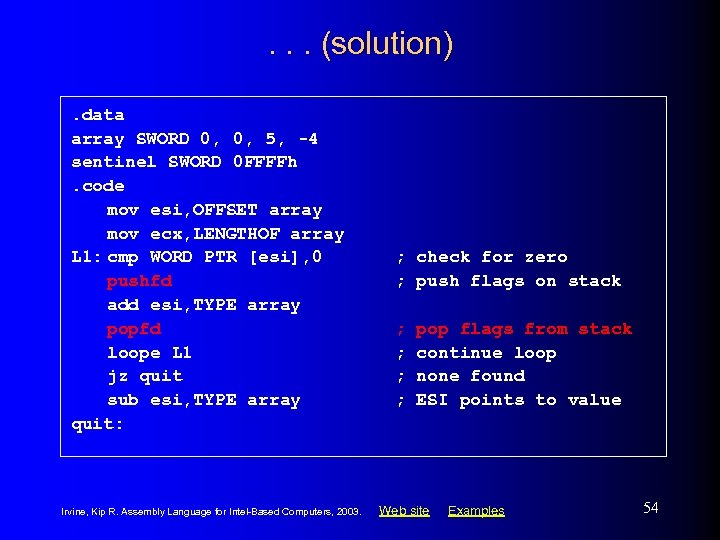
. . . (solution). data array SWORD 0, 0, 5, -4 sentinel SWORD 0 FFFFh. code mov esi, OFFSET array mov ecx, LENGTHOF array L 1: cmp WORD PTR [esi], 0 pushfd add esi, TYPE array popfd loope L 1 jz quit sub esi, TYPE array quit: Irvine, Kip R. Assembly Language for Intel-Based Computers, 2003. ; check for zero ; push flags on stack ; ; pop flags from stack continue loop none found ESI points to value Web site Examples 54

The End Irvine, Kip R. Assembly Language for Intel-Based Computers, 2003. Web site Examples 55
Скачать презентацию Week 10 Conditional Processing Assembly Language for Intel-Based
9ea29c9256cecd5043743d5dc3609a80.ppt