 Скачать презентацию Web Services SOA and Security May 11 2009
8eb1d075cd56e7f5b7e00db4602cca66.ppt
- Количество слайдов: 10



Web Services, SOA and Security May 11, 2009 Michael Burnett
Role of Web Services • Mechanism for sharing resources – Functional – Data – Hardware (including Sensors) • Isolates responsibility – Organizationally, Location, Technology • Enables new way of assembling applications – Less Stovepiping – Increased reuse through shared services • Within an SOA – Platform for Publication, Discovery, Access, Processing, Orchestration and Control 2
The Need for Security • As a Service Provider, you may not know: – Who • You are dealing with, who is consuming your offering • Potentially within the enterprise, other businesses, and end users – What • They are being used for • Services, by design, are often agnostic to the development and evolution of end user facing applications. • In a SOA world, a poorly implemented client application has the ability to compromise the entire SOA infrastructure and potentially the enterprise itself. Without control over the usage, need to protect the resources. 3
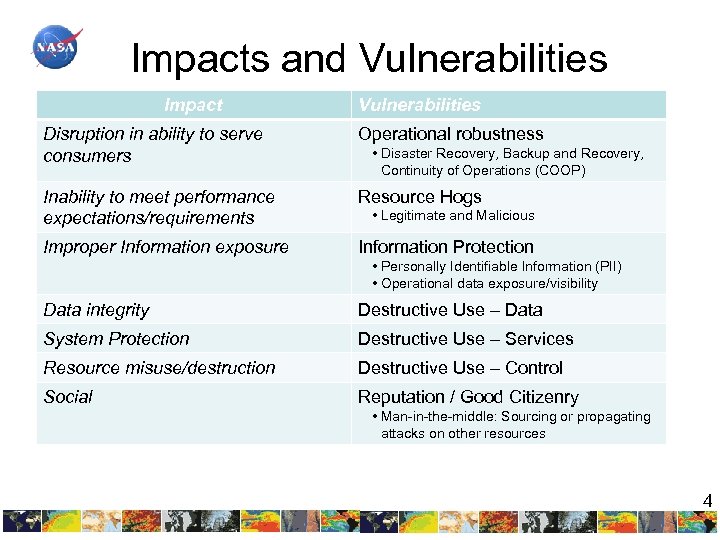
Impacts and Vulnerabilities Impact Vulnerabilities Disruption in ability to serve consumers Operational robustness Inability to meet performance expectations/requirements Resource Hogs Improper Information exposure Information Protection • Disaster Recovery, Backup and Recovery, Continuity of Operations (COOP) • Legitimate and Malicious • Personally Identifiable Information (PII) • Operational data exposure/visibility Data integrity Destructive Use – Data System Protection Destructive Use – Services Resource misuse/destruction Destructive Use – Control Social Reputation / Good Citizenry • Man-in-the-middle: Sourcing or propagating attacks on other resources 4
Response - Strategy • Multifaceted – must leverage all layers of the SOA – Hardware • Securing machines (physical and administrative) – Network • • Firewalls Web Appliances: Governance Rules converted on IP source, message, content – Interface • Token passing – Application • ACLs – Database • • Robustness – Redundancy, Disaster Recovery Planning, B/U & Restore Authentication and Authorization – User Account management services – “Special Arrangement” across NASA DAAC data/service providers • Exposes a Single-Sign-On capability that can be leveraged by 3 rd party apps to take advantage of ECHO’s ACLs, rules, and group membership to ensure all ecosystem applications have the same understanding of permissions and data access. – – Example: Client gets token from ECHO. Client passes token directly to external partner. Partner asks ECHO if token owner is a member of a specific group (for internal authorization) ASTER works in this model 5
Response – Resource Hogs • Automated firewall blocking for IPs – Denial of Service Attacks • Client identification – Application Tier Requires IP and Client. App. ID (like Google, Amazon, etc. ) – Shutdown session if a bad client • At the database level, maximum SQL query execution time before abandoning – No SQL runs longer than x minutes. 6
Response - Information Protection • Deliberately avoid PII and payment information – Use of side channels for payment, if required. • Access Control Lists (ACLs) – All data, multi-level, visibility, restrictions at group level. • Provider (3 rd party) control over their data using PUMP, ACLs, Provider Policies, SSL certifications, etc. • User authentication using token approach. Similar to WS-* • Standard security practices of controlled database accounts, SQL Injection prevention, encryption of passwords in database, etc. • Potential use appliance level message scrubbing. 7
Response - Destructive attacks • Vulnerabilities are significant – Ruin data/data integrity – Control of resources • Computing • Sensor • Flexible access control mechanism splitting users and permission roles across multiple levels of the architecture • Auditability with offsite log archival and searching • Well defined, public APIs – even to our own clients – no back doors (which offer additional vulnerability and risk) • The usual best practices of backups, snapshots, etc. 8
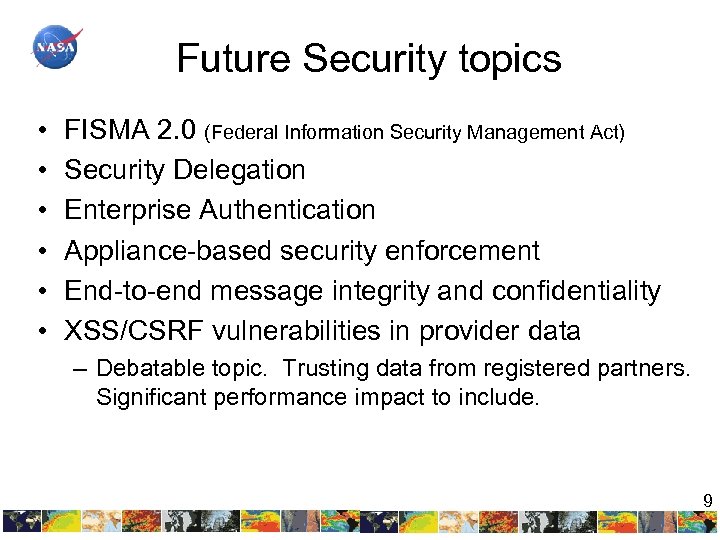
Future Security topics • • • FISMA 2. 0 (Federal Information Security Management Act) Security Delegation Enterprise Authentication Appliance-based security enforcement End-to-end message integrity and confidentiality XSS/CSRF vulnerabilities in provider data – Debatable topic. Trusting data from registered partners. Significant performance impact to include. 9
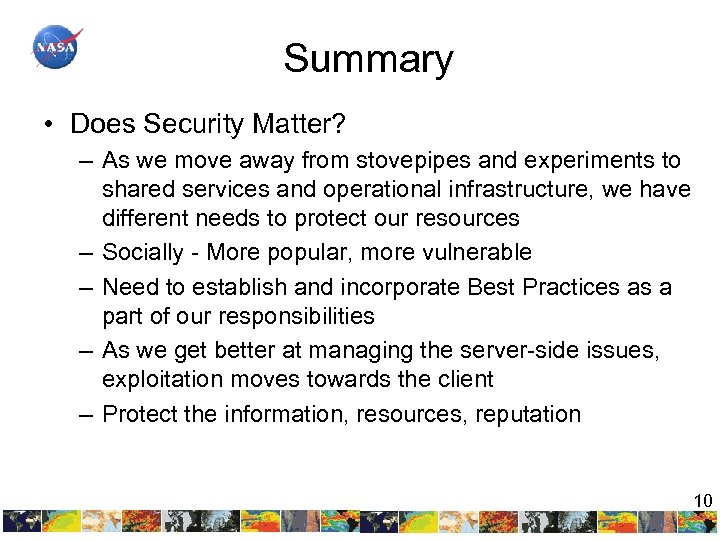
Summary • Does Security Matter? – As we move away from stovepipes and experiments to shared services and operational infrastructure, we have different needs to protect our resources – Socially - More popular, more vulnerable – Need to establish and incorporate Best Practices as a part of our responsibilities – As we get better at managing the server-side issues, exploitation moves towards the client – Protect the information, resources, reputation 10
Скачать презентацию Web Services SOA and Security May 11 2009
8eb1d075cd56e7f5b7e00db4602cca66.ppt