 Скачать презентацию Web Services Hongjun Song Computer Science The University
11f6b96fa5a4fb5569ef3488881d704b.ppt
- Количество слайдов: 45



Web Services Hongjun Song Computer Science The University of Memphis COMP 7100: Computers in the Information society 1
What is a Web Service? § A web service is a collection of protocols and standards used for exchanging data between applications or systems. § Software applications written in various programming languages and running on various platforms can use web services. 2
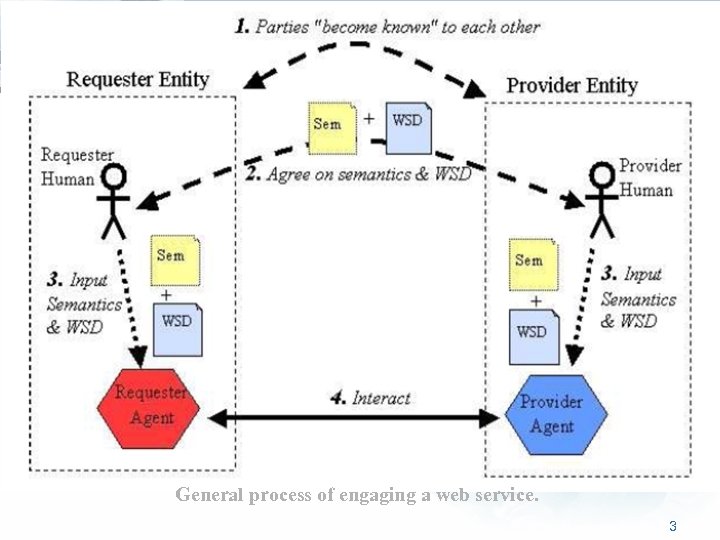
General process of engaging a web service. 3
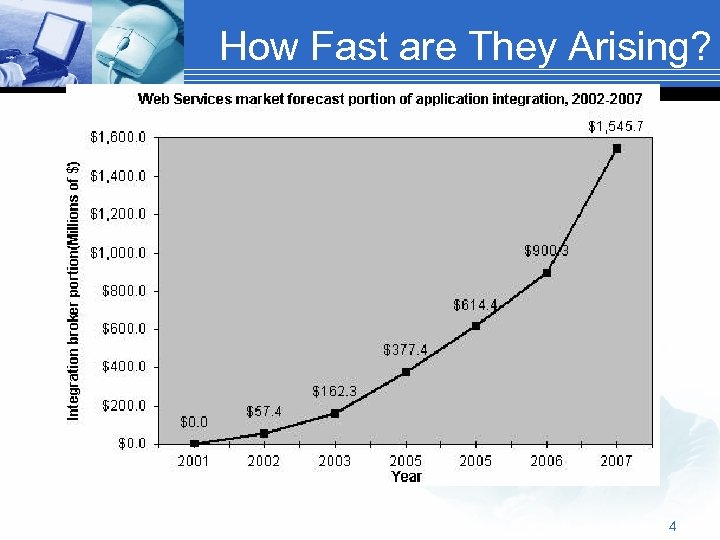
How Fast are They Arising? 4
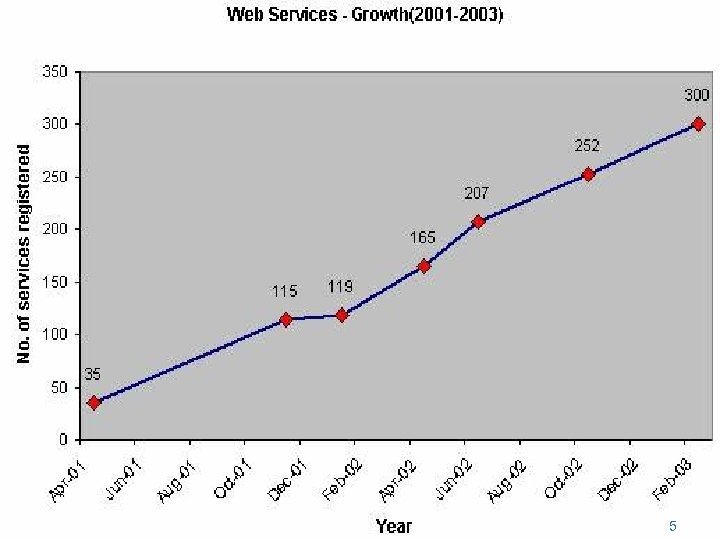
5
Creating a Web Service § Useful tools to create a Web Service are Simple Object Access Protocol (SOAP) § a way for applications to communicate with one another over the Internet, independent of platforms XML § a way for applications to communicate with one another over the Internet, independent of format/platforms 6
Creating a web service 2 § Web Services relies on XML-formatted messages to send data and receive commands § Web Services support three standard protocols, Http-Get Http-Post SOAP 7
Example: simple web service § a Web Service that converts degree Fahrenheit and Celsius each other using VB. Net § 1 <%@ Web. Service Language="VB" Class="Temp. Convertor" %> § 2 Imports System. Web. Services § 3 Public Class Temp. Convertor : Inherits Web. Service § 4 <Web. Method()> Public Function Tempture. F(int. F as integer) As Integer § 5 dim int. C as integer = (int. F - 32) * (5. 0/9. 0) § 6 Return (int. C) § 7 End Function § 8 <Web. Method()> Public Function Tempture. C(int. C as integer) As Integer § 9 dim int. F as integer = int. C * (9. 0/5. 0) + 32 § 10 Return (int. F) 11 End Function 12 End Class 8
Web Services: Wikis § Wiki is a piece of server software that allows users to freely create and edit Web page content using any Web browser § Creator of the concept: Ward Cunningham § Where do they fit in ? used to provide a group collaborative web presence § Famous Wikis: 9
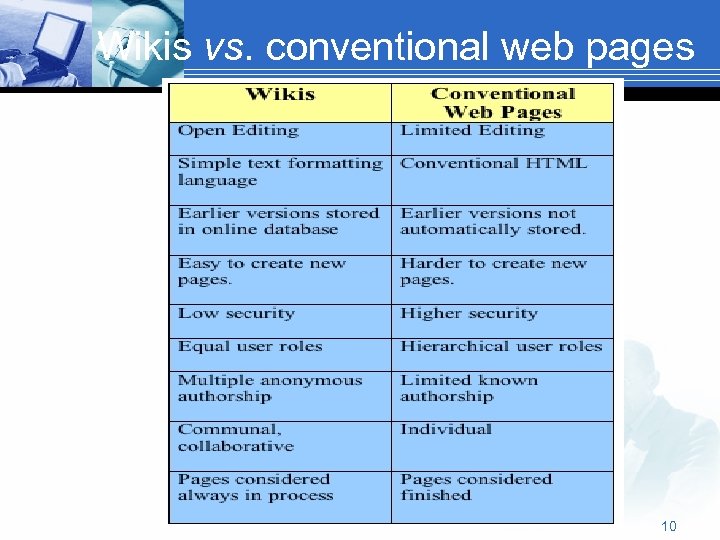
Wikis vs. conventional web pages 10
Key characteristics § enables documents to be written collectively in a simple markup language using a web browser § easy-to-use user-maintained database for searching or even creating information. § Most wikis are open to the general public without the need to register any user account § session log-in is requested to acquire a "wikisignature" cookie for auto-signing edits. § Private wiki servers require user authentication to edit, sometimes even to read pages 11
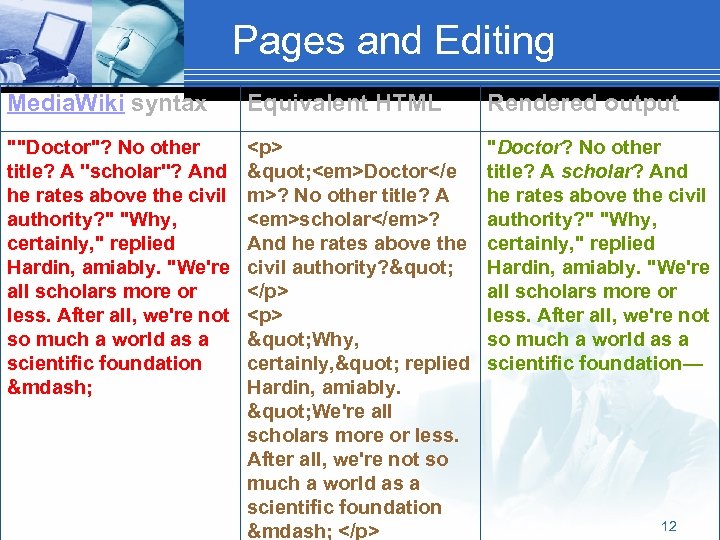
Pages and Editing Media. Wiki syntax Equivalent HTML Rendered output "''Doctor''? No other title? A ''scholar''? And he rates above the civil authority? " "Why, certainly, " replied Hardin, amiably. "We're all scholars more or less. After all, we're not so much a world as a scientific foundation — <p> " <em>Doctor</e m>? No other title? A <em>scholar</em>? And he rates above the civil authority? " </p> <p> " Why, certainly, " replied Hardin, amiably. " We're all scholars more or less. After all, we're not so much a world as a scientific foundation — </p> "Doctor? No other title? A scholar? And he rates above the civil authority? " "Why, certainly, " replied Hardin, amiably. "We're all scholars more or less. After all, we're not so much a world as a scientific foundation— 12
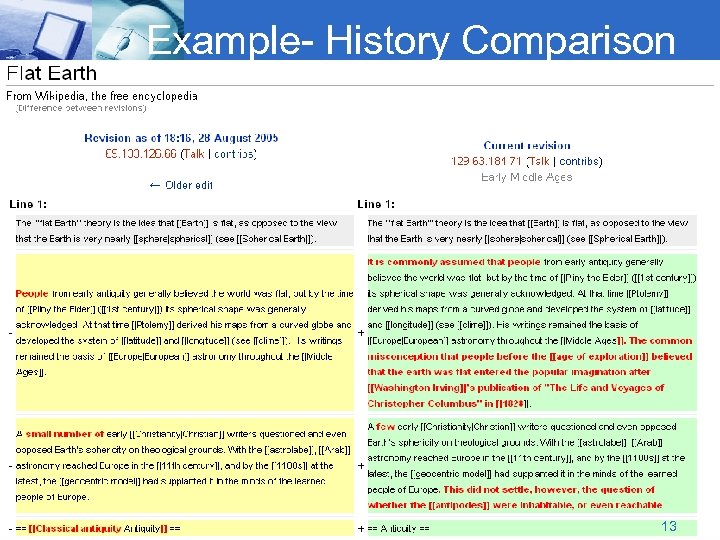
Example- History Comparison 13
Wiki Communites § wiki communities are private, particularly within enterprises as collaborative software § English-language Wikipedia is, by far, the world's largest wiki; the German-language Wikipedia is the second-largest. § Other large wikis include the Wiki. Web, Memory Alpha, Wikitravel, World 66 and Susning. nu, a Swedish-language knowledge base § For those interested in creating their own wiki, there are many publicly available "wiki farms", 14
List of wikis § Evo. Wiki – an Evolution-related wiki § Unilang – an online community and database dedicated to languages § Javapedia – a wiki focused on all aspects of the Java platform. § Mac Guide – a wiki about Apple Mac issues, run by Mac. Rumors. com § Wikisource – Primary sources for use in Wikipedia, a sister project of Wikipedia § Wikipedia – the world's largest Encyclopedia § Wikibooks – textbooks; sister project of Wikipedia Wikinews – A collaborative news service; sister project of Wikipedia § Intellipedia - a classified wiki that runs the top-secret network that links the U. S. intelligence community. 15
Web Services: Blogs § BLOG = WEB LOG § Blog combines text, images, and links to other blogs, web pages, and other media related to its topic. § Automated Website Publishing § Facilitates Publishing Content § Every Mary, Sue and John has a blog on the Internet. § No Fussing with layout/design Just Login, write something and post it away. 16
Why Blogging ? § Wouldn't it be good to get your own web page where you could publish these comments ? Make political statements Promote products and services Provide research information Showcase tutorials § If there is a subject that you are interested in, there is a good chance that some one is writing a blog about it. § Blogs are written by politicians, musicians, novelists, sports figures, newscasters, yourself 17
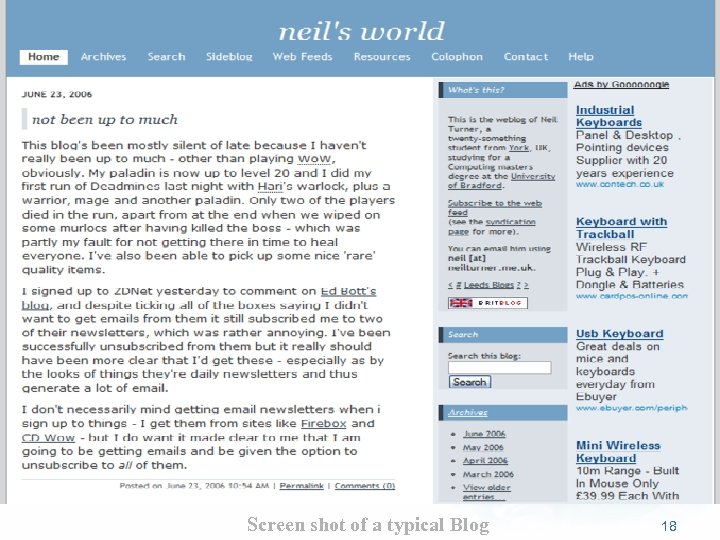
Screen shot of a typical Blog 18
A Taxonomy of Blogs § By Media type Videos- vlog, links- linklog, photos- photoblog § By device Blogs can also be defined by which type of device is used to compose it. A blog written on/for a mobile device(s) is called a moblog § Genre Some blogs focus on a particular subject, such as political blogs or travel blogs § Blog search engines search blog contents (known as the blogosphere), such as blogdigger, Feedster, and 19 Technorati
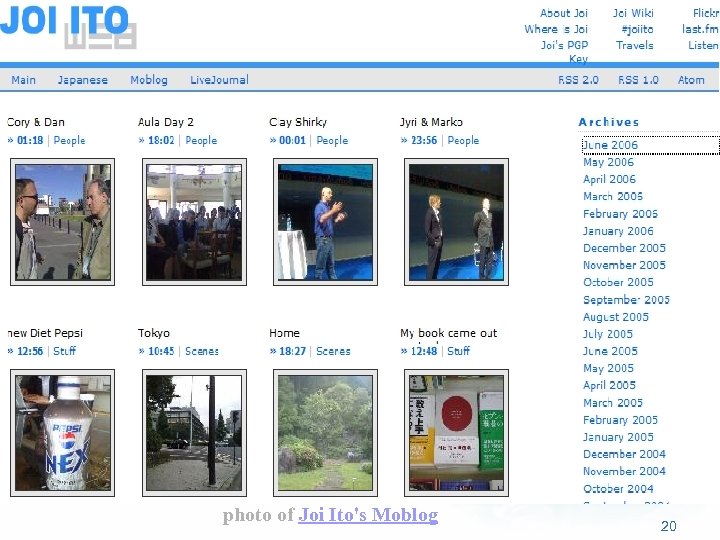
photo of Joi Ito's Moblog 20
Blogs: Legal issues § Major areas of concern are the issues of proprietary or confidential information, libel, and defamation Employers have fired employees who maintain personal blogs that discuss their employers In Singapore, two ethnic Chinese were punished under the country’s anti-sedition law for posting anti-Muslim remarks Ellen Simonetti, a US airline attendant, lost her job after posting photos of herself in uniform displaying more cleavage than ordinary on her blog. 21
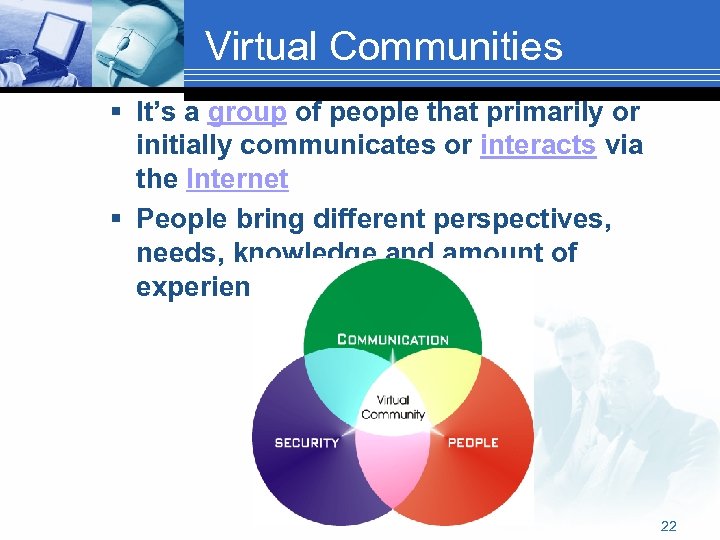
Virtual Communities § It’s a group of people that primarily or initially communicates or interacts via the Internet § People bring different perspectives, needs, knowledge and amount of experience to the process. 22
Virtual Community 2 § Why ? Socialize meeting people, playing around, sharing jokes/stories, just taking interest in each other. Work together § Share interests in issues and causes § Can form a nucleus for an online community. Have topical conversations § Online salons and discussion forums 23
Virtual Community 3 § Building a virtual community Identify your community purpose or goal Identify your target audience Think about which interaction tools would serve your purpose and audience and how to structure the space. Think about how you want to host or facilitate your community Build it Draw in the members Keep nurturing it (or it will die)! 24
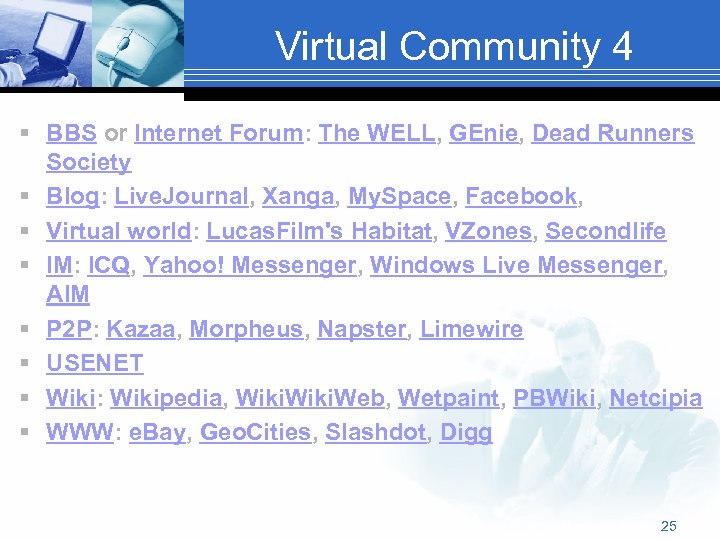
Virtual Community 4 § BBS or Internet Forum: The WELL, GEnie, Dead Runners Society § Blog: Live. Journal, Xanga, My. Space, Facebook, § Virtual world: Lucas. Film's Habitat, VZones, Secondlife § IM: ICQ, Yahoo! Messenger, Windows Live Messenger, AIM § P 2 P: Kazaa, Morpheus, Napster, Limewire § USENET § Wiki: Wikipedia, Wiki. Web, Wetpaint, PBWiki, Netcipia § WWW: e. Bay, Geo. Cities, Slashdot, Digg 25
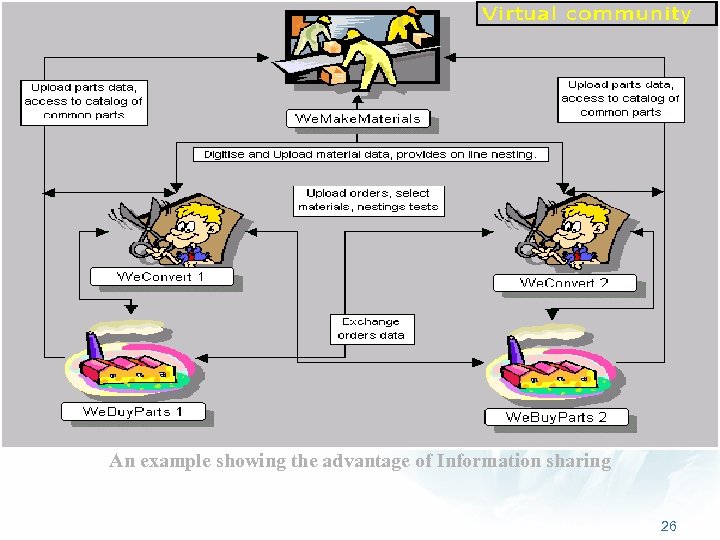
An example showing the advantage of Information sharing 26
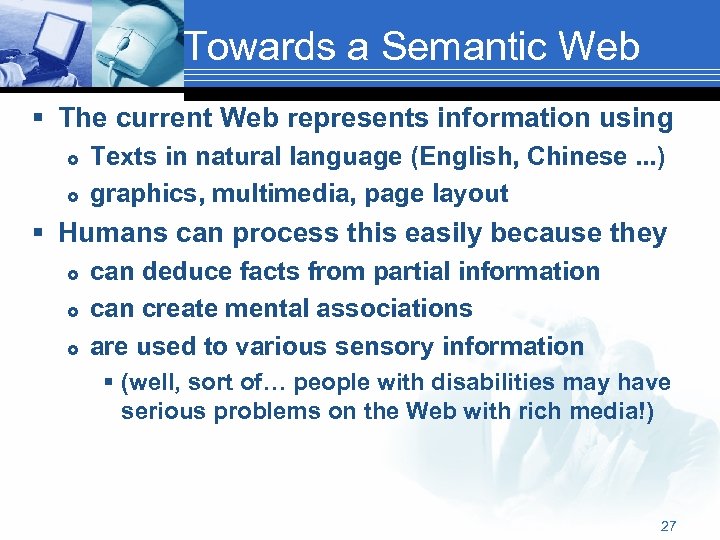
Towards a Semantic Web § The current Web represents information using Texts in natural language (English, Chinese. . . ) graphics, multimedia, page layout § Humans can process this easily because they can deduce facts from partial information can create mental associations are used to various sensory information § (well, sort of… people with disabilities may have serious problems on the Web with rich media!) 27
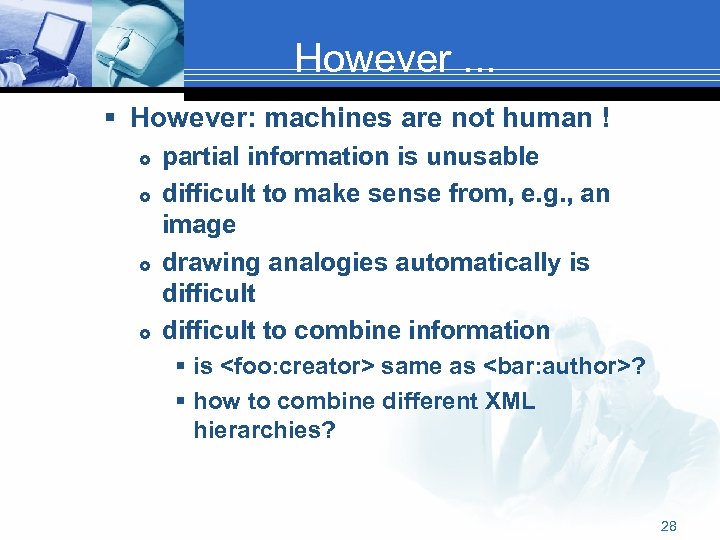
However. . . § However: machines are not human ! partial information is unusable difficult to make sense from, e. g. , an image drawing analogies automatically is difficult to combine information § is <foo: creator> same as <bar: author>? § how to combine different XML hierarchies? 28
Example § But. . your automatic airline reservation sys knows about your preferences builds up knowledge base using your past can combine the local knowledge with remote services: § airline preferences § dietary requirements § calendaring § etc 29
What is needed (technically) § Can a computer understand web content? understand web content unambiguous names for resources (that may also bind data to real world objects): URI-s a common data model to access, connect, describe the resources: RDF access to that data: SPARQL define common vocabularies: RDFS, OWL, SKOS reasoning logics: OWL, Rules § The “Semantic Web” is an extension of the current Web, providing a more semantically oriented infrastructure for the automatic integration and interpretation of data on the Web 30
Semantic Web: A Case Study § You need to decide where to spend a night on Chicago next Friday Hotel location information on web Meeting location information on desktop … but what brain will connect it all? If talk downtown and overnight stay for early flight from O’Hare, ONLY need hotels near airport, rides to/fro downtown § Semantic web should return only such listings, or even more personalized to you if it knows who you are (your choices) … 31
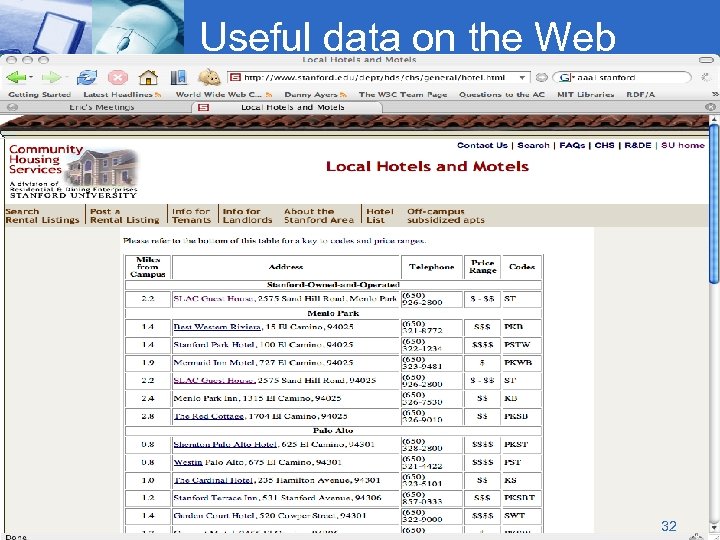
Useful data on the Web 32
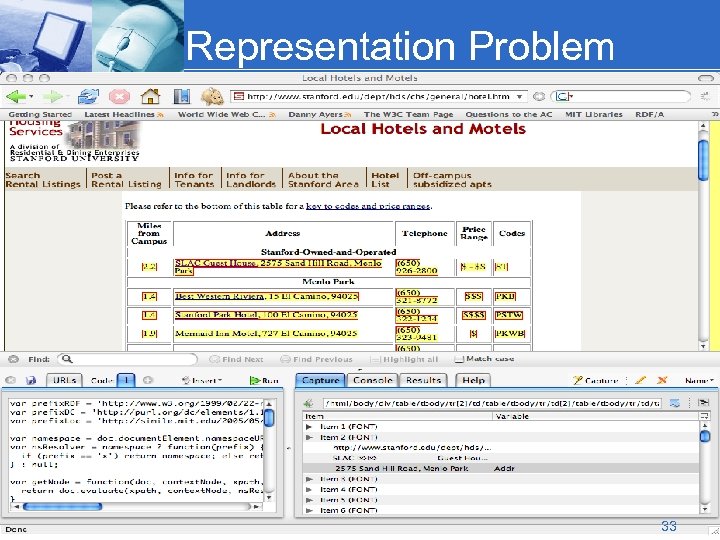
Representation Problem 33
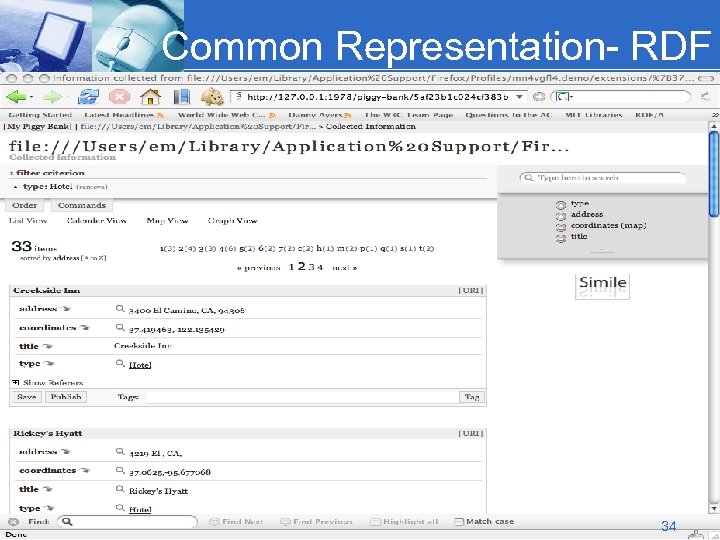
Common Representation- RDF 34
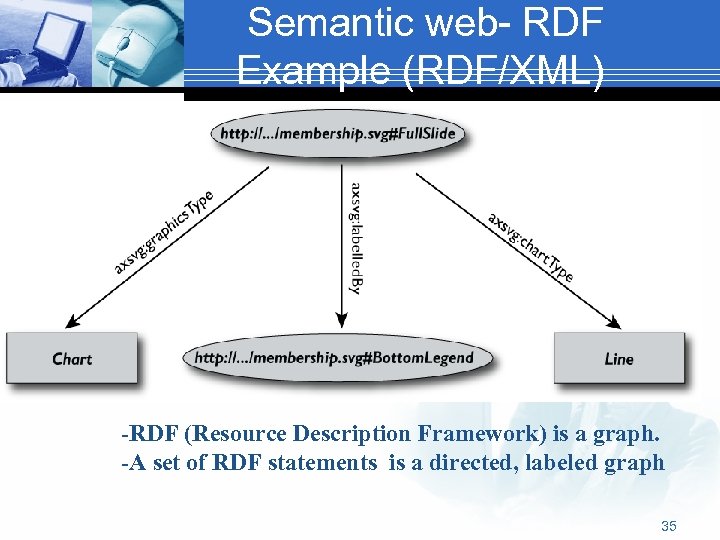
Semantic web- RDF Example (RDF/XML) -RDF (Resource Description Framework) is a graph. -A set of RDF statements is a directed, labeled graph 35
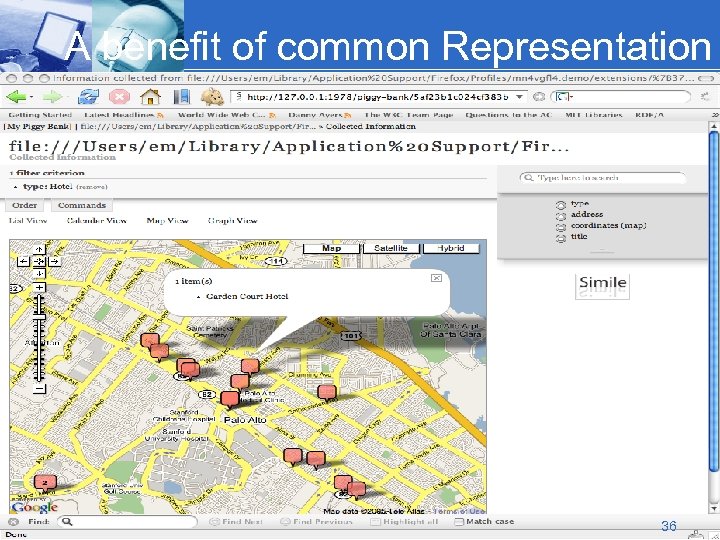
A benefit of common Representation 36
How to Achieve it? § There is a need to support Ontologies on the Semantic Web: “defines the concepts and relationships used to describe and represent an area of knowledge” § Examples OWL- A language for making ontological statements. OWL is intended to be used over the World Wide Web. XOL-XML Based Ontology language 37
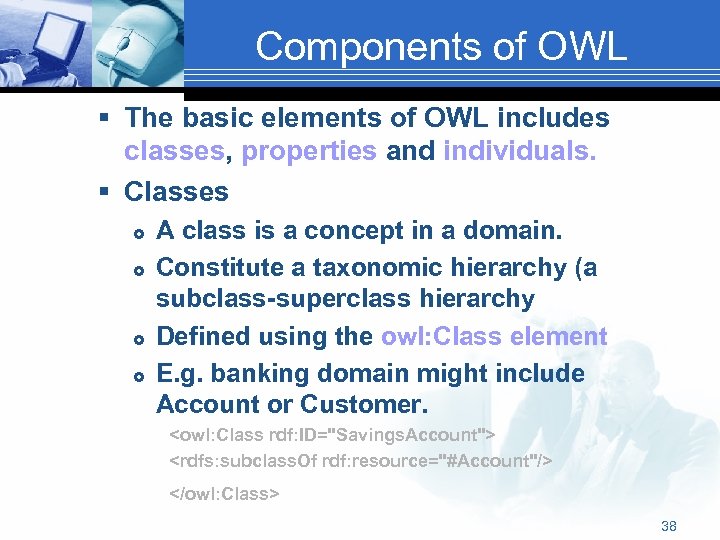
Components of OWL § The basic elements of OWL includes classes, properties and individuals. § Classes A class is a concept in a domain. Constitute a taxonomic hierarchy (a subclass-superclass hierarchy Defined using the owl: Class element E. g. banking domain might include Account or Customer. <owl: Class rdf: ID="Savings. Account"> <rdfs: subclass. Of rdf: resource="#Account"/> </owl: Class> 38
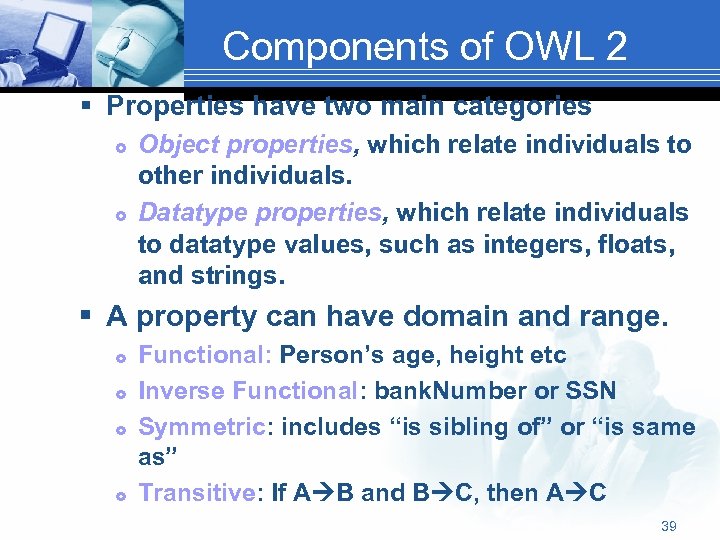
Components of OWL 2 § Properties have two main categories Object properties, which relate individuals to other individuals. Datatype properties, which relate individuals to datatype values, such as integers, floats, and strings. § A property can have domain and range. Functional: Person’s age, height etc Inverse Functional: bank. Number or SSN Symmetric: includes “is sibling of” or “is same as” Transitive: If A B and B C, then A C 39
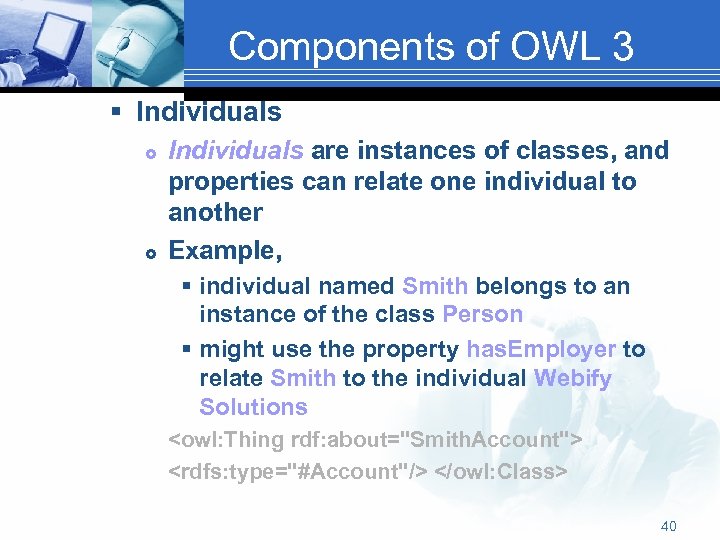
Components of OWL 3 § Individuals are instances of classes, and properties can relate one individual to another Example, § individual named Smith belongs to an instance of the class Person § might use the property has. Employer to relate Smith to the individual Webify Solutions <owl: Thing rdf: about="Smith. Account"> <rdfs: type="#Account"/> </owl: Class> 40
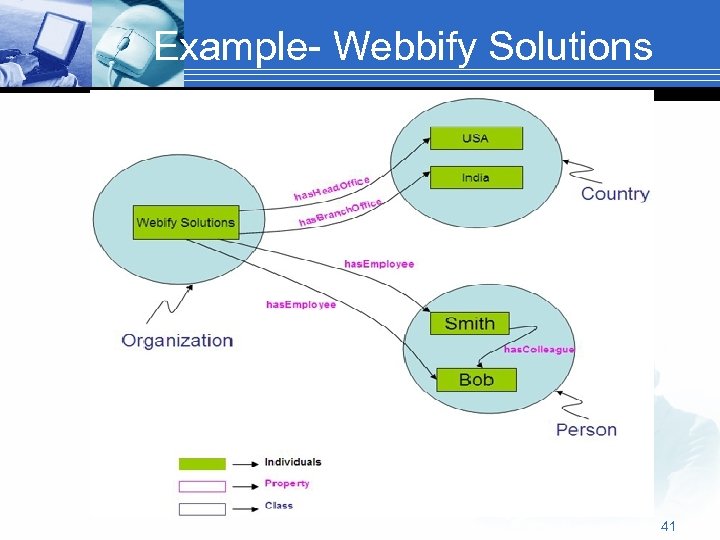
Example- Webbify Solutions 41
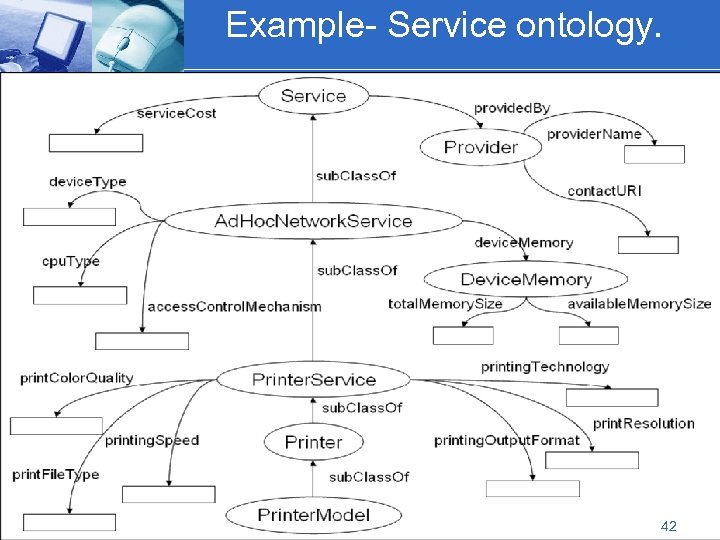
Example- Service ontology. 42
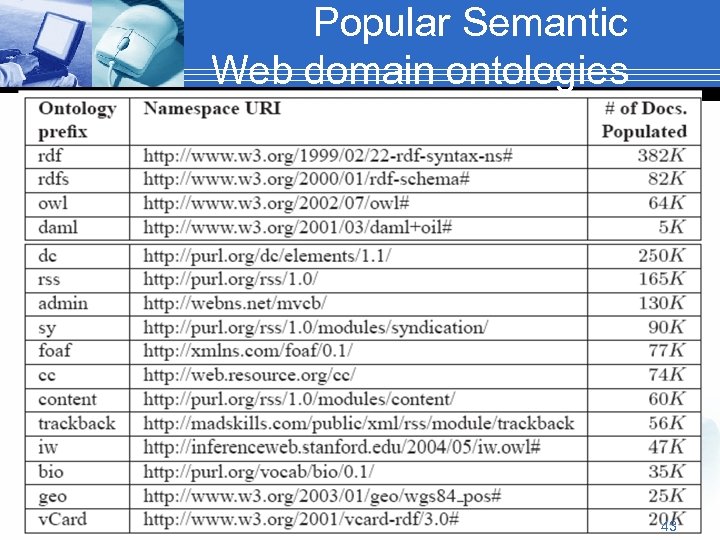
Popular Semantic Web domain ontologies 43
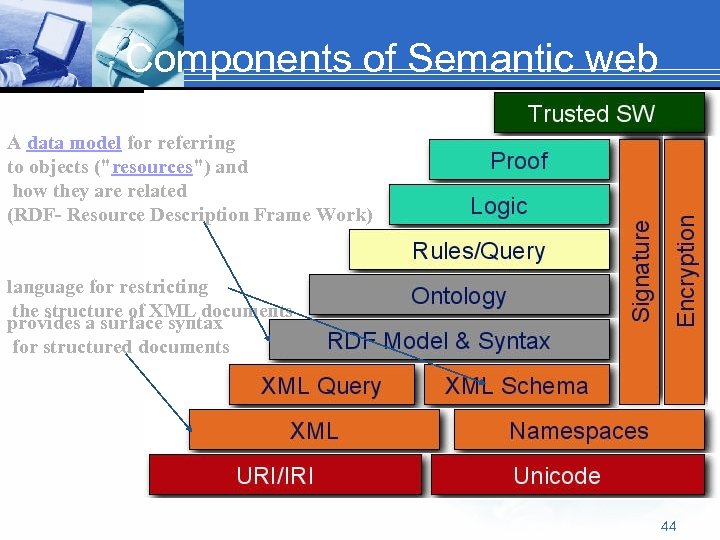
Components of Semantic web A data model for referring to objects ("resources") and how they are related (RDF- Resource Description Frame Work) language for restricting the structure of XML documents provides a surface syntax for structured documents 44
Outlook on Web Services § Web is becoming a universal infrastructure for communication and interaction Social interaction Economic Scientific “You can't tell how something will spread just by looking at how the html code works” [Tim Berners-Lee] § Web Science Research Initiative [WSRI, 'wiz-ree‘] [MIT and University of Southampton, 2006] A collaboration aimed at promoting analysis … A new science is emerging that must include elements of social science, psychology, economics and law, along with computer science/engineering. . 45
Скачать презентацию Web Services Hongjun Song Computer Science The University
11f6b96fa5a4fb5569ef3488881d704b.ppt