 Скачать презентацию WEB SERVICES Distributed Information System December 7 2009
8f4dbcbccd195ec5ecf043edcf053499.ppt
- Количество слайдов: 12



WEB SERVICES Distributed Information System December 7, 2009 Alvin MACCHIONE - Rémy JAVELLE 1
WEB SERVICES Summary 1 – What are Web services ? 2 – How does a Web service work? 3 – Different types of Web services. 4 – Examples 5 – Conclusion December 7, 2009 Alvin MACCHIONE - Rémy JAVELLE 2
1 – What are Web services ? 2 – How does a Web service work? - Application Programming Interfaces (API) - Request services - REST architecture - SOA architecture - OASIS - World Wide Web Consortium (W 3 C) December 7, 2009 Alvin MACCHIONE - Rémy JAVELLE 3
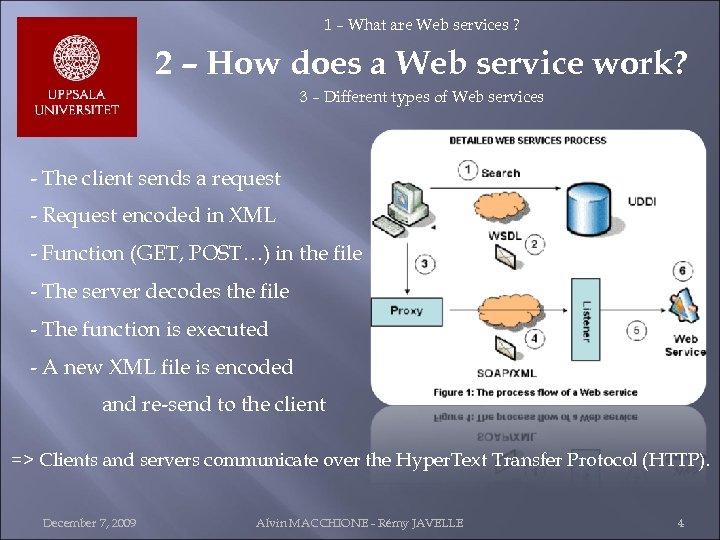
1 – What are Web services ? 2 – How does a Web service work? 3 – Different types of Web services - The client sends a request - Request encoded in XML - Function (GET, POST…) in the file - The server decodes the file - The function is executed - A new XML file is encoded and re-send to the client => Clients and servers communicate over the Hyper. Text Transfer Protocol (HTTP). December 7, 2009 Alvin MACCHIONE - Rémy JAVELLE 4
2 – How does a Web service work? 3 – Different types of Web services 4 – Examples => Service-oriented architecture (SOA): - SOA defines WS-* Web Services - Communication protocol: SOAP - Web Service Description Language (WSDL) for description - UDDI (Universal Description Discovery and Integration) directory December 7, 2009 Alvin MACCHIONE - Rémy JAVELLE 5
2 – How does a Web service work? 3 – Different types of Web services 4 – Examples => Service-oriented architecture (SOA): Advantages : - Interoperability between applications on many platforms - Use open protocols - Data and protocols are in plain text - Thanks to HTTP protocol, Web services can run through firewalls - Easy to implement December 7, 2009 Alvin MACCHIONE - Rémy JAVELLE 6
2 – How does a Web service work? 3 – Different types of Web services 4 – Examples => Service-oriented architecture (SOA): Disadvantages : - Norms are sometimes recent - Low performances - HTTP protocol: Web services can circle security measures implemented by firewalls December 7, 2009 Alvin MACCHIONE - Rémy JAVELLE 7
2 – How does a Web service work? 3 – Different types of Web services 4 – Examples => Representational state transfer (REST): - Base of the World Wide Web (WWW) - Different from SOA : clients and servers => agents and resources referenced with identifiers (URI/URL) - Interaction : identifier and action required December 7, 2009 Alvin MACCHIONE - Rémy JAVELLE 8
2 – How does a Web service work? 3 – Different types of Web services 4 – Examples => Representational state transfer (REST): Advantages : - Easy to maintain - No state client administration: Less memory used, simplicity, simultaneous requests, several servers … - Using URI: setting up cache servers December 7, 2009 Alvin MACCHIONE - Rémy JAVELLE 9
2 – How does a Web service work? 3 – Different types of Web services 4 – Examples => Representational state transfer (REST): Disadvantages : - The client has to keep locally all necessary data for a request: High consuming network bandwidth December 7, 2009 Alvin MACCHIONE - Rémy JAVELLE 10
3 – Different types of Web services 4 – Examples 5 – Conclusion Social Networking (Facebook, Twitter…) Travel agency (Ryanair, Easy. Jet…) Video sharing (Youtube …) Blogging (My. Space, Blogger…) E-Commerce (Amazon, Ebay…) Maps (Google maps, Mappy…) December 7, 2009 Alvin MACCHIONE - Rémy JAVELLE 11
4 – Examples 5 – Conclusion - Growing since 2000 - Security problems (HTTP) - REST architecture more and more common . . . QUESTIONS ? . . . December 7, 2009 Alvin MACCHIONE - Rémy JAVELLE 12
Скачать презентацию WEB SERVICES Distributed Information System December 7 2009
8f4dbcbccd195ec5ecf043edcf053499.ppt