 Скачать презентацию Web Services Brian A La Macchia Microsoft
33c7a818961b736b3e2f4d48e12dbedd.ppt
- Количество слайдов: 44



Web Services Brian A. La. Macchia Microsoft
Five Questions n n What is a Web Service? Why are Web Services interesting? n n Why should I care about them? What e-commerce business models do Web Services enable? What security and privacy issues need to be addressed for Web Services to be successful? What the heck is Microsoft’s. NET Platform all about, and how does. NET relate to Web Services?
What is a Web Service? n Software Design Principles n n n Abstraction Componentization n In your own programs n Reusable software components Current web usage n n User-oriented browsing User-oriented data publication
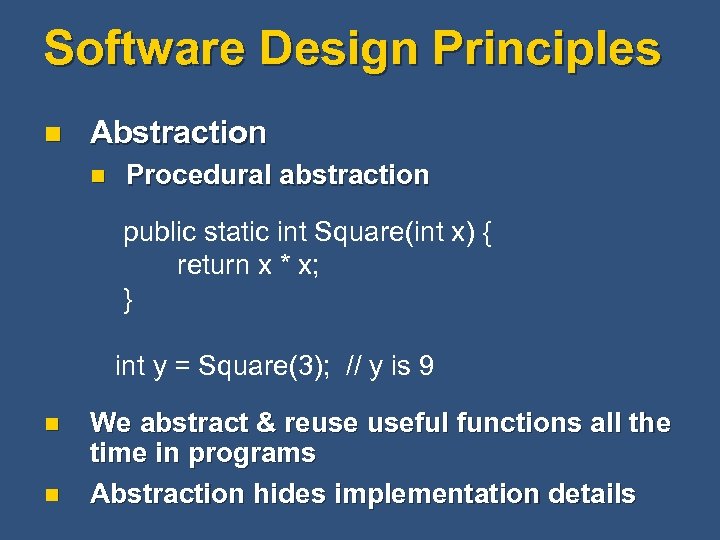
Software Design Principles n Abstraction n Procedural abstraction public static int Square(int x) { return x * x; } int y = Square(3); // y is 9 n n We abstract & reuse useful functions all the time in programs Abstraction hides implementation details
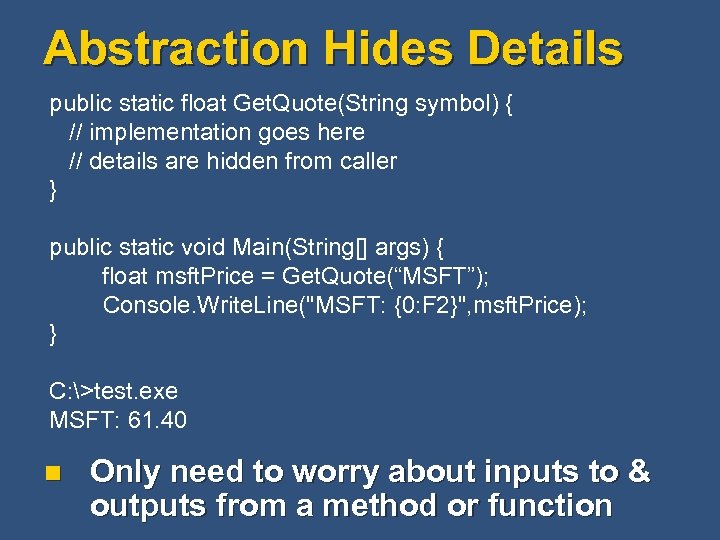
Abstraction Hides Details public static float Get. Quote(String symbol) { // implementation goes here // details are hidden from caller } public static void Main(String[] args) { float msft. Price = Get. Quote(“MSFT”); Console. Write. Line("MSFT: {0: F 2}", msft. Price); } C: >test. exe MSFT: 61. 40 n Only need to worry about inputs to & outputs from a method or function
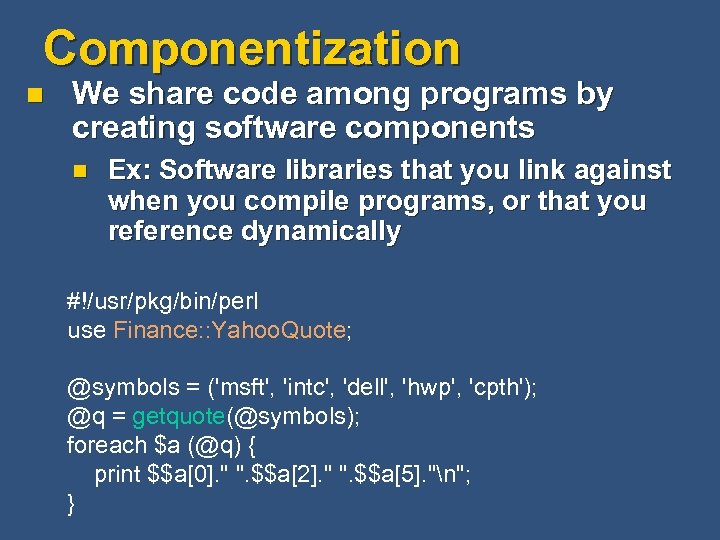
Componentization n We share code among programs by creating software components n Ex: Software libraries that you link against when you compile programs, or that you reference dynamically #!/usr/pkg/bin/perl use Finance: : Yahoo. Quote; @symbols = ('msft', 'intc', 'dell', 'hwp', 'cpth'); @q = getquote(@symbols); foreach $a (@q) { print $$a[0]. " ". $$a[2]. " ". $$a[5]. "n"; }
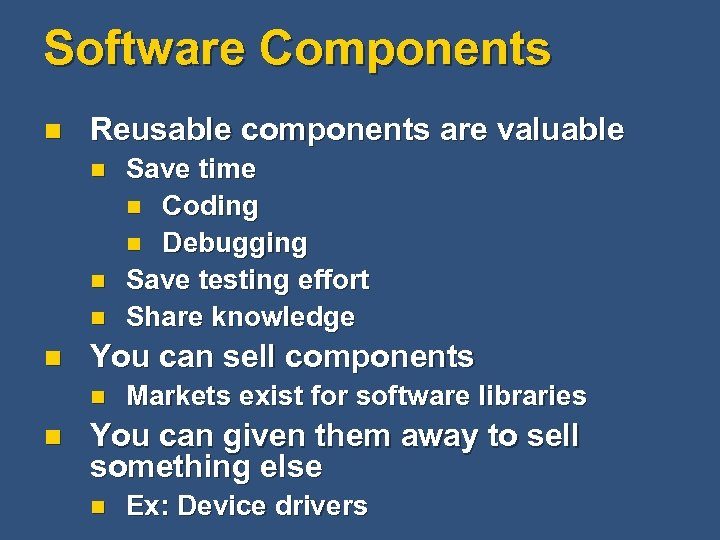
Software Components n Reusable components are valuable n n You can sell components n n Save time n Coding n Debugging Save testing effort Share knowledge Markets exist for software libraries You can given them away to sell something else n Ex: Device drivers
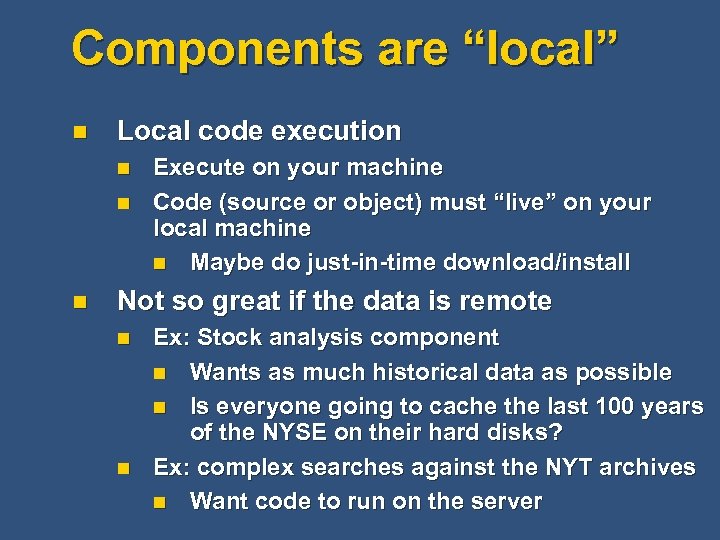
Components are “local” n Local code execution n Execute on your machine Code (source or object) must “live” on your local machine n Maybe do just-in-time download/install Not so great if the data is remote n n Ex: Stock analysis component n Wants as much historical data as possible n Is everyone going to cache the last 100 years of the NYSE on their hard disks? Ex: complex searches against the NYT archives n Want code to run on the server
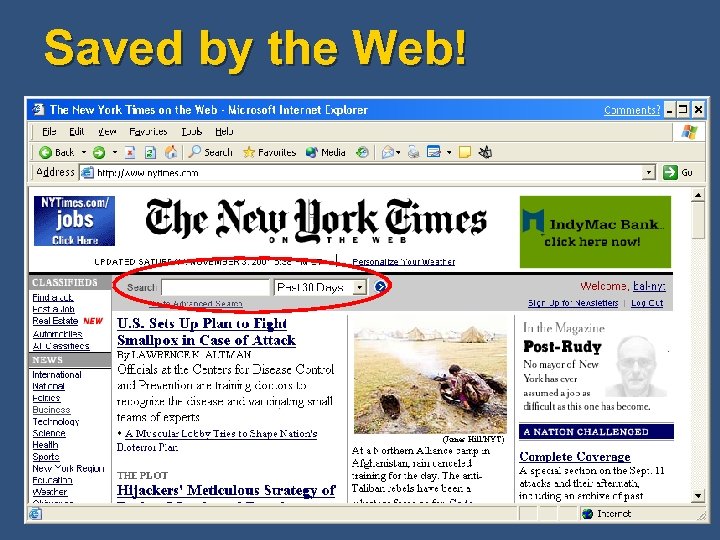
Saved by the Web!
Web Usage Today n Web usage today is browser-oriented n n n Users browse for information Vast databases are accessed through HTML gateways & user-friendly displays Example: Yahoo’s stock ticker n n n Yahoo has tons of stock price history sitting behind http: //quote. yahoo. com/ That info is easily available to anyone who browses to the right page But look at how the info is presented…
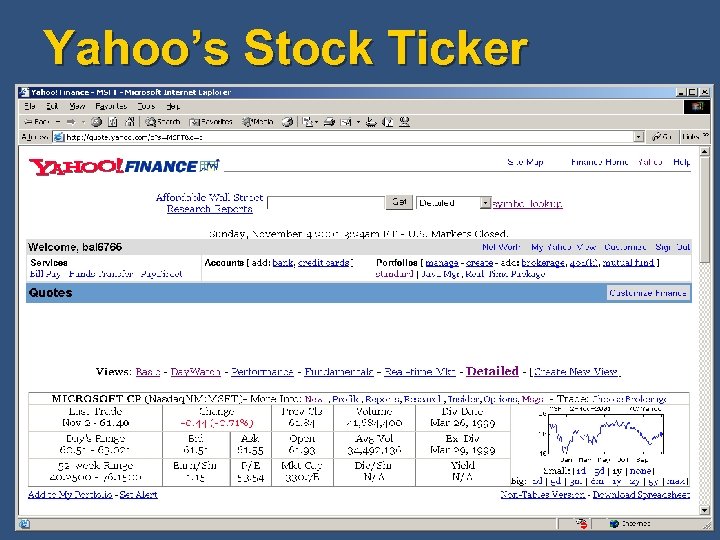
Yahoo’s Stock Ticker
“Screen-scraping” n n Data is formatted for easy use by people, not programs Programs need to mimic users to… n n n “Scrape the screen” n n Parse/make use of the data Call server-side functions (plot a chart, compute something, perform a search, etc. ) Download the HTML and then pattern-match against it Inefficient and fragile Data type semantics are lost We need a better mechanism for making Web-published data and component software functions available to programs
What is a Web Service? n Software components (application logic) accessible via standard Web protocols n n n Available to any client that speaks the necessary Web protocols (XML, SOAP) n n “Programming the Web” n Better: “remote procedure calls over the Web” Web sites with no user interface Platform independent components Enable highly distributed systems
Finding & talking to Web Services n Clients need answers to three separate questions: n n n What services are available? How do I communicate with this particular service? Let’s talk! (Give me some data…)
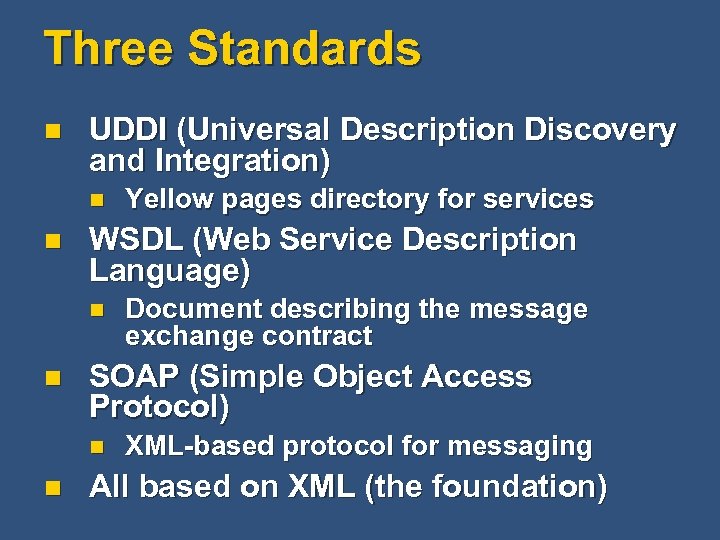
Three Standards n UDDI (Universal Description Discovery and Integration) n n WSDL (Web Service Description Language) n n Document describing the message exchange contract SOAP (Simple Object Access Protocol) n n Yellow pages directory for services XML-based protocol for messaging All based on XML (the foundation)
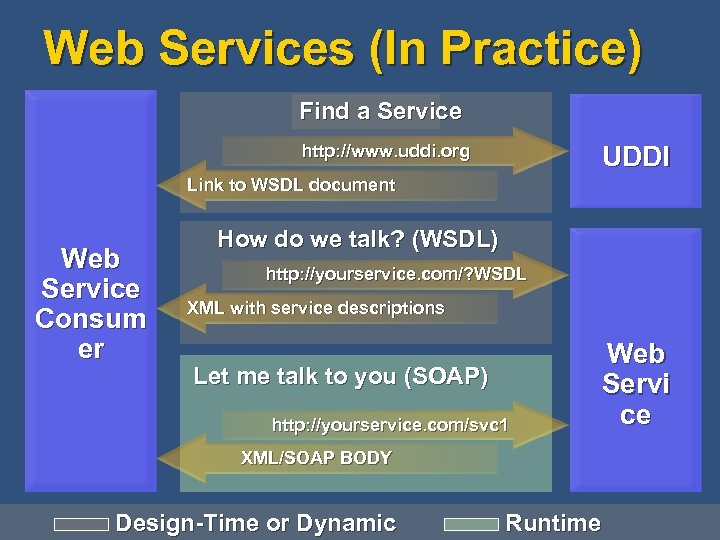
Web Services (In Practice) Find a Service http: //www. uddi. org UDDI Link to WSDL document Web Service Consum er How do we talk? (WSDL) http: //yourservice. com/? WSDL XML with service descriptions Let me talk to you (SOAP) http: //yourservice. com/svc 1 Web Servi ce XML/SOAP BODY Design-Time or Dynamic Runtime
Why are Web Services interesting?
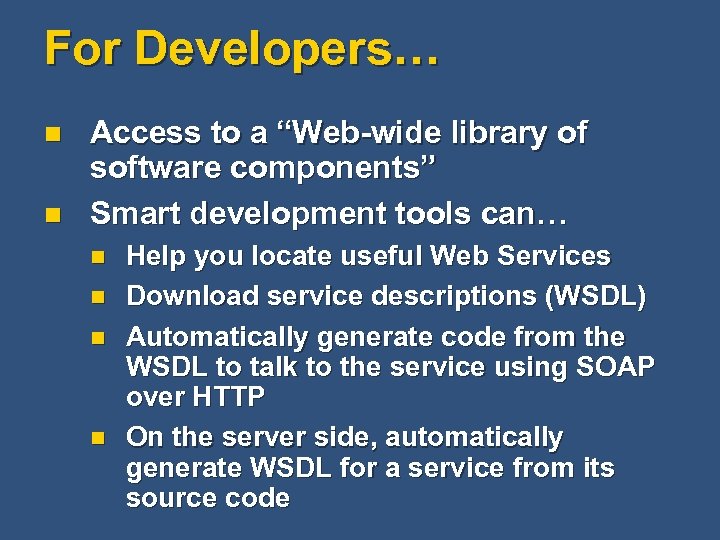
For Developers… n n Access to a “Web-wide library of software components” Smart development tools can… n n Help you locate useful Web Services Download service descriptions (WSDL) Automatically generate code from the WSDL to talk to the service using SOAP over HTTP On the server side, automatically generate WSDL for a service from its source code
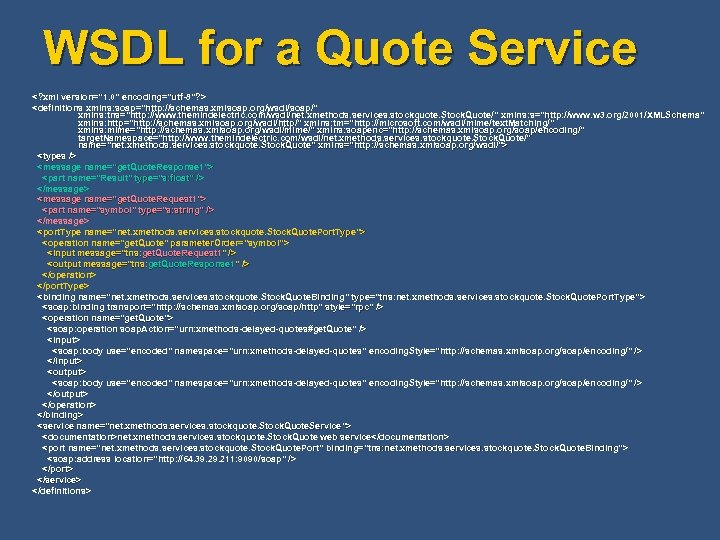
WSDL for a Quote Service <? xml version="1. 0" encoding="utf-8"? > <definitions xmlns: soap="http: //schemas. xmlsoap. org/wsdl/soap/" xmlns: tns="http: //www. themindelectric. com/wsdl/net. xmethods. services. stockquote. Stock. Quote/" xmlns: s="http: //www. w 3. org/2001/XMLSchema" xmlns: http="http: //schemas. xmlsoap. org/wsdl/http/" xmlns: tm="http: //microsoft. com/wsdl/mime/text. Matching/" xmlns: mime="http: //schemas. xmlsoap. org/wsdl/mime/" xmlns: soapenc="http: //schemas. xmlsoap. org/soap/encoding/" target. Namespace="http: //www. themindelectric. com/wsdl/net. xmethods. services. stockquote. Stock. Quote/" name="net. xmethods. services. stockquote. Stock. Quote" xmlns="http: //schemas. xmlsoap. org/wsdl/"> <types /> <message name="get. Quote. Response 1"> <part name="Result" type="s: float" /> type="s: float" </message> <message name="get. Quote. Request 1"> <part name="symbol" type="s: string" /> type="s: string" </message> <port. Type name="net. xmethods. services. stockquote. Stock. Quote. Port. Type"> <operation name="get. Quote" parameter. Order="symbol"> <input message="tns: get. Quote. Request 1" /> message="tns: get. Quote. Request 1" <output message="tns: get. Quote. Response 1" /> message="tns: get. Quote. Response 1" </operation> </port. Type> <binding name="net. xmethods. services. stockquote. Stock. Quote. Binding" type="tns: net. xmethods. services. stockquote. Stock. Quote. Port. Type"> <soap: binding transport="http: //schemas. xmlsoap. org/soap/http" style="rpc" /> <soap: binding transport="http: //schemas. xmlsoap. org/soap/http" style="rpc" <operation name="get. Quote"> <soap: operation soap. Action="urn: xmethods-delayed-quotes#get. Quote" /> <soap: operation soap. Action="urn: xmethods-delayed-quotes#get. Quote" <input> <soap: body use="encoded" namespace="urn: xmethods-delayed-quotes" encoding. Style="http: //schemas. xmlsoap. org/soap/encoding/" /> <soap: body namespace="urn: xmethods-delayed-quotes" encoding. Style="http: //schemas. xmlsoap. org/soap/encoding/" </input> <output> <soap: body use="encoded" namespace="urn: xmethods-delayed-quotes" encoding. Style="http: //schemas. xmlsoap. org/soap/encoding/" /> <soap: body namespace="urn: xmethods-delayed-quotes" encoding. Style="http: //schemas. xmlsoap. org/soap/encoding/" </output> </operation> </binding> <service name="net. xmethods. services. stockquote. Stock. Quote. Service"> <documentation>net. xmethods. services. stockquote. Stock. Quote web service</documentation> <documentation>net. xmethods. services. stockquote. Stock. Quote <port name="net. xmethods. services. stockquote. Stock. Quote. Port" binding="tns: net. xmethods. services. stockquote. Stock. Quote. Binding"> <soap: address location="http: //64. 39. 211: 9090/soap" /> <soap: address </port> </service> </definitions>
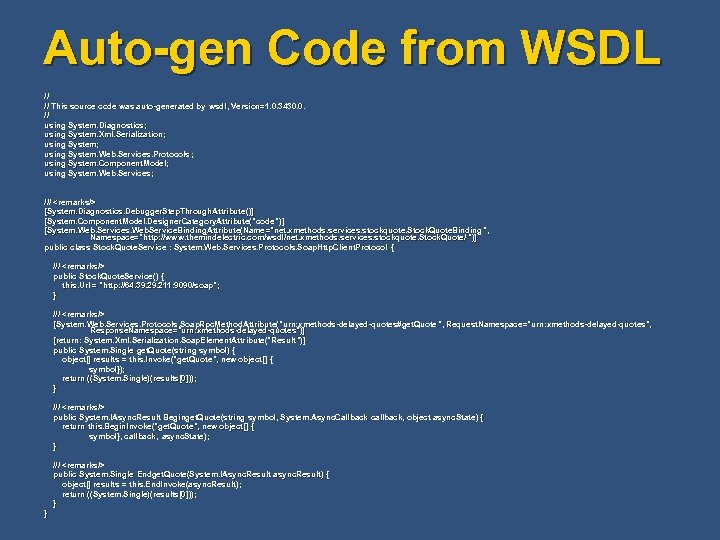
Auto-gen Code from WSDL // // This source code was auto-generated by wsdl, Version=1. 0. 3430. 0. wsdl, // using System. Diagnostics; using System. Xml. Serialization ; using System. Web. Services. Protocols ; using System. Component. Model; using System. Web. Services ; /// <remarks/> [System. Diagnostics. Debugger. Step. Through. Attribute ()] [System. Component. Model. Designer. Category. Attribute("code ")] [System. Web. Services. Web. Service. Binding. Attribute(Name ="net. xmethods. services. stockquote. Stock. Quote. Binding ", ="net. xmethods. services. stockquote. Stock. Quote. Binding Namespace="http: //www. themindelectric. com/wsdl/net. xmethods. services. stockquote. Stock. Quote/ ")] Namespace="http: //www. themindelectric. com/wsdl/net. xmethods. services. stockquote. Stock. Quote/ public class Stock. Quote. Service : System. Web. Services. Protocols. Soap. Http. Client. Protocol { /// <remarks/> public Stock. Quote. Service() { Stock. Quote. Service() this. Url = "http: //64. 39. 211: 9090/soap"; } /// <remarks/> [System. Web. Services. Protocols. Soap. Rpc. Method. Attribute("urn: xmethods-delayed-quotes#get. Quote ", Request. Namespace="urn: xmethods-delayed-quotes", [System. Web. Services. Protocols. Soap. Rpc. Method. Attribute("urn: xmethods-delayed-quotes#get. Quote Request. Namespace="urn: xmethods-delayed-quotes", Response. Namespace="urn: xmethods-delayed-quotes")] [return: System. Xml. Serialization. Soap. Element. Attribute("Result ")] public System. Single get. Quote(string symbol) { object[] results = this. Invoke("get. Quote", new object[] { this. Invoke("get. Quote", symbol}); return ((System. Single)(results[0])); } /// <remarks/> public System. IAsync. Result Beginget. Quote(string symbol, System. Async. Callback callback, object async. State) { async. State) return this. Begin. Invoke("get. Quote", new object[] { this. Begin. Invoke("get. Quote", symbol}, callback, async. State); } /// <remarks/> public System. Single Endget. Quote(System. IAsync. Result async. Result) { async. Result) object[] results = this. End. Invoke(async. Result ); return ((System. Single)(results[0])); } }
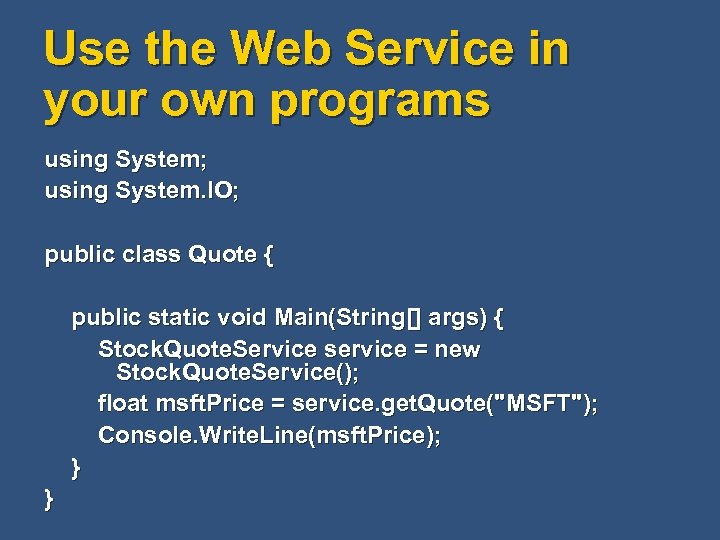
Use the Web Service in your own programs using System; using System. IO; public class Quote { public static void Main(String[] args) { Stock. Quote. Service service = new Stock. Quote. Service(); float msft. Price = service. get. Quote("MSFT"); Console. Write. Line(msft. Price); } }
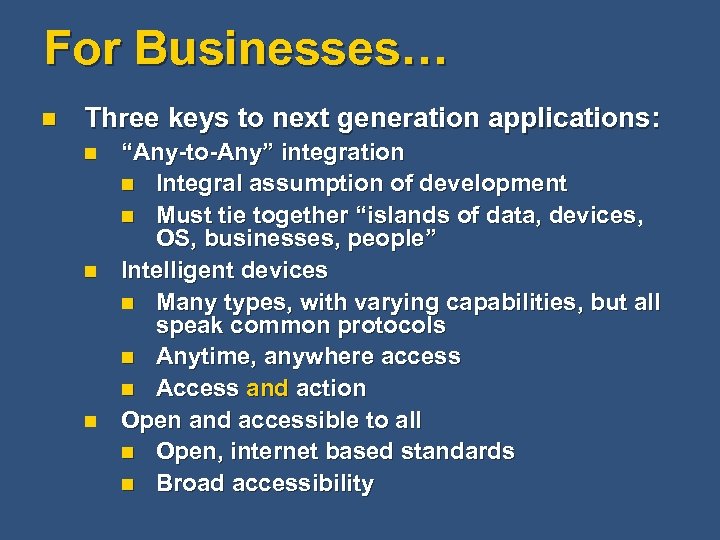
For Businesses… n Three keys to next generation applications: n n n “Any-to-Any” integration n Integral assumption of development n Must tie together “islands of data, devices, OS, businesses, people” Intelligent devices n Many types, with varying capabilities, but all speak common protocols n Anytime, anywhere access n Access and action Open and accessible to all n Open, internet based standards n Broad accessibility
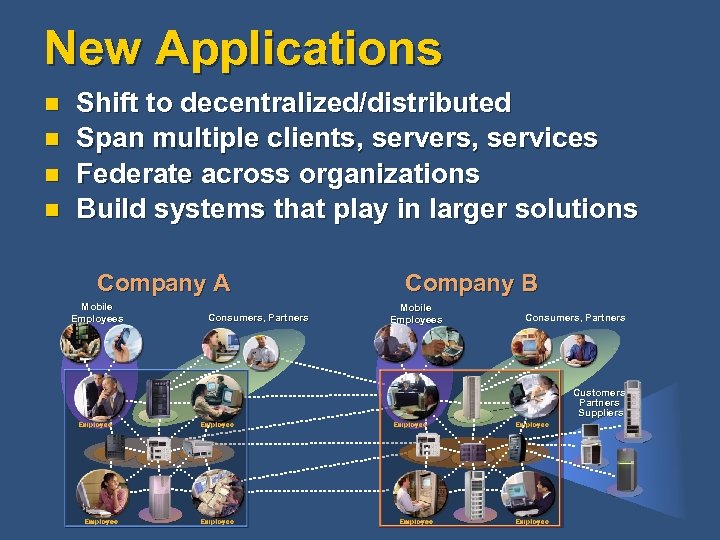
New Applications n n Shift to decentralized/distributed Span multiple clients, servers, services Federate across organizations Build systems that play in larger solutions Company A Mobile Employees Consumers, Partners Company B Mobile Employees Consumers, Partners Customers Partners Suppliers
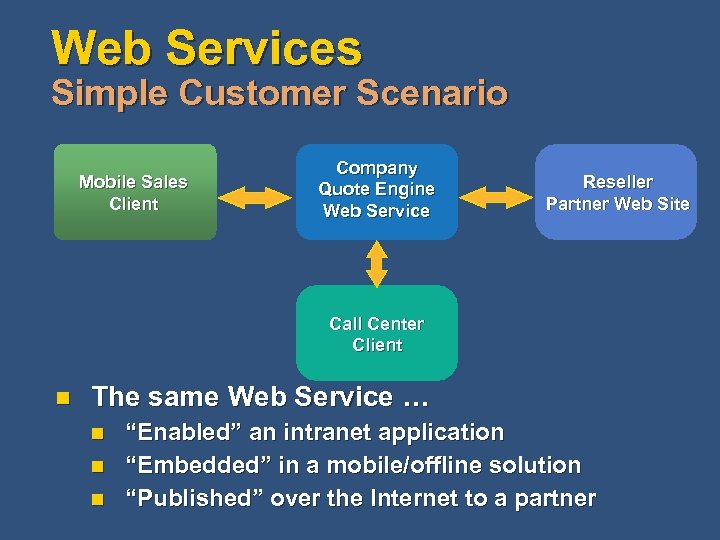
Web Services Simple Customer Scenario Mobile Sales Client Company Quote Engine Web Service Reseller Partner Web Site Call Center Client n The same Web Service … n n n “Enabled” an intranet application “Embedded” in a mobile/offline solution “Published” over the Internet to a partner
What e-commerce business models do Web Services enable?
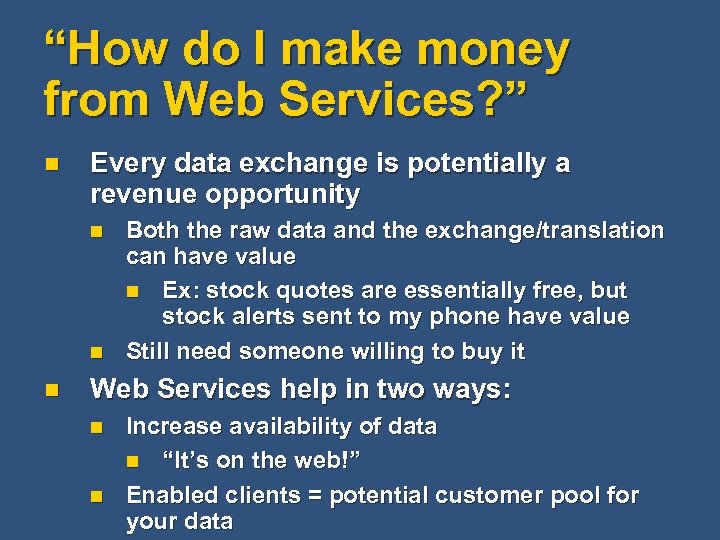
“How do I make money from Web Services? ” n Every data exchange is potentially a revenue opportunity n n n Both the raw data and the exchange/translation can have value n Ex: stock quotes are essentially free, but stock alerts sent to my phone have value Still need someone willing to buy it Web Services help in two ways: n n Increase availability of data n “It’s on the web!” Enabled clients = potential customer pool for your data
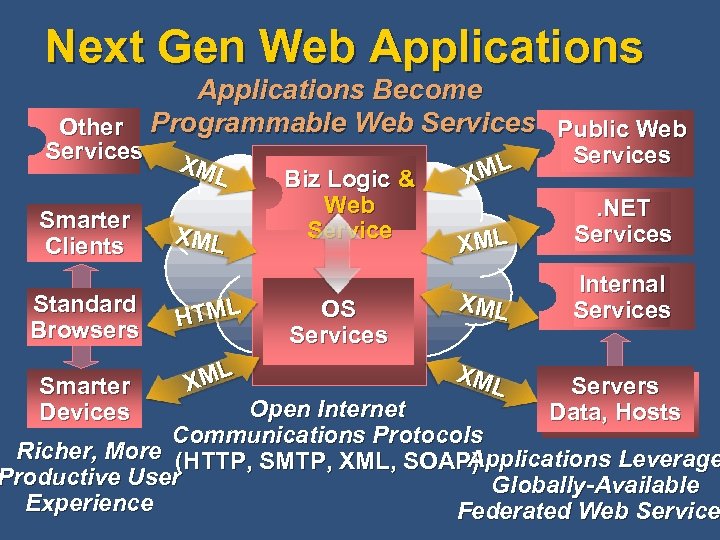
Next Gen Web Applications Become Other Programmable Web Services Public Web Services Smarter Clients Standard Browsers Smarter Devices XM L XML HTML L XM Biz Logic & Biz Web Tier Logic Service OS OS Services L XM Services XML . NET Services XML Internal Services XML Servers Data, Hosts Open Internet Communications Protocols Richer, More (HTTP, SMTP, XML, SOAP) Applications Leverage Productive User Globally-Available Experience Federated Web Service
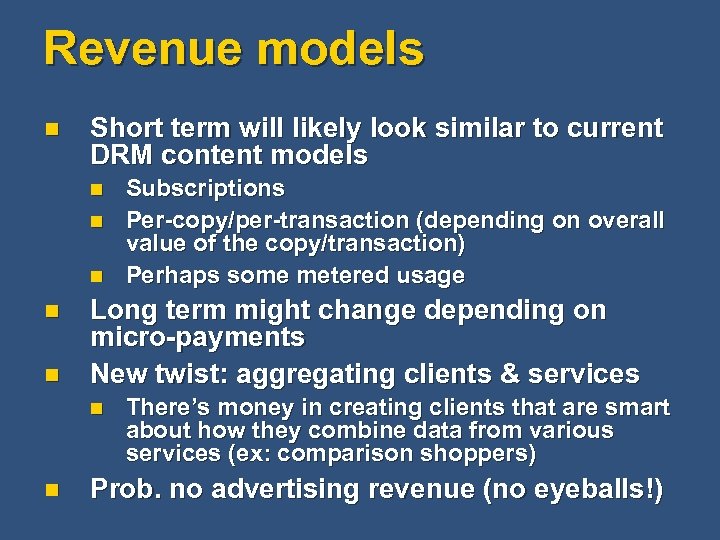
Revenue models n Short term will likely look similar to current DRM content models n n n Long term might change depending on micro-payments New twist: aggregating clients & services n n Subscriptions Per-copy/per-transaction (depending on overall value of the copy/transaction) Perhaps some metered usage There’s money in creating clients that are smart about how they combine data from various services (ex: comparison shoppers) Prob. no advertising revenue (no eyeballs!)
What security and privacy issues need to be addressed for Web Services to be successful?
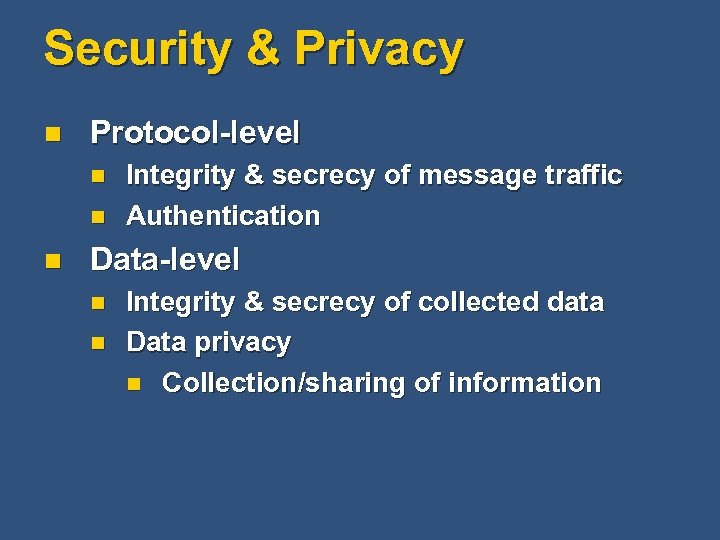
Security & Privacy n Protocol-level n n n Integrity & secrecy of message traffic Authentication Data-level n n Integrity & secrecy of collected data Data privacy n Collection/sharing of information
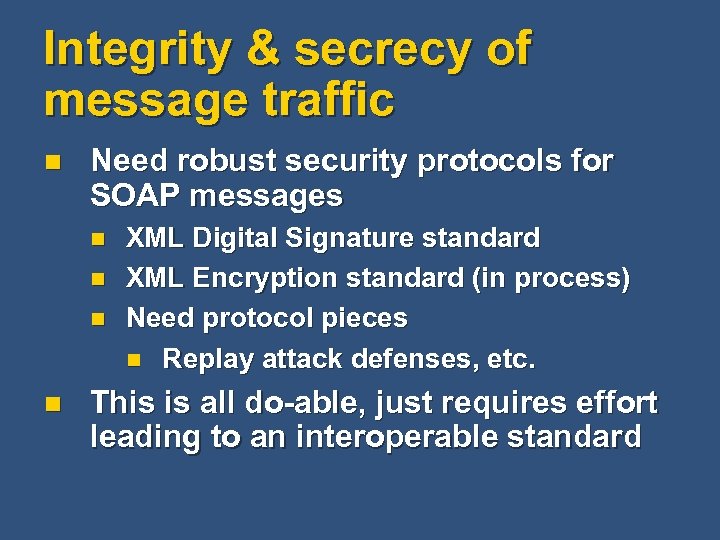
Integrity & secrecy of message traffic n Need robust security protocols for SOAP messages n n XML Digital Signature standard XML Encryption standard (in process) Need protocol pieces n Replay attack defenses, etc. This is all do-able, just requires effort leading to an interoperable standard
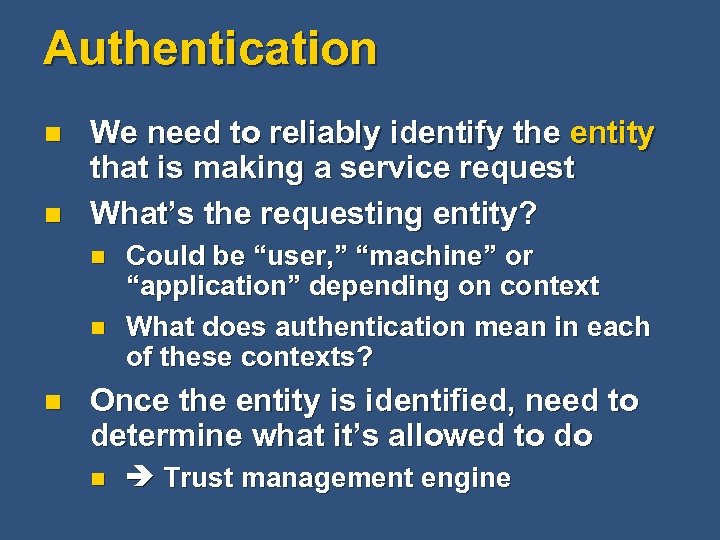
Authentication n n We need to reliably identify the entity that is making a service request What’s the requesting entity? n n n Could be “user, ” “machine” or “application” depending on context What does authentication mean in each of these contexts? Once the entity is identified, need to determine what it’s allowed to do n Trust management engine
Protecting stored data n Today, almost all Web sites use the “Trust us, your data is safe” method of data protection. n n Servers holding aggregated data are prime targets for attack No real incentive for services to deploy real security measures (e. g. PK crypto) We must design centralized data stores for per-user encrypted data Key management tools/UI still a problem
Data Privacy n Control over collection & distribution of personal information n n Lorrie Cranor covered this on Tuesday in her talk on P 3 P Essentially this is a DRM-type problem and likely require DRM-like solutions n n Digital rights management is primarily concerned with distribution of valuable content to “untrusted” users Data privacy is primarily concerned with the distribution of valuable personal data to “untrusted” centralized services.
What the heck is Microsoft’s. NET Platform all about, and how does. NET relate to Web Services?
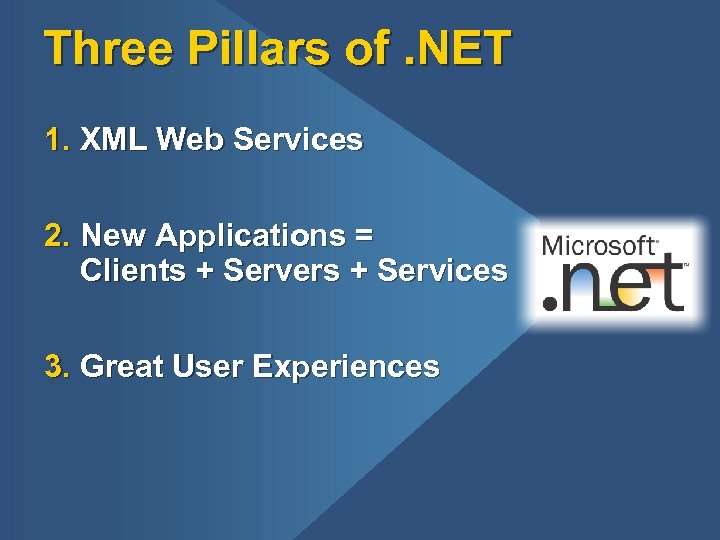
Three Pillars of. NET 1. XML Web Services 2. New Applications = Clients + Servers + Services 3. Great User Experiences
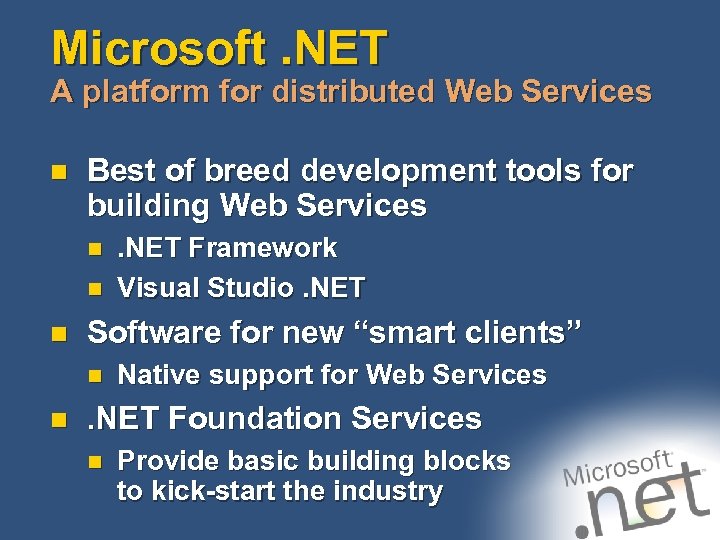
Microsoft. NET A platform for distributed Web Services n Best of breed development tools for building Web Services n n n Software for new “smart clients” n n . NET Framework Visual Studio. NET Native support for Web Services . NET Foundation Services n Provide basic building blocks to kick-start the industry
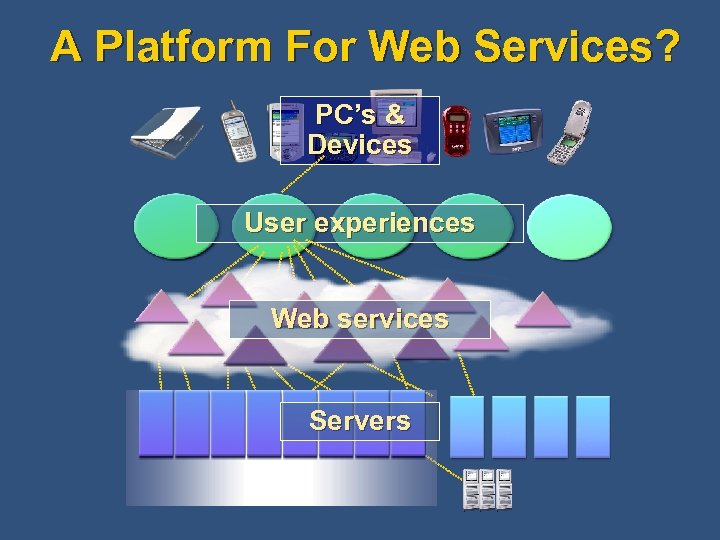
A Platform For Web Services? PC’s & Devices User experiences Web services Servers
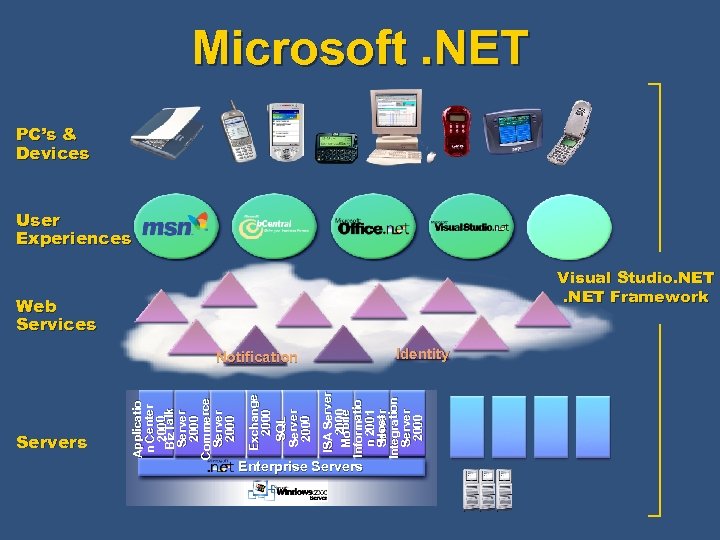
Servers Enterprise Servers ISA Server 2000 Mobile Informatio n 2001 Host Server Integration Server 2000 Exchange 2000 SQL Server 2000 Applicatio n Center 2000 Biz. Talk Server 2000 Commerce Server 2000 Microsoft. NET PC’s & Devices User Experiences Web Services Visual Studio. NET Framework Notification Identity
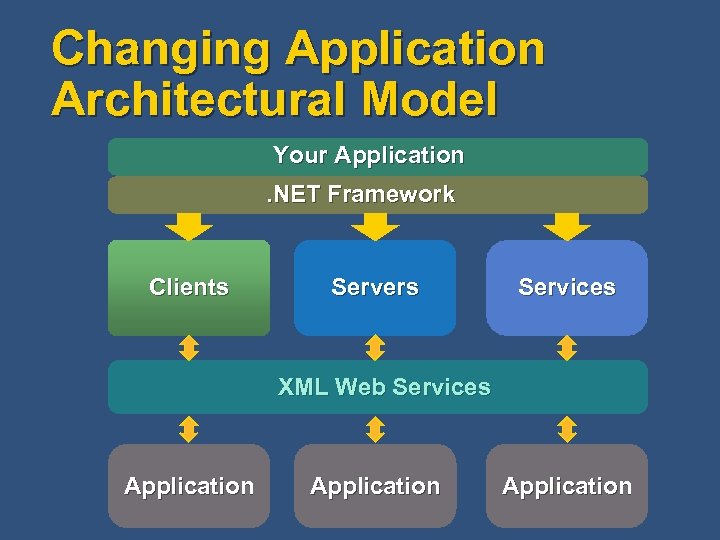
Changing Application Architectural Model Your Application. NET Framework Clients Servers Services XML Web Services Application
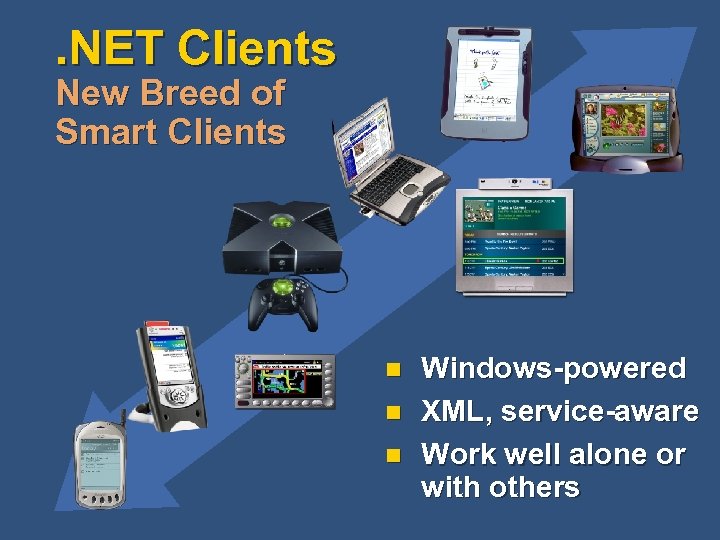
. NET Clients New Breed of Smart Clients n n n Windows-powered XML, service-aware Work well alone or with others
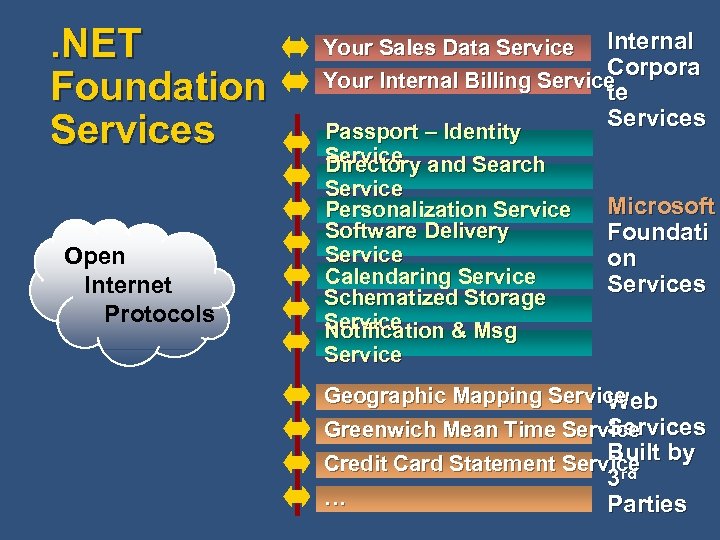
. NET Foundation Services Open Internet Protocols Your Sales Data Service Internal Corpora Your Internal Billing Service Passport – Identity Service and Search Directory Service Personalization Service Software Delivery Service Calendaring Service Schematized Storage Service Notification & Msg Service te Services Microsoft Foundati on Services Geographic Mapping Service Web Services Greenwich Mean Time Service Built Credit Card Statement Service by rd … 3 Parties
Summary n Web Services architecture n n n Reasons to move to Web Services n n n Componentizing web-accessible data Built on XML-based protocols Quickly tie together data islands “Any-to-Any” integration Microsoft. NET Platform n Comprehensive attempt to provide all the parts needed to enable Web Services n Development tools, hosting servers, building block services, etc.
Questions?
Скачать презентацию Web Services Brian A La Macchia Microsoft
33c7a818961b736b3e2f4d48e12dbedd.ppt