 Скачать презентацию Web Mining 網路探勘 Partially Supervised Learning 部分監督式學習
86549de28b654a3b30432876a9a79888.ppt
- Количество слайдов: 52



Web Mining (網路探勘 ) Partially Supervised Learning (部分監督式學習 ) 1011 WM 05 TLMXM 1 A Wed 8, 9 (15: 10 -17: 00) U 705 Min-Yuh Day 戴敏育 Assistant Professor 專任助理教授 Dept. of Information Management, Tamkang University 淡江大學 資訊管理學系 http: //mail. tku. edu. tw/myday/ 2012 -10 -24 1
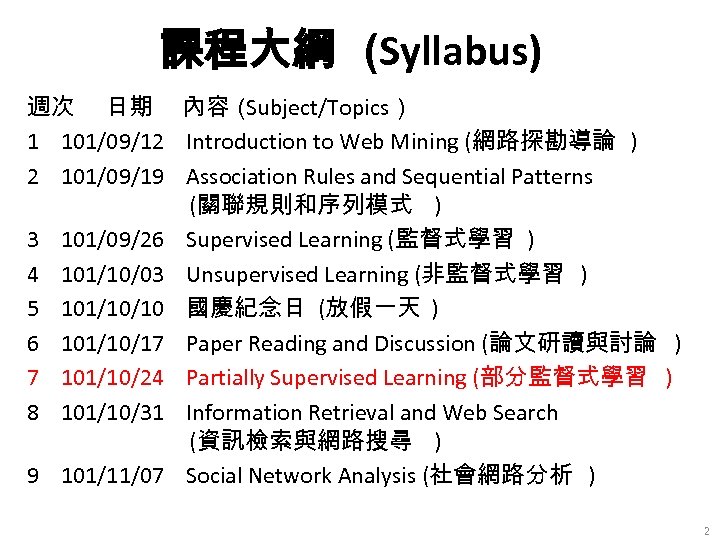
課程大綱 (Syllabus) 週次 日期 內容( Subject/Topics) 1 101/09/12 Introduction to Web Mining (網路探勘導論 ) 2 101/09/19 Association Rules and Sequential Patterns (關聯規則和序列模式 ) 3 101/09/26 Supervised Learning (監督式學習 ) 4 101/10/03 Unsupervised Learning (非監督式學習 ) 5 101/10/10 國慶紀念日 (放假一天 ) 6 101/10/17 Paper Reading and Discussion (論文研讀與討論 ) 7 101/10/24 Partially Supervised Learning (部分監督式學習 ) 8 101/10/31 Information Retrieval and Web Search (資訊檢索與網路搜尋 ) 9 101/11/07 Social Network Analysis (社會網路分析 ) 2
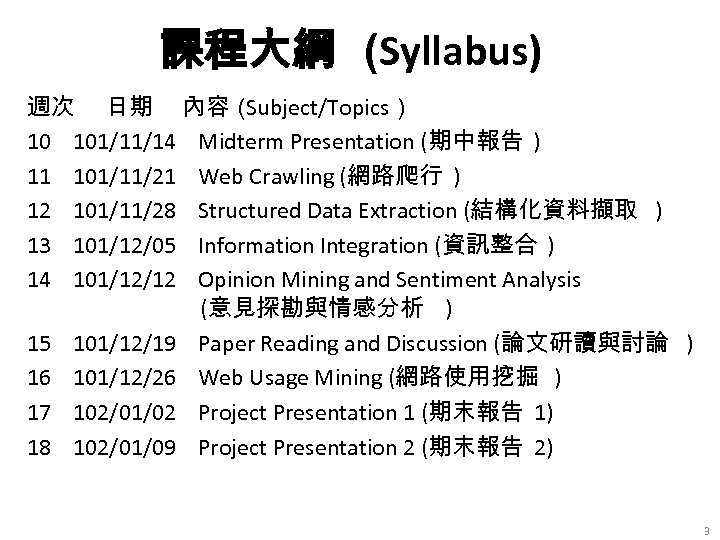
課程大綱 (Syllabus) 週次 日期 內容( Subject/Topics) 10 101/11/14 Midterm Presentation (期中報告 ) 11 101/11/21 Web Crawling (網路爬行 ) 12 101/11/28 Structured Data Extraction (結構化資料擷取 ) 13 101/12/05 Information Integration (資訊整合 ) 14 101/12/12 Opinion Mining and Sentiment Analysis (意見探勘與情感分析 ) 15 101/12/19 Paper Reading and Discussion (論文研讀與討論 ) 16 101/12/26 Web Usage Mining (網路使用挖掘 ) 17 102/01/02 Project Presentation 1 (期末報告 1) 18 102/01/09 Project Presentation 2 (期末報告 2) 3
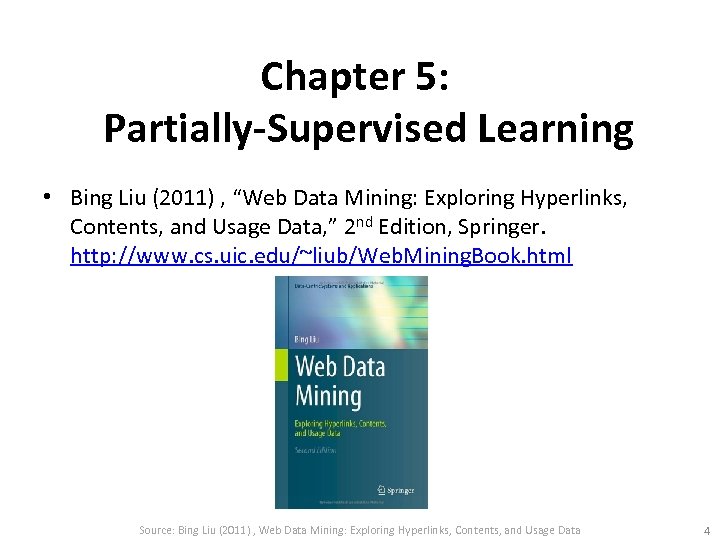
Chapter 5: Partially-Supervised Learning • Bing Liu (2011) , “Web Data Mining: Exploring Hyperlinks, Contents, and Usage Data, ” 2 nd Edition, Springer. http: //www. cs. uic. edu/~liub/Web. Mining. Book. html Source: Bing Liu (2011) , Web Data Mining: Exploring Hyperlinks, Contents, and Usage Data 4
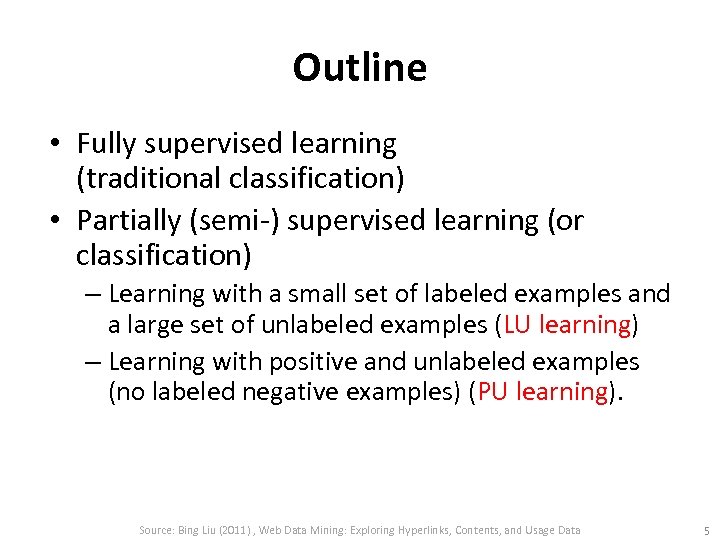
Outline • Fully supervised learning (traditional classification) • Partially (semi-) supervised learning (or classification) – Learning with a small set of labeled examples and a large set of unlabeled examples (LU learning) – Learning with positive and unlabeled examples (no labeled negative examples) (PU learning). Source: Bing Liu (2011) , Web Data Mining: Exploring Hyperlinks, Contents, and Usage Data 5
Learning from a small labeled set and a large unlabeled set LU learning Source: Bing Liu (2011) , Web Data Mining: Exploring Hyperlinks, Contents, and Usage Data 6
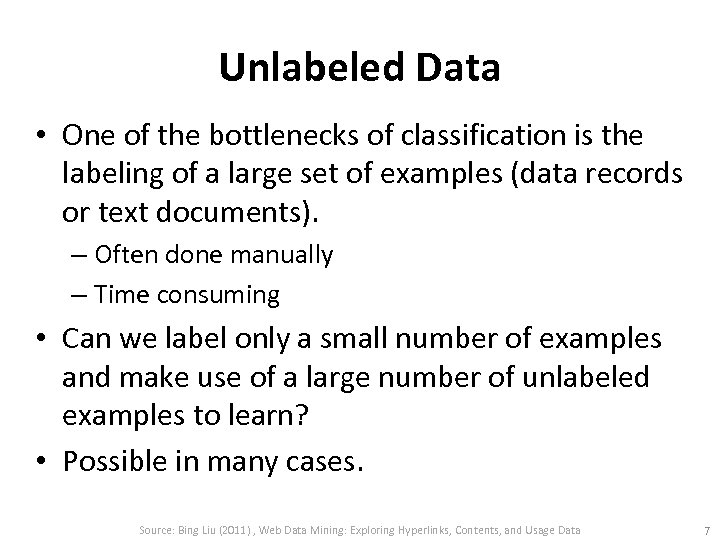
Unlabeled Data • One of the bottlenecks of classification is the labeling of a large set of examples (data records or text documents). – Often done manually – Time consuming • Can we label only a small number of examples and make use of a large number of unlabeled examples to learn? • Possible in many cases. Source: Bing Liu (2011) , Web Data Mining: Exploring Hyperlinks, Contents, and Usage Data 7
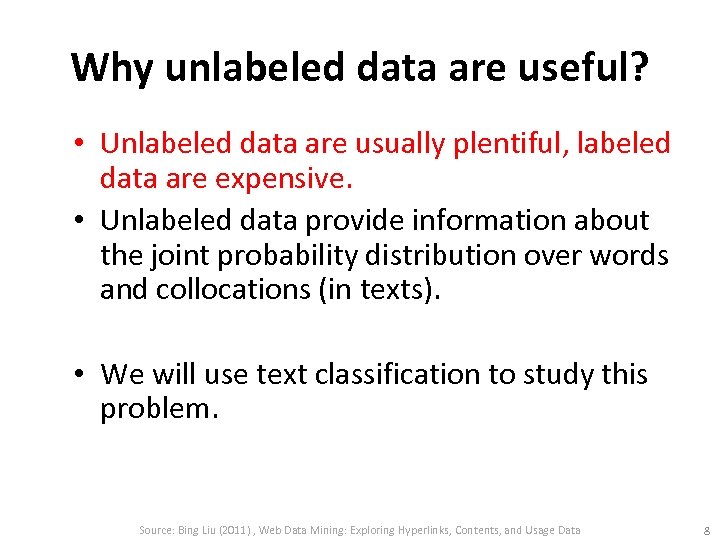
Why unlabeled data are useful? • Unlabeled data are usually plentiful, labeled data are expensive. • Unlabeled data provide information about the joint probability distribution over words and collocations (in texts). • We will use text classification to study this problem. Source: Bing Liu (2011) , Web Data Mining: Exploring Hyperlinks, Contents, and Usage Data 8
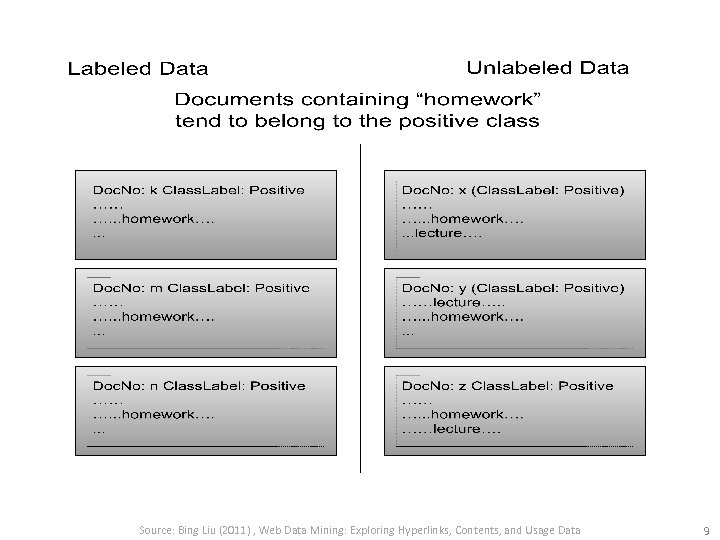
Source: Bing Liu (2011) , Web Data Mining: Exploring Hyperlinks, Contents, and Usage Data 9
How to use unlabeled data • One way is to use the EM algorithm – EM: Expectation Maximization • The EM algorithm is a popular iterative algorithm for maximum likelihood estimation in problems with missing data. • The EM algorithm consists of two steps, – Expectation step, i. e. , filling in the missing data – Maximization step – calculate a new maximum a posteriori estimate for the parameters. Source: Bing Liu (2011) , Web Data Mining: Exploring Hyperlinks, Contents, and Usage Data 10
Incorporating unlabeled Data with EM (Nigam et al, 2000) • Basic EM • Augmented EM with weighted unlabeled data • Augmented EM with multiple mixture components per class Source: Bing Liu (2011) , Web Data Mining: Exploring Hyperlinks, Contents, and Usage Data 11
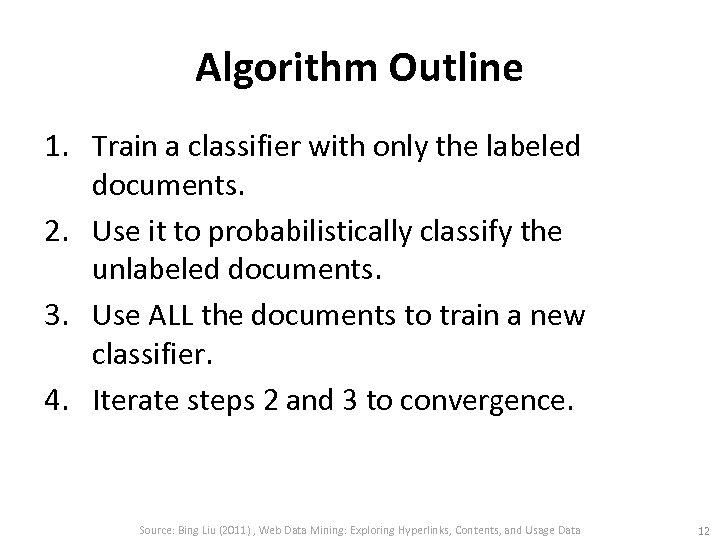
Algorithm Outline 1. Train a classifier with only the labeled documents. 2. Use it to probabilistically classify the unlabeled documents. 3. Use ALL the documents to train a new classifier. 4. Iterate steps 2 and 3 to convergence. Source: Bing Liu (2011) , Web Data Mining: Exploring Hyperlinks, Contents, and Usage Data 12
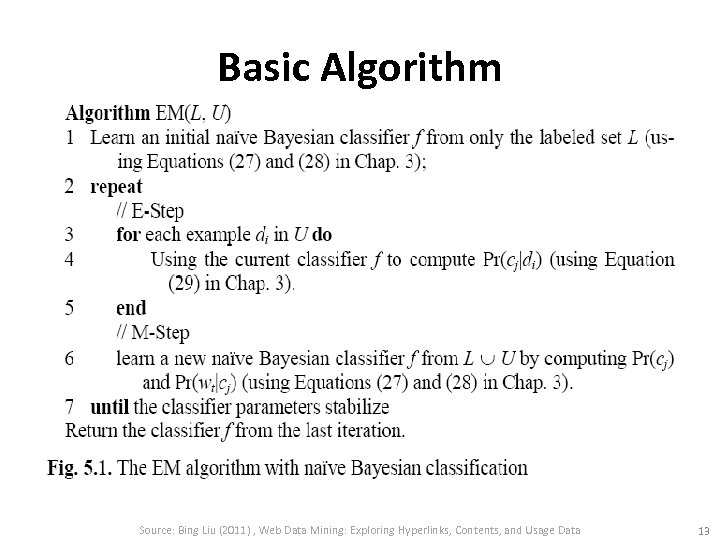
Basic Algorithm Source: Bing Liu (2011) , Web Data Mining: Exploring Hyperlinks, Contents, and Usage Data 13
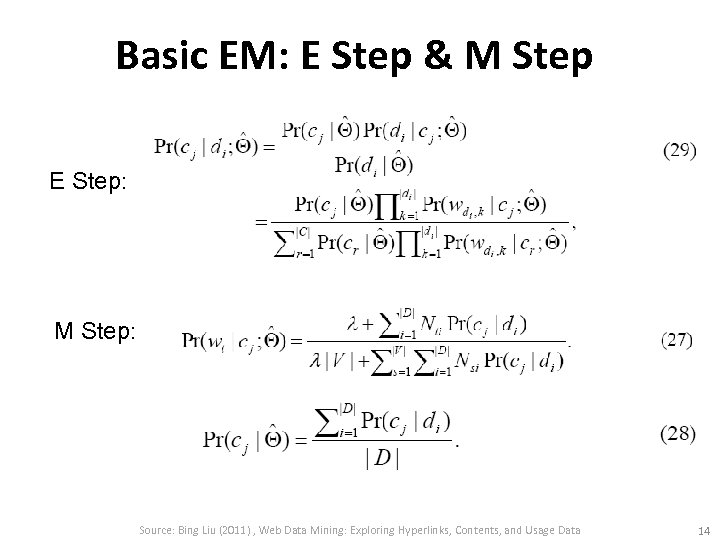
Basic EM: E Step & M Step E Step: M Step: Source: Bing Liu (2011) , Web Data Mining: Exploring Hyperlinks, Contents, and Usage Data 14
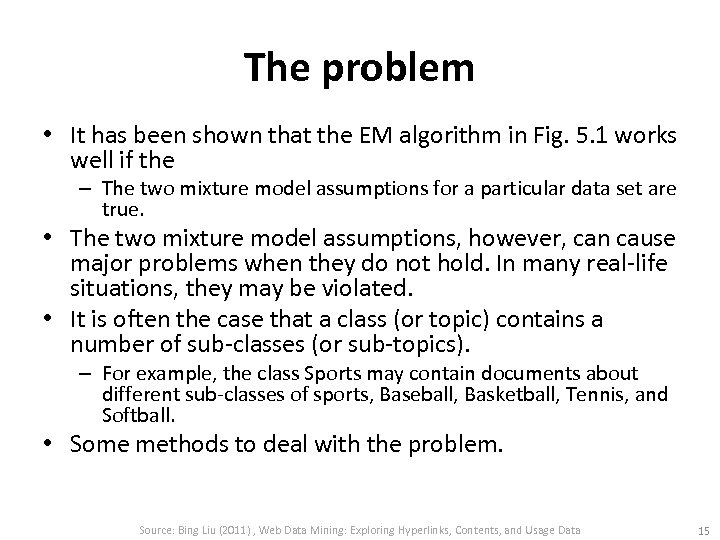
The problem • It has been shown that the EM algorithm in Fig. 5. 1 works well if the – The two mixture model assumptions for a particular data set are true. • The two mixture model assumptions, however, can cause major problems when they do not hold. In many real-life situations, they may be violated. • It is often the case that a class (or topic) contains a number of sub-classes (or sub-topics). – For example, the class Sports may contain documents about different sub-classes of sports, Baseball, Basketball, Tennis, and Softball. • Some methods to deal with the problem. Source: Bing Liu (2011) , Web Data Mining: Exploring Hyperlinks, Contents, and Usage Data 15
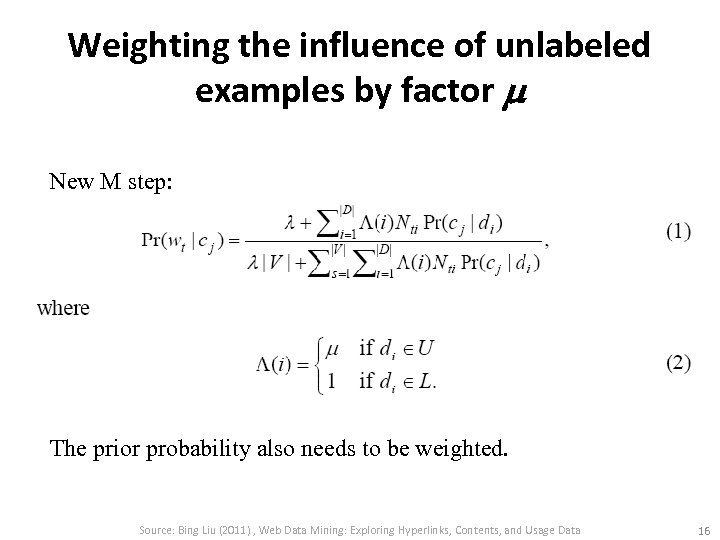
Weighting the influence of unlabeled examples by factor New M step: The prior probability also needs to be weighted. Source: Bing Liu (2011) , Web Data Mining: Exploring Hyperlinks, Contents, and Usage Data 16
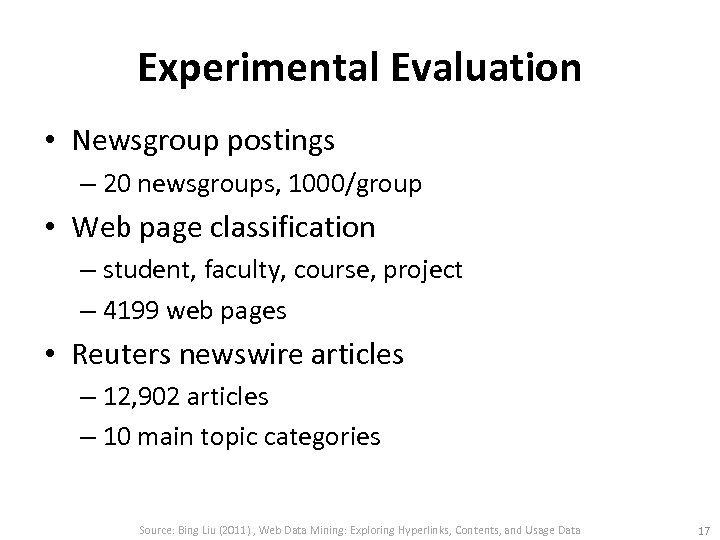
Experimental Evaluation • Newsgroup postings – 20 newsgroups, 1000/group • Web page classification – student, faculty, course, project – 4199 web pages • Reuters newswire articles – 12, 902 articles – 10 main topic categories Source: Bing Liu (2011) , Web Data Mining: Exploring Hyperlinks, Contents, and Usage Data 17
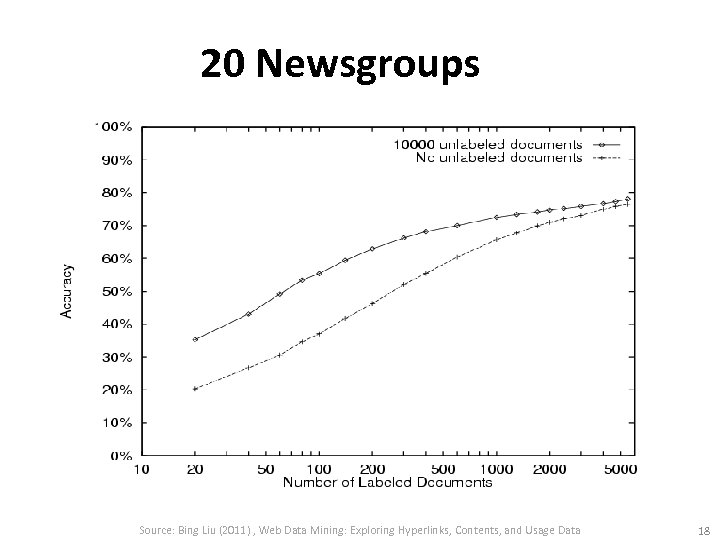
20 Newsgroups Source: Bing Liu (2011) , Web Data Mining: Exploring Hyperlinks, Contents, and Usage Data 18
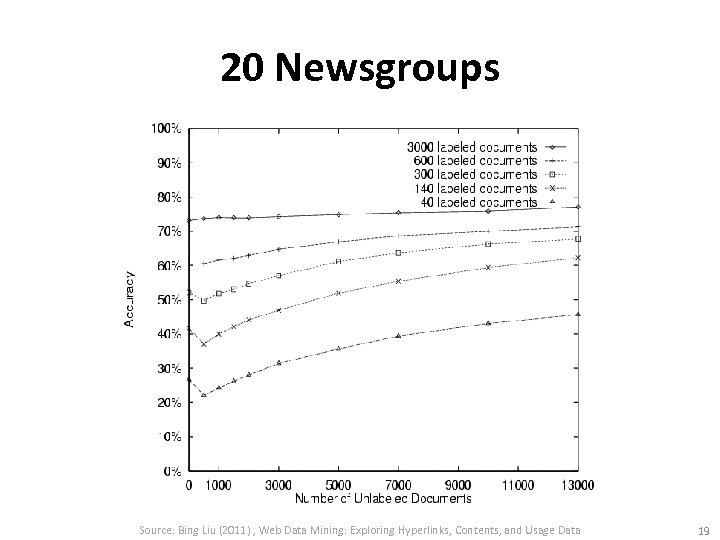
20 Newsgroups Source: Bing Liu (2011) , Web Data Mining: Exploring Hyperlinks, Contents, and Usage Data 19
Another approach: Co-training • Again, learning with a small labeled set and a large unlabeled set. • The attributes describing each example or instance can be partitioned into two subsets. Each of them is sufficient for learning the target function. – E. g. , hyperlinks and page contents in Web page classification. • Two classifiers can be learned from the same data. Source: Bing Liu (2011) , Web Data Mining: Exploring Hyperlinks, Contents, and Usage Data 20
![Co-training Algorithm [Blum and Mitchell, 1998] Given: labeled data L, unlabeled data U Loop:](https://present5.com/presentation/86549de28b654a3b30432876a9a79888/image-21.jpg "Co-training Algorithm [Blum and Mitchell, 1998] Given: labeled data L, unlabeled data U Loop:")
Co-training Algorithm [Blum and Mitchell, 1998] Given: labeled data L, unlabeled data U Loop: Train h 1 (e. g. , hyperlink classifier) using L Train h 2 (e. g. , page classifier) using L Allow h 1 to label p positive, n negative examples from U Allow h 2 to label p positive, n negative examples from U Add these most confident self-labeled examples to L Source: Bing Liu (2011) , Web Data Mining: Exploring Hyperlinks, Contents, and Usage Data 21
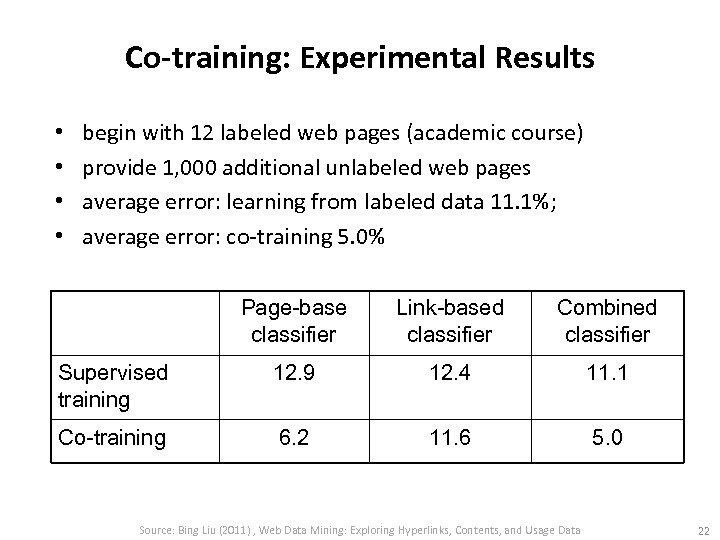
Co-training: Experimental Results • • begin with 12 labeled web pages (academic course) provide 1, 000 additional unlabeled web pages average error: learning from labeled data 11. 1%; average error: co-training 5. 0% Page-base classifier Link-based classifier Combined classifier Supervised training 12. 9 12. 4 11. 1 Co-training 6. 2 11. 6 5. 0 Source: Bing Liu (2011) , Web Data Mining: Exploring Hyperlinks, Contents, and Usage Data 22
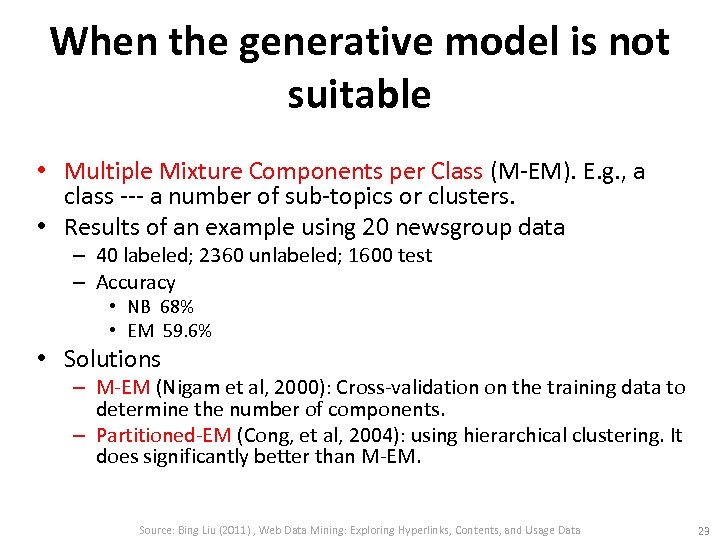
When the generative model is not suitable • Multiple Mixture Components per Class (M-EM). E. g. , a class --- a number of sub-topics or clusters. • Results of an example using 20 newsgroup data – 40 labeled; 2360 unlabeled; 1600 test – Accuracy • NB 68% • EM 59. 6% • Solutions – M-EM (Nigam et al, 2000): Cross-validation on the training data to determine the number of components. – Partitioned-EM (Cong, et al, 2004): using hierarchical clustering. It does significantly better than M-EM. Source: Bing Liu (2011) , Web Data Mining: Exploring Hyperlinks, Contents, and Usage Data 23
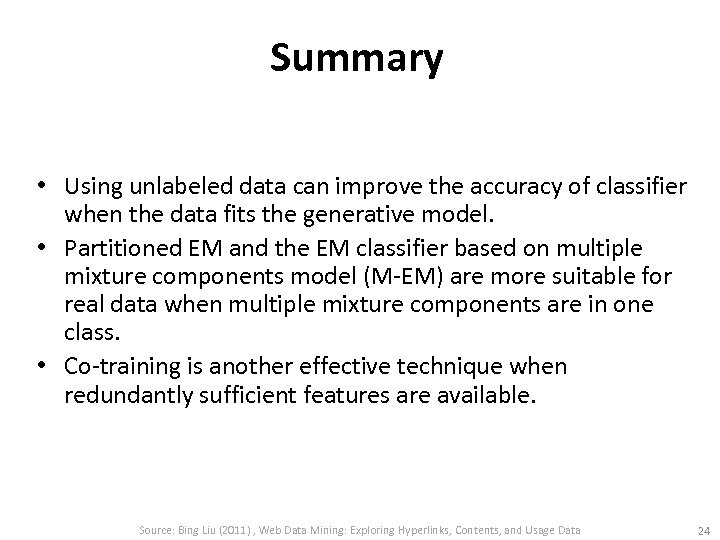
Summary • Using unlabeled data can improve the accuracy of classifier when the data fits the generative model. • Partitioned EM and the EM classifier based on multiple mixture components model (M-EM) are more suitable for real data when multiple mixture components are in one class. • Co-training is another effective technique when redundantly sufficient features are available. Source: Bing Liu (2011) , Web Data Mining: Exploring Hyperlinks, Contents, and Usage Data 24
Learning from Positive and Unlabeled Examples PU learning Source: Bing Liu (2011) , Web Data Mining: Exploring Hyperlinks, Contents, and Usage Data 25
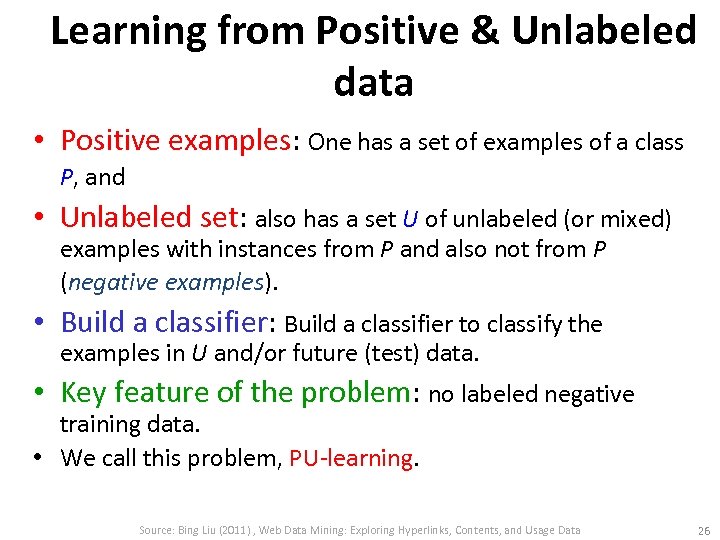
Learning from Positive & Unlabeled data • Positive examples: One has a set of examples of a class P, and • Unlabeled set: also has a set U of unlabeled (or mixed) examples with instances from P and also not from P (negative examples). • Build a classifier: Build a classifier to classify the examples in U and/or future (test) data. • Key feature of the problem: no labeled negative training data. • We call this problem, PU-learning. Source: Bing Liu (2011) , Web Data Mining: Exploring Hyperlinks, Contents, and Usage Data 26
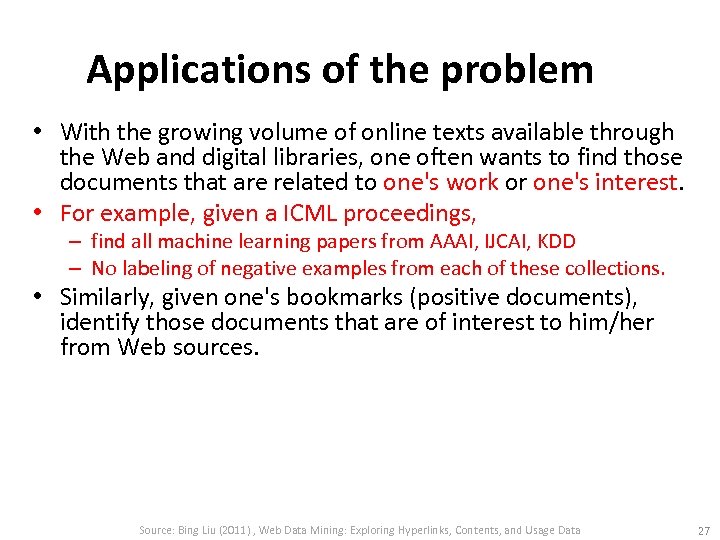
Applications of the problem • With the growing volume of online texts available through the Web and digital libraries, one often wants to find those documents that are related to one's work or one's interest. • For example, given a ICML proceedings, – find all machine learning papers from AAAI, IJCAI, KDD – No labeling of negative examples from each of these collections. • Similarly, given one's bookmarks (positive documents), identify those documents that are of interest to him/her from Web sources. Source: Bing Liu (2011) , Web Data Mining: Exploring Hyperlinks, Contents, and Usage Data 27
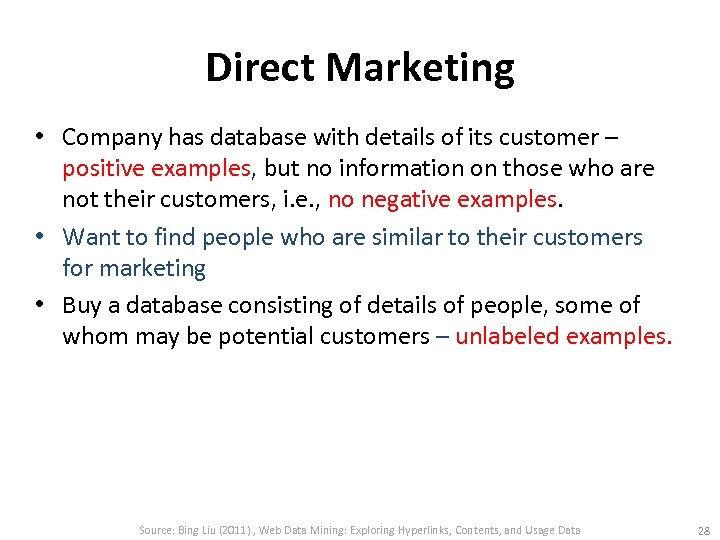
Direct Marketing • Company has database with details of its customer – positive examples, but no information on those who are not their customers, i. e. , no negative examples. • Want to find people who are similar to their customers for marketing • Buy a database consisting of details of people, some of whom may be potential customers – unlabeled examples. Source: Bing Liu (2011) , Web Data Mining: Exploring Hyperlinks, Contents, and Usage Data 28
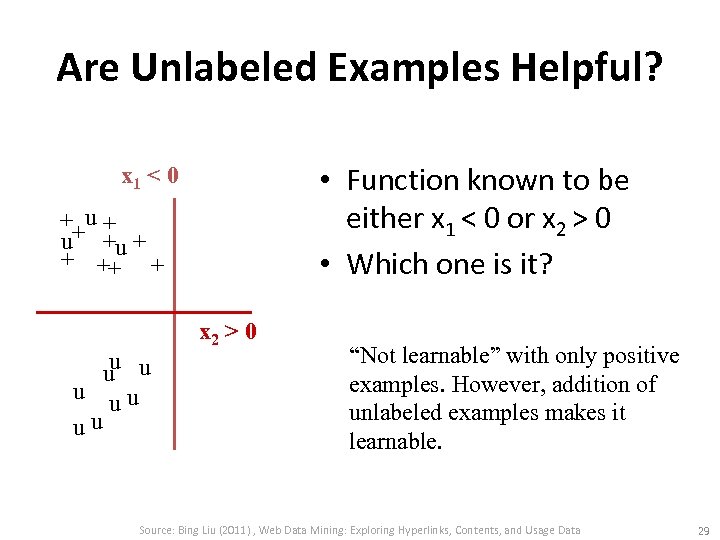
Are Unlabeled Examples Helpful? • Function known to be either x 1 < 0 or x 2 > 0 • Which one is it? x 1 < 0 ++u + u +u + + ++ + u u uu uu x 2 > 0 “Not learnable” with only positive examples. However, addition of unlabeled examples makes it learnable. Source: Bing Liu (2011) , Web Data Mining: Exploring Hyperlinks, Contents, and Usage Data 29
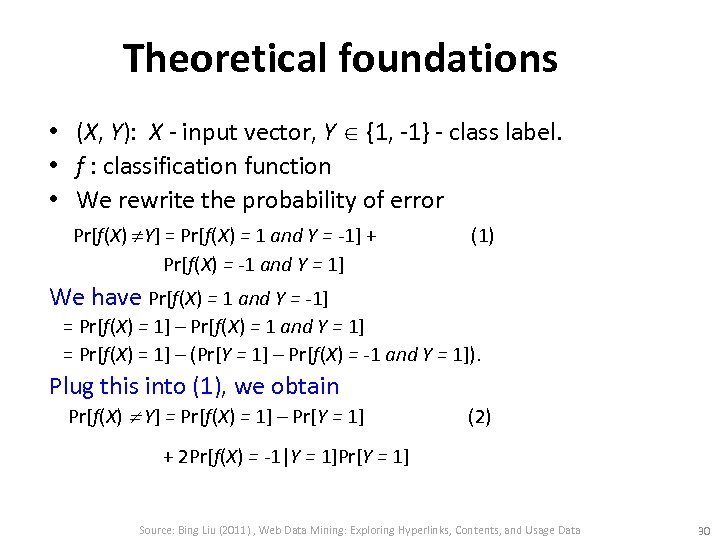
Theoretical foundations • (X, Y): X - input vector, Y {1, -1} - class label. • f : classification function • We rewrite the probability of error Pr[f(X) Y] = Pr[f(X) = 1 and Y = -1] + Pr[f(X) = -1 and Y = 1] (1) We have Pr[f(X) = 1 and Y = -1] = Pr[f(X) = 1] – Pr[f(X) = 1 and Y = 1] = Pr[f(X) = 1] – (Pr[Y = 1] – Pr[f(X) = -1 and Y = 1]). Plug this into (1), we obtain Pr[f(X) Y] = Pr[f(X) = 1] – Pr[Y = 1] (2) + 2 Pr[f(X) = -1|Y = 1]Pr[Y = 1] Source: Bing Liu (2011) , Web Data Mining: Exploring Hyperlinks, Contents, and Usage Data 30
![Theoretical foundations (cont) • Pr[f(X) Y] = Pr[f(X) = 1] – Pr[Y = 1]](https://present5.com/presentation/86549de28b654a3b30432876a9a79888/image-31.jpg "Theoretical foundations (cont) • Pr[f(X) Y] = Pr[f(X) = 1] – Pr[Y = 1]")
Theoretical foundations (cont) • Pr[f(X) Y] = Pr[f(X) = 1] – Pr[Y = 1] (2) + 2 Pr[f(X) = -1|Y = 1] Pr[Y = 1] • Note that Pr[Y = 1] is constant. • If we can hold Pr[f(X) = -1|Y = 1] small, then learning is approximately the same as minimizing Pr[f(X) = 1]. • Holding Pr[f(X) = -1|Y = 1] small while minimizing Pr[f(X) = 1] is approximately the same as – minimizing Pru[f(X) = 1] – while holding Pr. P[f(X) = 1] ≥ r (where r is recall Pr[f(X)=1| Y=1]) which is the same as (Prp[f(X) = -1] ≤ 1 – r) if the set of positive examples P and the set of unlabeled examples U are large enough. • Theorem 1 and Theorem 2 in [Liu et al 2002] state these formally in the noiseless case and in the noisy case. Source: Bing Liu (2011) , Web Data Mining: Exploring Hyperlinks, Contents, and Usage Data 31
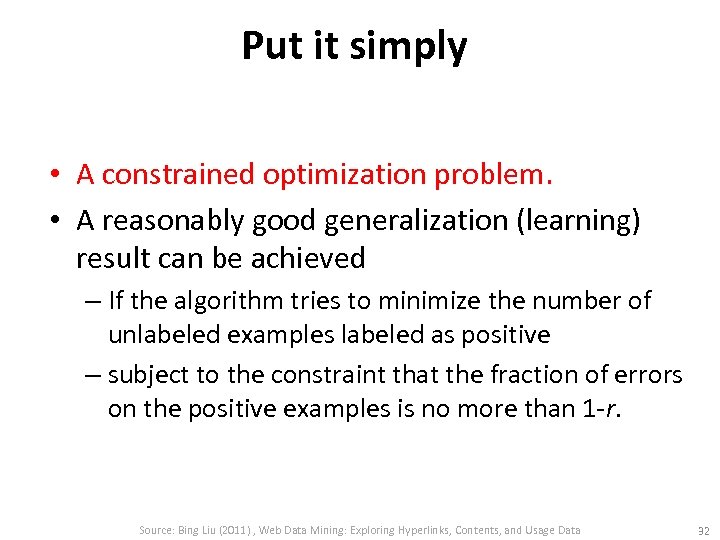
Put it simply • A constrained optimization problem. • A reasonably good generalization (learning) result can be achieved – If the algorithm tries to minimize the number of unlabeled examples labeled as positive – subject to the constraint that the fraction of errors on the positive examples is no more than 1 -r. Source: Bing Liu (2011) , Web Data Mining: Exploring Hyperlinks, Contents, and Usage Data 32
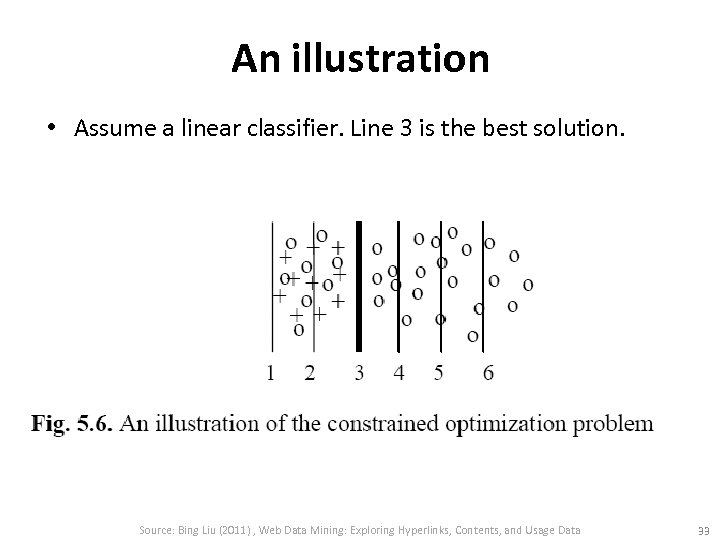
An illustration • Assume a linear classifier. Line 3 is the best solution. Source: Bing Liu (2011) , Web Data Mining: Exploring Hyperlinks, Contents, and Usage Data 33
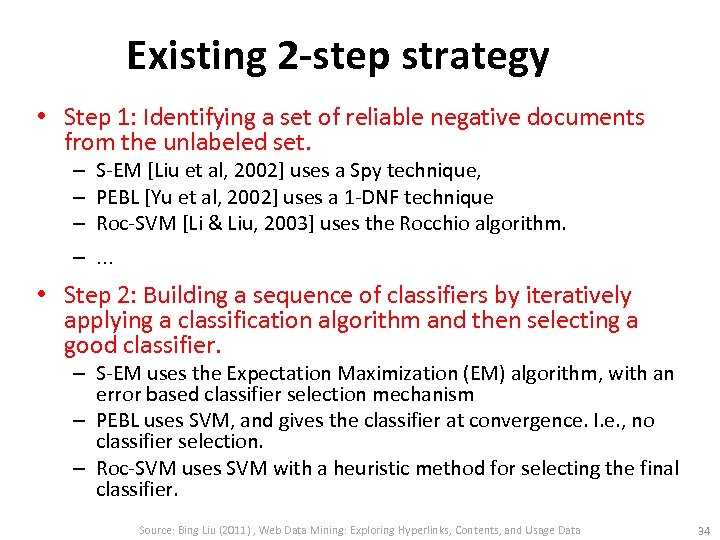
Existing 2 -step strategy • Step 1: Identifying a set of reliable negative documents from the unlabeled set. – S-EM [Liu et al, 2002] uses a Spy technique, – PEBL [Yu et al, 2002] uses a 1 -DNF technique – Roc-SVM [Li & Liu, 2003] uses the Rocchio algorithm. – … • Step 2: Building a sequence of classifiers by iteratively applying a classification algorithm and then selecting a good classifier. – S-EM uses the Expectation Maximization (EM) algorithm, with an error based classifier selection mechanism – PEBL uses SVM, and gives the classifier at convergence. I. e. , no classifier selection. – Roc-SVM uses SVM with a heuristic method for selecting the final classifier. Source: Bing Liu (2011) , Web Data Mining: Exploring Hyperlinks, Contents, and Usage Data 34
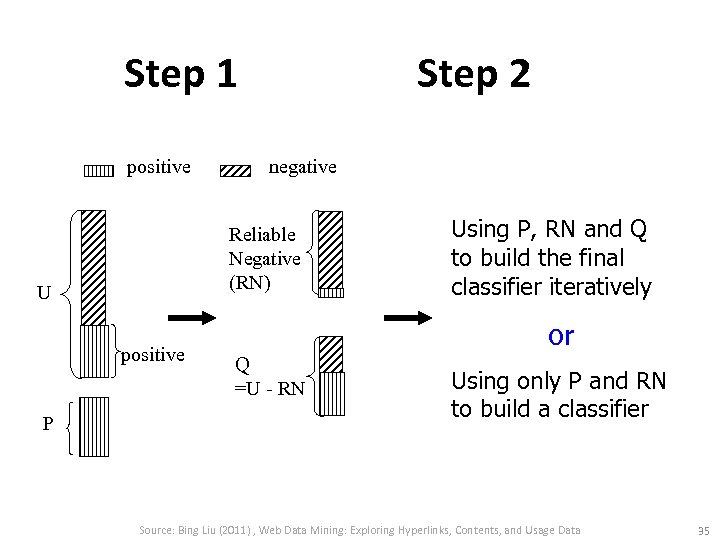
Step 1 positive negative Reliable Negative (RN) U positive P Step 2 Using P, RN and Q to build the final classifier iteratively or Q =U - RN Using only P and RN to build a classifier Source: Bing Liu (2011) , Web Data Mining: Exploring Hyperlinks, Contents, and Usage Data 35
Step 1: The Spy technique • Sample a certain % of positive examples and put them into unlabeled set to act as “spies”. • Run a classification algorithm assuming all unlabeled examples are negative, – we will know the behavior of those actual positive examples in the unlabeled set through the “spies”. • We can then extract reliable negative examples from the unlabeled set more accurately. Source: Bing Liu (2011) , Web Data Mining: Exploring Hyperlinks, Contents, and Usage Data 36
Step 1: Other methods • 1 -DNF method: – Find the set of words W that occur in the positive documents more frequently than in the unlabeled set. – Extract those documents from unlabeled set that do not contain any word in W. These documents form the reliable negative documents. • Rocchio method from information retrieval. • Naïve Bayesian method. Source: Bing Liu (2011) , Web Data Mining: Exploring Hyperlinks, Contents, and Usage Data 37
Step 2: Running EM or SVM iteratively (1) Running a classification algorithm iteratively – Run EM using P, RN and Q until it converges, or – Run SVM iteratively using P, RN and Q until this no document from Q can be classified as negative. RN and Q are updated in each iteration, or – … (2) Classifier selection. Source: Bing Liu (2011) , Web Data Mining: Exploring Hyperlinks, Contents, and Usage Data 38
Do they follow theory? • Yes, heuristic methods because – Step 1 tries to find some initial reliable negative examples from the unlabeled set. – Step 2 tried to identify more and more negative examples iteratively. • The two steps together form an iterative strategy of increasing the number of unlabeled examples that are classified as negative while maintaining the positive examples correctly classified. Source: Bing Liu (2011) , Web Data Mining: Exploring Hyperlinks, Contents, and Usage Data 39
Can SVM be applied directly? • Can we use SVM to directly deal with the problem of learning with positive and unlabeled examples, without using two steps? • Yes, with a little re-formulation. Source: Bing Liu (2011) , Web Data Mining: Exploring Hyperlinks, Contents, and Usage Data 40
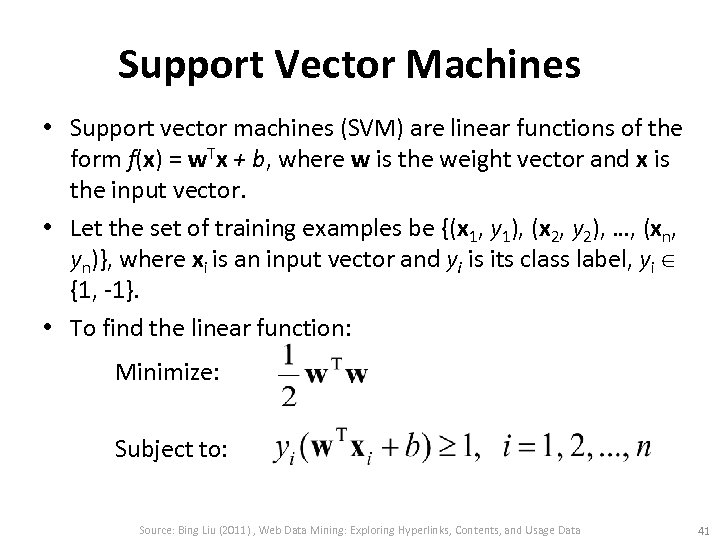
Support Vector Machines • Support vector machines (SVM) are linear functions of the form f(x) = w. Tx + b, where w is the weight vector and x is the input vector. • Let the set of training examples be {(x 1, y 1), (x 2, y 2), …, (xn, yn)}, where xi is an input vector and yi is its class label, yi {1, -1}. • To find the linear function: Minimize: Subject to: Source: Bing Liu (2011) , Web Data Mining: Exploring Hyperlinks, Contents, and Usage Data 41
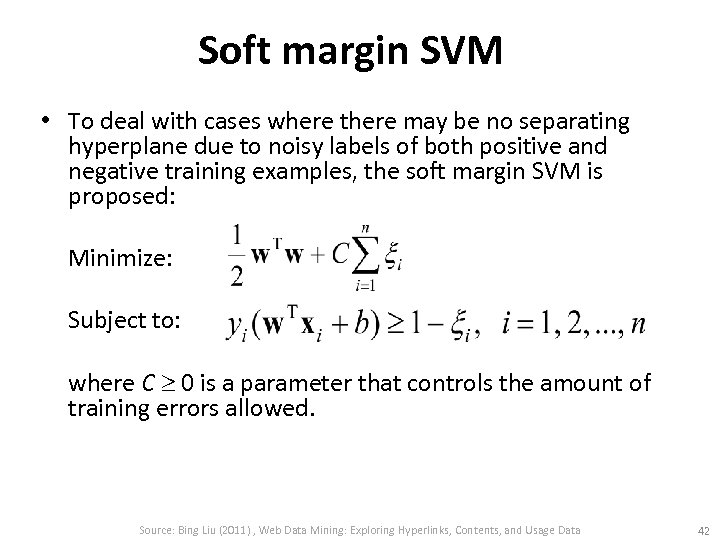
Soft margin SVM • To deal with cases where there may be no separating hyperplane due to noisy labels of both positive and negative training examples, the soft margin SVM is proposed: Minimize: Subject to: where C 0 is a parameter that controls the amount of training errors allowed. Source: Bing Liu (2011) , Web Data Mining: Exploring Hyperlinks, Contents, and Usage Data 42
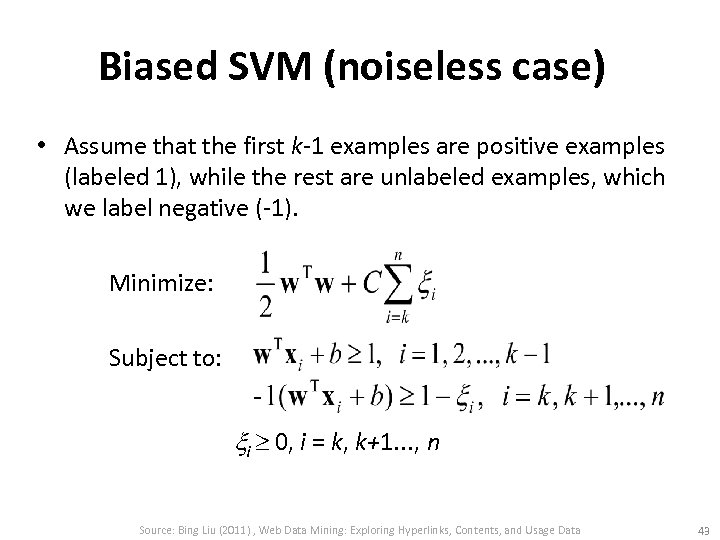
Biased SVM (noiseless case) • Assume that the first k-1 examples are positive examples (labeled 1), while the rest are unlabeled examples, which we label negative (-1). Minimize: Subject to: i 0, i = k, k+1…, n Source: Bing Liu (2011) , Web Data Mining: Exploring Hyperlinks, Contents, and Usage Data 43
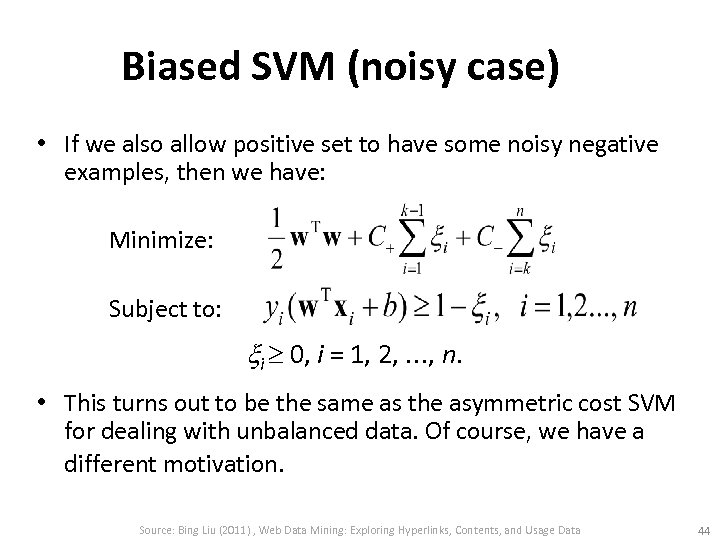
Biased SVM (noisy case) • If we also allow positive set to have some noisy negative examples, then we have: Minimize: Subject to: i 0, i = 1, 2, …, n. • This turns out to be the same as the asymmetric cost SVM for dealing with unbalanced data. Of course, we have a different motivation. Source: Bing Liu (2011) , Web Data Mining: Exploring Hyperlinks, Contents, and Usage Data 44
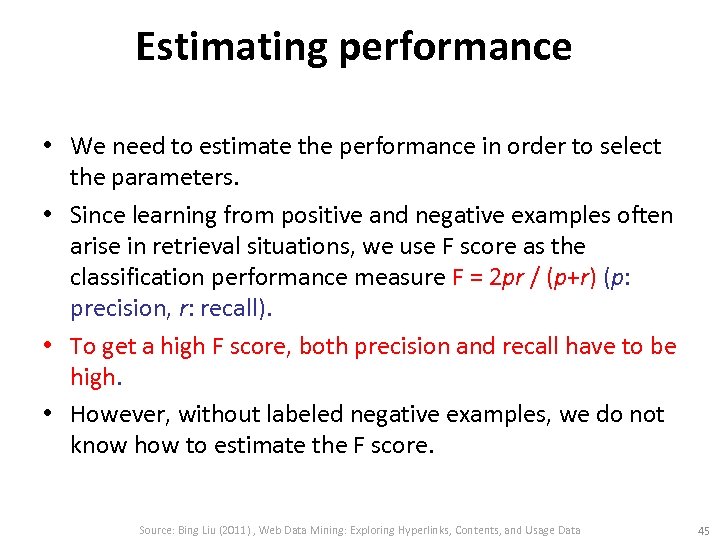
Estimating performance • We need to estimate the performance in order to select the parameters. • Since learning from positive and negative examples often arise in retrieval situations, we use F score as the classification performance measure F = 2 pr / (p+r) (p: precision, r: recall). • To get a high F score, both precision and recall have to be high. • However, without labeled negative examples, we do not know how to estimate the F score. Source: Bing Liu (2011) , Web Data Mining: Exploring Hyperlinks, Contents, and Usage Data 45
![A performance criterion • Performance criteria pr/Pr[Y=1]: It can be estimated directly from the](https://present5.com/presentation/86549de28b654a3b30432876a9a79888/image-46.jpg "A performance criterion • Performance criteria pr/Pr[Y=1]: It can be estimated directly from the")
A performance criterion • Performance criteria pr/Pr[Y=1]: It can be estimated directly from the validation set as r 2/Pr[f(X) = 1] – Recall r = Pr[f(X)=1| Y=1] – Precision p = Pr[Y=1| f(X)=1] To see this Pr[f(X)=1|Y=1] Pr[Y=1] = Pr[Y=1|f(X)=1] Pr[f(X)=1] //both side times r • Behavior similar to the F-score (= 2 pr / (p+r)) Source: Bing Liu (2011) , Web Data Mining: Exploring Hyperlinks, Contents, and Usage Data 46
![A performance criterion (cont …) • r 2/Pr[f(X) = 1] • r can be](https://present5.com/presentation/86549de28b654a3b30432876a9a79888/image-47.jpg "A performance criterion (cont …) • r 2/Pr[f(X) = 1] • r can be")
A performance criterion (cont …) • r 2/Pr[f(X) = 1] • r can be estimated from positive examples in the validation set. • Pr[f(X) = 1] can be obtained using the full validation set. • This criterion actually reflects theory very well. Source: Bing Liu (2011) , Web Data Mining: Exploring Hyperlinks, Contents, and Usage Data 47
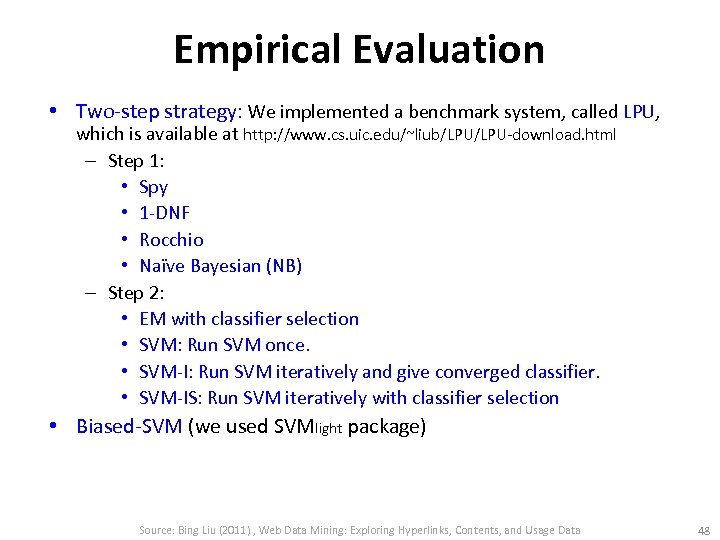
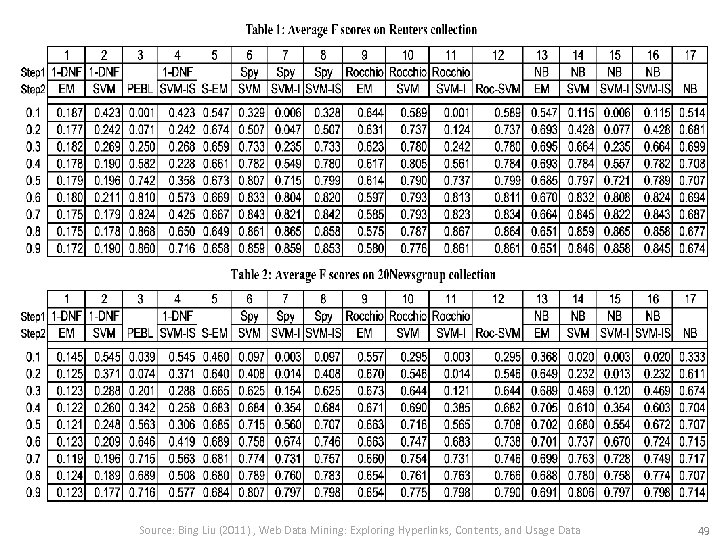
Empirical Evaluation • Two-step strategy: We implemented a benchmark system, called LPU, which is available at http: //www. cs. uic. edu/~liub/LPU-download. html – Step 1: • Spy • 1 -DNF • Rocchio • Naïve Bayesian (NB) – Step 2: • EM with classifier selection • SVM: Run SVM once. • SVM-I: Run SVM iteratively and give converged classifier. • SVM-IS: Run SVM iteratively with classifier selection • Biased-SVM (we used SVMlight package) Source: Bing Liu (2011) , Web Data Mining: Exploring Hyperlinks, Contents, and Usage Data 48
Source: Bing Liu (2011) , Web Data Mining: Exploring Hyperlinks, Contents, and Usage Data 49
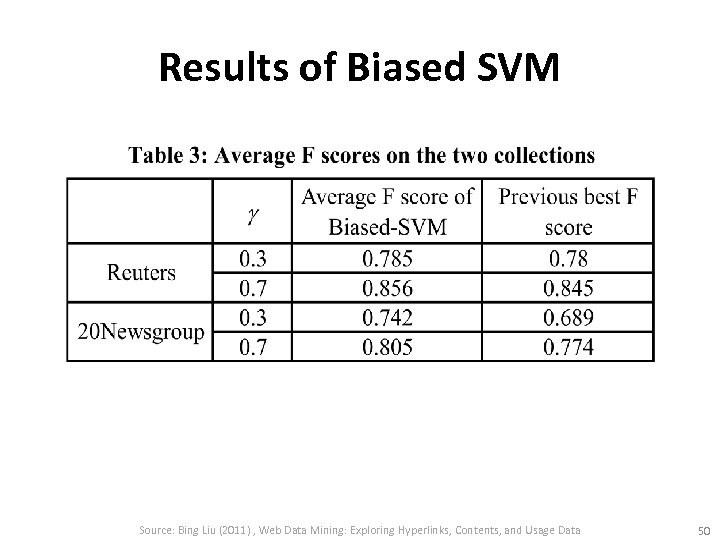
Results of Biased SVM Source: Bing Liu (2011) , Web Data Mining: Exploring Hyperlinks, Contents, and Usage Data 50
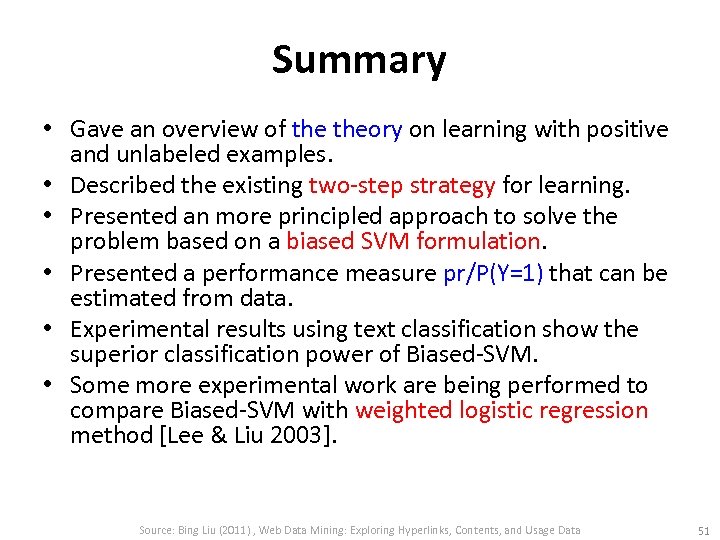
Summary • Gave an overview of theory on learning with positive and unlabeled examples. • Described the existing two-step strategy for learning. • Presented an more principled approach to solve the problem based on a biased SVM formulation. • Presented a performance measure pr/P(Y=1) that can be estimated from data. • Experimental results using text classification show the superior classification power of Biased-SVM. • Some more experimental work are being performed to compare Biased-SVM with weighted logistic regression method [Lee & Liu 2003]. Source: Bing Liu (2011) , Web Data Mining: Exploring Hyperlinks, Contents, and Usage Data 51
References • Bing Liu (2011) , “Web Data Mining: Exploring Hyperlinks, Contents, and Usage Data, ” 2 nd Edition, Springer. http: //www. cs. uic. edu/~liub/Web. Mining. Book. html 52
Скачать презентацию Web Mining 網路探勘 Partially Supervised Learning 部分監督式學習
86549de28b654a3b30432876a9a79888.ppt