 Скачать презентацию Web Development Design Foundations with HTML 5
17af2fb37888a75748a39b5b0dd855f9.ppt
- Количество слайдов: 36



Web Development & Design Foundations with HTML 5 8 th Edition CHAPTER 1 KEY CONCEPTS Copyright © Terry Felke-Morris http: //terrymorris. net 1
Writing Valid HTML Check your code for syntax errors ◦ Benefit: ◦ Valid code more consistent browser display W 3 C HTML Validation Tool ◦ http: //validator. w 3. org Copyright © Terry Felke-Morris http: //terrymorris. net 2
Internet The interconnected network of computer networks that spans the globe. Copyright © Terry Felke-Morris http: //terrymorris. net 3
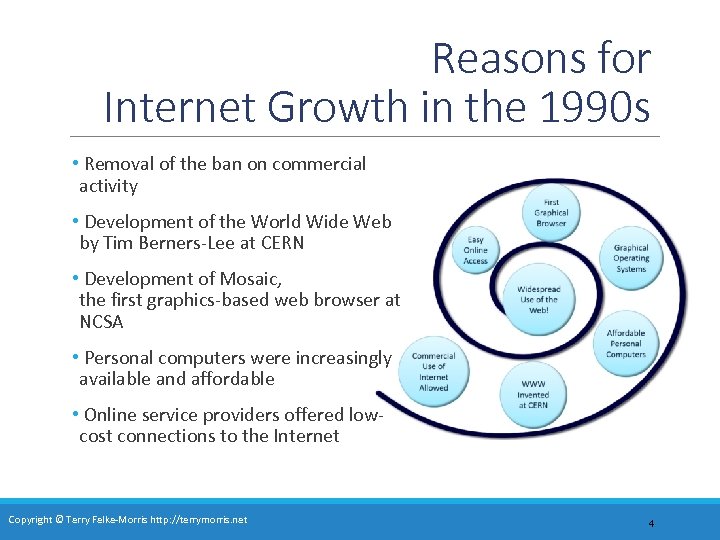
Reasons for Internet Growth in the 1990 s • Removal of the ban on commercial activity • Development of the World Wide Web by Tim Berners-Lee at CERN • Development of Mosaic, the first graphics-based web browser at NCSA • Personal computers were increasingly available and affordable • Online service providers offered lowcost connections to the Internet Copyright © Terry Felke-Morris http: //terrymorris. net 4
The World Wide Web The graphical user interface to information stored on computers running web servers connected to the Internet. Copyright © Terry Felke-Morris http: //terrymorris. net 5
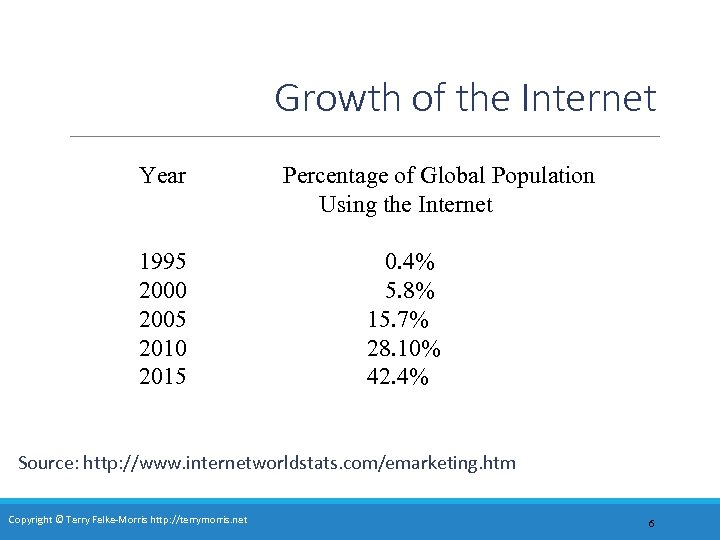
Growth of the Internet Year 1995 2000 2005 2010 2015 Percentage of Global Population Using the Internet 0. 4% 5. 8% 15. 7% 28. 10% 42. 4% Source: http: //www. internetworldstats. com/emarketing. htm Copyright © Terry Felke-Morris http: //terrymorris. net 6
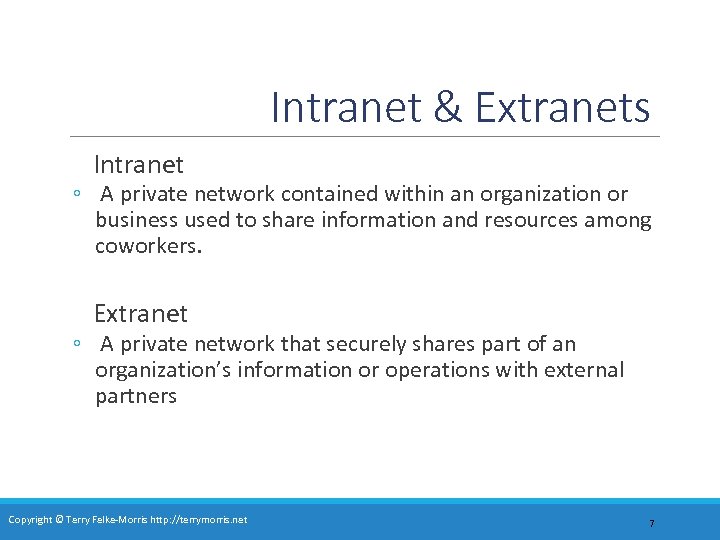
Intranet & Extranets Intranet ◦ A private network contained within an organization or business used to share information and resources among coworkers. Extranet ◦ A private network that securely shares part of an organization’s information or operations with external partners Copyright © Terry Felke-Morris http: //terrymorris. net 7
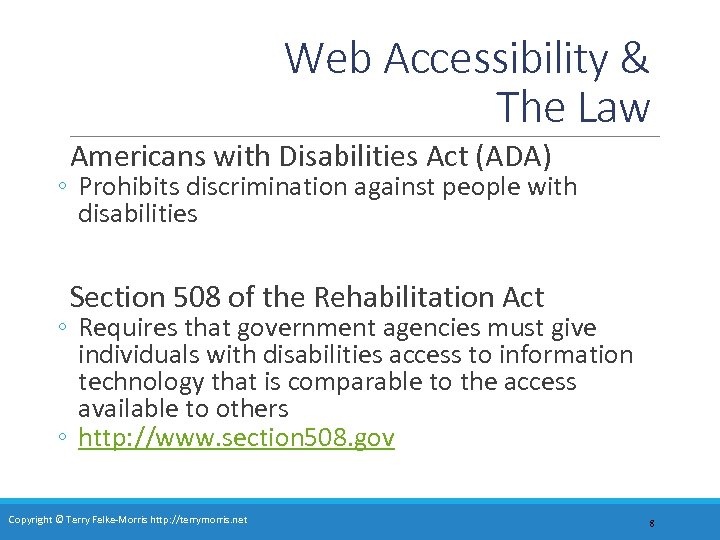
Web Accessibility & The Law Americans with Disabilities Act (ADA) ◦ Prohibits discrimination against people with disabilities Section 508 of the Rehabilitation Act ◦ Requires that government agencies must give individuals with disabilities access to information technology that is comparable to the access available to others ◦ http: //www. section 508. gov Copyright © Terry Felke-Morris http: //terrymorris. net 8
Universal Design for the Web Universal Design ◦ the design of products and environments to be usable by all people, to the greatest extent possible, without the need for adaptation or specialized design http: //www. ncsu. edu/www/ncsu/design/sod 5/cud/about_ud. htm Copyright © Terry Felke-Morris http: //terrymorris. net 9
Reliability & Information on the Web Questions to Ask: ◦ Is the organization credible? ◦ How recent is the information? ◦ Are there links to additional resources? ◦ Is it Wikipedia? Copyright © Terry Felke-Morris http: //terrymorris. net 10
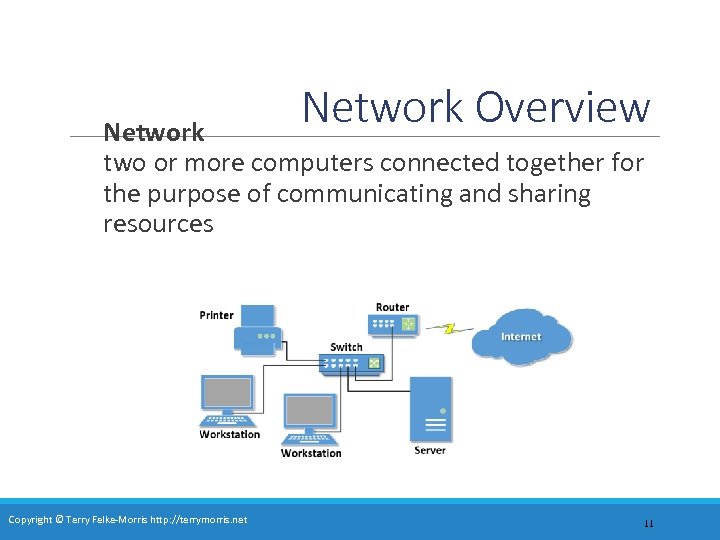
Network Overview Network two or more computers connected together for the purpose of communicating and sharing resources Copyright © Terry Felke-Morris http: //terrymorris. net 11
Networks LAN – Local Area Network ◦ Usually confined to a single building or group of buildings WAN – Wide Area Network ◦ Usually uses some form of public or commercial communications network to connect computers is widely dispersed geographical areas. Copyright © Terry Felke-Morris http: //terrymorris. net 12
Internet Infrastructure Internet Backbone A high capacity communication link that carries data gathered from smaller links that interconnect with it. Maps of the Internet Backbone ◦ http: //www. google. com/search? q=global+internet+backbone+map+images Copyright © Terry Felke-Morris http: //terrymorris. net 13
The Client/Server Model Client/Server can describe a relationship between two computer programs – the "client" and the "server". Client ◦ requests some type of service (such as a file or database access) from the server. Server ◦ fulfills the request and transmits the results to the client over a network Copyright © Terry Felke-Morris http: //terrymorris. net 14
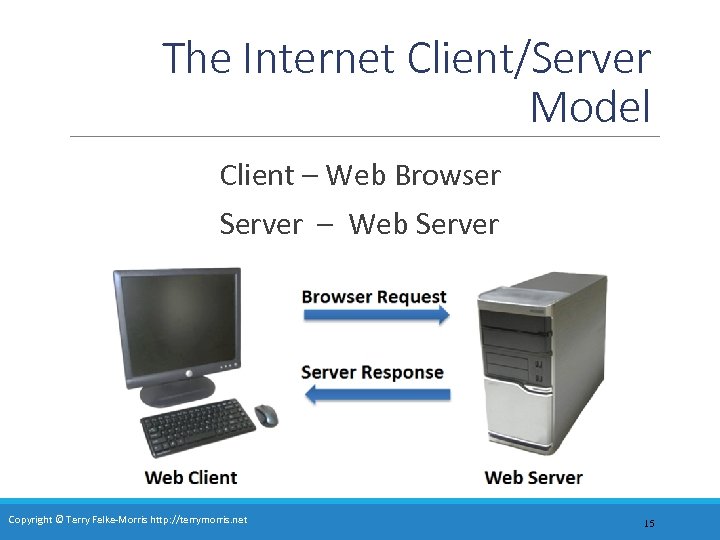
The Internet Client/Server Model Client – Web Browser Server – Web Server Copyright © Terry Felke-Morris http: //terrymorris. net 15
Web Client Connected to the Internet when needed Usually runs web browser (client) software (such as Internet Explorer or Firefox) Uses HTTP (Hypertext Transfer Protocol) Requests web pages from server Receives web pages and files from server Copyright © Terry Felke-Morris http: //terrymorris. net 16
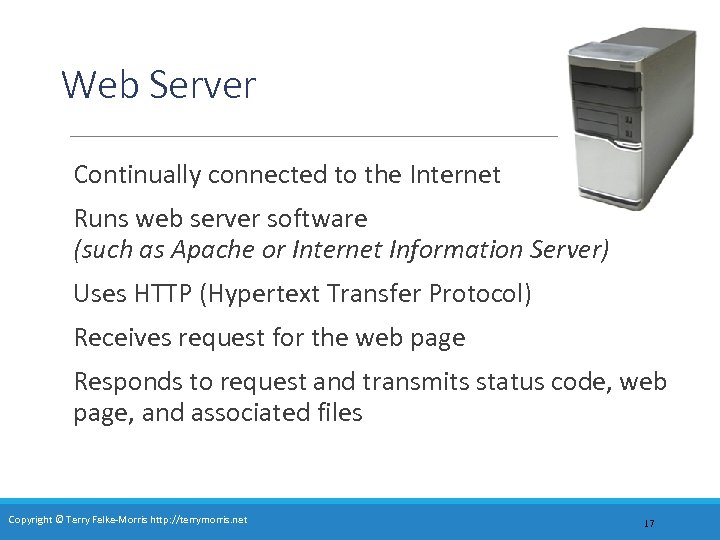
Web Server Continually connected to the Internet Runs web server software (such as Apache or Internet Information Server) Uses HTTP (Hypertext Transfer Protocol) Receives request for the web page Responds to request and transmits status code, web page, and associated files Copyright © Terry Felke-Morris http: //terrymorris. net 17
MIME Type Multi-Purpose Internet Mail Extension ◦ a set of rules that allow multimedia documents to be exchanged among many different computer systems Copyright © Terry Felke-Morris http: //terrymorris. net 18
Internet Protocols ◦ Rules that describe the methods used for clients and servers to communicate with each other over a network. ◦ There is no single protocol that makes the Internet and Web work. ◦ A number of protocols with specific functions are needed. Copyright © Terry Felke-Morris http: //terrymorris. net 19
FTP File Transfer Protocol A set of rules that allow files to be exchanged between computers on the Internet. Web developers commonly use FTP to transfer web page files from their computers to web servers. FTP is also used to download programs and files from other servers to individual computers. Copyright © Terry Felke-Morris http: //terrymorris. net 20
E-mail Protocols Sending E-mail ◦ SMTP Simple Mail Transfer Protocol Receiving E-mail ◦ POP (POP 3) Post Office Protocol ◦ IMAP Internet Mail Access Protocol Copyright © Terry Felke-Morris http: //terrymorris. net 21
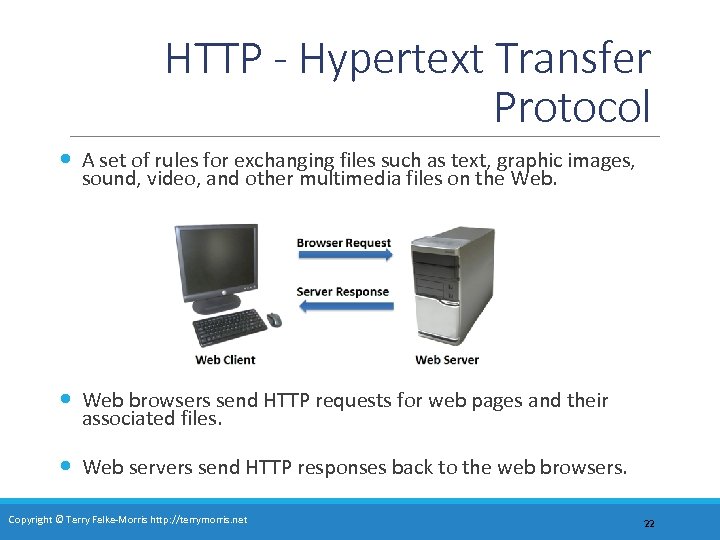
HTTP - Hypertext Transfer Protocol A set of rules for exchanging files such as text, graphic images, sound, video, and other multimedia files on the Web browsers send HTTP requests for web pages and their associated files. Web servers send HTTP responses back to the web browsers. Copyright © Terry Felke-Morris http: //terrymorris. net 22
TCP/IP Transmission Control Protocol/ Internet Protocol TCP/IP has been adopted as the official communication protocol of the Internet. TCP and IP have different functions that work together to ensure reliable communication over the Internet. Copyright © Terry Felke-Morris http: //terrymorris. net 23
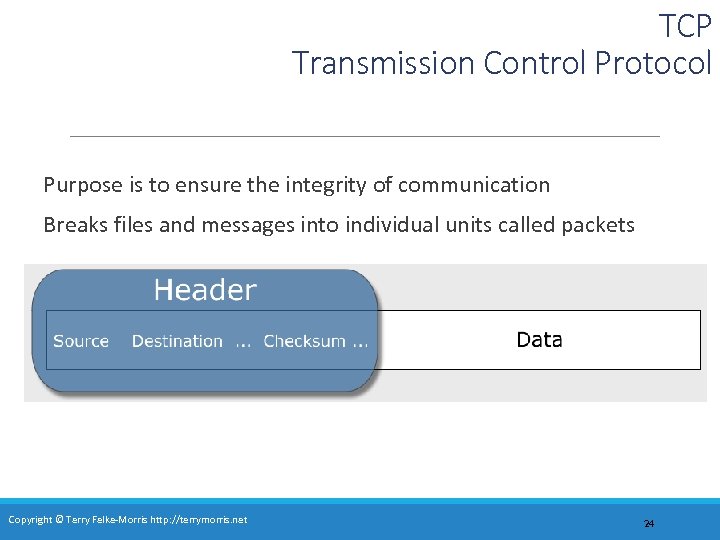
TCP Transmission Control Protocol Purpose is to ensure the integrity of communication Breaks files and messages into individual units called packets Copyright © Terry Felke-Morris http: //terrymorris. net 24
IP Internet Protocol A set of rules that controls how data is sent between computers on the Internet. IP routes a packet to the correct destination address. The packet gets successively forwarded to the next closest router (a hardware device designed to move network traffic) until it reaches its destination. http: //www. tracert. com/cgi-bin/trace. pl Copyright © Terry Felke-Morris http: //terrymorris. net 25
IP Address Each device connected to the Internet has a unique numeric IP address. These addresses consist of a set of four groups of numbers, called octets. 173. 194. 116. 72 will get you Google! An IP address may correspond to a domain name. Copyright © Terry Felke-Morris http: //terrymorris. net 26
Domain Name Locates an organization or other entity on the Internet Domain Name System ◦ Divides the Internet into logical groups and understandable names ◦ Associates unique computer IP Addresses with the textbased domain names you type into a web browser ◦ Browser: http: //google. com ◦ IP Address: 173. 194. 116. 72 Copyright © Terry Felke-Morris http: //terrymorris. net 27
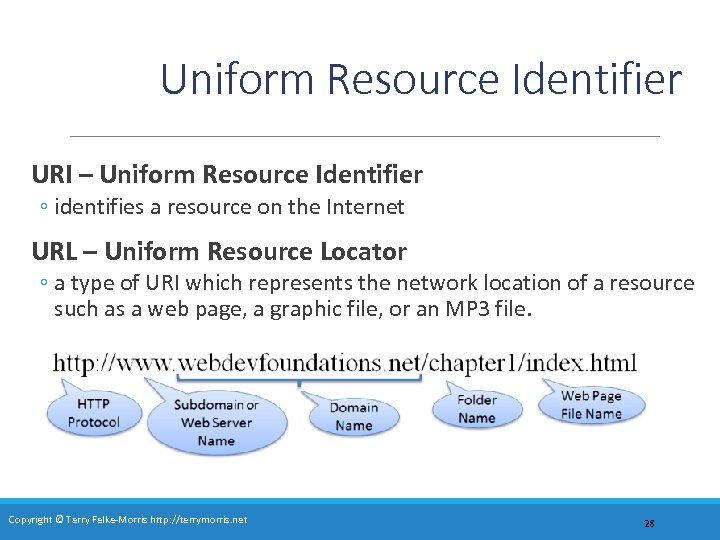
Uniform Resource Identifier URI – Uniform Resource Identifier ◦ identifies a resource on the Internet URL – Uniform Resource Locator ◦ a type of URI which represents the network location of a resource such as a web page, a graphic file, or an MP 3 file. Copyright © Terry Felke-Morris http: //terrymorris. net 28
TLD Top-Level Domain Name A top-level domain (TLD) identifies the rightmost part of the domain name. Examples of generic TLDs: . com, . org, . net, . mil, . gov, . edu, . int, . aero, . asia, . cat, . jobs, . name, . biz, . mobi, . museum, . info, . coop, . post, . pro, . tel, . travel Copyright © Terry Felke-Morris http: //terrymorris. net 29
County Code TLDs Two character codes originally intended to indicate the geographical location (country) of the web site. In practice, it is fairly easy to obtain a domain name with a country code TLD that is not local to the registrant. Examples: ◦. tv, . ws, . au, . jp, . uk ◦ See http: //www. iana. org/cctld-whois. htm Copyright © Terry Felke-Morris http: //terrymorris. net 30
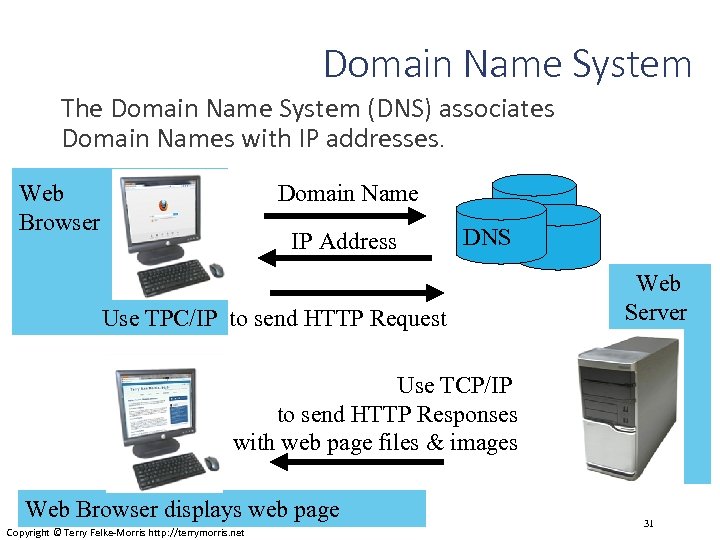
Domain Name System The Domain Name System (DNS) associates Domain Names with IP addresses. Web Browser Domain Name IP Address DNS Use TPC/IP to send HTTP Request Web Server Use TCP/IP to send HTTP Responses with web page files & images Web Browser displays web page Copyright © Terry Felke-Morris http: //terrymorris. net 31
Markup Languages SGML – Standard Generalized Markup Language ◦ A standard for specifying a markup language or tag set HTML – Hypertext Markup Language ◦ The set of markup symbols or codes placed in a file intended for display on a web browser. Copyright © Terry Felke-Morris http: //terrymorris. net 32
Markup Languages (2) XML – e. Xtensible Markup Language ◦ A text-based language designed to describe, deliver, and exchange structured information. ◦ It is not intended to replace HTML – it is intended to extend the power of HTML by separating data from presentation. Copyright © Terry Felke-Morris http: //terrymorris. net 33
Markup Languages (3) XHTML – e. Xtensible Hypertext Markup Language ◦ Developed by the W 3 C as the reformulation of HTML 4. 0 as an application of XML. ◦ It combines the formatting strengths of HTML 4. 0 and the data structure and extensibility strengths of XML. Copyright © Terry Felke-Morris http: //terrymorris. net 34
Markup Languages (4) HTML 5 ◦ The next version of HTML 4 and XHTML ◦ http: //www. w 3. org/html/ Copyright © Terry Felke-Morris http: //terrymorris. net 35
Popular Uses of the Internet E-Commerce Mobile Access Blogs Wikis Social Networking RSS Podcasts Web 2. 0 Cloud Computing Copyright © Terry Felke-Morris http: //terrymorris. net 36
Скачать презентацию Web Development Design Foundations with HTML 5
17af2fb37888a75748a39b5b0dd855f9.ppt