 Скачать презентацию Web-Based Library- and Information-Science Education Its Problems Its
2a38d4d7699e25df314b0af82fc208a0.ppt
- Количество слайдов: 60



Web-Based Library- and Information-Science Education: Its Problems, Its Promise, and Its Development at the Graduate School of Library and Information Science, The University of Texas at Austin Ronald E. Wyllys This presentation is available at http: //www. gslis. utexas. edu/~l 3875 rw/ GSLIS - The University of Texas at Austin Presented at the Tenth Transborder Library Forum, 2000 March 25
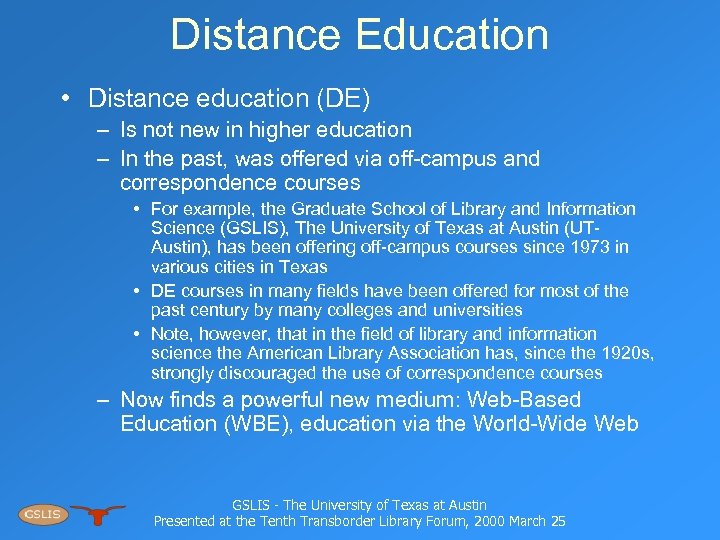
Distance Education • Distance education (DE) – Is not new in higher education – In the past, was offered via off-campus and correspondence courses • For example, the Graduate School of Library and Information Science (GSLIS), The University of Texas at Austin (UTAustin), has been offering off-campus courses since 1973 in various cities in Texas • DE courses in many fields have been offered for most of the past century by many colleges and universities • Note, however, that in the field of library and information science the American Library Association has, since the 1920 s, strongly discouraged the use of correspondence courses – Now finds a powerful new medium: Web-Based Education (WBE), education via the World-Wide Web GSLIS - The University of Texas at Austin Presented at the Tenth Transborder Library Forum, 2000 March 25
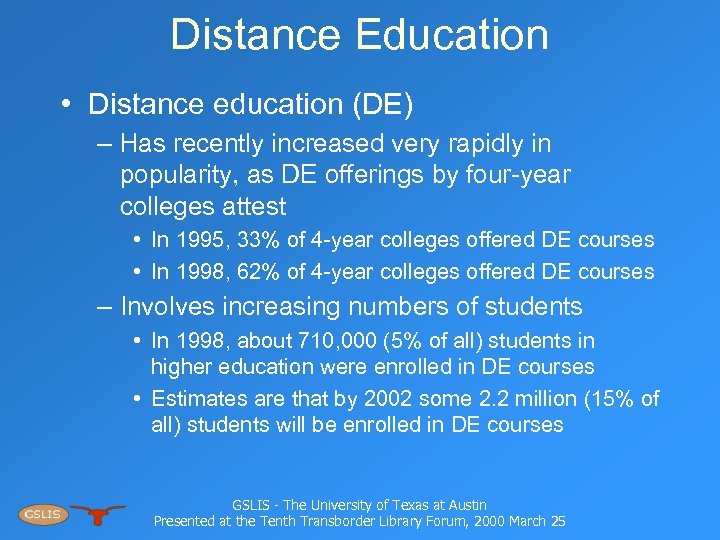
Distance Education • Distance education (DE) – Has recently increased very rapidly in popularity, as DE offerings by four-year colleges attest • In 1995, 33% of 4 -year colleges offered DE courses • In 1998, 62% of 4 -year colleges offered DE courses – Involves increasing numbers of students • In 1998, about 710, 000 (5% of all) students in higher education were enrolled in DE courses • Estimates are that by 2002 some 2. 2 million (15% of all) students will be enrolled in DE courses GSLIS - The University of Texas at Austin Presented at the Tenth Transborder Library Forum, 2000 March 25
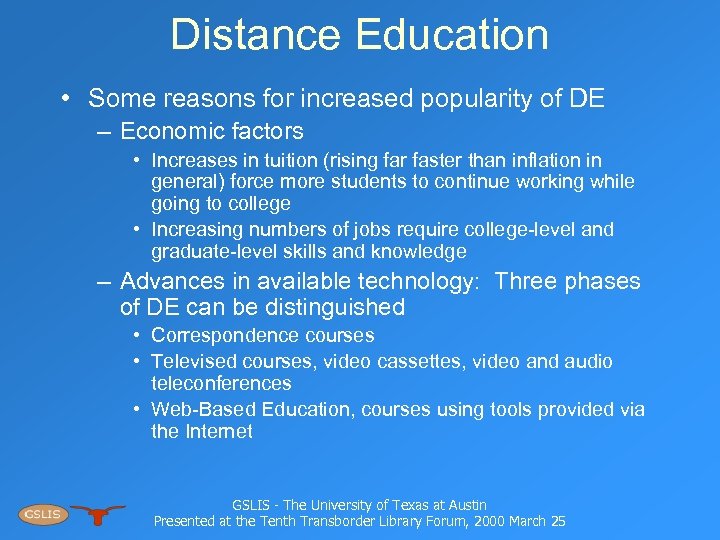
Distance Education • Some reasons for increased popularity of DE – Economic factors • Increases in tuition (rising far faster than inflation in general) force more students to continue working while going to college • Increasing numbers of jobs require college-level and graduate-level skills and knowledge – Advances in available technology: Three phases of DE can be distinguished • Correspondence courses • Televised courses, video cassettes, video and audio teleconferences • Web-Based Education, courses using tools provided via the Internet GSLIS - The University of Texas at Austin Presented at the Tenth Transborder Library Forum, 2000 March 25
Web-Based Education • Present report – Is based on a study that was the focus of the Fall 1999 class in Systems Analysis and Evaluation at GSLIS • This GSLIS study was conducted by – Students: Andrew Adaryukov, Sheron Barnes, Allison Bartman, Malaika Boyd, Travis Duke, Yun-Ho Jung, Ching Lien, Chiao-Feng Lin, Mark Linsenmayer, Yue Liu, Itzel Mc. Claren, Michelle Minto, Carlos Ovalle, Anne Price, C. S. Roshan, Morrie Schulman, Nancy Sparks, Ross Speir, Chris Stewart, Astrid Stimac, John Stubbe, Ryan Sullivan, Jiayin Tang, Alexia Thompson-Young, Mary Tucker, Carolyn Wickoff – Instructor: R. E. Wyllys GSLIS - The University of Texas at Austin Presented at the Tenth Transborder Library Forum, 2000 March 25
Web-Based Education • The GSLIS study examined five broad areas – History and overview of WBE – Instructional design for WBE – Faculty and staff views of WBE and what they need in order to offer WBE – Student views of WBE – Technology tools and needs for WBE • Full text of the GSLIS study is available on the World-Wide Web. To obtain it, start at http: //www. gslis. utexas. edu/~l 3875 rw/ GSLIS - The University of Texas at Austin Presented at the Tenth Transborder Library Forum, 2000 March 25
Highlights of WBE History at UT-Austin • 1993: WBE at UT-Austin began when UT put its first 2 servers on the Web, joining 123 other Web servers in the world at that time • 1994: Award-winning World Lecture Hall started (http: //www. utexas. edu/lecture) • 1996: Center for Instructional Technologies was founded to champion innovative instructional technologies at UT-Austin (http: //www. utexas. edu/cc/cit/) • 1999: UT-Austin's Technology Enhanced Learning Committee report states: The question. . . is not whether we [UT-Austin] should get involved. We should. Peter Drucker. . . predicts the demise of the American university in the next 20 years if costs continue to escalate. If universities are unwilling to change, private industry will be happy to supply remotely the learning environments that students need to achieve their educational goals. GSLIS - The University of Texas at Austin Presented at the Tenth Transborder Library Forum, 2000 March 25
Highlights of WBE History in the GSLIS • Late 1980 s: First use of email by faculty for communicating with students in certain classes. (Email is now a part of all GSLIS courses. ) • 1994: First use of Webpages for course materials in selected classes. • 1994 - 2000: Rapidly increasing use of Web for a variety of course materials, in an increasing number of GSLIS courses. Today almost all GSLIS courses make considerable use of Web for materials and communication and thus are heavily, though not completely, Web-based (WB) GSLIS - The University of Texas at Austin Presented at the Tenth Transborder Library Forum, 2000 March 25
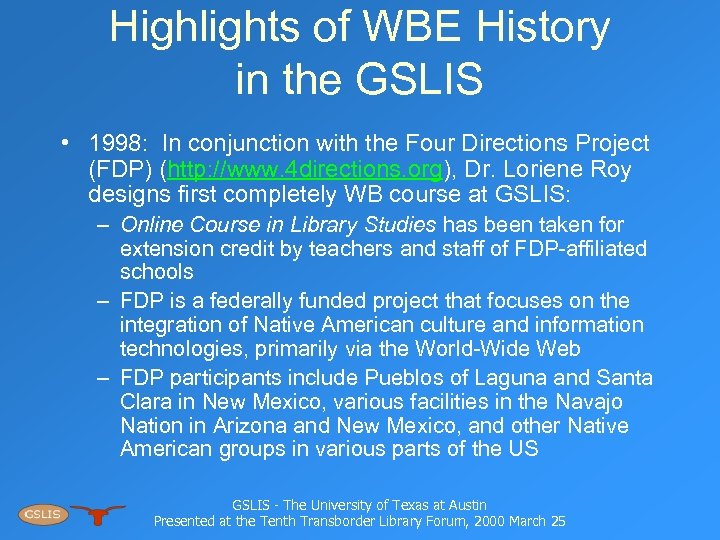
Highlights of WBE History in the GSLIS • 1998: In conjunction with the Four Directions Project (FDP) (http: //www. 4 directions. org), Dr. Loriene Roy designs first completely WB course at GSLIS: – Online Course in Library Studies has been taken for extension credit by teachers and staff of FDP-affiliated schools – FDP is a federally funded project that focuses on the integration of Native American culture and information technologies, primarily via the World-Wide Web – FDP participants include Pueblos of Laguna and Santa Clara in New Mexico, various facilities in the Navajo Nation in Arizona and New Mexico, and other Native American groups in various parts of the US GSLIS - The University of Texas at Austin Presented at the Tenth Transborder Library Forum, 2000 March 25
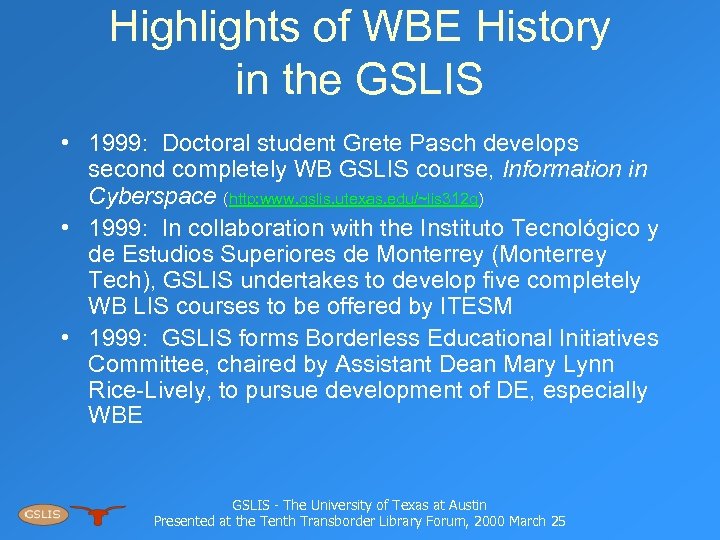
Highlights of WBE History in the GSLIS • 1999: Doctoral student Grete Pasch develops second completely WB GSLIS course, Information in Cyberspace (http: www. gslis. utexas. edu/~lis 312 g) • 1999: In collaboration with the Instituto Tecnológico y de Estudios Superiores de Monterrey (Monterrey Tech), GSLIS undertakes to develop five completely WB LIS courses to be offered by ITESM • 1999: GSLIS forms Borderless Educational Initiatives Committee, chaired by Assistant Dean Mary Lynn Rice-Lively, to pursue development of DE, especially WBE GSLIS - The University of Texas at Austin Presented at the Tenth Transborder Library Forum, 2000 March 25
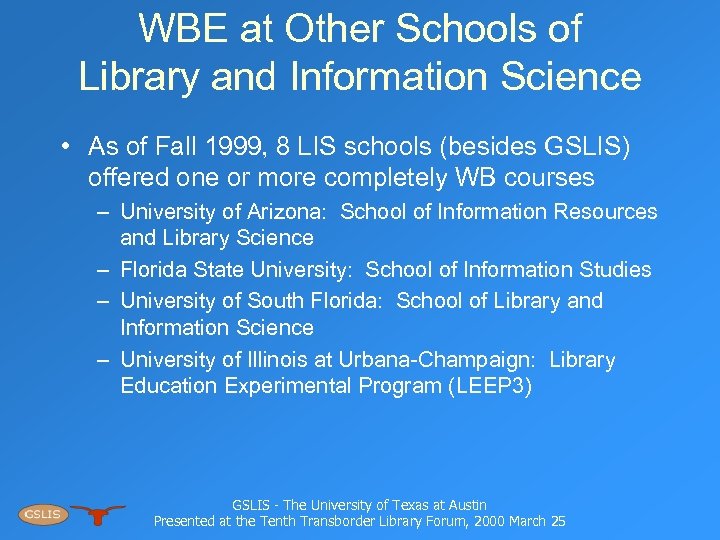
WBE at Other Schools of Library and Information Science • As of Fall 1999, 8 LIS schools (besides GSLIS) offered one or more completely WB courses – University of Arizona: School of Information Resources and Library Science – Florida State University: School of Information Studies – University of South Florida: School of Library and Information Science – University of Illinois at Urbana-Champaign: Library Education Experimental Program (LEEP 3) GSLIS - The University of Texas at Austin Presented at the Tenth Transborder Library Forum, 2000 March 25
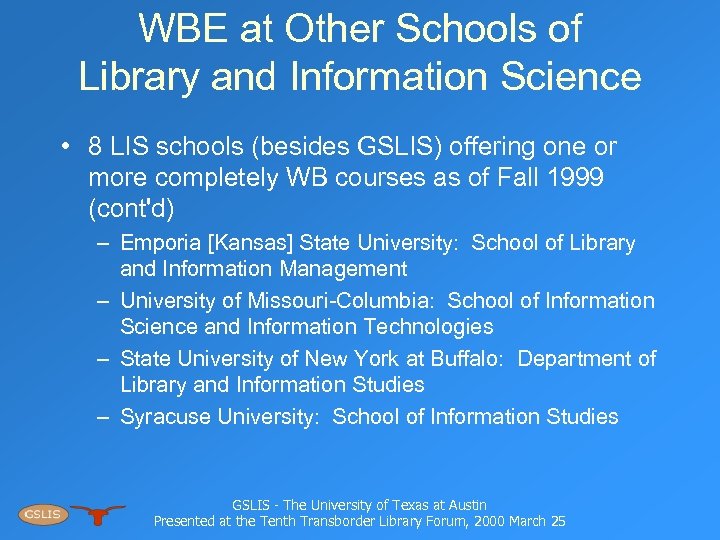
WBE at Other Schools of Library and Information Science • 8 LIS schools (besides GSLIS) offering one or more completely WB courses as of Fall 1999 (cont'd) – Emporia [Kansas] State University: School of Library and Information Management – University of Missouri-Columbia: School of Information Science and Information Technologies – State University of New York at Buffalo: Department of Library and Information Studies – Syracuse University: School of Information Studies GSLIS - The University of Texas at Austin Presented at the Tenth Transborder Library Forum, 2000 March 25
WBE at Other Schools of Library and Information Science • Most of the 9 schools offer 15 -25% (typically, 4 to 6) of their courses as WB. Largest numbers are: – Florida State Univ. offers 21 out of its 45 courses – Syracuse University offers 13 WB courses each semester • All 9 programs have require some on-campus participation – Shortest is FSU, which requires a 3 -day on-campus orientation – UIUC's LEEP 3 and Syracuse require a summer orientation and introductory period, plus brief on-campus periods before each semester GSLIS - The University of Texas at Austin Presented at the Tenth Transborder Library Forum, 2000 March 25
WBE at Other Schools of Library and Information Science • Most popular software programs for WBE at the 9 schools: – Web. CT (http: //www. webct. com/) – Course. Info (http: //www. blackboard. com/) – First. Class (http: //www. softarc. com/index. shtml) • The 8 schools (besides GSLIS) require students to have at least the following equipment: – – – At least a 486 -based PC or equivalent Macintosh A high-speed modem with at least 28, 000 bps rate Direct access to the Internet via dialup or faster connection A graphical Web browser in an up-to-date version Email capability, in browser or other application software GSLIS - The University of Texas at Austin Presented at the Tenth Transborder Library Forum, 2000 March 25
Concerns concerning WBE • Accreditation: What do accreditation agencies think of WBE? – Southern Association of Colleges and Schools (UT -Austin's accreditor) recognizes validity of DE – ALA's Committee on Accreditation (the GSLIS MLIS program's accreditor) does not currently distinguish among forms of delivery of course material. Main COA concern is that DE courses make available to DE students services comparable to those of on-campus courses GSLIS - The University of Texas at Austin Presented at the Tenth Transborder Library Forum, 2000 March 25
Concerns concerning WBE (cont'd) • Usability: To make WBE usable requires – User analysis: what do users want? what do they need? Note that "users" includes students, instructors, and staff. – Task analysis: what tasks must be accomplished? What skills are needed for the tasks? who in organization can provide (or acquire) these skills? – Interface analysis, design, and testing: it is crucial that WBE lesson plans, tools, and modules be tested before being put into general use GSLIS - The University of Texas at Austin Presented at the Tenth Transborder Library Forum, 2000 March 25
Concerns concerning WBE (cont'd) • Accessibility – What are access requirements of typical students? • General equipment needs noted in earlier slide • Any special equipment needs for particular courses? – What are special access needs of individuals with disabilities? (Cf. ADA guidelines as to disabilities) • Web content and accessibility guidelines (http: //www. w 3. org/wai) • • Web. ABLE Solutions (http: //www. Web. ABLE. com) HTML Writer’s guide Web site (http: //www. hwg. org) Microsoft’s Enable site (http: //www. microsoft. com/enable) An automated accessibility evaluator (http: //www. cast. org/bobby) GSLIS - The University of Texas at Austin Presented at the Tenth Transborder Library Forum, 2000 March 25
Concerns concerning WBE (cont'd) • Copyright – Current copyright law provides for "fair use" of copyright materials for certain teaching and research purposes – Copyright is a very complicated area of questions involving statutes, case law, and numerous questions arising from Web use that have yet to be adjudicated – UT-Austin has appointed, as its Manager of Intellectual Property, an attorney, Georgia Harper, who has provided several online pages dealing with copyright, including • "Copyright and the University" (http: //www. utsystem. edu/OGC/Intellectual. Property/admin. htm) • "Crash Course in Copyright” (http: //www. utsystem. edu/OGC/Intellectual. Property/cprtindx. htm#top) GSLIS - The University of Texas at Austin Presented at the Tenth Transborder Library Forum, 2000 March 25
Concerns concerning WBE (cont'd) • Copyright – Other sources of information on copyright and WBE • UCLA Office of Instructional Development - Copyright Issues for Academics (http: //www. oid. ucla. edu/fnmc/fairuse. htm) • The Copyright Website (http: //www. benedict. com/) • Stanford University Libraries' Copyright and Fair Use (http: //fairuse. stanford. edu/) • US Copyright Office Report on Copyright and Digital Distance Education (http: //www. loc. gov/copyright/) • Copyright Law on the Internet (http: //www. cli. org/Caching. html) GSLIS - The University of Texas at Austin Presented at the Tenth Transborder Library Forum, 2000 March 25
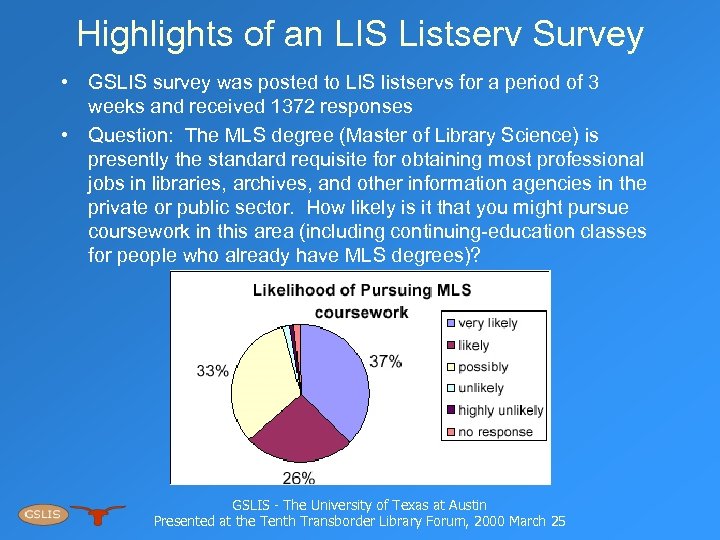
Highlights of an LIS Listserv Survey • GSLIS survey was posted to LIS listservs for a period of 3 weeks and received 1372 responses • Question: The MLS degree (Master of Library Science) is presently the standard requisite for obtaining most professional jobs in libraries, archives, and other information agencies in the private or public sector. How likely is it that you might pursue coursework in this area (including continuing-education classes for people who already have MLS degrees)? GSLIS - The University of Texas at Austin Presented at the Tenth Transborder Library Forum, 2000 March 25
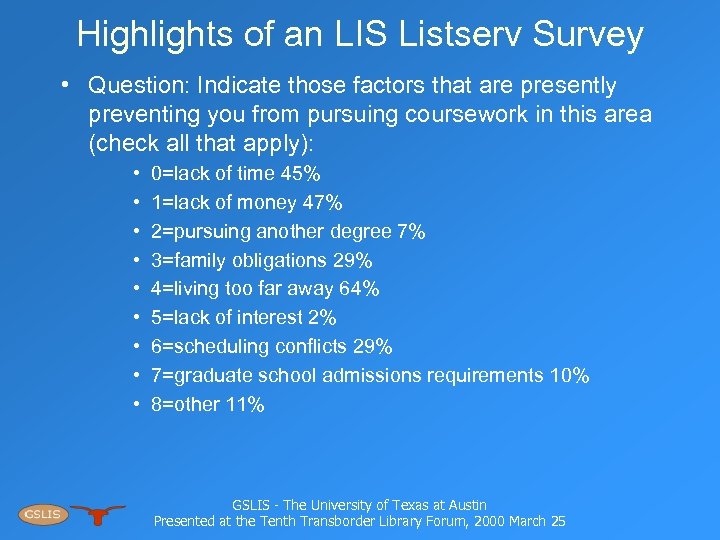
Highlights of an LIS Listserv Survey • Question: Indicate those factors that are presently preventing you from pursuing coursework in this area (check all that apply): • • • 0=lack of time 45% 1=lack of money 47% 2=pursuing another degree 7% 3=family obligations 29% 4=living too far away 64% 5=lack of interest 2% 6=scheduling conflicts 29% 7=graduate school admissions requirements 10% 8=other 11% GSLIS - The University of Texas at Austin Presented at the Tenth Transborder Library Forum, 2000 March 25
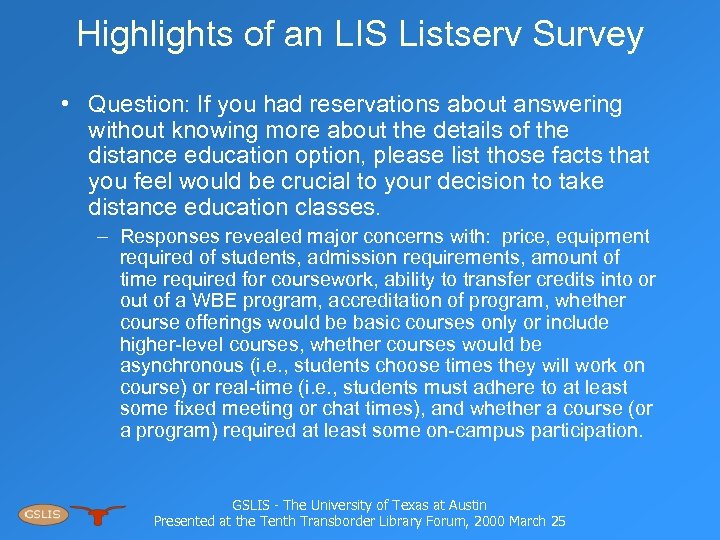
Highlights of an LIS Listserv Survey • Question: If you had reservations about answering without knowing more about the details of the distance education option, please list those facts that you feel would be crucial to your decision to take distance education classes. – Responses revealed major concerns with: price, equipment required of students, admission requirements, amount of time required for coursework, ability to transfer credits into or out of a WBE program, accreditation of program, whether course offerings would be basic courses only or include higher-level courses, whether courses would be asynchronous (i. e. , students choose times they will work on course) or real-time (i. e. , students must adhere to at least some fixed meeting or chat times), and whether a course (or a program) required at least some on-campus participation. GSLIS - The University of Texas at Austin Presented at the Tenth Transborder Library Forum, 2000 March 25
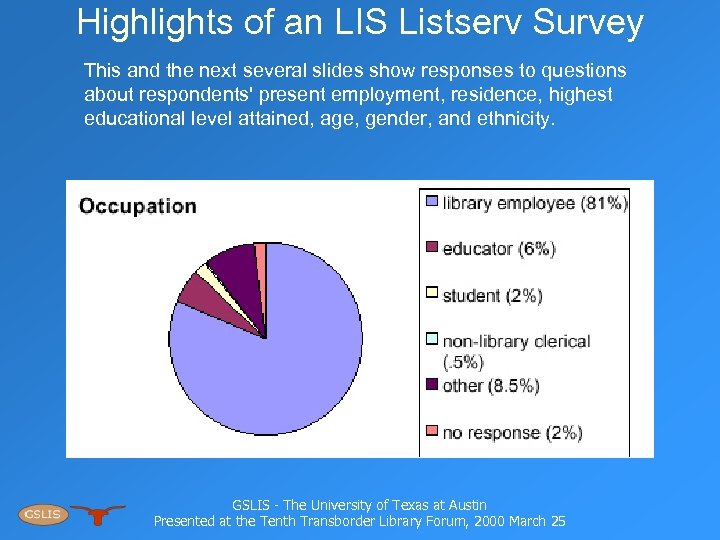
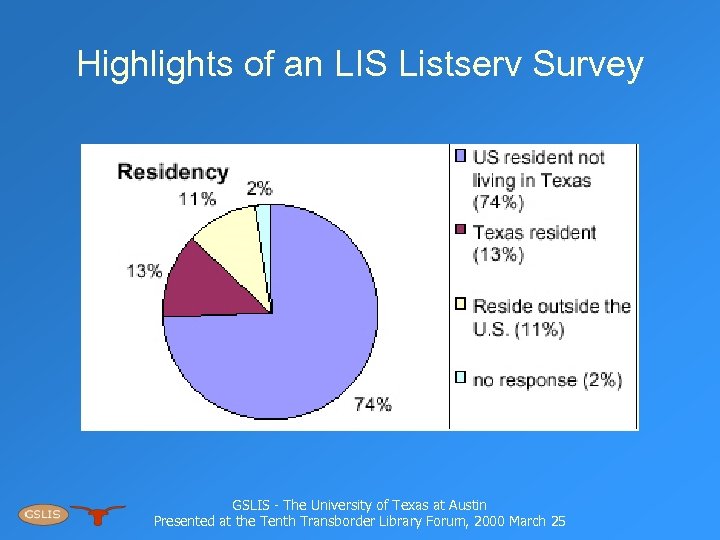
Highlights of an LIS Listserv Survey This and the next several slides show responses to questions about respondents' present employment, residence, highest educational level attained, age, gender, and ethnicity. GSLIS - The University of Texas at Austin Presented at the Tenth Transborder Library Forum, 2000 March 25
Highlights of an LIS Listserv Survey GSLIS - The University of Texas at Austin Presented at the Tenth Transborder Library Forum, 2000 March 25
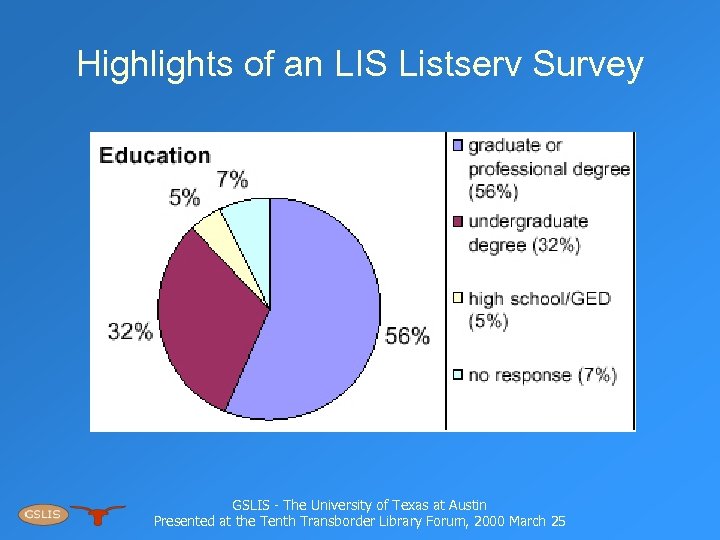
Highlights of an LIS Listserv Survey GSLIS - The University of Texas at Austin Presented at the Tenth Transborder Library Forum, 2000 March 25
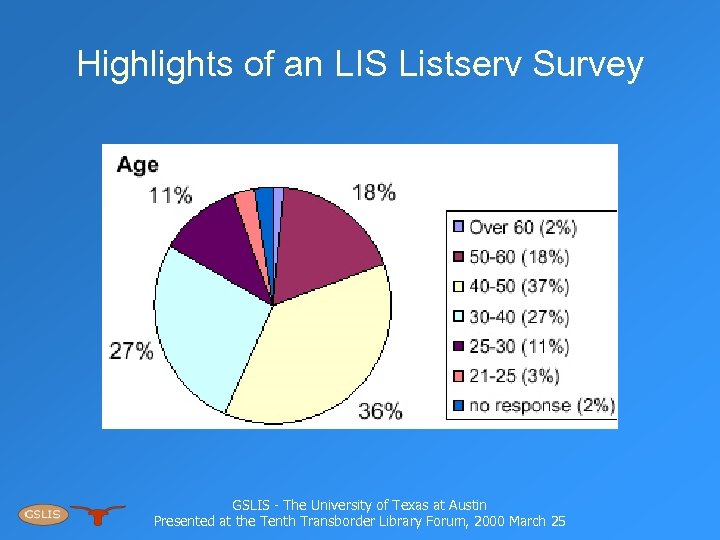
Highlights of an LIS Listserv Survey GSLIS - The University of Texas at Austin Presented at the Tenth Transborder Library Forum, 2000 March 25
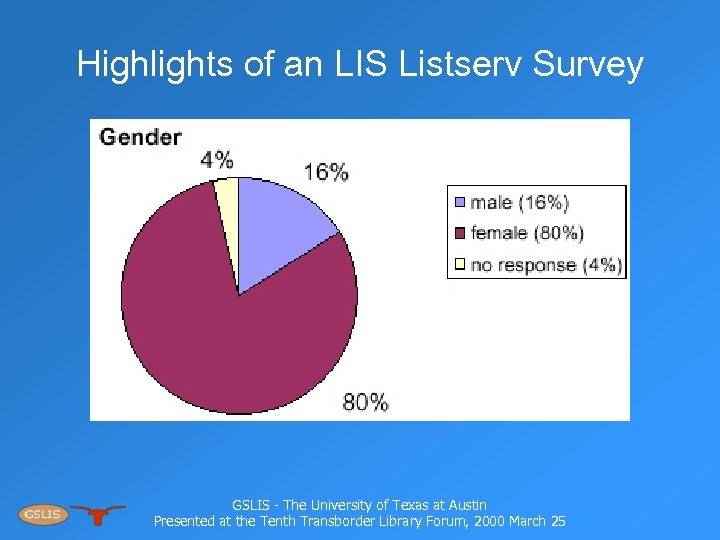
Highlights of an LIS Listserv Survey GSLIS - The University of Texas at Austin Presented at the Tenth Transborder Library Forum, 2000 March 25
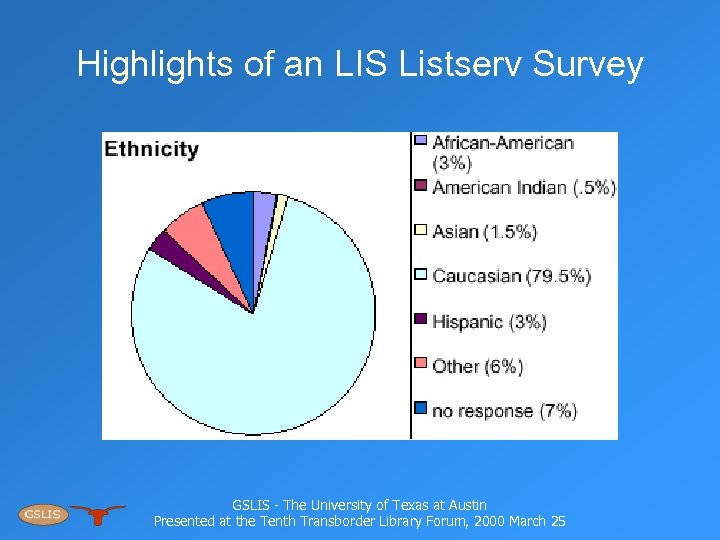
Highlights of an LIS Listserv Survey GSLIS - The University of Texas at Austin Presented at the Tenth Transborder Library Forum, 2000 March 25
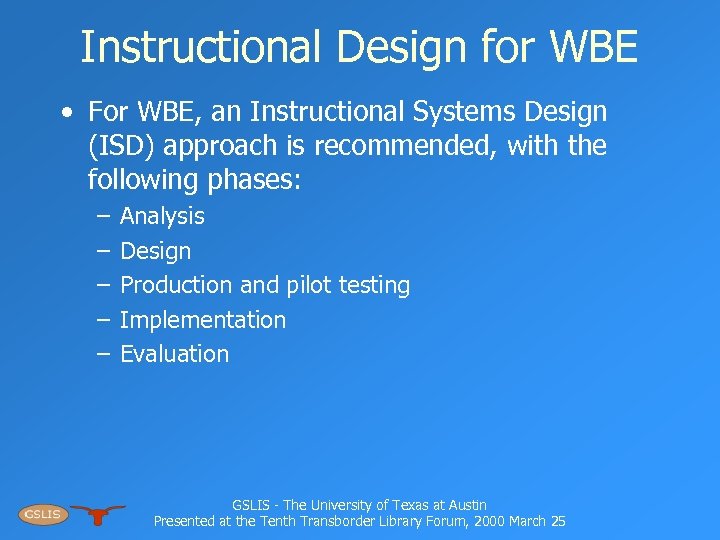
Instructional Design for WBE • For WBE, an Instructional Systems Design (ISD) approach is recommended, with the following phases: – – – Analysis Design Production and pilot testing Implementation Evaluation GSLIS - The University of Texas at Austin Presented at the Tenth Transborder Library Forum, 2000 March 25
Instructional Design for WBE • Other issues in ISD for WBE – Time factors – Cost factors – Skills needed by students and faculty – Team development GSLIS - The University of Texas at Austin Presented at the Tenth Transborder Library Forum, 2000 March 25
Instructional Design for WBE • An instructional development plan for a WB course must – Determine instructional strategies and learning design – Provide opportunities for interaction – Allow for varied learning styles – Choose an instruction-delivery system – Design and prepare content GSLIS - The University of Texas at Austin Presented at the Tenth Transborder Library Forum, 2000 March 25
Instructional Design for WBE • To design and prepare content for a WB course, developers must – Organize the content for delivery on the Web – Provide the student with orientation and navigation clues within the content – Devise templates and standards – Create storyboards and flowcharts • WB courses need to be developed by teams of people with varied skills. Individuals who possess all the needed skills are rare. GSLIS - The University of Texas at Austin Presented at the Tenth Transborder Library Forum, 2000 March 25
Faculty & Staff in WBE • A 1999 study by UCLA's Higher Education Research Institute 1 found that technological innovation is a major source of stress for faculty members of U. S. universities and colleges. • Next slide is a graph of the HERI findings arranged by faculty ages 1 Available at: http: //www. gseis. ucla. edu/heri/Faculty_Overview. html GSLIS - The University of Texas at Austin Presented at the Tenth Transborder Library Forum, 2000 March 25
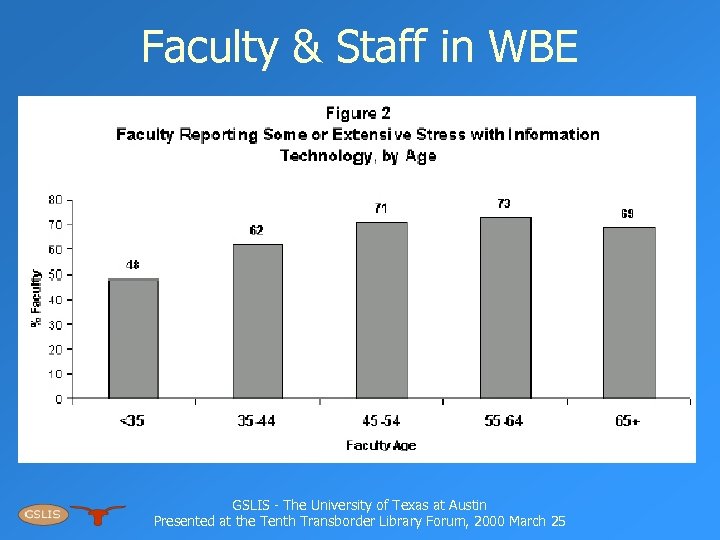
Faculty & Staff in WBE GSLIS - The University of Texas at Austin Presented at the Tenth Transborder Library Forum, 2000 March 25
Faculty & Staff in WBE • GSLIS study found that faculty and staff – Have numerous concerns regarding WBE – Must work together to provide satisfactory WBE – Must be persuaded, not forced, into participating in WBE – Must be convinced that their participation in WBE will be properly recognized in pay, promotion, and tenure decisions GSLIS - The University of Texas at Austin Presented at the Tenth Transborder Library Forum, 2000 March 25
Recommendations concerning Faculty-Staff and WBE • A school of LIS must – Establish specific goals, policies, standards, and objectives for a WBE program and its role in fulfilling the school's overall objectives – Articulate the WBE mission to faculty, staff, and students – Determine a single point of contact responsible for coordinating WBE – Designate administrative staff responsible that include • Registration and enrollment • Student advising • Tuition and financial aid coordination GSLIS - The University of Texas at Austin Presented at the Tenth Transborder Library Forum, 2000 March 25
Recommendations concerning Faculty-Staff and WBE (cont'd) • A school of LIS must – Market and promote the WBE program – Promote faculty collaboration within the school as well as with faculty in other disciplines within the university – Provide faculty training and development programs, and resources for WBE technical skills as well as for pedagogical methods – Maintain computing and telecommunications resources for faculty and students – Continuously monitor effectiveness of WBE and work to improve it GSLIS - The University of Texas at Austin Presented at the Tenth Transborder Library Forum, 2000 March 25
Recommendations concerning Faculty-Staff and WBE (cont'd) • A school of LIS must – Develop a WBE staff that includes at least • Instructional designer • Programmer/Technician • Graphics Designer/Video Producer – Provide technically savvy Teaching Assistants to assist participating faculty – Utilize pertinent resources elsewhere within the university – Employ the school's students, as well as students from other disciplines, in student WBE jobs – Pay competitive salaries for WBE professional staff GSLIS - The University of Texas at Austin Presented at the Tenth Transborder Library Forum, 2000 March 25
Recommendations concerning Faculty-Staff and WBE (cont'd) • A school of LIS must – Encourage faculty participation in WBE, including experimentation, and by seriously considering and resolving factors that tend to work against faculty participation – Provide a solid support system, clearly stated policies and expectations, and adequate compensation and training before requiring faculty to participate in WBE – Ensure that faculty experimenting with WBE share their discoveries with non-participating faculty, e. g. , through round-table discussions of WBE – Ensure that faculty are involved and contribute to WBE as team members, but final decisions on a school's WBE must remain with school's administration GSLIS - The University of Texas at Austin Presented at the Tenth Transborder Library Forum, 2000 March 25
Students and WBE • Overall, students have many concerns with WBE but also generally view it as having a high potential for being beneficial GSLIS - The University of Texas at Austin Presented at the Tenth Transborder Library Forum, 2000 March 25
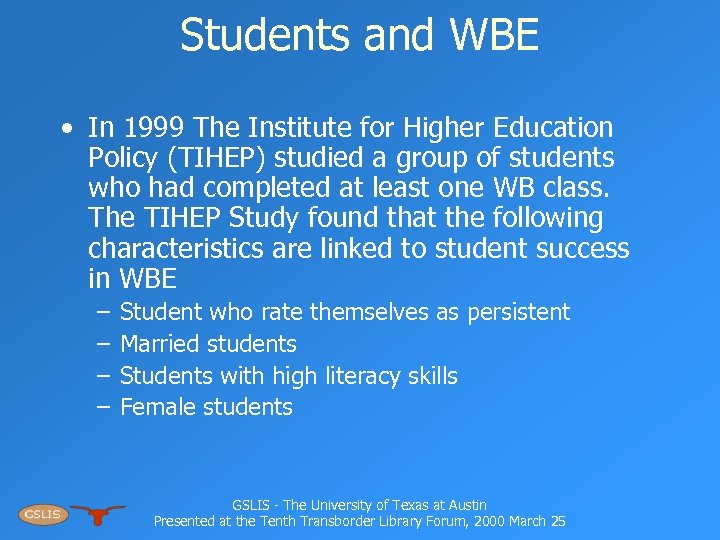
Students and WBE • In 1999 The Institute for Higher Education Policy (TIHEP) studied a group of students who had completed at least one WB class. The TIHEP Study found that the following characteristics are linked to student success in WBE – – Student who rate themselves as persistent Married students Students with high literacy skills Female students GSLIS - The University of Texas at Austin Presented at the Tenth Transborder Library Forum, 2000 March 25
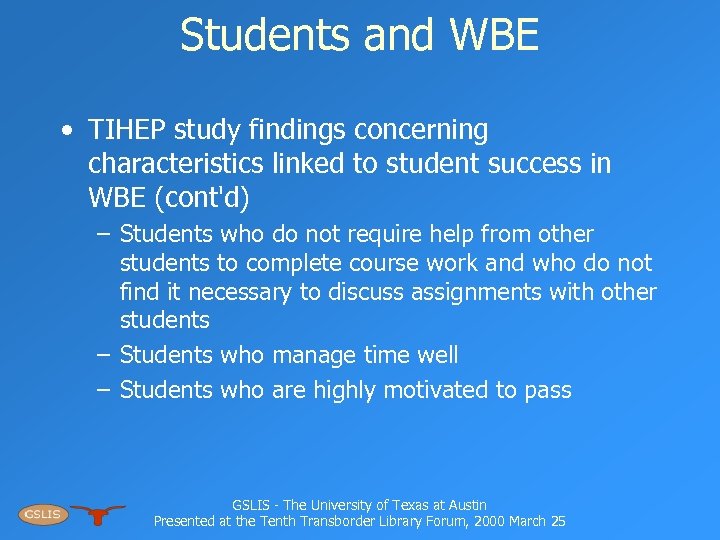
Students and WBE • TIHEP study findings concerning characteristics linked to student success in WBE (cont'd) – Students who do not require help from other students to complete course work and who do not find it necessary to discuss assignments with other students – Students who manage time well – Students who are highly motivated to pass GSLIS - The University of Texas at Austin Presented at the Tenth Transborder Library Forum, 2000 March 25
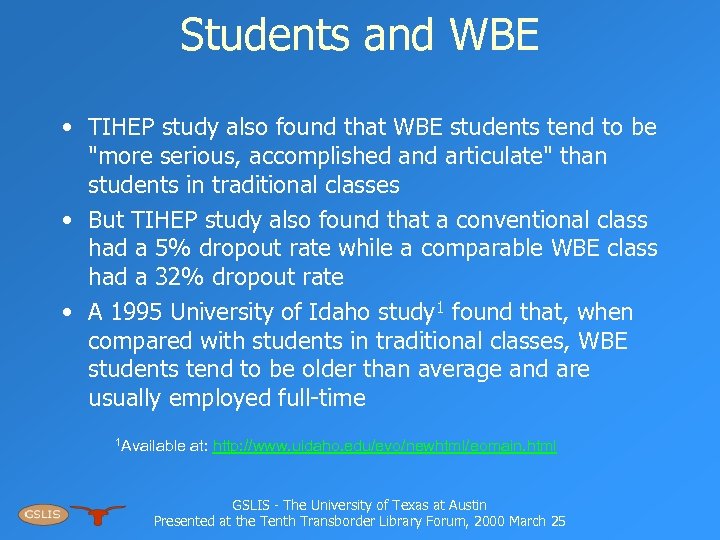
Students and WBE • TIHEP study also found that WBE students tend to be "more serious, accomplished and articulate" than students in traditional classes • But TIHEP study also found that a conventional class had a 5% dropout rate while a comparable WBE class had a 32% dropout rate • A 1995 University of Idaho study 1 found that, when compared with students in traditional classes, WBE students tend to be older than average and are usually employed full-time 1 Available at: http: //www. uidaho. edu/evo/newhtml/eomain. html GSLIS - The University of Texas at Austin Presented at the Tenth Transborder Library Forum, 2000 March 25
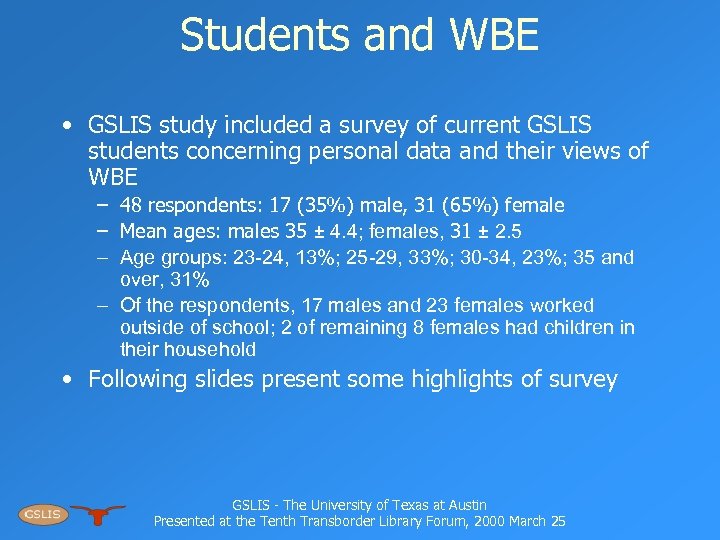
Students and WBE • GSLIS study included a survey of current GSLIS students concerning personal data and their views of WBE – 48 respondents: 17 (35%) male, 31 (65%) female – Mean ages: males 35 ± 4. 4; females, 31 ± 2. 5 – Age groups: 23 -24, 13%; 25 -29, 33%; 30 -34, 23%; 35 and over, 31% – Of the respondents, 17 males and 23 females worked outside of school; 2 of remaining 8 females had children in their household • Following slides present some highlights of survey GSLIS - The University of Texas at Austin Presented at the Tenth Transborder Library Forum, 2000 March 25
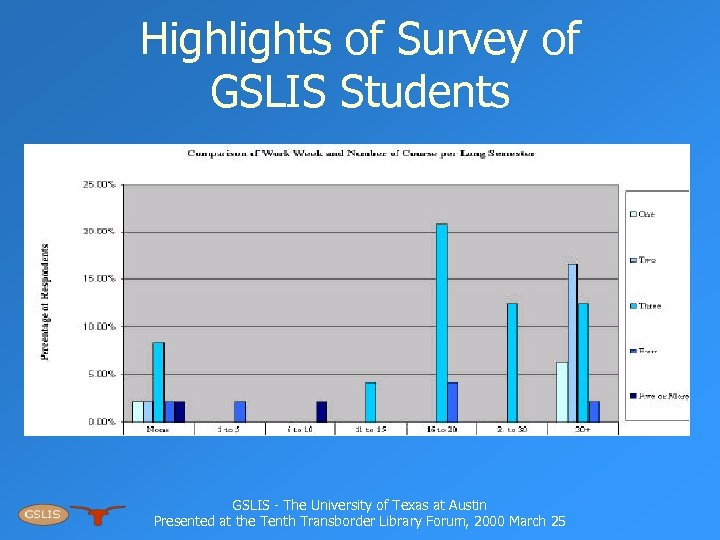
Highlights of Survey of GSLIS Students GSLIS - The University of Texas at Austin Presented at the Tenth Transborder Library Forum, 2000 March 25
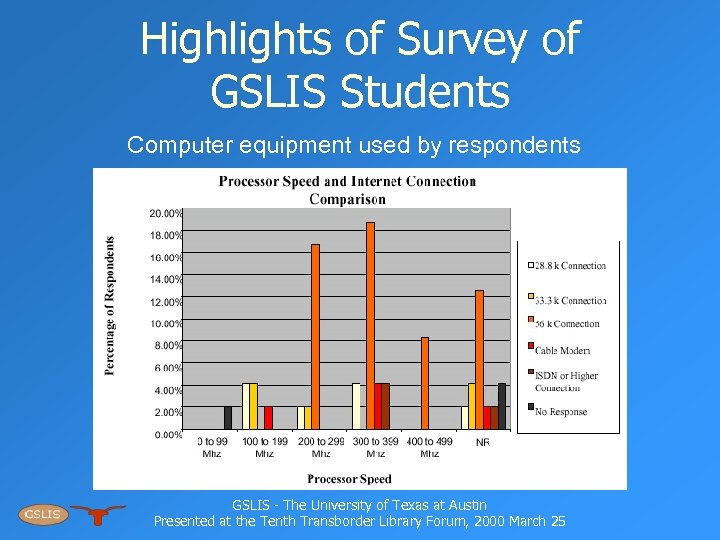
Highlights of Survey of GSLIS Students Computer equipment used by respondents GSLIS - The University of Texas at Austin Presented at the Tenth Transborder Library Forum, 2000 March 25
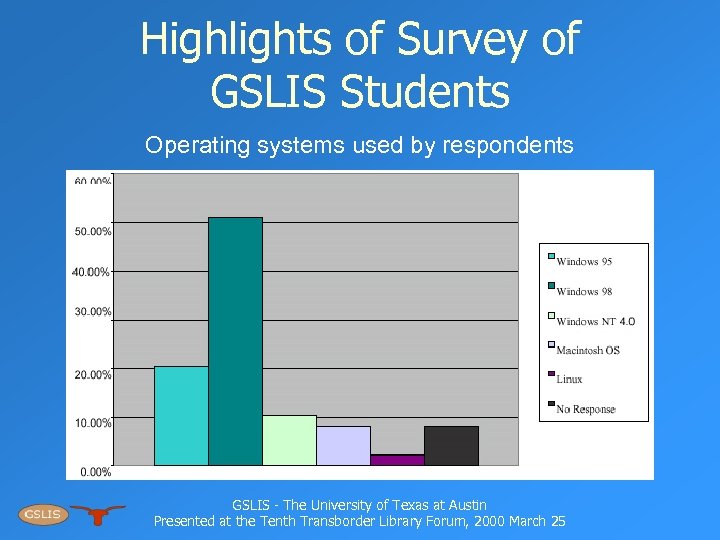
Highlights of Survey of GSLIS Students Operating systems used by respondents GSLIS - The University of Texas at Austin Presented at the Tenth Transborder Library Forum, 2000 March 25
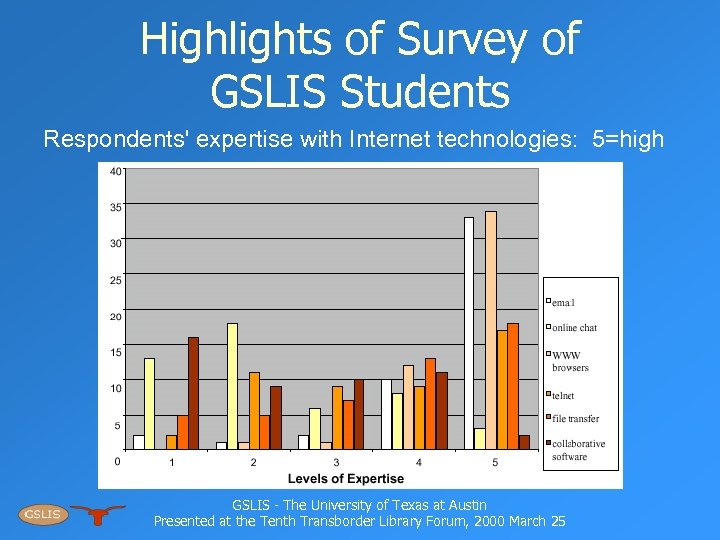
Highlights of Survey of GSLIS Students Respondents' expertise with Internet technologies: 5=high GSLIS - The University of Texas at Austin Presented at the Tenth Transborder Library Forum, 2000 March 25
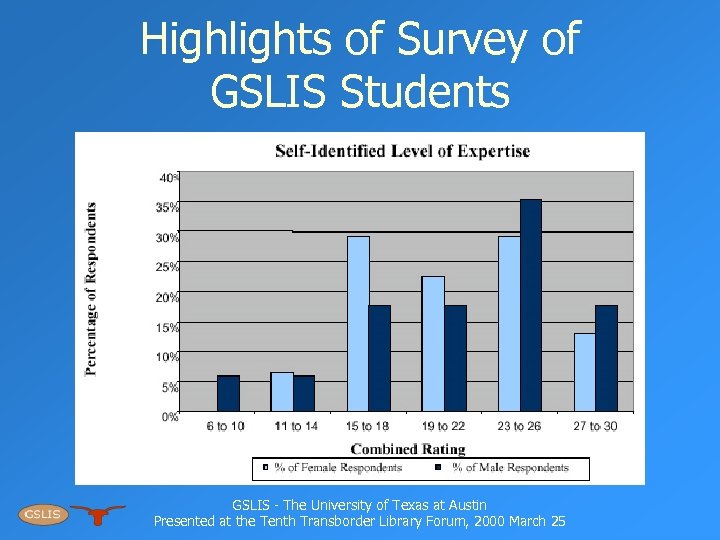
Highlights of Survey of GSLIS Students GSLIS - The University of Texas at Austin Presented at the Tenth Transborder Library Forum, 2000 March 25
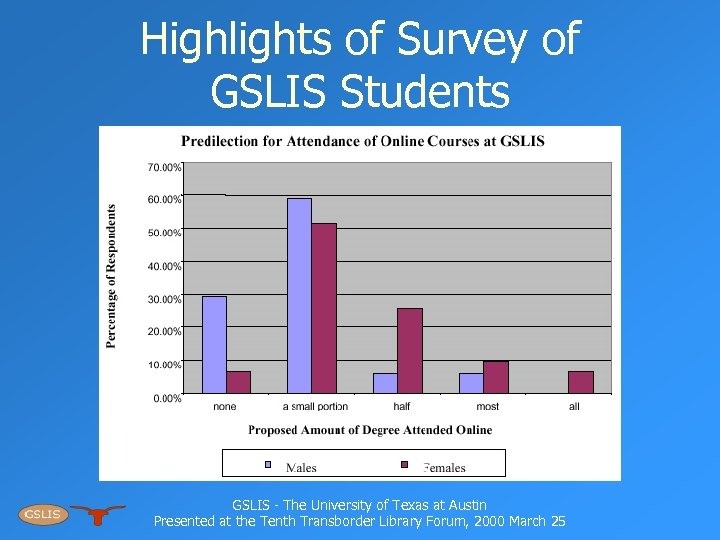
Highlights of Survey of GSLIS Students GSLIS - The University of Texas at Austin Presented at the Tenth Transborder Library Forum, 2000 March 25
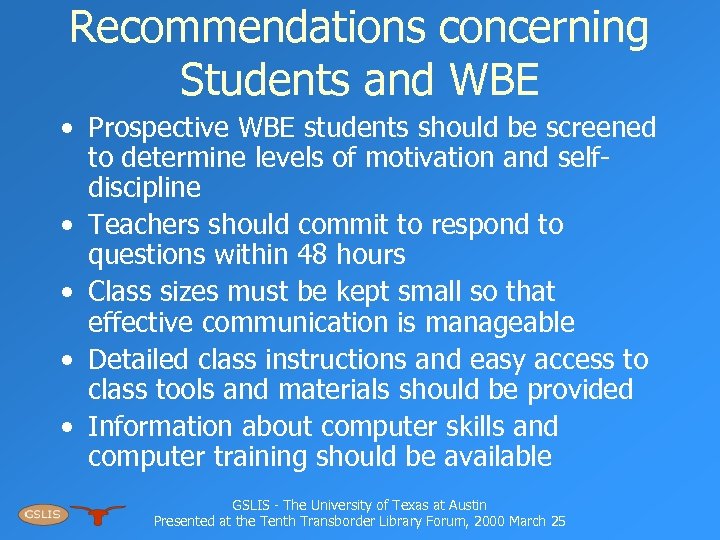
Recommendations concerning Students and WBE • Prospective WBE students should be screened to determine levels of motivation and selfdiscipline • Teachers should commit to respond to questions within 48 hours • Class sizes must be kept small so that effective communication is manageable • Detailed class instructions and easy access to class tools and materials should be provided • Information about computer skills and computer training should be available GSLIS - The University of Texas at Austin Presented at the Tenth Transborder Library Forum, 2000 March 25
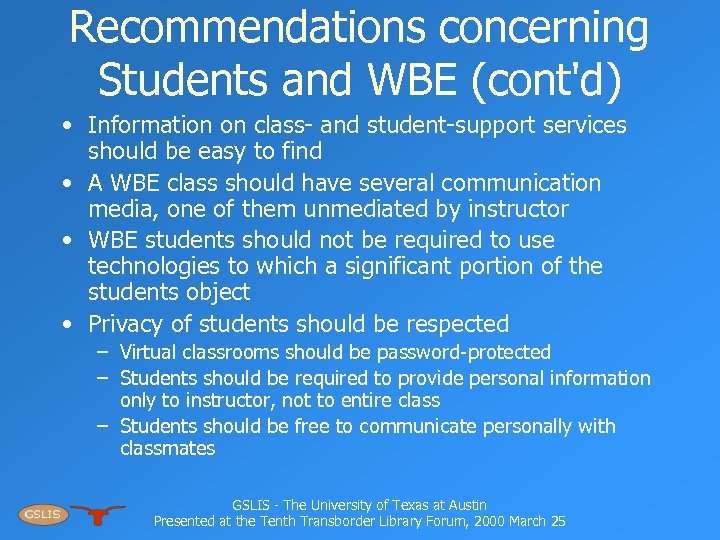
Recommendations concerning Students and WBE (cont'd) • Information on class- and student-support services should be easy to find • A WBE class should have several communication media, one of them unmediated by instructor • WBE students should not be required to use technologies to which a significant portion of the students object • Privacy of students should be respected – Virtual classrooms should be password-protected – Students should be required to provide personal information only to instructor, not to entire class – Students should be free to communicate personally with classmates GSLIS - The University of Texas at Austin Presented at the Tenth Transborder Library Forum, 2000 March 25
Recommendations concerning Students and WBE (cont'd) • Students should be notified the first day of class if software in use has electronic monitoring capabilities • Students should be informed at outset about rules and realities of copyright and plagiarism on the Internet • Policies governing student behavior should be publicized at the beginning of the course • Instructors must make an effort to build a relationship with each student • No new technologies should be introduced while a class is in progress. Technological requirements (hardware, software, and skills) should be stated at the beginning of the course. GSLIS - The University of Texas at Austin Presented at the Tenth Transborder Library Forum, 2000 March 25
Recommendations concerning Students and WBE (cont'd) • Asynchronous technologies should be used as much as possible to allow students to create schedules in accordance with their needs • Since communication over the Internet has been shown to erode social barriers, this tendency should be exploited by requiring all students to participate and contribute ideas • At the same time, instructors must create and enforce rules governing acceptable styles of communication GSLIS - The University of Texas at Austin Presented at the Tenth Transborder Library Forum, 2000 March 25
Technologies of WBE • Technologies needed for WBE include those involved in the – Creation of WB course content: e. g. , HTML editors, video and audio capturing technologies, multimedia authoring tools, Web publishing tools – Delivery of course content • Synchronous communication (real-time interaction between parties): e. g. , Web-based audio or video conferencing, white boards, chat • Asynchronous communication: e. g. , email, Web pages, listservs, newsgroups, and other Web-deliverable content such as Power. Point presentations, Portable Document Format (PDF) files, and streaming audio and video – Serving of Web pages: e. g. , server hardware, software servers running on Windows NT, Unix, or Linux GSLIS - The University of Texas at Austin Presented at the Tenth Transborder Library Forum, 2000 March 25
Technologies of WBE • Some major technological concerns in WBE include – Assuring student privacy – Providing security and authentication • Is the student doing the work really the person he or she claims to be? • How can electronic payments be made safely? • How can password protection be given to course files and records? GSLIS - The University of Texas at Austin Presented at the Tenth Transborder Library Forum, 2000 March 25
Recommendations concerning WBE Technologies • Available courseware packages should be regularly monitored to ensure that the best courseware package for each particular course is used • Hardware acquired for use as Web servers should be scalable upwards to handle possible rapid growth of both (a) the number of WBE courses and (b) the file and service requirements of individual courses GSLIS - The University of Texas at Austin Presented at the Tenth Transborder Library Forum, 2000 March 25
Recommendations concerning WBE Technologies (cont'd) • Till typical connection speeds become faster than the currently widespread 28. 6 Kbps, make as little use as possible of requirements for synchronous communication in WBE – This also applies to certain asynchronous tools, e. g. , streaming audio and video – An alternative is to provide students enrolling in a WB course with a CD containing the large files they will need to use in the course GSLIS - The University of Texas at Austin Presented at the Tenth Transborder Library Forum, 2000 March 25
Recommendations concerning WBE Technologies (cont'd) • Students in WBE courses should have access to equipment meeting following minimum requirements – – Processor speed: 233 Mhz Memory: 32 MB Monitor: Color, 800 x 600 resolution Browser: Latest general-release version of either Internet Explorer or Netscape, together with appropriate plug-ins – Operating system: Windows 98, or Windows NT (with Service Pack 5), or Windows 2000, or Mac OS 8. 1 – Student's system should include: CD-ROM drive, video card, sound card, speakers and/or headphones – If the course requires video-conferencing capability, student's system should include a desktop video camera GSLIS - The University of Texas at Austin Presented at the Tenth Transborder Library Forum, 2000 March 25
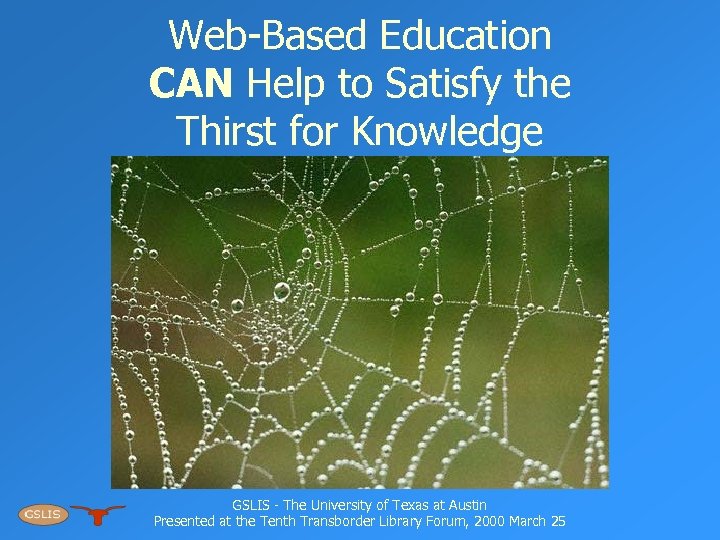
Web-Based Education CAN Help to Satisfy the Thirst for Knowledge GSLIS - The University of Texas at Austin Presented at the Tenth Transborder Library Forum, 2000 March 25
Скачать презентацию Web-Based Library- and Information-Science Education Its Problems Its
2a38d4d7699e25df314b0af82fc208a0.ppt