 Скачать презентацию Web and Grid Services Slides taken from a
cee0c0183b51617b5ed1a9ef8e1c7495.ppt
- Количество слайдов: 53



Web and Grid Services Slides taken from a variety of sources: GT 4 tutorial, by Borja Sotomayor http: //gdp. globus. org/gt 4 -tutorial/ International Summer school on Grid Computing 2007 m by Malcolm Atkinson http: //www. iceageeu. org/issgc 07/index. cfm HP introduction to WSRF by Sanjay Dahiya http: //foss. in/slides/lb 2004/wsrf-intro. ppt USC Viterbi School of Engineering
• • • Service Oriented Architecture Web Services WS-RF Globus implementation of WS-RF OGSA-DAI USC Viterbi School of Engineering
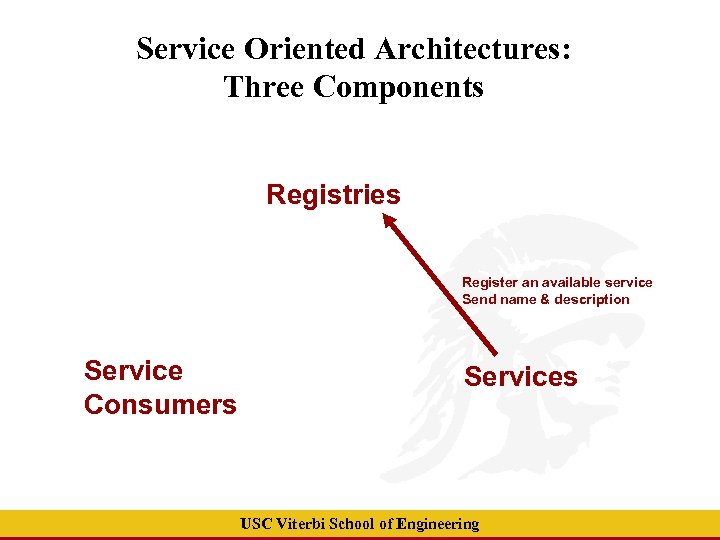
Service Oriented Architectures: Three Components Registries Register an available service Send name & description Service Consumers Services USC Viterbi School of Engineering
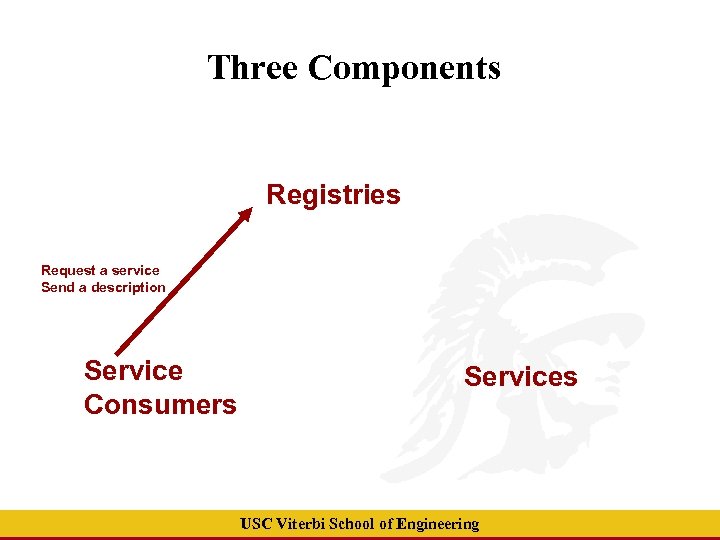
Three Components Registries Request a service Send a description Service Consumers Services USC Viterbi School of Engineering
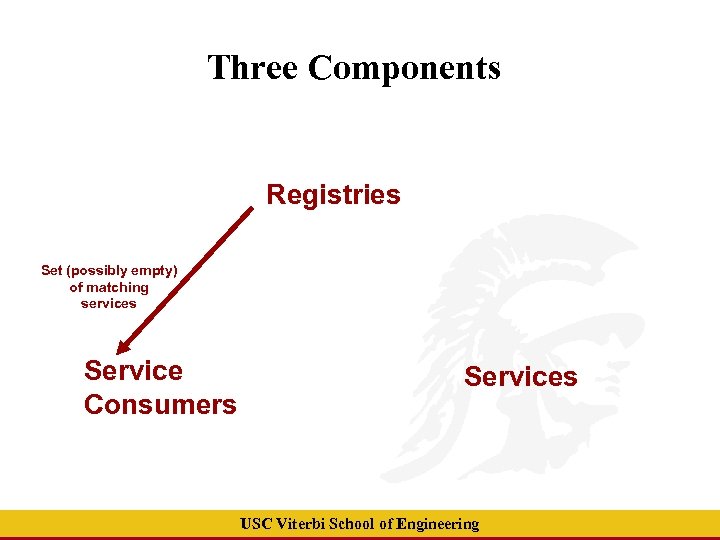
Three Components Registries Set (possibly empty) of matching services Service Consumers Services USC Viterbi School of Engineering
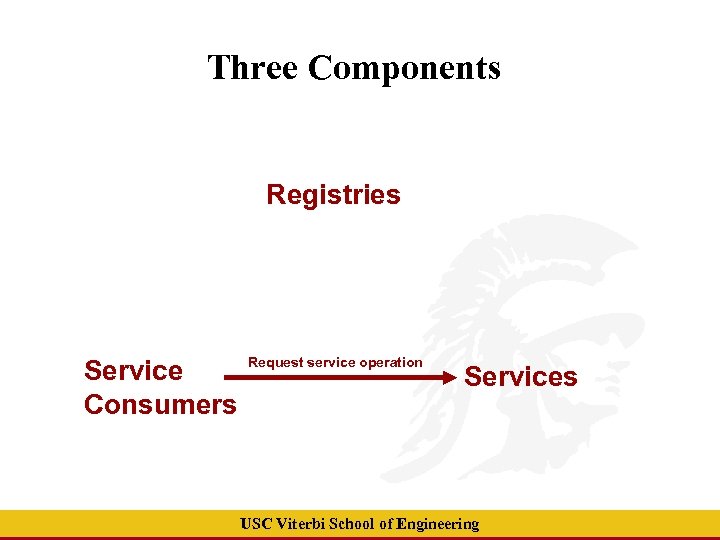
Three Components Registries Service Consumers Request service operation Services USC Viterbi School of Engineering
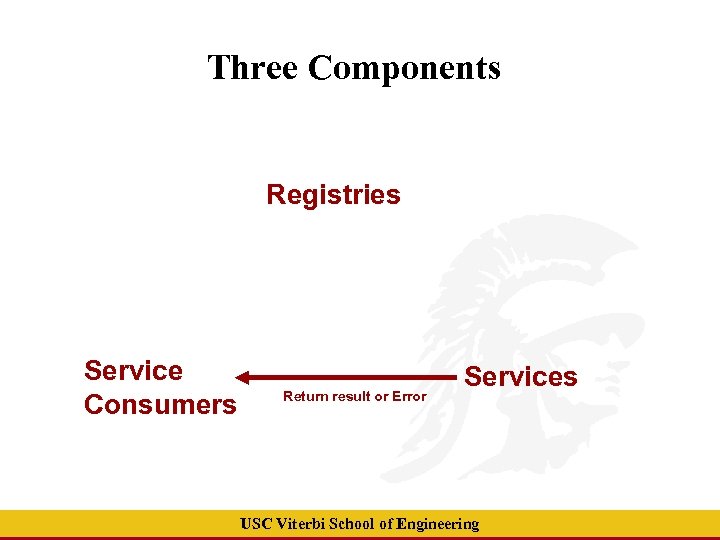
Three Components Registries Service Consumers Return result or Error Services USC Viterbi School of Engineering
Composed behaviour • Services are themselves consumers – They may compose and wrap other services • The registry is itself a consumer • A federation of registries may deal with registry services reliability & performance • Observer services may report on quality of services and help with diagnostics • Agreements between services may be set up – Service-Level Agreements – Permitting sustained interaction USC Viterbi School of Engineering
Web Services USC Viterbi School of Engineering
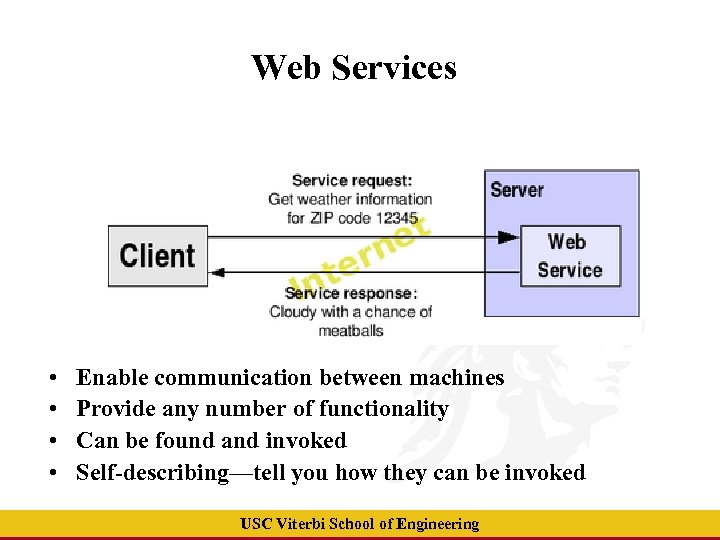
Web Services • • Enable communication between machines Provide any number of functionality Can be found and invoked Self-describing—tell you how they can be invoked USC Viterbi School of Engineering
Web Services • Web Services are platform-independent and languageindependent, since they use standard XML languages • Most Web Services use HTTP for transmitting messages (such as the service request and response) – Good for going through firewalls • Issues: – Overhead: XML is not as efficient for data transmission as using a proprietary binary code. What you win in portability, you lose in efficiency. – Limited in functionality, no explicit state management or lifecycle management USC Viterbi School of Engineering
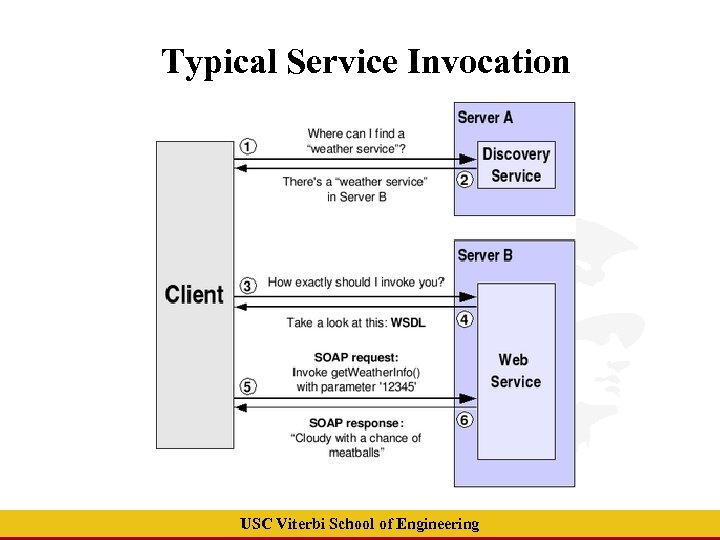
Typical Service Invocation USC Viterbi School of Engineering
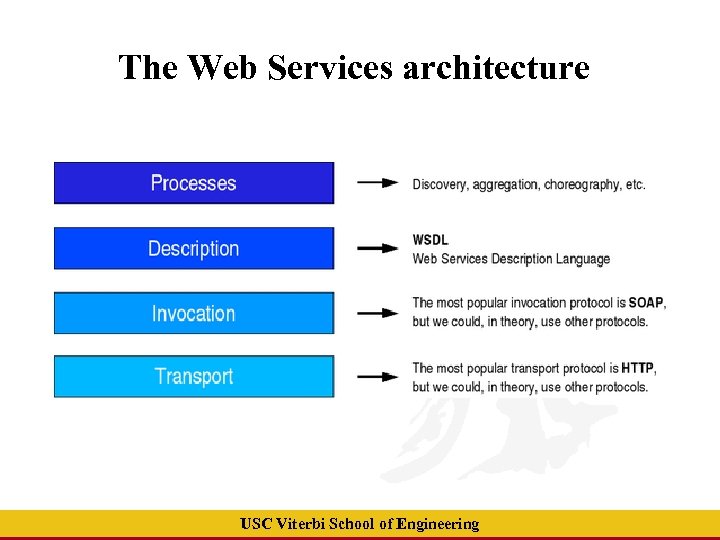
The Web Services architecture USC Viterbi School of Engineering
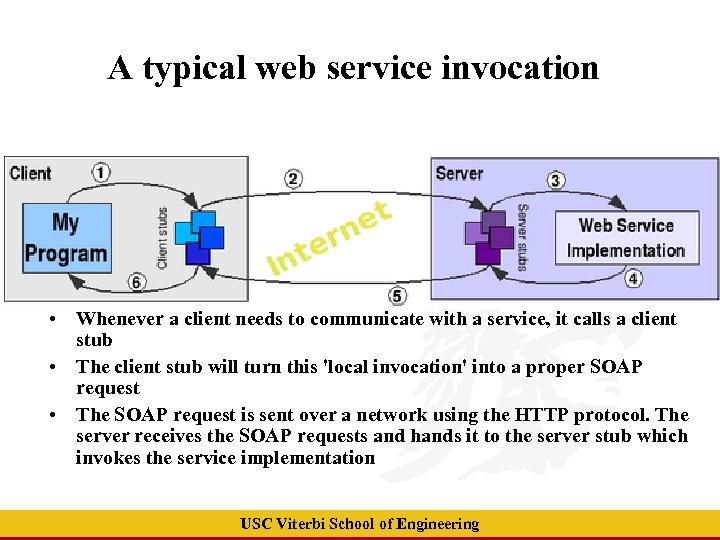
A typical web service invocation • Whenever a client needs to communicate with a service, it calls a client stub • The client stub will turn this 'local invocation' into a proper SOAP request • The SOAP request is sent over a network using the HTTP protocol. The server receives the SOAP requests and hands it to the server stub which invokes the service implementation USC Viterbi School of Engineering
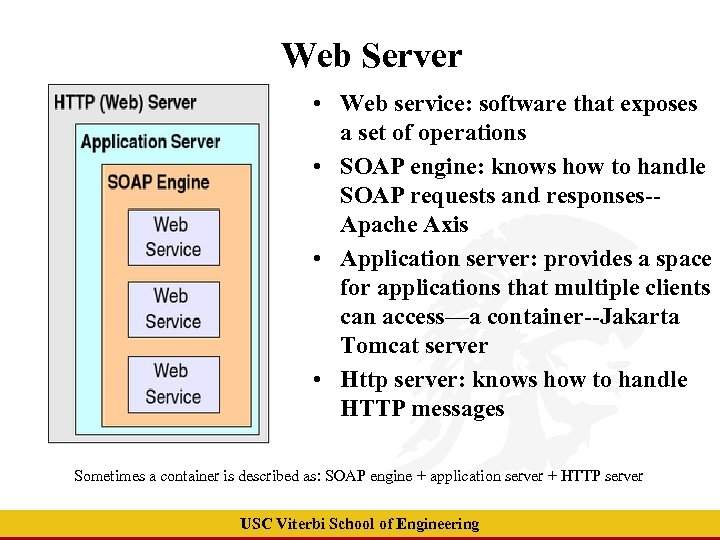
Web Server • Web service: software that exposes a set of operations • SOAP engine: knows how to handle SOAP requests and responses-Apache Axis • Application server: provides a space for applications that multiple clients can access—a container--Jakarta Tomcat server • Http server: knows how to handle HTTP messages Sometimes a container is described as: SOAP engine + application server + HTTP server USC Viterbi School of Engineering
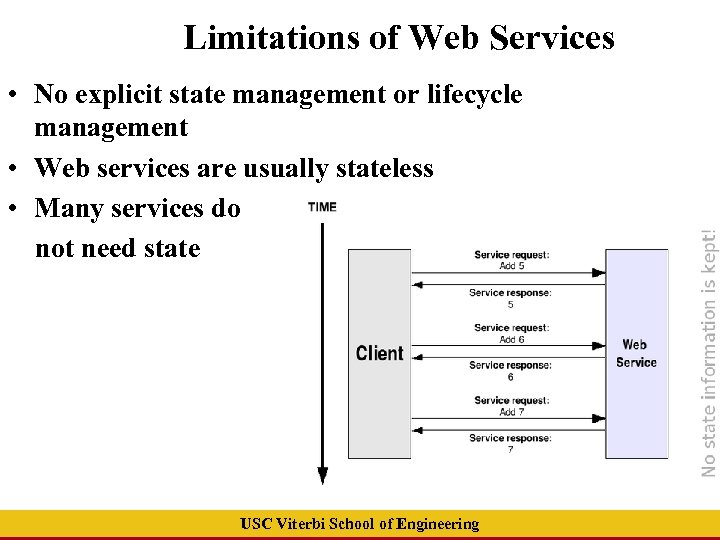
Limitations of Web Services • No explicit state management or lifecycle management • Web services are usually stateless • Many services do not need state USC Viterbi School of Engineering
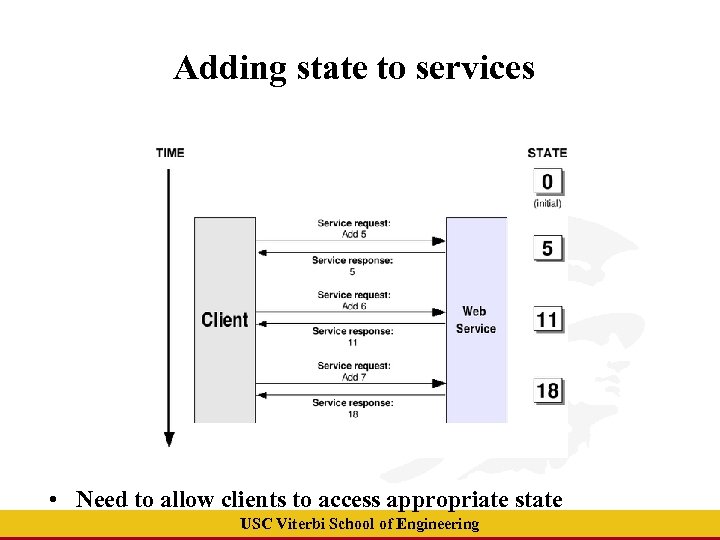
Adding state to services • Need to allow clients to access appropriate state USC Viterbi School of Engineering
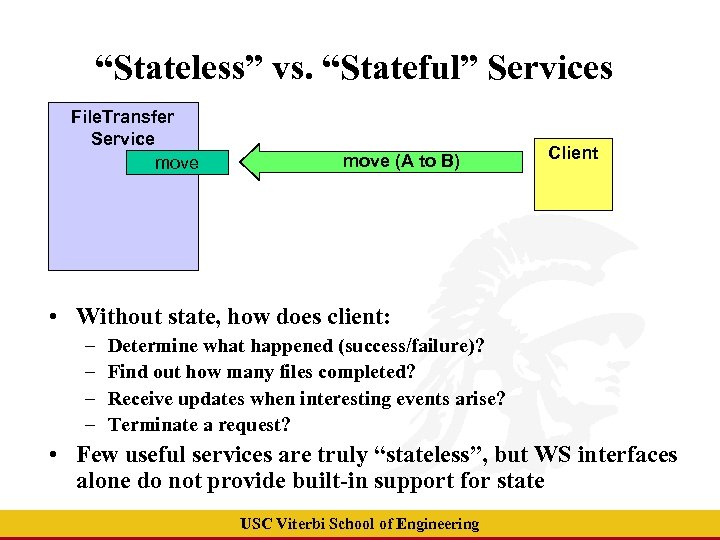
“Stateless” vs. “Stateful” Services File. Transfer Service move (A to B) Client • Without state, how does client: – – Determine what happened (success/failure)? Find out how many files completed? Receive updates when interesting events arise? Terminate a request? • Few useful services are truly “stateless”, but WS interfaces alone do not provide built-in support for state USC Viterbi School of Engineering
Open Grid Services Architecture USC Viterbi School of Engineering
Before OGSA • Grid services before OGSA – – Resource management (Globus GRAM) Resource discovery (Globus MDS) Data Management (Globus Grid. FTP, RLS) Security • All had – Different mechanism for access – Different mechanism for discovery – Different mechanisms for management USC Viterbi School of Engineering
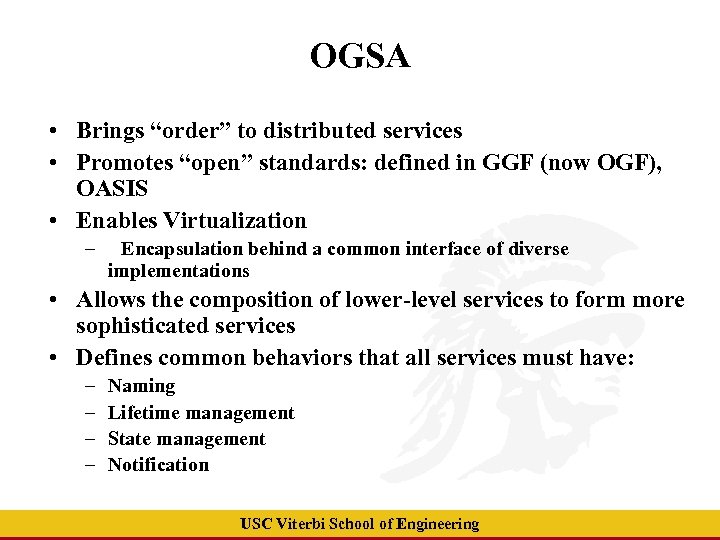
OGSA • Brings “order” to distributed services • Promotes “open” standards: defined in GGF (now OGF), OASIS • Enables Virtualization – Encapsulation behind a common interface of diverse implementations • Allows the composition of lower-level services to form more sophisticated services • Defines common behaviors that all services must have: – – Naming Lifetime management State management Notification USC Viterbi School of Engineering
USC Viterbi School of Engineering
WSRF USC Viterbi School of Engineering
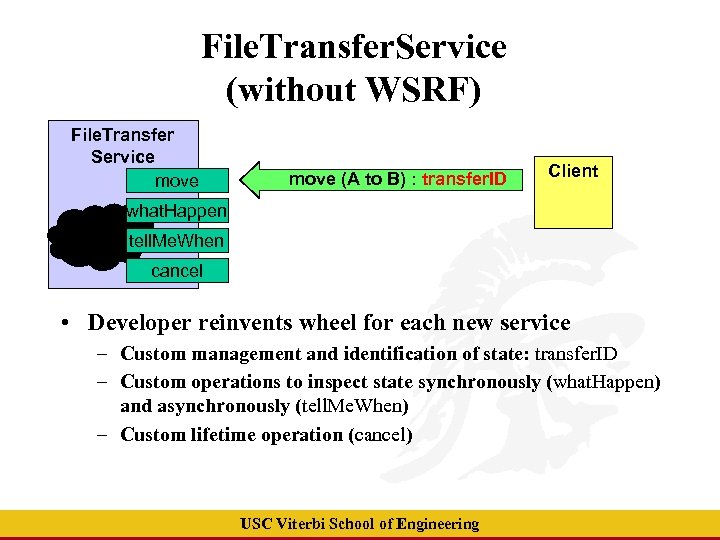
File. Transfer. Service (without WSRF) File. Transfer Service move (A to B) : transfer. ID Client what. Happen state tell. Me. When cancel • Developer reinvents wheel for each new service – Custom management and identification of state: transfer. ID – Custom operations to inspect state synchronously (what. Happen) and asynchronously (tell. Me. When) – Custom lifetime operation (cancel) USC Viterbi School of Engineering
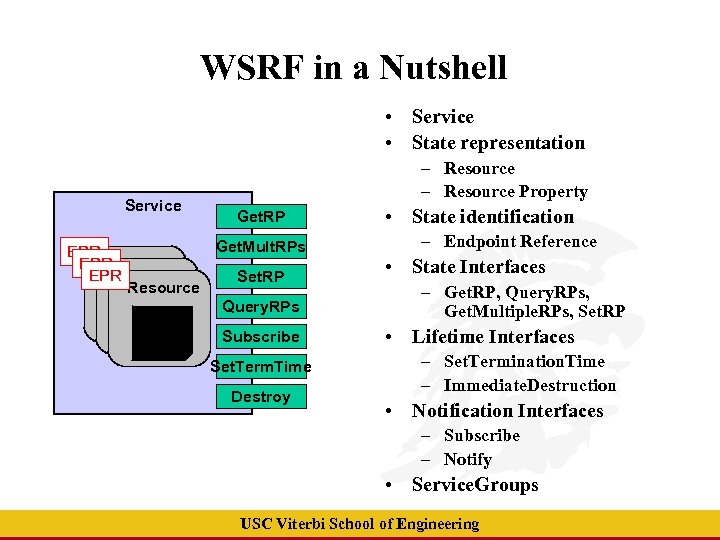
WSRF in a Nutshell • Service • State representation Service EPR EPR – Resource Property Get. RP Get. Mult. RPs Resource Set. RP Query. RPs Subscribe Set. Term. Time Destroy • State identification – Endpoint Reference • State Interfaces – Get. RP, Query. RPs, Get. Multiple. RPs, Set. RP • Lifetime Interfaces – Set. Termination. Time – Immediate. Destruction • Notification Interfaces – Subscribe – Notify • Service. Groups USC Viterbi School of Engineering
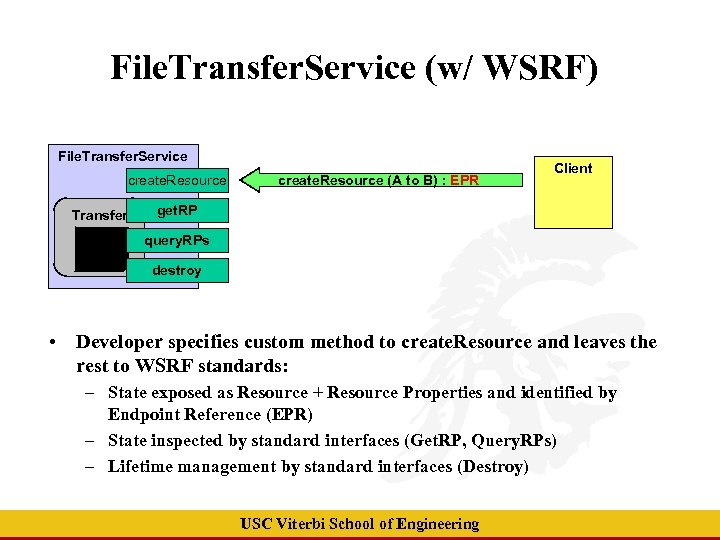
File. Transfer. Service (w/ WSRF) File. Transfer. Service create. Resource Transfer Client get. RP RPs create. Resource (A to B) : EPR query. RPs destroy • Developer specifies custom method to create. Resource and leaves the rest to WSRF standards: – State exposed as Resource + Resource Properties and identified by Endpoint Reference (EPR) – State inspected by standard interfaces (Get. RP, Query. RPs) – Lifetime management by standard interfaces (Destroy) USC Viterbi School of Engineering
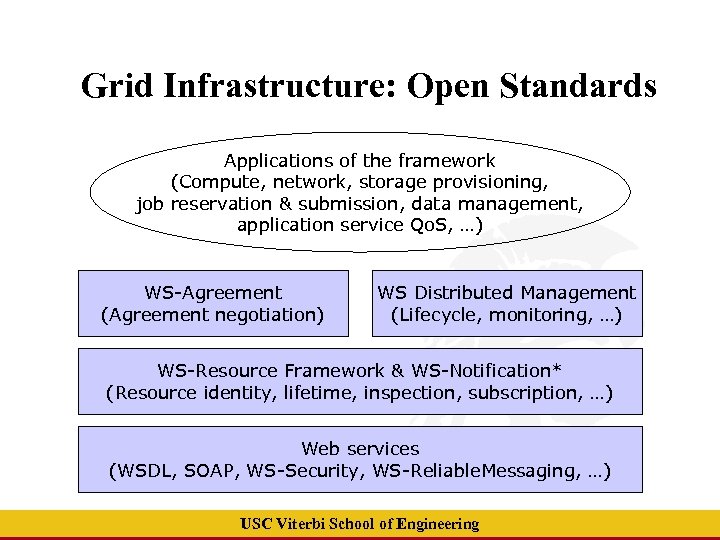
Grid Infrastructure: Open Standards Applications of the framework (Compute, network, storage provisioning, job reservation & submission, data management, application service Qo. S, …) WS-Agreement (Agreement negotiation) WS Distributed Management (Lifecycle, monitoring, …) WS-Resource Framework & WS-Notification* (Resource identity, lifetime, inspection, subscription, …) Web services (WSDL, SOAP, WS-Security, WS-Reliable. Messaging, …) USC Viterbi School of Engineering
WS-Resource Properties • Each resource has a Resource Properties document. • Resource Properties document is referred in service port. Type in WSDL. • Defined in XML schema. • Each element in the Resource Properties document is a Resource Property (RP). • Resource properties can be queried using multiple query dialects. • Independent of back-end implementation. USC Viterbi School of Engineering
Accessing Resource Properties • Pull – Client can query the RP document, using query engines. • Get. Resource. Property • Get. Multiple. Resource. Properties • Query. Resource. Properties • Push – Allows services to send changes in their resources’ RPs to interested parties. • WS-Notification USC Viterbi School of Engineering
WS-Notification • Subscriber indicates interest in a particular “Topic” by issuing a “subscribe” request • Broker (intermediary) permits decoupling Publisher and Subscriber • “Subscriptions” are WS-Resources • Publisher need NOT be a Web Service • Notification may be “triggered” by: – WS Resource Property value changes – Other “situations” • Broker examines current subscriptions • Brokers may – “Transform” or “interpret” topics – Federate to provide scalability USC Viterbi School of Engineering
WS-Notification • Characteristics of WS-Notification: – Web services integration of traditional enterprise publish/subscribe messaging patterns • Composes with other Web services technologies • Facilitates integration between different messaging middleware environments – Standardizes the role of Brokers, Publishers, Subscribers and Consumers – Provides two forms of publish/subscribe: direct publishing and brokered publishing – Standardizes Web service message exchanges for publishing, subscribing and notification delivery – Defines XML model of Topics and Topic. Spaces to categorize and organize notification messsages USC Viterbi School of Engineering
WS-Resource Lifetime • Creating new resources. • Destroying old resources. – Immediate destruction. – Scheduled destruction using termination time. • Soft-state lifetime management – Lifetime extension. • Example : – jobs in a batch submission system could be represented as resources – submitting a new job causes a new resource to be created – when the job is completed, the resource is destroyed. USC Viterbi School of Engineering
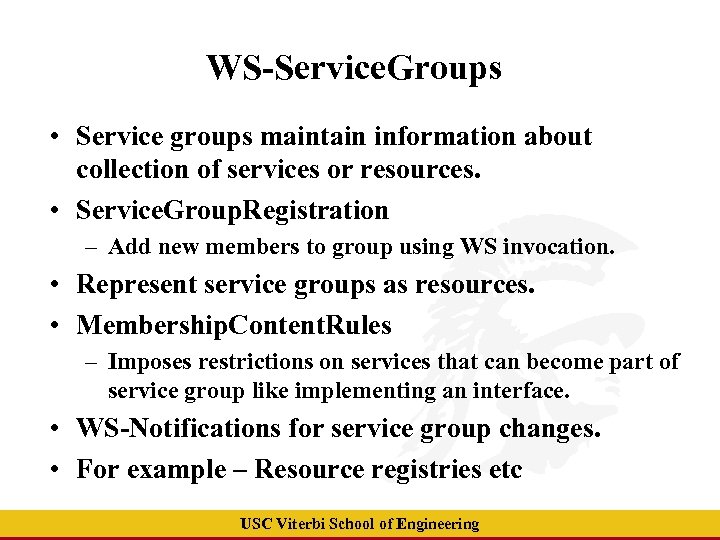
WS-Service. Groups • Service groups maintain information about collection of services or resources. • Service. Group. Registration – Add new members to group using WS invocation. • Represent service groups as resources. • Membership. Content. Rules – Imposes restrictions on services that can become part of service group like implementing an interface. • WS-Notifications for service group changes. • For example – Resource registries etc USC Viterbi School of Engineering
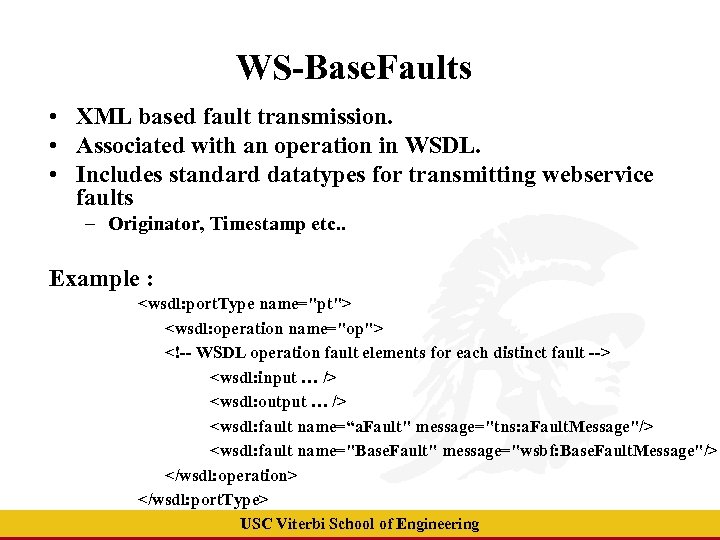
WS-Base. Faults • XML based fault transmission. • Associated with an operation in WSDL. • Includes standard datatypes for transmitting webservice faults – Originator, Timestamp etc. . Example : <wsdl: port. Type name="pt"> <wsdl: operation name="op"> <!-- WSDL operation fault elements for each distinct fault --> <wsdl: input … /> <wsdl: output … /> <wsdl: fault name=“a. Fault" message="tns: a. Fault. Message"/> <wsdl: fault name="Base. Fault" message="wsbf: Base. Fault. Message"/> </wsdl: operation> </wsdl: port. Type> USC Viterbi School of Engineering
Globus Toolkit implementation of WSRF USC Viterbi School of Engineering
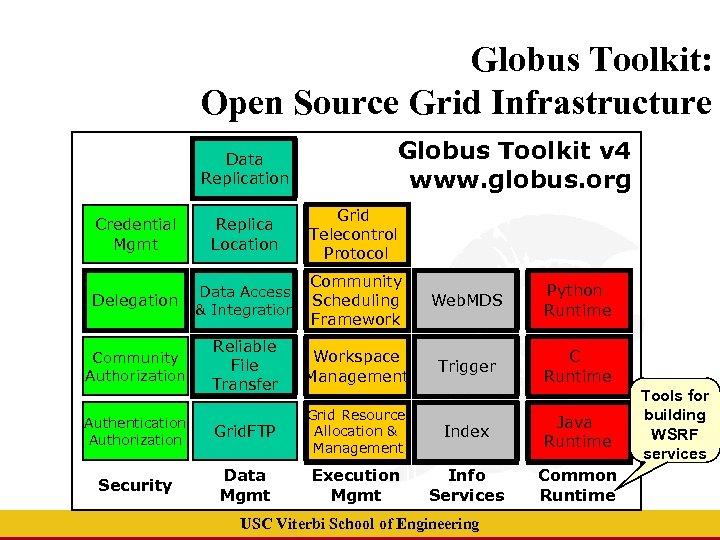
Globus Toolkit: Open Source Grid Infrastructure Data Replication Globus Toolkit v 4 www. globus. org Credential Mgmt Replica Location Grid Telecontrol Protocol Delegation Data Access & Integration Community Scheduling Framework Web. MDS Python Runtime Community Authorization Reliable File Transfer Workspace Management Trigger C Runtime Authentication Authorization Grid. FTP Grid Resource Allocation & Management Index Java Runtime Security Data Mgmt Execution Mgmt Info Services Common Runtime USC Viterbi School of Engineering Tools for building WSRF services
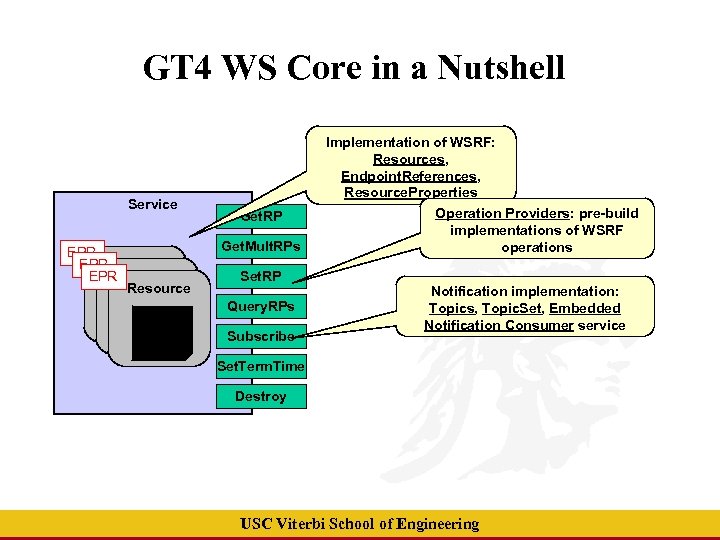
GT 4 WS Core in a Nutshell Service EPR EPR Get. RP Get. Mult. RPs Resource Set. RP Query. RPs Subscribe Implementation of WSRF: Resources, Endpoint. References, Resource. Properties Operation Providers: pre-build implementations of WSRF operations Notification implementation: Topics, Topic. Set, Embedded Notification Consumer service Set. Term. Time Destroy USC Viterbi School of Engineering
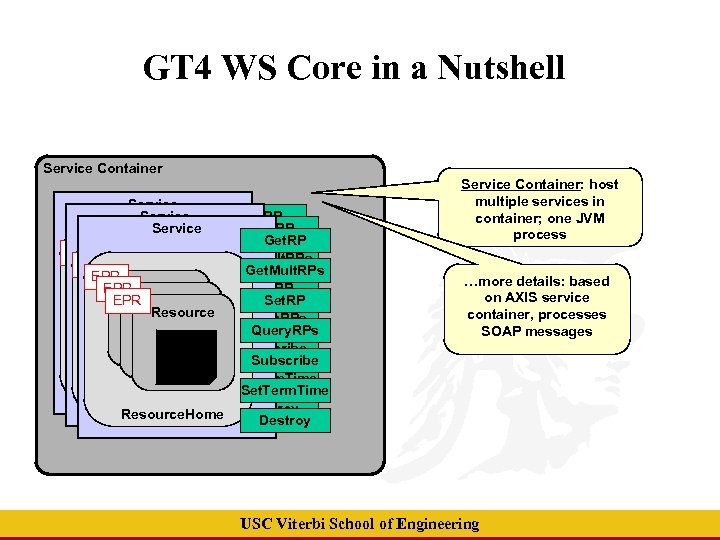
GT 4 WS Core in a Nutshell Service Container Service Get. RP Get. Mult. RPs EPR Get. Mult. RPs Set. RP EPRResource EPR Set. RP EPRResource Query. RPs RPs Query. RPs Subscribe Set. Term. Time Resource. Home Destroy Service Container: host multiple services in container; one JVM process …more details: based on AXIS service container, processes SOAP messages USC Viterbi School of Engineering
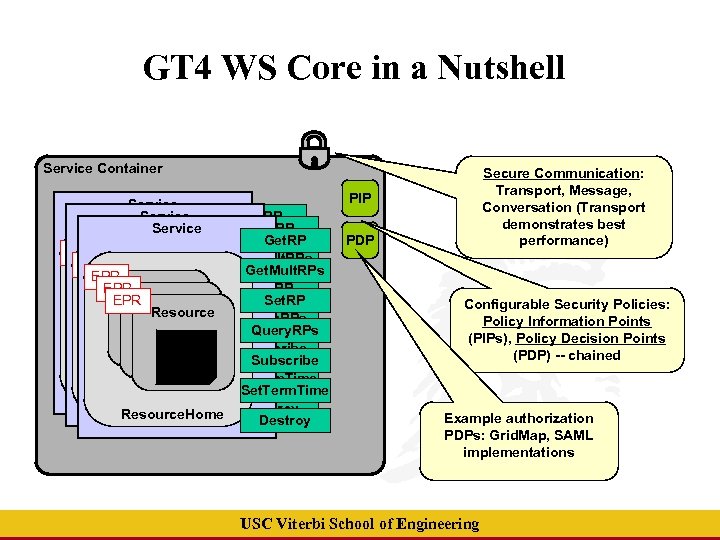
GT 4 WS Core in a Nutshell Service Container Service Secure Communication: Transport, Message, Conversation (Transport demonstrates best performance) PIP Get. RP Get. Mult. RPs EPR Get. Mult. RPs Set. RP EPRResource EPR Set. RP EPRResource Query. RPs RPs Query. RPs Subscribe Set. Term. Time Resource. Home Destroy PDP Configurable Security Policies: Policy Information Points (PIPs), Policy Decision Points (PDP) -- chained Example authorization PDPs: Grid. Map, SAML implementations USC Viterbi School of Engineering
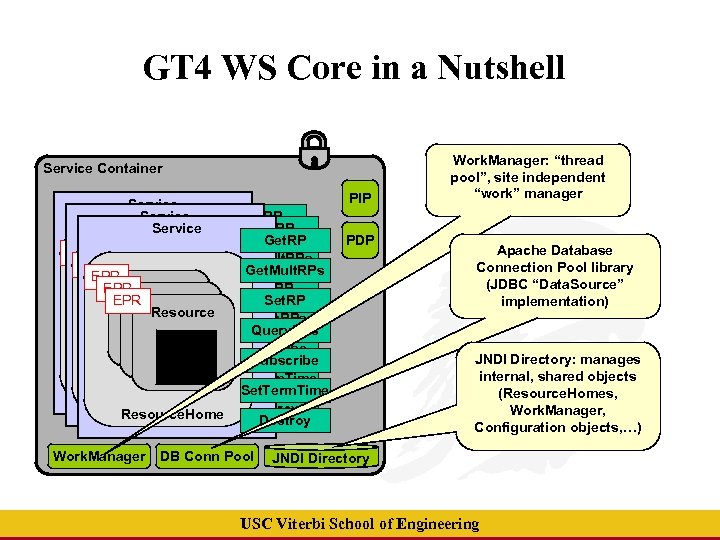
GT 4 WS Core in a Nutshell Service Container PIP Service Get. RP Get. Mult. RPs EPR Get. Mult. RPs Set. RP EPRResource EPR Set. RP EPRResource Query. RPs RPs Query. RPs Subscribe Set. Term. Time Resource. Home Destroy Work. Manager DB Conn Pool PDP Work. Manager: “thread pool”, site independent “work” manager Apache Database Connection Pool library (JDBC “Data. Source” implementation) JNDI Directory: manages internal, shared objects (Resource. Homes, Work. Manager, Configuration objects, …) JNDI Directory USC Viterbi School of Engineering
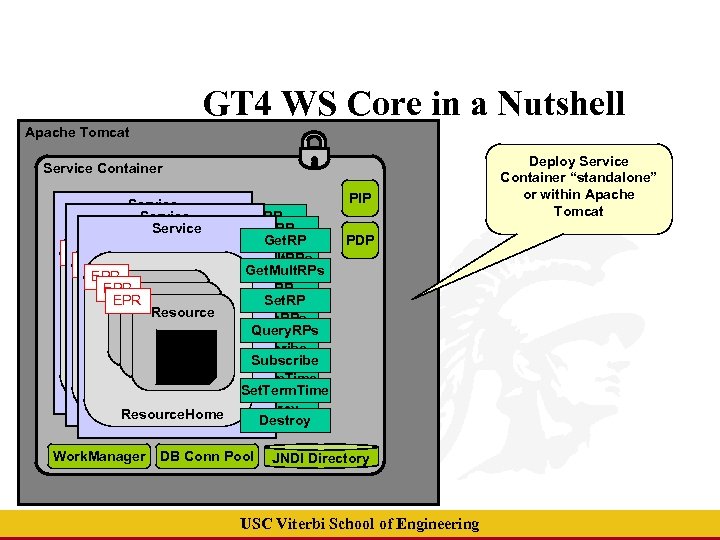
GT 4 WS Core in a Nutshell Apache Tomcat Service Container PIP Service Get. RP Get. Mult. RPs EPR Get. Mult. RPs Set. RP EPRResource EPR Set. RP EPRResource Query. RPs RPs Query. RPs Subscribe Set. Term. Time Resource. Home Destroy Work. Manager DB Conn Pool PDP JNDI Directory USC Viterbi School of Engineering Deploy Service Container “standalone” or within Apache Tomcat
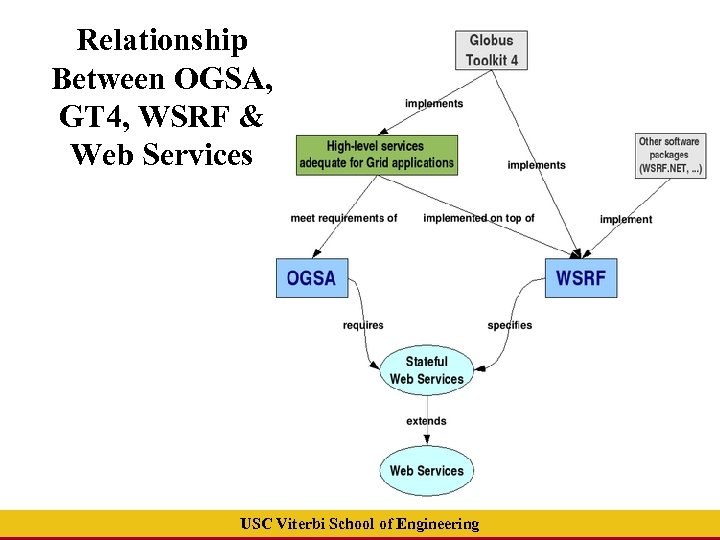
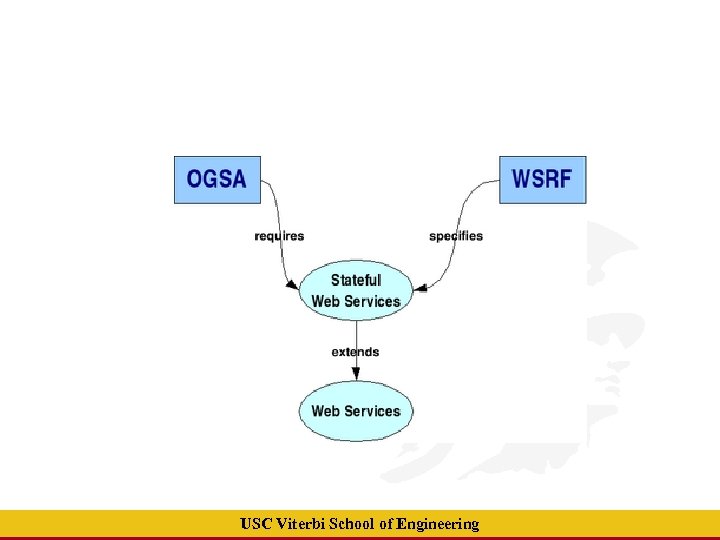
Relationship Between OGSA, GT 4, WSRF & Web Services USC Viterbi School of Engineering
Dealing with Data OGSA-DAI USC Viterbi School of Engineering
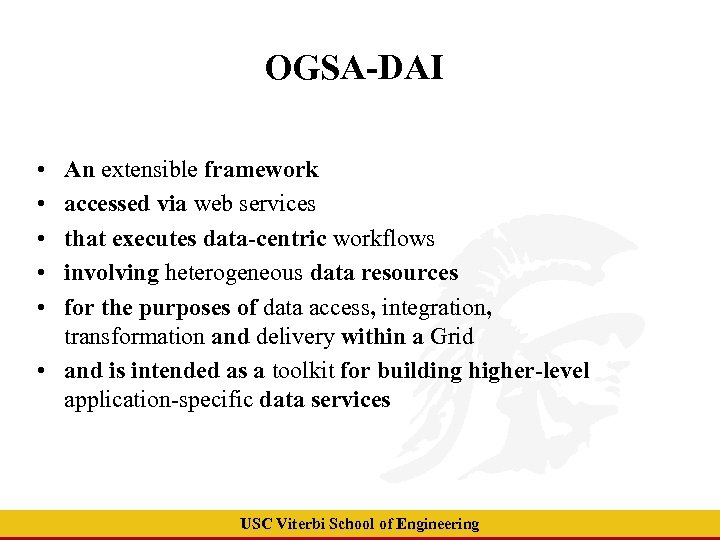
OGSA-DAI • • • An extensible framework accessed via web services that executes data-centric workflows involving heterogeneous data resources for the purposes of data access, integration, transformation and delivery within a Grid • and is intended as a toolkit for building higher-level application-specific data services USC Viterbi School of Engineering
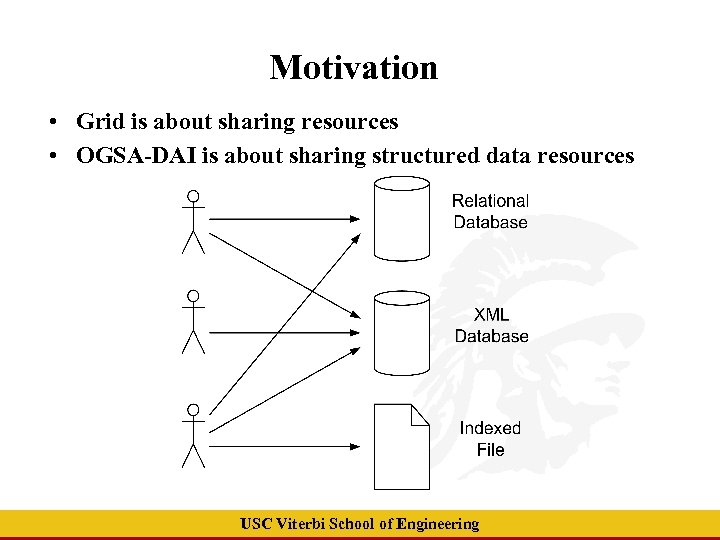
Motivation • Grid is about sharing resources • OGSA-DAI is about sharing structured data resources USC Viterbi School of Engineering
Sharing data via website download • ZIP up data and put it on a website • Pros – Easy distribution for providers – Easy access for consumers • Cons – Consumers have to download all the data – Consumers have to load data into local databases to use it – Static snapshot – Security USC Viterbi School of Engineering
Sharing data via direct access • Providers tell consumers – Database URL – mycomputer. epcc. ed. ac. uk: 3306 – Username – user. ID – Password – password • Pros – Consumers have direct access, so it should be faster • Cons – – – Firewall issues User and password management is hard No consistent security model Hard to use in grid/web service workflows Continued on next slide… USC Viterbi School of Engineering
Sharing data via direct access • Cons (continued) – No server-side layer in which to standardize database heterogeneities – Client needs to know, and have installed, correct driver for the database. – Different drivers for Java, C#, C++, Fortran etc. – Totally different API for different database types, e. g. JDBC for Relational, XMLDB for XML, Lucene for indexed files. USC Viterbi School of Engineering
Domain-specific web services • Manipulate data using domain-specific operations, e. g. – Book find. By. ISBN(ISBN) – List<Book> find. By. Author(Author) – List<Book> find. By. Keyword(Word) • Pros – – Fits with grid/web service approach Abstraction hides back-end database details Web services are programming language neutral Operations likely to map well to authorization policies USC Viterbi School of Engineering
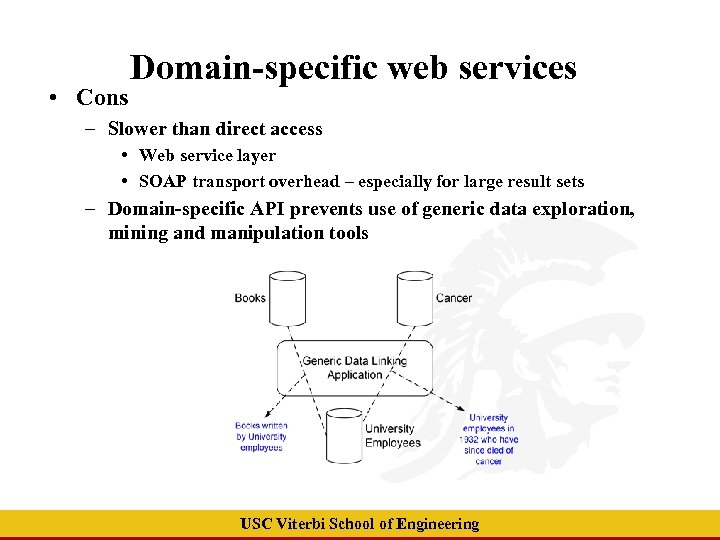
• Cons Domain-specific web services – Slower than direct access • Web service layer • SOAP transport overhead – especially for large result sets – Domain-specific API prevents use of generic data exploration, mining and manipulation tools USC Viterbi School of Engineering
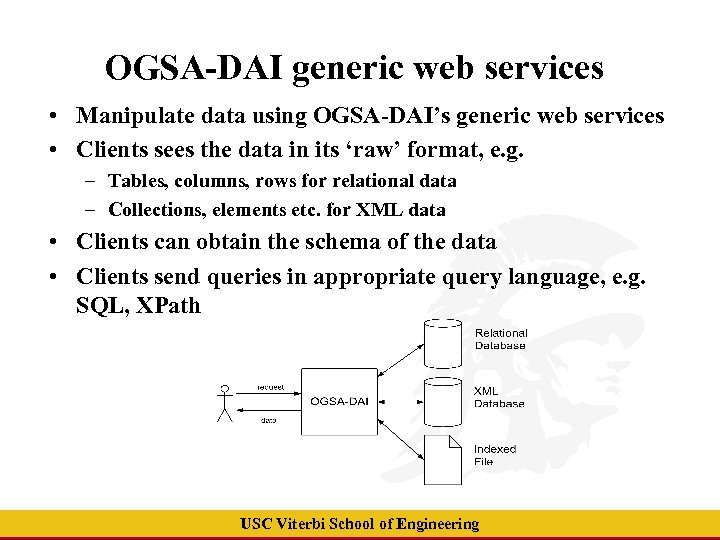
OGSA-DAI generic web services • Manipulate data using OGSA-DAI’s generic web services • Clients sees the data in its ‘raw’ format, e. g. – Tables, columns, rows for relational data – Collections, elements etc. for XML data • Clients can obtain the schema of the data • Clients send queries in appropriate query language, e. g. SQL, XPath USC Viterbi School of Engineering
OGSA-DAI • Pros: – Fits with grid/web service approach. – Web services are programming language neutral. – Access to schema and raw data supports generic tools. • Cons: – Slower than direct connection mainly due to SOAP overhead. – One more layer between client and data – Data not transferred in efficient binary format. USC Viterbi School of Engineering
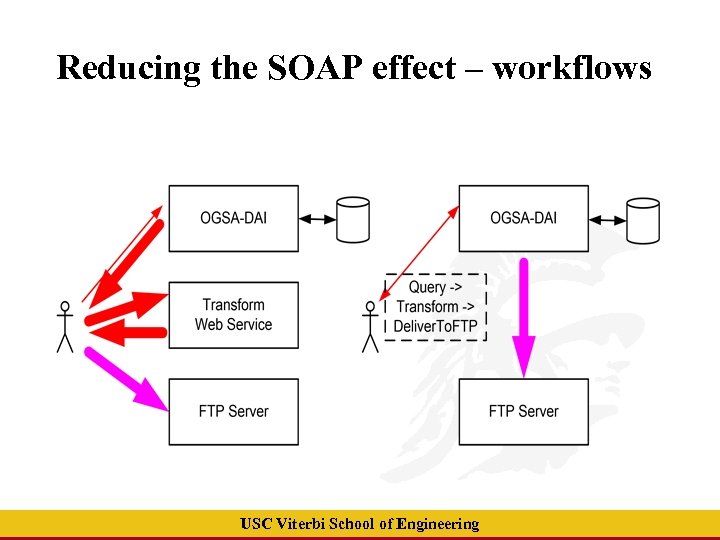
Reducing the SOAP effect – workflows USC Viterbi School of Engineering
Скачать презентацию Web and Grid Services Slides taken from a
cee0c0183b51617b5ed1a9ef8e1c7495.ppt