 Скачать презентацию Weather in your back yard Observations Ray Martin
5ec73da53a01fe50049469f77ce5b366.ppt
- Количество слайдов: 21



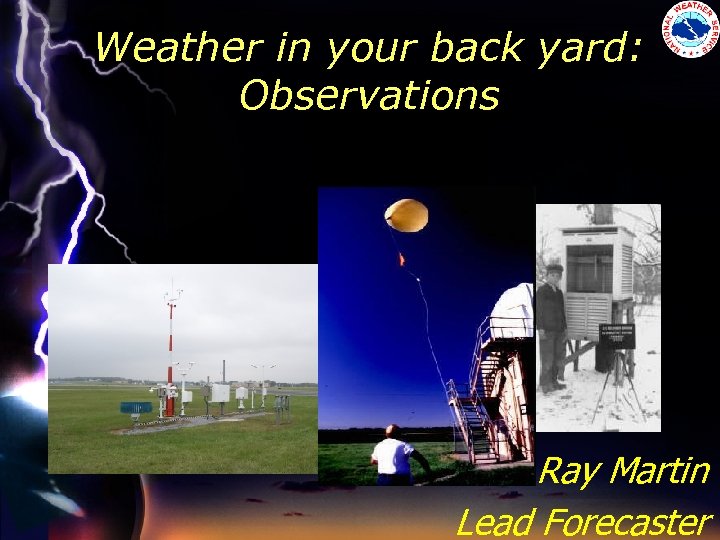
Weather in your back yard: Observations Ray Martin Lead Forecaster
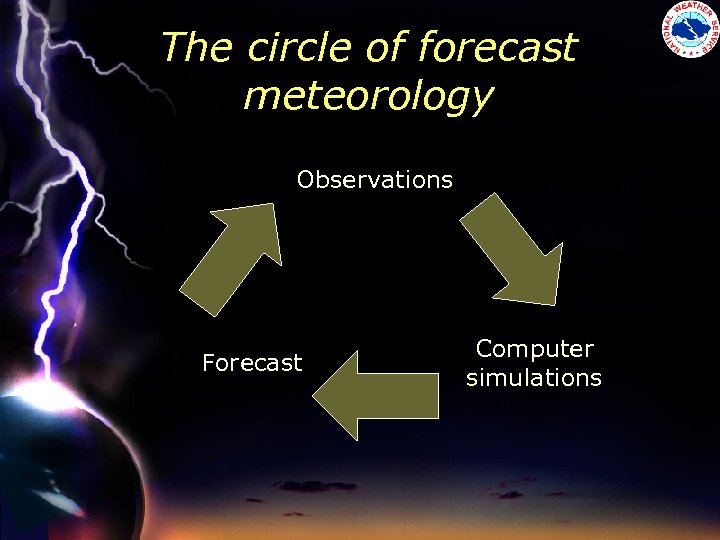
The circle of forecast meteorology Observations Forecast Computer simulations
Where do weather observations come from? ALL OVER! Common sources… Airports Cooperative weather stations Professional electronic weather stations People like you!
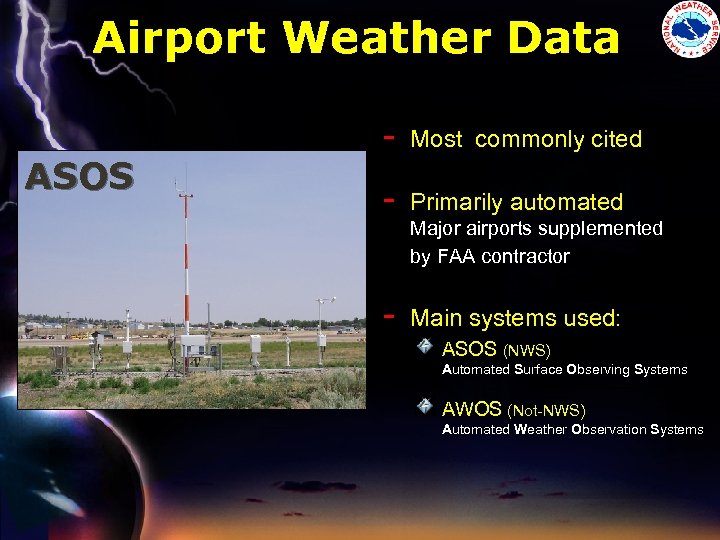
Airport Weather Data ASOS - Most commonly cited - Primarily automated - Main systems used: Major airports supplemented by FAA contractor ASOS (NWS) Automated Surface Observing Systems AWOS (Not-NWS) Automated Weather Observation Systems
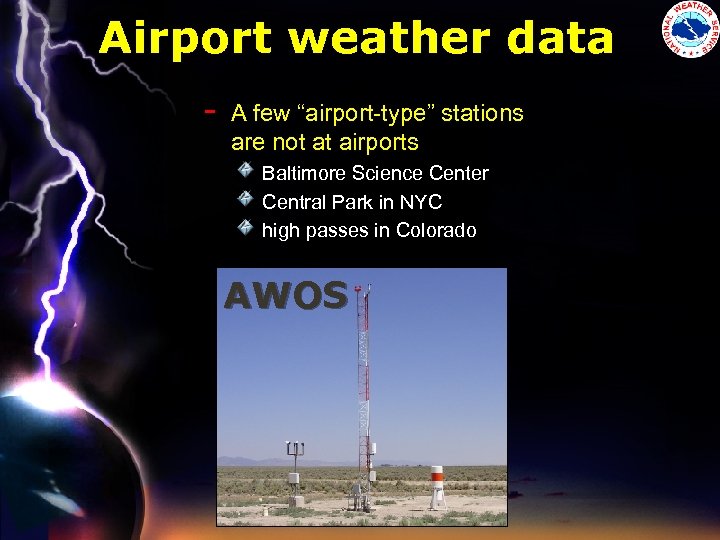
Airport weather data - A few “airport-type” stations are not at airports Baltimore Science Center Central Park in NYC high passes in Colorado AWOS
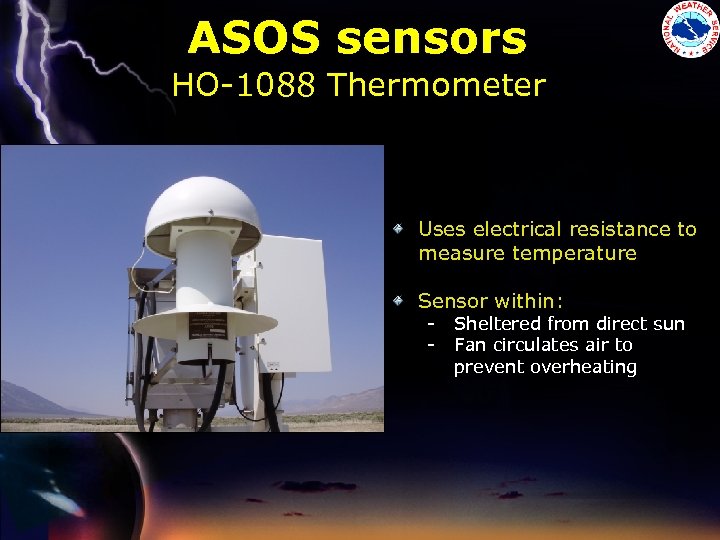
ASOS sensors HO-1088 Thermometer Uses electrical resistance to measure temperature Sensor within: - Sheltered from direct sun - Fan circulates air to prevent overheating
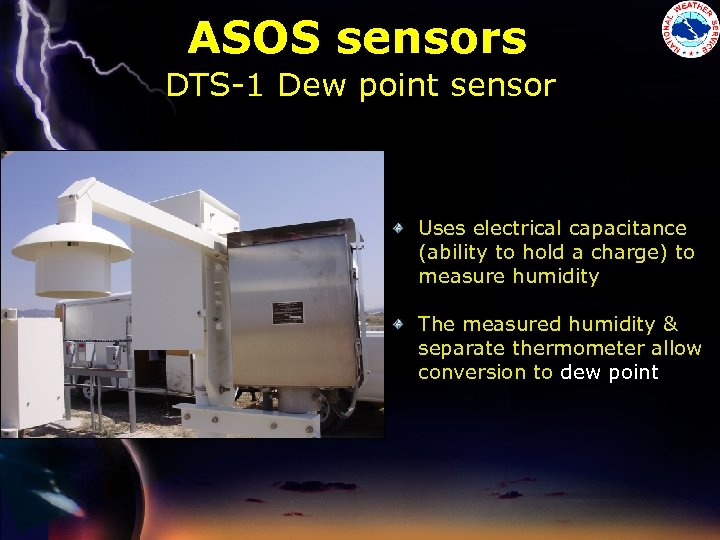
ASOS sensors DTS-1 Dew point sensor Uses electrical capacitance (ability to hold a charge) to measure humidity The measured humidity & separate thermometer allow conversion to dew point
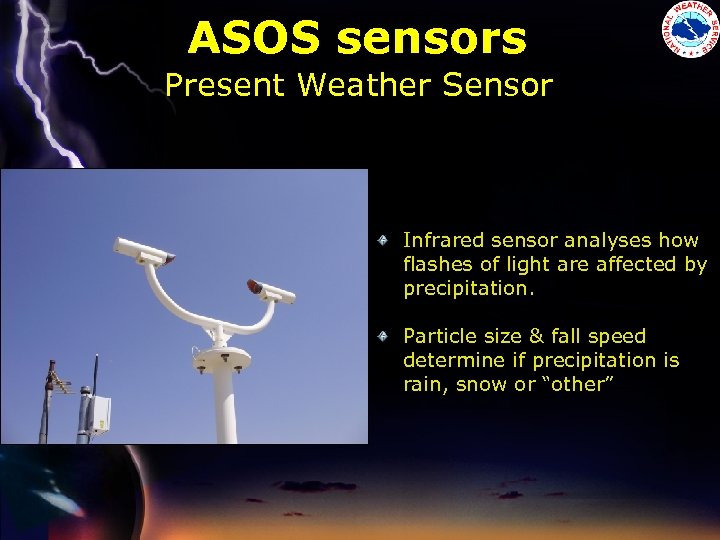
ASOS sensors Present Weather Sensor Infrared sensor analyses how flashes of light are affected by precipitation. Particle size & fall speed determine if precipitation is rain, snow or “other”
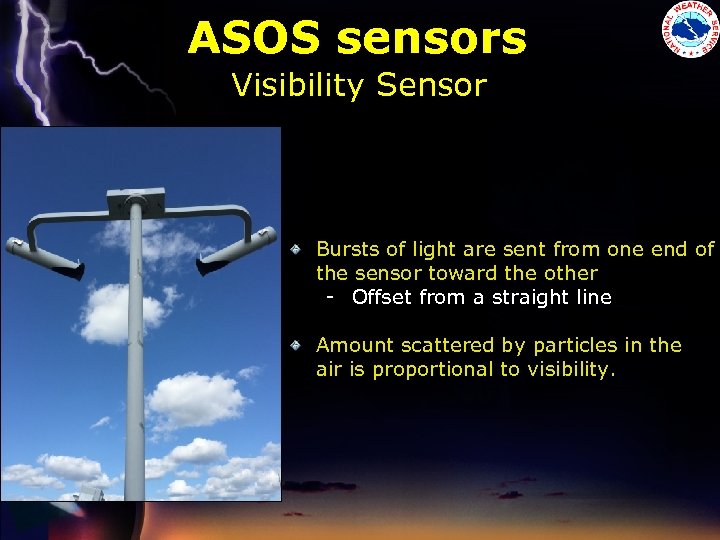
ASOS sensors Visibility Sensor Bursts of light are sent from one end of the sensor toward the other - Offset from a straight line Amount scattered by particles in the air is proportional to visibility.
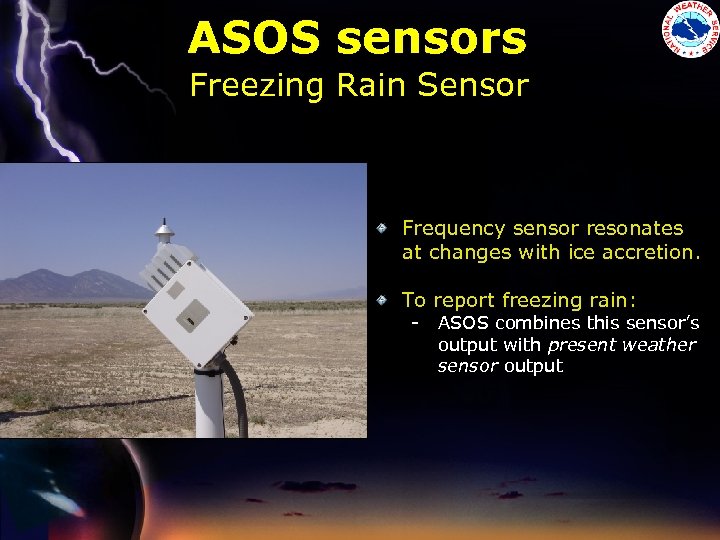
ASOS sensors Freezing Rain Sensor Frequency sensor resonates at changes with ice accretion. To report freezing rain: - ASOS combines this sensor’s output with present weather sensor output
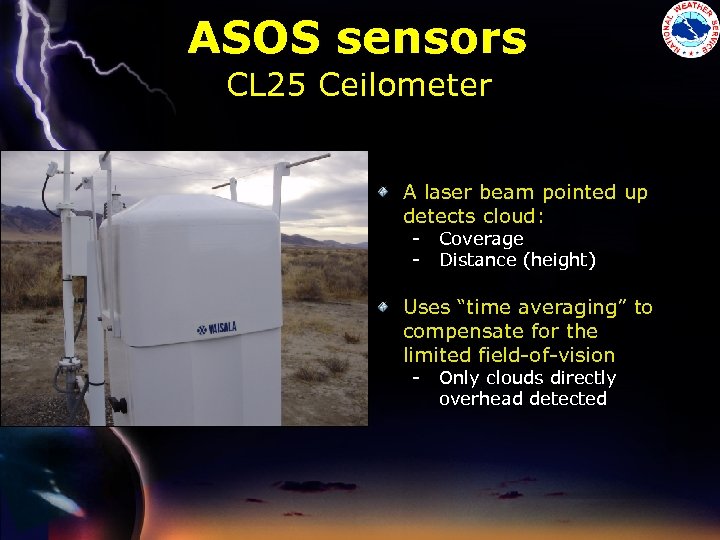
ASOS sensors CL 25 Ceilometer A laser beam pointed up detects cloud: - Coverage - Distance (height) Uses “time averaging” to compensate for the limited field-of-vision - Only clouds directly overhead detected
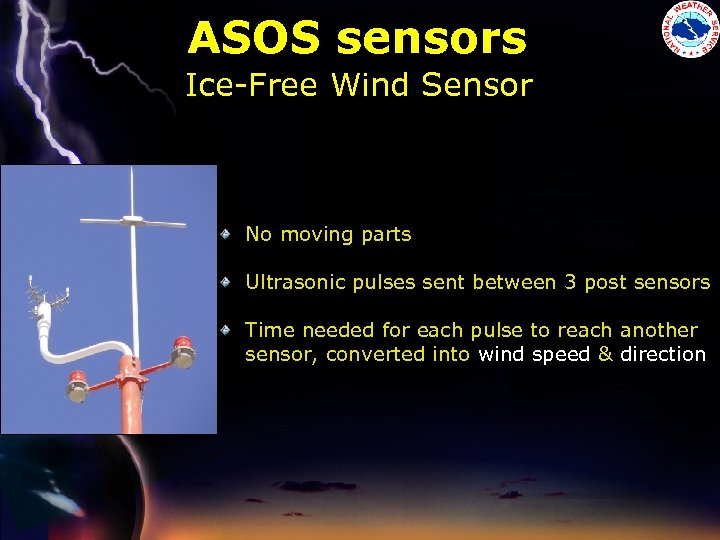
ASOS sensors Ice-Free Wind Sensor No moving parts Ultrasonic pulses sent between 3 post sensors Time needed for each pulse to reach another sensor, converted into wind speed & direction
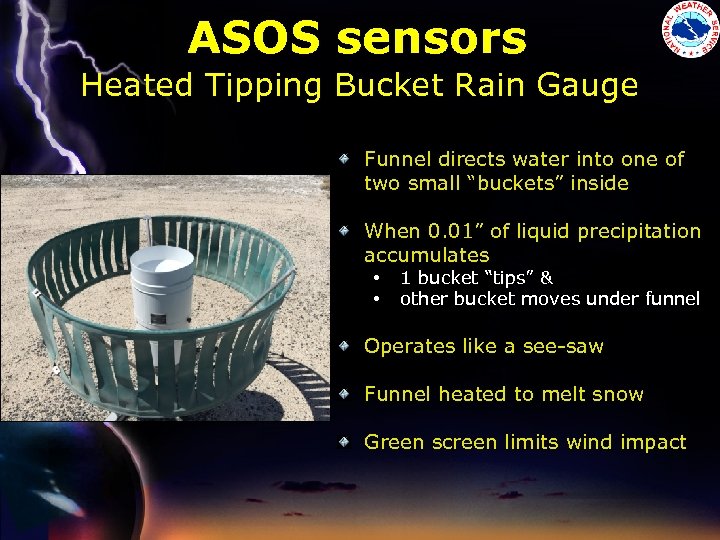
ASOS sensors Heated Tipping Bucket Rain Gauge Funnel directs water into one of two small “buckets” inside When 0. 01” of liquid precipitation accumulates • • 1 bucket “tips” & other bucket moves under funnel Operates like a see-saw Funnel heated to melt snow Green screen limits wind impact
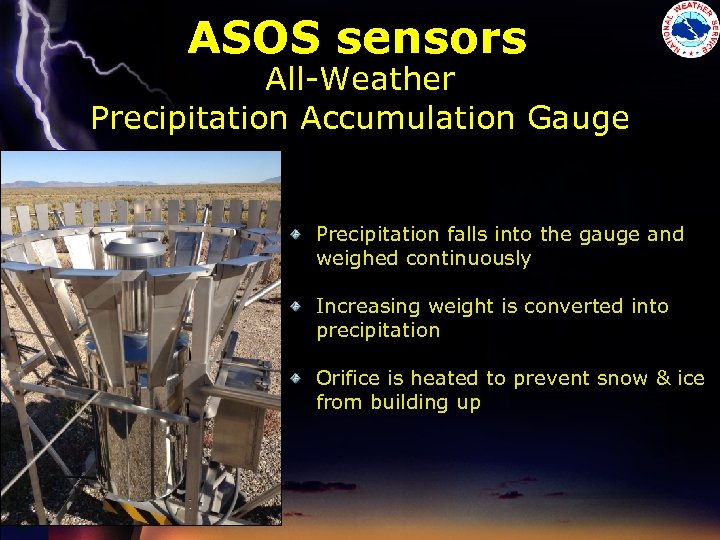
ASOS sensors All-Weather Precipitation Accumulation Gauge Precipitation falls into the gauge and weighed continuously Increasing weight is converted into precipitation Orifice is heated to prevent snow & ice from building up
What ASOS can’t observe We still need people to report… Tornadoes Shallow or patchy fog Blowing dust Smoke Falling ash / volcanic eruptions Hail, sleet, and snow grains Mixed precipitation types Snowfall & Snowpack Lightning that doesn’t reach the ground Clouds: - not directly overhead - > 25, 000’ - what kind of clouds
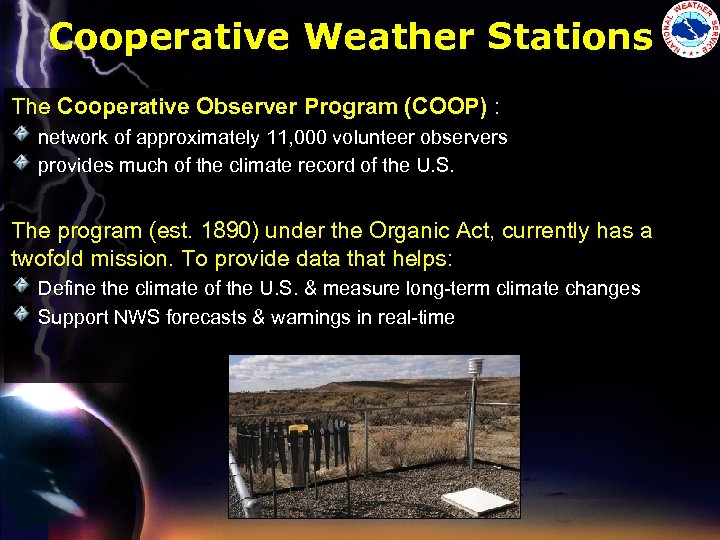
Cooperative Weather Stations The Cooperative Observer Program (COOP) : network of approximately 11, 000 volunteer observers provides much of the climate record of the U. S. The program (est. 1890) under the Organic Act, currently has a twofold mission. To provide data that helps: Define the climate of the U. S. & measure long-term climate changes Support NWS forecasts & warnings in real-time
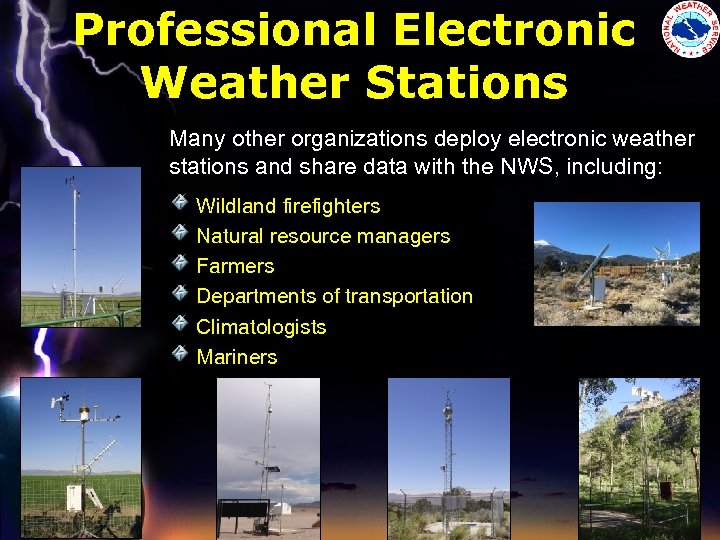
Professional Electronic Weather Stations Many other organizations deploy electronic weather stations and share data with the NWS, including: Wildland firefighters Natural resource managers Farmers Departments of transportation Climatologists Mariners
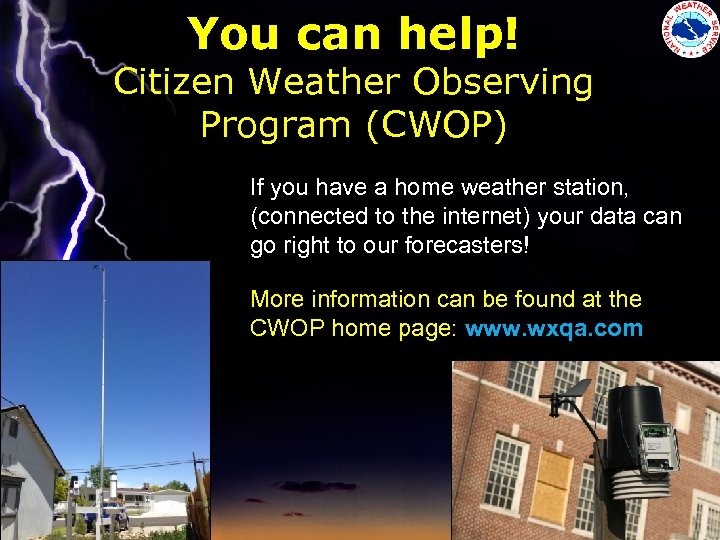
You can help! Citizen Weather Observing Program (CWOP) If you have a home weather station, (connected to the internet) your data can go right to our forecasters! More information can be found at the CWOP home page: www. wxqa. com
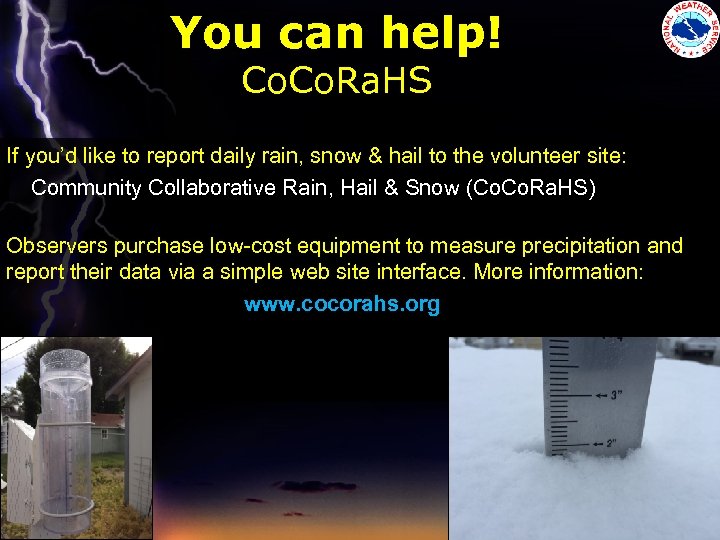
You can help! Co. Ra. HS If you’d like to report daily rain, snow & hail to the volunteer site: Community Collaborative Rain, Hail & Snow (Co. Ra. HS) Observers purchase low-cost equipment to measure precipitation and report their data via a simple web site interface. More information: www. cocorahs. org
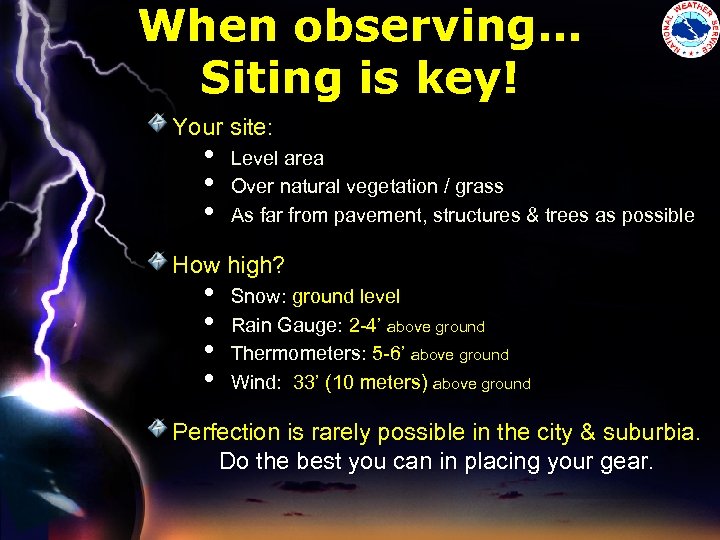
When observing… Siting is key! Your site: • • • Level area Over natural vegetation / grass As far from pavement, structures & trees as possible How high? • • Snow: ground level Rain Gauge: 2 -4’ above ground Thermometers: 5 -6’ above ground Wind: 33’ (10 meters) above ground Perfection is rarely possible in the city & suburbia. Do the best you can in placing your gear.
Questions ? / Remember This… ASOS stations are NWS owned & maintained • • • High precision & quality Many at airports Not a very dense national network Other observations (like yours) help supplement! • • Good placement Away from pavement / trees / structures Do your best Join wxqa. com (CWOP) if on-line Thanks for attending!
Скачать презентацию Weather in your back yard Observations Ray Martin
5ec73da53a01fe50049469f77ce5b366.ppt