 Скачать презентацию We re Better Together Southern California Credit Union Alliance
3ac4d699ad89af8707d547fdab6f7f57.ppt
- Количество слайдов: 26



We’re Better Together! Southern California Credit Union Alliance June 3, 2010
The Challenge • Small and mid-sized credit unions are in trouble • Operating expenses exceed net interest margins • Non-interest income is threatened by legislative actions • Loan loss and share insurance expenses are the highest on record • Corporate capital investments have been wiped out • Capital erosion is forcing many credit unions to merge, shrink or, at minimum, stand on the sidelines
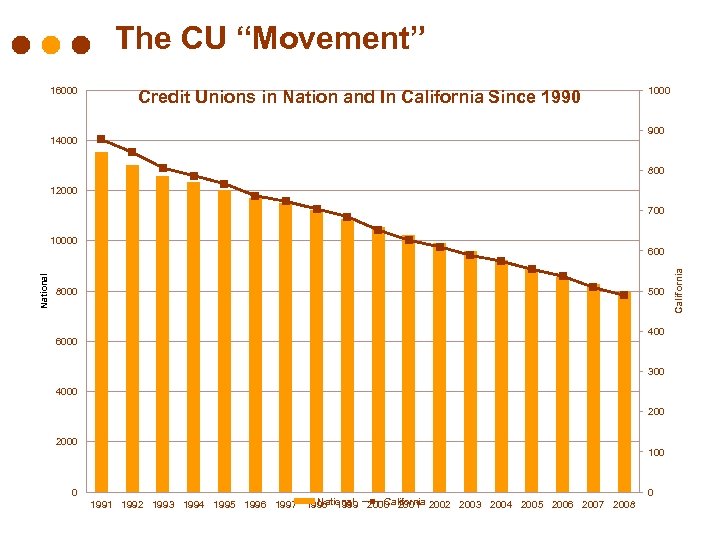
The CU “Movement” 16000 Credit Unions in Nation and In California Since 1990 1000 900 14000 800 12000 700 600 8000 500 400 6000 300 4000 2000 0 100 National 2001 2002 C 1991 1992 1993 1994 1995 1996 1997 1998 1999 2000 alifornia 2003 2004 2005 2006 2007 2008 0 California National 10000
The Reality • Can’t impact housing and unemployment crises • Can’t undo the corporate capital write-offs or the CSP “taxes” • And the market – and only the market – establishes the target net interest margin. • What we can impact and control is operating expenses • We can do it via cooperation and collaboration • The SCCUA is a testament to that
The Case for Collaboration 1. We need to regain our value leadership 2. We need to restore our earnings and capital 3. We need to focus more time, effort and resources on what our members elected us to do or our boards hired us to do 4. WE’RE COOPERATIVES!!
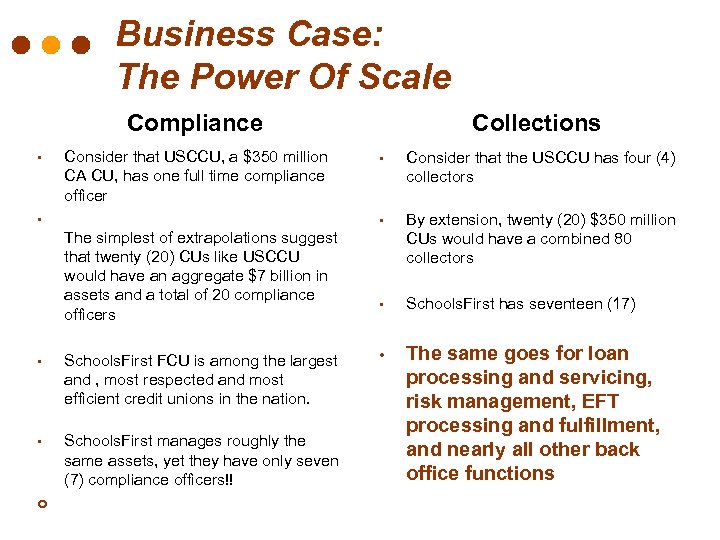
Business Case: The Power Of Scale Compliance • Consider that USCCU, a $350 million CA CU, has one full time compliance officer The simplest of extrapolations suggest that twenty (20) CUs like USCCU would have an aggregate $7 billion in assets and a total of 20 compliance officers • Schools. First FCU is among the largest and , most respected and most efficient credit unions in the nation. • Schools. First manages roughly the same assets, yet they have only seven (7) compliance officers!! • Consider that the USCCU has four (4) collectors • • ¢ Collections By extension, twenty (20) $350 million CUs would have a combined 80 collectors • Schools. First has seventeen (17) • The same goes for loan processing and servicing, risk management, EFT processing and fulfillment, and nearly all other back office functions
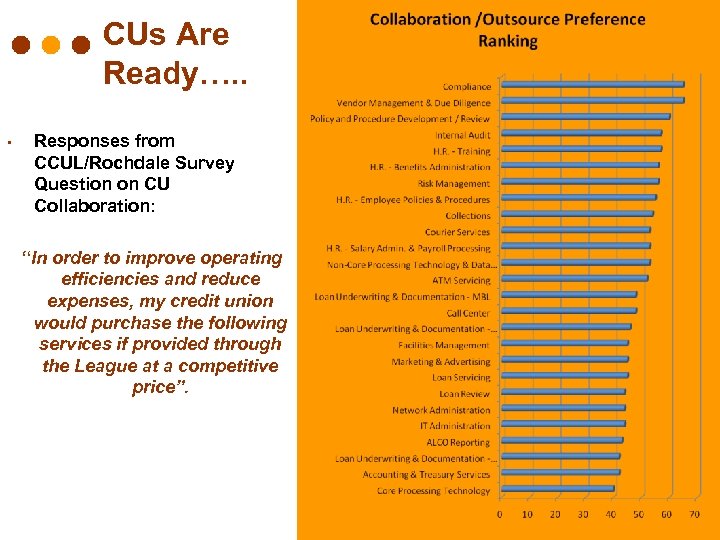
CUs Are Ready…. . • Responses from CCUL/Rochdale Survey Question on CU Collaboration: “In order to improve operating efficiencies and reduce expenses, my credit union would purchase the following services if provided through the League at a competitive price”.
Now’s The Time! • Not A New Concept • We’ve long had the wisdom, but we’ve lacked the necessity and the will to make it happen • It’s Necessary NOW!!
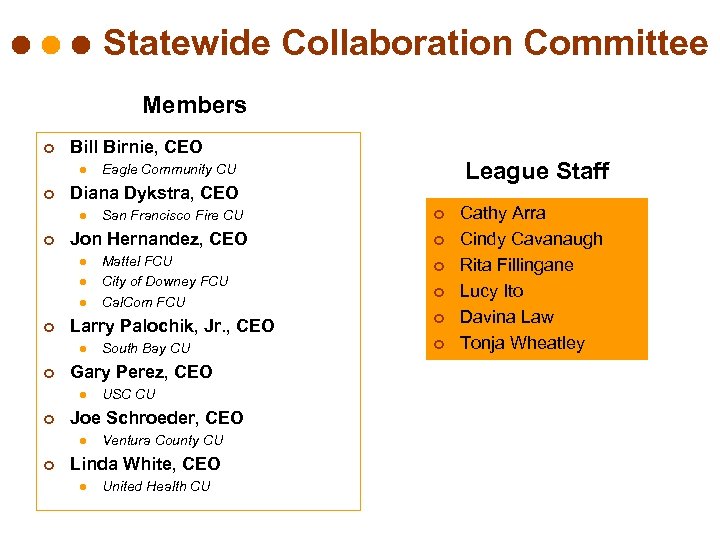
Statewide Collaboration Committee Members ¢ Bill Birnie, CEO l ¢ Diana Dykstra, CEO l ¢ l l USC CU Joe Schroeder, CEO l ¢ South Bay CU Gary Perez, CEO l ¢ Mattel FCU City of Downey FCU Cal. Com FCU Larry Palochik, Jr. , CEO l ¢ San Francisco Fire CU Jon Hernandez, CEO l ¢ League Staff Eagle Community CU Ventura County CU Linda White, CEO l United Health CU ¢ ¢ ¢ Cathy Arra Cindy Cavanaugh Rita Fillingane Lucy Ito Davina Law Tonja Wheatley
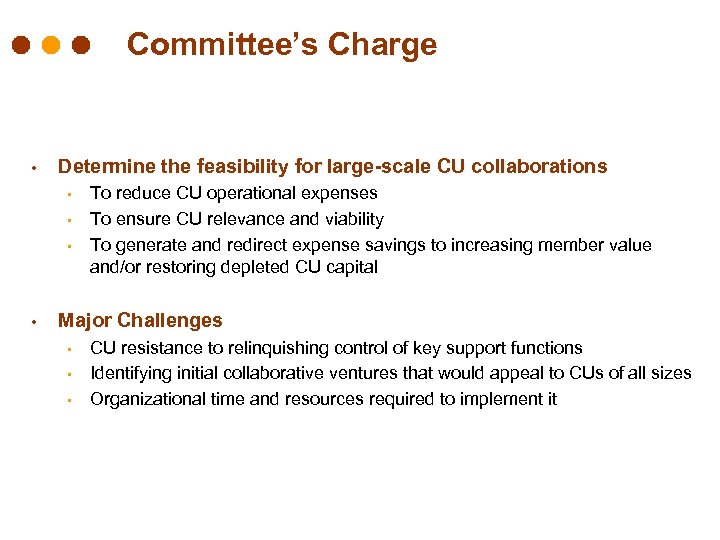
Committee’s Charge • Determine the feasibility for large-scale CU collaborations • • To reduce CU operational expenses To ensure CU relevance and viability To generate and redirect expense savings to increasing member value and/or restoring depleted CU capital Major Challenges • • • CU resistance to relinquishing control of key support functions Identifying initial collaborative ventures that would appeal to CUs of all sizes Organizational time and resources required to implement it
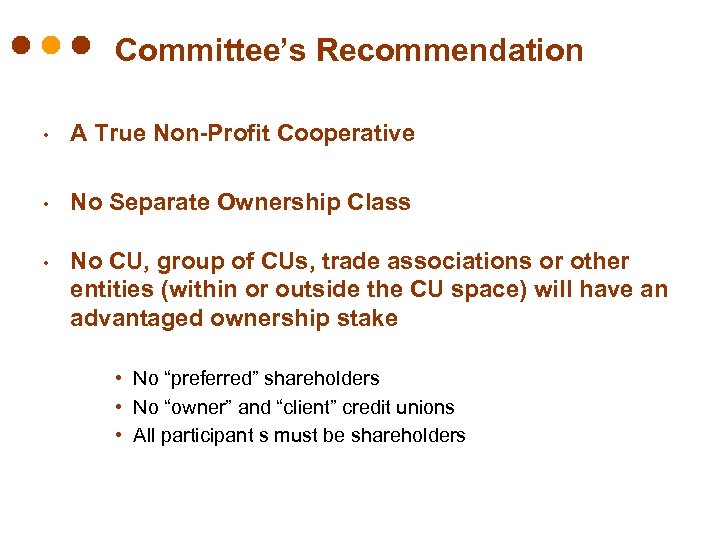
Committee’s Recommendation • A True Non-Profit Cooperative • No Separate Ownership Class • No CU, group of CUs, trade associations or other entities (within or outside the CU space) will have an advantaged ownership stake • No “preferred” shareholders • No “owner” and “client” credit unions • All participant s must be shareholders
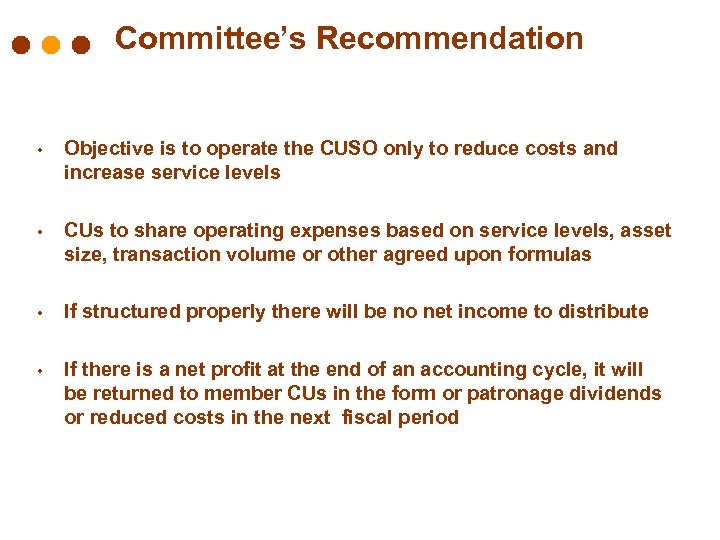
Committee’s Recommendation • Objective is to operate the CUSO only to reduce costs and increase service levels • CUs to share operating expenses based on service levels, asset size, transaction volume or other agreed upon formulas • If structured properly there will be no net income to distribute • If there is a net profit at the end of an accounting cycle, it will be returned to member CUs in the form or patronage dividends or reduced costs in the next fiscal period
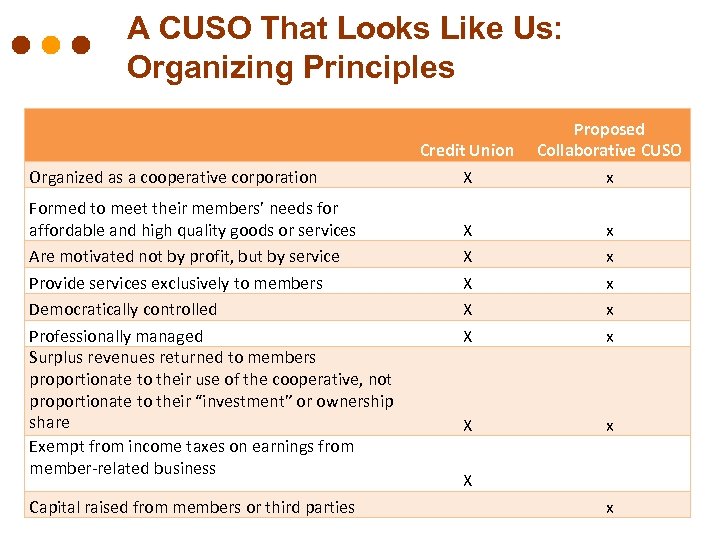
A CUSO That Looks Like Us: Organizing Principles Organized as a cooperative corporation Formed to meet their members’ needs for affordable and high quality goods or services Are motivated not by profit, but by service Provide services exclusively to members Democratically controlled Professionally managed Surplus revenues returned to members proportionate to their use of the cooperative, not proportionate to their “investment” or ownership share Exempt from income taxes on earnings from member-related business Capital raised from members or third parties Credit Union X Proposed Collaborative CUSO x X X X x x x X x
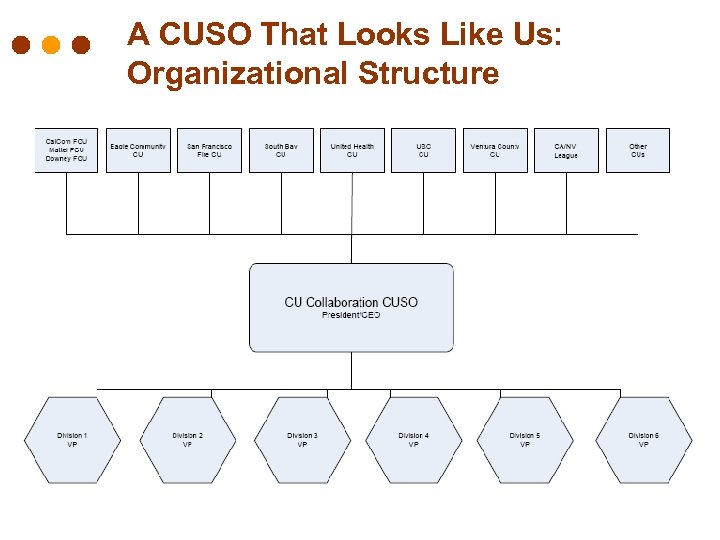
A CUSO That Looks Like Us: Organizational Structure
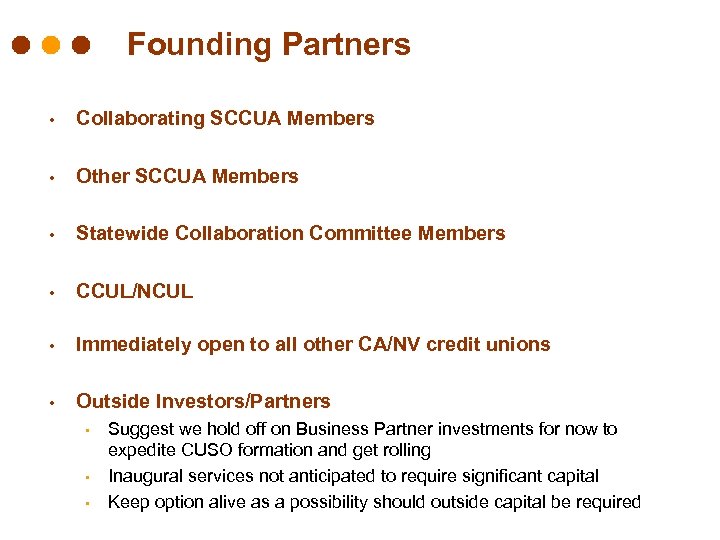
Founding Partners • Collaborating SCCUA Members • Other SCCUA Members • Statewide Collaboration Committee Members • CCUL/NCUL • Immediately open to all other CA/NV credit unions • Outside Investors/Partners • • • Suggest we hold off on Business Partner investments for now to expedite CUSO formation and get rolling Inaugural services not anticipated to require significant capital Keep option alive as a possibility should outside capital be required
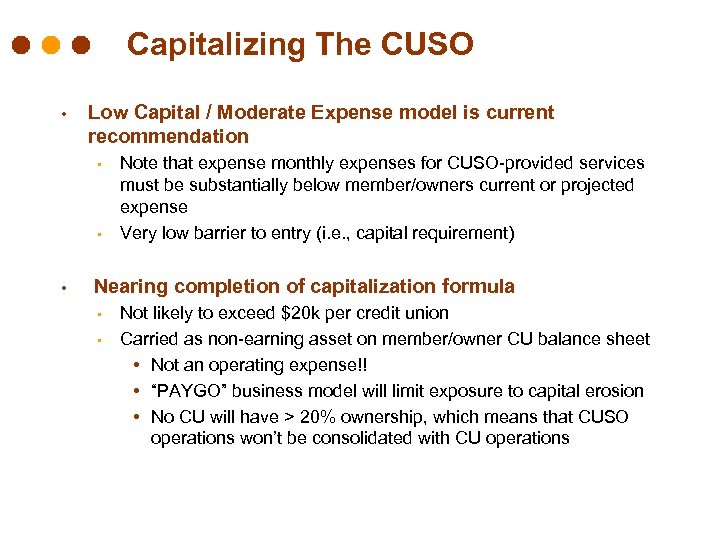
Capitalizing The CUSO • Low Capital / Moderate Expense model is current recommendation • • • Note that expense monthly expenses for CUSO-provided services must be substantially below member/owners current or projected expense Very low barrier to entry (i. e. , capital requirement) Nearing completion of capitalization formula • • Not likely to exceed $20 k per credit union Carried as non-earning asset on member/owner CU balance sheet • Not an operating expense!! • “PAYGO” business model will limit exposure to capital erosion • No CU will have > 20% ownership, which means that CUSO operations won’t be consolidated with CU operations
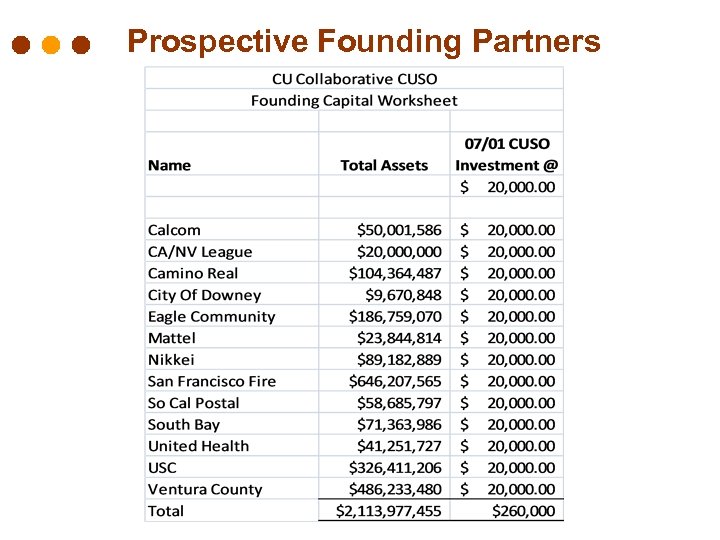
Prospective Founding Partners
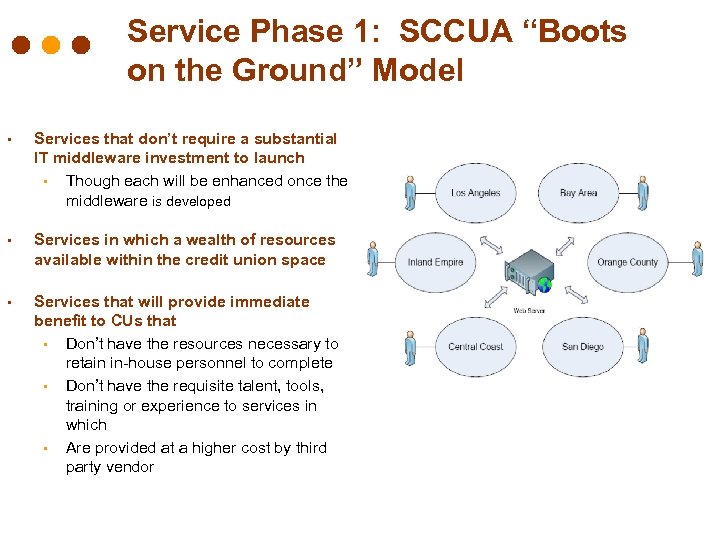
Service Phase 1: SCCUA “Boots on the Ground” Model • Services that don’t require a substantial IT middleware investment to launch • Though each will be enhanced once the middleware is developed • Services in which a wealth of resources available within the credit union space • Services that will provide immediate benefit to CUs that • Don’t have the resources necessary to retain in-house personnel to complete • Don’t have the requisite talent, tools, training or experience to services in which • Are provided at a higher cost by third party vendor
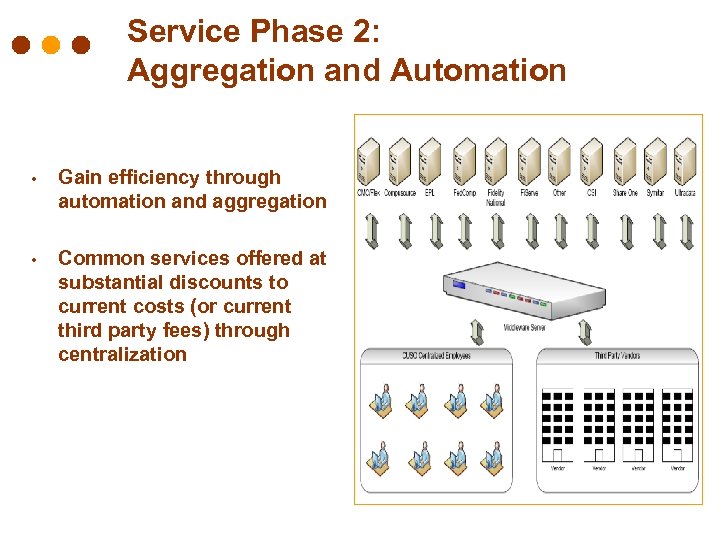
Service Phase 2: Aggregation and Automation • Gain efficiency through automation and aggregation • Common services offered at substantial discounts to current costs (or current third party fees) through centralization
Centralization is the Key • CU expense reductions contingent on centralization to achieve economies of scale • A few experienced, well trained, back-office professionals to meet the needs of several credit unions • Key is to limit the need for on-site visits • Goal is monthly or quarterly (preferred) visits • To accomplish this, CUs must • Accept uniform policy standards (with modest customization options) • Designate the shared resource as THEIR officer or coordinator • Authorize and implement electronic interface between the compliance monitoring center and the CU host system
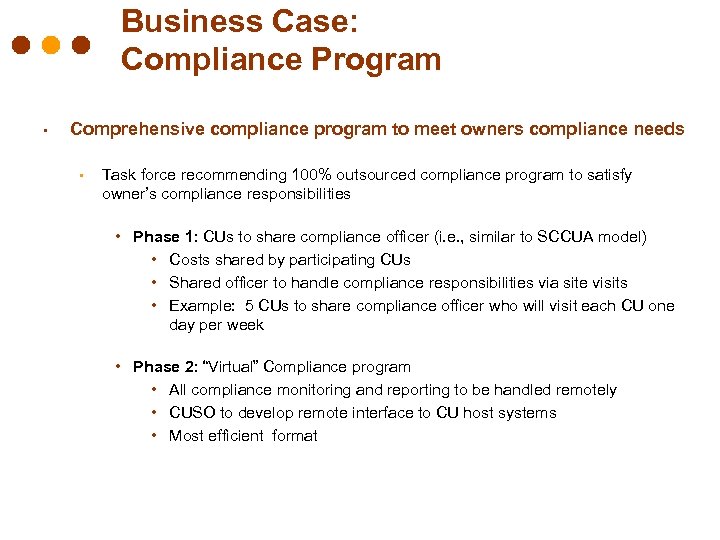
Business Case: Compliance Program • Comprehensive compliance program to meet owners compliance needs • Task force recommending 100% outsourced compliance program to satisfy owner’s compliance responsibilities • Phase 1: CUs to share compliance officer (i. e. , similar to SCCUA model) • Costs shared by participating CUs • Shared officer to handle compliance responsibilities via site visits • Example: 5 CUs to share compliance officer who will visit each CU one day per week • Phase 2: “Virtual” Compliance program • All compliance monitoring and reporting to be handled remotely • CUSO to develop remote interface to CU host systems • Most efficient format
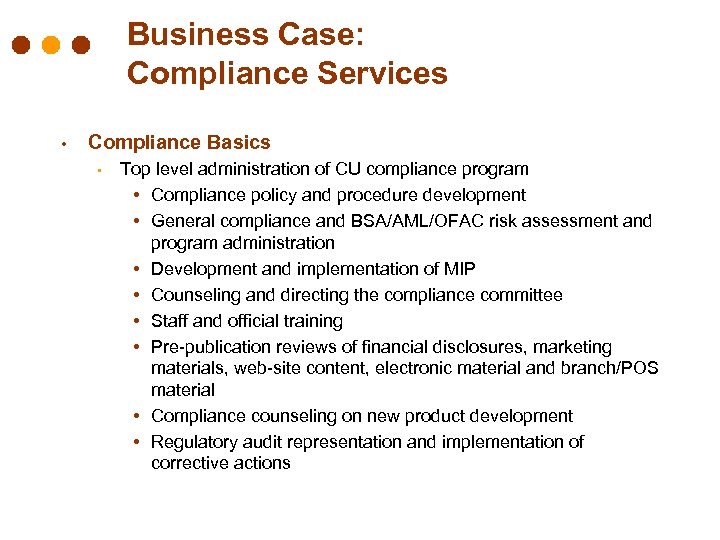
Business Case: Compliance Services • Compliance Basics • Top level administration of CU compliance program • Compliance policy and procedure development • General compliance and BSA/AML/OFAC risk assessment and program administration • Development and implementation of MIP • Counseling and directing the compliance committee • Staff and official training • Pre-publication reviews of financial disclosures, marketing materials, web-site content, electronic material and branch/POS material • Compliance counseling on new product development • Regulatory audit representation and implementation of corrective actions
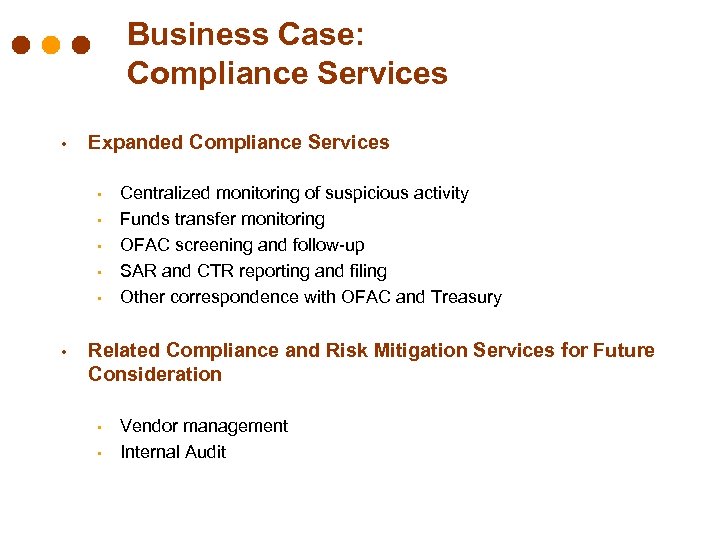
Business Case: Compliance Services • Expanded Compliance Services • • • Centralized monitoring of suspicious activity Funds transfer monitoring OFAC screening and follow-up SAR and CTR reporting and filing Other correspondence with OFAC and Treasury Related Compliance and Risk Mitigation Services for Future Consideration • • Vendor management Internal Audit
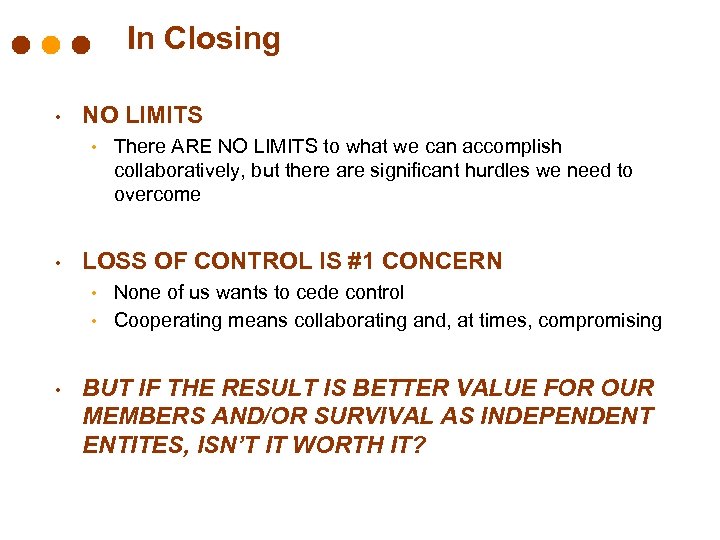
In Closing • NO LIMITS • • LOSS OF CONTROL IS #1 CONCERN • • • There ARE NO LIMITS to what we can accomplish collaboratively, but there are significant hurdles we need to overcome None of us wants to cede control Cooperating means collaborating and, at times, compromising BUT IF THE RESULT IS BETTER VALUE FOR OUR MEMBERS AND/OR SURVIVAL AS INDEPENDENT ENTITES, ISN’T IT WORTH IT?
SCCUA: Can We Follow Your Lead? ? We’re Better Together!!
Thank You!! Gary J. Perez, Chief Executive Officer GJPerez@usccreditunion. org 213 -821 -7122 John Parsons, Chief Collaborations Officer JParsons@usccreditunion. org 213 -821 -7235 FIGHT ON!!!!
Скачать презентацию We re Better Together Southern California Credit Union Alliance
3ac4d699ad89af8707d547fdab6f7f57.ppt