


 Скачать презентацию We don t inherit the world from our parents
efca0324dd3b3a89b109b1a193de0888.ppt
- Количество слайдов: 19
 “We don’t inherit the world from our parents, We borrow it from our children. ” Sioux Indians
 Centres of Family Business Learning Harvard Business School Babson Business School IMD Business School INSEAD Business School Kellogg School of Management Stetson University School of Business Administration 2
 Research • Families may fail to recognize that family business conflict results from a lack of participation and limited opportunities for the family to constructively explore individual differences related to values, goals and vision – T. Hubler, ‘The Ten Most prevalent obstacles to Family-Business Succession Planning’, Family Business Review, XII(2)(1999) 117 -21 • Craig Aronoff and John L. Ward, based on their as family business consultants, suggest that such family meetings teach communication skills, encourage independence and build self-esteem – C. E. Aronoff and J. L. Ward, Family Meetings: How to Build a Stronger Family and a Stronger Business (Marietta, GA: Business Owners Resources, 1992) 3
 Research • 80% of the families have gone bankrupt, or have sold or acquired over the past 50 years. Families business statistics offer a similar picture, with only 3 out of 10 family businesses surviving into the second generation, and only 1 out of 10 handed down to a third. The average life span of family firms (after a successful start-up) is 24 years, which coincides with the average time the founder is associated with the company. – Beckhard, R. and Dyer, W. (1983 b). ‘Managing continuity in the family-owned business, ’ Organizational Dynamics, 12: 5 -12. 4
 Family Constitutions Global Families Indian Families Ford Motor Company GMR Group Marriott International Dabur Group Cargill Murugappa Group Perrier Mineral Water Apollo Hospitals Heineken Beer Godrej 5
 The Family Business Opportunity 6
 India Tops in Family Feuds over Family Wealth • Forty percent of the globe's wealthy population have direct experience of their family fortune leading to disputes, but the percentage is even higher in India, where 61% of the rich have seen relationships deteriorate into feuds over money, according to a new report. In contrast, 53% of respondents in Singapore, 51% in Hong Kong have experienced family tension as a result of wealth, as against just 11% in Qatar. • 35% of global high net worth individuals do not have confidence in their children to protect their inheritance. Source: Barclays 7
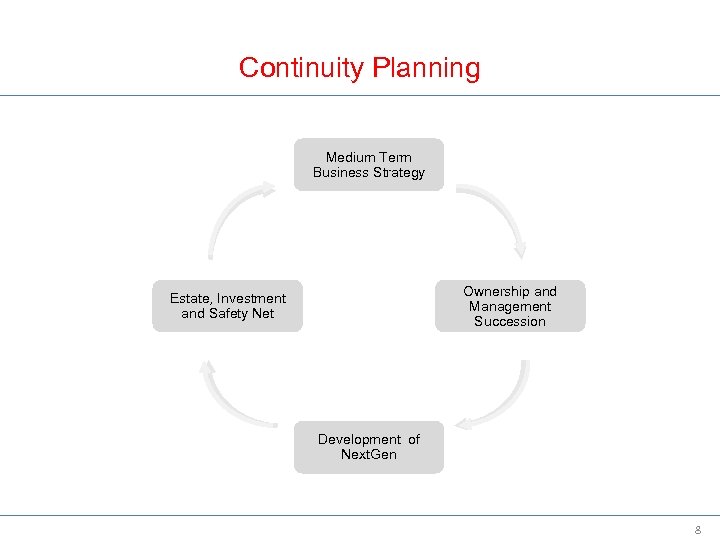 Continuity Planning Medium Term Business Strategy Ownership and Management Succession Estate, Investment and Safety Net Development of Next. Gen 8
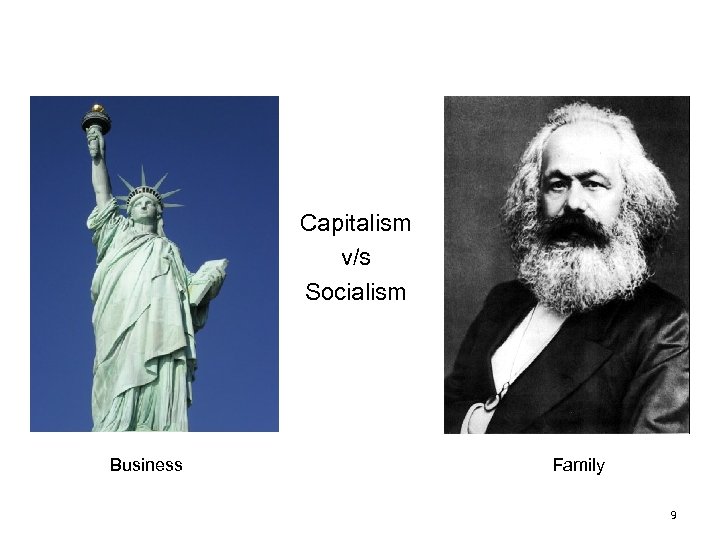 Capitalism v/s Socialism Business Family 9
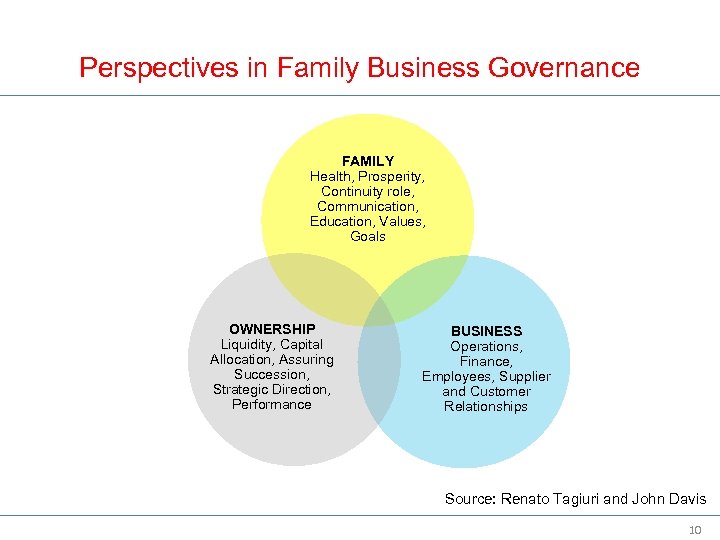 Perspectives in Family Business Governance FAMILY Health, Prosperity, Continuity role, Communication, Education, Values, Goals OWNERSHIP Liquidity, Capital Allocation, Assuring Succession, Strategic Direction, Performance BUSINESS Operations, Finance, Employees, Supplier and Customer Relationships Source: Renato Tagiuri and John Davis 10
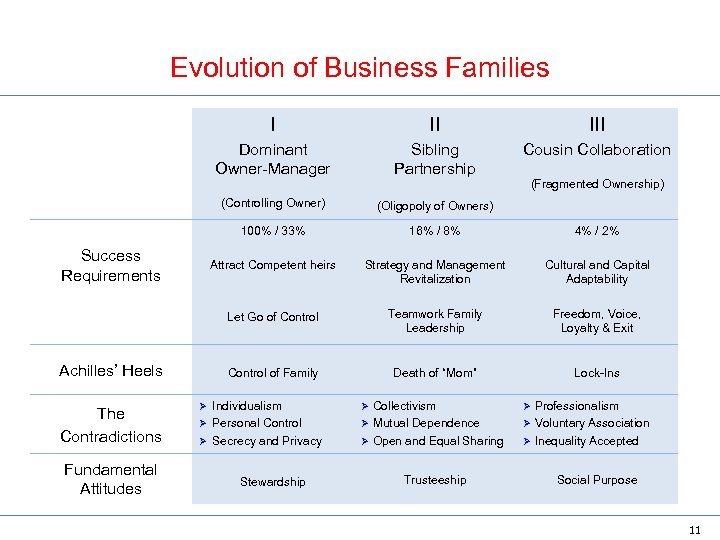 Evolution of Business Families I (Oligopoly of Owners) 16% / 8% 4% / 2% Attract Competent heirs Strategy and Management Revitalization Cultural and Capital Adaptability Let Go of Control Fundamental Attitudes Cousin Collaboration 100% / 33% The Contradictions Sibling Partnership (Controlling Owner) Achilles’ Heels III Dominant Owner-Manager Success Requirements II Teamwork Family Leadership Freedom, Voice, Loyalty & Exit Control of Family Death of “Mom” Lock-Ins (Fragmented Ownership) Ø Individualism Ø Collectivism Ø Professionalism Ø Personal Control Ø Mutual Dependence Ø Voluntary Association Ø Secrecy and Privacy Ø Open and Equal Sharing Ø Inequality Accepted Stewardship Trusteeship Social Purpose 11
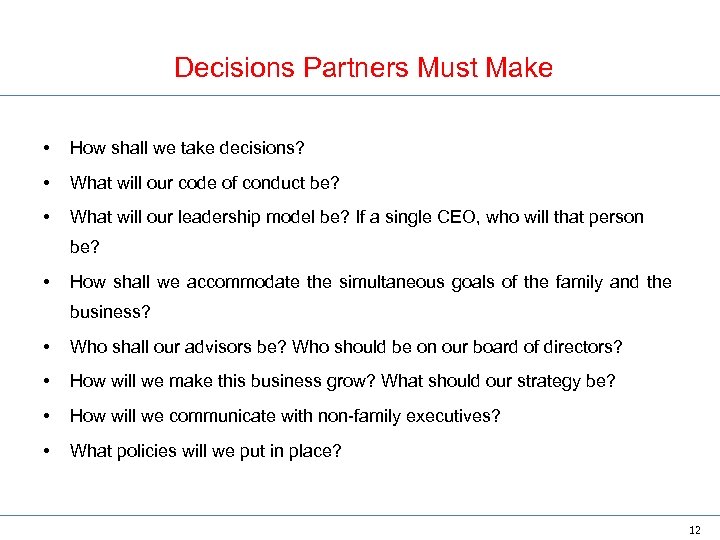 Decisions Partners Must Make • How shall we take decisions? • What will our code of conduct be? • What will our leadership model be? If a single CEO, who will that person be? • How shall we accommodate the simultaneous goals of the family and the business? • Who shall our advisors be? Who should be on our board of directors? • How will we make this business grow? What should our strategy be? • How will we communicate with non-family executives? • What policies will we put in place? 12
 Sample Policies • • • Rights and Obligations of Individuals/Women/Non-Employed Owners Role of Family Members in the Business Employment/Compensation/ Performance Evaluation Policy Family Fun/Bonding Safety Net Media Policy Conflict of Interest Family Education and Mentoring Policy Philanthropy 13
 Sample Processes • Managing Succession • Managing Differences • Constitution Review • Information /Reports 14
 Sample Structures • Family Council • Family Business Board • Independent Board • Non Business Family Forum • Family Safety Fund • Family Office for Investments 15
 Some Ownership Policies • Conditions for ownership and voting rights • Dispute resolution process • Dividends / Drawings • Redemption process • Business valuation methodology • Buy-sell agreement (shareholder’s agreement) • Rights and responsibilities of non-employed owners • Rules for travel and other major expenses • Addressing family member’s financial problems 16
 17
17
 "There is a tide in the affairs of men. Which taken at the flood, leads on to fortune; Omitted, all the voyage of their life is bound in shallows and in miseries. ” William Shakespeare
 Resources and Acknowledgement • Family Businesses: The Essentials, Leach, Peter, 2007 • 9 Elements of Family Business Success, Fishman, Allen E. , 2009 • Getting Along in Family Business: The Relationship Intelligence Handbook, Hoover, Edwin A. , Hoover, Colette Lombard, 1999 • Perpetuating the Family Business, Ward, John L. , 2004 • Business Maharajas, Piramal, Gita, 1997 • Family Meetings: How to Build a Stronger Family and a Stronger Business, Craig E. Aronoff, Ph. D. and John L. Ward, Ph. D. , 2002 • Developing Family Business Policies: Your Guide to the Future, Craig E. Aronoff, Ph. D. , Joseph H. Astrachan, Ph. D. and John L. Ward, Ph. D. , 1998 • Family Business Values: How to Assure a Legacy of Continuity and Success, Craig E. Aronoff, Ph. D. and John L. Ward, Ph. D. , 2001 19