 Скачать презентацию We BWor K The Ultimate Teaching Assistant Olly
bc5fbff46d6ff804a12f2cbf00bb8ddf.ppt
- Количество слайдов: 15



We. BWor. K: The Ultimate Teaching Assistant? Olly Gotel Rick Kline Christelle Scharff Andy Wildenberg* May Faculty Institute (05/16/06) Jackie Baldwin * Eileen Crupi Tabitha Estrellado
Agenda • Introductions and survey of online tools • We. BWor. K: – What it is, where it is used, what you can do with it, what we are doing with it and why • Using We. BWor. K as a CS student: – Range of questions it supports (with extensions) – Randomization and attempts • Be the universal instructor/student: – Question formulation, answer entry and getting feedback (as both an instructor and student) • Lessons to date • Future work May Faculty Institute (05/16/06)
What Is We. BWor. K? • Web-based, automated problem generation, delivery and grading system • Free, open-source project funded by NSF • Initial development and applications in the fields of mathematics, physics • Currently in use at more than 50 colleges and universities May Faculty Institute (05/16/06)
How Can It Help? • • Homework, Quizzes, Practice Randomization Instant feedback Ability to “try again” May Faculty Institute (05/16/06)
Who Else Is Doing This? • We. BWor. K: math, physics • OWL (Thomson Course Technologies): chemistry (and perhaps other fields) • Code. Lab, Course. Marker, Codewitz, Gradience May Faculty Institute (05/16/06)
We. BWor. K at Pace • Extend We. BWor. K for use in computer science curriculum • Interface We. BWor. K with other tools to facilitate grading of new problem types • Enhance feedback mechanisms for both students and instructors • Work funded by NSF grant May Faculty Institute (05/16/06)
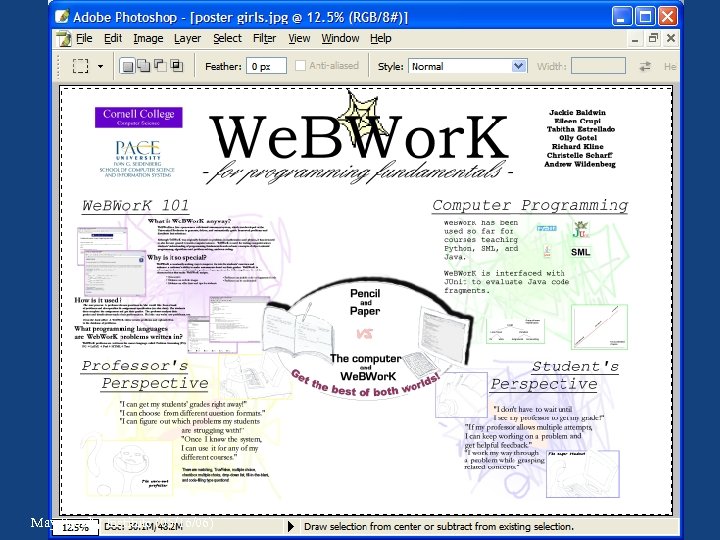
May Faculty Institute (05/16/06)
Using We. BWor. K in CS 121/IS 223 • Fall 2005 (Java): – For in-class tests (multiple choice / matching) • Spring 2006 (Python and Java): – For in-class tests (multiple choice / matching) – For homework exercises TEACHING & LEARNING: LESSONS FROM EXPERIENCE May Faculty Institute (05/16/06)
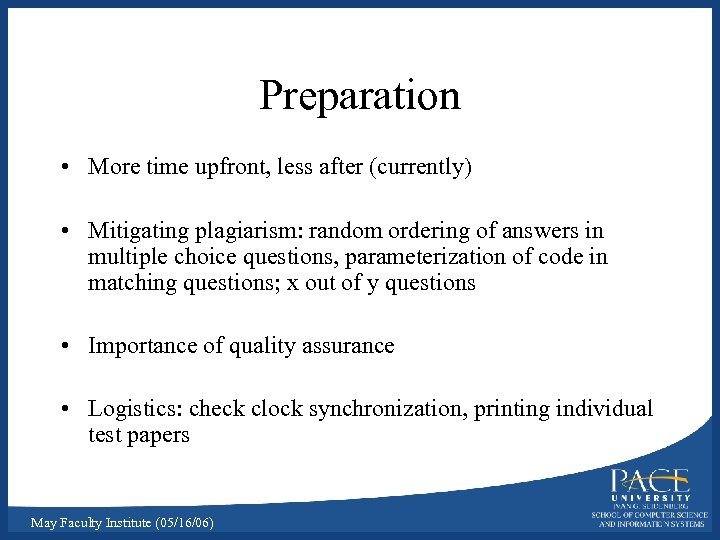
Preparation • More time upfront, less after (currently) • Mitigating plagiarism: random ordering of answers in multiple choice questions, parameterization of code in matching questions; x out of y questions • Importance of quality assurance • Logistics: check clock synchronization, printing individual test papers May Faculty Institute (05/16/06)
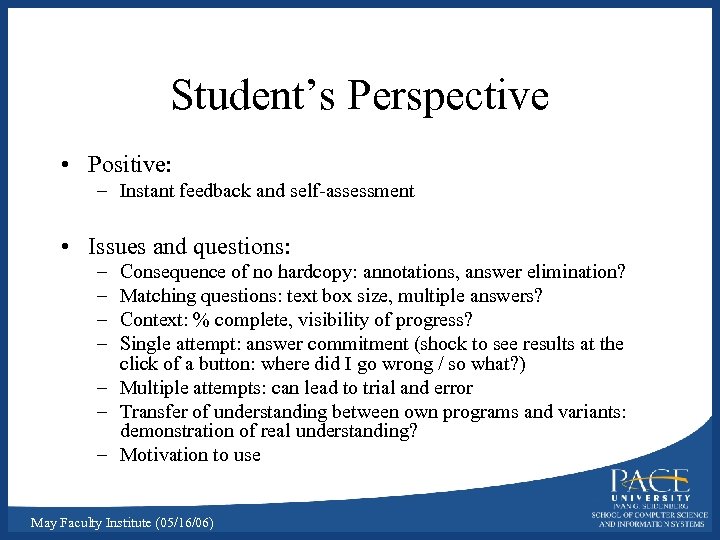
Student’s Perspective • Positive: – Instant feedback and self-assessment • Issues and questions: – – Consequence of no hardcopy: annotations, answer elimination? Matching questions: text box size, multiple answers? Context: % complete, visibility of progress? Single attempt: answer commitment (shock to see results at the click of a button: where did I go wrong / so what? ) – Multiple attempts: can lead to trial and error – Transfer of understanding between own programs and variants: demonstration of real understanding? – Motivation to use May Faculty Institute (05/16/06)
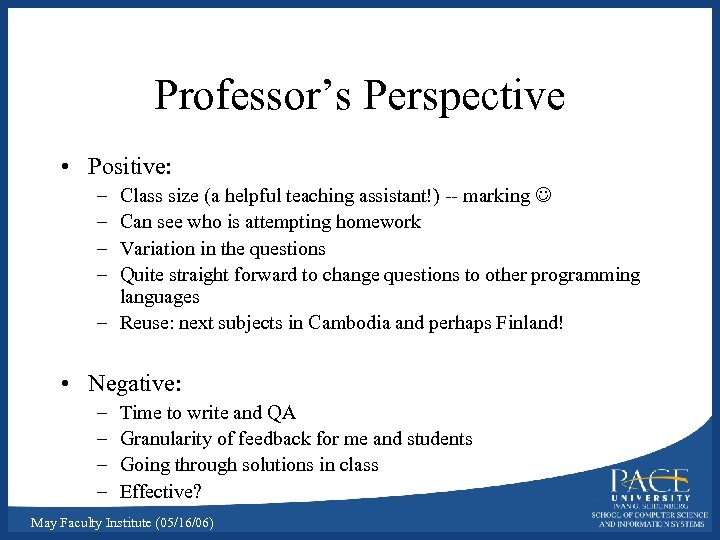
Professor’s Perspective • Positive: – – Class size (a helpful teaching assistant!) -- marking Can see who is attempting homework Variation in the questions Quite straight forward to change questions to other programming languages – Reuse: next subjects in Cambodia and perhaps Finland! • Negative: – – Time to write and QA Granularity of feedback for me and students Going through solutions in class Effective? May Faculty Institute (05/16/06)
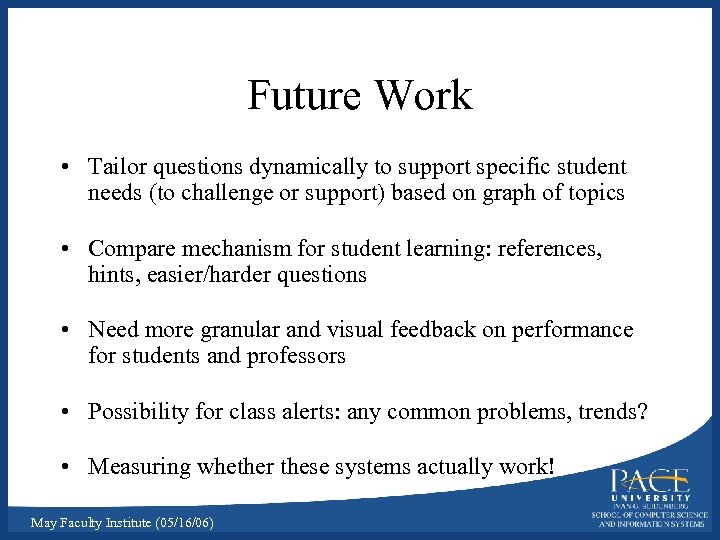
Future Work • Tailor questions dynamically to support specific student needs (to challenge or support) based on graph of topics • Compare mechanism for student learning: references, hints, easier/harder questions • Need more granular and visual feedback on performance for students and professors • Possibility for class alerts: any common problems, trends? • Measuring whether these systems actually work! May Faculty Institute (05/16/06)
Dissemination • Poster Presentation at the Special Interest Group on Computer Science Education Conference, Houston (SIGCSE 2006) • Poster Presentation at the Innovation and Technology in Computer Science Education Conference, University of Bologna, Italy (ITi. CSE 2006) May Faculty Institute (05/16/06)
Your Questions ? May Faculty Institute (05/16/06)
Our Questions … May Faculty Institute (05/16/06)
Скачать презентацию We BWor K The Ultimate Teaching Assistant Olly
bc5fbff46d6ff804a12f2cbf00bb8ddf.ppt