 Скачать презентацию WDB Weather and Water Database 19 th EGOWS
215fe9215f9f72113bc281a876ee75d4.ppt
- Количество слайдов: 36



WDB Weather and Water Database 19 th EGOWS Meeting, Ljubljana, June 9 -12, 2008. Norwegian Meteorological Institute METNO
Outline • • • Introduction Background of WDB Overview of WDB Components Future of WDB Norwegian Meteorological Institute METNO
Who are we? • Michael Akinde – Ph. D. , Database Architect, IT, Met. no – Systems architect on ROAD system at SMHI(2003 -2006) • Vegard Bønes – M. Sc. , Senior Engineer, IT, Met. no • Børge Moe – M. Sc. , Senior Engineer, IT, Met. no Norwegian Meteorological Institute METNO
Who are you? • Survey: please raise your hands. . . – – – Who Who Who has coded programs? has written SQL queries? has worked with database APIs (JDBC, ODBC, etc)? knows what database normalization is? knows what a database index is? has written database extensions? Norwegian Meteorological Institute METNO
What is this about? • We need to store weather/water data • We need indexed (fast) access to time series retrieved from multiple files or sources • We need access from a variety of applications • We need products to be consistent • We want to be able to track changes • We want programs to be independent of the data format • We have limited ressources Norwegian Meteorological Institute METNO
What is WDB? • WDB is a storage system for meteorological, hydrological, and oceanographic data – Developed by the PROFF program at met. no – Based on the ROAD (SMHI) architecture Norwegian Meteorological Institute METNO
History of ROAD • Operational meteorological database, developed in the late 90’s at SMHI; operational since 2001 • Responsible for 90% of SMHI’s automatic production • One of the world’s fastest meteorological databases • Mature and well-established production system; 3 rd generation in development 2006 -2008 Norwegian Meteorological Institute METNO
Problems of ROAD • Like most met systems, ROAD is a legacy system – Prior to ROAD 3 G, the loading chain of the ROAD system included Fortran code developed in the 1970 s • SMHI is in the process of a major rehaul of the production systems in terms of migrating software from Open. VMS to Linux • IBM Informix platform – Geodetic datablade (geospatial extension) – Licenses are expensive Norwegian Meteorological Institute METNO
WDB is… • Open source collaboration between met. no and SMHI • Can be considered the 4 th generation of the ROAD system – Built from the ground up without legacy code – Developed at met. no • Released under the GNU GPL 2 license Fast, Free, Flexible Norwegian Meteorological Institute METNO
WDB: Open Source Alternative • Should be robust enough to handle high volume, high availability production – e. g. , as the backend engine of yr. no • Should be flexible – e. g. , to easily handle new types of data • Should support quality and consistency of data • Should be simple to use • Should be easy to maintain and operate Norwegian Meteorological Institute METNO
WDB provides. . . • Quick and easy to deploy data storage system • Modular loading programs – Easy to add more… • Data-independent application programmers interface (API) – Usable, in theory, from any environment • Fast performance on queries Norwegian Meteorological Institute METNO
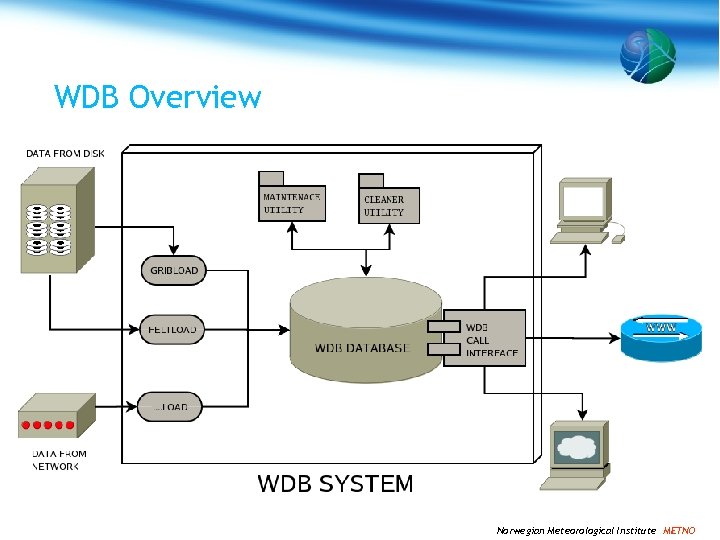
WDB Overview Norwegian Meteorological Institute METNO
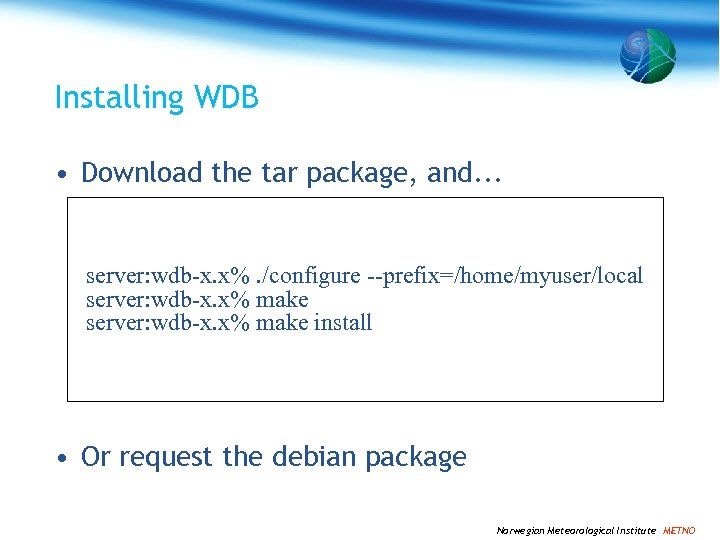
Installing WDB • Download the tar package, and. . . server: wdb-x. x%. /configure --prefix=/home/myuser/local server: wdb-x. x% make install • Or request the debian package Norwegian Meteorological Institute METNO
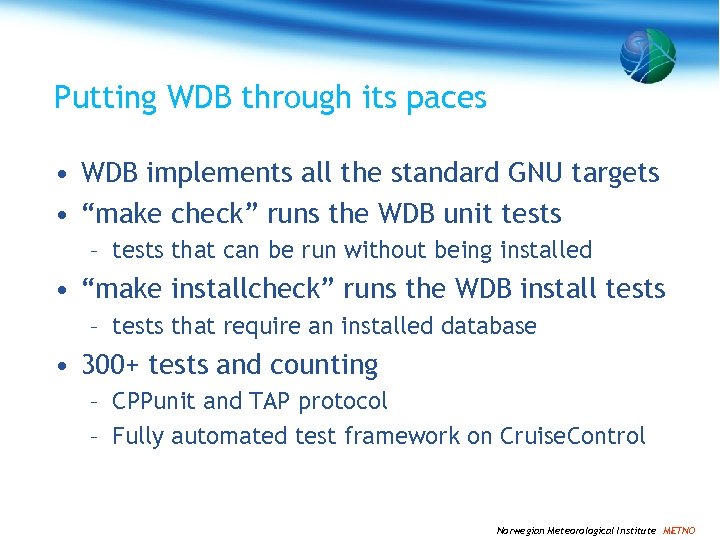
Putting WDB through its paces • WDB implements all the standard GNU targets • “make check” runs the WDB unit tests – tests that can be run without being installed • “make installcheck” runs the WDB install tests – tests that require an installed database • 300+ tests and counting – CPPunit and TAP protocol – Fully automated test framework on Cruise. Control Norwegian Meteorological Institute METNO
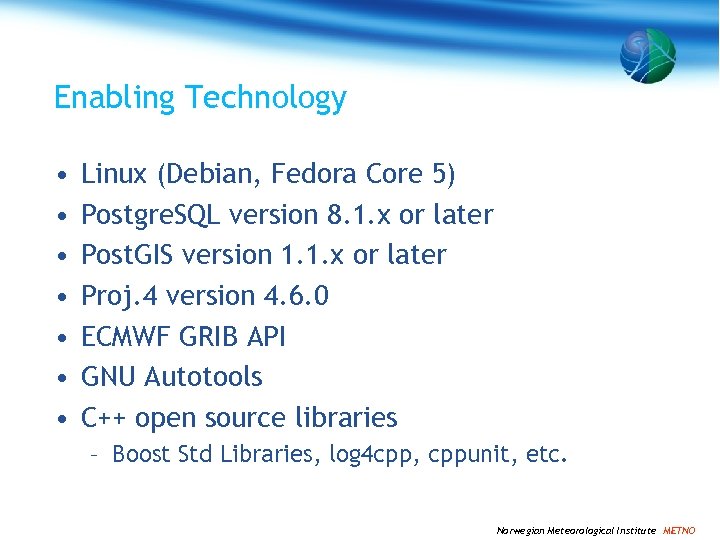
Enabling Technology • • Linux (Debian, Fedora Core 5) Postgre. SQL version 8. 1. x or later Post. GIS version 1. 1. x or later Proj. 4 version 4. 6. 0 ECMWF GRIB API GNU Autotools C++ open source libraries – Boost Std Libraries, log 4 cpp, cppunit, etc. Norwegian Meteorological Institute METNO
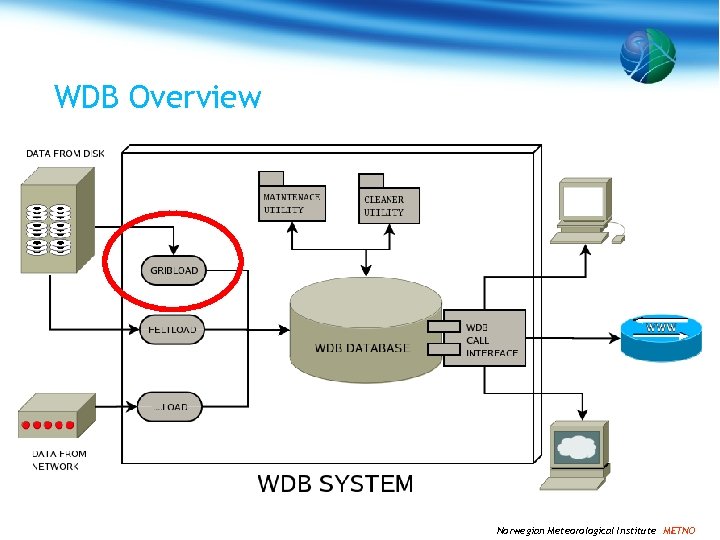
WDB Overview Norwegian Meteorological Institute METNO
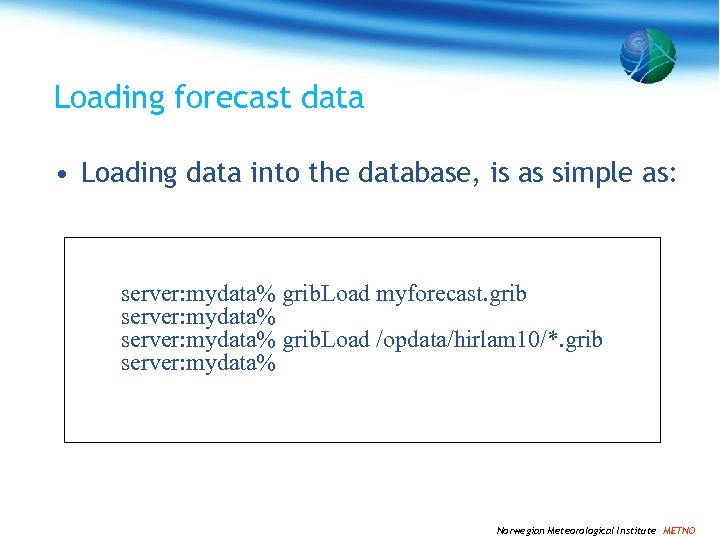
Loading forecast data • Loading data into the database, is as simple as: server: mydata% grib. Load myforecast. grib server: mydata% grib. Load /opdata/hirlam 10/*. grib server: mydata% Norwegian Meteorological Institute METNO
Loading Programs • GRIBLoad is the design pattern for the WDB loading programs • Loads one or more GRIB 1 files into the database – Uses ECMWF GRIB API, so theoretically, GRIB 2 works as well – Stand-alone client program that connects to any WDB database • Loaders for other grid formats are easily built in the same way by reusing code • Loading of BUFR will be ported from ROAD Norwegian Meteorological Institute METNO
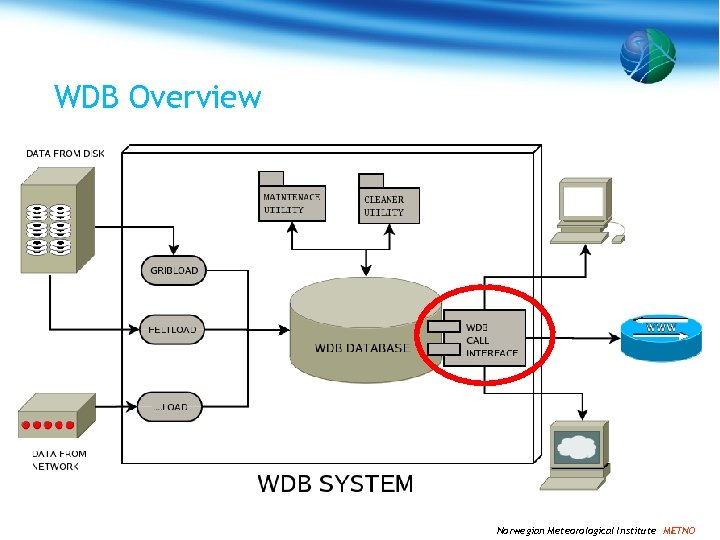
WDB Overview Norwegian Meteorological Institute METNO
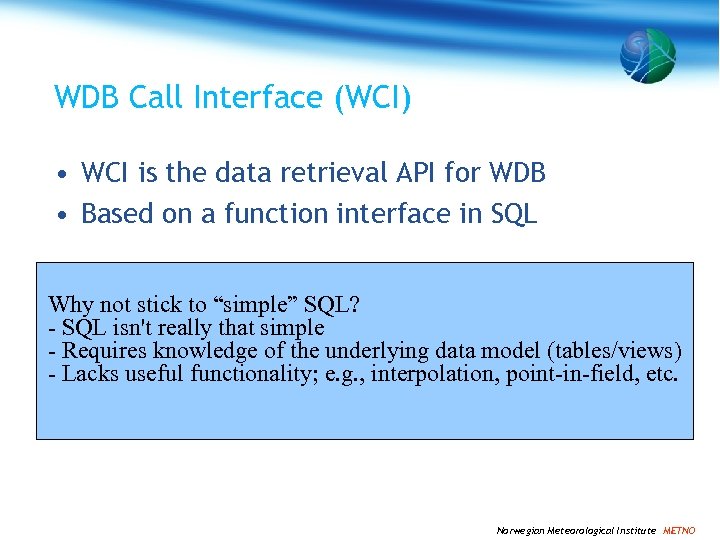
WDB Call Interface (WCI) • WCI is the data retrieval API for WDB • Based on a function interface in SQL Why not stick to “simple” SQL? - SQL isn't really that simple - Requires knowledge of the underlying data model (tables/views) - Lacks useful functionality; e. g. , interpolation, point-in-field, etc. Norwegian Meteorological Institute METNO
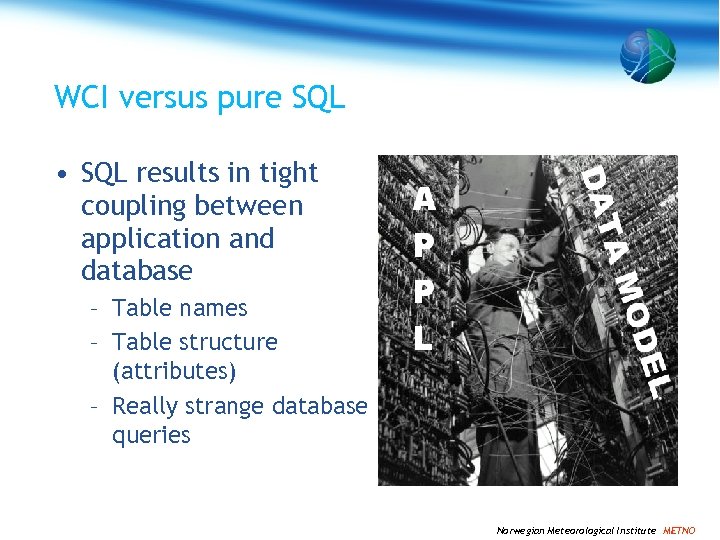
WCI versus pure SQL • SQL results in tight coupling between application and database – Table names – Table structure (attributes) – Really strange database queries Norwegian Meteorological Institute METNO
WDB Call Interface (WCI) • WCI is the data retrieval API for WDB • Based on a function interface in SQL Why not a lib file? - Changes in a library require that the applications using the library are recompiled - New libraries need to be pushed to the user (application) - Each operating system, machine and language = its own library Norwegian Meteorological Institute METNO
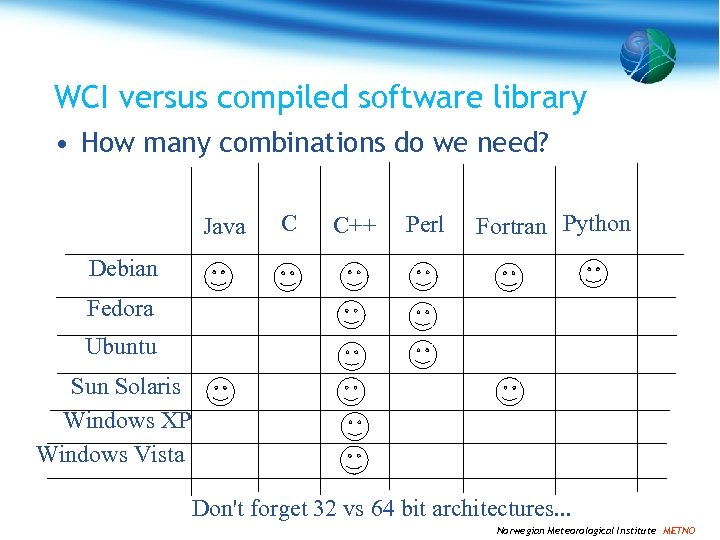
WCI versus compiled software library • How many combinations do we need? Java C C++ Perl Fortran Python Debian Fedora Ubuntu Sun Solaris Windows XP Windows Vista Don't forget 32 vs 64 bit architectures. . . Norwegian Meteorological Institute METNO
WDB Call Interface Features • Stable Interface • Performance – 100 -1000 values/s in single point retrieval (to be improved) – 10 million floating points/s in field retrieval (about 100 fields/s) • Functionality: – Pointwise, Timeseries, 2 d-volumes, Quality information – Coming: Paths, Interpolation in space and time, 3 D volumes? • Easy to program – 1/2 page of code to retrieve MHO-data • Platforms: C/C++, Java, Perl, Python, Fortran, ODBC… • Operating systems: Pretty much anything. . . Norwegian Meteorological Institute METNO
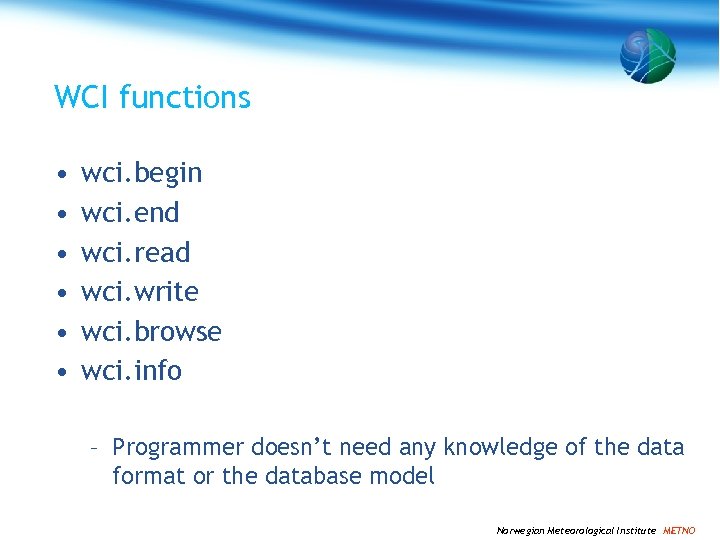
WCI functions • • • wci. begin wci. end wci. read wci. write wci. browse wci. info – Programmer doesn’t need any knowledge of the data format or the database model Norwegian Meteorological Institute METNO
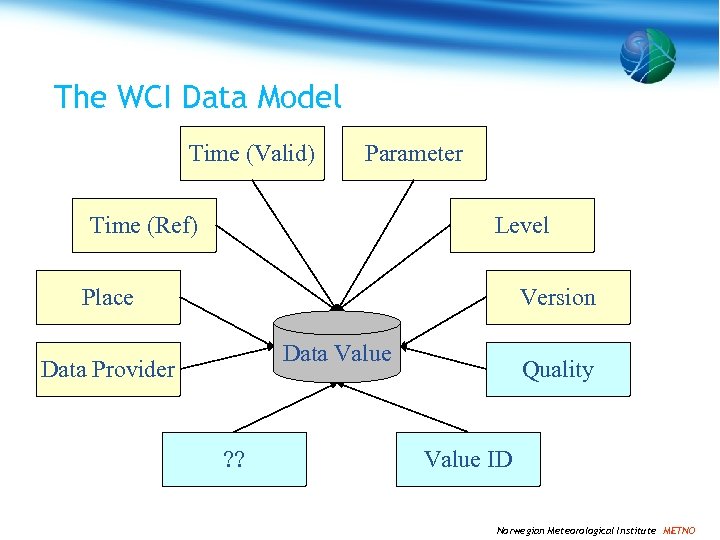
The WCI Data Model Time (Valid) Parameter Time (Ref) Level Place Version Data Value Data Provider ? ? Quality Value ID Norwegian Meteorological Institute METNO
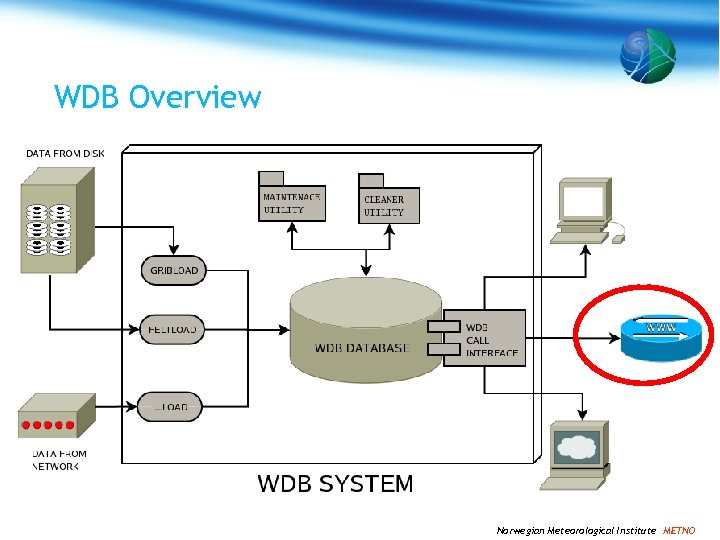
WDB Overview Norwegian Meteorological Institute METNO
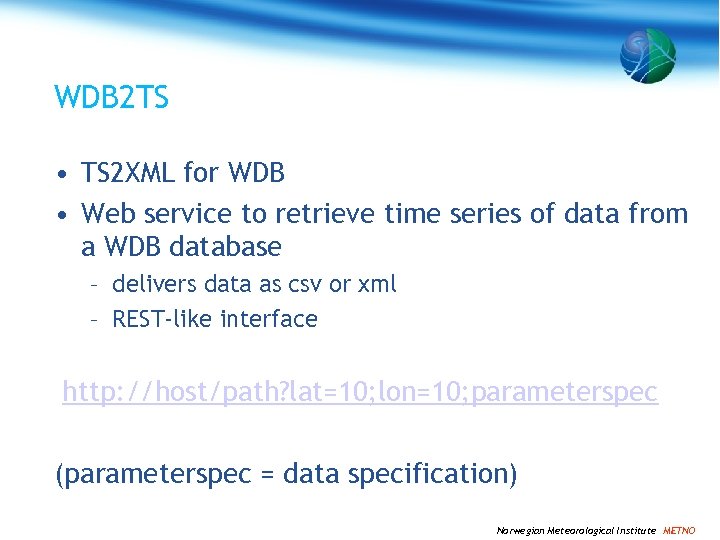
WDB 2 TS • TS 2 XML for WDB • Web service to retrieve time series of data from a WDB database – delivers data as csv or xml – REST-like interface http: //host/path? lat=10; lon=10; parameterspec (parameterspec = data specification) Norwegian Meteorological Institute METNO
The Road ahead for WDB • WDB version 0. 6. 0 – First production version of WDB – Hindcast archive (12 TBs of grids) • WDB version 0. 7. 4 – To be released next week – We currently release a new version about once a month – Implements a new loading program • FELT: met. no field format • Approximate time to develop: 2 weeks x 2 persons Norwegian Meteorological Institute METNO
WDB Roadmap • Version 0. 8. 0 is scheduled for July 2008 – Official beta version of WDB – Limited scale real-time production • Version 0. 9. 0 is scheduled for October 2008 – Release candidate version (full-scale testing) • Version 1. 0 scheduled for December 2008 – Full-scale production version • WDB is a part of the PROFF framework; minimum expected life-time is at least 15 years Norwegian Meteorological Institute METNO
Future thoughts? • Complete integration with Diana • More data types – Fields (Net. CDF, GRIB 2, etc. ) – Observations (BUFR, XML) • Better administration tools • Verified Stability – 24 x 7 hands-free operation (have this in ROAD…) • Improved Performance – We have not started optimizations Norwegian Meteorological Institute METNO
Future thoughts? • Scalability and fail-over – Want more load? Add another server – Want to guarantee up-time? Add more servers • Consistency – Easy on one server; we want multiple servers – Distributed data/replication is a well-known problem in the database community – Problems: huge data, geographically distant regions • Tracking of changes – Metadata can be used to track history… Norwegian Meteorological Institute METNO
Recommended Reading • WDB website (wdb. met. no) – – – WDB User Manual WCI User Manual Man Pages for all WDB utilities Source code browser (SVN repository and doxygen) Developer documentation (design docs) Eclipse setup instructions • Subscribe to WDB project on Freshmeat. net Norwegian Meteorological Institute METNO
Summary • WDB is designed as a generic weather/water database system – Perspective: one core system that can be leveraged for many different uses – Functionality that isn't implemented can probably be added – For users: fast access to data – For developers: a simple, generic interface to all kinds of different data – For operators: a system that is easy to maintain Norwegian Meteorological Institute METNO
Concluding thoughts… • Many, many more WDB systems in the future – WDB is intended as the backbone of the production systems at met. no and SMHI • Open source is a different model of collaboration which can be of great benefit to meteorological institutions – We all require broadly the same functionality – Good communications = better systems – Free as in Freedom Norwegian Meteorological Institute METNO
THANK YOU ! Questions? E-mail: michael. akinde@met. no Norwegian Meteorological Institute METNO
Скачать презентацию WDB Weather and Water Database 19 th EGOWS
215fe9215f9f72113bc281a876ee75d4.ppt