


 Скачать презентацию WCRP Peace Education Standing Commission A Short Introduction
9ad50d2f3c6ad6a67bc7cf520e361a20.ppt
- Количество слайдов: 13
 WCRP Peace Education Standing Commission A Short. Introduction Dr. Werner Haussmann University of Erlangen- Nuremberg member of the PESC Advisory Council
 The object of this lecture l information l illumination l invitation „Since wars begin in the minds of men, it is in the minds of men that the defences of peace must be constructed. “ (Preamble of the UNESCO Constitution)
 Who is PESC? (I) l The Peace Education Standing commission (PESC) is a branch of the World Conference on Religion and Peace (WCRP). Founded in 1970, the World Conference on Religion and Peace (WCRP) is organized on an international, regional and national level, on every continent, and in some of the most troubled places on earth. WCRP is based on the principle of profound respect for religious differences, and is solely dedicated to multi-religious cooperation for peace. WCRP is uniquely equipped to unleash the enormous power of the world's religions in effective multi-religious actions. Often in close cooperation with governments and pre-eminent civil counterparts WCRP has mobilized the collaborative capacities of religious communities at every level of society in the following areas: Conflict Transformation and Reconciliation, Human Rights and Responsibilities, The Child and the Family, Development and Ecology, Disarmament and Security, Peace Education
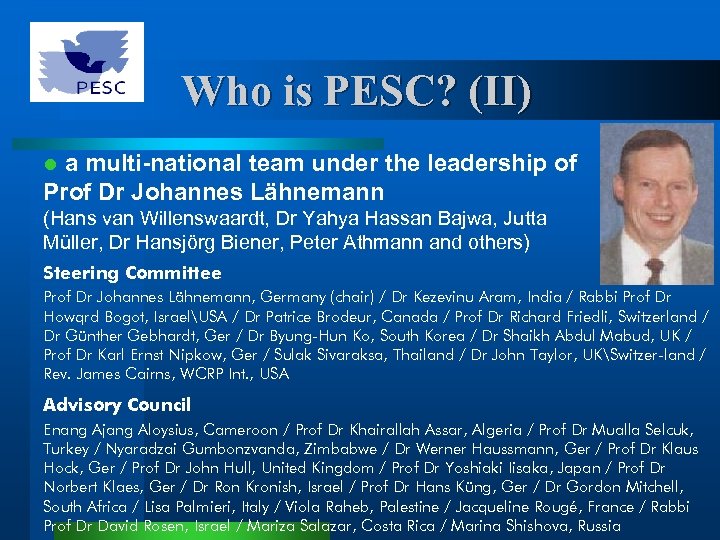 Who is PESC? (II) a multi-national team under the leadership of Prof Dr Johannes Lähnemann l (Hans van Willenswaardt, Dr Yahya Hassan Bajwa, Jutta Müller, Dr Hansjörg Biener, Peter Athmann and others) Steering Committee Prof Dr Johannes Lähnemann, Germany (chair) / Dr Kezevinu Aram, India / Rabbi Prof Dr Howqrd Bogot, IsraelUSA / Dr Patrice Brodeur, Canada / Prof Dr Richard Friedli, Switzerland / Dr Günther Gebhardt, Ger / Dr Byung-Hun Ko, South Korea / Dr Shaikh Abdul Mabud, UK / Prof Dr Karl Ernst Nipkow, Ger / Sulak Sivaraksa, Thailand / Dr John Taylor, UKSwitzer-land / Rev. James Cairns, WCRP Int. , USA Advisory Council Enang Ajang Aloysius, Cameroon / Prof Dr Khairallah Assar, Algeria / Prof Dr Mualla Selcuk, Turkey / Nyaradzai Gumbonzvanda, Zimbabwe / Dr Werner Haussmann, Ger / Prof Dr Klaus Hock, Ger / Prof Dr John Hull, United Kingdom / Prof Dr Yoshiaki Iisaka, Japan / Prof Dr Norbert Klaes, Ger / Dr Ron Kronish, Israel / Prof Dr Hans Küng, Ger / Dr Gordon Mitchell, South Africa / Lisa Palmieri, Italy / Viola Raheb, Palestine / Jacqueline Rougé, France / Rabbi Prof Dr David Rosen, Israel / Mariza Salazar, Costa Rica / Marina Shishova, Russia
 Why is PESC necessary? l The duty of Religions. . . - Can religions contribute to the flourishing of peace instead of war in the minds (and hearts) of men? - Do religions have a contribution to make towards educating men in peace and non-violence? l The duty of PESC: Much important work is already being carried out today in the field of Peace Education. PESC has taken upon itself the job of bringing this practical work closer together with the messages and forces of peace inherent in the various religious traditions.
 Fields of PESC-activities Research on and support of (inter-)religious Peace Education initiatives in three main areas Religious and Interreligious Education l Education towards violence-free communication and conflict solution l Environmental education and education towards soc economical development l „Our aim is the scientific support and worldwide networking of Peace Education projects of an interconfessional and inter-religious nature. “
 What is PESC doing? analysing projects from various world regions and providing information for Religion, Politics, Science and Economy l setting up contacts between the various parties: active participants, media, sponsors, leading religious and political representatives, educationalists for religious education. . . l presenting important contact addresses, model projects and significant results on the Internet l organising courses on the subject “Religions and Peace Education” l http: //www. wcrp. de/pesc
 Activities and Outcomes Area 1 Religious and interreligious education Area 2 Area 3 Education towards violence free communication and conflict solution Environmental education and education for socioeconomic development Fundamental Problems l Challenges and Tasks for Religions l Possibilities and Demands l Examples of Good Practice l More information. . . Research-Report ’ 98, Research-Report ‘ 99, Research-Report 2000
 Activities and Outcomes Projectsand case studies Area 1: Religious and inter-religious education l l l The “Cologne Textbook project” on the representation of Islam in recognised text books in Germany The political development programme of the “Institute for Comparative Religion in South Africa” in Capetown Development of Textbook Research “The representation of Christianity in textbooks of Islamic countries” Peace Education workshop in Amman “Living in the Holy Land: Respecting Differences” More information. . . Research-Report ’ 98, Research-Report ‘ 99, Research-Report 2000
 Activities and Outcomes Projectsand case studies Area 2: Education towards violence free communication and conflict solution l l l The village and peace-school of Neve Shalom/ Wahat as-Salam The Swiss research about the influence of spiritual trainings/religious experiences on conflict situations spiritual conflict-solving work of the Buddhist lay movement, Rissho Kosei Kai The role of religions in conflicts and peacebuilding (interviews) Peace Projects in Israel and Palestine The „Steps against Violence/Peace to the City“ programme in Braunschweig More information. . . Research-Report ’ 98, Research-Report ‘ 99, Research-Report 2000
 Activities and Outcomes Projectsand case studies Area 3: Environtmental education and education for socio-economic development l l l Sarvodya Movement, Sri Lanka The „Alternatives to Consumerism“-Project in Asia „Green Food“ (Netherlands) „The Role of Religion in Conflict and its Transformation“ as a part of „The Hague Appeal“ cooperation with the 7 th „Nuremberg forum“ More information. . . Research-Report ’ 98, Research-Report ‘ 99, Research-Report 2000
 Conclusion „As World Peace needs Peace between the Religions, as Peace between the Religions needs Dialogue between the Religions, as Dialogue between the Religions needs fundamental research and reflections in the Religions, it is evident: No Peace, no dialogue, no fundamental reflections without the necessary educational efforts!“
 Invitation Peace Education Standing Commission Welcome