 Скачать презентацию Water Wiki An opportunity for UN-Water Presentation by
1dbfc8d15a784ee605d22cc8ae79a2ce.ppt
- Количество слайдов: 15



Water. Wiki An opportunity for UN-Water Presentation by UNDP Juerg Staudenmann, Andrew Hudson & Joakim Harlin 9 th UN-Water Meeting, Stockholm (16 -17 August 2008)
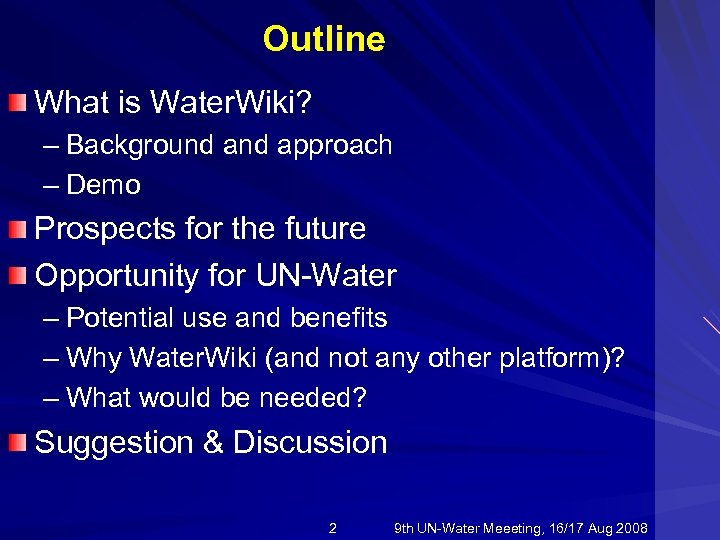
Outline What is Water. Wiki? – Background approach – Demo Prospects for the future Opportunity for UN-Water – Potential use and benefits – Why Water. Wiki (and not any other platform)? – What would be needed? Suggestion & Discussion 2 9 th UN-Water Meeeting, 16/17 Aug 2008
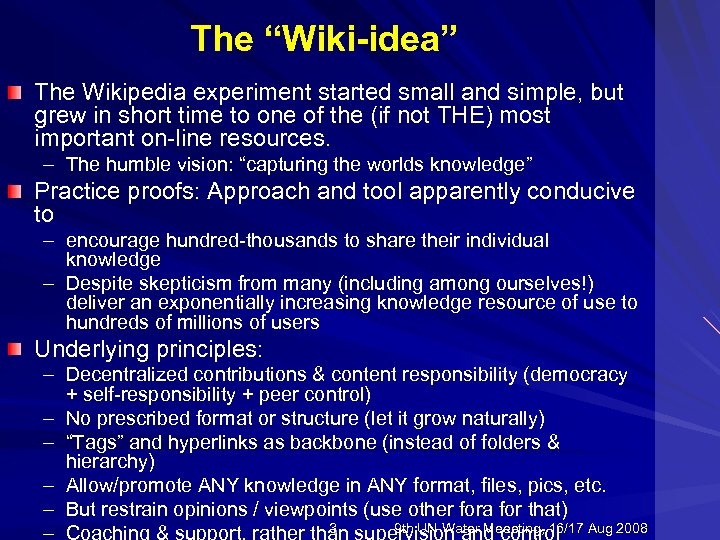
The “Wiki-idea” The Wikipedia experiment started small and simple, but grew in short time to one of the (if not THE) most important on-line resources. – The humble vision: “capturing the worlds knowledge” Practice proofs: Approach and tool apparently conducive to – encourage hundred-thousands to share their individual knowledge – Despite skepticism from many (including among ourselves!) deliver an exponentially increasing knowledge resource of use to hundreds of millions of users Underlying principles: – Decentralized contributions & content responsibility (democracy + self-responsibility + peer control) – No prescribed format or structure (let it grow naturally) – “Tags” and hyperlinks as backbone (instead of folders & hierarchy) – Allow/promote ANY knowledge in ANY format, files, pics, etc. – But restrain opinions / viewpoints (use other fora for that) 3 9 th UN-Water Meeeting, 16/17 – Coaching & support, rather than supervision and control Aug 2008
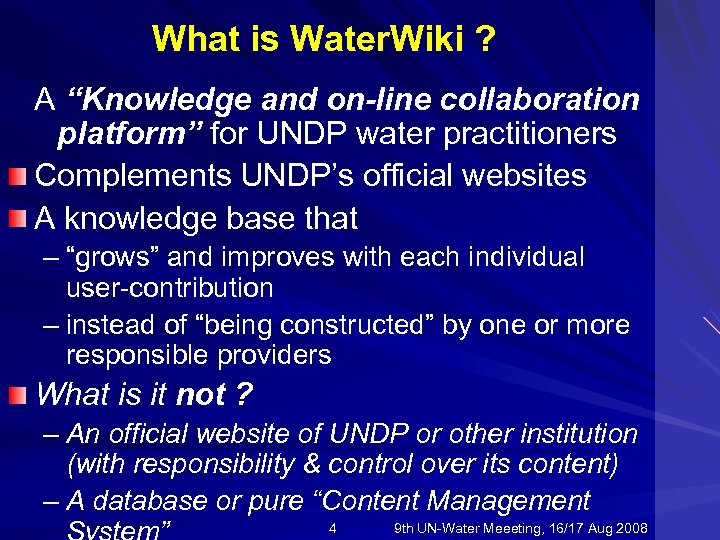
What is Water. Wiki ? A “Knowledge and on-line collaboration platform” for UNDP water practitioners Complements UNDP’s official websites A knowledge base that – “grows” and improves with each individual user-contribution – instead of “being constructed” by one or more responsible providers What is it not ? – An official website of UNDP or other institution (with responsibility & control over its content) – A database or pure “Content Management 4 9 th UN-Water Meeeting, 16/17 Aug 2008
Background Emerged from a real NEED – to systematically map & document projects, reports & key documents, organizations / “who-is-who and does what”, and other UNDP-relevant “knowledge on Water” in Europe & CIS – for a knowledge map and on-line collaboration platform APPROACH chosen – Web-based and interactive tool for info, knowledge and experiences (instead of “storing it all on a C: drive”) – A knowledge exchange platform that works like a “Potluck-cooking party” rather than a restaurant visit – “something like Wikipedia”, an easy-to-use tool that allows practitioner to directly contribute content 5 9 th UN-Water Meeeting, 16/17 Aug 2008 (“decentralized”)
How does it work ? Like Wikipedia … – Easy to use, open-source, real-time knowledge-contribution site – Each contributor is self-responsible for content – Anything can be undone, if needed (full history & roll-back functions) … BUT: – While content is visible to anyone, only registered & logged-in users can create new or edit existing pages/articles, upload files, insert links, pics, videos (You. Tube), rate or discuss contributions. . . Quality control: – Decentralized / peer-controlled / democratic: users mutually monitor, comment and directly edit each others contributions – Each contribution is attributed to its contributor – Few facilitators (“knowledge farmers”) mainly assist users, guide or selectively complement contributions, to maximize usability/benefit – Build on, and references / cross-links to original knowledge sources, e. g. “official information” on UN agency websites 6 9 th UN-Water Meeeting, 16/17 Aug 2008
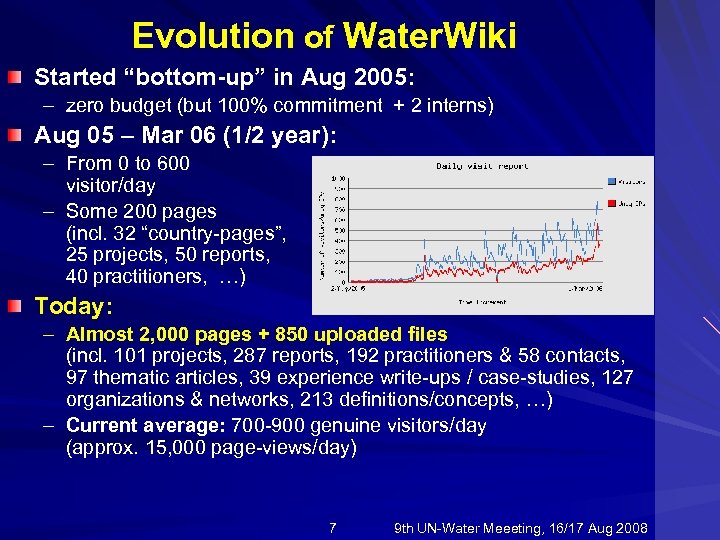
Evolution of Water. Wiki Started “bottom-up” in Aug 2005: – zero budget (but 100% commitment + 2 interns) Aug 05 – Mar 06 (1/2 year): – From 0 to 600 visitor/day – Some 200 pages (incl. 32 “country-pages”, 25 projects, 50 reports, 40 practitioners, …) Today: – Almost 2, 000 pages + 850 uploaded files (incl. 101 projects, 287 reports, 192 practitioners & 58 contacts, 97 thematic articles, 39 experience write-ups / case-studies, 127 organizations & networks, 213 definitions/concepts, …) – Current average: 700 -900 genuine visitors/day (approx. 15, 000 page-views/day) 7 9 th UN-Water Meeeting, 16/17 Aug 2008
Demo (http: //Water. Wiki. net) Welcome – navigation, Help, recent changes, search … – How to edit (tag-cloud, links) Reports – “Water Monitoring” – HDR 2006 (Overview, Chapters, Link to MDGs) Experience & Case Studies – Uzbekistan - “Celebrating Communities for WSS” – Category “Experience” (Comparative Experience Water Councils) Toolkits: New HRBA programme Country, River Basin, and other “Portal-pages” – Countries (Uzbekistan/Central Asia) – Projects (“transcluded” list from UNDP homepage) 8 9 th UN-Water Meeeting, 16/17 Aug 2008
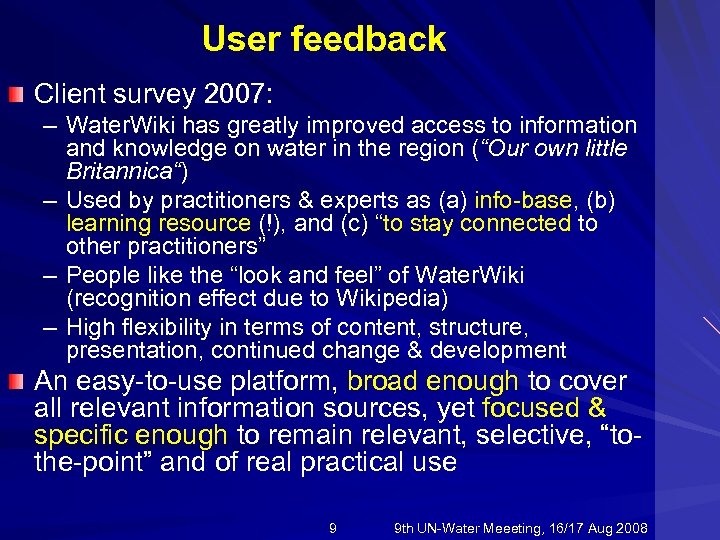
User feedback Client survey 2007: – Water. Wiki has greatly improved access to information and knowledge on water in the region (“Our own little Britannica“) – Used by practitioners & experts as (a) info-base, (b) learning resource (!), and (c) “to stay connected to other practitioners” – People like the “look and feel” of Water. Wiki (recognition effect due to Wikipedia) – High flexibility in terms of content, structure, presentation, continued change & development An easy-to-use platform, broad enough to cover all relevant information sources, yet focused & specific enough to remain relevant, selective, “tothe-point” and of real practical use 9 9 th UN-Water Meeeting, 16/17 Aug 2008
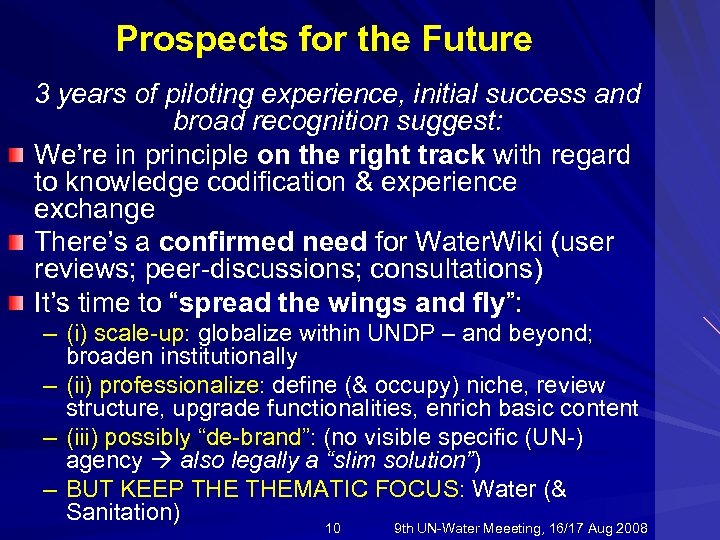
Prospects for the Future 3 years of piloting experience, initial success and broad recognition suggest: We’re in principle on the right track with regard to knowledge codification & experience exchange There’s a confirmed need for Water. Wiki (user reviews; peer-discussions; consultations) It’s time to “spread the wings and fly”: – (i) scale-up: globalize within UNDP – and beyond; broaden institutionally – (ii) professionalize: define (& occupy) niche, review structure, upgrade functionalities, enrich basic content – (iii) possibly “de-brand”: (no visible specific (UN-) agency also legally a “slim solution”) – BUT KEEP THEMATIC FOCUS: Water (& Sanitation) 10 9 th UN-Water Meeeting, 16/17 Aug 2008
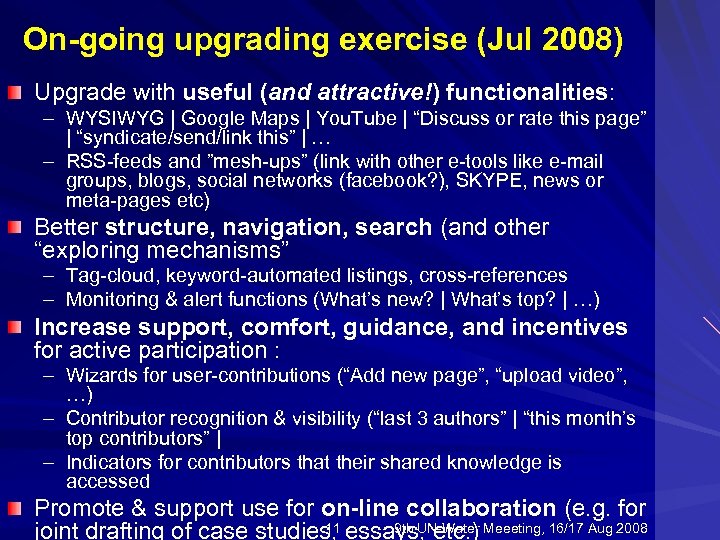
On-going upgrading exercise (Jul 2008) Upgrade with useful (and attractive!) functionalities: – WYSIWYG | Google Maps | You. Tube | “Discuss or rate this page” | “syndicate/send/link this” | … – RSS-feeds and ”mesh-ups” (link with other e-tools like e-mail groups, blogs, social networks (facebook? ), SKYPE, news or meta-pages etc) Better structure, navigation, search (and other “exploring mechanisms” – Tag-cloud, keyword-automated listings, cross-references – Monitoring & alert functions (What’s new? | What’s top? | …) Increase support, comfort, guidance, and incentives for active participation : – Wizards for user-contributions (“Add new page”, “upload video”, …) – Contributor recognition & visibility (“last 3 authors” | “this month’s top contributors” | – Indicators for contributors that their shared knowledge is accessed Promote & support use for on-line collaboration (e. g. for 11 9 th UN-Water joint drafting of case studies, essays, etc. ) Meeeting, 16/17 Aug 2008
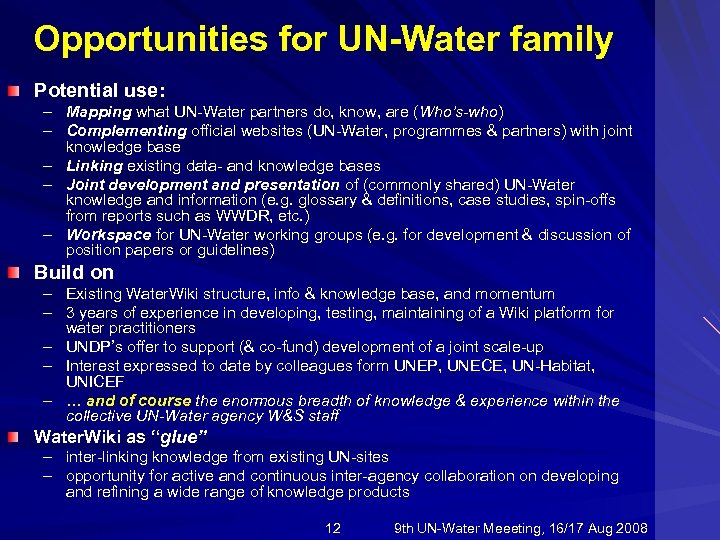
Opportunities for UN-Water family Potential use: – Mapping what UN-Water partners do, know, are (Who’s-who) – Complementing official websites (UN-Water, programmes & partners) with joint knowledge base – Linking existing data- and knowledge bases – Joint development and presentation of (commonly shared) UN-Water knowledge and information (e. g. glossary & definitions, case studies, spin-offs from reports such as WWDR, etc. ) – Workspace for UN-Water working groups (e. g. for development & discussion of position papers or guidelines) Build on – Existing Water. Wiki structure, info & knowledge base, and momentum – 3 years of experience in developing, testing, maintaining of a Wiki platform for water practitioners – UNDP’s offer to support (& co-fund) development of a joint scale-up – Interest expressed to date by colleagues form UNEP, UNECE, UN-Habitat, UNICEF – … and of course the enormous breadth of knowledge & experience within the collective UN-Water agency W&S staff Water. Wiki as “glue” – inter-linking knowledge from existing UN-sites – opportunity for active and continuous inter-agency collaboration on developing and refining a wide range of knowledge products 12 9 th UN-Water Meeeting, 16/17 Aug 2008
Why Water. Wiki ? Use momentum and recognition-effect: – Already existing (tested) platform with significant content & community – Initial success and broad recognition – Wikipedia-similarity : People know instantly what to expect and how it works Wiki. Media as platform is widely tested and used – Widely tested and used, technically stable, open source (= continuous improvement of functionalities and “extensions” guaranteed) – Lots of functionalities and potentials (easy for UN IT-support staff to link & work with) – High-rank indexing by Google and other search engines ! Why not any other platform (such as Aquastat, GEMS, IW: LEARN, etc. )? – They usually are specific (GEF or water quality or indicator data) – They generally are owned by and/or attributed to certain institutions (only) – They in most cases are centrally generated, updated, maintained Why of interest for Water. Wiki? – As the “UN-Water Wikipedia”, Water. Wiki could become exponentially 13 9 th UN-Water Meeeting, users more relevant and useful for a much wider range of potential 16/17 Aug 2008
For consideration & discussion 1. UNDP “offers” Water. Wiki as possible multi- institutional (UN-Water) collaborative knowledge platform 2. Provided consensus be reached on embarking on such a joint exercise, an estimated USD 100, 000 would be required over 1 year for – – comprehensive mapping of existing sites, tools, trends adequate consultations with all UN-Water agencies development and implementation of Water. Wiki concept (scale-up and maintenance/support) 14 Roll-out of new Water. Wiki 9 th UN-Water Meeeting, 16/17 Aug 2008
Thank you ! http: //Water. Wiki. net 15 9 th UN-Water Meeeting, 16/17 Aug 2008
Скачать презентацию Water Wiki An opportunity for UN-Water Presentation by
1dbfc8d15a784ee605d22cc8ae79a2ce.ppt