 Скачать презентацию Water Treatment Processes ENVR 890 Mark D Sobsey
fbd915f349298c2b1dd13b5c573e86d2.ppt
- Количество слайдов: 62



Water Treatment Processes ENVR 890 Mark D. Sobsey Spring, 2007
Water Sources and Water Treatment • Drinking water should be essentially free of diseasecausing microbes, but often this is not the case. – A large proportion of the world’s population drinks microbially contaminated water, especially in developing countries • Using the best possible source of water for potable water supply and protecting it from microbial and chemical contamination is the goal – In many places an adequate supply of pristine water or water that can be protected from contamination is not available • The burden of providing microbially safe drinking water supplies from contaminated natural waters rests upon water treatment processes – The efficiency of removal or inactivation of enteric microbes and other pathogenic microbes in specific water treatment processes has been determined for some microbes but not others. – The ability of water treatment processes and systems to reduce
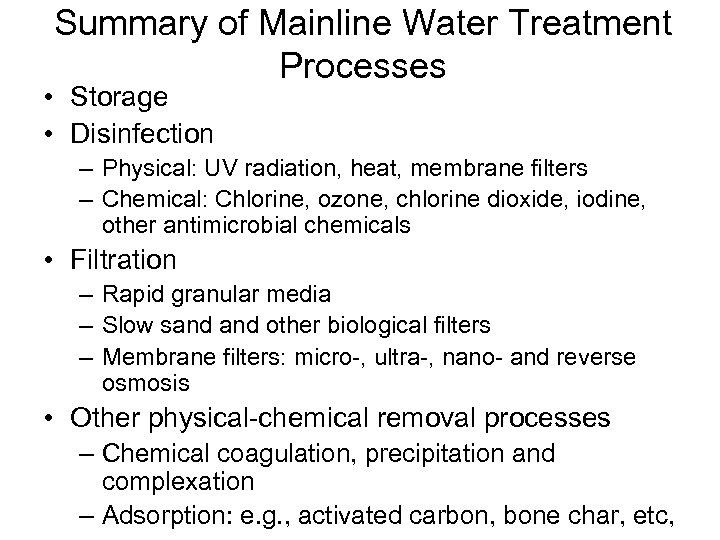
Summary of Mainline Water Treatment Processes • Storage • Disinfection – Physical: UV radiation, heat, membrane filters – Chemical: Chlorine, ozone, chlorine dioxide, iodine, other antimicrobial chemicals • Filtration – Rapid granular media – Slow sand other biological filters – Membrane filters: micro-, ultra-, nano- and reverse osmosis • Other physical-chemical removal processes – Chemical coagulation, precipitation and complexation – Adsorption: e. g. , activated carbon, bone char, etc,
Water Treatment Processes: Storage Reservoirs, aquifers & other systems: – store water – protect it from contamination • Factors influencing microbe reductions (sitespecific) – detention time – temperature – microbial activity – water quality: particulates, dissolved solids, salinity – sunlight – sedimentation – land use – precipitation – runoff or infiltration
Water Storage and Microbial Reductions • Microbe levels reduced over time by natural antimicrobial processes and microbial death/die-off • Human enteric viruses in surface water reduced 4001, 000 -fold when stored 6‑ 7 months (The Netherlands) – Indicator bacteria reductions were less extensive, probably due to recontamination by waterfowl. • Protozoan cyst reductions (log 10) by storage were 1. 6 for Cryptosporidium and 1. 9 for Giardia after about 5 months (The Netherlands; G. J Medema, Ph. D. diss. ) – Recent ICR data indicates lower protozoan levels in reservoir or lake sources than in river sources; suggests declines in Giardia & Cryptosporidium by storage
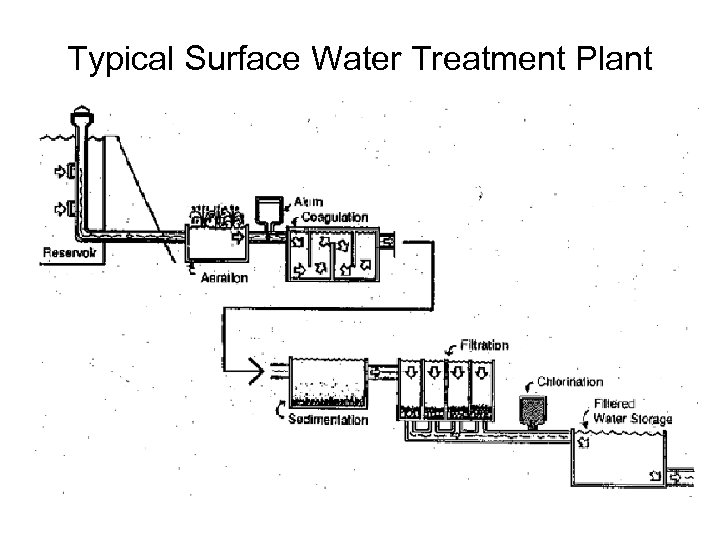
Typical Surface Water Treatment Plant
Chemical Coagulation-Flocculation Removes suspended particulate and colloidal substances from water, including microorganisms. Coagulation: colloidal destabilization • Typically, add alum (aluminum sulfate) or ferric chloride or sulfate to the water with rapid mixing and controlled p. H conditions • Insoluble aluminum or ferric hydroxide and aluminum or iron hydroxo complexes form • These complexes entrap and adsorb suspended particulate and colloidal material.
Coagulation-Flocculation, Continued Flocculation: • Slow mixing (flocculation) that provides for a period of time to promote the aggregation and growth of the insoluble particles (flocs). • The particles collide, stick together abd grow larger • The resulting large floc particles are subsequently removed by gravity sedimentation (or direct filtration) • Smaller floc particles are too small to settle and are removed by filtration
Microbe Reductions by Chemical Coagulation-Flocculation • Considerable reductions of enteric microbe concentrations. • Reductions In laboratory and pilot scale field studies: – >99 percent using alum or ferric salts as coagulants – Some studies report much lower removal efficiencies (<90%) – Conflicting information may be related to process control • coagulant concentration, p. H and mixing speed during flocculation. • Expected microbe reductions bof 90 -99%, if critical process variables are adequately controlled • No microbe inactivation by alum or iron coagulation – Infectious microbes remain in the chemical floc – The floc removed by settling and/or filtration must
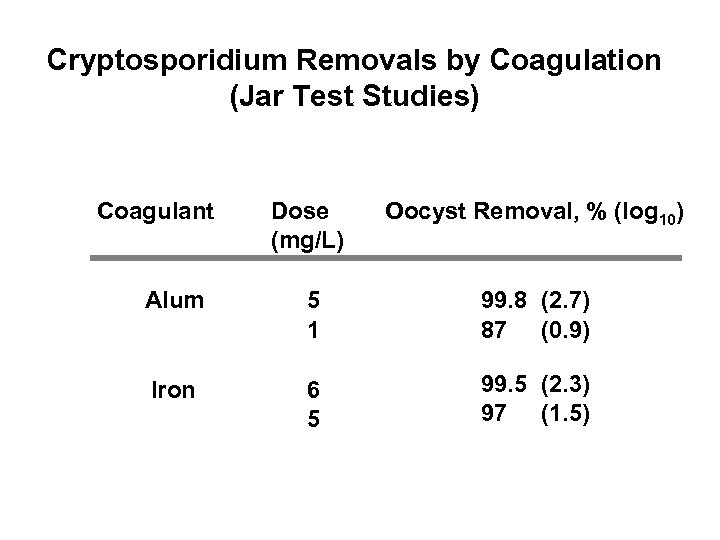
Cryptosporidium Removals by Coagulation (Jar Test Studies) Coagulant Dose (mg/L) Oocyst Removal, % (log 10) Alum 5 1 99. 8 (2. 7) 87 (0. 9) Iron 6 5 99. 5 (2. 3) 97 (1. 5)
Water Softening and Microbe Reductions • ”Hard" Water: contains excessive amounts of calcium and magnesium ions – iron and manganese can also contribute to hardness. • Hardness ions are removed by adding lime (Ca. O) and sometimes soda ash (Na 2 CO 3) to precipitate them as carbonates, hydroxides and oxides. • This process, called softening, is basically a type of coagulation‑flocculation process. • Microbe reductions similar to alum and iron coagulation when p. H is <10 • Microbe reductions >99. 99% possible when p. H is >11 – microbial inactivation + physical removal
Microbial Reductions by Softening Treatment • Softening with lime only (straight lime softening); moderate high p. H – ineffective enteric microbe reductions: about 75%. • Lime‑soda ash softening – results in the removal of magnesium as well as calcium hardness at higher p. H levels (p. H >11) – enteric microbe reductions >99%. – Lime‑soda ash softening at p. H 10. 4, 10. 8 and 11. 2 has produced virus reductions of 99. 6, 99. 9 and 99. 993 percent, respectively. • At lower p. H levels (p. H <11), microbe removal is mainly a physical process – infectious microbes accumulate in the floc particles and the resulting chemical sludge. • At p. H levels above 11, enteric microbes are physically removed and infectivity is also destroyed – more rapid and extensive microbe inactivation at higher p. H levels.
Granular Media Filtration • Used to remove suspended particles (turbidity) incl. microbes. • Historically, two types of granular media filters: – Slow sand filters: uniform bed of sand; – low flow rate <0. 1 GPM/ft 2 – biological process: 1 -2 cm “slime” layer (schmutzdecke) – Rapid sand filters: 1, 2 or 3 layers of sand/other media; – >1 GPM/ft 2 – physical-chemical process; depth filtration • Diatomaceous earth filters – fossilized skeletons of diatoms (crystalline
Slow Sand Filters • Less widely used for large US municipal water supplies • Effective; widely used in Europe; small water supplies; developing countries • Filter through a 3‑ to 5‑foot deep bed of unstratified sand • flow rate ~0. 05 gallons per minute per square foot. • Biological growth develops in the upper surface of the sand is primarily responsible for particle and microbe removal. • Effective without pretreatment of the water by coagulation‑flocculation
Microbial Reductions by Slow Sand Filtration • Effective in removing enteric microbes from water. • Virus removals >99% in lab models of slow sand filters. – Up to 4 log 10; no infectious viruses recovered from filter effluents • Field studies: – naturally occurring enteric viruses removals • 97 to >99. 8 percent; average 98% overall; • Comparable removals of E. coli bacteria. – Virus removals=99‑ 99. 9%; – high bacteria removals (UK study)
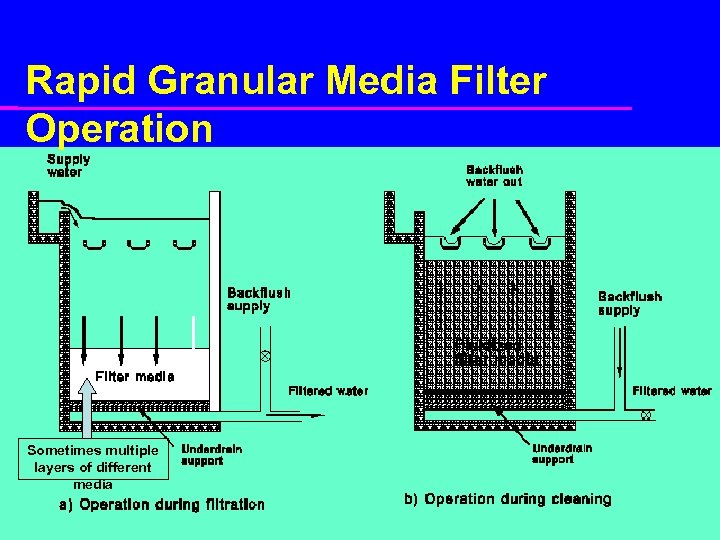
Rapid Granular Media Filter Operation Sometimes multiple layers of different media
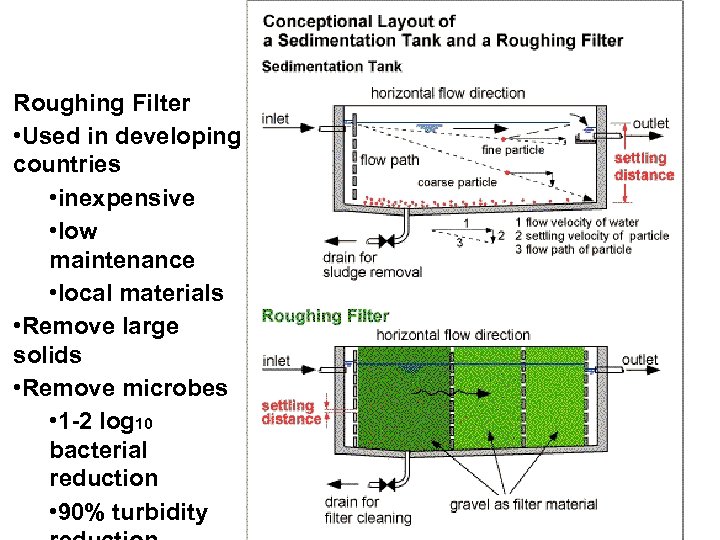
Roughing Filter • Used in developing countries • inexpensive • low maintenance • local materials • Remove large solids • Remove microbes • 1 -2 log 10 bacterial reduction • 90% turbidity
Microbe Reductions by Rapid Granular Media Filters • Ineffective to remove enteric microbes unless preceded by chemical coagulation‑flocculation. • Preceded chemical coagulation‑flocculation & sedimentation • Enteric microbe removals of 90 ->99 % achieved. • Field (pilot) studies: rapid sand filtration preceded by iron coagulation‑flocculation: virus removal <50% (poor control? ). • Giardia lamblia: removals not always high; related to turbidity removal; >99% removals reported when optimized. – Removal not high unless turbidity is reduced to ~0. 2 NTU. • Lowest removals shortly after filter backwashing – Microbes primarily removed in filter by
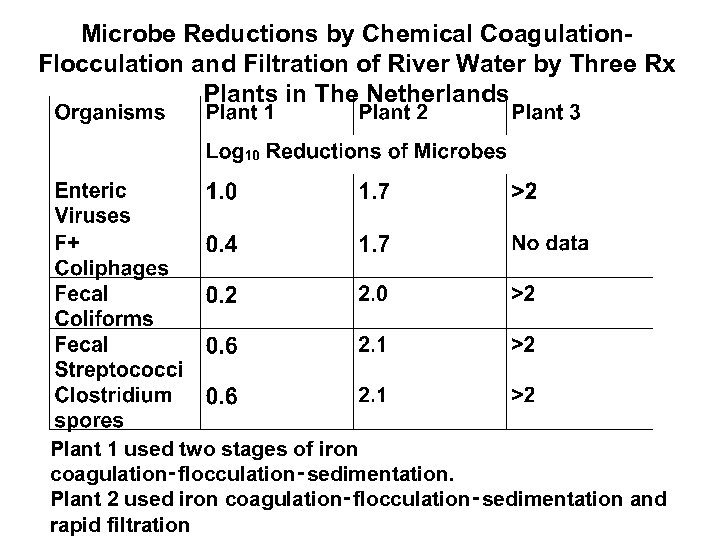
Microbe Reductions by Chemical Coagulation. Flocculation and Filtration of River Water by Three Rx Plants in The Netherlands Plant 1 used two stages of iron coagulation‑flocculation‑sedimentation. Plant 2 used iron coagulation‑flocculation‑sedimentation and rapid filtration
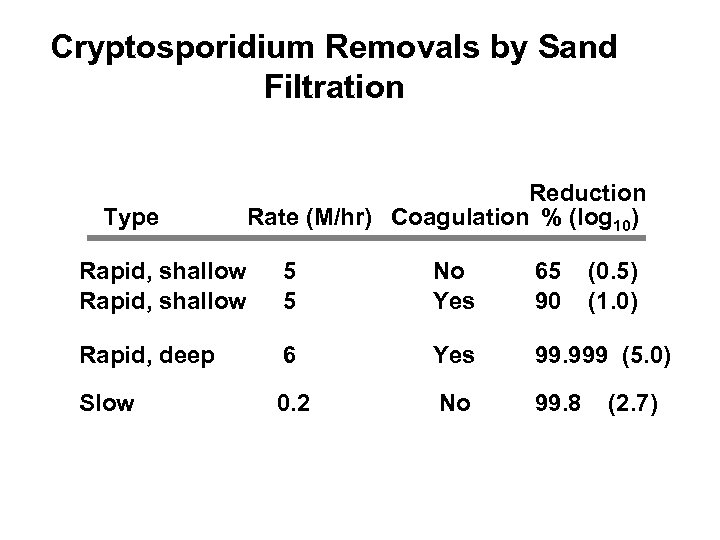
Cryptosporidium Removals by Sand Filtration Type Reduction Rate (M/hr) Coagulation % (log 10) Rapid, shallow 5 5 No Yes 65 (0. 5) 90 (1. 0) Rapid, deep 6 Yes 99. 999 (5. 0) Slow 0. 2 No 99. 8 (2. 7)
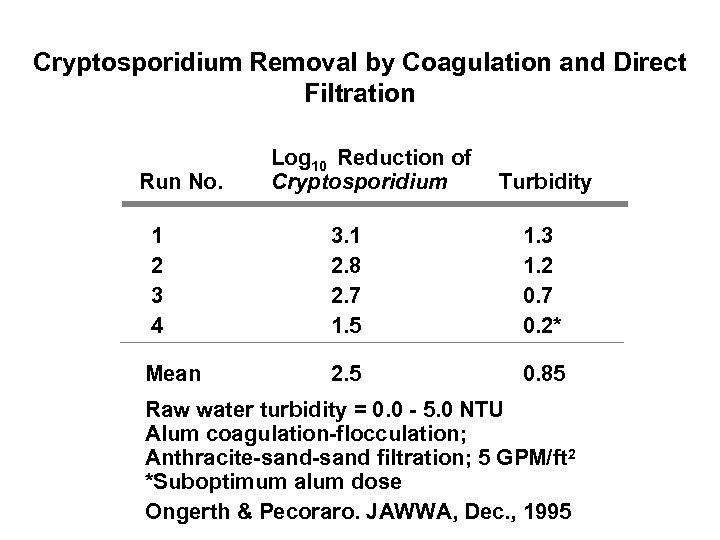
Cryptosporidium Removal by Coagulation and Direct Filtration Run No. Log 10 Reduction of Cryptosporidium Turbidity 1 2 3 4 3. 1 2. 8 2. 7 1. 5 1. 3 1. 2 0. 7 0. 2* Mean 2. 5 0. 85 Raw water turbidity = 0. 0 - 5. 0 NTU Alum coagulation-flocculation; Anthracite-sand filtration; 5 GPM/ft 2 *Suboptimum alum dose Ongerth & Pecoraro. JAWWA, Dec. , 1995
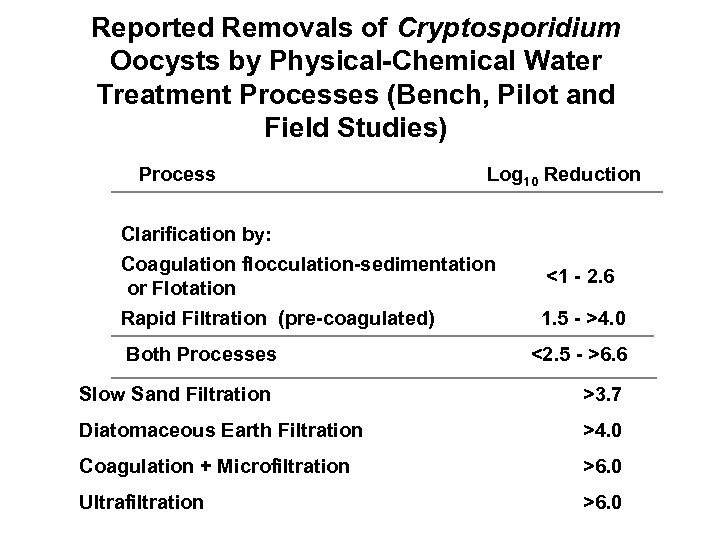
Reported Removals of Cryptosporidium Oocysts by Physical-Chemical Water Treatment Processes (Bench, Pilot and Field Studies) Process Log 10 Reduction Clarification by: Coagulation flocculation-sedimentation or Flotation Rapid Filtration (pre-coagulated) <1 - 2. 6 1. 5 - >4. 0 Both Processes Slow Sand Filtration <2. 5 - >6. 6 >3. 7 Diatomaceous Earth Filtration >4. 0 Coagulation + Microfiltration >6. 0 Ultrafiltration >6. 0
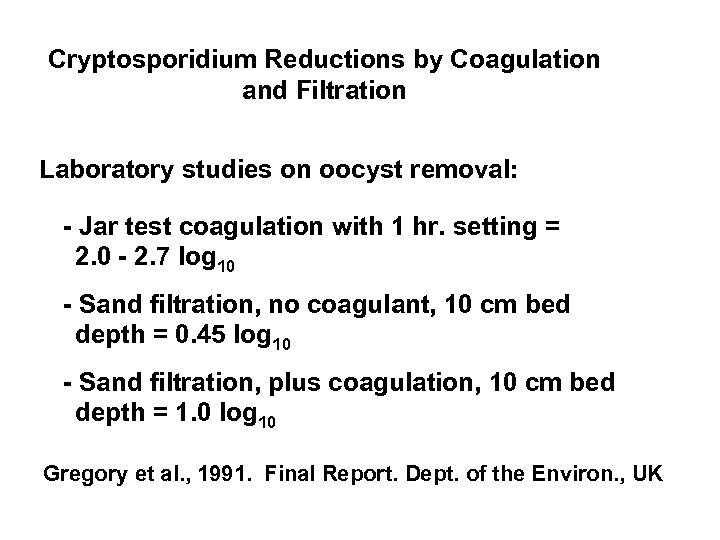
Cryptosporidium Reductions by Coagulation and Filtration Laboratory studies on oocyst removal: - Jar test coagulation with 1 hr. setting = 2. 0 - 2. 7 log 10 - Sand filtration, no coagulant, 10 cm bed depth = 0. 45 log 10 - Sand filtration, plus coagulation, 10 cm bed depth = 1. 0 log 10 Gregory et al. , 1991. Final Report. Dept. of the Environ. , UK
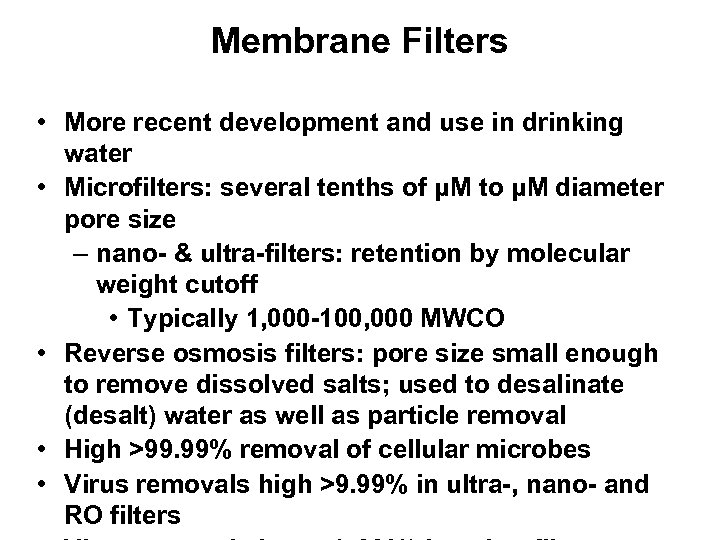
Membrane Filters • More recent development and use in drinking water • Microfilters: several tenths of μM to μM diameter pore size – nano- & ultra-filters: retention by molecular weight cutoff • Typically 1, 000 -100, 000 MWCO • Reverse osmosis filters: pore size small enough to remove dissolved salts; used to desalinate (desalt) water as well as particle removal • High >99. 99% removal of cellular microbes • Virus removals high >9. 99% in ultra-, nano- and RO filters
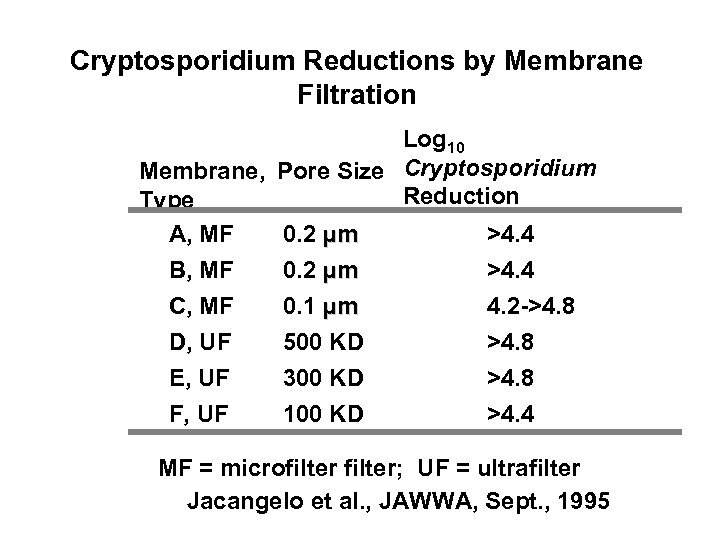
Cryptosporidium Reductions by Membrane Filtration Log 10 Membrane, Pore Size Cryptosporidium Reduction Type A, MF 0. 2 µm >4. 4 B, MF 0. 2 µm >4. 4 C, MF 0. 1 µm 4. 2 ->4. 8 D, UF 500 KD >4. 8 E, UF 300 KD >4. 8 F, UF 100 KD >4. 4 MF = microfilter; UF = ultrafilter Jacangelo et al. , JAWWA, Sept. , 1995
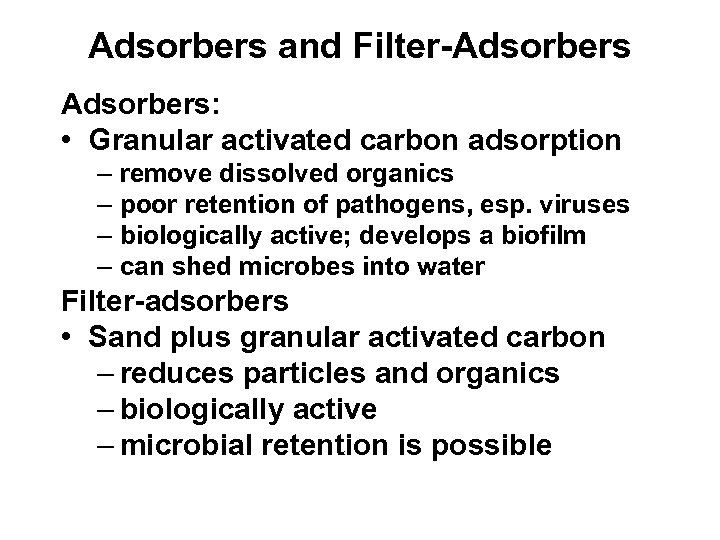
Adsorbers and Filter-Adsorbers: • Granular activated carbon adsorption – remove dissolved organics – poor retention of pathogens, esp. viruses – biologically active; develops a biofilm – can shed microbes into water Filter-adsorbers • Sand plus granular activated carbon – reduces particles and organics – biologically active – microbial retention is possible
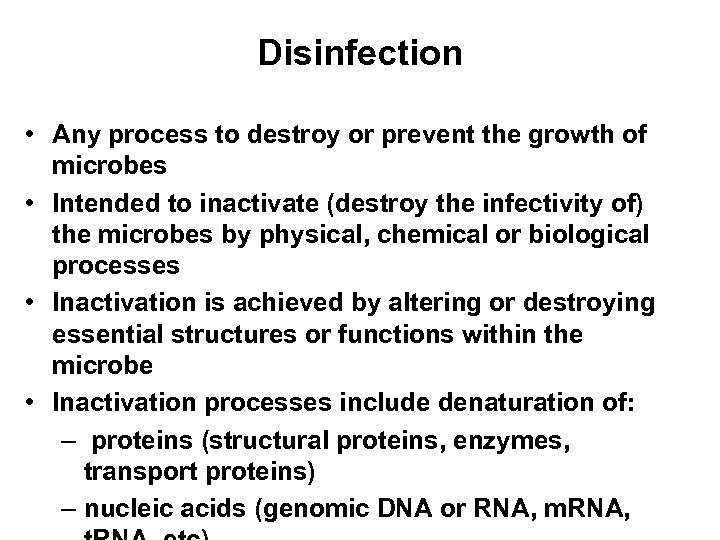
Disinfection • Any process to destroy or prevent the growth of microbes • Intended to inactivate (destroy the infectivity of) the microbes by physical, chemical or biological processes • Inactivation is achieved by altering or destroying essential structures or functions within the microbe • Inactivation processes include denaturation of: – proteins (structural proteins, enzymes, transport proteins) – nucleic acids (genomic DNA or RNA, m. RNA,
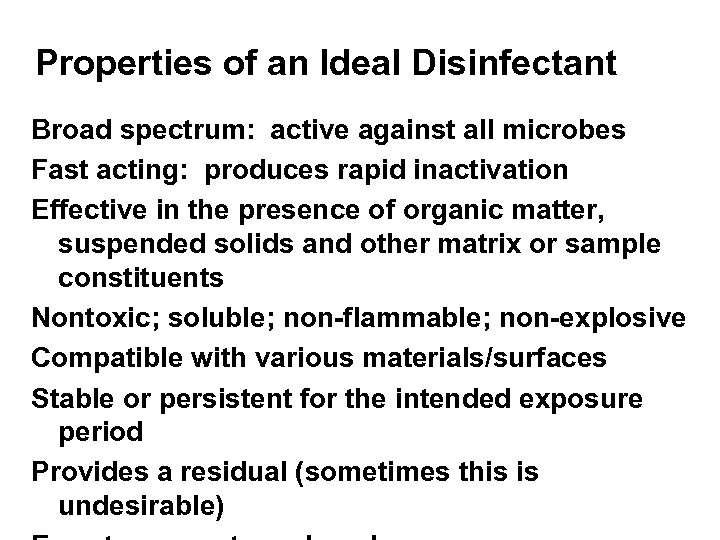
Properties of an Ideal Disinfectant Broad spectrum: active against all microbes Fast acting: produces rapid inactivation Effective in the presence of organic matter, suspended solids and other matrix or sample constituents Nontoxic; soluble; non-flammable; non-explosive Compatible with various materials/surfaces Stable or persistent for the intended exposure period Provides a residual (sometimes this is undesirable)
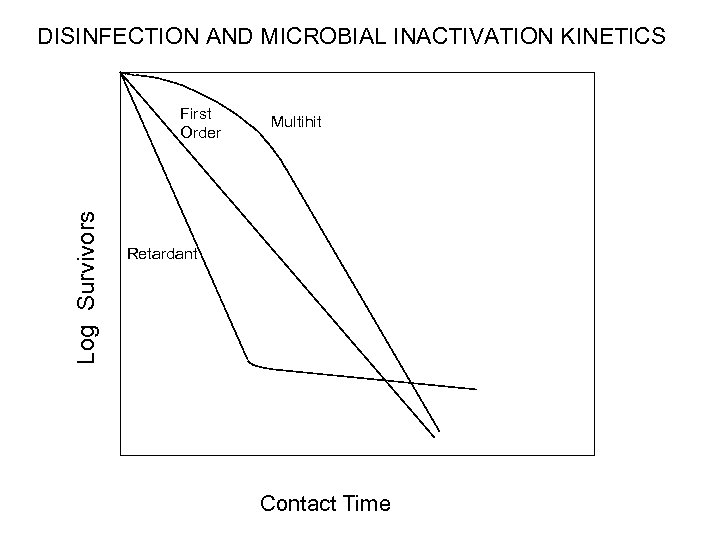
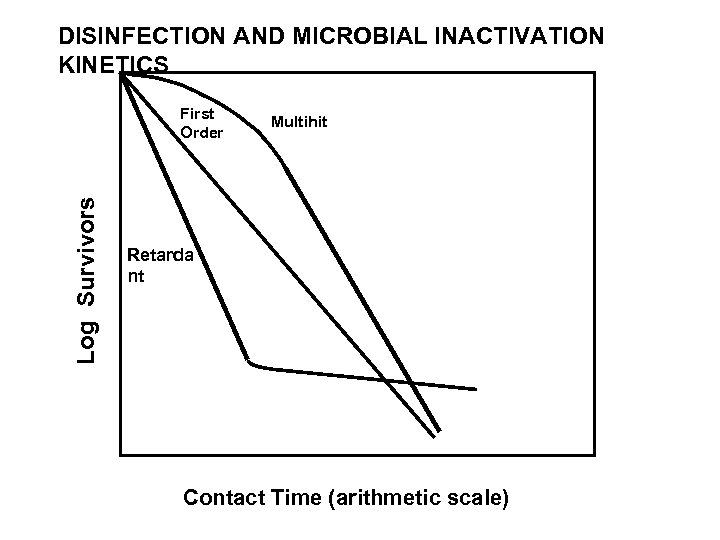
DISINFECTION AND MICROBIAL INACTIVATION KINETICS Log Survivors First Order Multihit Retardant Contact Time
Disinfection Kinetics • Disinfection is a kinetic process • Increased inactivation with increased exposure or contact time. – Chick's Law: disinfection is a first‑order reaction. (NOT!) – Multihit-hit or concave up kinetics: initial slow rate; multiple targets to be “hit” – Concave down or retardant kinetics: initial fast rate; decreases over time • Different susceptibilities of microbes to inactivation; heterogeneous population • Decline of of disinfectant concentration over time • CT Concept: Disinfection can be expressed at the product of disinfectant concentration X contact time – Applies best when disinfection kinetics are first order • Disinfectant concentration and contact time have an equal effect on CT products
Disinfectants in Water Treatment • • • Free Chlorine Monochloramine Ozone Chlorine Dioxide UV Light • Low pressure mercury lamp (monochromatic) • Medium pressure mercury lamp (polychromatic) • Pulsed broadband radiation • Boiling • At household level in many countries and for emergencies in other countries (USA) • Iodine • Short-term use; long-term use a health concern
Summary Properties of Water Disinfectants • Free chlorine: HOCl (hypochlorous) acid and OCl- (hypochlorite ion) – HOCl at low and p. H OCl- at highp. H; HOCl more potent germicide than OCl– strong oxidant; relatively stable in water (provides a disinfectant residual) • Chloramines: mostly NH 2 Cl: weak oxidant; provides a stable residual • ozone, O 3: strong oxidant; provides no residual (too volatile, reactive) • Chlorine dioxide, Cl. O 2, : strong oxidant; unstable (dissolved gas) • Concerns due to health risks of chemical disinfectants and their by‑products (DBPs), especially free chlorine and its DBPs • UV radiation
Disinfection of Microbes in Water: Conventional Methods used in the Developed World • Historically, the essential barrier to prevention and control of waterborne microbial transmission and waterborne disease. • Free chlorine: HOCl (hypochlorous) acid and OCl(hypochlorite ion) – HOCl at lower p. H and OCl- at higher p. H; HOCl a more potent germicide than OCl– strong oxidant and relatively stable in water (provides a disinfectant residual) • Chloramines: mostly NH 3 Cl: weak oxidant; provides a stable residual • ozone, O 3 , strong oxidant; provides no residual (too volatile and reactive) • Chlorine dioxide, Cl. O 2, , string oxidant but not very stable residual
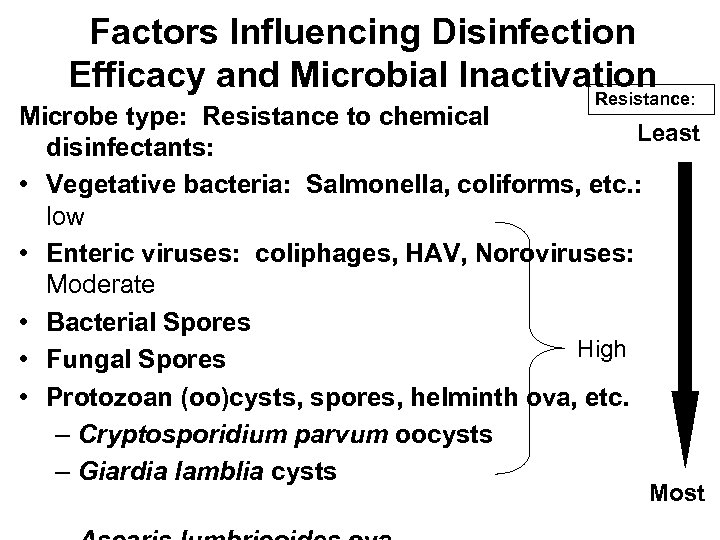
Factors Influencing Disinfection Efficacy and Microbial Inactivation Resistance: Microbe type: Resistance to chemical Least disinfectants: • Vegetative bacteria: Salmonella, coliforms, etc. : low • Enteric viruses: coliphages, HAV, Noroviruses: Moderate • Bacterial Spores High • Fungal Spores • Protozoan (oo)cysts, spores, helminth ova, etc. – Cryptosporidium parvum oocysts – Giardia lamblia cysts Most
Factors Influencing Disinfection Efficacy and Microbial Inactivation (Continued) Type of Disinfectant and Mode of Action Free chlorine: strong oxidant; oxidizes various protein sulfhydryl groups; alters membrane permeability; also, oxidize/denature nucleic acid components, etc. Ozone: strong oxidant; ditto free chlorine Chlorine dioxide: strong oxidant; ditto free chlorine Electrochemically generated mixed oxidants: strong oxidant; probably ditto free chlorine Combined chlorine/chloramines: weak oxidant; denatures sulfhydryl groups of proteins Ultraviolet radiation: nucleic acid damage:
Factors Influencing Disinfection Efficacy and Microbial Inactivation, Continued Microbial strain differences and microbial selection: • Disinfectant exposure may select for resistant strains Physical protection: • Aggregation • particle-association • protection within membranes and other solids Chemical factors: • p. H • Salts and ions • Soluble organic matter
Some Factors Influencing Disinfection Efficacy and Microbial Inactivation - Bacteria • Surface properties conferring susceptibility or resistance: • Resistance: Spore; acid fast (cell wall lipids); capsule; pili • Susceptibility: sulfhydryl (-SH) groups; phospholipids; enzymes; porins and other transport structures, etc. • Physiological state and resistance: • Antecedent growth conditions: low-nutrient growth increases resistance to inactivation • Injury; resuscitation and injury repair; • disinfectant exposure may selection for resistant strains • Physical protection:
Efficacy and Inactivation - Viruses Virus type, structure and composition: • Envelope (lipids): typically labile to disinfectants • Capsid structures and capsid proteins (change in conformation state) • Nucleic acids: genomic DNA, RNA; # strands • Glycoproteins: often on virus outer surface; typically labile to disinfectants Physical state of the virus(es): • Aggregated • Particle-associated • Embedded within other materia (within membranes)
Factors Influencing Disinfection Efficacy and Microbial Inactivation - Parasites Parasite type, structure and composition: Protozoan cysts, oocysts and spores Some are very resistant to chemical disinfectants Helminth ova: some are very resistant to chemical disinfection, drying and heat. – Strain differences and selection: Disinfectant exposure may select for resistant strains – Physical protection: Aggregation; particle-association; protection
Factors Influencing Disinfection Efficacy and Microbial Inactivation - Water Quality • Particulates: protect microbes from inactivation; consume disinfectant • Dissolved organics: protect microbes from inactivation; consumes or absorbs (for UV radiation) disinfectant; Coat microbe (deposit on surface) • p. H: influences microbe inactivation by some agents – free chlorine more effective at low p. H where HOCl predominates • neutral HOCl species more easily reaches microbe surface and penetrates) • negative charged OCl- has a harder time reaching negatively charged microbe surface – chlorine dioxide is more effective at high p. H • Inorganic compounds and ions: influences microbe inactivation by some disinfectants; depends on
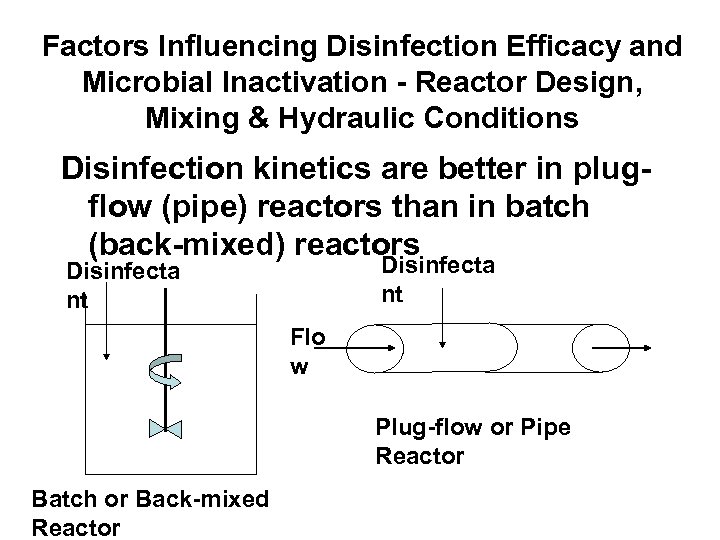
Factors Influencing Disinfection Efficacy and Microbial Inactivation - Reactor Design, Mixing & Hydraulic Conditions Disinfection kinetics are better in plugflow (pipe) reactors than in batch (back-mixed) reactors Disinfecta nt Flo w Plug-flow or Pipe Reactor Batch or Back-mixed Reactor
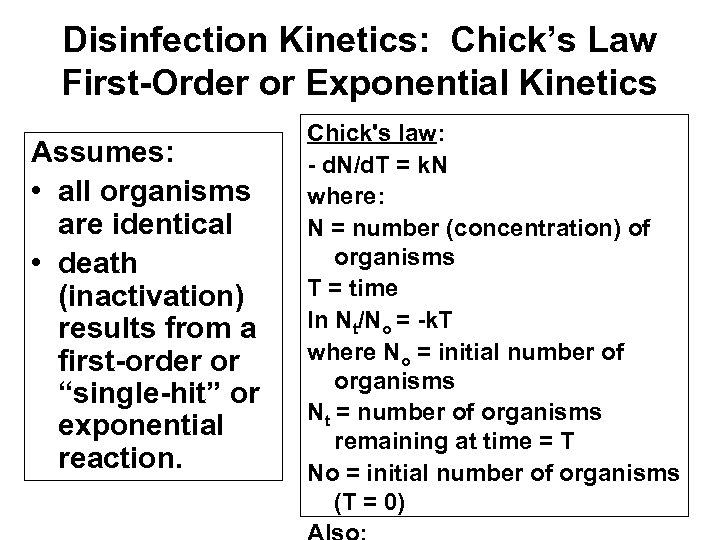
Disinfection Kinetics: Chick’s Law First-Order or Exponential Kinetics Assumes: • all organisms are identical • death (inactivation) results from a first-order or “single-hit” or exponential reaction. Chick's law: - d. N/d. T = k. N where: N = number (concentration) of organisms T = time ln Nt/No = -k. T where No = initial number of organisms Nt = number of organisms remaining at time = T No = initial number of organisms (T = 0)
DISINFECTION AND MICROBIAL INACTIVATION KINETICS Log Survivors First Order Multihit Retarda nt Contact Time (arithmetic scale)
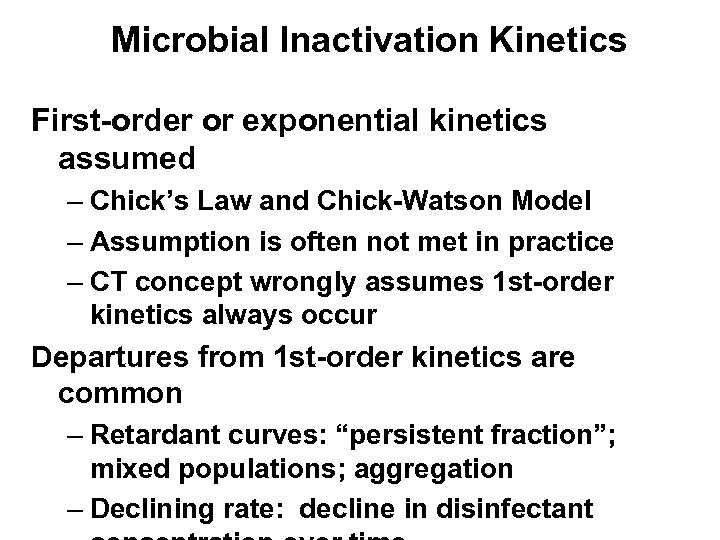
Microbial Inactivation Kinetics First-order or exponential kinetics assumed – Chick’s Law and Chick-Watson Model – Assumption is often not met in practice – CT concept wrongly assumes 1 st-order kinetics always occur Departures from 1 st-order kinetics are common – Retardant curves: “persistent fraction”; mixed populations; aggregation – Declining rate: decline in disinfectant
Types of Disinfection Kinetics • Disinfection is a kinetic process • Increased inactivation with increased exposure or contact time. – Chick's Law: disinfection is a first‑order reaction. (NOT!) – Multihit-hit or concave up kinetics: initial slow rate; multiple targets to be “hit”; diffusion-limitions in reaching “targets” – Concave down or retardant kinetics: initial fast rate that decreases over time • Different susceptibilities of microbes to inactivation; heterogeneous population • Decline of of disinfectant concentration
Disinfection Activity and the CT Concept • Disinfection activity can be expressed as the product of disinfection concentration (C) and contact time (T) Assumes first order kinetics (Chick’s Law) such that disinfectant concentration and contact time have the same “weight” or contribution in disinfection activity and in contributiong to CT • Example: If CT = 100 mg/l-minutes, then – If C = 10 mg/l, T must = 10 min. in order to get CT = 100 mg/l-min. – If C = 1 mg/l, then T must = 100 min. to get CT = 100 mg/l-min. – If C = 50 mg/l, then T must = 2 min. to get CT = 100 mg/l-min. – So, any combinationof C and T giving a product of
Factors Influencing Disinfection of Microbes • Microbe type: disinfection resistance from least to most: vegetative bacteria viruses protozoan cysts, spores and eggs • Type of disinfectant: order of efficacy against Giardia from best to worst – O 3 Cl. O 2 iodine/free chlorine chloramines – BUT, order of effectiveness varies with type of microbe • Microbial aggregation: – protects microbes from inactivation – microbes within aggregates not be readily reached by the disinfectant • Particulates: protects from inactivation; shielded/embedded in particles • Dissolved organics: protects – consumes or absorbs (UV radiation) disinfectant; coats microbes • Inorganic compounds and ions: effects vary with
Inactivation of Cryptosporidium Oocysts in Water by Chemical Disinfectants Disinfectant CT 99 (mg-min/L) Reference Free Chlorine 7, 200+ Korich et al. , 1990 Monochloramine 7, 200+ Korich et al. , 1990 Chlorine Dioxide >78 Korich et al. , 1990 Mixed oxidants <120 Venczel et al. , 199 Ozone ~3 -18 Finc Korich et al. , 199 Owens et al. , 199 C. parvum oocysts inactivated by low doses of UV radiation: <10 m. Joules/cm 2
Free Chlorine - Background and History • Considered to be first used in 1905 in London – But, electrochemically generated chlorine from brine (Na. Cl) was first used in water treatment the late 1800 s • Reactions for free chlorine formation: Cl 2 (g) + H 2 O <=> HOCl + H+ + Cl. HOCl <=> H+ + OCl • Chemical forms of free chlorine: Cl 2 (gas), Na. OCl (liquid), or Ca(OCl)2 (solid) • Has been the “disinfectant of choice” in US until recently. • recommended maximum residual concentration of free chlorine < 5 mg/L (by US EPA) • Concerns about the toxicity of free chlorine
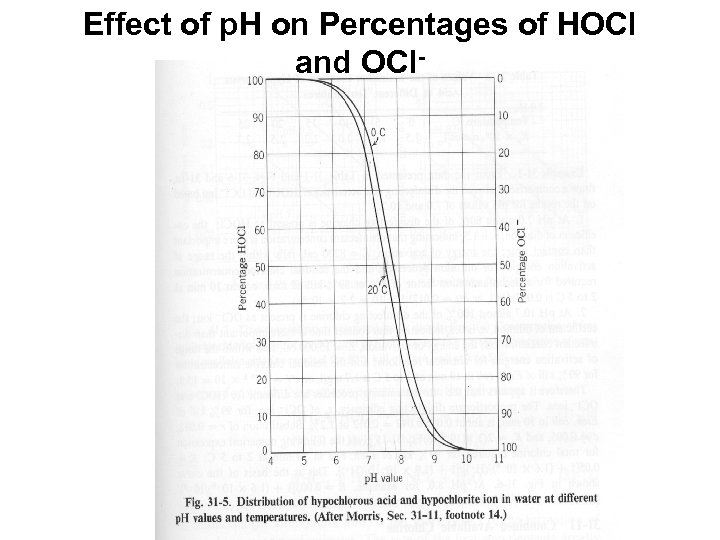
Effect of p. H on Percentages of HOCl and OCl-
Free Chlorine and Microbial Inactivation • Greater microbial inactivation at lower p. H (HOCl) than at high p. H (OCl-) – Probably due to greater reactivity of the neutral chemical species with the microbes and its constituents • Main functional targets of inactivation: – Bacteria: respiratory activities, transport activities, nucleic acid synthesis. – Viruses: reaction with both protein coat (capsid) and nucleic acid genome – Parasites: mode of action is uncertain • Resistance of Cryptosporidium to free chlorine (and monochloramine) has been a problem in drinking water supplies – Free chlorine (bleach) is actually used to excyst C.
Monochloramine - History and Background • First used in Ottawa, Canada and Denver, Co. (1917) • Became popular to maintain a more stable chlorine residual and to control taste and odor problems and bacterial re-growth in distribution system in 1930’s • Decreased usage due to ammonia shortage during World War II • Increased interest in monochloramine: – alternative disinfectant to free chlorine due to low THM potentials – more stable disinfectant residual; persists in distribution system – secondary disinfectant to ozone and chlorine dioxide disinfection to provide long-lasting residuals
Monochloramine: Chemistry and Generation) Monochloramine formation: • HOCl + NH 3 <=> NH 2 Cl + H 2 O • Stable at p. H 7 - 9, moderate oxidation potential • Generation – pre-formed monochloramine: mix hypochlorite and ammonium chloride (NH 4 Cl) solution at Cl 2 : N ratio at 4: 1 by weight, 10: 1 on a molar ratio at p. H 7 -9 – dynamic or forming monochloramination: – initial free chlorine residual, folloowed by ammonia addition to produce monochloramine • greater initial disinfection efficacy due to free chlorine • Dosed at several mg/L
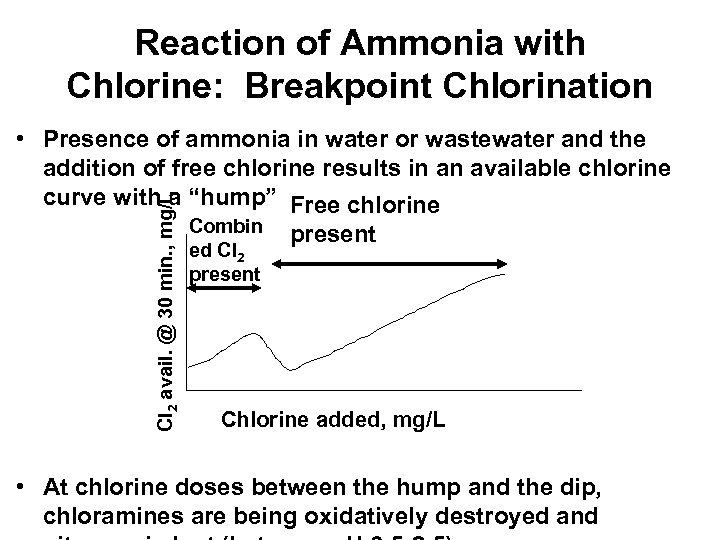
Reaction of Ammonia with Chlorine: Breakpoint Chlorination Cl 2 avail. @ 30 min. , mg/L • Presence of ammonia in water or wastewater and the addition of free chlorine results in an available chlorine curve with a “hump” Free chlorine Combin ed Cl 2 present Chlorine added, mg/L • At chlorine doses between the hump and the dip, chloramines are being oxidatively destroyed and
Ozone • First used in 1893 at Oudshoon • Used in 40 WTPs in US in 1990 (growing use since then), but more than 1000 WTPs in European countries • Increased interest as an alternative to free chlorine (strong oxidant; strong microbiocidal activity; perhaps less toxic DBPs) – A secondary disinfectant giving a stable residual may be needed to protect water after ozonation, due to short-lasting ozone residual. • Colorless gas; relatively unstable; reacts with itself and with OH- in water; less stable at higher p. H • Formed by passing dry air (or oxygen) through high voltage electrodes to produce gaseous ozone that is bubbled into the water to be treated.
Chlorine Dioxide • First used in Niagara Fall, NY in 1944 to control phenolic tastes and algae problems • Used in 600 WTP (84 in the US) in 1970’s as primary disinfectant and for taste and odor control • Very soluble in water; generated as a gas or a liquid on-site, usually by reaction of Cl 2 gas with Na. Cl. O 2 : – 2 Na. Cl. O 2 + Cl 2 2 Cl. O 2 + 2 Na. Cl • Usage became limited after discovery of it’s toxicity in 1970’s & 1980’s – thyroid, neurological disorders and anemia in experimental animals by chlorate • Recommended maximum combined concentration of chlorine dioxide and it’s by-products < 0. 5 mg/L (by US EPA in 1990’s)
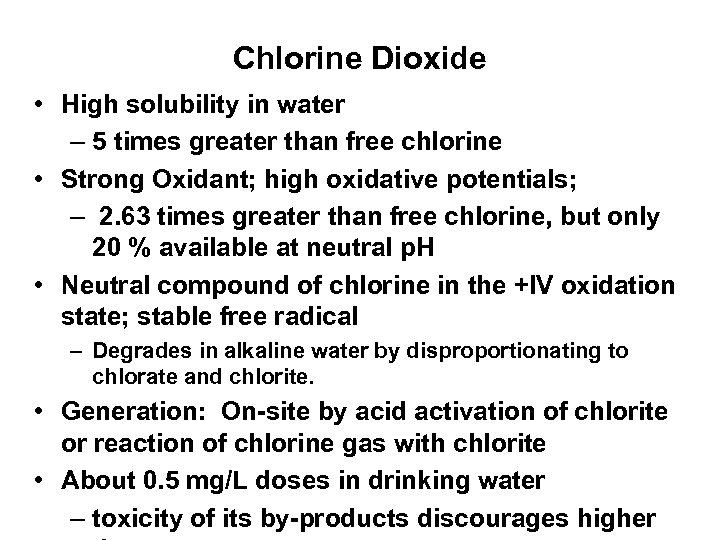
Chlorine Dioxide • High solubility in water – 5 times greater than free chlorine • Strong Oxidant; high oxidative potentials; – 2. 63 times greater than free chlorine, but only 20 % available at neutral p. H • Neutral compound of chlorine in the +IV oxidation state; stable free radical – Degrades in alkaline water by disproportionating to chlorate and chlorite. • Generation: On-site by acid activation of chlorite or reaction of chlorine gas with chlorite • About 0. 5 mg/L doses in drinking water – toxicity of its by-products discourages higher
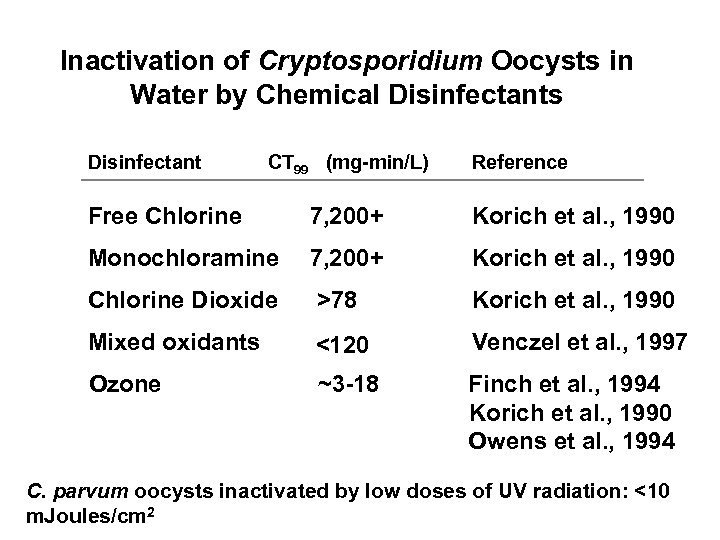
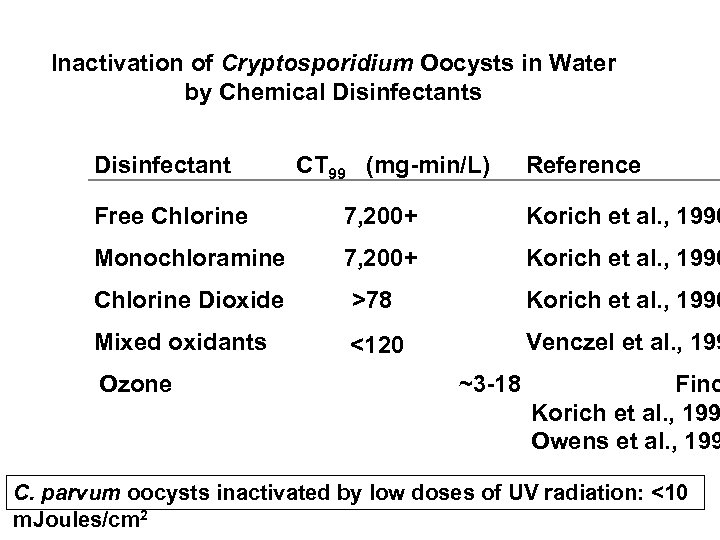
Inactivation of Cryptosporidium Oocysts in Water by Chemical Disinfectants Disinfectant CT 99 (mg-min/L) Reference Free Chlorine 7, 200+ Korich et al. , 1990 Monochloramine 7, 200+ Korich et al. , 1990 Chlorine Dioxide >78 Korich et al. , 1990 Mixed oxidants <120 Venczel et al. , 1997 Ozone ~3 -18 Finch et al. , 1994 Korich et al. , 1990 Owens et al. , 1994 C. parvum oocysts inactivated by low doses of UV radiation: <10 m. Joules/cm 2
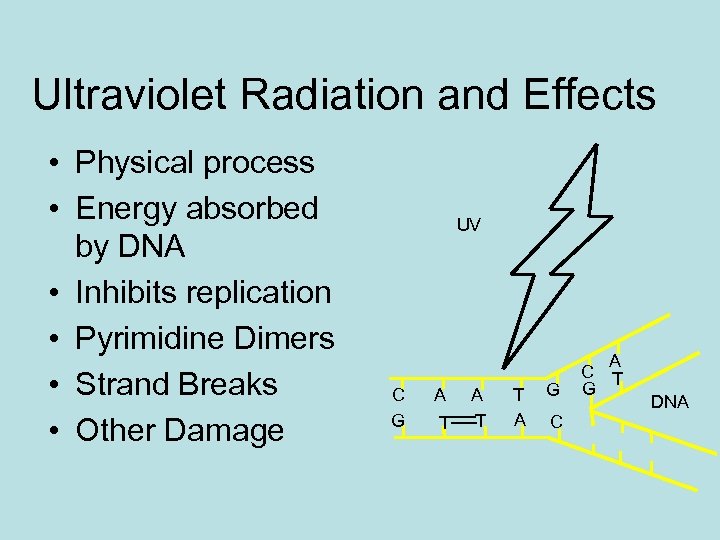
Ultraviolet Radiation and Effects • Physical process • Energy absorbed by DNA • Inhibits replication • Pyrimidine Dimers • Strand Breaks • Other Damage UV C G A T T A G C A C T G DNA
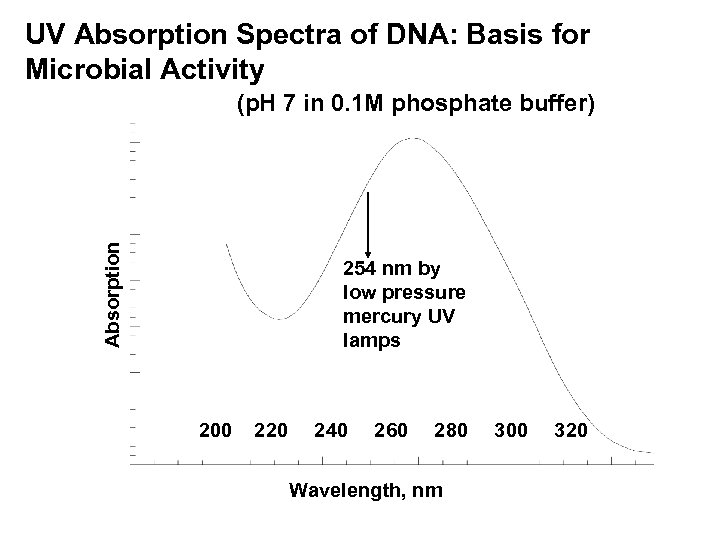
UV Absorption Spectra of DNA: Basis for Microbial Activity Absorption (p. H 7 in 0. 1 M phosphate buffer) 254 nm by low pressure mercury UV lamps 200 220 240 260 280 Wavelength, nm 300 320
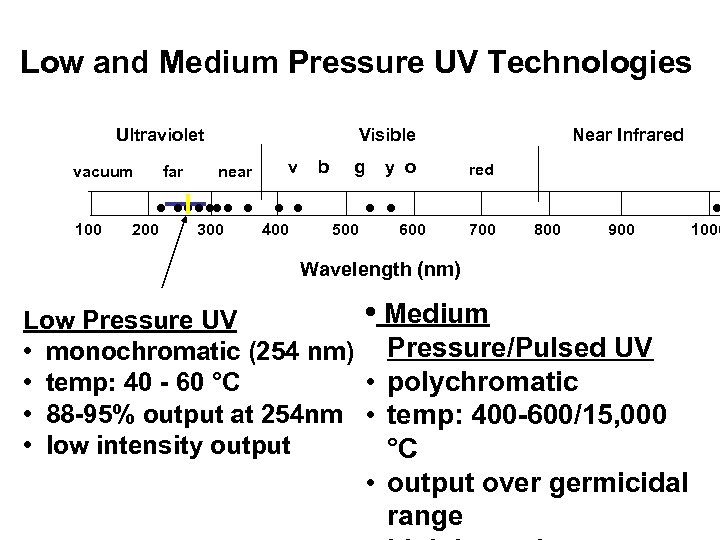
Low and Medium Pressure UV Technologies Ultraviolet vacuum 100 far Visible near v b g y o • • • • • • 200 300 400 500 • • 600 Near Infrared 700 800 900 • 1000 Wavelength (nm) • Medium Low Pressure UV • monochromatic (254 nm) Pressure/Pulsed UV • polychromatic • temp: 40 - 60 °C • 88 -95% output at 254 nm • temp: 400 -600/15, 000 • low intensity output °C • output over germicidal range
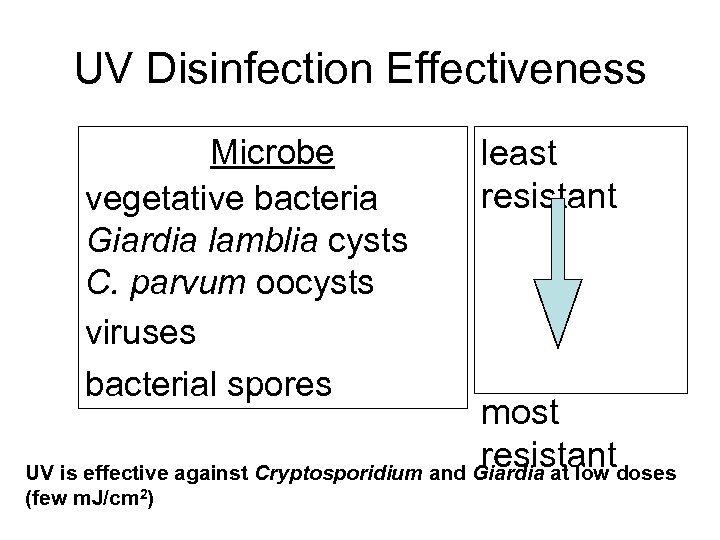
UV Disinfection Effectiveness Microbe vegetative bacteria Giardia lamblia cysts C. parvum oocysts viruses bacterial spores least resistant most resistant UV is effective against Cryptosporidium and Giardia at low doses (few m. J/cm 2)
Скачать презентацию Water Treatment Processes ENVR 890 Mark D Sobsey
fbd915f349298c2b1dd13b5c573e86d2.ppt