


 Скачать презентацию Water Testing How we measure what you can t
9189bbf1c38e027540f1568f1aef90d3.ppt
- Количество слайдов: 36
 Water Testing: How we measure what you can’t see 1 st Elmvale Water Festival August 4, 2007 Ray Clement Laboratory Services Branch, Ontario Ministry of the Environment 1
 Water Testing Overview • Steps taken to analyze water • What is trace? • How do we know we’re right? • New environmental issues and challenges 2
 Water Testing Steps in Water Analysis • Determine objectives • Take a sample for testing • Prepare sample for analysis • Analyze sample • Interpret results with quality control 3
 Water Testing Objectives of Water Analysis • • Ensure safety of drinking water Emergency Response (e. g. , industrial spills) Litigation Research The specific methods used depend on the study objectives, type of water tested (drinking, surface, other), and other factors 4
 Water Testing Sampling Considerations • Sample taken must be representative of the water body being tested 5
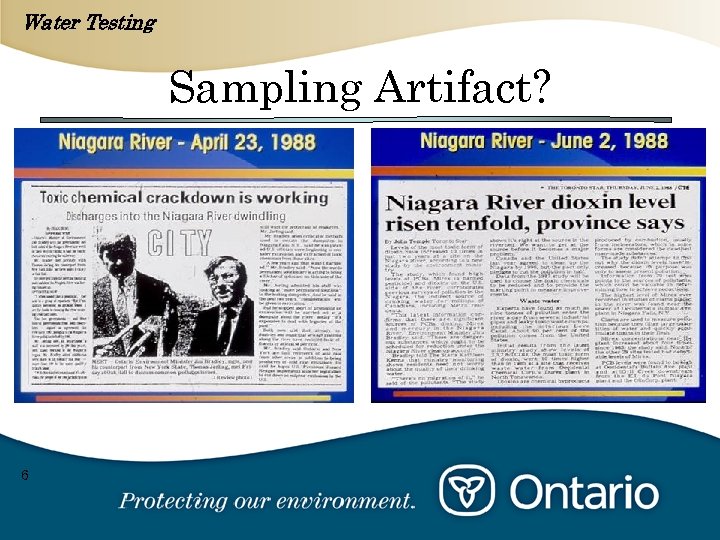 Water Testing Sampling Artifact? 6
 Water Testing Sampling Considerations • Sample taken must be representative of the water body being tested • Sampling containers must be appropriate and specially cleaned before use (e. g. , plastic for metals, glass for organics) • Shipping and storage considerations 7
 Water Testing Prepare Sample for Analysis • Extraction step • Interference removal step • Concentration step 8
 Water Testing Extraction Step • Methods used depend on substance we are testing for • For organic chemicals like PCBs or pesticides, use organic solvent not miscible with water • Sometimes, water filtered and particulates extracted separately 9
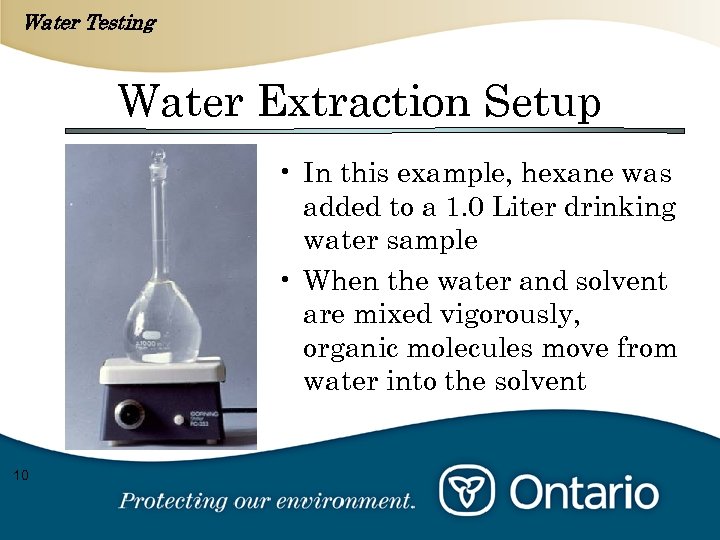 Water Testing Water Extraction Setup • In this example, hexane was added to a 1. 0 Liter drinking water sample • When the water and solvent are mixed vigorously, organic molecules move from water into the solvent 10
 Water Testing Water Extraction Setup • After the water and solvent have mixed well, the solvent is withdrawn from the top – this process is repeated 2 -3 times to make sure all organic compounds are removed 11
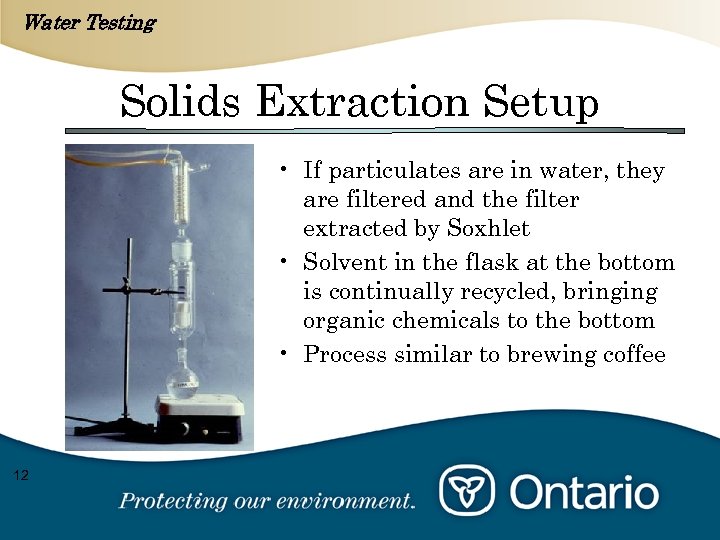 Water Testing Solids Extraction Setup • If particulates are in water, they are filtered and the filter extracted by Soxhlet • Solvent in the flask at the bottom is continually recycled, bringing organic chemicals to the bottom • Process similar to brewing coffee 12
 Water Testing Interference Removal Step • The compounds you are looking for are not the only ones in the sample • Other compounds – Interferences – can result in incorrect results • Interferences are removed by various chemical operations known as Cleanup 13
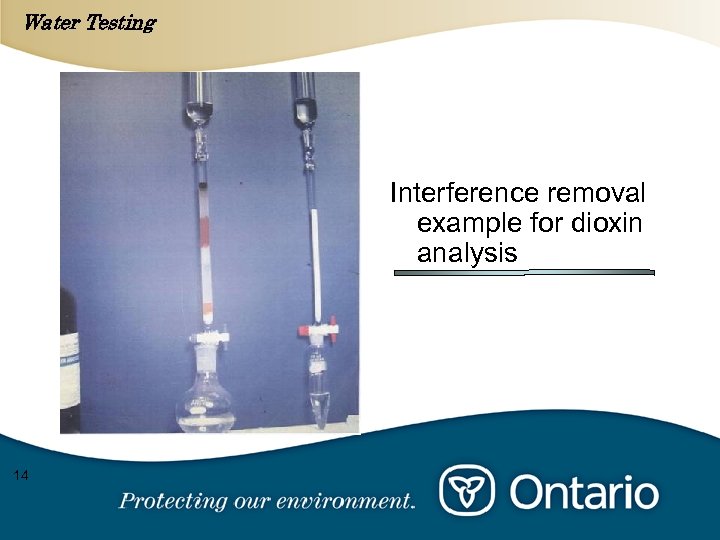 Water Testing Interference removal example for dioxin analysis 14
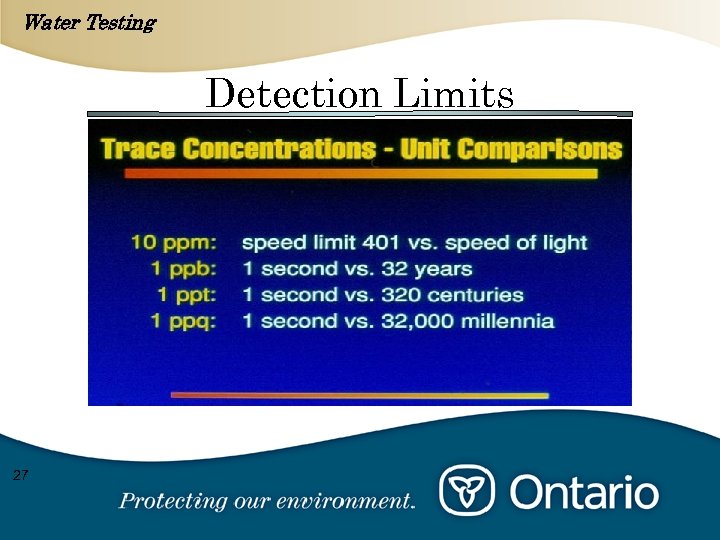
 Water Testing Concentration Step • The sample must be reduced in size before analysis because it is too dilute to achieve really low detection limits • ppb = parts-per-billion [1 part in 109] • ppt = parts-per-trillion [1 part in 1012] • ppq = parts-per-quadrillion [1 part in 1015] 15
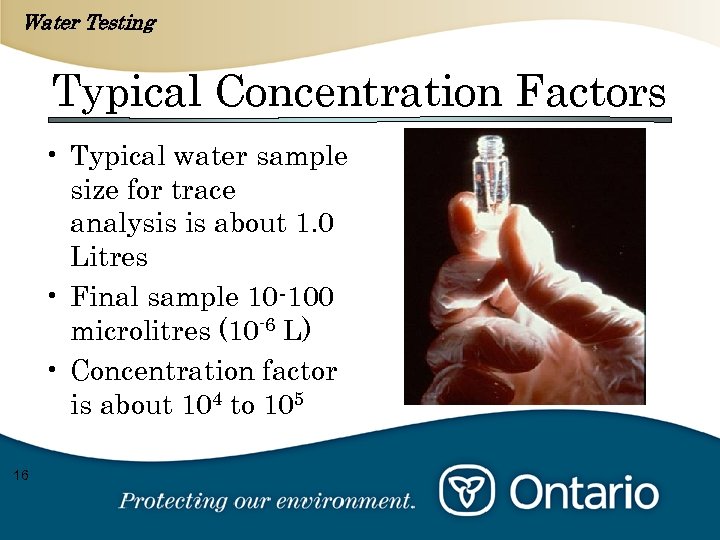 Water Testing Typical Concentration Factors • Typical water sample size for trace analysis is about 1. 0 Litres • Final sample 10 -100 microlitres (10 -6 L) • Concentration factor is about 104 to 105 16
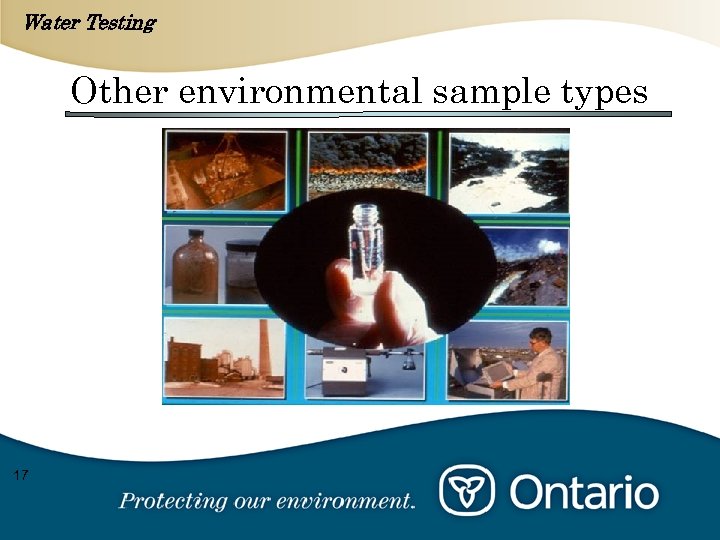 Water Testing Other environmental sample types 17
 Water Testing Sample Analysis Considerations • Many different types of chemical instrumentation are available for the final analysis step • For metals, one of most effective is called an Inductively-Coupled Plasma Mass Spectrometer (ICP-MS) 18
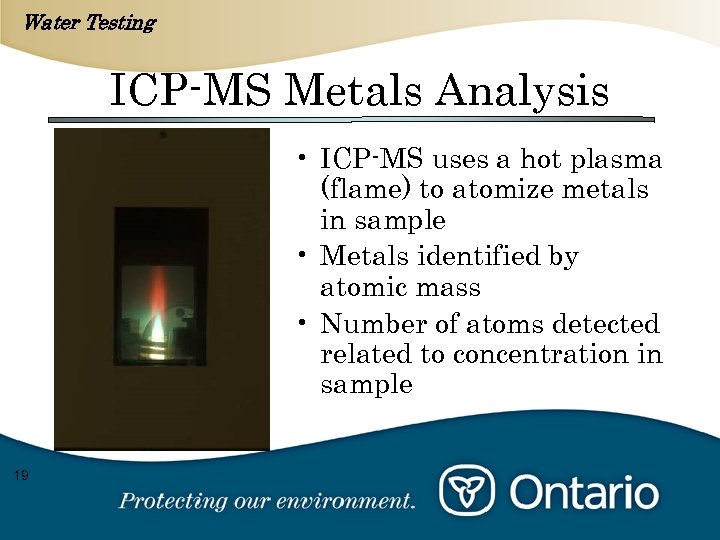 Water Testing ICP-MS Metals Analysis • ICP-MS uses a hot plasma (flame) to atomize metals in sample • Metals identified by atomic mass • Number of atoms detected related to concentration in sample 19
 Water Testing GC-MS Organics Analysis • For organics, instrumentation used is called a gas chromatograph-mass spectrometer (GC-MS) • Dozens of types of GC-MS systems exist, costing from $100 K to $1. 5 million • Capabilities of systems different, but basic principles the same 20
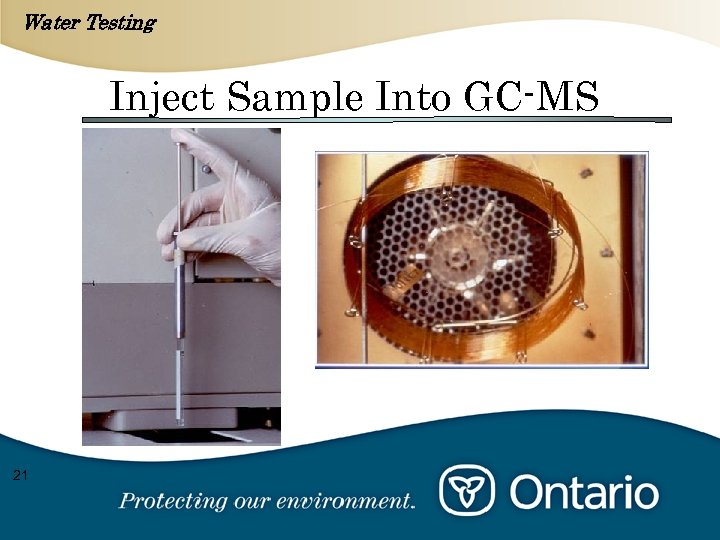 Water Testing Inject Sample Into GC-MS 21
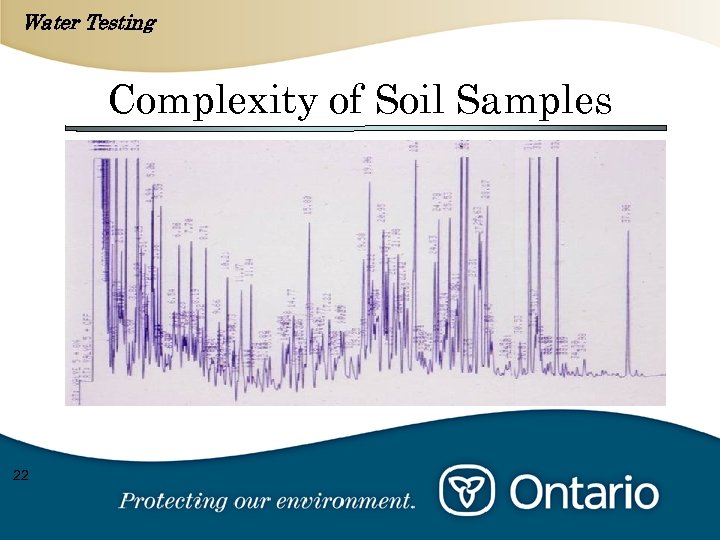 Water Testing Complexity of Soil Samples 22
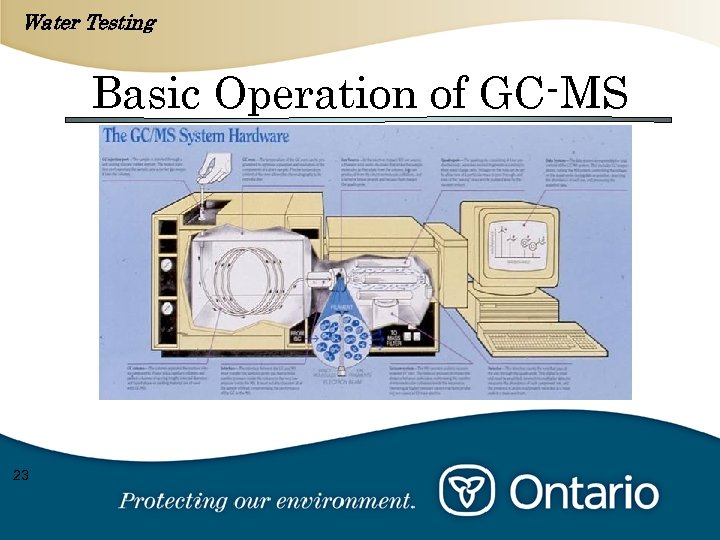 Water Testing Basic Operation of GC-MS 23
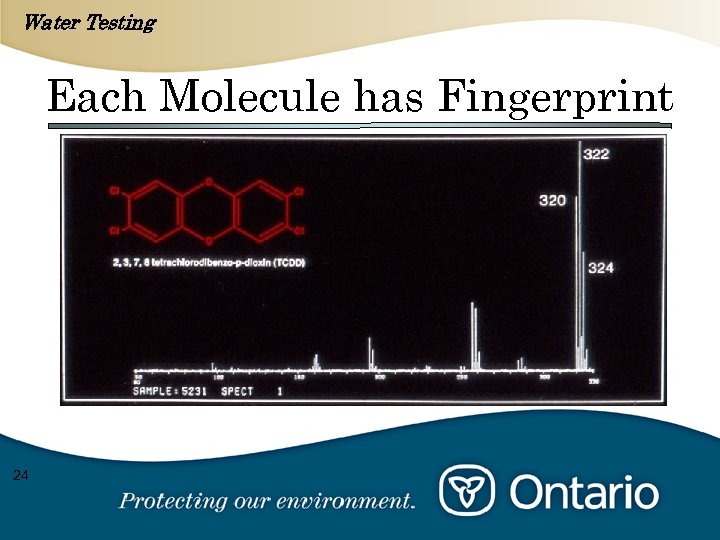 Water Testing Each Molecule has Fingerprint 24
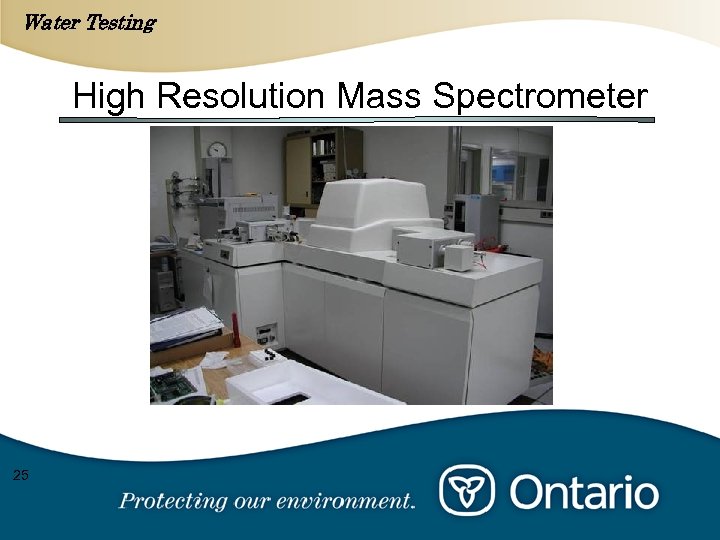 Water Testing High Resolution Mass Spectrometer 25
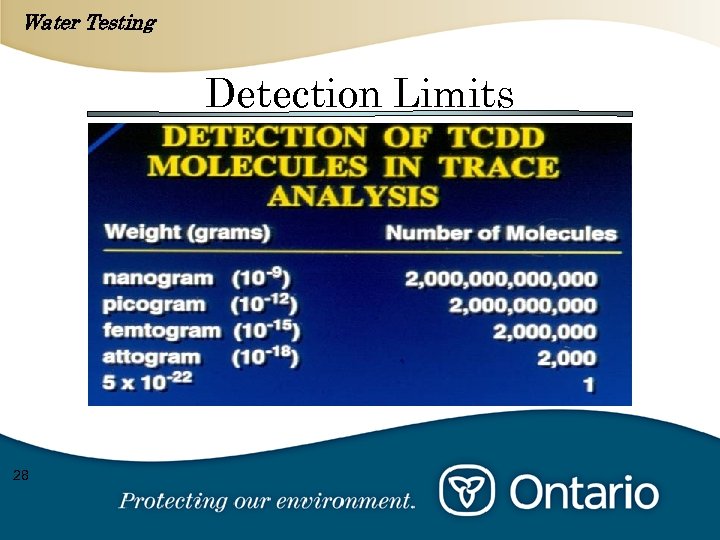
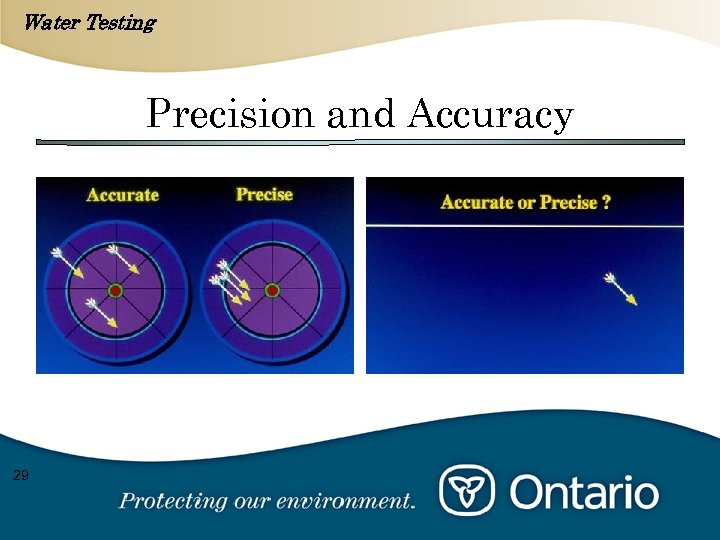
 Water Testing Characteristics of Methods • Detection Limit • Accuracy – How close to the real concentration? • Precision – Related to measurement uncertainty 26
 Water Testing Detection Limits 27
 Water Testing Detection Limits 28
 Water Testing Precision and Accuracy 29
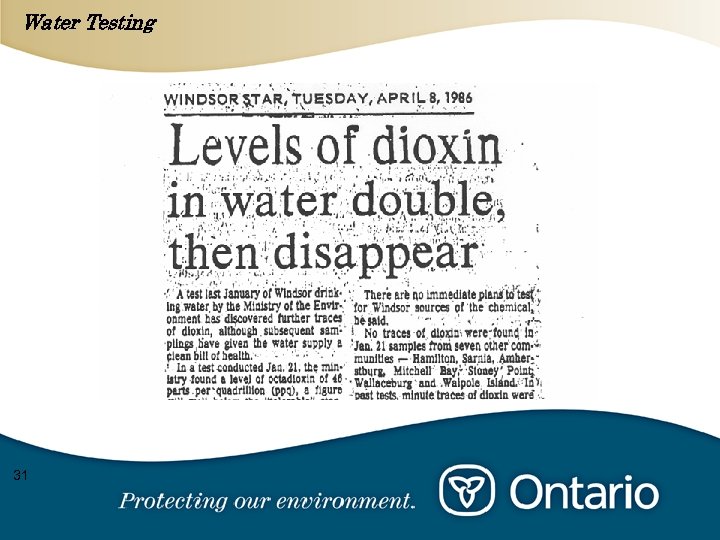
 Water Testing Data Interpretation: Public Understanding • • 30 Analysis of dioxin in lake water 3 samples on consecutive days Detection limits 0. 1 – 0. 3 ppt Actual results: Day 1 – 0. 2 ppt Day 2 – 0. 4 ppt Day 3 – not detected What was the newspaper headline?
 Water Testing 31
 Water Testing New Millennium – New Challenges • • • 32 Pharmaceuticals & Personal Care Products Perfluorinated compounds Water Disinfection Byproducts Brominated Flame Retardants (BFRs) Algal Toxins: microcystins, anatoxins Organometallic Compounds: tin, lead
 Water Testing The Future of Environmental Trace Analysis More of less, faster and cheaper 33
 Water Testing How Many Chemicals? Date: 08/1/2007 11: 14: 18 EST Count: 32, 261, 560 organic/inorganic substances 15, 057, 189 commercially available chemicals 34
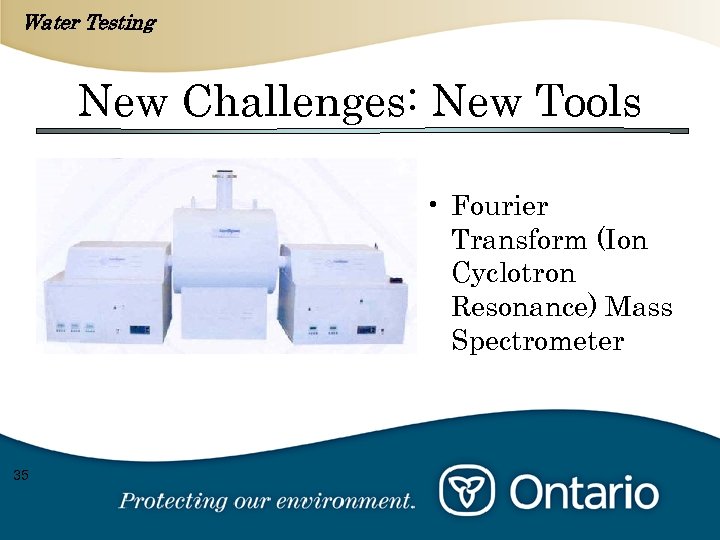 Water Testing New Challenges: New Tools • Fourier Transform (Ion Cyclotron Resonance) Mass Spectrometer 35
 Water Testing 36