


 Скачать презентацию Water Sources Pollution and Purification Chapter 13 1
de0f1842c4b85b7a52ada80f00bf538e.ppt
- Количество слайдов: 40
 Water: Sources, Pollution, and Purification Chapter 13 1
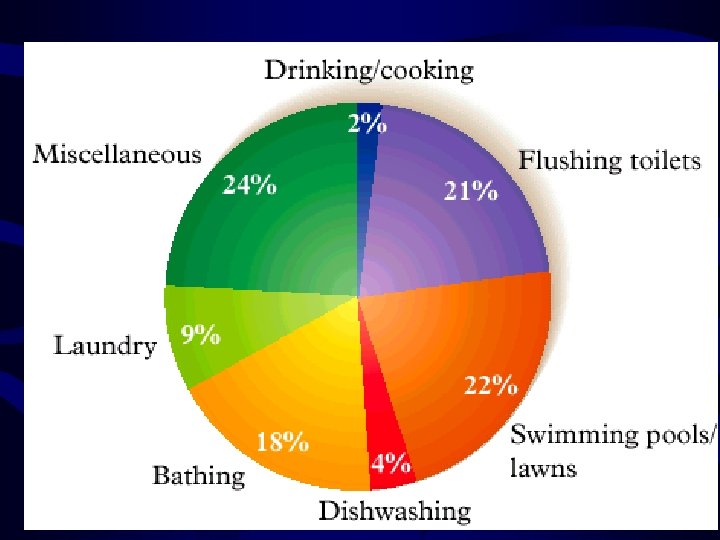
 Introduction • Water Usage in the United States – 300 L/day person – 100, 000 L/year person – Only 2% is used for drinking and cooking • Industrial Use is much larger than personal use – Thousands of L/pound of food – Thousands of L/pound of building material • We will explore sources of water, how it is purified for humans, and its pollution problems 2
 3
3
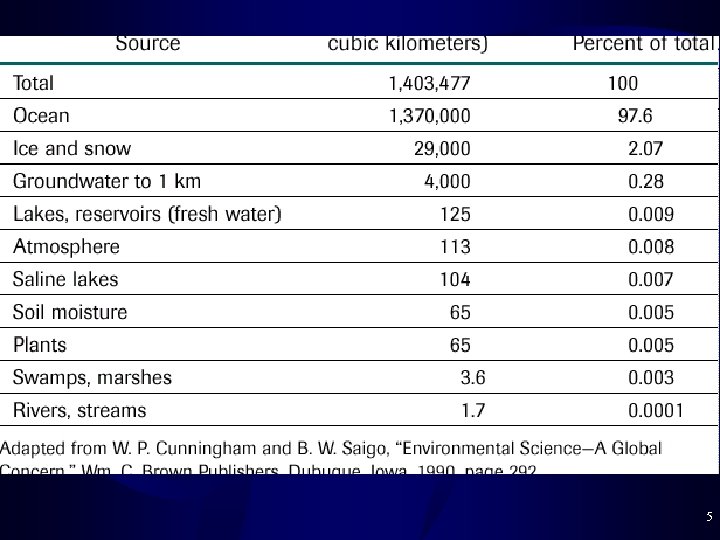
 Sources of Drinking Water • Inaccessibility of Drinking Water – 98% of Earth’s water is Salty (Oceans) – 2% of Earth’s water is fresh • Much of this is trapped as ice and snow in glaciers • 0. 01% of Earth’s water is fresh surface water: lakes and rivers • Groundwater – 0. 3% of Earth’s water is < 1 km underground freshwater – Aquifer = permanent underground lake • Usually sand/gravel layer over rock/clay layer • Extract with a well: 39% of US public water + much irrigation 4
 5
5
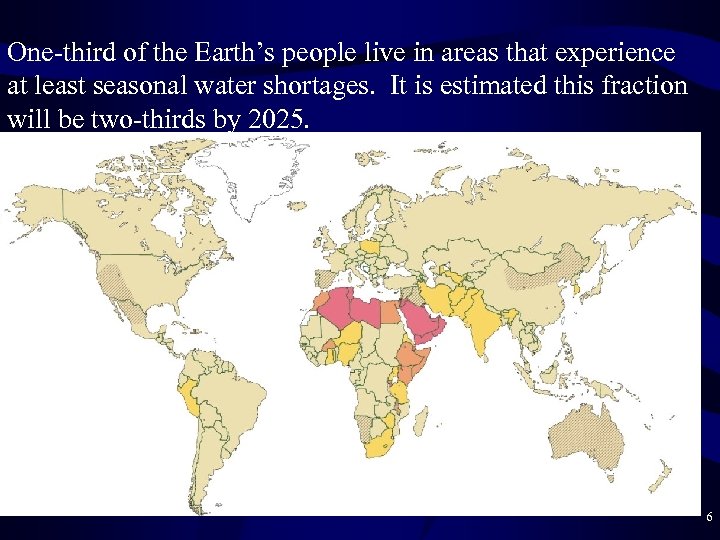 One-third of the Earth’s people live in areas that experience at least seasonal water shortages. It is estimated this fraction will be two-thirds by 2025. 6
 Water Purification • Quality of Fresh Water is variable – Purification steps vary with the source of the water – Purification may be for purposes other than drinking • Wash water performs better when Ca 2+/Mg 2+ are removed • These ions have no ill effect in drinking water • Aeration = removal of dissolved gases – Water from aquifers often has dissolved gases that may add an odor or flavor to the water • H 2 S = Hydrogen Sulfide • CH 3 SH = methanethiol (and other sulfur compounds) • Volatile organic compounds = carbon compounds that evaporate easily (acetone, ether, benzene) 7
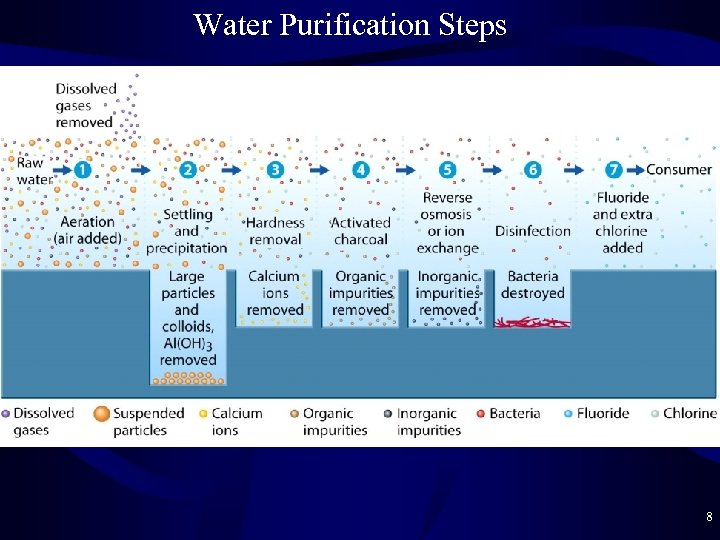 Water Purification Steps 8
 Aeration • Aeration = bubbling air through the water – Air bubbles absorb the other gases and remove them – O 2 in the air can oxidize some organics to CO 2 gas CH 4 + 2 O 2 ----> CO 2 + 2 H 2 O – Cheap and widely used purification step • Settling – Surface water often contains suspended particles from soil (clay = Si. O 2 makes colloids) and animal/plant matter – Settling pond: larger (> 1 mm) particles settle to bottom 9
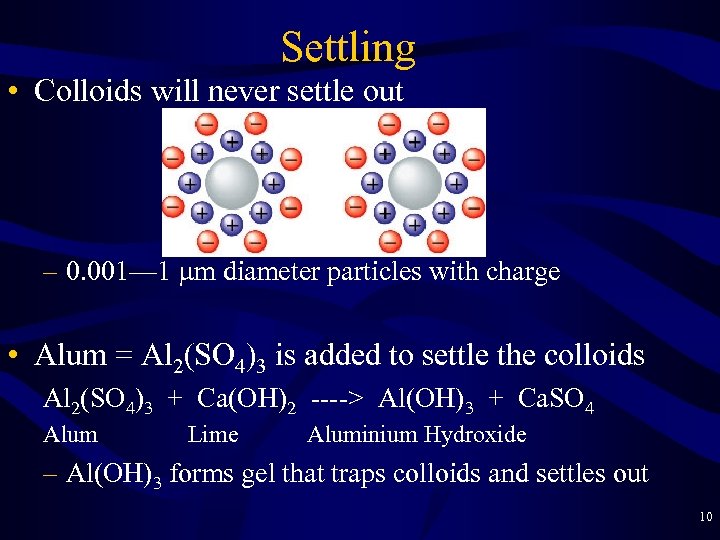 Settling • Colloids will never settle out – 0. 001— 1 mm diameter particles with charge • Alum = Al 2(SO 4)3 is added to settle the colloids Al 2(SO 4)3 + Ca(OH)2 ----> Al(OH)3 + Ca. SO 4 Alum Lime Aluminium Hydroxide – Al(OH)3 forms gel that traps colloids and settles out 10
 Softening • Softening – Hard Water = water with dissolved Ca 2+ and/or Mg 2+ Ca 2+ + CO 32 - ----> Ca. CO 3 solid is filtered out Mg 2+ + 2 OH- ----> Mg(OH)2 solid is filtered out – The result is called soft water – Hard Water Problems (Mc. Pherson) • Ca 2+ and Mg 2+ form precipitates with soap = scum • Ca 2+ and/or Mg 2+ form precipitates with CO 32 - = scale 11
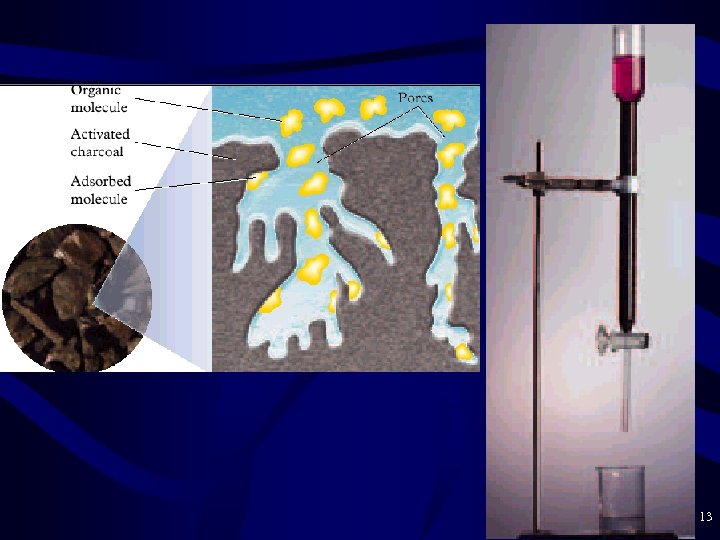
 Charcoal Purification • Charcoal Purification – Nonionic (neutral compounds like most organics) will adsorb to the surface of charcoal (like dissolves like) – Activated carbon = finely divided charcoal with large surface area – Pesticides, chlorinated solvents, and other organics not previously removed are trapped by the carbon – Expensive, not done widely – Many individuals buy charcoal filters for tap water – After the charcoal is saturated, you must discard and get a new filter 12
 13
13
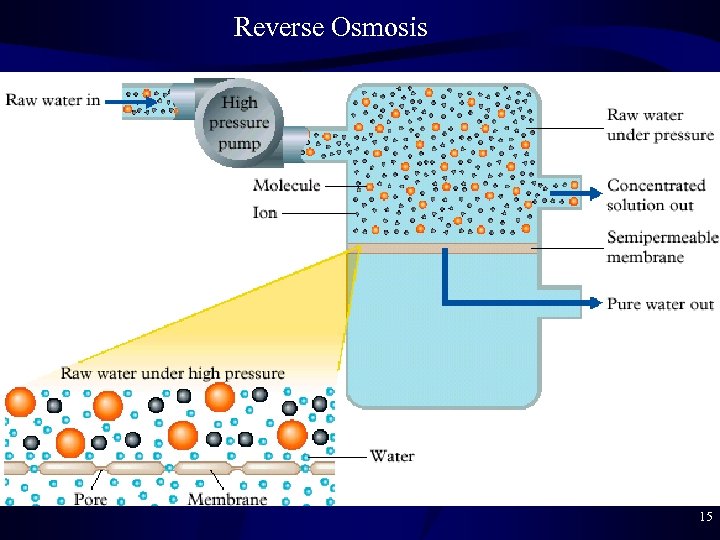
 Reverse Osmosis • Reverse Osmosis – Osmosis = natural movement of water from high concentration to low concentration through a membrane – Reverse osmosis = purification of water using high pressure to force water from low to high concentration • Membrane only allows water, not ions, to pass due to size • Cellulose acetate is often the membrane compound • Ions removed: Na+, K+, Pb 2+, Hg 2+, NO 3 -, PO 32 - – Problems: expensive, wasteful (discard more H 2 O than keep) – Desalination = fresh water from salt water • Expensive, less than 0. 1% of fresh water used is desalinated 14
 Reverse Osmosis 15
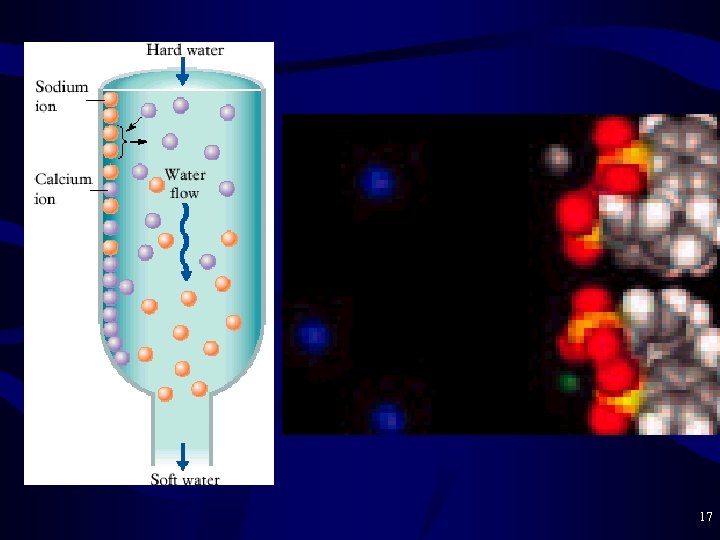
 Ion Exchange • Ion Exchange – Often used as an alternative softening step – Resin = organic polymer beads with cation binding sites R—SO 3 - Na+ – Resin prefers to bind cations of higher charge R—SO 3 - Na+ + Ca 2+ ----> R—SO 3 - Ca 2+ + Na+ Hard water Soft water – Resin can be regenerated R—SO 3 - Ca 2+ + Na. Cl ----> R—SO 3 - Na+ + Ca 2+ 16
 17
17
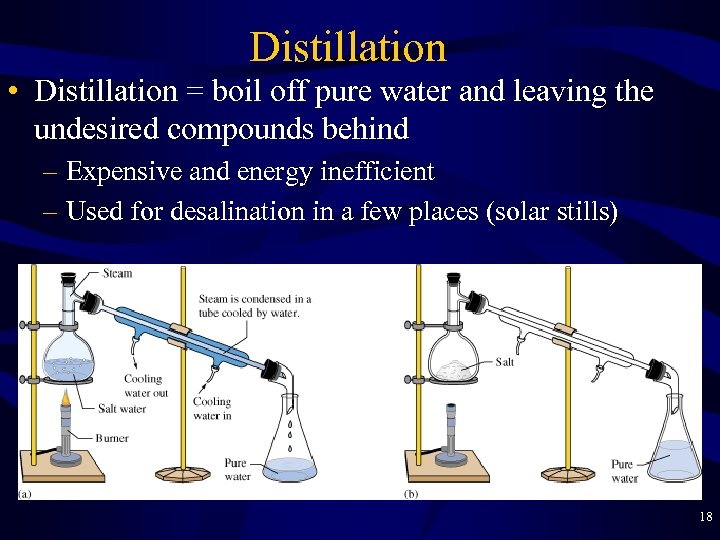 Distillation • Distillation = boil off pure water and leaving the undesired compounds behind – Expensive and energy inefficient – Used for desalination in a few places (solar stills) 18
 Arsenic Removal Example • Arsenic (As) is a toxic, cancer causing element – Groundwater often contains As as arsenate As. O 43 • Naturally occurring component of some minerals • Byproduct of smelting gold, silver, copper, nickel – World Health Organization (WHO) says 10 ppb is safe • 1% of US public water has As > 25 ppb • US law just been changed from 50 ppb to 10 ppb – Removal of As • Can’t use ion exchange because arsenate is an anion • Fe 3+ + As. O 43 - ----> Fe. As. O 4 solid which is then filtered off 19
 Disinfection by Chlorination • Bacteria/Viruses not all removed by purification – Disinfection = killing bacteria/viruses in water – HOCl = hypochlorous acid is the active compound • Passes through cell membrane to kill microorganisms – 75% of US population uses chlorinated water – Large scale chlorination: Cl 2 + H 2 O HOCl + HCl – Cl 2 gas is toxic and must be handled by experts 20
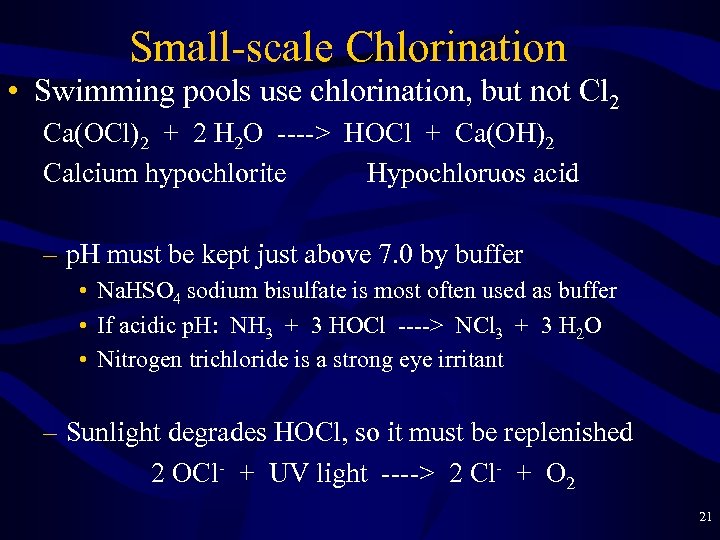 Small-scale Chlorination • Swimming pools use chlorination, but not Cl 2 Ca(OCl)2 + 2 H 2 O ----> HOCl + Ca(OH)2 Calcium hypochlorite Hypochloruos acid – p. H must be kept just above 7. 0 by buffer • Na. HSO 4 sodium bisulfate is most often used as buffer • If acidic p. H: NH 3 + 3 HOCl ----> NCl 3 + 3 H 2 O • Nitrogen trichloride is a strong eye irritant – Sunlight degrades HOCl, so it must be replenished 2 OCl- + UV light ----> 2 Cl- + O 2 21
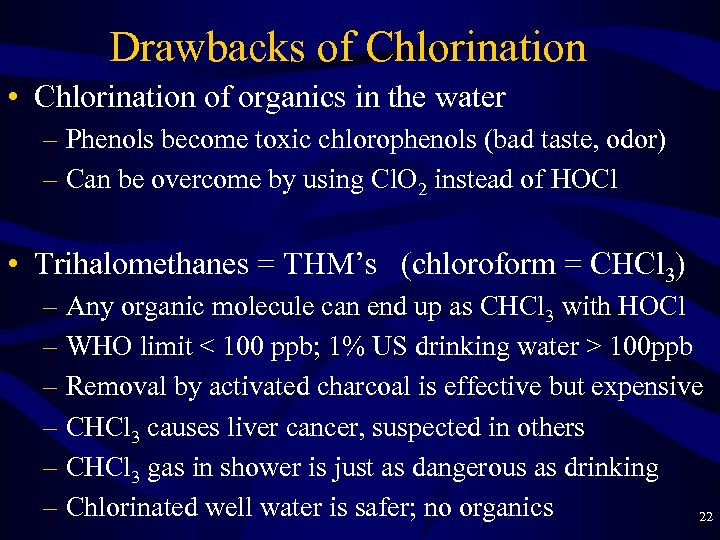 Drawbacks of Chlorination • Chlorination of organics in the water – Phenols become toxic chlorophenols (bad taste, odor) – Can be overcome by using Cl. O 2 instead of HOCl • Trihalomethanes = THM’s (chloroform = CHCl 3) – Any organic molecule can end up as CHCl 3 with HOCl – WHO limit < 100 ppb; 1% US drinking water > 100 ppb – Removal by activated charcoal is effective but expensive – CHCl 3 causes liver cancer, suspected in others – CHCl 3 gas in shower is just as dangerous as drinking – Chlorinated well water is safer; no organics 22
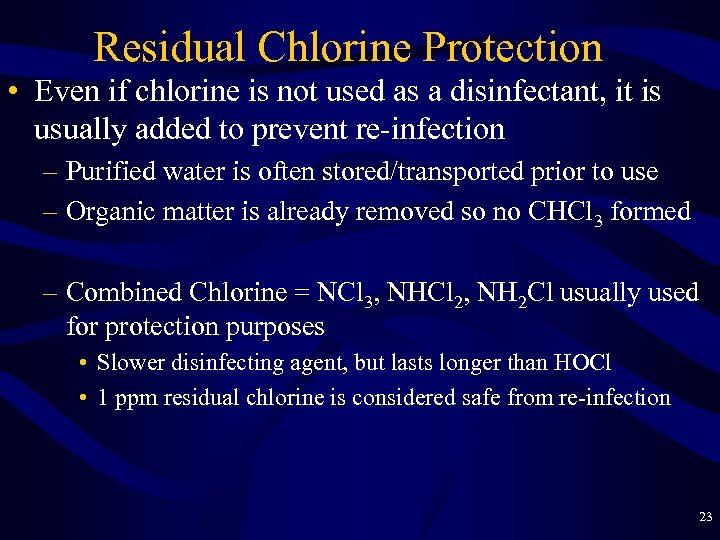 Residual Chlorine Protection • Even if chlorine is not used as a disinfectant, it is usually added to prevent re-infection – Purified water is often stored/transported prior to use – Organic matter is already removed so no CHCl 3 formed – Combined Chlorine = NCl 3, NHCl 2, NH 2 Cl usually used for protection purposes • Slower disinfecting agent, but lasts longer than HOCl • 1 ppm residual chlorine is considered safe from re-infection 23
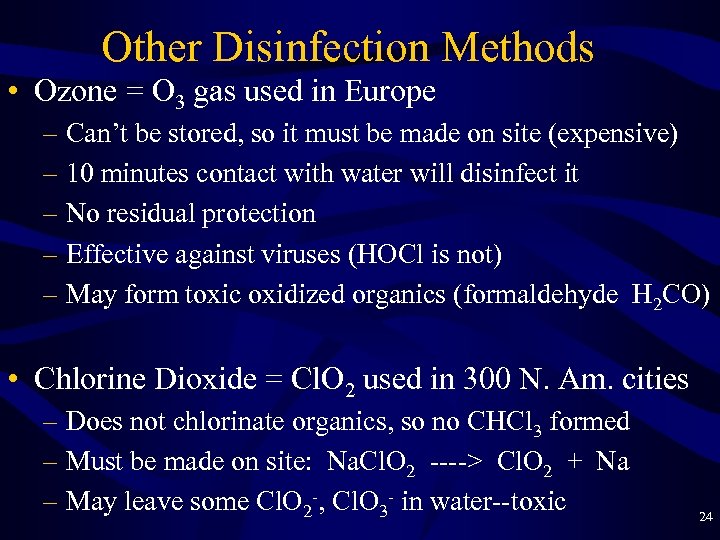 Other Disinfection Methods • Ozone = O 3 gas used in Europe – Can’t be stored, so it must be made on site (expensive) – 10 minutes contact with water will disinfect it – No residual protection – Effective against viruses (HOCl is not) – May form toxic oxidized organics (formaldehyde H 2 CO) • Chlorine Dioxide = Cl. O 2 used in 300 N. Am. cities – Does not chlorinate organics, so no CHCl 3 formed – Must be made on site: Na. Cl. O 2 ----> Cl. O 2 + Na – May leave some Cl. O 2 -, Cl. O 3 - in water--toxic 24
 Other Disinfection Methods • UV light alters DNA killing microorganisms – 10 s irradiation is effective – Same effect UV light has on skin—cancer – Dissolved substances and colloids block light – Small setups possible—Melhorn Deionized water • Is it worth the risk to disinfect water? – Waterborne diseases kill 20 million people/year – 0. 5 million killed in Peru in the 1990’s by cholera – CHCl 3 appears much less fatal! 25
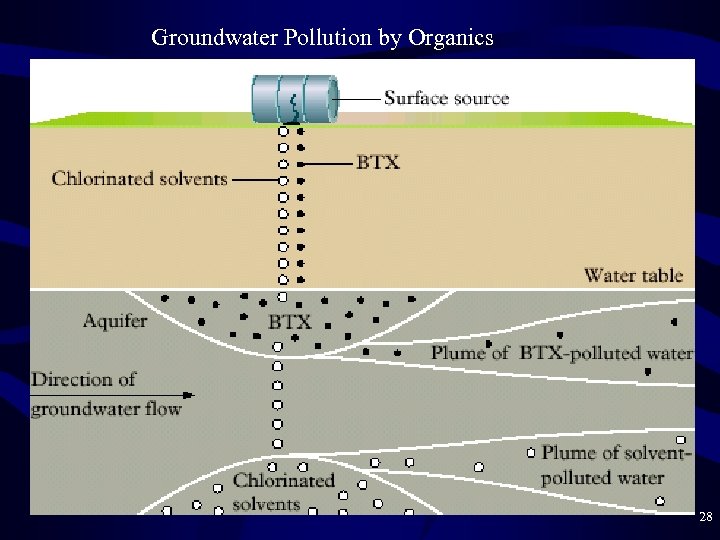
 Groundwater Pollution by Organics • Importance of groundwater pollution – Ignored until about 1980 (out of site, out of mind) – Has been used increasingly as drinking water – Can’t be cleaned up easily like surface water can: – Pump-and-treat: continuous process, very expensive • Organic Compounds in Groundwater – Leachate = liquid draining (leaching) from surface source • Landfills • Industrial Sites • Agricultural Land • 1940— 1980 was the age of groundwater pollution 26
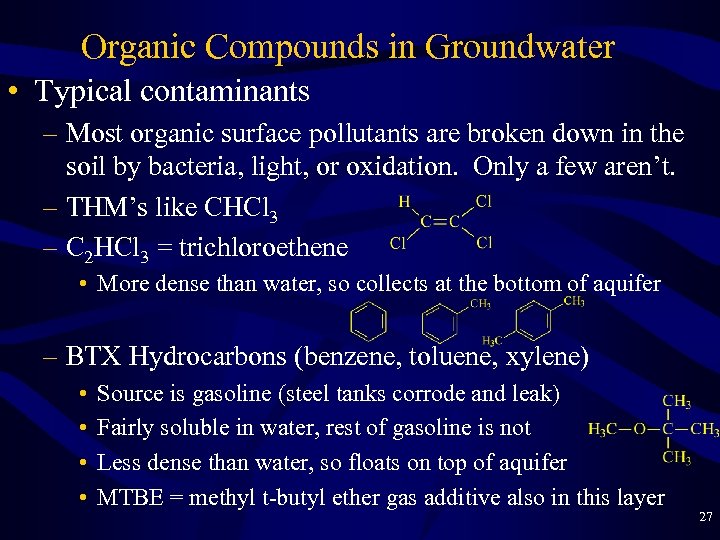 Organic Compounds in Groundwater • Typical contaminants – Most organic surface pollutants are broken down in the soil by bacteria, light, or oxidation. Only a few aren’t. – THM’s like CHCl 3 – C 2 HCl 3 = trichloroethene • More dense than water, so collects at the bottom of aquifer – BTX Hydrocarbons (benzene, toluene, xylene) • • Source is gasoline (steel tanks corrode and leak) Fairly soluble in water, rest of gasoline is not Less dense than water, so floats on top of aquifer MTBE = methyl t-butyl ether gas additive also in this layer 27
 Groundwater Pollution by Organics 28
 Water Pollution by Nitrogen Compunds • Nitrogen is used by plants: NO 3 - (nitrate), NH 4+ (ammonium cation) used as fertilizers – Environmental Protection Agency (EPA) limit for nitrate in drinking water is 10 ppm • • Uncontaminated groundwater = 2 ppm nitrate 9% of shallow aquifers have > 10 ppm nitrate Cities usually use deep aquifers which are less contaminated Rural wells in shallow aquifers often face nitrate problem – Sources of nitrate • Fertilized farmland • Unfertilized farmland still produces nitrate due to high plant and microorganism activity 29
 Nitrate Health Risks • Methemoglobinemia = “blue baby syndrome” – NO 3 - + bacteria ----> NO 2 - (nitrite anion) – NO 2 - combines with Hemoglobin, blocking oxygen transport (thus the blue color) – Most adults have enzymes that return the Hemoglobin to a useful state – Most infants don’t yet have the mechanism to do this – Largely a rural problem, as is nitrate pollution 30
 Removal of Nitrogen • Ammonium ion removal – Ammonium cation is converted to ammonia gas and removed by aeration NH 4+ + OH- ----> NH 3 + H 2 O – Ion exchange works because ammonium is a cation • Nitrate removal – Denitrification = bacteria can turn NO 3 - into N 2 gas 31
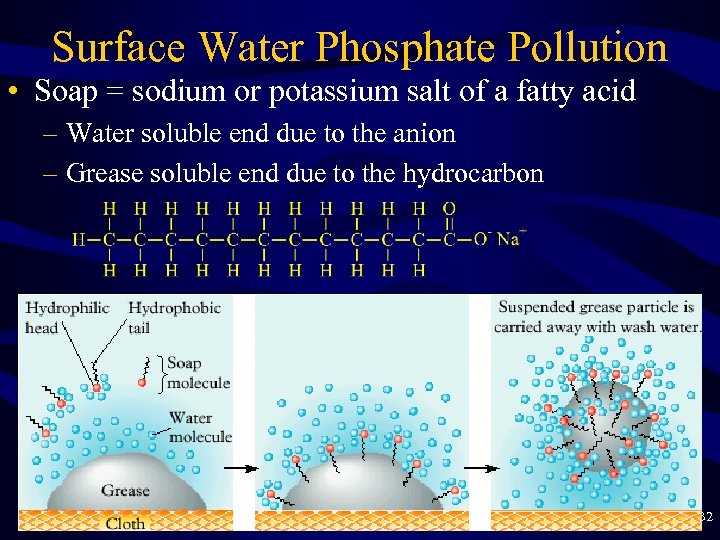 Surface Water Phosphate Pollution • Soap = sodium or potassium salt of a fatty acid – Water soluble end due to the anion – Grease soluble end due to the hydrocarbon 32
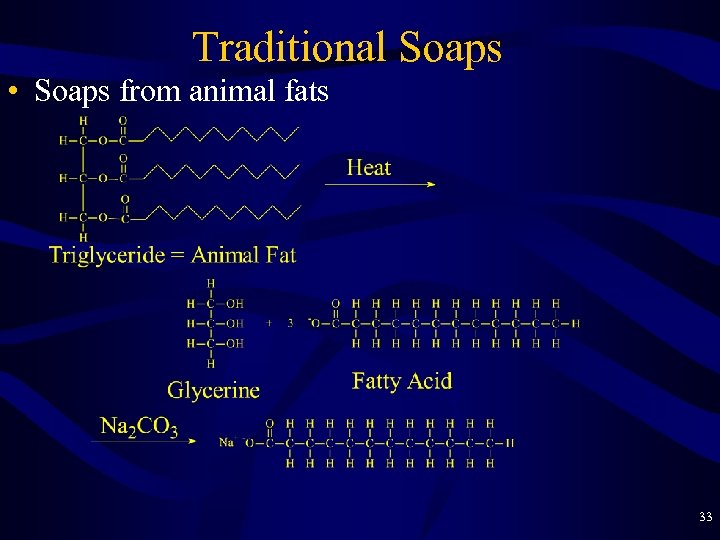 Traditional Soaps • Soaps from animal fats 33
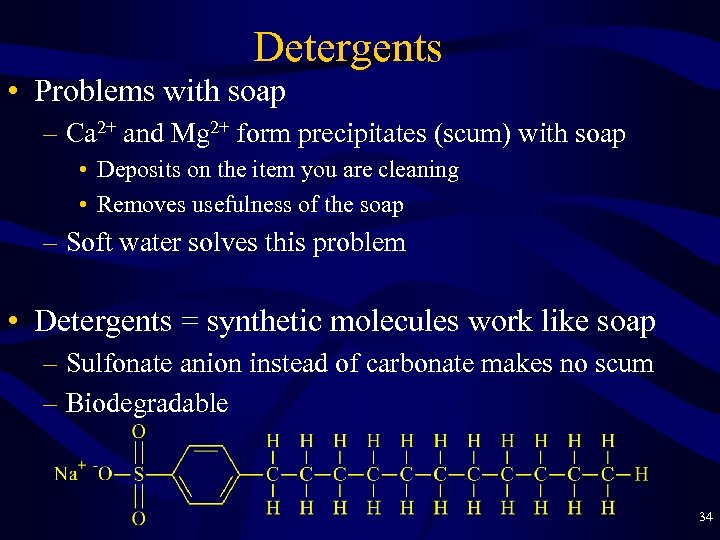 Detergents • Problems with soap – Ca 2+ and Mg 2+ form precipitates (scum) with soap • Deposits on the item you are cleaning • Removes usefulness of the soap – Soft water solves this problem • Detergents = synthetic molecules work like soap – Sulfonate anion instead of carbonate makes no scum – Biodegradable 34
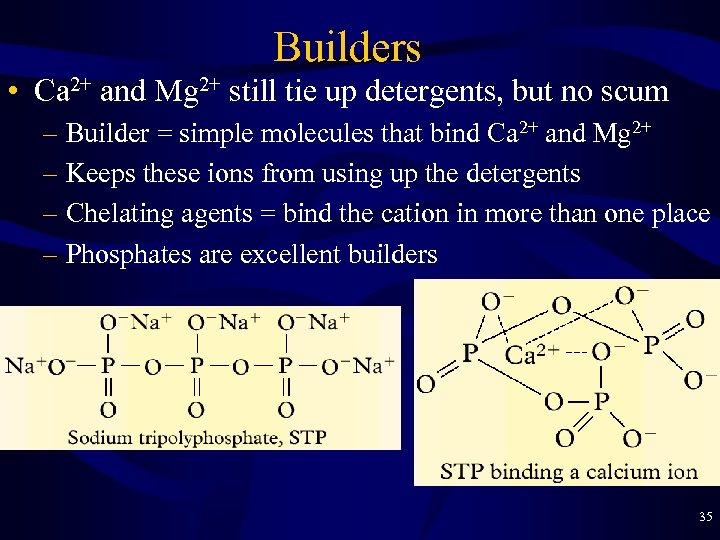 Builders • Ca 2+ and Mg 2+ still tie up detergents, but no scum – Builder = simple molecules that bind Ca 2+ and Mg 2+ – Keeps these ions from using up the detergents – Chelating agents = bind the cation in more than one place – Phosphates are excellent builders 35
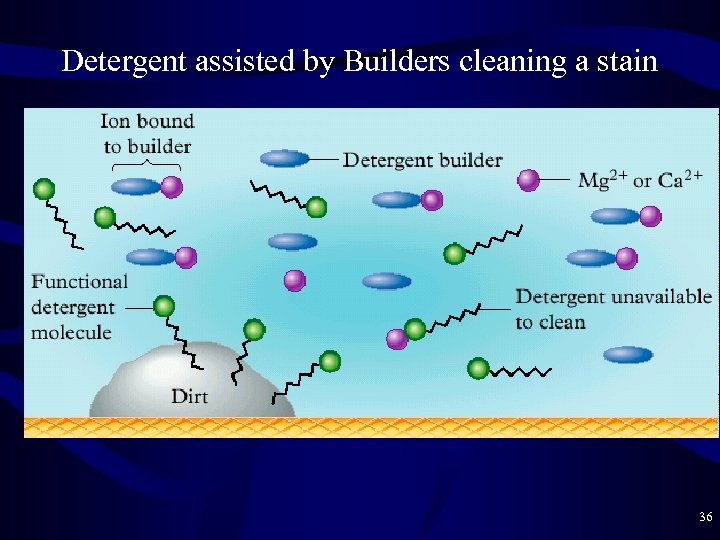 Detergent assisted by Builders cleaning a stain 36
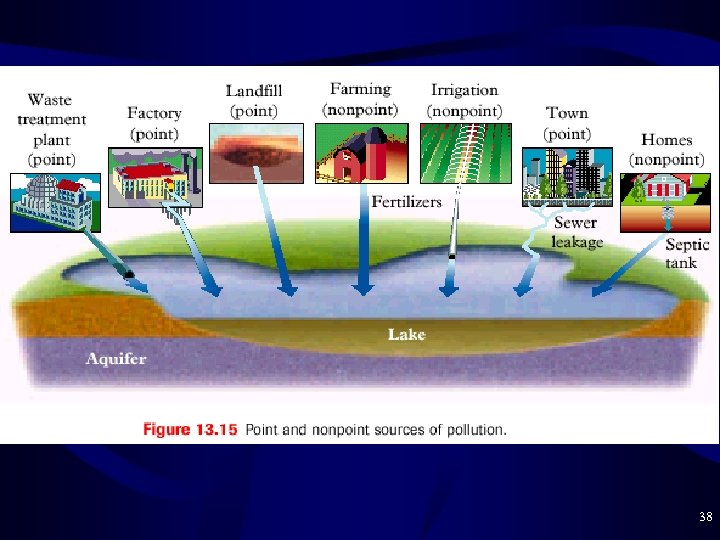
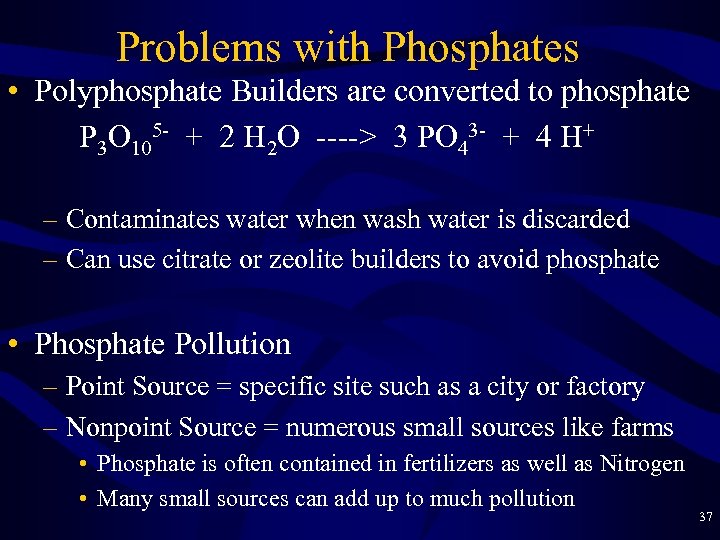 Problems with Phosphates • Polyphosphate Builders are converted to phosphate P 3 O 105 - + 2 H 2 O ----> 3 PO 43 - + 4 H+ – Contaminates water when wash water is discarded – Can use citrate or zeolite builders to avoid phosphate • Phosphate Pollution – Point Source = specific site such as a city or factory – Nonpoint Source = numerous small sources like farms • Phosphate is often contained in fertilizers as well as Nitrogen • Many small sources can add up to much pollution 37
 38
38
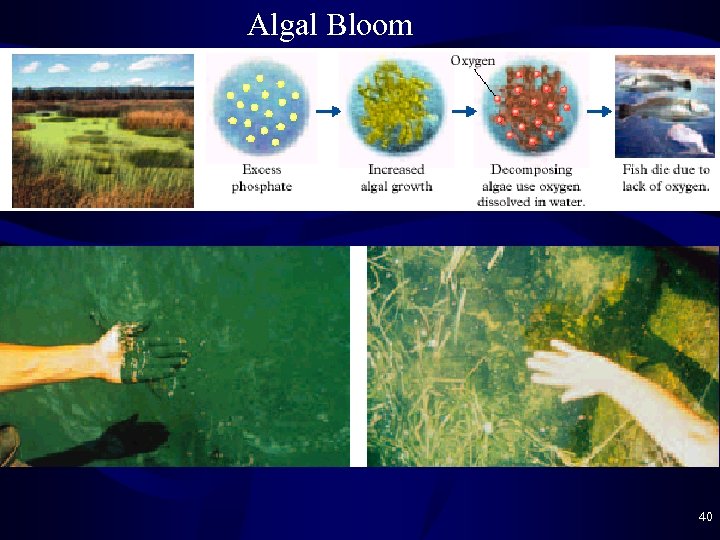
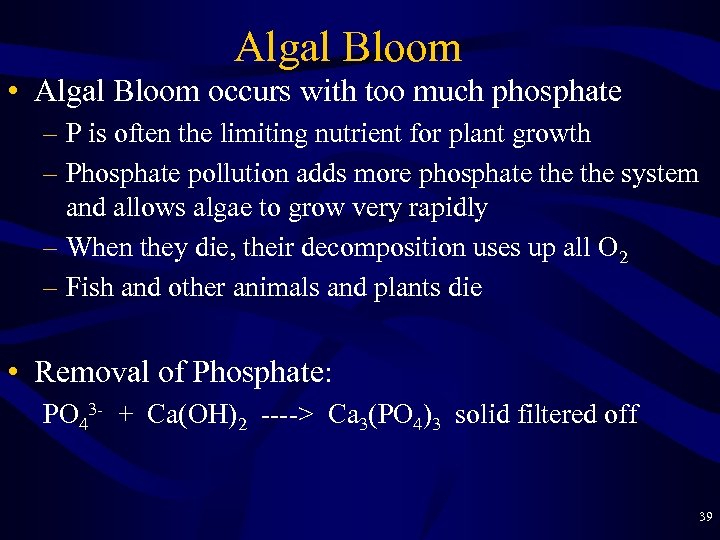 Algal Bloom • Algal Bloom occurs with too much phosphate – P is often the limiting nutrient for plant growth – Phosphate pollution adds more phosphate the system and allows algae to grow very rapidly – When they die, their decomposition uses up all O 2 – Fish and other animals and plants die • Removal of Phosphate: PO 43 - + Ca(OH)2 ----> Ca 3(PO 4)3 solid filtered off 39
 Algal Bloom 40