


 Скачать презентацию Water Services Trust Fund Financial Support for Improved
cab4933a7aa54f63d9d0cb17513fd64c.ppt
- Количество слайдов: 16
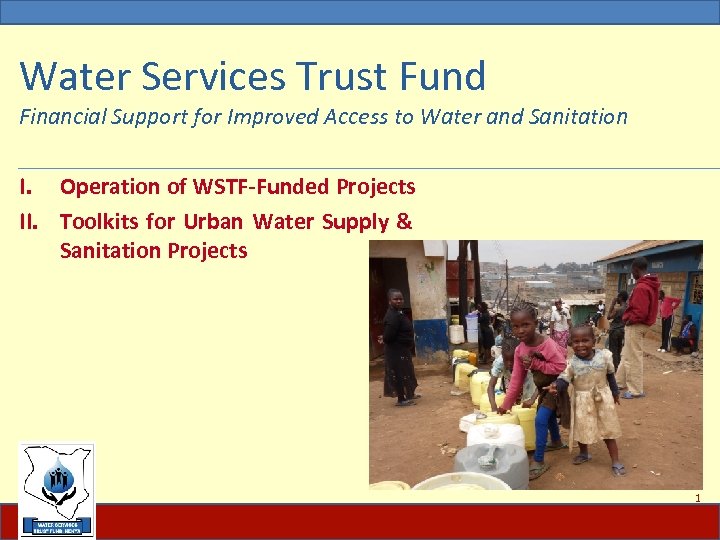 Water Services Trust Fund Financial Support for Improved Access to Water and Sanitation I. Operation of WSTF-Funded Projects II. Toolkits for Urban Water Supply & Sanitation Projects 1
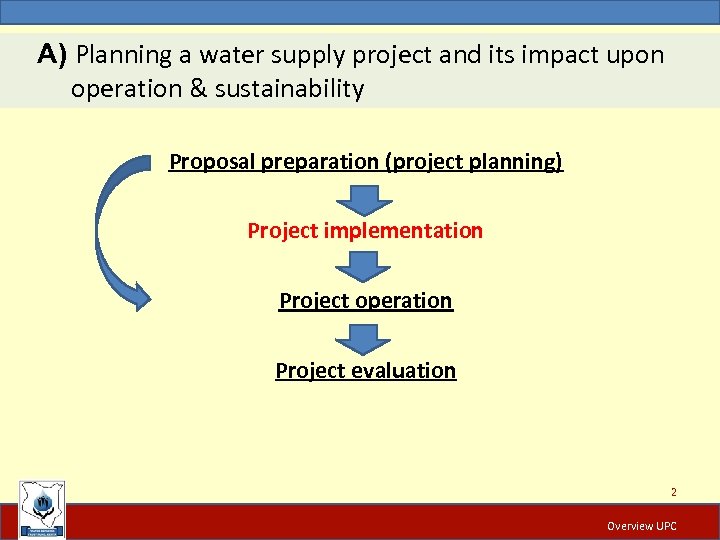 A) Planning a water supply project and its impact upon operation & sustainability Proposal preparation (project planning) Project implementation Project operation Project evaluation 2 Overview UPC
 A) Planning a water supply project and its impact upon operation & sustainability What are the main objectives we want to achieve with our pro-poor water supply and sanitation projects? 1. Social objectives 2. Public health objectives 3. Financial & commercial objectives 4. Technical objectives (choice of technology & maintenance & repair) 5. Environmental objectives 6. Sector objectives 7. Image objective • Only proper planning results in sustainable operation!! • Good planning requires considering all objectives 3 Overview UPC
 A) Planning a water supply project and its impact upon operation & sustainability (continued) How to get it wrong? Racecourse Water Project in Kitwe, Zambia Causes of failure: • Project guides by its social & public health objectives only (1/250) • Neglect of the current water supply situation and of the decisions people make with reward to water & budget • Neglect of commercial objectives and interests of Kiosk Operators • Neglect of kiosk design (to control costs) 4 Overview UPC
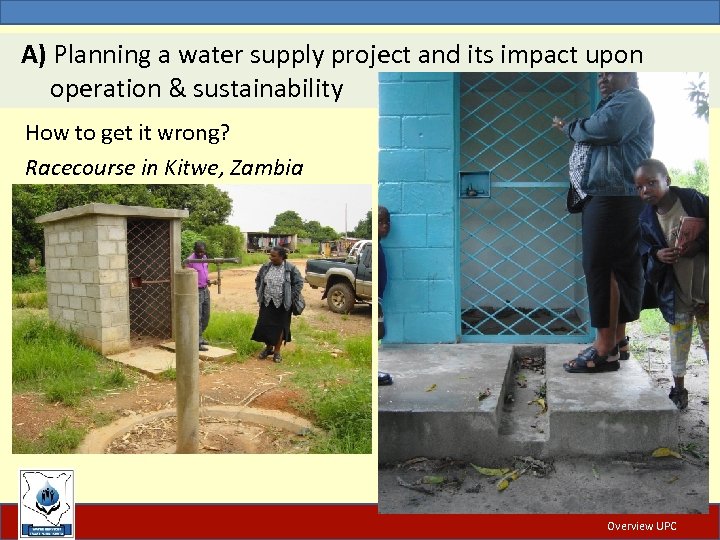 A) Planning a water supply project and its impact upon operation & sustainability How to get it wrong? Racecourse in Kitwe, Zambia 5 Overview UPC
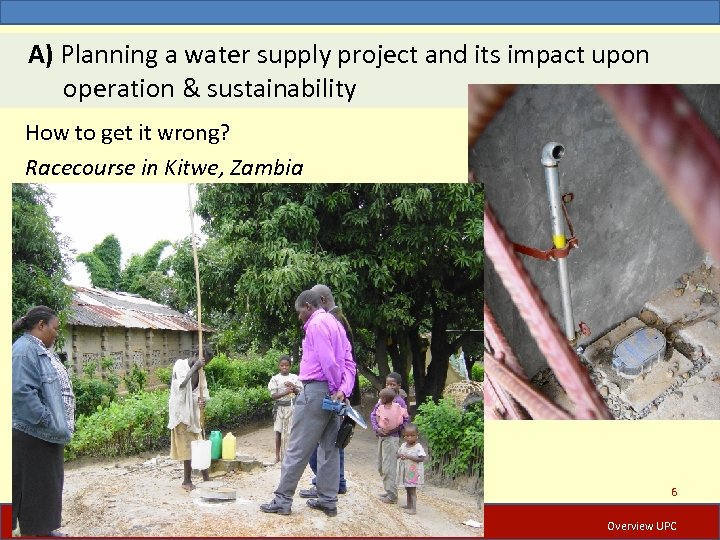 A) Planning a water supply project and its impact upon operation & sustainability How to get it wrong? Racecourse in Kitwe, Zambia 6 Overview UPC
 A) Planning a water supply project and its impact upon operation & sustainability So what happened to the project? • • • Few customers at each kiosk Consumption levels (litres/person/day) are low (2 -3 litres) Operator incomes are low Operators are not motivated to be at the kiosk & to pay their water bill Kiosks are abandoned & closed Revenue & collection efficiency is low but maintenance costs are relatively high Water bills are not paid & no longer prepared WSP is not motivated to carry out all required maintenance & repair works (the scheme is perceived as not viable) Gradual neglect of the scheme Dilapidated scheme & poor water supply 7 Overview UPC
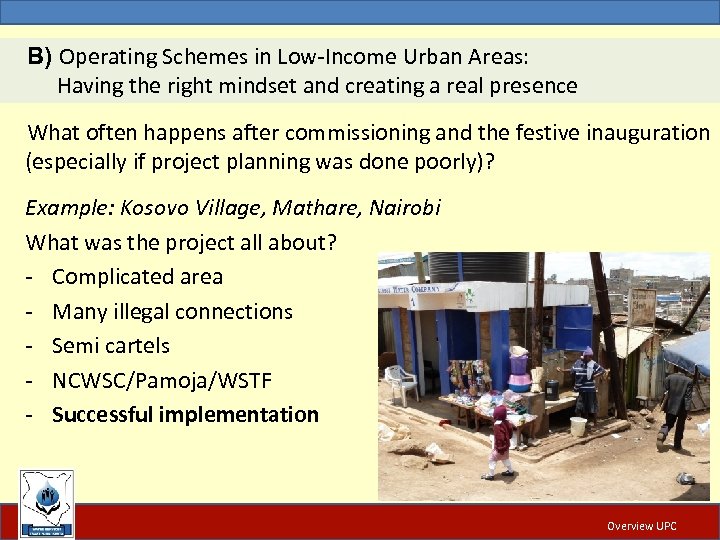 B) Operating Schemes in Low-Income Urban Areas: Having the right mindset and creating a real presence What often happens after commissioning and the festive inauguration (especially if project planning was done poorly)? Example: Kosovo Village, Mathare, Nairobi What was the project all about? - Complicated area - Many illegal connections - Semi cartels - NCWSC/Pamoja/WSTF - Successful implementation 8 Overview UPC
 B) Operating Schemes in Low-Income Urban Areas: Having the right mindset and creating a real presence (continued) What is the key problem? The WSP did not establish a real presence in the area: • The scheme is not monitored • Maintenance and repair works are not carried out • Customers receive no bills or estimated bills • Customer complaints are not addressed • Local committees that are supposed to work with the WSP are ignored 9 Overview UPC
 B) Operating Schemes in Low-Income Urban Areas: Having the right mindset and creating a real presence What are the consequences? • Kiosks become dirty • Meters are not read • Bills are not prepared or residents receive the wrong bills • Illegal connections gradually reappear • People prefer to get/buy (cheaper) water from an illegal connection • Fewer people come to the kiosks • Kiosks are often closed • Pipes and kiosks are vandalised • Customers do not know how to enquire or file complaints • The scheme is seen as not viable 10 Overview UPC
 B) Operating Schemes in Low-Income Urban Areas: Having the right mindset and creating a real presence What is the solution? 1. Developing a new mindset: • Seeing slums as a business opportunity • Providing better services in slums reduces out Uf. W (non-revenue water) • Treating slum dwellers as normal customers 11 Overview UPC
 B) Operating Schemes in Low-Income Urban Areas: Having the right mindset and creating a real presence 2. Adopting improved operation procedures and practices: • • • Creating a small team (existing staff members) offering services in slums Decentralized operation More efficient use of staff (Plumbers in Webuye) Creating a small local office (Mathare Nairobi) Implementing a customer care concept Close monitoring of the scheme Carrying out the necessary O&M works Prepare bill based on real meter readings Experiment with pre-paid meters (Nakuru) 12 Overview UPC
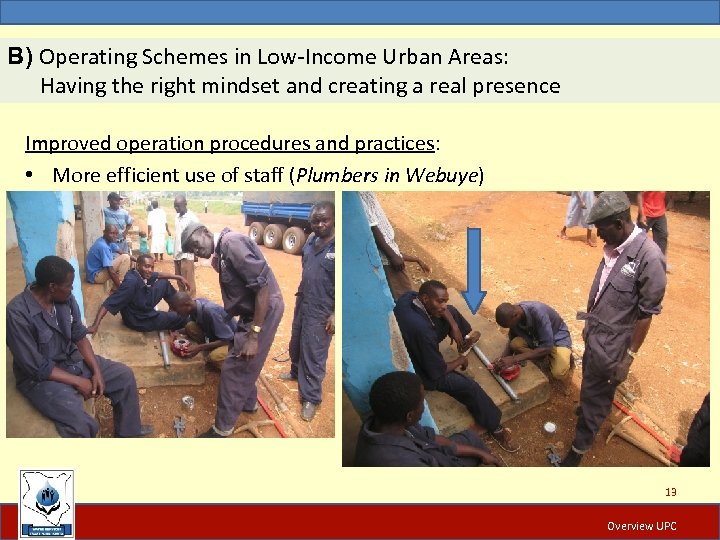 B) Operating Schemes in Low-Income Urban Areas: Having the right mindset and creating a real presence Improved operation procedures and practices: • More efficient use of staff (Plumbers in Webuye) 13 Overview UPC
 B) Operating Schemes in Low-Income Urban Areas: Having the right mindset and creating a real presence Moving beyond project implementation: • Should a WSTF-funded project end with its inauguration? Remember: We aim to provide sustainable access to safe water & sanitation!! • The WSTF is developing tools that can be used to assess the performance (and sustainability) of commissioned the funded projects • This tool, which will be included in the toolkits, should be used by the Field Monitors and by the WSTF…. . but can also be used by the WSPs 14 Overview UPC
 Community-management: a solution? • If their water supply projects in slums flop many WSP and donors conclude that pro-poor water supply & sanitation are to be left to the NGOs and the community • The principle; why should I, being a slum dweller, be made dependent upon the ability of my fellow slum dwellers to operate a water supply scheme? Why am I not entitled to receiving services from the licensed provider? Am I different? Not a real Kenyan? • The Sector Reforms • Romanticizing the community and the creation of cartels 15 Overview UPC
 Thank You! 16 Overview UPC