


 Скачать презентацию Water Rights and Policies Water Governance and Institutions
ddcd53e6460cc99a9502643b0a890033.ppt
- Количество слайдов: 23
 Water Rights and Policies: Water Governance and Institutions Dr. Bas JM van Vliet, Environmental Policy Group Wageningen University 23 -27 April 2006
 Contents lectures n Tuesday 25 April: Water Governance and institutions n n Definitions Market based governance…Urban Water Infrastructures n n Distributed Governance n n n Characteristics Privatisation Liberalisation Demand side management River basin – water shed management Wednesday 26 April: Presentation of Cases of Water Governance
 Governance vis-a-vis policy n Remember the narrow and broader definitions of “policy”: n n n Narrow: interventions by government Broader: all actions and influences in a triad network around a specific topic If policy were defined in terms of governmental intervention only, then governance is a much broader term If not, than governance is pretty much the same! “Governance encompasses laws, regulations, institutions but also relates to governmental actions, institutions, domestic activities and networks of influence, including international market forces, the private sector and civil society” (Rogers and Hall, 2003)
 Water Governance n Water governance refers to the range of political, social, economic and administrative systems that are in place to develop and manage water resources, and the delivery of water services, at different levels of society (Global water Partnership, 2002)
 Who’s in charge? n If not only governmental bodies: who else? Civil Society, companies, institutes… Rogers and Hall, 2003, p. 9: Also ‘’strangers or people with different interests’’ who can “peacefully discuss and agree to co-operate and coordinate their actions” n What would be your comment on such definition? n n
 Forms of governance** n n n From Hierarchical (or Top Down, Command Control, regulation based) Via Market Based (Creating or Using Markets, economic instruments) To Distributed (or horizontal or negotiated policy making) governance models * *Dublin Principles (1992) and other international water treaties favour distributed models **Note the similarities with policy instruments discussion!
 Market based governance
 Governing urban water infrastructures n n Special Large Technical Systems: physical networks (pipes, canals, pumps, basins) link providers and users to each other Features: n n n Universal services (public and merit goods) Uniformity of products, lack of substitutes Flows in stead of units Inelastic prices Natural Monopolies Captive Consumers
 Governing urban water infrastructures n n Infrastructures mostly publicly owned and managed Public utilities accused of being “overstaffed, inefficient, inflexible, incapable to meet customer’s demands”
 Governing urban water infrastructures n Failure of public management n n n State organisations insulated from competitive incentives in labour, capital or product markets Exposed to short term political interventions, interest groups State firm managers may pursue their own utility rather than the public interest. Tax payers have no tools to signal dissatisfaction
 Privatisation of urban water infrastructures n Is privatisation the answer n It depends! n n n Form of private party involvement Competitive structure of teh sector Type of private company and range of its operations The post privatisation regulatory regime Don´t privatise without proper plan, otherwise n Combined disadvantages of monopoly (no consumer choice, no incentive to innovate) AND lack of (democratic) control. Example: governance failure Cochabamba (Bolivia)
 Market-based Governance: Liberalisation, Privatisation n “Privatisation of water” is internationally debated: n n Water is a public service and should not be subject to company strategies and profit making Examples of bad governance presented as show cases n However: ideological arguments sometimes overshadow what’s really going on n Privatisation: transfer of (part of) water services from public to private parties Better to speak of Private Participation in water sectors It depends on wider governance schemes whether private participation can be successful n n
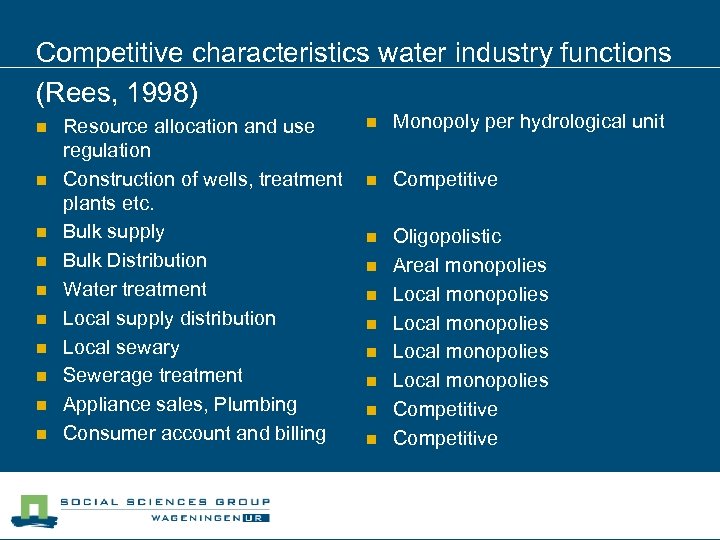 Competitive characteristics water industry functions (Rees, 1998) n n n n n Resource allocation and use regulation Construction of wells, treatment plants etc. Bulk supply Bulk Distribution Water treatment Local supply distribution Local sewary Sewerage treatment Appliance sales, Plumbing Consumer account and billing n Monopoly per hydrological unit n Competitive n Oligopolistic Areal monopolies Local monopolies Competitive n n n n
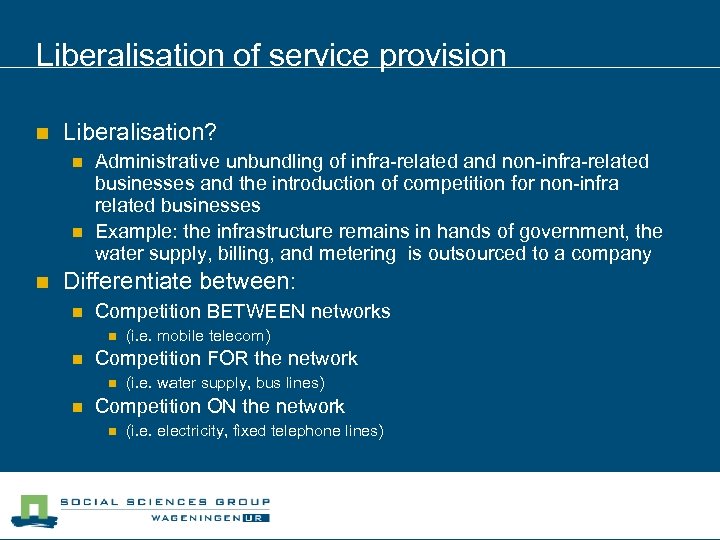 Liberalisation of service provision n Liberalisation? n n n Administrative unbundling of infra-related and non-infra-related businesses and the introduction of competition for non-infra related businesses Example: the infrastructure remains in hands of government, the water supply, billing, and metering is outsourced to a company Differentiate between: n Competition BETWEEN networks n n Competition FOR the network n n (i. e. mobile telecom) (i. e. water supply, bus lines) Competition ON the network n (i. e. electricity, fixed telephone lines)
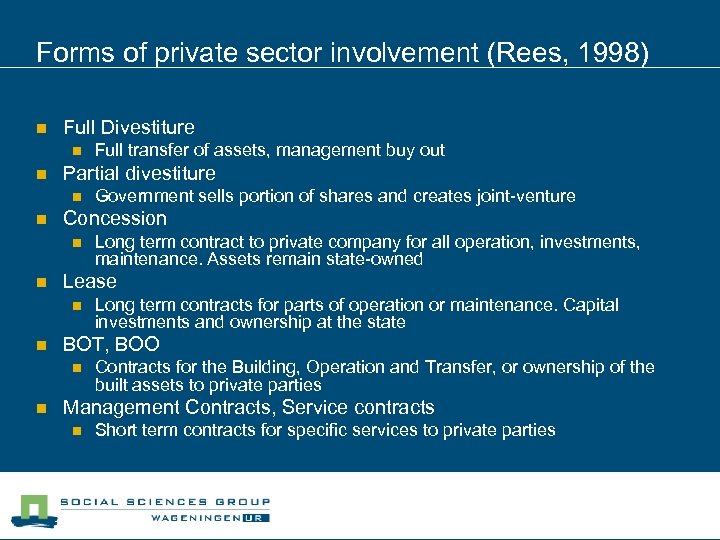 Forms of private sector involvement (Rees, 1998) n Full Divestiture n n Partial divestiture n n Long term contracts for parts of operation or maintenance. Capital investments and ownership at the state BOT, BOO n n Long term contract to private company for all operation, investments, maintenance. Assets remain state-owned Lease n n Government sells portion of shares and creates joint-venture Concession n n Full transfer of assets, management buy out Contracts for the Building, Operation and Transfer, or ownership of the built assets to private parties Management Contracts, Service contracts n Short term contracts for specific services to private parties
 Distributed Governance
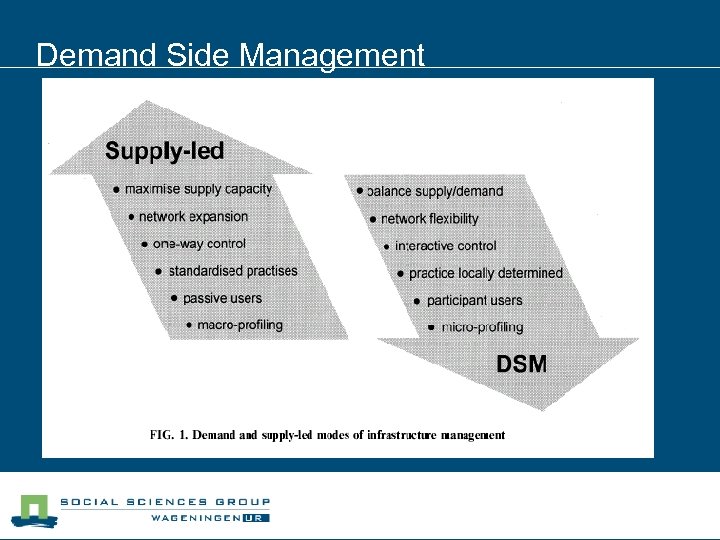
 Demand Side Management as a form of distributed water governance n n Assumption: No single actor is driving the system…but a complex network of users, providers, producers, regulators Demand Side Management (in water infrastructures) n n influencing demand to prevent investments in new capacity and over-capacity in parts of networks peak shaving (reducing consumption in hot spots and stimulating it at cold spots) managing beyond the meter = Distributed governance as users become co-managers of the system
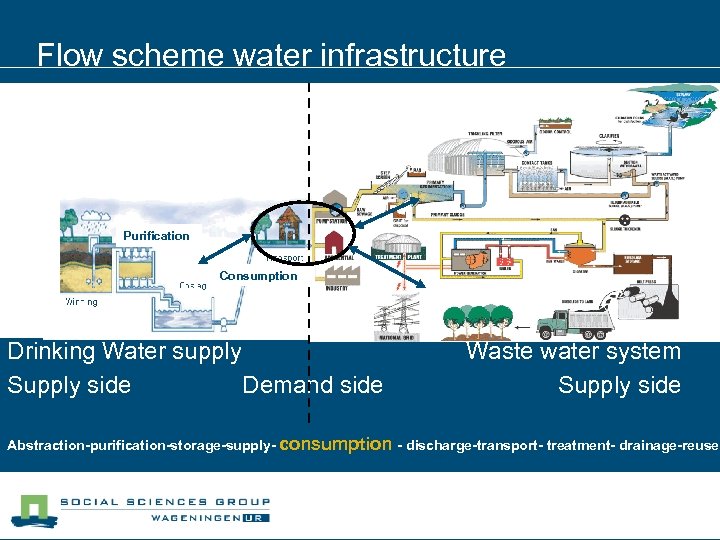 Flow scheme water infrastructure Purification Consumption Drinking Water supply Supply side Demand side Waste water system Supply side Abstraction-purification-storage-supply- consumption - discharge-transport- treatment- drainage-reuse
 Demand Side Management
 River basin management as distributed water governance Approach is: n n NOT to comply to jurisdictional boundaries (Department of Water, Agriculture, Spatial Planning etc); NOR to governmental levels such as states, districts, cities; BUT to follow the water flow! It needs the facilitation of special basin agency or commission that overrules the institutions in place. Taking river basins and watersheds as object of governance, water engineers should give way to other parties at the table!
 Further reading All available in WEC Library: n Boelens R. and Hoogendam P. (eds. ) (2002), Water Rights and Empowerment. Assen: Van Gorcum. Chapter 1 (Water Rights and Collective Action in Community Irrigation) and chapter 6 (Water Rights and Watersheds. Managing Multiple Water Uses and Strengthening Stakeholder Platforms). n Connelly, J. and G. Smith (2003), Politics and the Environment, from Theory to Practice (second edition). London: Routledge n Rees, J. (1998), Regulation and Private participation in water management. Stockholm: Global Water Partnership (TAC background paper No. 1) n Rogers, P. and A. W. Hall (2003), Effective Water Governance. Stockholm: Global Water Partnership (TEC Background paper no. 7) n Von Benda-Beckmann, Von Benda-Beckmann and Spiertz (1998), Equity and Legal Pluralism: Taking Customary Law into Account in Natural Resource Policies. In: Boelens and Dávila (eds. ) Searching for Equity. Assen: Van Gorcum, pp. 57 -69
 Exercise n Discuss possible forms of private participation as a governance option for your case n n Outline the different functions of the system Which functions can be privatised? Which should be privatised? Discuss the watershed / river basin management as an option (for rural water cases) and discuss DSM (for urban infrastructures)
 Presentations tomorrow 5 groups n Water drilling (2) n Urban water supply n Urban Sanitation n Wadi management Presentation (10 minutes) of exercises 1. Policy instruments and triad networks 2. Policy evaluation and research proposal 3. Water Governance options Discussion and evaluation