


 Скачать презентацию Water Quality Sensing Dr Eric De Carlo Professor
f30909cb138761c34177610005587b0a.ppt
- Количество слайдов: 40
 Water Quality Sensing Dr. Eric De. Carlo, Professor Marine Geology and Geochemistry Division Dr. Grieg Steward, Associate Professor Biological Oceanography Division Dr. Margaret Mc. Manus, Associate Professor Physical Oceanography Division Department of Oceanography School of Ocean and Earth Science and Technology (SOEST) University of Hawaii at Manoa 7 July 2009
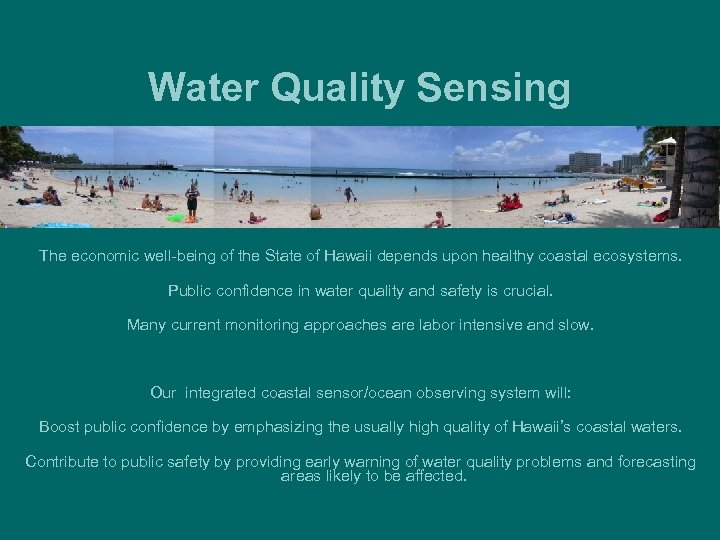 Water Quality Sensing The economic well-being of the State of Hawaii depends upon healthy coastal ecosystems. Public confidence in water quality and safety is crucial. Many current monitoring approaches are labor intensive and slow. Our integrated coastal sensor/ocean observing system will: Boost public confidence by emphasizing the usually high quality of Hawaii’s coastal waters. Contribute to public safety by providing early warning of water quality problems and forecasting areas likely to be affected.
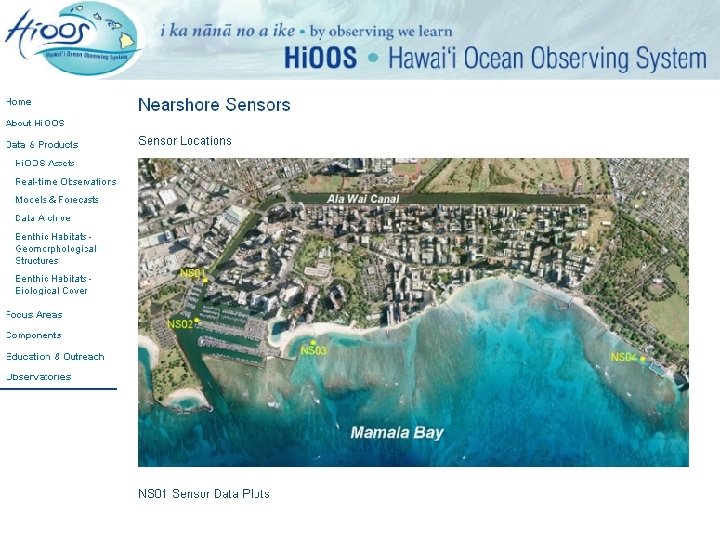
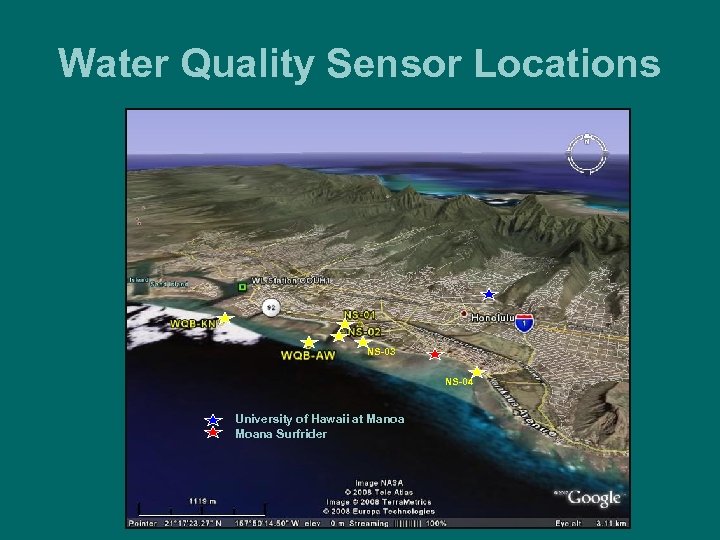 Water Quality Sensor Locations NS-03 NS-04 University of Hawaii at Manoa Moana Surfrider
 Outline 1. Near Shore Water Quality Sensors 1. Water Quality Buoys 2. Pathogen Sampling 3. The Future
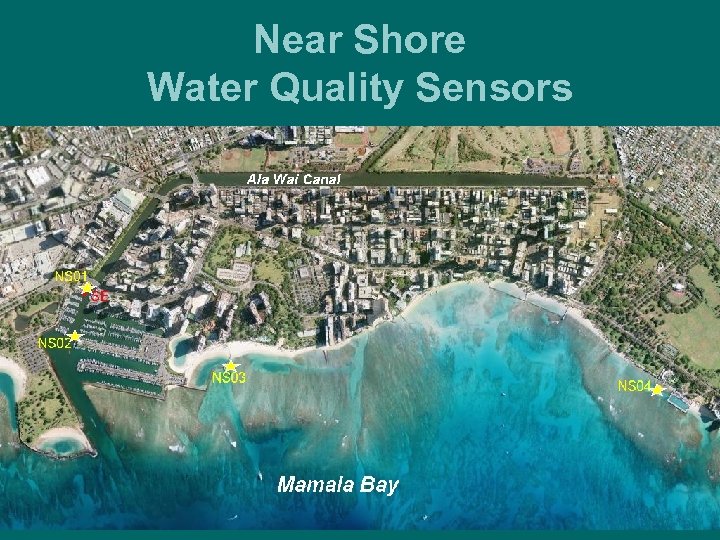 Near Shore Water Quality Sensors
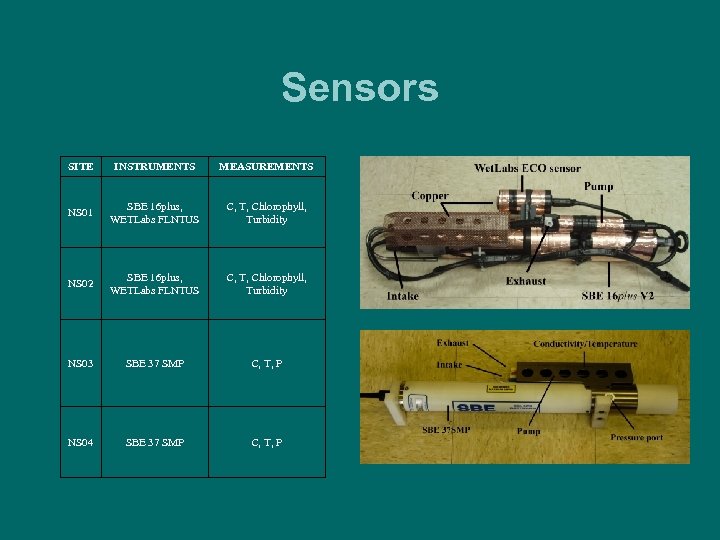 Sensors SITE INSTRUMENTS MEASUREMENTS NS 01 SBE 16 plus, WETLabs FLNTUS C, T, Chlorophyll, Turbidity NS 02 SBE 16 plus, WETLabs FLNTUS C, T, Chlorophyll, Turbidity NS 03 SBE 37 SMP C, T, P NS 04 SBE 37 SMP C, T, P
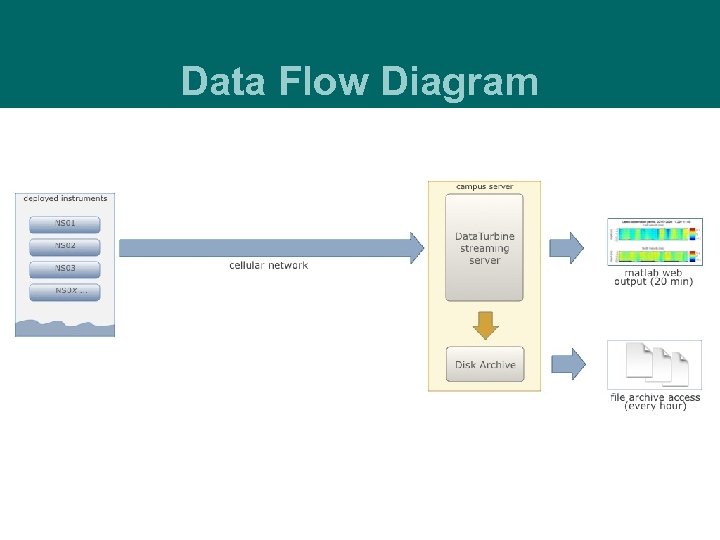 Data Flow Diagram
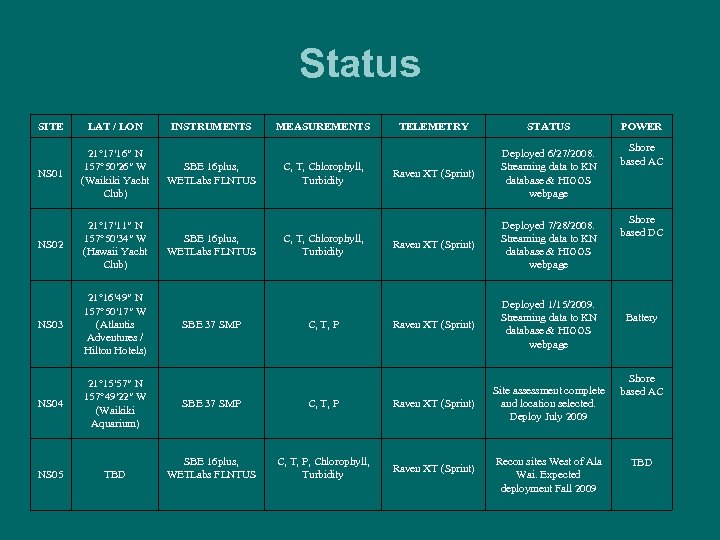 Status SITE LAT / LON NS 01 21° 17′ 16″ N 157° 50′ 26″ W (Waikiki Yacht Club) NS 02 21° 17′ 11″ N 157° 50′ 34″ W (Hawaii Yacht Club) NS 03 21° 16′ 49″ N 157° 50′ 17″ W (Atlantis Adventures / Hilton Hotels) NS 04 21° 15′ 57″ N 157° 49′ 22″ W (Waikiki Aquarium) NS 05 TBD INSTRUMENTS SBE 16 plus, WETLabs FLNTUS SBE 37 SMP MEASUREMENTS C, T, Chlorophyll, Turbidity C, T, P TELEMETRY STATUS Raven XT (Sprint) Deployed 6/27/2008. Streaming data to KN database & HIOOS webpage Raven XT (Sprint) Deployed 7/28/2008. Streaming data to KN database & HIOOS webpage Raven XT (Sprint) Deployed 1/15/2009. Streaming data to KN database & HIOOS webpage Site assessment complete and location selected. Deploy July 2009 SBE 37 SMP C, T, P Raven XT (Sprint) SBE 16 plus, WETLabs FLNTUS C, T, P, Chlorophyll, Turbidity Raven XT (Sprint) Recon sites West of Ala Wai. Expected deployment Fall 2009 POWER Shore based AC Shore based DC Battery Shore based AC TBD
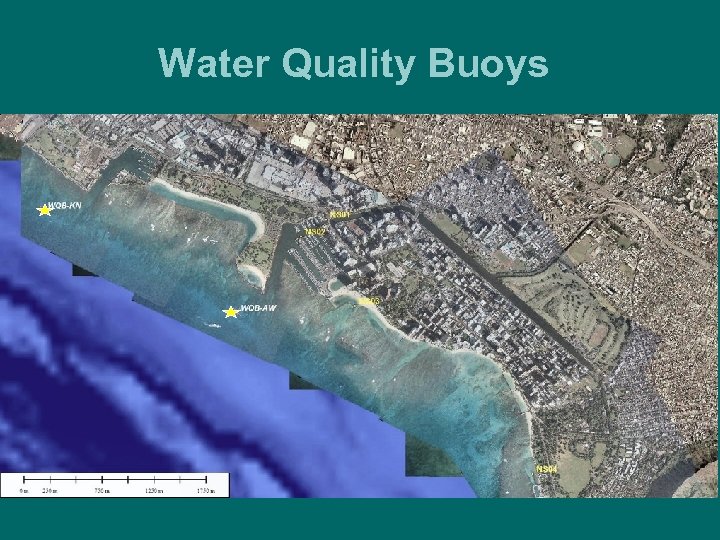 Water Quality Buoys
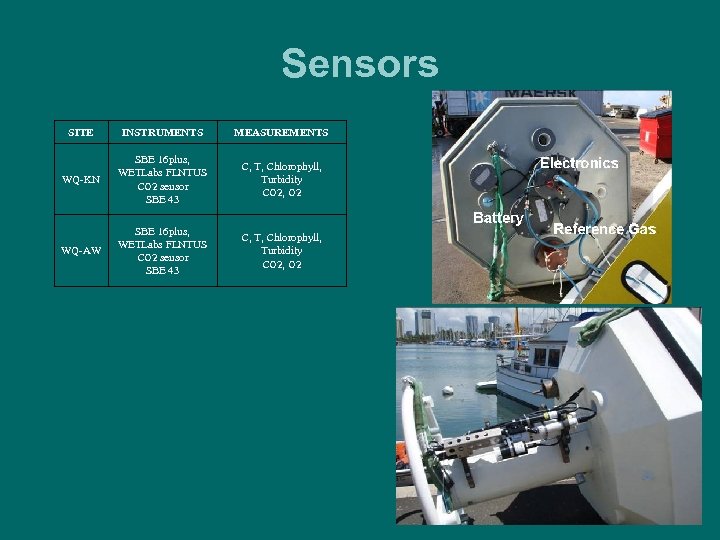 Sensors SITE INSTRUMENTS MEASUREMENTS WQ-KN SBE 16 plus, WETLabs FLNTUS CO 2 sensor SBE 43 C, T, Chlorophyll, Turbidity CO 2, O 2 WQ-AW SBE 16 plus, WETLabs FLNTUS CO 2 sensor SBE 43 C, T, Chlorophyll, Turbidity CO 2, O 2
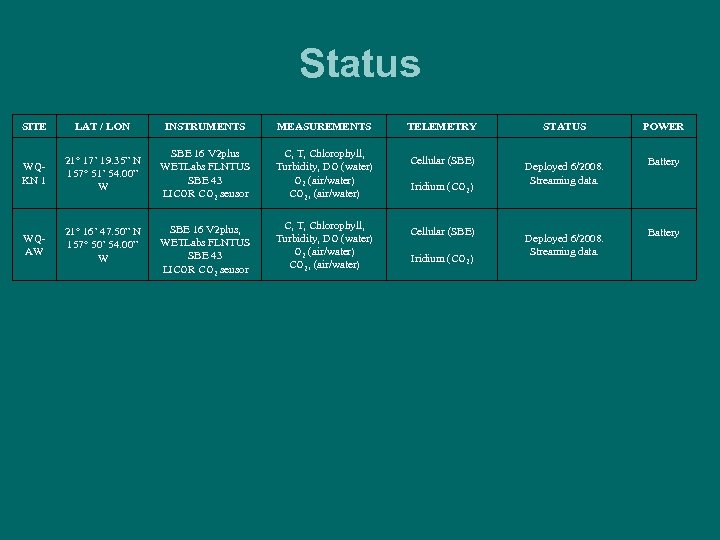 Status SITE LAT / LON INSTRUMENTS MEASUREMENTS WQKN 1 21° 17’ 19. 35” N 157° 51’ 54. 00” W SBE 16 V 2 plus WETLabs FLNTUS SBE 43 LICOR CO 2 sensor C, T, Chlorophyll, Turbidity, DO (water) O 2 (air/water) CO 2, (air/water) WQAW 21° 16’ 47. 50” N 157° 50’ 54. 00” W SBE 16 V 2 plus, WETLabs FLNTUS SBE 43 LICOR CO 2 sensor C, T, Chlorophyll, Turbidity, DO (water) O 2 (air/water) CO 2, (air/water) TELEMETRY Cellular (SBE) Iridium (CO 2) STATUS Deployed 6/2008. Streaming data. POWER Battery
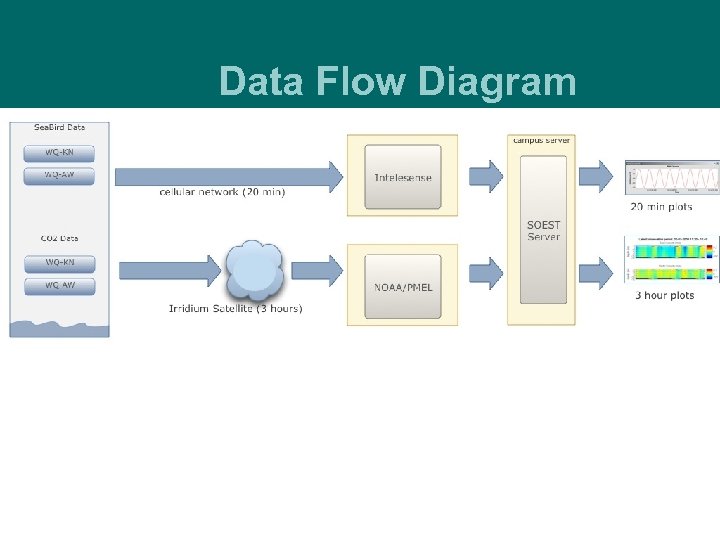 Data Flow Diagram
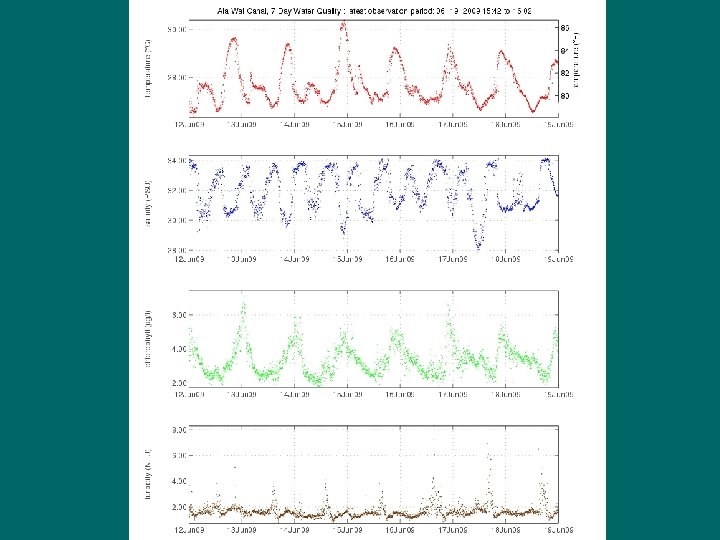
 Early Warning System Alert Matlab code on SOEST server Automatic, hourly threshold checks • NS 01, NS 02 – salinity and temperature • USGS – rainfall, stream height, stream flow If threshold is exceeded, the program sends text message to Members of the Ala Wai Research Group • cell phone or emails (depending on choice) Triggers sampling alert Other hourly checks (sends alerts if web sites are down)
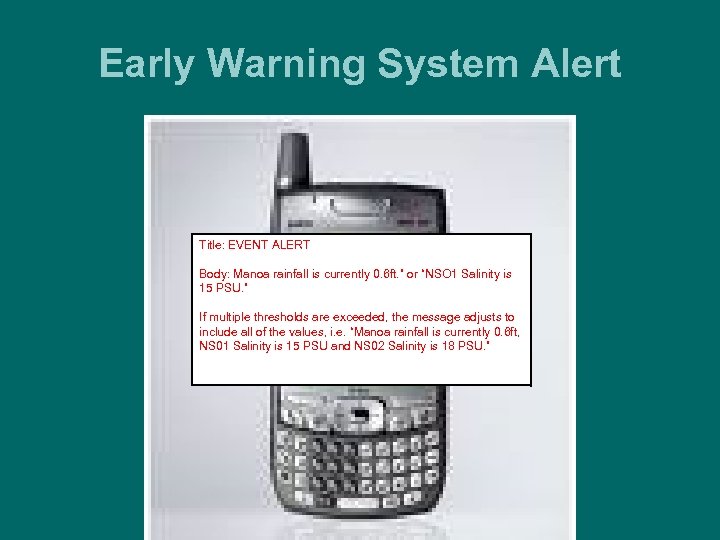 Early Warning System Alert Title: EVENT ALERT Body: Manoa rainfall is currently 0. 6 ft. ” or “NSO 1 Salinity is 15 PSU. ” If multiple thresholds are exceeded, the message adjusts to include all of the values, i. e. “Manoa rainfall is currently 0. 6 ft, NS 01 Salinity is 15 PSU and NS 02 Salinity is 18 PSU. ”
 What about Pathogens? ¡ Current sensors great for monitoring chemical and physical properties of the water ¡ A major issue for coastal recreational water users is the presence of pathogenic bacteria and viruses
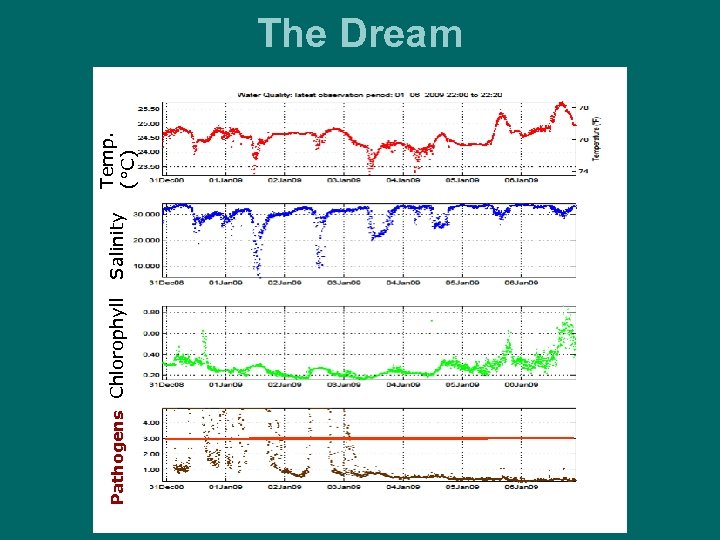 Pathogens Turbidity Chlorophyll Salinity Temp. (°C) The Dream
 The Reality ¡ No off-the-shelf sensors yet available for pathogen detection in seawater ¡ Conventional methods are labor-intensive, slow
 The Reality
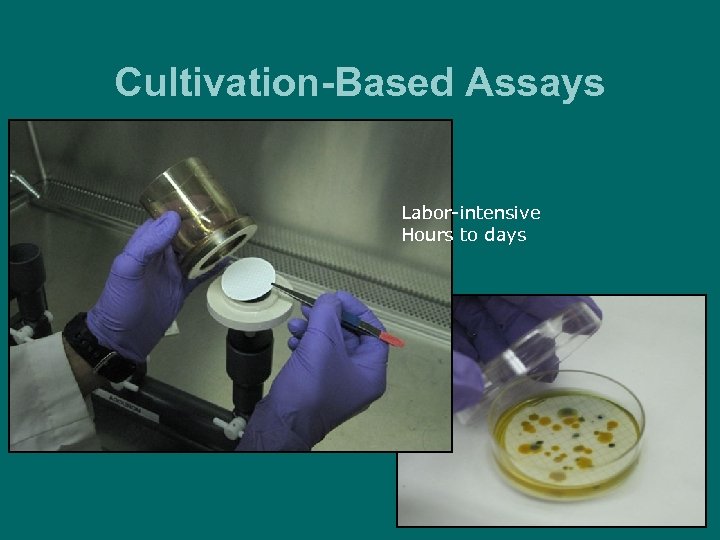 Cultivation-Based Assays Labor-intensive Hours to days
 Molecular & Direct Detection Methods ¡ Molecular - extract DNA, use tools to detect specific genes of interest ¡ Direct Detection - Capture pathogenic viruses or bacteria on a sensor surface
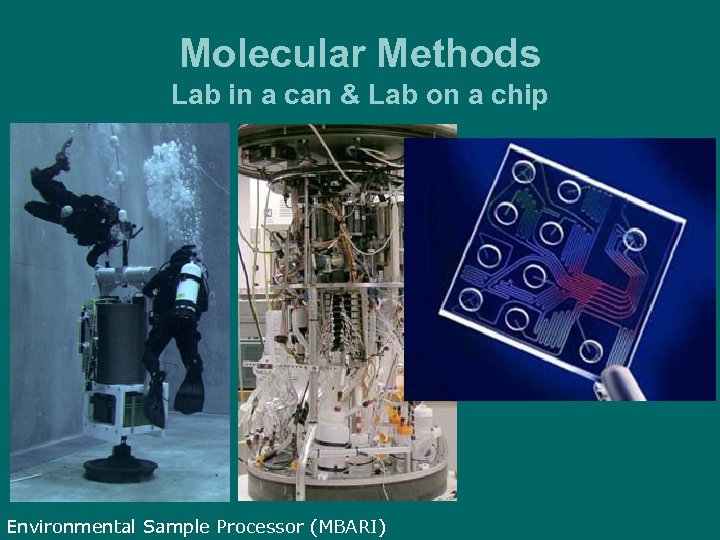 Molecular Methods Lab in a can & Lab on a chip Expensive, complicated High maintenance Environmental Sample Processor (MBARI)
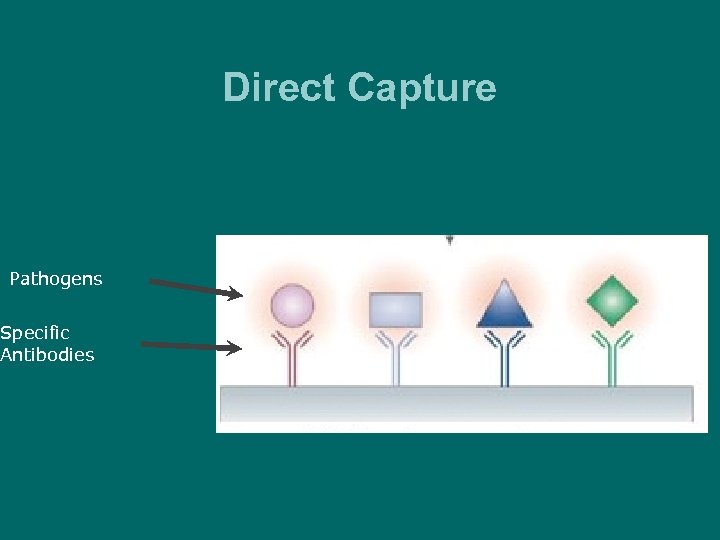 Direct Capture Pathogens Specific Antibodies
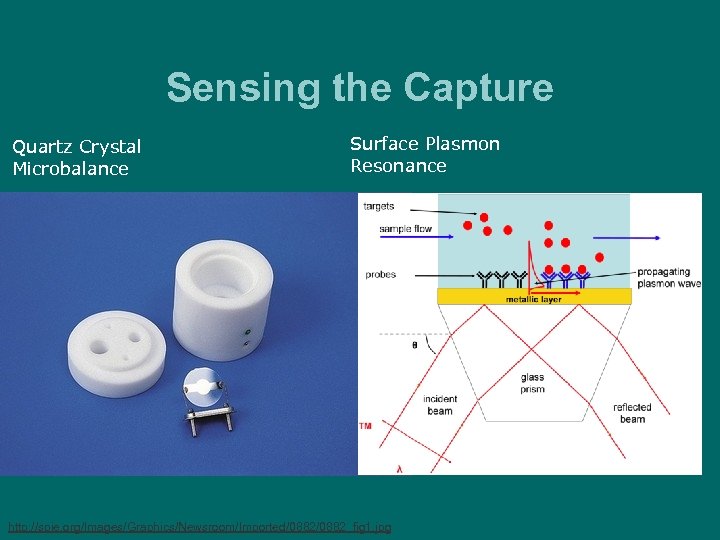 Sensing the Capture Quartz Crystal Microbalance Surface Plasmon Resonance http: //www. biosensors. pan. olsztyn. pl/images/stories/reserearchprofile/qcm-2. jpg http: //spie. org/Images/Graphics/Newsroom/Imported/0882_fig 1. jpg
 The Challenges for Automation ¡ Biofouling ¡ What are we looking for? Too many potential pathogens to screen for all of them ¡ The needle in a haystack
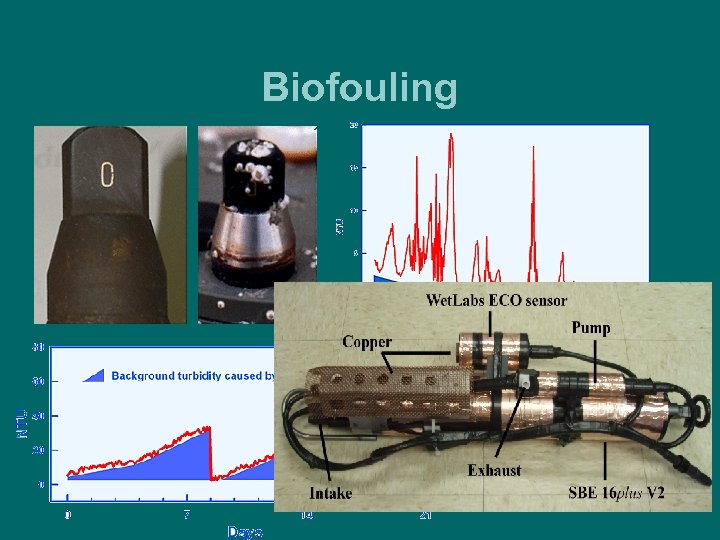 Biofouling www. d-a-instruments. com/images/
 What are we looking for? ¡ Sewage Pathogens l There are many possible pathogens, usually present at low levels l Indicator organisms, not pathogenic, but more abundant and come from the same source (e. g. , enterococci as indicators of sewage) ¡ Non-sewage pathogens: some pathogens are not pollutants
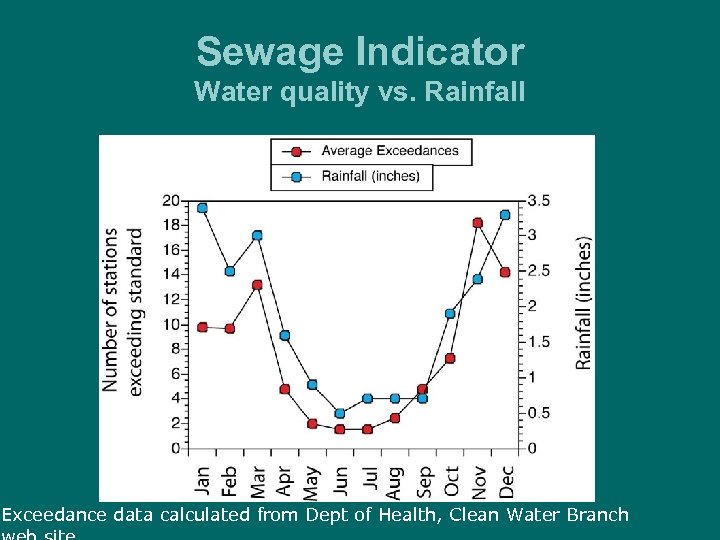 Sewage Indicator Water quality vs. Rainfall Exceedance data calculated from Dept of Health, Clean Water Branch
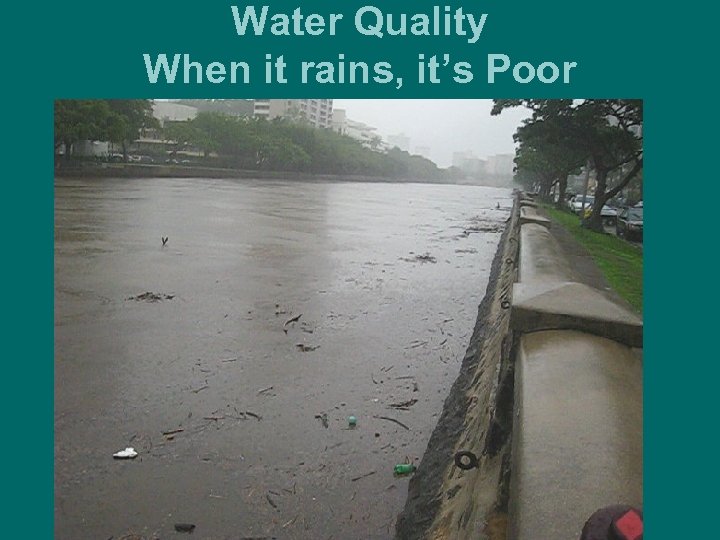 Water Quality When it rains, it’s Poor
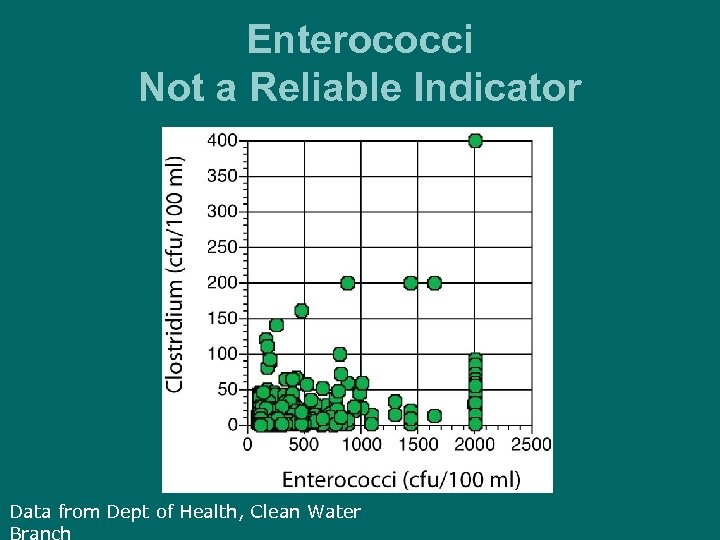 Enterococci Not a Reliable Indicator Data from Dept of Health, Clean Water Branch
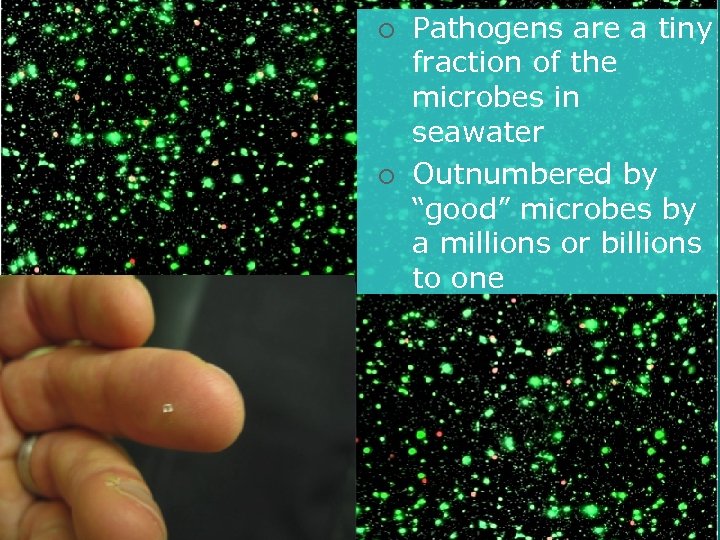 Pathogens are a tiny The Needle in the Haystack the fraction of microbes in seawater ¡ Outnumbered by “good” microbes by a millions or billions to one ¡
 The Future (for Pathogens) ¡ Pathogen sensors are under development, but there are hurdles to routine deployment ¡ In the meantime, the abundance of non-sewage pathogens, like vibrios, may be predictable using data from existing sensors and predictive models.
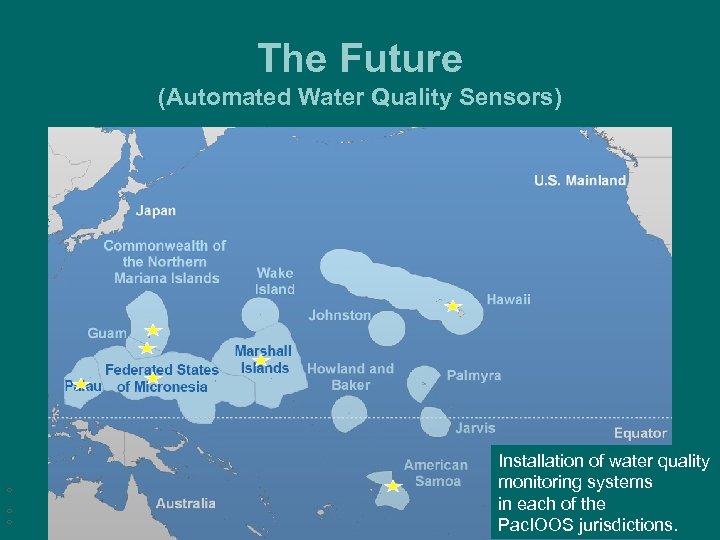 The Future (Automated Water Quality Sensors) ¡ ¡ ¡ Installation of water quality You could also go into our plans for water quality deployments in the Pacific region and illustrate the potentialmonitoring systems linkage to the instruments Rusty has out with CRED in each of the CRED is backbone of ecological Part of IOOS future Pac. IOOS jurisdictions.
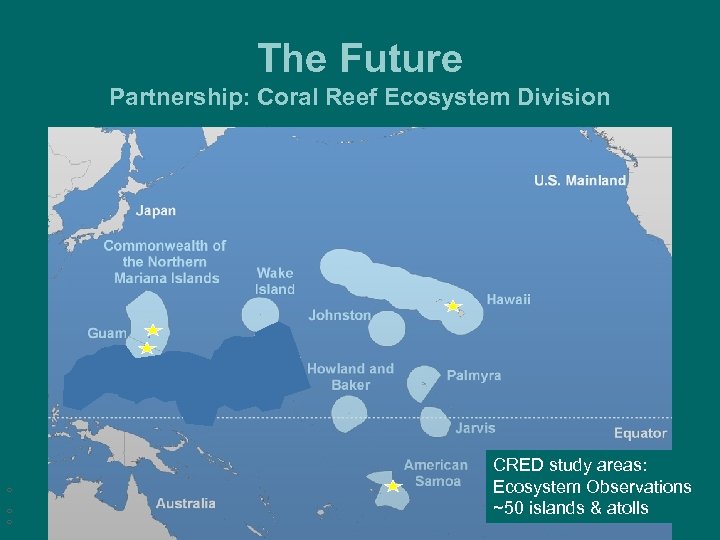 The Future Partnership: Coral Reef Ecosystem Division ¡ ¡ ¡ CRED study areas: You could also go into our plans for water quality deployments in the Pacific region and illustrate the potential linkage to the Ecosystem Observations instruments Rusty has out with CRED is backbone of ecological ~50 islands & atolls Part of IOOS future
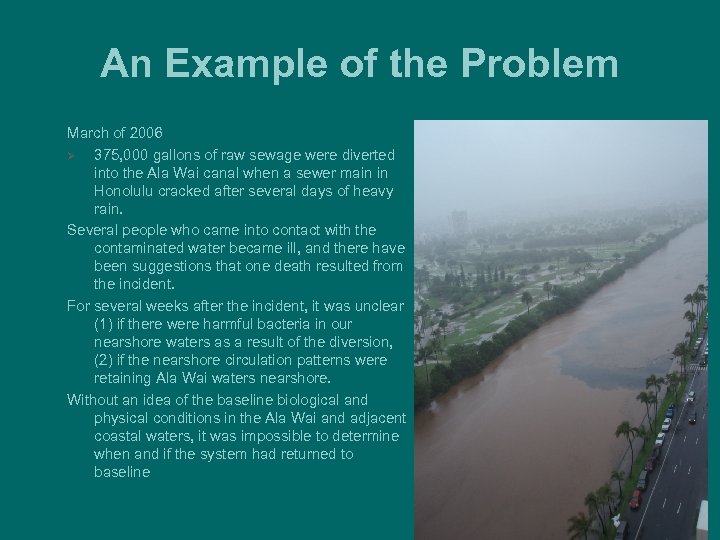 An Example of the Problem March of 2006 Ø 375, 000 gallons of raw sewage were diverted into the Ala Wai canal when a sewer main in Honolulu cracked after several days of heavy rain. Several people who came into contact with the contaminated water became ill, and there have been suggestions that one death resulted from the incident. For several weeks after the incident, it was unclear (1) if there were harmful bacteria in our nearshore waters as a result of the diversion, (2) if the nearshore circulation patterns were retaining Ala Wai waters nearshore. Without an idea of the baseline biological and physical conditions in the Ala Wai and adjacent coastal waters, it was impossible to determine when and if the system had returned to baseline
 Ala Wai Research Group ¡ Members include: l l l Drs. Geno Pawlak and Sergio Jaramillo, Ms Jennifer Patterson (Ocean Resource Engineering UH Manoa) Drs. Margaret Mc. Manus, Eric De. Carlo, and Grieg Steward, Mr. Ross Timmerman, Mr. Mike Tomlinson, and Ms. Olivia Nigro (Oceanography UH Manoa) Dr. Marc Ericksen and Mr. Andrew Rocheleau (Sea Engineering) l l ¡ ¡ ¡ Army Corps of Engineers (CH 2 M Hill Lisa Kettley) USGS - invited Regular Conference calls/workshops 3 times/year Linked by ALERT system Coordinated physical and biological sampling