


 Скачать презентацию Water quality monitoring pre post-2015 6 th Session of
a37188a071682fe26f4bde2178cffdc9.ppt
- Количество слайдов: 17
 Water quality monitoring pre+post-2015 6 th Session of Joint Task Force on Environmental Indicators 15 0 t-2 s Po + UNECE, Palais des Nations Geneva, 30 October 2012 re P Rifat Hossain (hossainr@who. int) Water Sanitation Hygiene & Health World Health Organization 2012 -10 -30
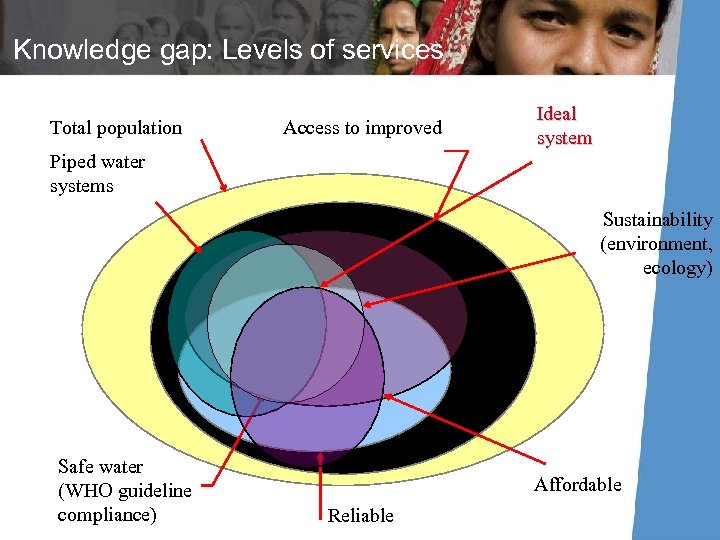 Knowledge gap: Levels of services Total population Access to improved Ideal system Piped water systems Sustainability (environment, ecology) Safe water (WHO guideline compliance) Affordable Reliable
 WQ monitoring … • MDG monitoring • Need for water quality monitoring • Lack of comparable data • Monitoring done with proxy indicator • JMP has addressed this through • Rapid Assessment Surveys (2003 -2006) • JMP Task Force on Water Quality monitoring • Task Force recommendations – Relevant WQ parameters at the global level: • E-Coli, Arsenic and Fluoride and perhaps also nitrate – Tools to monitor: • More RADWQ • WQ testing through household surveys • Data from regulators
 WQ monitoring issues… • MDG target met for water • JMP announcement: demand for info about quality of water • 783 million without improved water: several billion without safe water? • What about risk assessment? • Relevant pending issues from TF recommendations • More RADWQ: handbook finalized • WQ testing through household surveys: MICS and DHS pilots • Post-2015 – UN resolution: 64/292, recognized the right to safe and clean drinking-water and sanitation as a human right essential to the full enjoyment of life and all other human rights – WHO resolution A 64/24, also promoted safe drinking-water – Focus on WQ in water thematic working group of post-2015
 Criteria for WQ indicators • A good indicator • unambiguously measures to provide an approximation of reality that is as accurate as needed • Considerations for determining WQ indicators: • Easily measurable • Cost efficient • Clearly defined • Verifiable • Acceptable • Policy relevant • Developed with participation • Purpose of having a PROXY: • To collect information that has relevance to what is sought, when what is sought cannot be measured directly
 Additional criteria for JMP WQ indicators • Global: – Available for a limited number of countries • Goes back to the MDG base-line year 1990 – Availability even less, mostly recent • Comparability across countries and over time – Challenging because of non-comparable information
 JMP relies on survey and census data Household surveys using cluster sampling: DHS Demographic and Health Survey MICS Multiple Indicator Cluster Survey LSMS Living Standard Measurement Study CWIQ Core Welfare Indicator Questionnaire WHS World Health survey HBS Household Budget Survey Etc. & National census
 MDG target + Indicators MDG 7 Target 7 c: • Halve, by 2015, the proportion of people without sustainable access to safe drinking water and basic sanitation Indicator to monitor (proxy for access to safe drinking-water): • Proportion of the population that uses an improved drinking-water source (urban + rural) An improved drinking water source is: “a source that by the nature of its construction adequately protects the source from outside contamination in particular with fecal matter”
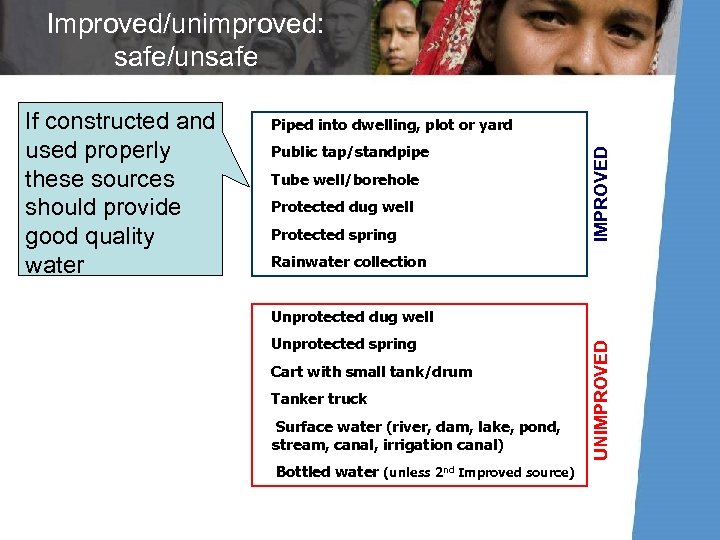 Improved/unimproved: safe/unsafe ØPublic tap/standpipe ØTube well/borehole ØProtected dug well ØProtected spring IMPROVED ØPiped into dwelling, plot or yard ØRainwater collection ØUnprotected dug well ØUnprotected spring ØCart with small tank/drum ØTanker truck Ø Surface water (river, dam, lake, pond, stream, canal, irrigation canal) Ø Bottled water (unless 2 nd Improved source) UNIMPROVED If constructed and used properly these sources should provide good quality water
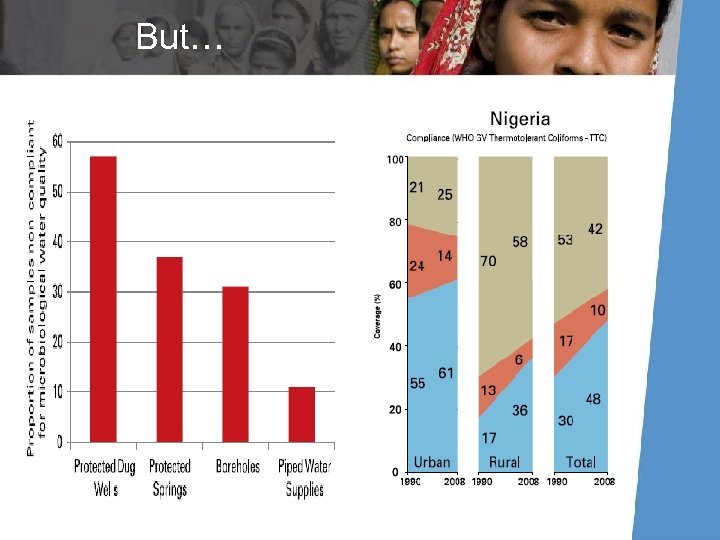 But…
But…
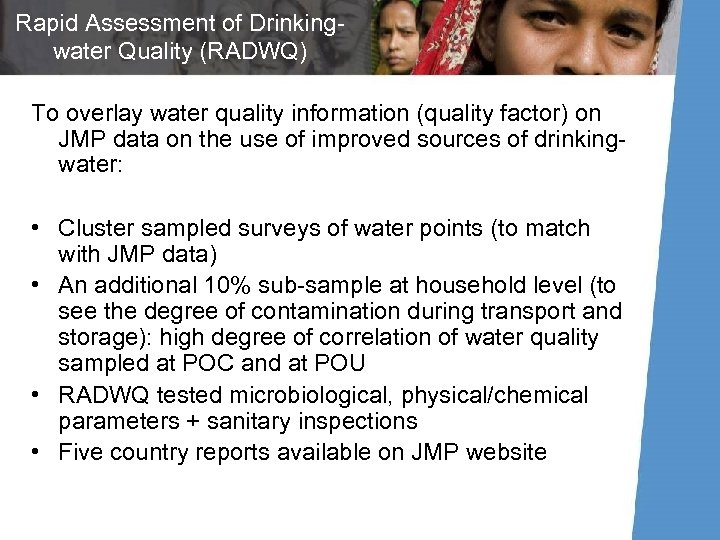 Rapid Assessment of Drinkingwater Quality (RADWQ) To overlay water quality information (quality factor) on JMP data on the use of improved sources of drinkingwater: • Cluster sampled surveys of water points (to match with JMP data) • An additional 10% sub-sample at household level (to see the degree of contamination during transport and storage): high degree of correlation of water quality sampled at POC and at POU • RADWQ tested microbiological, physical/chemical parameters + sanitary inspections • Five country reports available on JMP website
 Post-2015 Challenge • Can we formulate a set of post-2015 goal or target(s) with indicators that appeal enough to the politicians and which are significantly different and more ambitious than our current target? • For what do we want to get support from our Ministers? from UNSGAB? from the UN-SG? post-2015? • Tension: Ideal & Normative vs. Practical & Measurable & Achievable
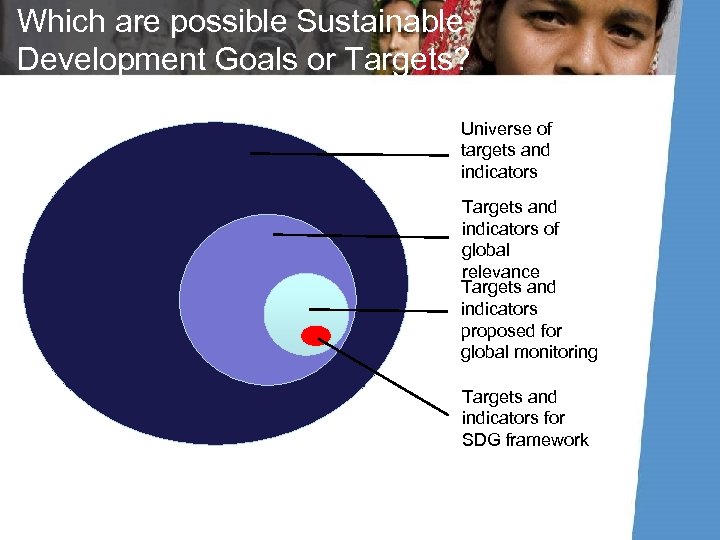 Which are possible Sustainable Development Goals or Targets? Universe of targets and indicators Targets and indicators of global relevance Targets and indicators proposed for global monitoring Targets and indicators for SDG framework
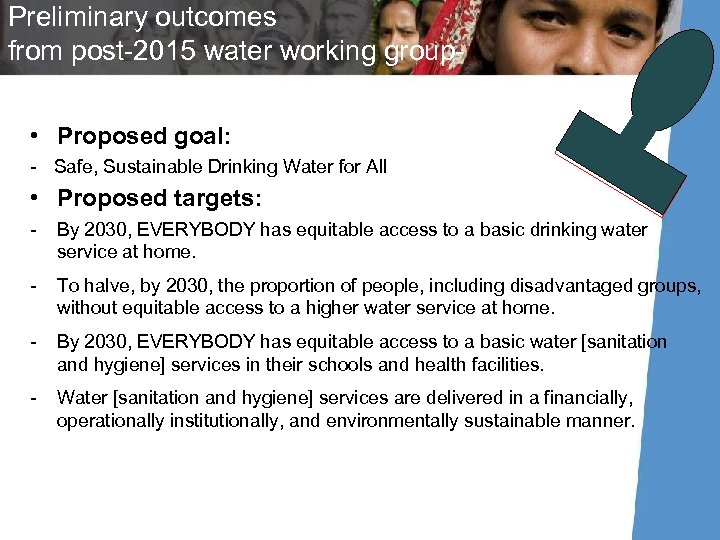 Preliminary outcomes from post-2015 water working group • Proposed goal: - Safe, Sustainable Drinking Water for All • Proposed targets: DR AF T - By 2030, EVERYBODY has equitable access to a basic drinking water service at home. - To halve, by 2030, the proportion of people, including disadvantaged groups, without equitable access to a higher water service at home. - By 2030, EVERYBODY has equitable access to a basic water [sanitation and hygiene] services in their schools and health facilities. - Water [sanitation and hygiene] services are delivered in a financially, operationally institutionally, and environmentally sustainable manner.
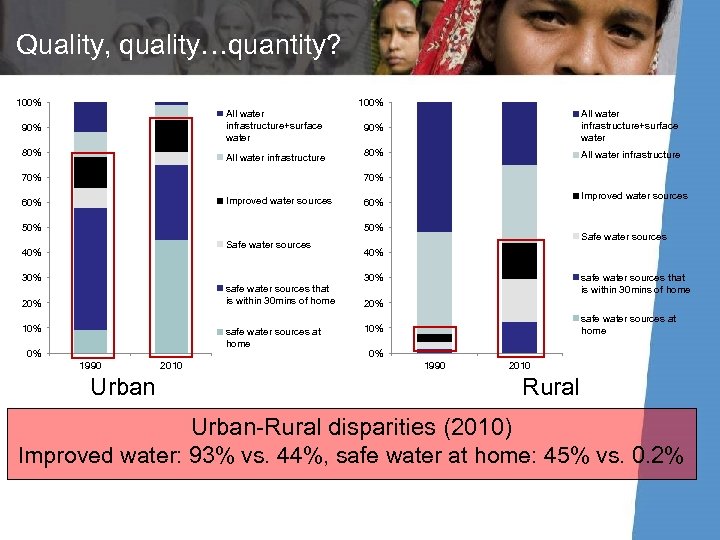 Quality, quality…quantity? 100% 90% All water infrastructure+surface water 80% All water infrastructure 70% Improved water sources 60% 50% Safe water sources 40% 30% safe water sources that is within 30 mins of home 20% 10% safe water sources at home 0% 1990 Urban 2010 Safe water sources 40% safe water sources that is within 30 mins of home 30% 20% safe water sources at home 10% 0% 1990 2010 Rural Urban-Rural disparities (2010) Improved water: 93% vs. 44%, safe water at home: 45% vs. 0. 2%
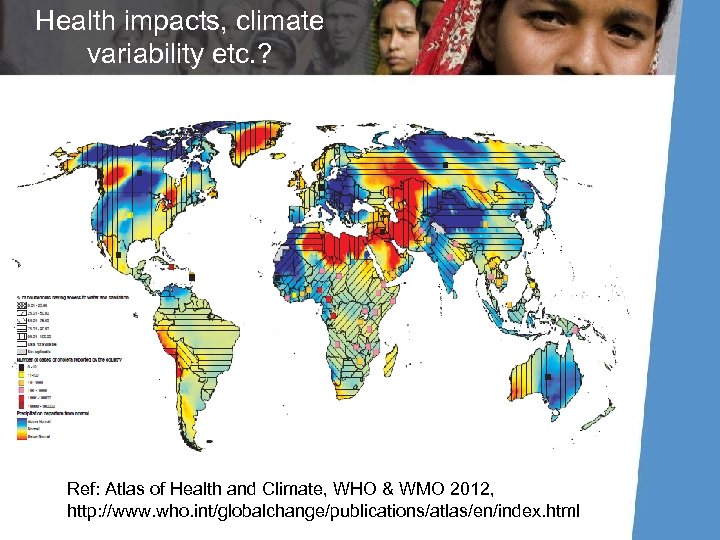 Health impacts, climate variability etc. ? Ref: Atlas of Health and Climate, WHO & WMO 2012, http: //www. who. int/globalchange/publications/atlas/en/index. html
 Thank you! JMP Web Site: www. wssinfo. org