 Скачать презентацию Water Prices and Values John Braden University of
622d804c4be3048c247a38cbce67dacb.ppt
- Количество слайдов: 29



Water Prices and Values John Braden University of Illinois, USA Visiting, Katholieke Universiteit Leuven Lecture 1 Leuven, Belgium March 2004
Outline of Lecture Series 1. 2. 3. 4. 5. Prices & Values Managing Water Demand Agricultural Pollution Urban Stormwater & Flooding River Pollution
Outline – Lecture 1 1. Economic significance of water 2. Why care about economic value? 3. How is economic value determined? - Market prices - Constructed prices 4. Application to water resources
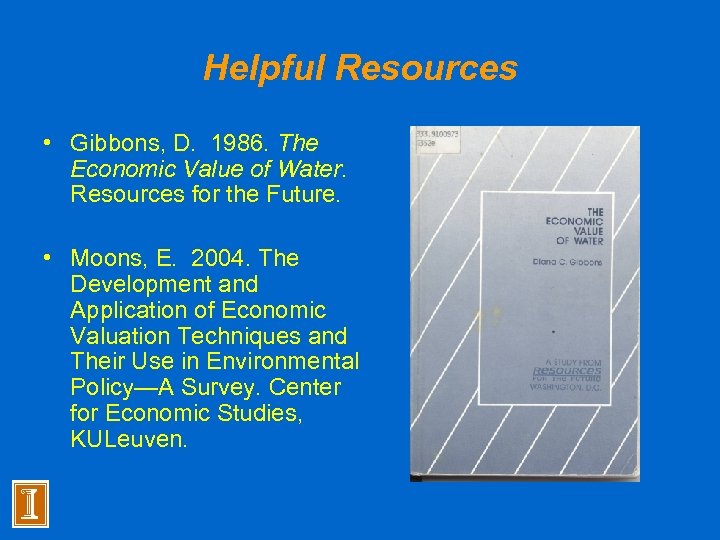
Helpful Resources • Gibbons, D. 1986. The Economic Value of Water. Resources for the Future. • Moons, E. 2004. The Development and Application of Economic Valuation Techniques and Their Use in Environmental Policy—A Survey. Center for Economic Studies, KULeuven.
What is distinctive about water? • Fundamental – Humanity – Ecology • Total value vs. marginal value • Value in situ as well as in use • Seasonal and variable • Fugitive (sometimes) • Renewable (usually)
Economic Importance of Water • • • Drinking & sanitation Industrial processes Aesthetics & culture Recreation Navigation Power Agriculture/irrigation Habitat/ecosystem Flooding (renewal, erosion)
Why assign economic value? • Choices between uses (water & public funds) – Optimal regulation – Provision of public goods (ecosystems, recreation, aesthetics) – Cost-benefit analysis • Liability – Damage claims
Value and Price • Intrinsic utilitarian (instrumental) • “Economic Value” ~ Willingness to Pay. • Price = Marginal Willingness to Pay
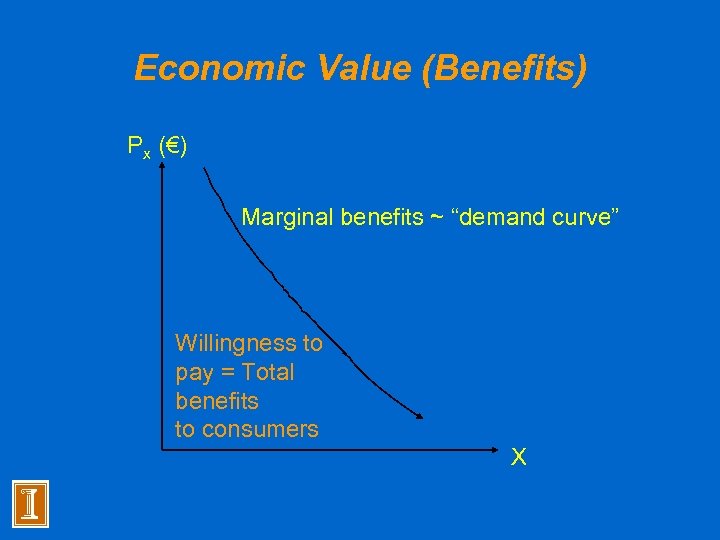
Economic Value (Benefits) Px (€) Marginal benefits ~ “demand curve” Willingness to pay = Total benefits to consumers X
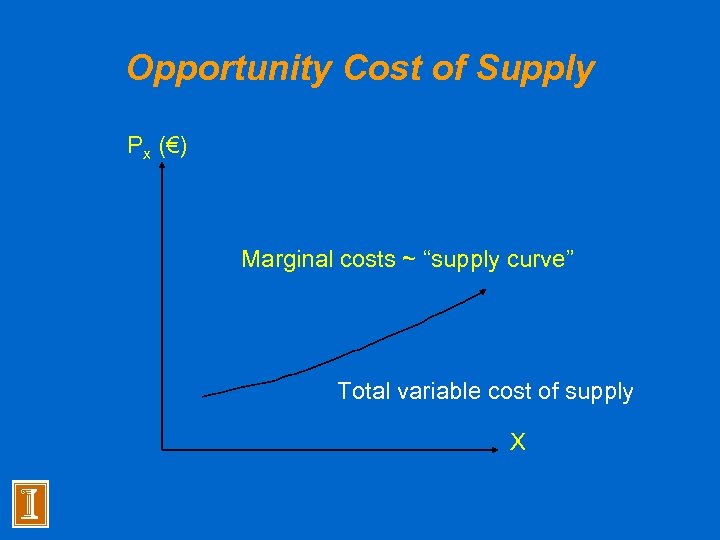
Opportunity Cost of Supply Px (€) Marginal costs ~ “supply curve” Total variable cost of supply X
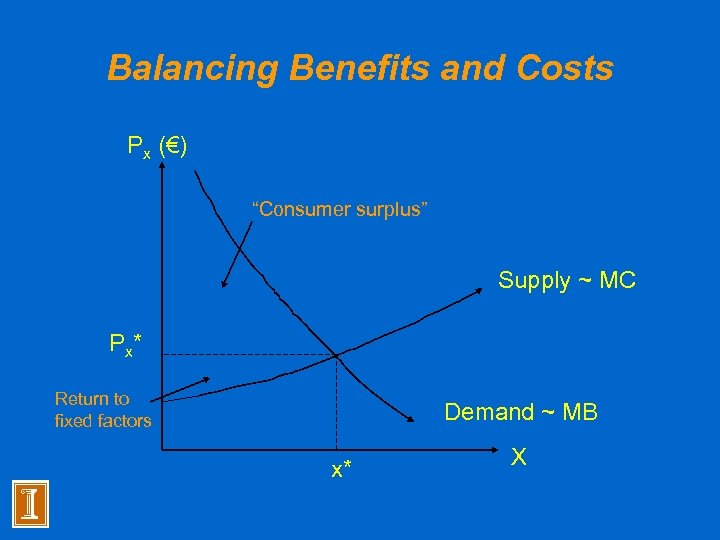
Balancing Benefits and Costs Px (€) “Consumer surplus” Supply ~ MC P x* Return to fixed factors Demand ~ MB x* X
Market Prices & Economic Value • Competition: Price = MB* = MC* – “Pure case”; useful approximation – Max consumer surplus; Min profits • Small changes • Limitations – – Uncompetitive market Disequilibrium Policy distortions Nonmarket goods
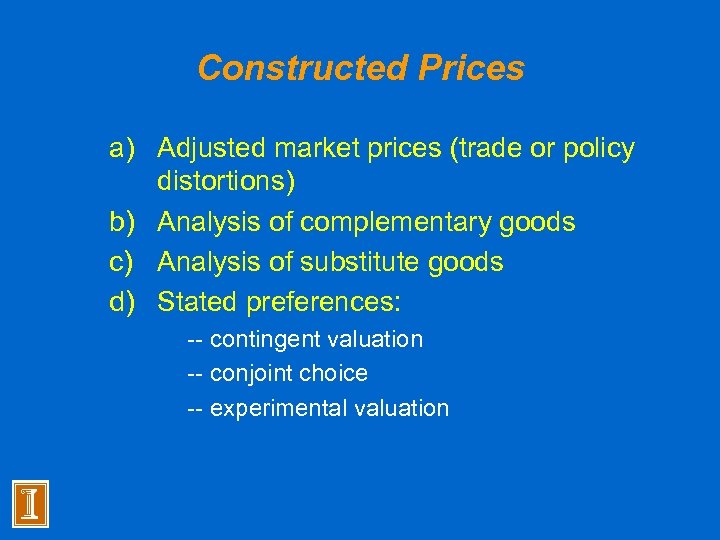
Constructed Prices a) Adjusted market prices (trade or policy distortions) b) Analysis of complementary goods c) Analysis of substitute goods d) Stated preferences: -- contingent valuation -- conjoint choice -- experimental valuation
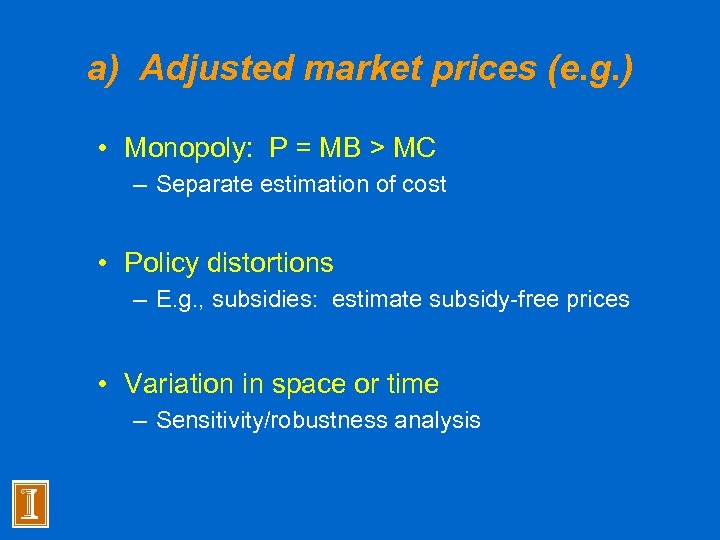
a) Adjusted market prices (e. g. ) • Monopoly: P = MB > MC – Separate estimation of cost • Policy distortions – E. g. , subsidies: estimate subsidy-free prices • Variation in space or time – Sensitivity/robustness analysis
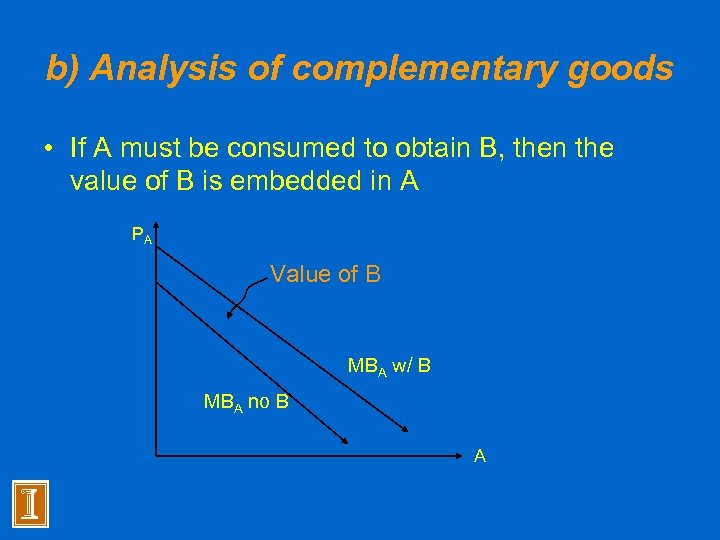
b) Analysis of complementary goods • If A must be consumed to obtain B, then the value of B is embedded in A PA Value of B MBA w/ B MBA no B A
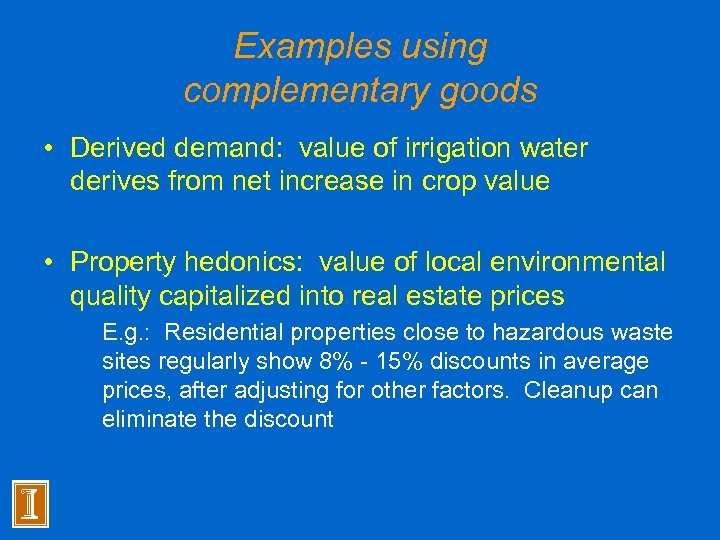
Examples using complementary goods • Derived demand: value of irrigation water derives from net increase in crop value • Property hedonics: value of local environmental quality capitalized into real estate prices E. g. : Residential properties close to hazardous waste sites regularly show 8% - 15% discounts in average prices, after adjusting for other factors. Cleanup can eliminate the discount
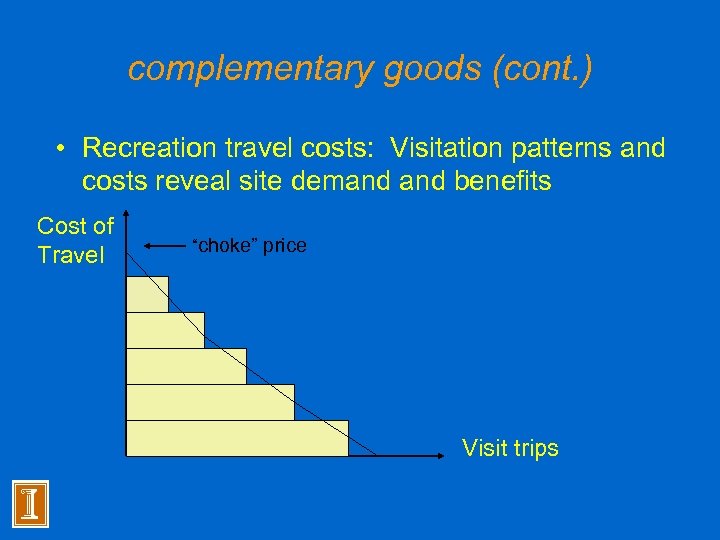
complementary goods (cont. ) • Recreation travel costs: Visitation patterns and costs reveal site demand benefits Cost of Travel “choke” price Visit trips
c) Analysis of substitute goods • Replacement cost – E. g. , Value of a destroyed wetland = cost of constructing a replacement • Cost of aversion or mitigation – E. g. , Value of clean air = avoided medical costs + lost wages + discomfort due to dirty air – E. g. , Value of safe water = added cost of home filters or bottled water used instead of regular tap water
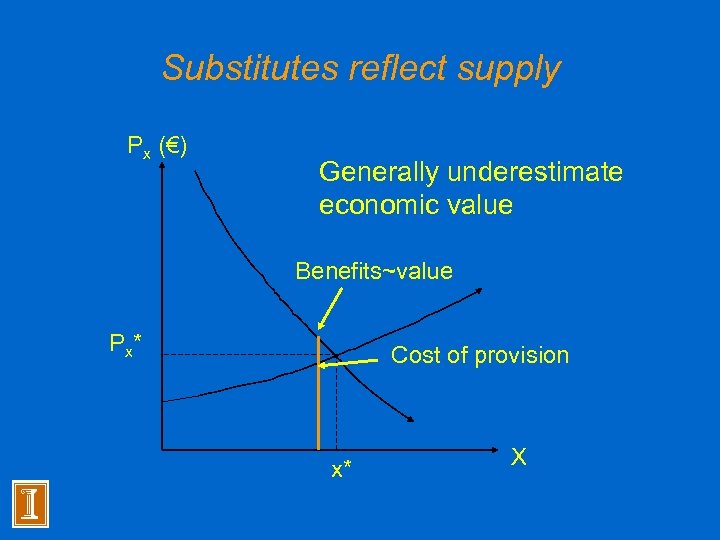
Substitutes reflect supply Px (€) Generally underestimate economic value Benefits~value P x* Cost of provision x* X
d) Stated preferences: contingent valuation • Surveys asking respondents to value hypothetical scenarios • “Best practices” • Various elicitation schemes
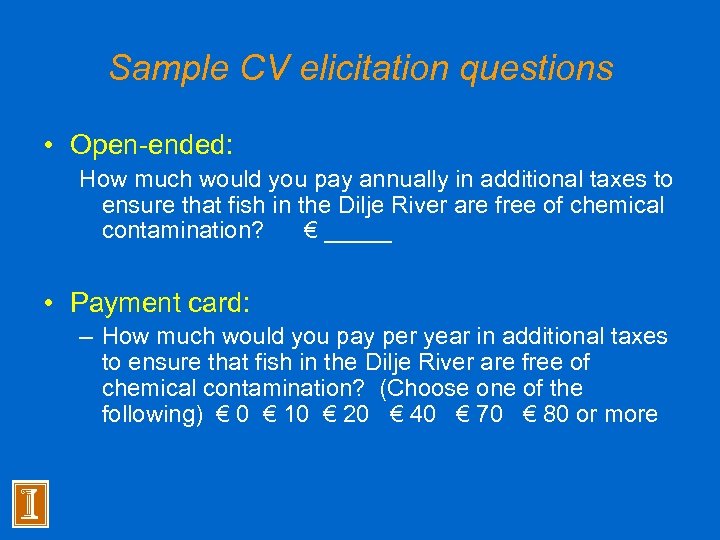
Sample CV elicitation questions • Open-ended: How much would you pay annually in additional taxes to ensure that fish in the Dilje River are free of chemical contamination? € _____ • Payment card: – How much would you pay per year in additional taxes to ensure that fish in the Dilje River are free of chemical contamination? (Choose one of the following) € 0 € 10 € 20 € 40 € 70 € 80 or more
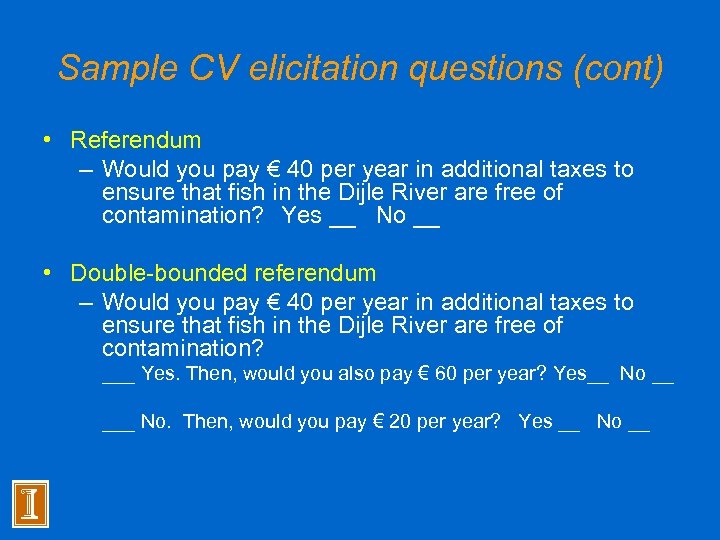
Sample CV elicitation questions (cont) • Referendum – Would you pay € 40 per year in additional taxes to ensure that fish in the Dijle River are free of contamination? Yes __ No __ • Double-bounded referendum – Would you pay € 40 per year in additional taxes to ensure that fish in the Dijle River are free of contamination? ___ Yes. Then, would you also pay € 60 per year? Yes__ No __ ___ No. Then, would you pay € 20 per year? Yes __ No __
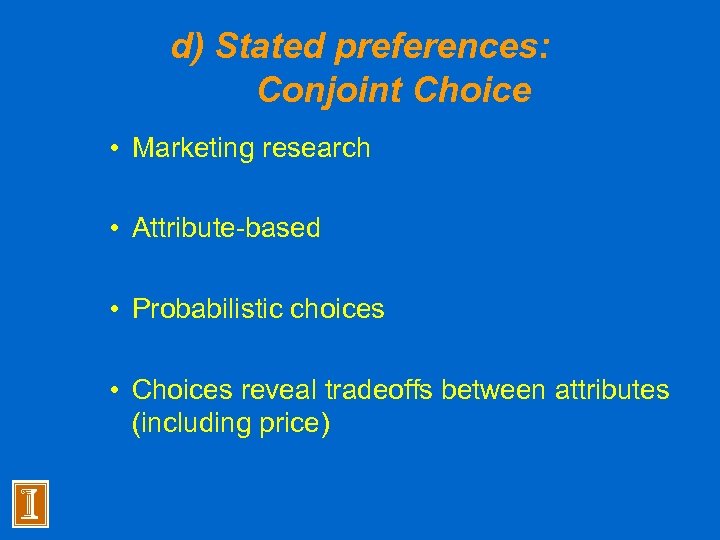
d) Stated preferences: Conjoint Choice • Marketing research • Attribute-based • Probabilistic choices • Choices reveal tradeoffs between attributes (including price)
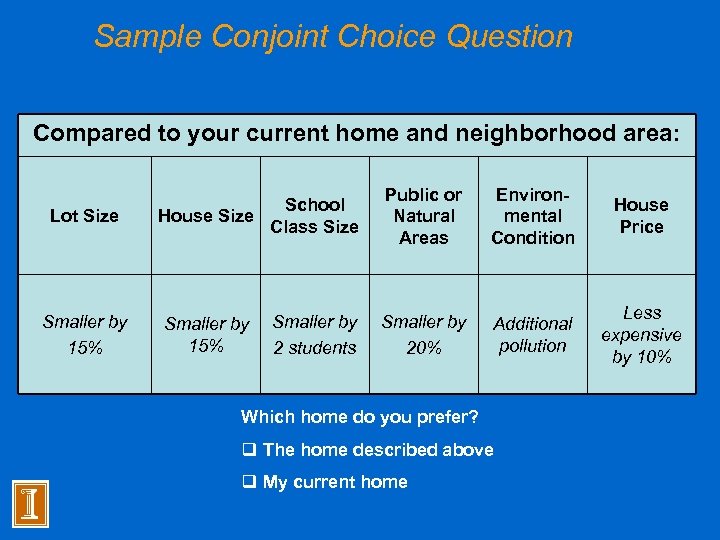
Sample Conjoint Choice Question Compared to your current home and neighborhood area: Lot Size Smaller by 15% School House Size Class Size Public or Natural Areas Environmental Condition House Price Smaller by 2 students Smaller by 20% Additional pollution Less expensive by 10% Smaller by 15% Which home do you prefer? q The home described above q My current home
d) Stated Preferences: Experimental Valuation • Experimental valuation – Choices in laboratory settings with real payments – Better for behavioral diagnosis than applied valuation
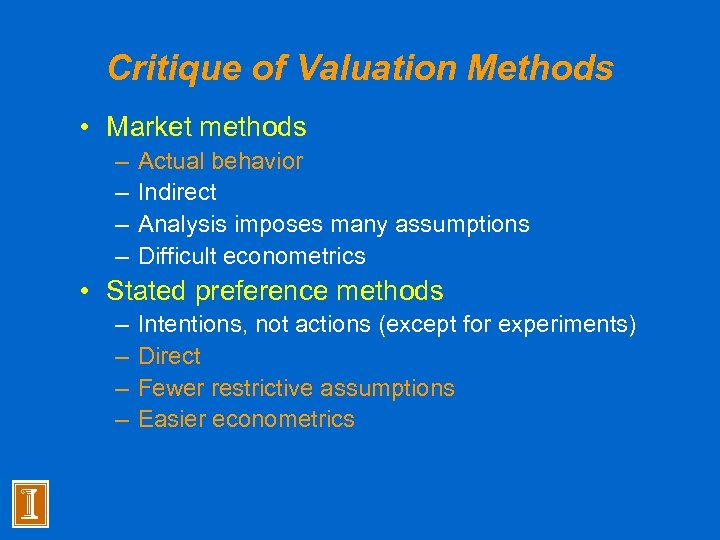
Critique of Valuation Methods • Market methods – – Actual behavior Indirect Analysis imposes many assumptions Difficult econometrics • Stated preference methods – – Intentions, not actions (except for experiments) Direct Fewer restrictive assumptions Easier econometrics
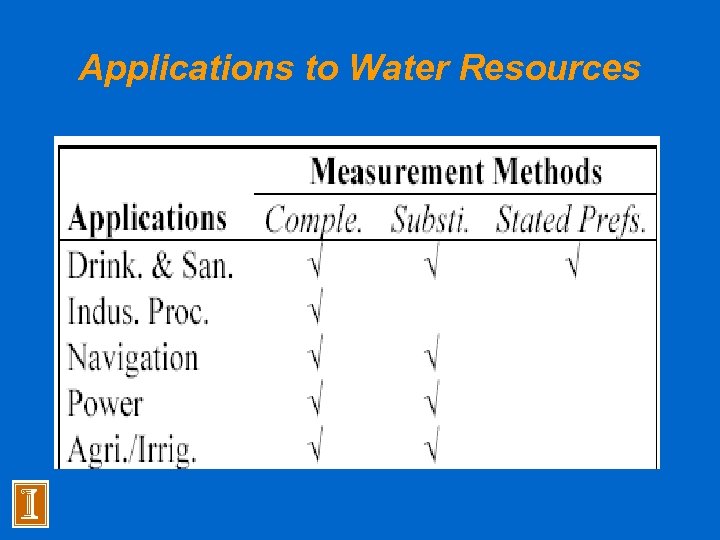
Applications to Water Resources
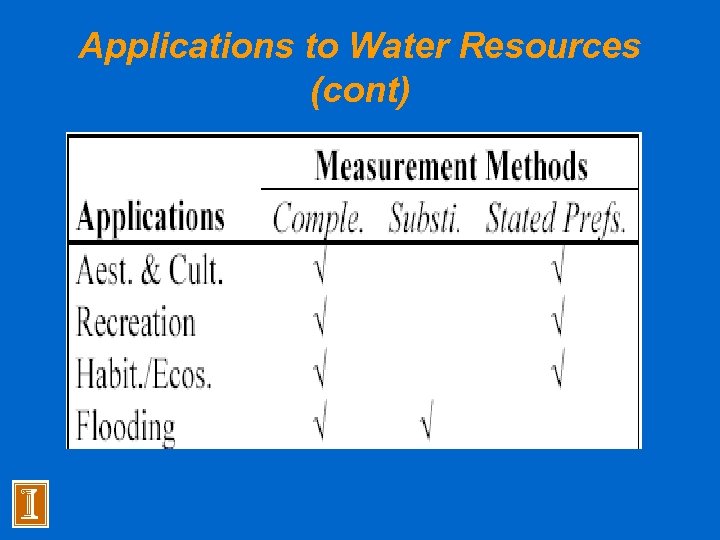
Applications to Water Resources (cont)
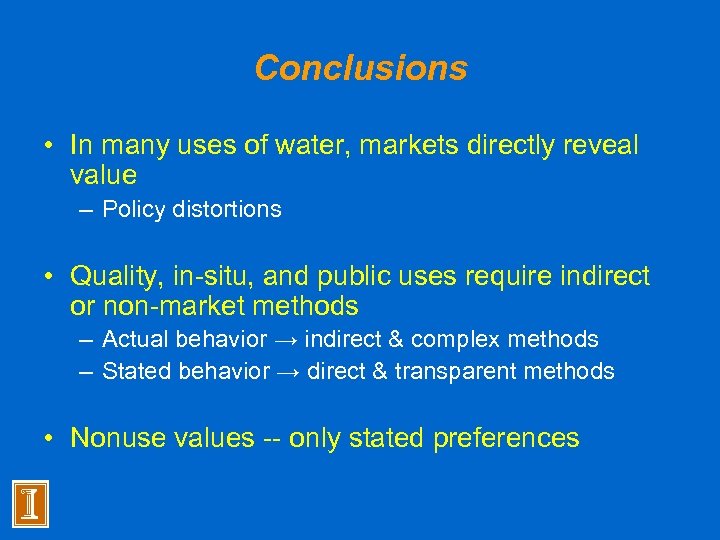
Conclusions • In many uses of water, markets directly reveal value – Policy distortions • Quality, in-situ, and public uses require indirect or non-market methods – Actual behavior → indirect & complex methods – Stated behavior → direct & transparent methods • Nonuse values -- only stated preferences
Скачать презентацию Water Prices and Values John Braden University of
622d804c4be3048c247a38cbce67dacb.ppt