


 Скачать презентацию Water Power Peer Review Active Flow Control on
9ed253e14b4186617365789e2904b05e.ppt
- Количество слайдов: 9
 Water Power Peer Review Active Flow Control on Bidirectional Rotors for Tidal MHK Applications 1 | Program Name or Ancillary Text C. P. van Dam University of California, Davis cpvandam@ucdavis. edu 26 September 2011 eere. energy. gov
 Purpose, Objectives, & Integration Objective: Design a rotor for bidirectional rotor tidal turbines (BRTT), with improved cost effectiveness via the application of microtabs for active aerodynamic control (AAC). – BRTT: a horizontal axis, axial flow turbine designed for tidal sites with currents running in only two prevailing directions (in 180°opposition to each other) • 4% - 7% less energy capture than traditional turbine configuration, but 7. 8% - 9. 6% less cost of energy (UK DTI) • Aero/hydro-dynamically, bidirectional rotor and hydrofoils are inherently less efficient than conventional rotors/hydrofoils – Microtabs: small tabs that extend approximately normal to an airfoil/blade surface, typically 1%-2% of chord in height, with aerodynamic effectiveness similar to conventional flaps • Extensive research completed for wind turbine applications, but mostly for load control, not performance enhancement 2 | Wind and Water Power Program eere. energy. gov
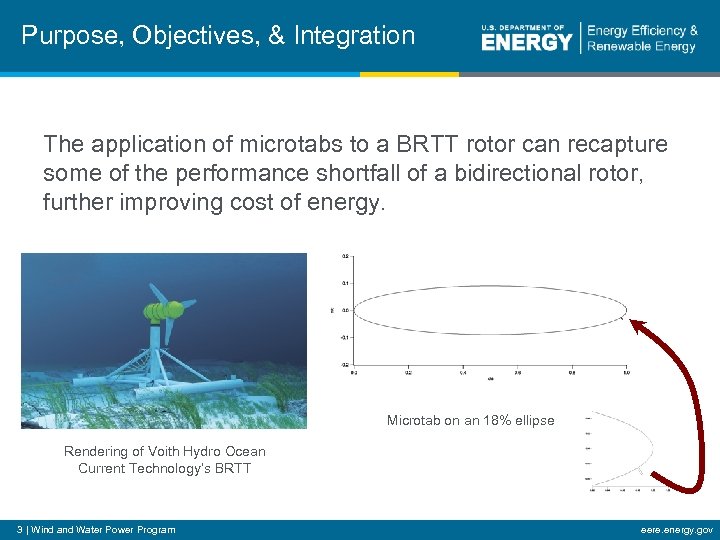 Purpose, Objectives, & Integration The application of microtabs to a BRTT rotor can recapture some of the performance shortfall of a bidirectional rotor, further improving cost of energy. Microtab on an 18% ellipse Rendering of Voith Hydro Ocean Current Technology’s BRTT 3 | Wind and Water Power Program eere. energy. gov
 Purpose, Objectives, & Integration • Improved cost of energy will aid technology adoption • Microtab/active aerodynamic control technology can be applied to BRTT MHK turbines, most other rotor-based MHK turbines, and has synergies with ongoing wind power research in active load control • Getting a head start on “smart” rotor research for MHK – Wind technology is much more mature than MHK, but smart rotor research only began in recent years • We have future plans for developing this concept with industry partnerships with the ultimate goal of full commercialization 4 | Wind and Water Power Program eere. energy. gov
 Technical Approach • Applying a suite of computational tools that have been used extensively for wind power RD&D – – RANS CFD – OVERFLOW Air/hydro-foil design – XFOIL, various in-house tools BEM – WT Perf, in-house tools etc. • Drawing upon wind power experience, but wary of unique MHK phenomena: – Cavitation – Increased soiling from biofouling – Air-water interface • Conducting fundamental research on active aerodynamic control on bluff trailing edge air/hydro-foils 5 | Wind and Water Power Program eere. energy. gov
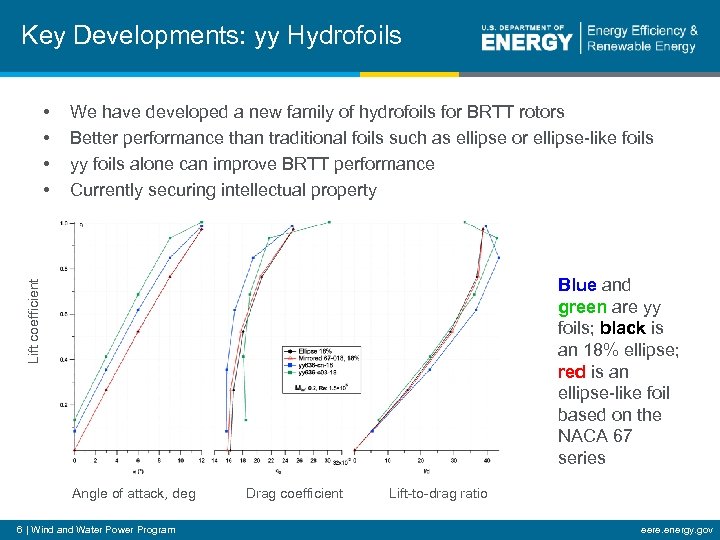 Key Developments: yy Hydrofoils We have developed a new family of hydrofoils for BRTT rotors Better performance than traditional foils such as ellipse or ellipse-like foils yy foils alone can improve BRTT performance Currently securing intellectual property Blue and green are yy foils; black is an 18% ellipse; red is an ellipse-like foil based on the NACA 67 series Lift coefficient • • Angle of attack, deg 6 | Wind and Water Power Program Drag coefficient Lift-to-drag ratio eere. energy. gov
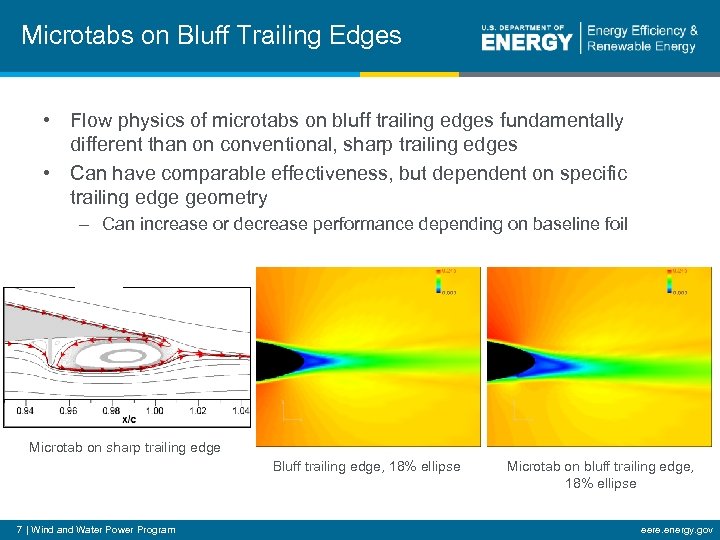 Microtabs on Bluff Trailing Edges • Flow physics of microtabs on bluff trailing edges fundamentally different than on conventional, sharp trailing edges • Can have comparable effectiveness, but dependent on specific trailing edge geometry – Can increase or decrease performance depending on baseline foil Microtab on sharp trailing edge Bluff trailing edge, 18% ellipse 7 | Wind and Water Power Program Microtab on bluff trailing edge, 18% ellipse eere. energy. gov
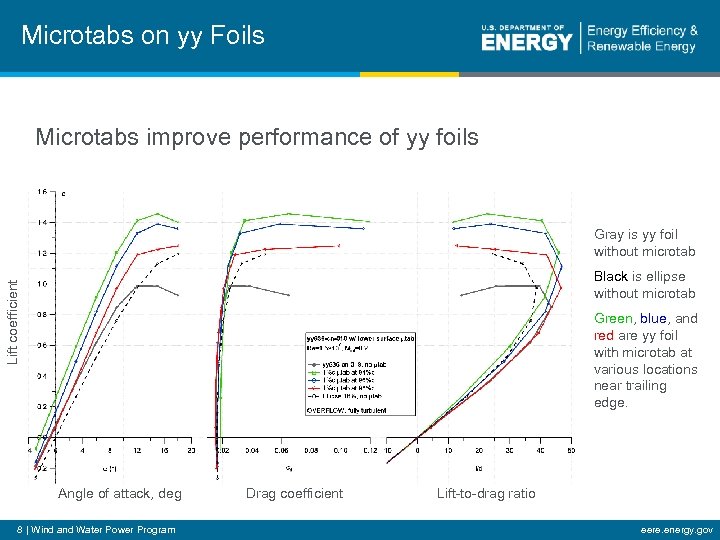 Microtabs on yy Foils Microtabs improve performance of yy foils Gray is yy foil without microtab Lift coefficient Black is ellipse without microtab Green, blue, and red are yy foil with microtab at various locations near trailing edge. Angle of attack, deg 8 | Wind and Water Power Program Drag coefficient Lift-to-drag ratio eere. energy. gov
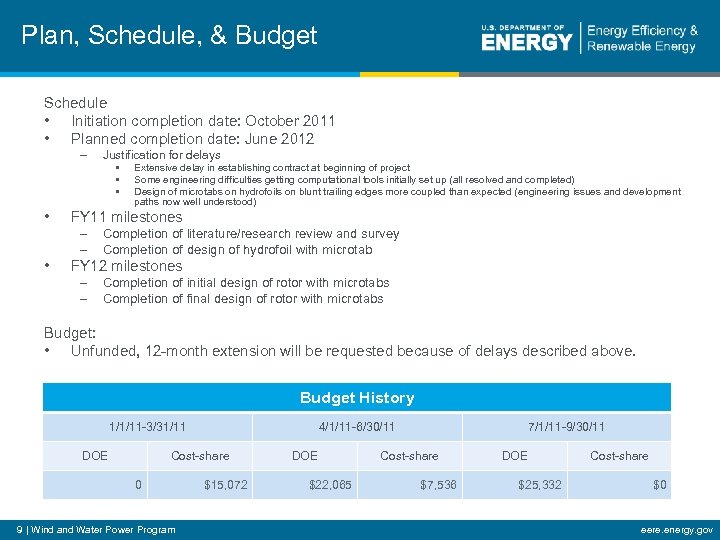 Plan, Schedule, & Budget Schedule • Initiation completion date: October 2011 • Planned completion date: June 2012 – Justification for delays • • FY 11 milestones – – • Extensive delay in establishing contract at beginning of project Some engineering difficulties getting computational tools initially set up (all resolved and completed) Design of microtabs on hydrofoils on blunt trailing edges more coupled than expected (engineering issues and development paths now well understood) Completion of literature/research review and survey Completion of design of hydrofoil with microtab FY 12 milestones – – Completion of initial design of rotor with microtabs Completion of final design of rotor with microtabs Budget: • Unfunded, 12 -month extension will be requested because of delays described above. Budget History 1/1/11 -3/31/11 DOE 4/1/11 -6/30/11 Cost-share 0 9 | Wind and Water Power Program $15, 072 DOE $22, 065 7/1/11 -9/30/11 Cost-share $7, 536 DOE $25, 332 Cost-share $0 eere. energy. gov