


 Скачать презентацию Water Law and Water Rights CEE 6490 David
dd65239653fecb2428833f6a7274bd12.ppt
- Количество слайдов: 16
 Water Law and Water Rights CEE 6490 David Rosenberg “Whiskey is for drinking, water is for fighting over. ” --Mark Twain
 Learning Objectives • Describe roles of water law for different users • Differentiate major doctrines of water law • List federal laws and powers that affect water use • Compare U. S. and international water law CEE 6490 David Rosenberg 2
 Why have water law(s)? Roles for water laws: http: //tinyurl. com/zhv 49 cs CEE 6490 David Rosenberg 3
 Major Doctrines of Water Law • Surface water – Riparian (adjacent to surface water) – Appropriation (use of water) • Groundwater – – Absolute ownership Reasonable use Correlative rights Appropriation CEE 6490 David Rosenberg 4
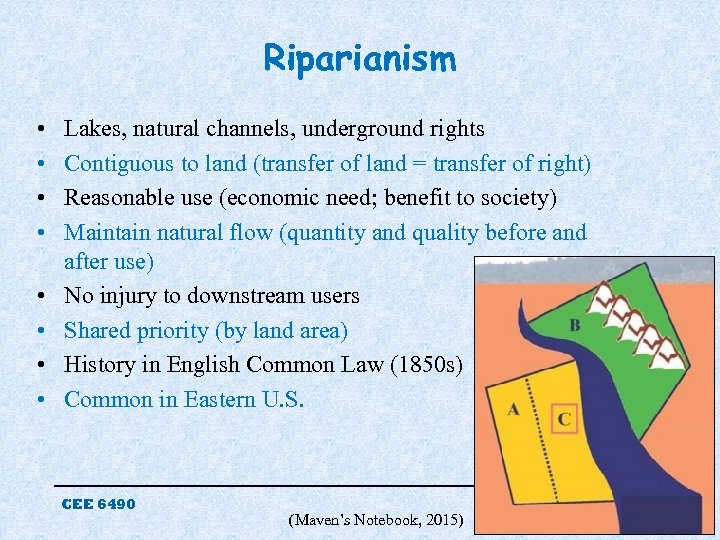 Riparianism • • Lakes, natural channels, underground rights Contiguous to land (transfer of land = transfer of right) Reasonable use (economic need; benefit to society) Maintain natural flow (quantity and quality before and after use) No injury to downstream users Shared priority (by land area) History in English Common Law (1850 s) Common in Eastern U. S. CEE 6490 (Maven’s Notebook, 2015) David Rosenberg 5
 Prior Appropriation • Water flowing in natural channels; subterranean streams • “First in time, first in right” – no land ownership required • Senior appropriator entitled to full amount of reasonable and beneficial use • Use it or lose it (due diligence) • Shortages shared unequally: senior rights receive all their water before junior rights receive any • Transfer of right apart from land • History in U. S. western expansion; Manifest Destiny; mining development CEE 6490 David Rosenberg 6
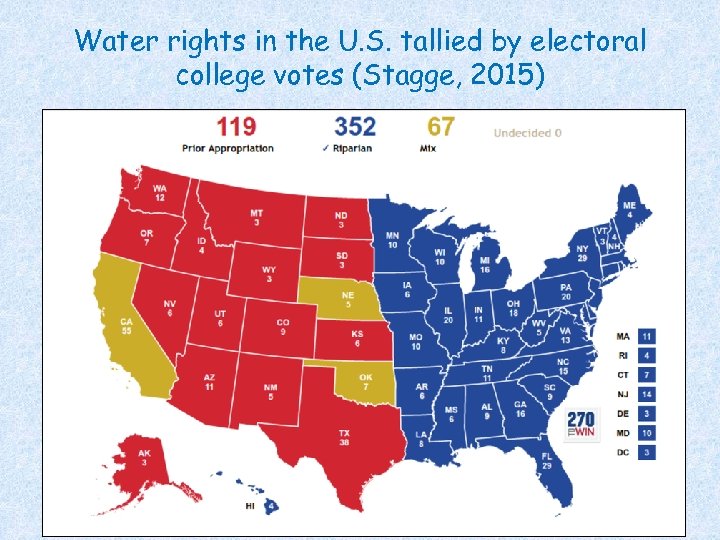 Water rights in the U. S. tallied by electoral college votes (Stagge, 2015) CEE 6490 David Rosenberg 7
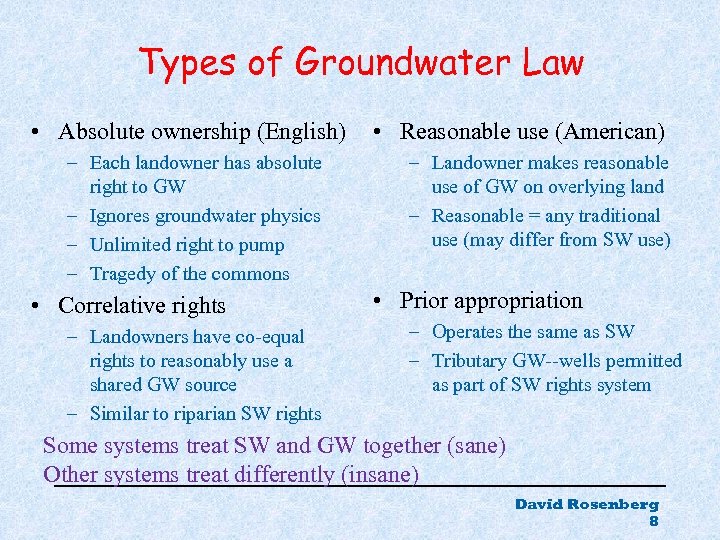 Types of Groundwater Law • Absolute ownership (English) – Each landowner has absolute right to GW – Ignores groundwater physics – Unlimited right to pump – Tragedy of the commons • Correlative rights – Landowners have co-equal rights to reasonably use a shared GW source – Similar to riparian SW rights • Reasonable use (American) – Landowner makes reasonable use of GW on overlying land – Reasonable = any traditional use (may differ from SW use) • Prior appropriation – Operates the same as SW – Tributary GW--wells permitted as part of SW rights system Some systems treat SW and GW together (sane) Other systems treat differently (insane) David Rosenberg 8
 Federal Powers • Commerce power: regulate commerce between states • Proprietary power: over federal public land (33% of all US land), can sell/give away resources • Welfare power: tax and spend • Treaty-making power: U. S. Senate must ratify • Judicial power: U. S. Supreme Court resolves lawsuits among states – Appoints a “Special Master” who investigates claims, collects data, makes recommendations – Court reviews and decides based on “equitable apportionment” • Compact power: states enter into with consent of Congress CEE 6490 David Rosenberg 9
 Federal Reserved Rights (post 1850) • Reserved lands no longer open to homesteading • National Forests, Parks, military installations, Wilderness Areas, Native American (Indian) Reservations, etc. • Water reserved with land to accomplish reservation goal • Winters Rights (1908, Winters vs US) – – – Ft. Belknap Indian Reservation, Montana over Milk River dispute Water rights attached to reserved land Date to when land is set aside (1888) Maintained even if not exercised Once quantified (difficult!) often most senior appropriation Why significant? CEE 6490 David Rosenberg 10
 Other Federal Rights • Aboriginal rights (US vs Klammath and Modoc Tribes, 1938) – Many Native American tribes do not have reservations – But have lived on and irrigated same land for ~700 years (time immemorial) – Very senior water rights; do not expire with non-use • Pueblo Rights – Ripened with Spanish settlement prior to U. S. forming (1600 s) – Examples: • New Mexico • Los Angeles, CA • San Diego, CA CEE 6490 David Rosenberg 11
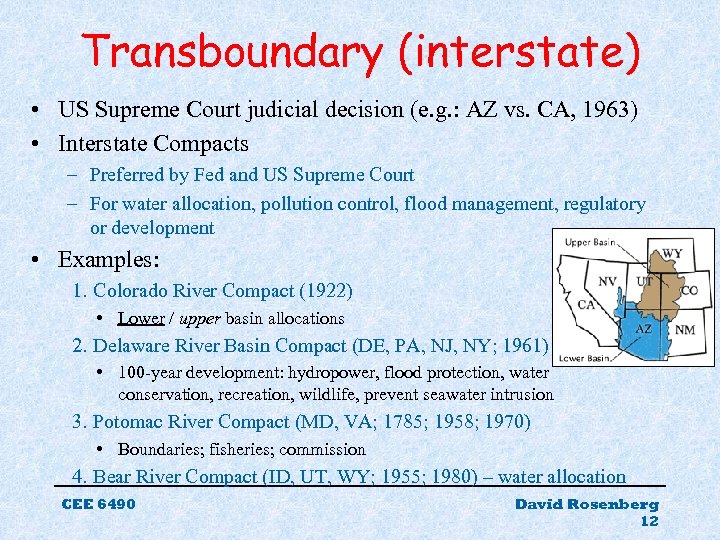 Transboundary (interstate) • US Supreme Court judicial decision (e. g. : AZ vs. CA, 1963) • Interstate Compacts – Preferred by Fed and US Supreme Court – For water allocation, pollution control, flood management, regulatory or development • Examples: 1. Colorado River Compact (1922) • Lower / upper basin allocations 2. Delaware River Basin Compact (DE, PA, NJ, NY; 1961) • 100 -year development: hydropower, flood protection, water conservation, recreation, wildlife, prevent seawater intrusion 3. Potomac River Compact (MD, VA; 1785; 1958; 1970) • Boundaries; fisheries; commission 4. Bear River Compact (ID, UT, WY; 1955; 1980) – water allocation CEE 6490 David Rosenberg 12
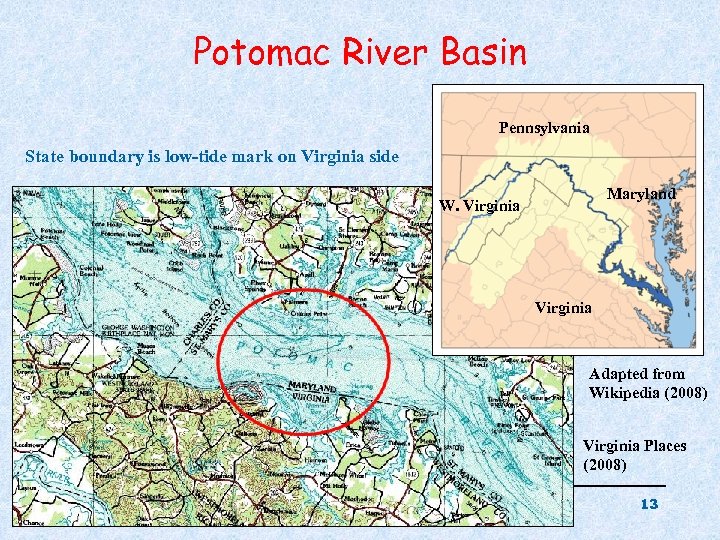 Potomac River Basin Pennsylvania State boundary is low-tide mark on Virginia side Maryland W. Virginia Adapted from Wikipedia (2008) Virginia Places (2008) CEE 6490 13
 International Water Rights/Law • Do not exist in practice • Are not enforceable • Embodied in basic principals by international bodies – – – Equitable and reasonable utilization and participation Regular exchange of data and information Cooperation among riparian nations Cause no significant harm to other basin states Develop institutions for joint management • Nations often make self-serving doctrine-based claims • Often practically achieved through treaties CEE 6490 David Rosenberg 14
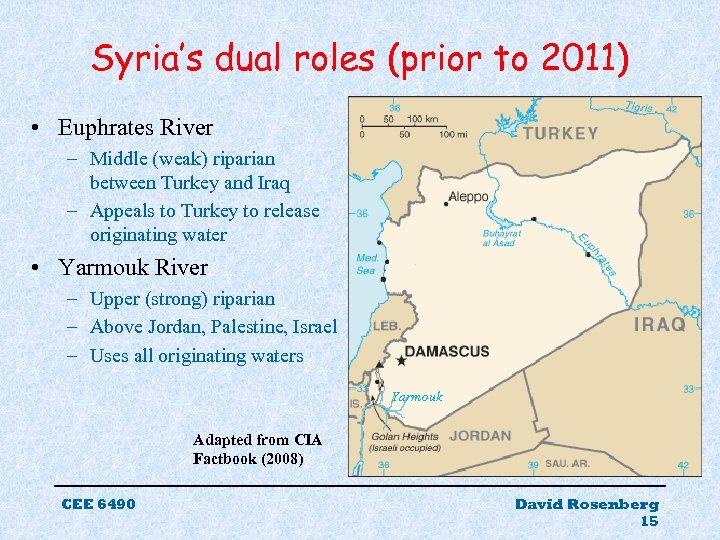 Syria’s dual roles (prior to 2011) • Euphrates River – Middle (weak) riparian between Turkey and Iraq – Appeals to Turkey to release originating water • Yarmouk River – Upper (strong) riparian – Above Jordan, Palestine, Israel – Uses all originating waters Yarmouk Adapted from CIA Factbook (2008) CEE 6490 David Rosenberg 15
 Conclusions • Water law is a way to codify behavioral norms and proscribe recourse when norms are broken • Riparian and appropriation doctrines • Application depends on water type and location • Sometimes related, sometimes not • Many overlapping International, Federal, State, Local, and customs apply • Need to understand system(s) that are enforced in the area were water management will occur CEE 6490 David Rosenberg 16