


 Скачать презентацию Water Health in Alaska considerations for water
3db993bb14a3f1863dadfb155710b3d0.ppt
- Количество слайдов: 22
 Water & Health in Alaska considerations for water quantity Troy Ritter, REHS, MPH, DAAS Applied Sciences Manager ANTHC-DEHE
 Documented health benefits of improved water service in Alaska • Acute respiratory infections • Skin infections • Invasive pneumococcal disease
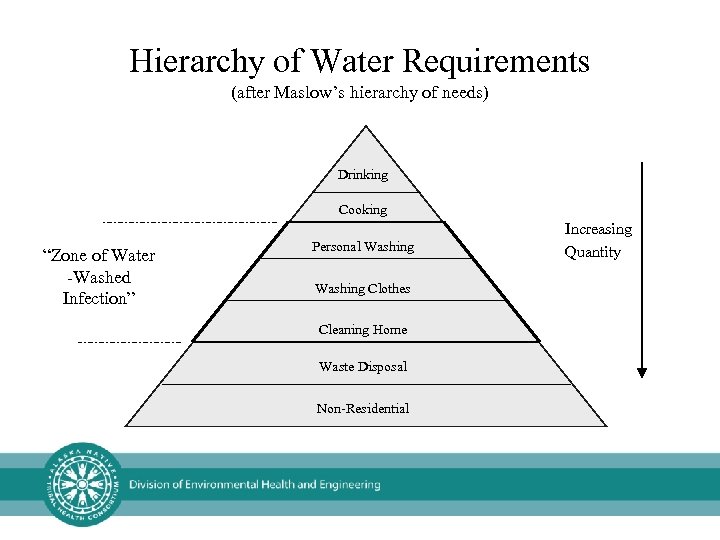
 Bradley Classifications • Waterborne diseases: where the pathogen is in the water and causes illness when ingested • Water-washed diseases: where transmission of the pathogen is interrupted by washing with water
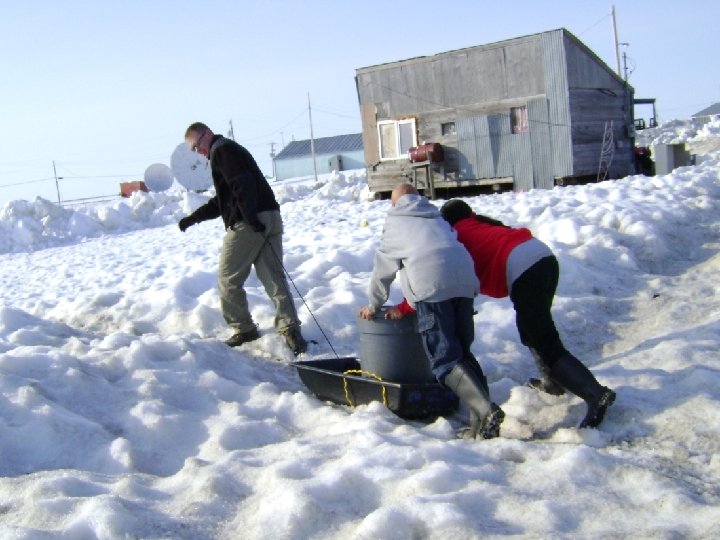
 How much water is needed for optimal health?
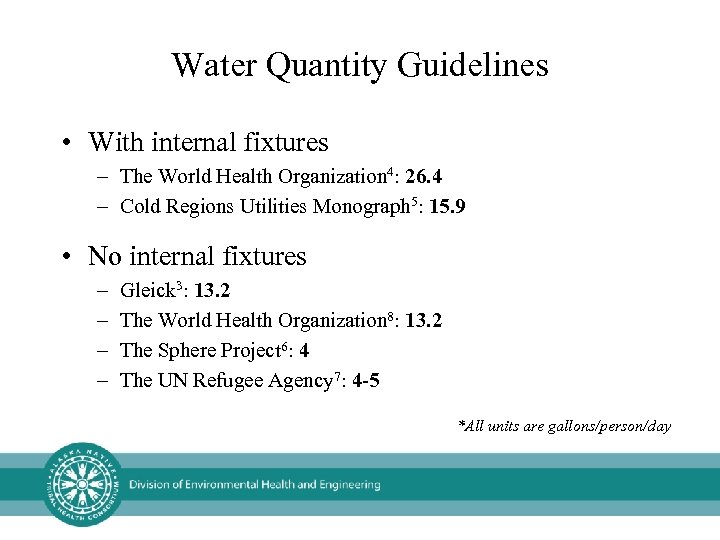 Water Quantity Guidelines • With internal fixtures – The World Health Organization 4: 26. 4 – Cold Regions Utilities Monograph 5: 15. 9 • No internal fixtures – – Gleick 3: 13. 2 The World Health Organization 8: 13. 2 The Sphere Project 6: 4 The UN Refugee Agency 7: 4 -5 *All units are gallons/person/day
 How much water is needed for optimal health (in Alaska)?
 Impact of piped water on rates of infections • Start with 4 villages with only self haul water • Collected data on water use and health • Most households were proved piped services • Collect data on water use and health after pipes
 Opportunities for Observation 1. Water use in self-haul households 2. Water use in piped households 3. Water use in transition from self-haul to piped
 Water use in self-haul households Residential water use < 2 gpcpd
 Change in Household Water Use (volume) Mean Water Use Predicted Water Use Self-haul Water Use
 Change in Soap Use (volume) Self-haul use
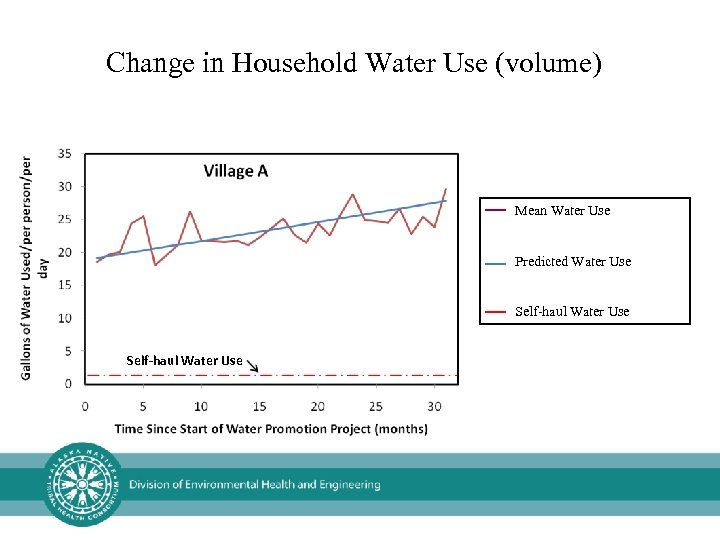
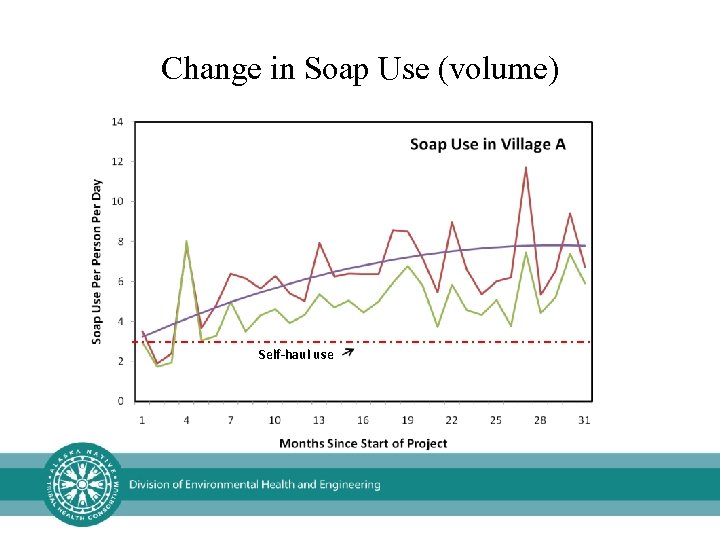
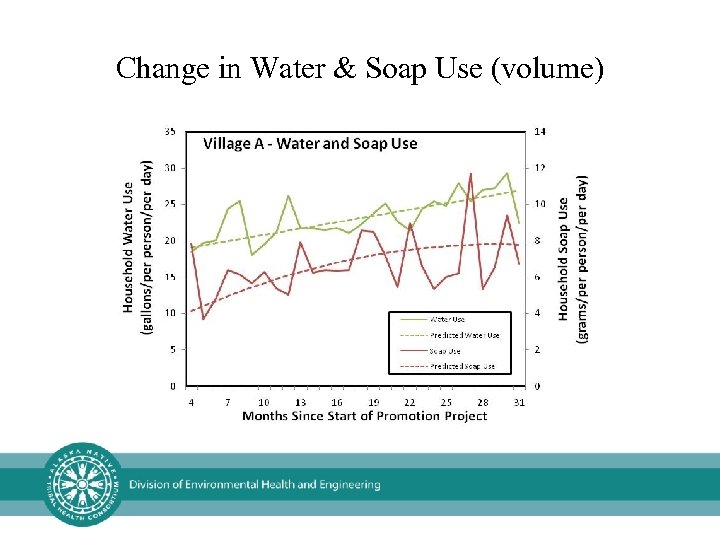 Change in Water & Soap Use (volume)
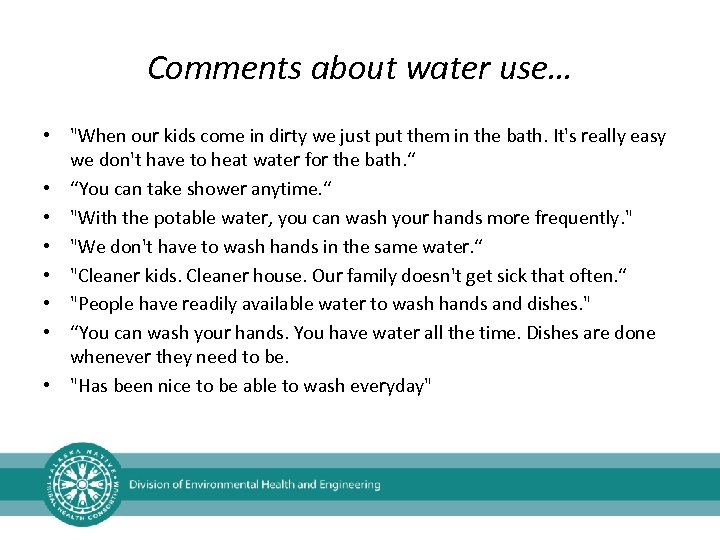 Comments about water use… • "When our kids come in dirty we just put them in the bath. It's really easy we don't have to heat water for the bath. “ • “You can take shower anytime. “ • "With the potable water, you can wash your hands more frequently. " • "We don't have to wash hands in the same water. “ • "Cleaner kids. Cleaner house. Our family doesn't get sick that often. “ • "People have readily available water to wash hands and dishes. " • “You can wash your hands. You have water all the time. Dishes are done whenever they need to be. • "Has been nice to be able to wash everyday"
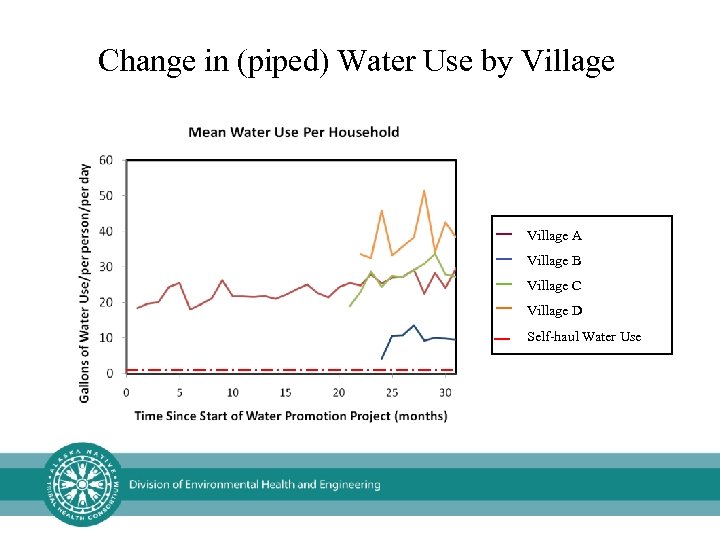 Change in (piped) Water Use by Village A Village B Village C Village D Self-haul Water Use
 What about small vehicle haul systems?
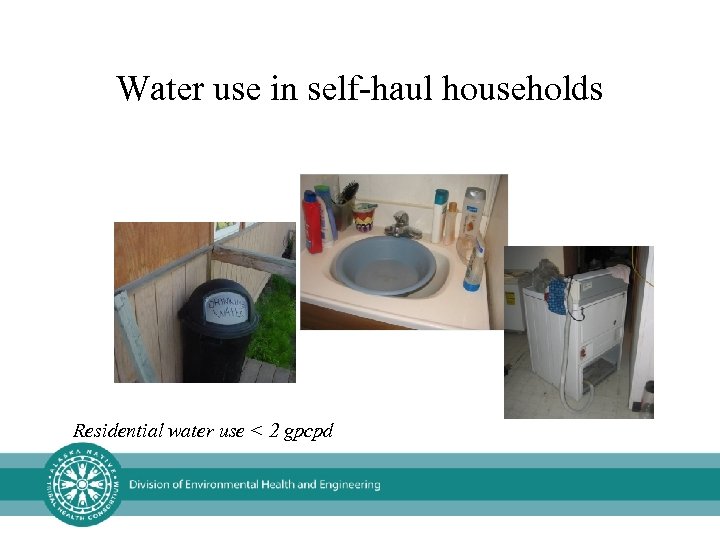
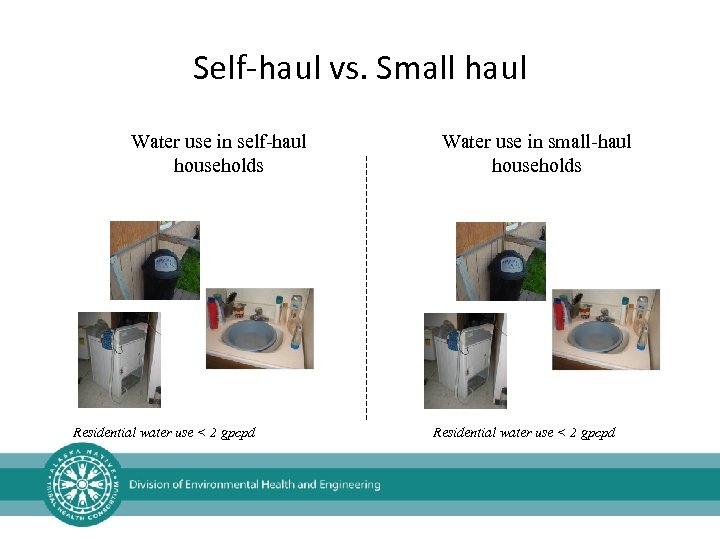 Self-haul vs. Small haul Water use in self-haul households Residential water use < 2 gpcpd Water use in small-haul households Residential water use < 2 gpcpd
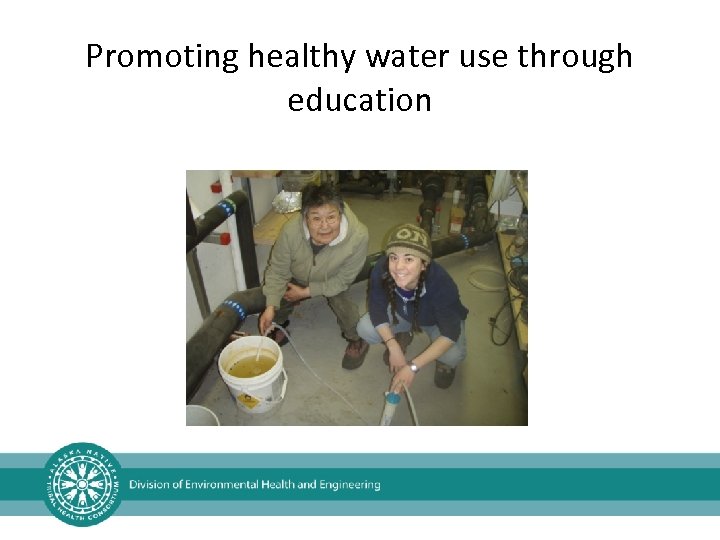 Promoting healthy water use through education
 “You can teach a dog to swim but you can’t teach a dog to snorkel” - Calie Ritter, age 6
 Recommendations for optimal health • There’s no “magic number”. Water use needs are specific to the system and population. • Optimal health is achieved through an integrated approach that includes provision of infrastructure, proper O&M and education to encourage healthy water use behaviors. • Water service must be affordable in order to provide a health benefit. User fees should be independent of water use.
 References 1. Brundin, I. , & Hennessey, T. (2011). Literature review of water quantity standard for optimal health in arctic regions. 2. Eichelberger, L. P. (2010). Living in utility scarcity: energy and water insecurity in northwest Alaska. Am Journal of Public Health, 100(6): 1010 -18. 3. 4. 5. 3. Gleick, P. (1996). Basic water requirements for human activities: Meeting basic needs. Water International, 21: 83 -92. 4. Howard, G. & Bartram, J. (2003). Domestic Water Quantity, Service Level and Health, World Health Organization. Retrieved January 20, 2012 from http: //www. who. int/water_sanitation_health/diseases/WSH 03. 02. pdf 5. Smith, D. W. (Ed. ). (1996). Cold Regions Utilities Monograph, (3 ed Ed. ). New York, NY: American Society of Civil Engineers. 6. The Sphere Project. (2011). Minimum standards in water supply, sanitation and hygiene promotion. In The Sphere Project Handbook, (pp 79 -137). Rugby, UK: Practical Action Publishing. Retrieved January 18, 2012 from http: //www. your-brochureonline. co. uk/sphere_handbook_english_2011/html/ 7. UNHCR. (1992). Water Manual for Refugee Situations. Retrieved January 18, 2011 from http: //www. unhcr. org/3 ae 6 bd 100. html 8. World Health Organization. (2010). Minimum water quantity needed for domestic use in emergencies. Retrieved January 18, 2012 http: //www. who. int/water_sanitation_health/hygiene/envsan/minimumquantity. pdf
 Hierarchy of Water Requirements (after Maslow’s hierarchy of needs) Drinking Cooking “Zone of Water -Washed Infection” Personal Washing Clothes Cleaning Home Waste Disposal Non-Residential Increasing Quantity