


 Скачать презентацию Water Fluoridation Harmful to Health Ineffective Unethical
ddb09a1d3bb0d6ec6a125db83fb5c213.ppt
- Количество слайдов: 26
 Water Fluoridation Harmful to Health, Ineffective & Unethical Dr Mark Diesendorf Sustainability Centre Pty Ltd and Institute of Environmental Studies, UNSW Web: www. sustainabilitycentre. com. au
 WHAT IS FLUORIDATION? • Most water supplies contain 0. 1 to 0. 2 ppm of fluoride (F- ) naturally. • Fluoridation increases the natural F- concentration to 1 ppm (i. e. 5 to 10 times natural level). It is not a small “adjustment”. • Purpose is to try to reduce tooth decay. • Some well water and bore water supplies contain 1 ppm or more naturally. • Fluoridation is mass medication.
 FLUORIDATION IS MASS MEDICATION • Fluoridation is administered to treat people, not to make water safer to drink. So it is a medication. • Medical dictionaries and practice establish that preventive medicines are medicines. • F- in mg/day doses is not an essential nutrient. • Natural substances may be medicines: e. g. penicillin, digitalis, salicylates, radioisotopes, etc. • Mass medication violates two principles of medical ethics.
 VIOLATIONS OF MEDICAL ETHICS • Principle of informed consent to medication • Principle of controlled dose.
 DAILY F- DOSE IS NOT CONTROLLED • Even when F- concentration is controlled (e. g. at 1 ppm), daily dose (mg/day) cannot be. • Large variations in tap-water intake. In fluoridated areas, high F- intake groups are: - formula-fed infants get 100 x dose of breast-fed infants; young children who drink mostly soft drinks; labourers and athletes; people with diabetes insipidus, kidney disease, etc. ; heavy tea drinkers get double dose.
 WHICH COUNTRIES ARE MORE THAN 50% FLUORIDATED? Only: USA Australia New Zealand Ireland Singapore Columbia Malaysia Israel
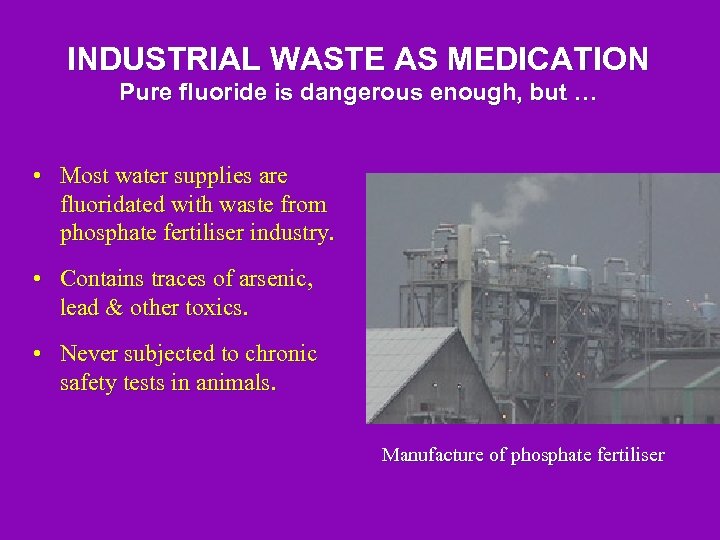 INDUSTRIAL WASTE AS MEDICATION Pure fluoride is dangerous enough, but … • Most water supplies are fluoridated with waste from phosphate fertiliser industry. • Contains traces of arsenic, lead & other toxics. • Never subjected to chronic safety tests in animals. Manufacture of phosphate fertiliser
 DOES FLUORIDATION REDUCE TOOTH DECAY? Only one point of agreement between pro- and anticases: Big reductions in tooth decay occurred in most industrialised countries in 1960 s and 70 s. But they occurred in both unfluoridated and fluoridated countries. What was the cause? Reductions occurred before Ftoothpaste was widely used.
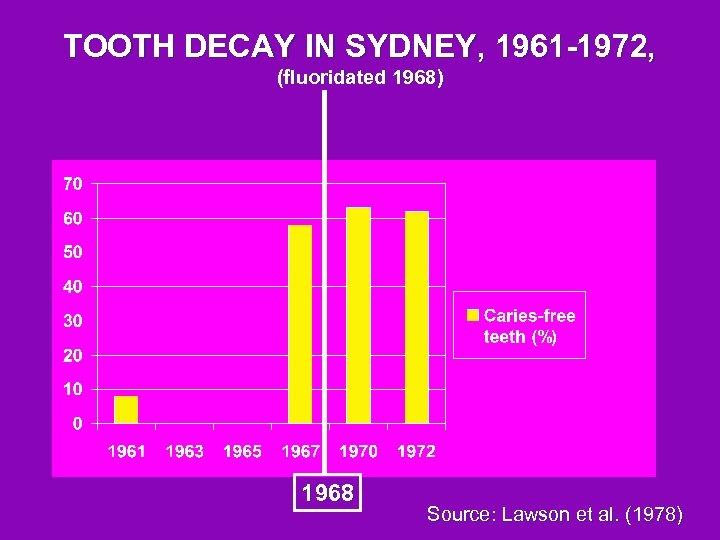 TOOTH DECAY IN SYDNEY, 1961 -1972, (fluoridated 1968) 1968 Source: Lawson et al. (1978)
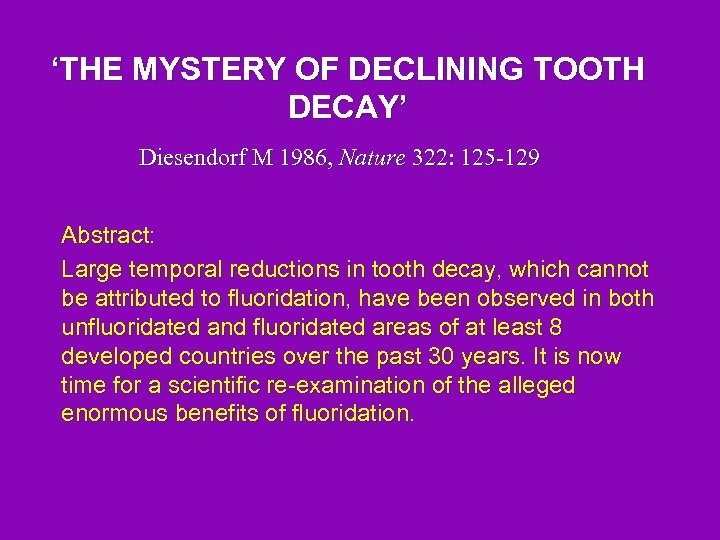 ‘THE MYSTERY OF DECLINING TOOTH DECAY’ Diesendorf M 1986, Nature 322: 125 -129 Abstract: Large temporal reductions in tooth decay, which cannot be attributed to fluoridation, have been observed in both unfluoridated and fluoridated areas of at least 8 developed countries over the past 30 years. It is now time for a scientific re-examination of the alleged enormous benefits of fluoridation.
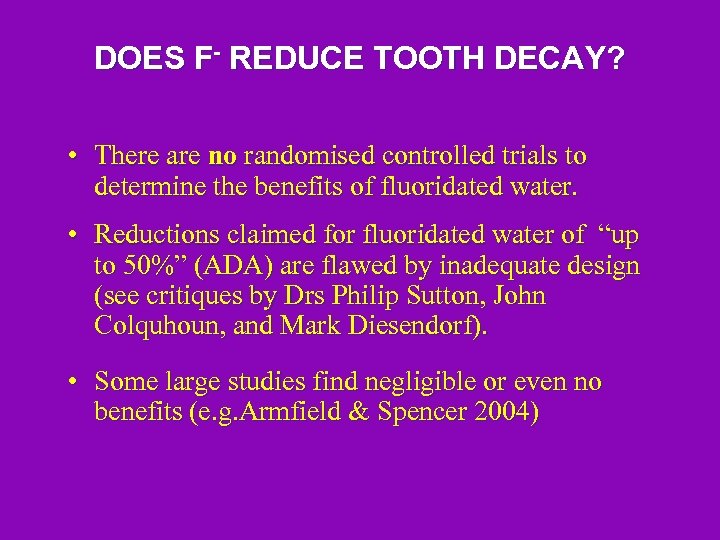 DOES F- REDUCE TOOTH DECAY? • There are no randomised controlled trials to determine the benefits of fluoridated water. • Reductions claimed for fluoridated water of “up to 50%” (ADA) are flawed by inadequate design (see critiques by Drs Philip Sutton, John Colquhoun, and Mark Diesendorf). • Some large studies find negligible or even no benefits (e. g. Armfield & Spencer 2004)
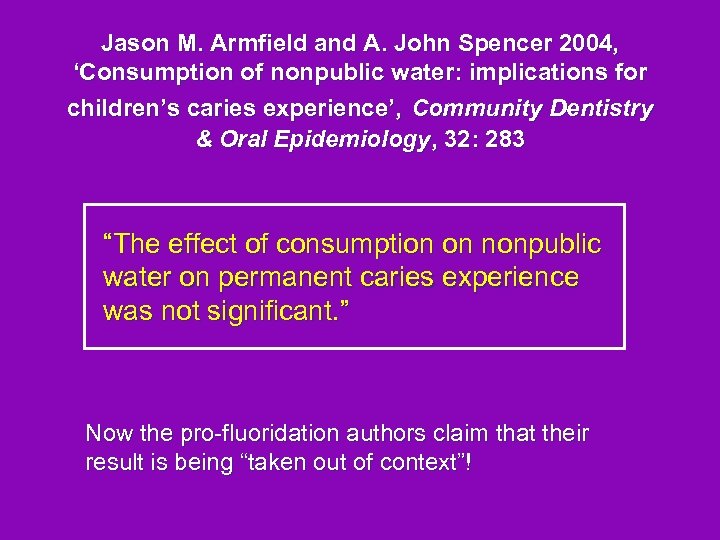 Jason M. Armfield and A. John Spencer 2004, ‘Consumption of nonpublic water: implications for children’s caries experience’, Community Dentistry & Oral Epidemiology, 32: 283 “The effect of consumption on nonpublic water on permanent caries experience was not significant. ” Now the pro-fluoridation authors claim that their result is being “taken out of context”!
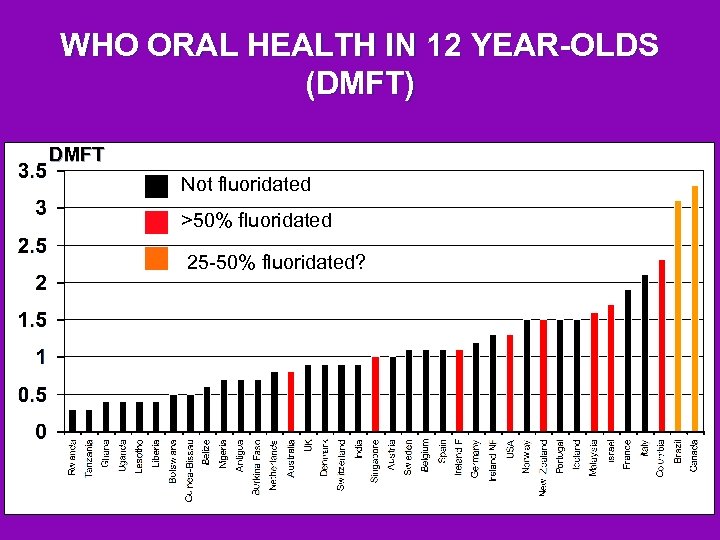 WHO ORAL HEALTH IN 12 YEAR-OLDS (DMFT) DMFT Not fluoridated >50% fluoridated 25 -50% fluoridated?
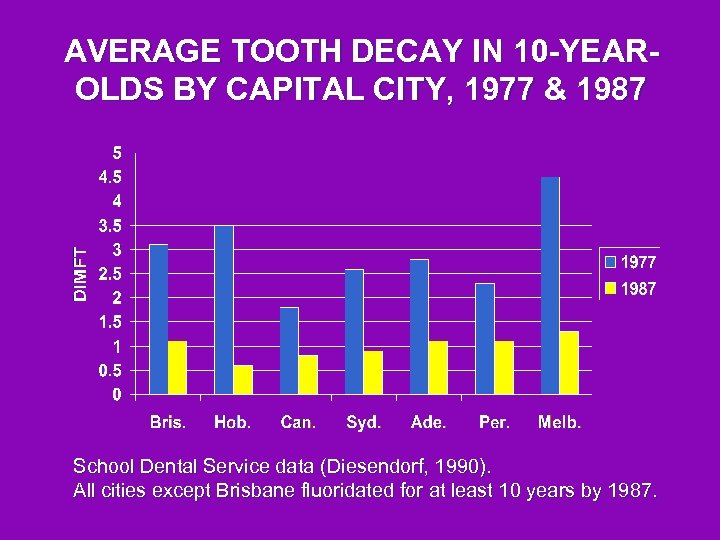 AVERAGE TOOTH DECAY IN 10 -YEAROLDS BY CAPITAL CITY, 1977 & 1987 School Dental Service data (Diesendorf, 1990). All cities except Brisbane fluoridated for at least 10 years by 1987.
 HOW DOES FLUORIDE ACT ON THE TEETH? • Early notion that ingested F- was incorporated in tooth structure and strengthened it. WRONG! • Nowadays: mechanism predominantly ‘topical’ (surface); even pro-fluoridation US Centers for Disease Control admit this. • So, people are being misled that they have to ingest fluoridated water.
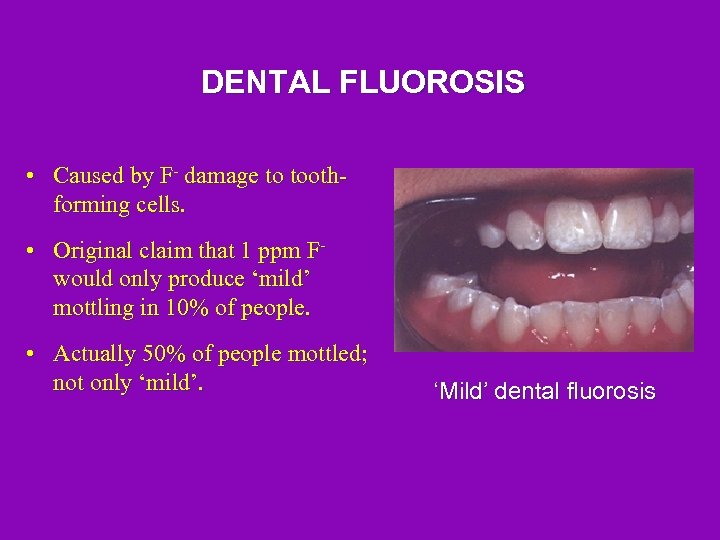 DENTAL FLUOROSIS • Caused by F- damage to toothforming cells. • Original claim that 1 ppm Fwould only produce ‘mild’ mottling in 10% of people. • Actually 50% of people mottled; not only ‘mild’. ‘Mild’ dental fluorosis
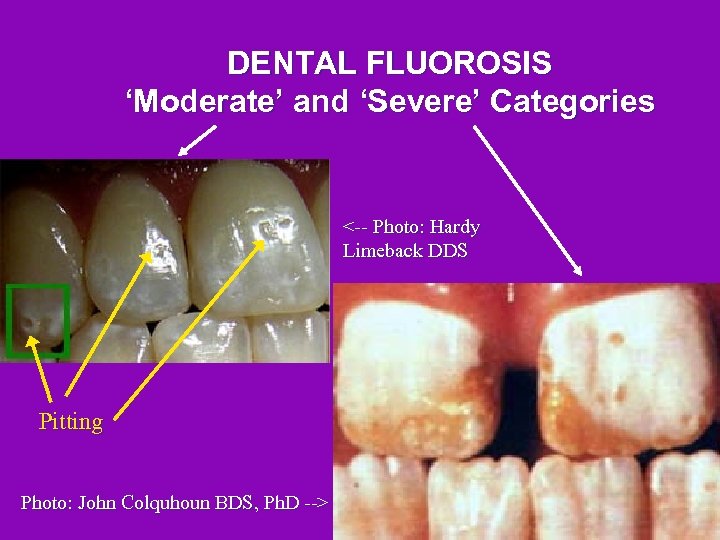 DENTAL FLUOROSIS ‘Moderate’ and ‘Severe’ Categories <-- Photo: Hardy Limeback DDS Pitting Photo: John Colquhoun BDS, Ph. D -->
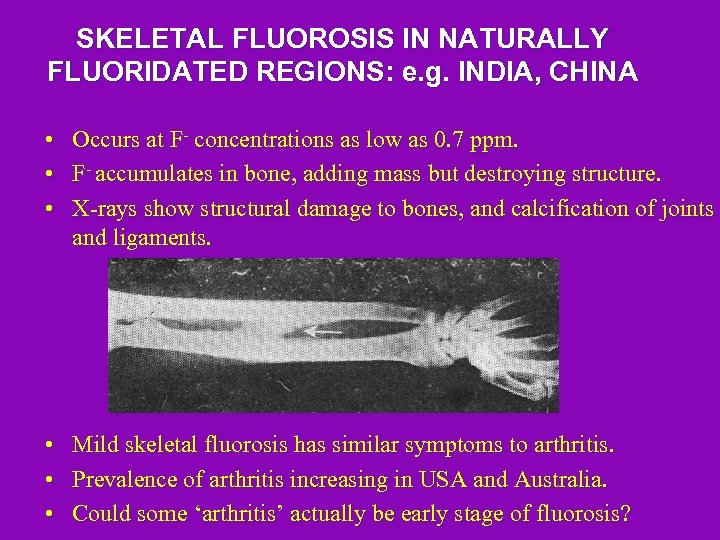 SKELETAL FLUOROSIS IN NATURALLY FLUORIDATED REGIONS: e. g. INDIA, CHINA • • • Occurs at F- concentrations as low as 0. 7 ppm. F- accumulates in bone, adding mass but destroying structure. X-rays show structural damage to bones, and calcification of joints and ligaments. • Mild skeletal fluorosis has similar symptoms to arthritis. • Prevalence of arthritis increasing in USA and Australia. • Could some ‘arthritis’ actually be early stage of fluorosis?
 HIP FRACTURES IN THE AGED • Disabling; may be fatal. • Cumulative lifetime F- dose exceeds dose where osteoporosis patients developed hip fractures. • Majority of epidemiological studies find more hip fractures in fluoridated areas. • In China, fracture rate doubled @ 1. 5 ppm and tripled @ 4. 3 ppm.
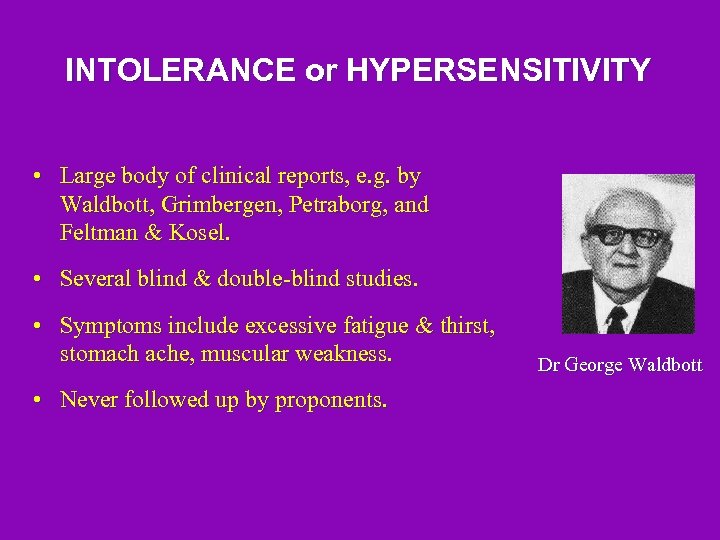 INTOLERANCE or HYPERSENSITIVITY • Large body of clinical reports, e. g. by Waldbott, Grimbergen, Petraborg, and Feltman & Kosel. • Several blind & double-blind studies. • Symptoms include excessive fatigue & thirst, stomach ache, muscular weakness. • Never followed up by proponents. Dr George Waldbott
 BIOLOGICAL EFFECTS • F- is highly active biologically, not inert. • In lab. , F- inhibits enzymes; induces genetic changes; & increases uptake of aluminium by brain. • In lab. , Al. Fx complexes disrupt G-proteins. This could change homeostasis, metabolism, growth & differentiation of living organisms. (NEW) • F- concentrates in pineal gland causing earlier onset of puberty in animals. (NEW)
 SUMMARY: RISKS OF FLUORIDATION Well established in humans Probable in humans • Dental fluorosis • Skeletal fluorosis • Hypersensitivity/intolerance reactions • Hip & other bone fractures • ‘Arthritis’ = early stage of skeletal fluorosis • Interference with thyroid function Possible, based on • Genetic damage in lab experiments lab. & animal • Brain damage in animals expts, but so far • Many diseases involving biological signalling not proven in • Chronic poisoning from traces of toxics humans
 CAN SIMILAR BENEFITS BE OBTAINED WITH LESS RISK BY OTHER METHODS? • It is possible to have low caries without F intake: e. g. Australian Aborigines on original diet; Hopewood orphanage Australia in 1950 s; most of EU today • Public health officials can influence children’s diet, e. g. by public education and controls on foods sold in school shops & canteens. • Daily, supervised F toothbrushing and/or rinsing (at say 2 ppm) programs in elementary schools are lowrisk (for children older than 5 years) and assist lowincome groups.
 POLITICAL & EQUITY ASPECTS • The principal risk factors for dental caries are poverty and poor diet, not the absence of fluoridation. • Governments use fluoridation to justify cuts to dental health programs for school children & aged. • They cynically peddle myth that fluoridation helps the poor. • But the poor have highest prevalence of dental caries, with or without fluoridation (even in Sydney). • The poor ingest a chronic poison that they cannot afford to avoid. • The poor are more susceptible to fluoride-induced diseases. • Governments use fluoridation to distract attention away from real causes of tooth decay that are politically too hard.
 CONCLUSION • Fluoridation is mass medication with uncontrolled dose. Unethical. • Negligible benefit from ingesting F-. • At best fluoridated water, acting at tooth surfaces, reduces tooth decay in a fraction of 1% of tooth surfaces. • Ingestion of F- damages teeth via dental fluorosis and damages bones via skeletal fluorosis and hip fractures. • Worrying biological effects and lab & animal experiments. • Chronic toxicity from impurities in silicofluoride wastes from phosphate fertiliser industry. • Given this evidence, Local and State Govts would be socially irresponsible and open to litigation for supporting fluoridation.
 FURTHER READING • Web site of of Fluoride Action Network, convened by Dr Paul Connett, Professor of Chemistry, St Lawrence University, USA: www. fluoridealert. org ; • Mark Diesendorf, 2003, ‘A kick in the teeth for scientific debate’, Australasian Science volume 24, no. 8, pp 35 -37, September. (A referenced version may be downloaded from www. sustainbilitycentre. com. au/Fluoride. Publics. html)