


 Скачать презентацию Water and Water Use II Earth s Water
f324a03491c2a806a75457b604e724b5.ppt
- Количество слайдов: 61
 Water and Water Use II
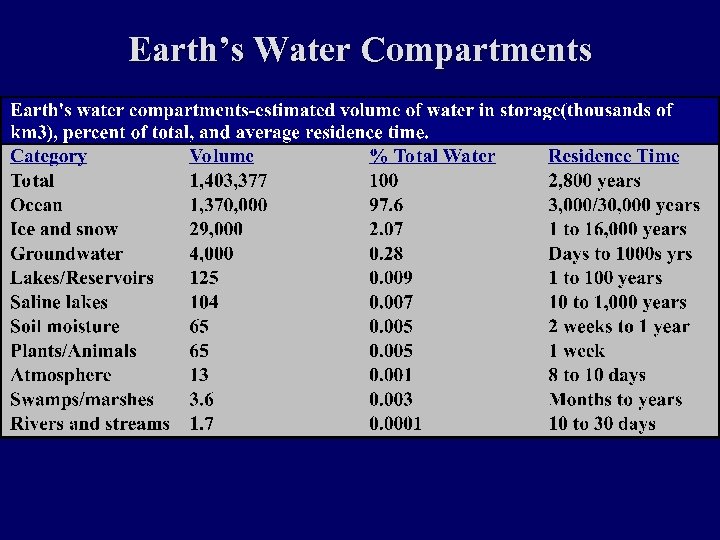 Earth’s Water Compartments
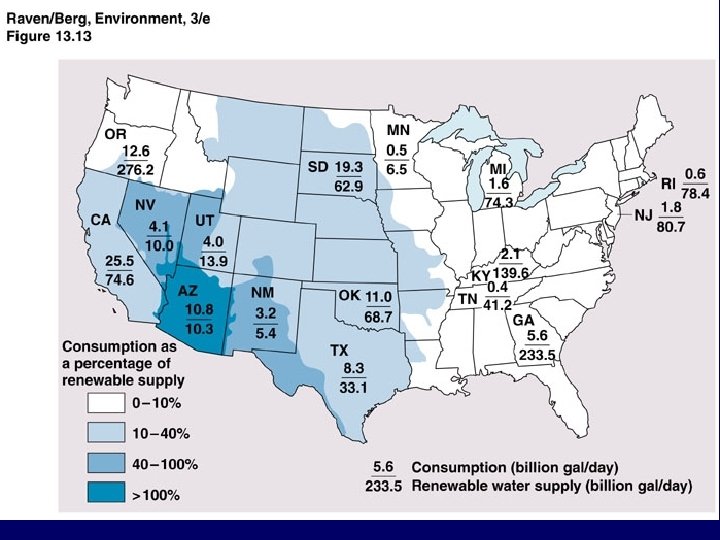
 Renewable Water Supplies Water is renewable due to surface runoff plus the infiltration into accessible freshwater aquifers. Withdrawal = Total amount taken for any purpose. Humans withdraw about 10% of the total annual renewable supply. Consumption = Water no longer available for use because it has evaporated, transpired, been incorporated into products and crops, consumed by man or livestock, ejected directly into sea, or otherwise removed from freshwater resources.
 Renewable Water Supplies The term consumption excludes water losses during transport of water between the points or points of abstractions and point or points of use. It is estimated that between 30 – 50% of urban water is lost due to leaking pipes (Since 1976 Boston has reduced losses from 50% to 36%). In Norway the figure is estimated to be as high as 70% loss. Degradation = Change in quality so water is no longer as usable.
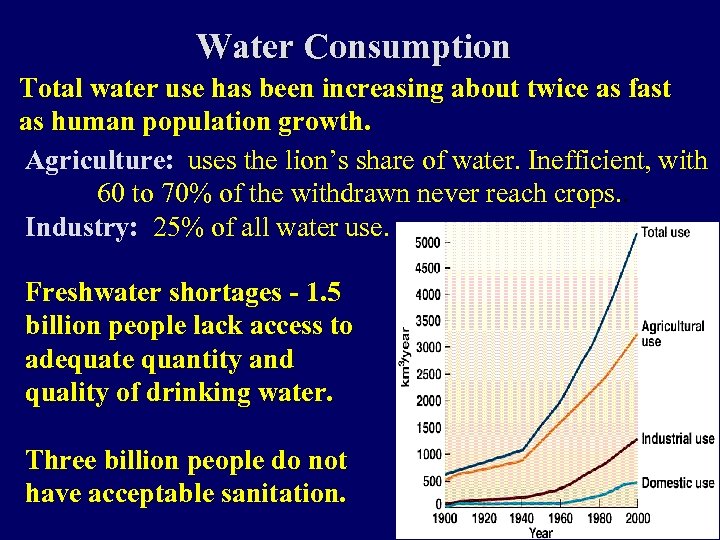 Water Consumption Total water use has been increasing about twice as fast as human population growth. Agriculture: uses the lion’s share of water. Inefficient, with 60 to 70% of the withdrawn never reach crops. . Industry: 25% of all water use. Freshwater shortages - 1. 5 billion people lack access to adequate quantity and quality of drinking water. Three billion people do not have acceptable sanitation.
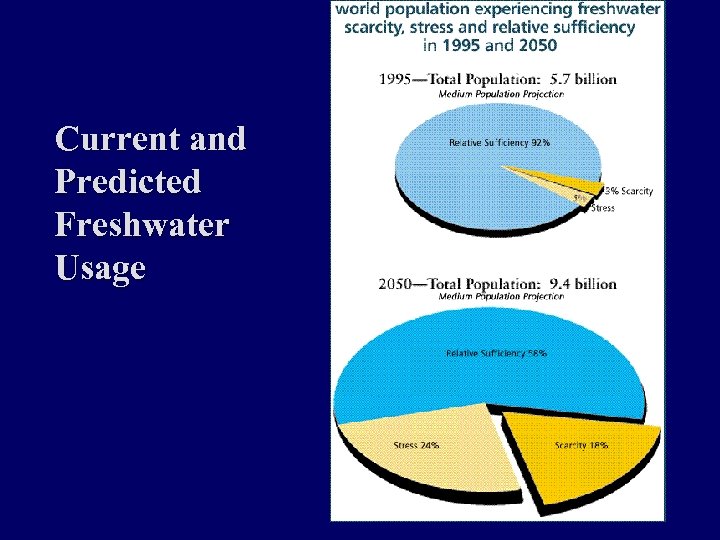 Current and Predicted Freshwater Usage
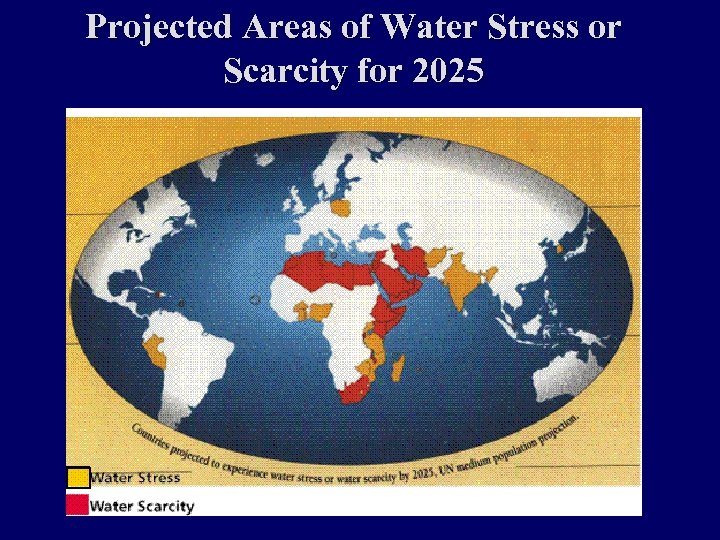 Projected Areas of Water Stress or Scarcity for 2025
 The Profligate Urban Consumer A relatively small proportion of domestic water is used on the essential purposes needed for life and health. Daily per capita consumption on essentials in a typical modern household with a piped supply providing 150 - 200 liters per head is as follows: Drinking and cooking = 3 -6 liters, Washing and personal hygiene = 15 -20 liters, (excluding use of flush toilets, baths and showers). Cleaning the house = 3 -10 liters. Total = 21 -36 liters. In the UK, 83 liters a day are used on toilets, baths, showers, washing machines and dishwashers. Garden use, car washing, dripping taps and leakage consume 49 liters.
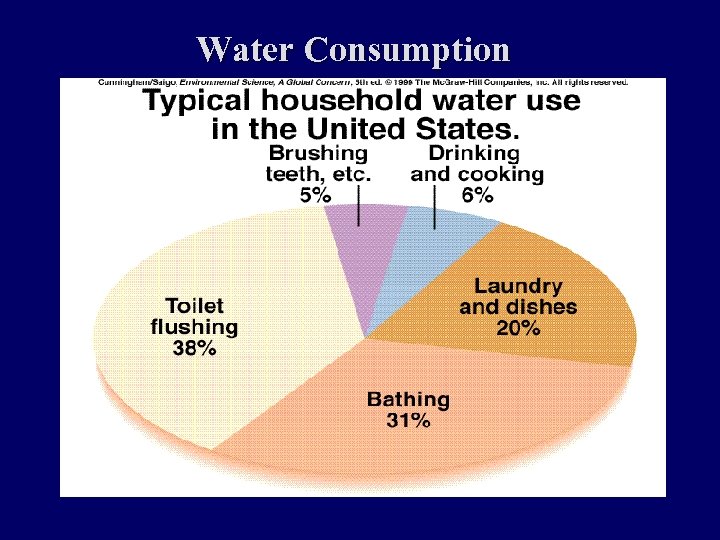 Water Consumption
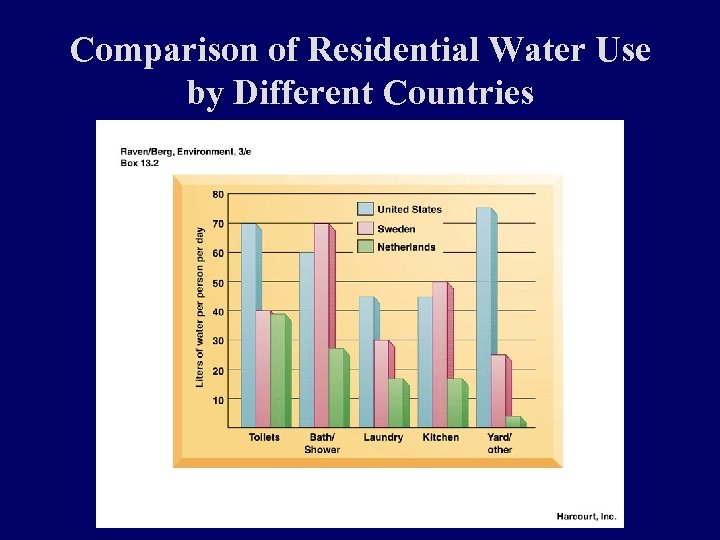 Comparison of Residential Water Use by Different Countries
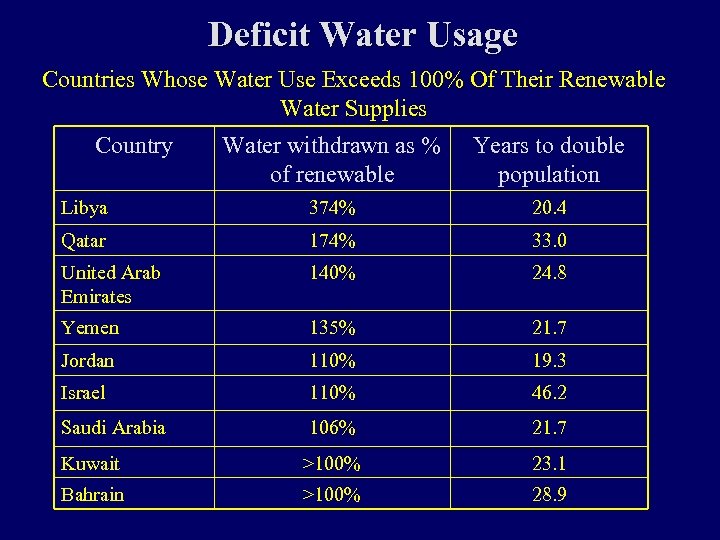 Deficit Water Usage Countries Whose Water Use Exceeds 100% Of Their Renewable Water Supplies Country Water withdrawn as % of renewable Years to double population Libya 374% 20. 4 Qatar 174% 33. 0 United Arab Emirates 140% 24. 8 Yemen 135% 21. 7 Jordan 110% 19. 3 Israel 110% 46. 2 Saudi Arabia 106% 21. 7 Kuwait >100% 23. 1 Bahrain >100% 28. 9
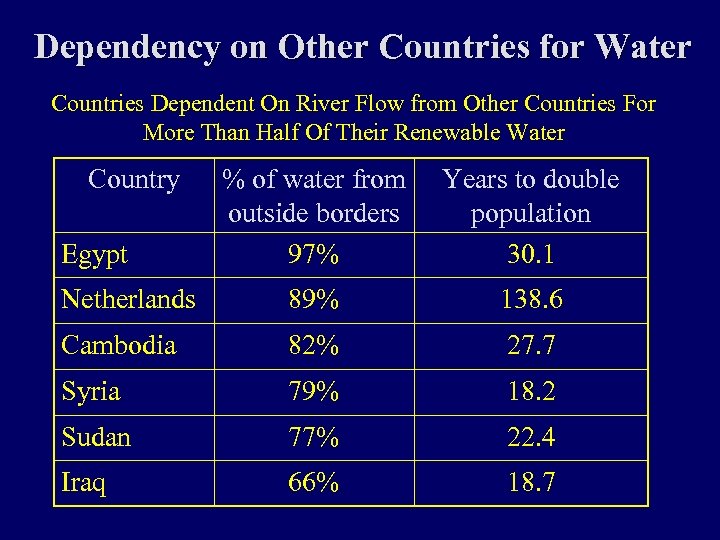 Dependency on Other Countries for Water Countries Dependent On River Flow from Other Countries For More Than Half Of Their Renewable Water Country % of water from outside borders 97% Years to double population 30. 1 Netherlands 89% 138. 6 Cambodia 82% 27. 7 Syria 79% 18. 2 Sudan 77% 22. 4 Iraq 66% 18. 7 Egypt
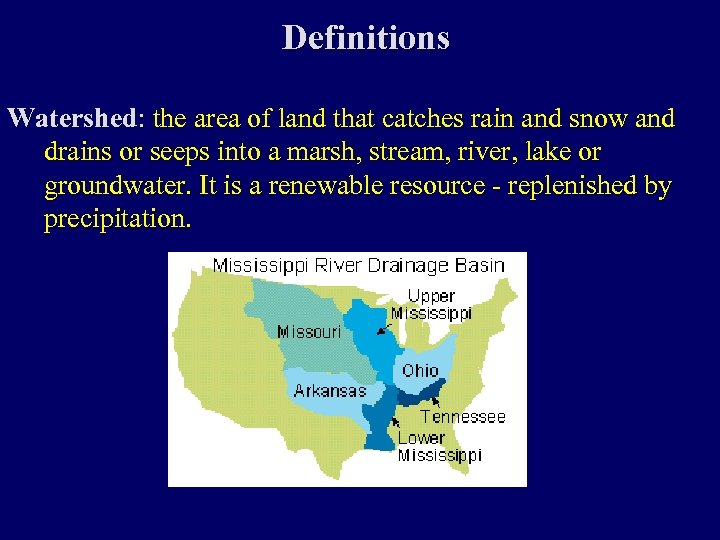 Definitions Watershed: the area of land that catches rain and snow and drains or seeps into a marsh, stream, river, lake or groundwater. It is a renewable resource - replenished by precipitation.
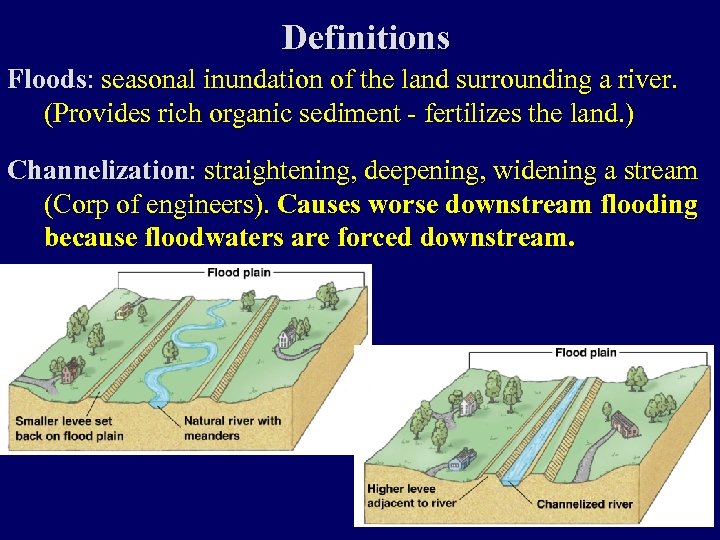 Definitions Floods: seasonal inundation of the land surrounding a river. (Provides rich organic sediment - fertilizes the land. ) Channelization: straightening, deepening, widening a stream (Corp of engineers). Causes worse downstream flooding because floodwaters are forced downstream.
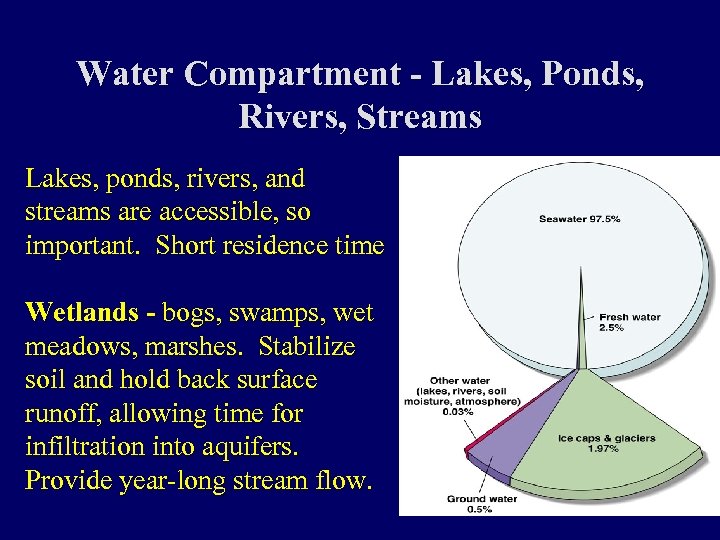 Water Compartment - Lakes, Ponds, Rivers, Streams Lakes, ponds, rivers, and streams are accessible, so important. Short residence time Wetlands - bogs, swamps, wet meadows, marshes. Stabilize soil and hold back surface runoff, allowing time for infiltration into aquifers. Provide year-long stream flow.
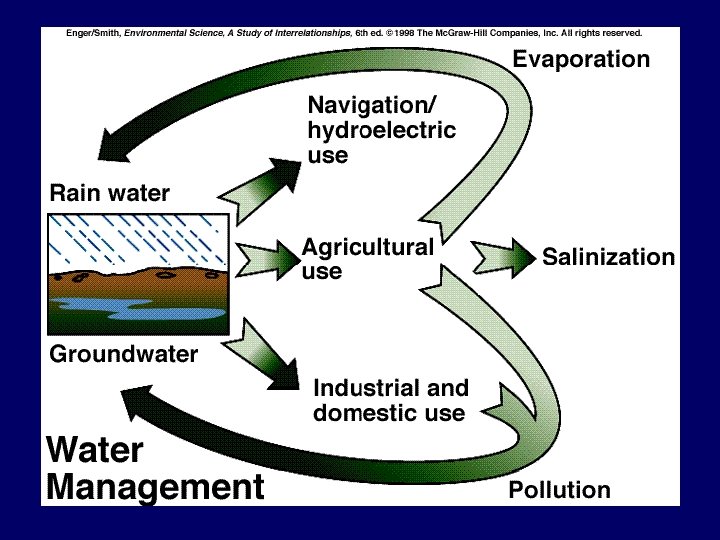
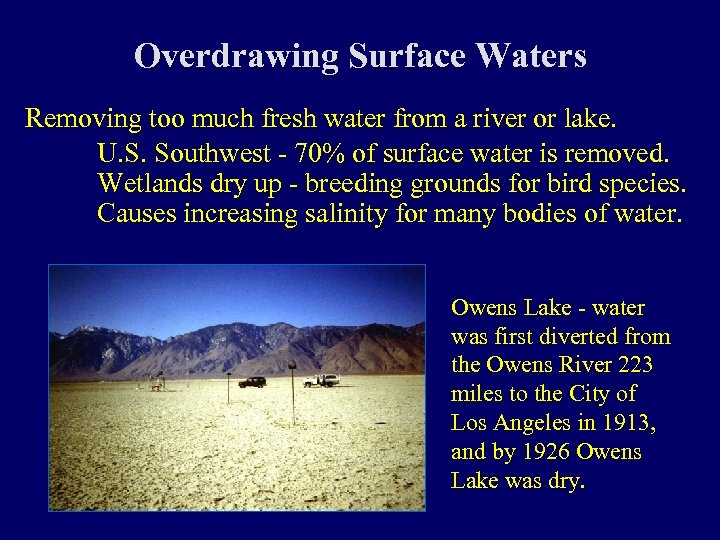 Overdrawing Surface Waters Removing too much fresh water from a river or lake. U. S. Southwest - 70% of surface water is removed. Wetlands dry up - breeding grounds for bird species. Causes increasing salinity for many bodies of water. Owens Lake - water was first diverted from the Owens River 223 miles to the City of Los Angeles in 1913, and by 1926 Owens Lake was dry.
 Global Surface Water Issues The level of the Dead Sea plummeted more than 10 meters during the 20 th century. In an agreement in 1981 between Israel and Jordan, they increased the volume of water they could take from the River Jordan, which has been reduced to little more than a drainage ditch. In northern Israel the Sea of Galilee, which gives much of the south its water, is shrinking and threatening to turn saline.
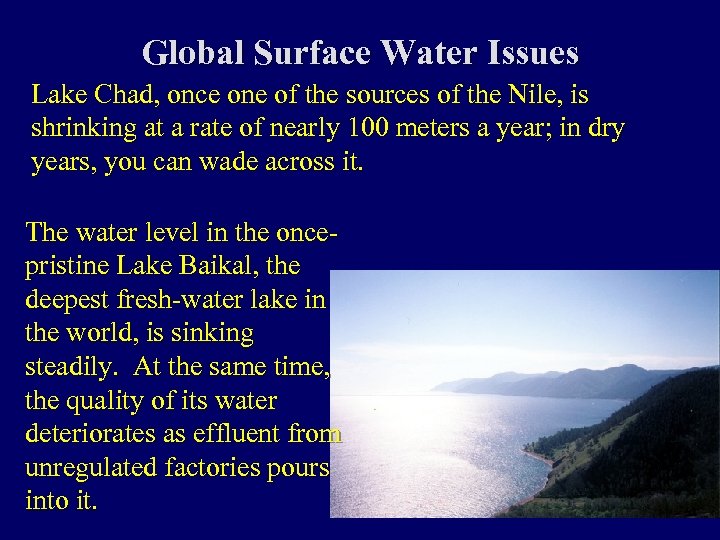 Global Surface Water Issues Lake Chad, once one of the sources of the Nile, is shrinking at a rate of nearly 100 meters a year; in dry years, you can wade across it. The water level in the oncepristine Lake Baikal, the deepest fresh-water lake in the world, is sinking steadily. At the same time, the quality of its water deteriorates as effluent from unregulated factories pours into it.
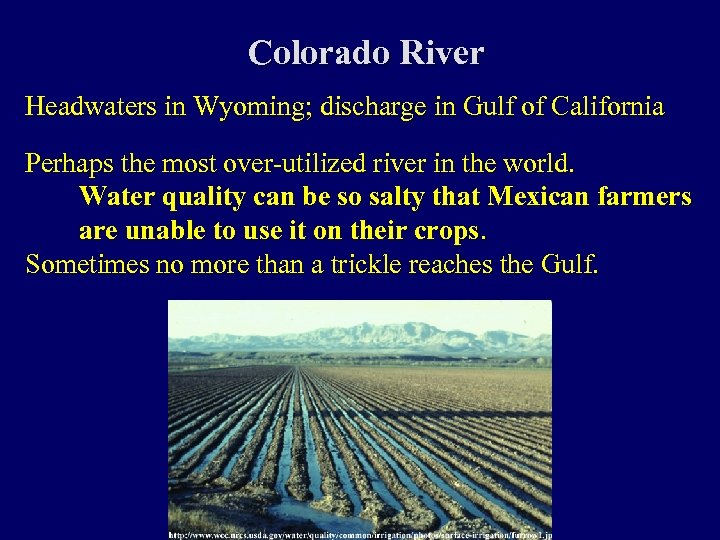 Colorado River Headwaters in Wyoming; discharge in Gulf of California Perhaps the most over-utilized river in the world. Water quality can be so salty that Mexican farmers are unable to use it on their crops. Sometimes no more than a trickle reaches the Gulf.
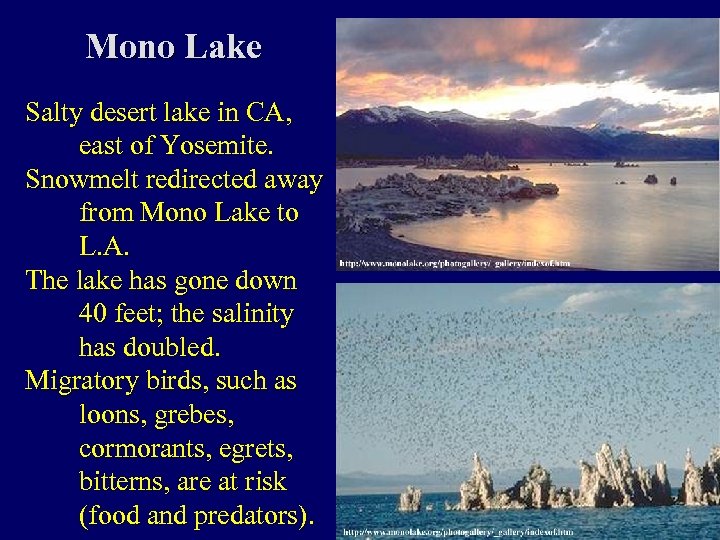 Mono Lake Salty desert lake in CA, east of Yosemite. Snowmelt redirected away from Mono Lake to L. A. The lake has gone down 40 feet; the salinity has doubled. Migratory birds, such as loons, grebes, cormorants, egrets, bitterns, are at risk (food and predators).
 Groundwater Facts Groundwater accounts for more than 95% of all fresh water available for use. Approximately 50% of Americans obtain all or part of their drinking water from groundwater. Nearly 95% of rural residents rely on groundwater for their drinking supply. About half of irrigated cropland uses groundwater. Approximately one third of industrial water needs are fulfilled by using groundwater.
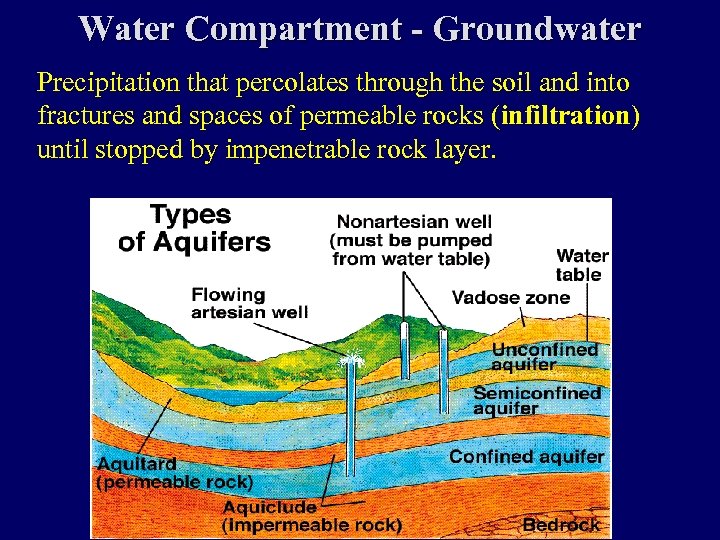 Water Compartment - Groundwater Precipitation that percolates through the soil and into fractures and spaces of permeable rocks (infiltration) until stopped by impenetrable rock layer.
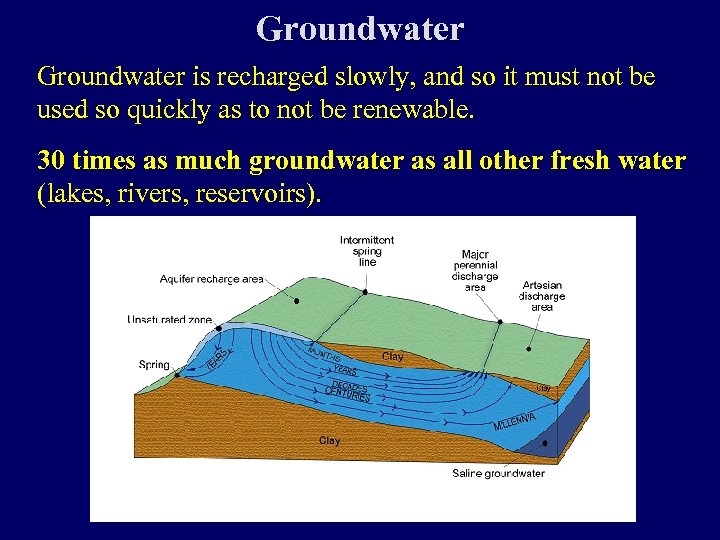 Groundwater is recharged slowly, and so it must not be used so quickly as to not be renewable. 30 times as much groundwater as all other fresh water (lakes, rivers, reservoirs).
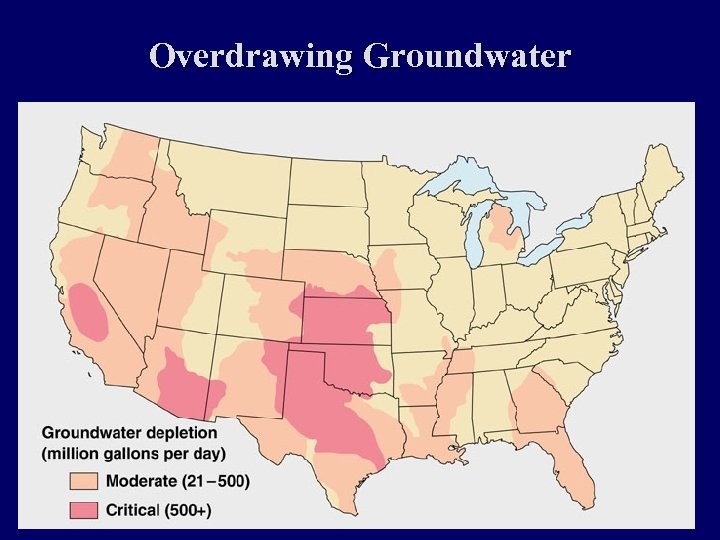 Overdrawing Groundwater
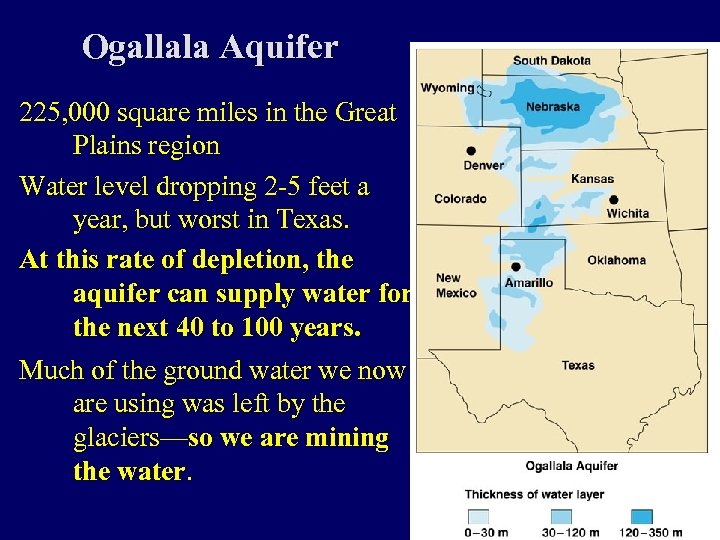 Ogallala Aquifer 225, 000 square miles in the Great Plains region Water level dropping 2 -5 feet a year, but worst in Texas. At this rate of depletion, the aquifer can supply water for the next 40 to 100 years. Much of the ground water we now are using was left by the glaciers—so we are mining the water.
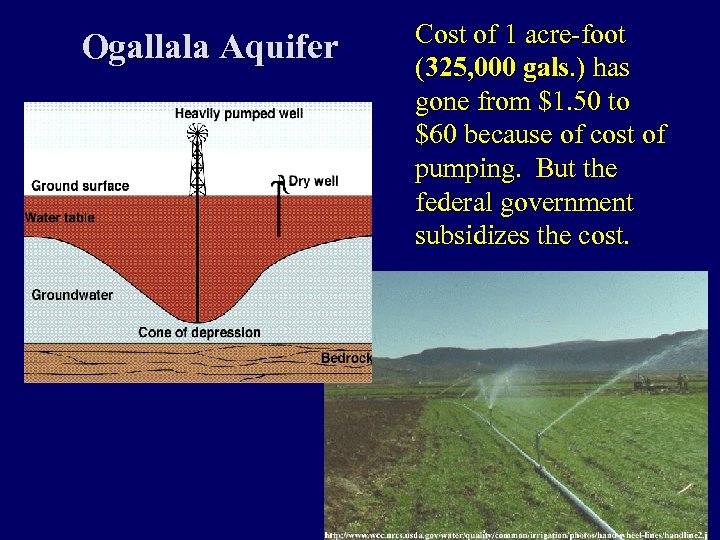 Ogallala Aquifer Cost of 1 acre-foot (325, 000 gals. ) has gone from $1. 50 to $60 because of cost of pumping. But the federal government subsidizes the cost.
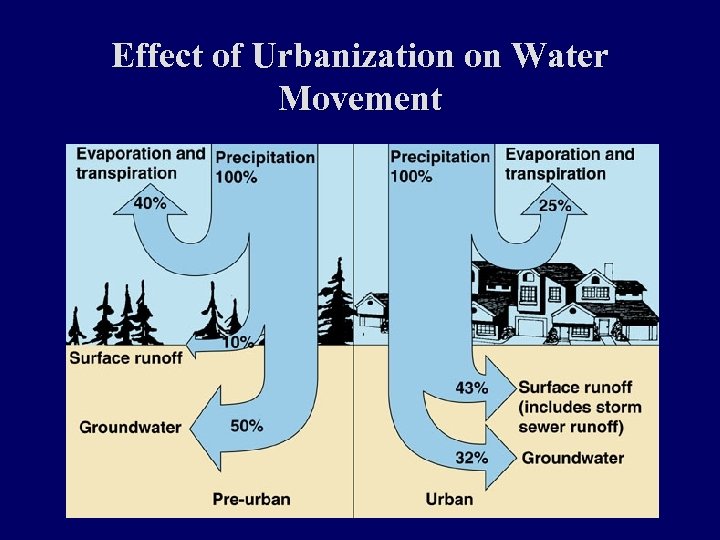 Effect of Urbanization on Water Movement
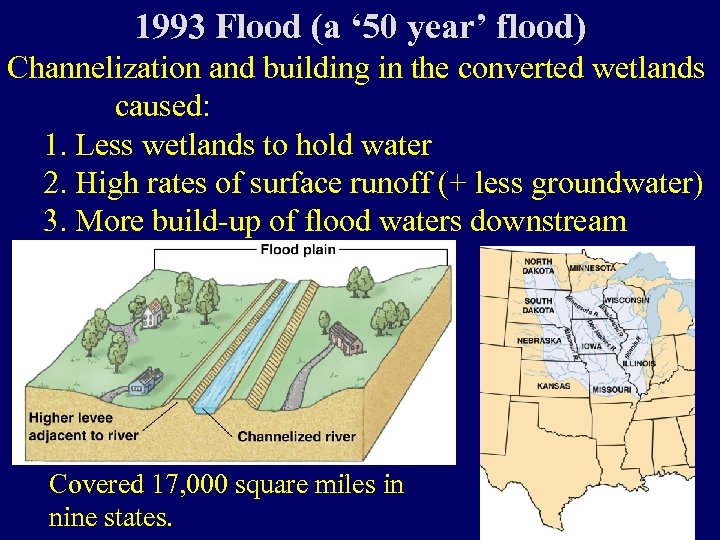 1993 Flood (a ‘ 50 year’ flood) Channelization and building in the converted wetlands caused: 1. Less wetlands to hold water 2. High rates of surface runoff (+ less groundwater) 3. More build-up of flood waters downstream Covered 17, 000 square miles in nine states.
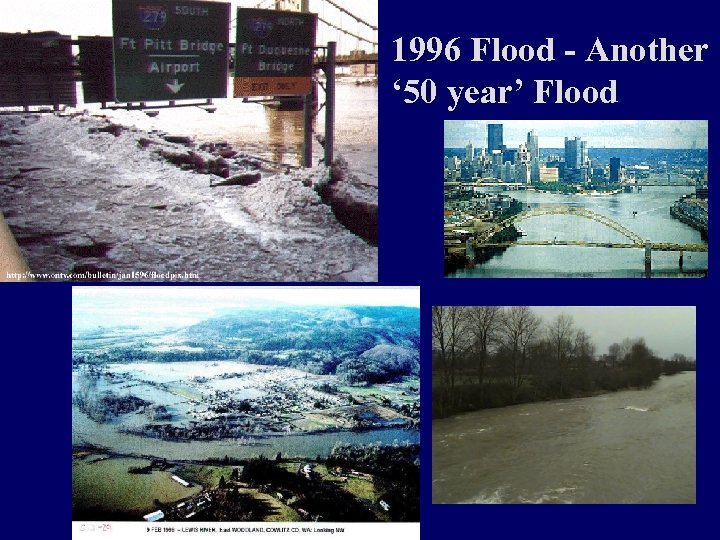 1996 Flood - Another ‘ 50 year’ Flood
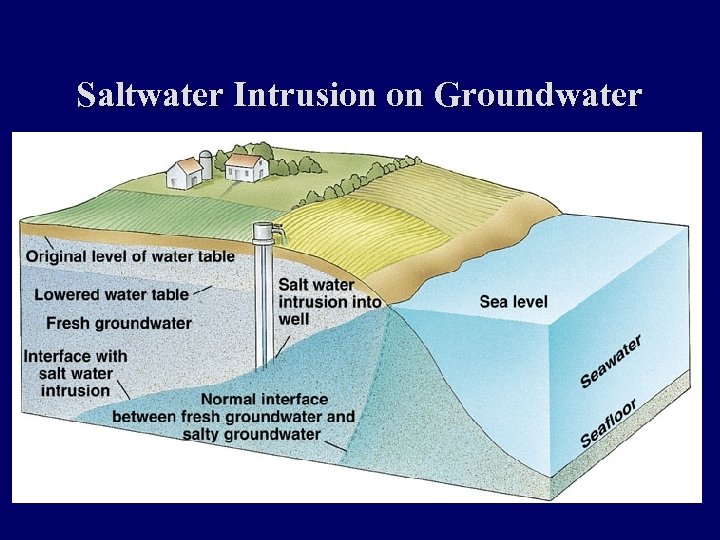 Saltwater Intrusion on Groundwater
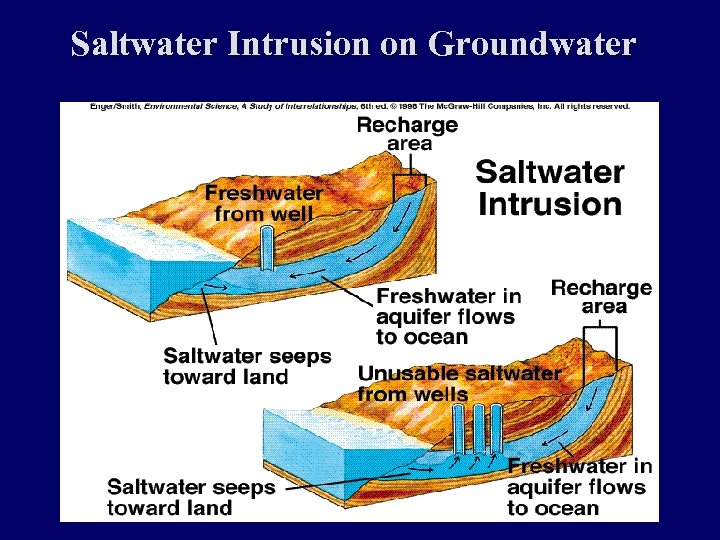 Saltwater Intrusion on Groundwater
 Water Usage Issues Important issues: How much water does each individual “need”? In what ways can we develop fresh water resources in a safe renewable manner. How can we conserve and wisely use the water resources available?
 How Much Water Is Needed Person The average person needs a minimum of 1. 3 gallons (5 liters) of water per day to survive in a moderate climate at an average activity level. The minimum amount of water needed for drinking, cooking, bathing, and sanitation is 13 gallons (50 liters).
 How Much Water Is Needed Person The average person in the United States uses between 65 to 78 gallons of water (250 to 300 liters) per day for drinking, cooking, bathing, and watering their yards. The average person in the Netherlands uses only 27 gallons (104 liters) per day for the same tasks. Many people in the poorest nations survive on far less than the recommended amount. The average person in Somalia uses only 2. 3 gallons (8. 9 liters) of water person per day.
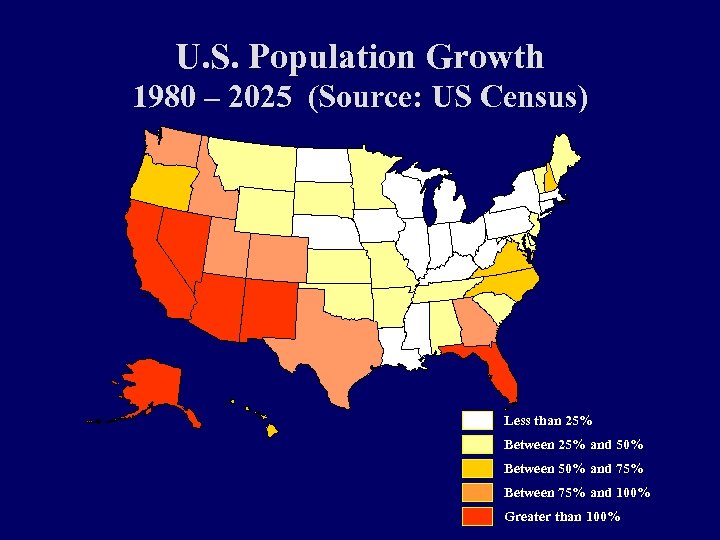 U. S. Population Growth 1980 – 2025 (Source: US Census) Less than 25% Between 25% and 50% Between 50% and 75% Between 75% and 100% Greater than 100%
 Accessing More Water Desalinization: removal of salts making water fit to drink Distillation: boiling off and collection of water. High energy input. Reverse osmosis: forcing salt water through a membrane that is permeable to water but not salt. Harvesting Icebergs: Huge amounts of fresh water are available in icebergs if they can be towed without excessive melting. Reservoirs, Canals, and Aqueducts: Refer back to earlier discussions of consequences.
 Accessing More Water Collection of moisture from fog: techniques to cause condensation of fog on surfaces that allow for collection and storage of fresh water. Collection of rainwater: collection from roof systems to supply both drinking water and bathing water.
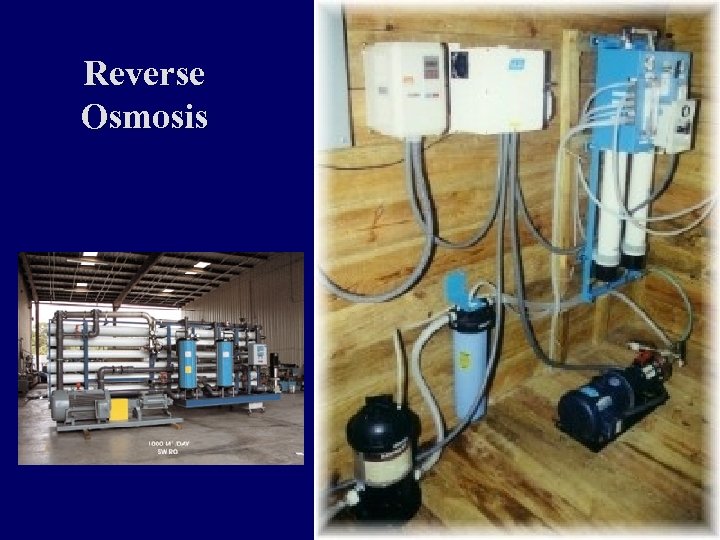 Reverse Osmosis
 Desalinization - Usage Of the more than 7, 500 desalinization plants in operation worldwide, 60% are located in the Middle East. The world's largest plant in Saudi Arabia produces 128 MGD of desalted water. In contrast, 12% of the world's capacity is produced in the Americas, with most of the plants located in the Caribbean and Florida.
 Desalinization - Byproducts Desalinization plants produce liquid wastes that may contain all or some of the following constituents: high salt concentrations, chemicals used during defouling of plant equipment and pretreatment, and toxic metals (which are most likely to be present if the discharge water was in contact with metallic materials used in construction of the plant facilities).
 Desalinization - Byproducts Liquid wastes may be discharged directly into the ocean, combined with other discharges (e. g. , power plant cooling water or sewage treatment plant effluent) before ocean discharge, discharged into a sewer for treatment in a sewage treatment plant, or dried out and disposed of in a landfill. Desalinization plants also produce a small amount of solid waste (e. g. , spent pretreatment filters and solid particles that are filtered out in the pretreatment process).
 Desalinization - Byproducts For example, the capacity of the City of Santa Barbara's desalinization plant is 7, 500 AF/yr (about 7. 16 MGD). In May 1992, the plant produced 6. 7 MGD of product water and generated 8. 2 MGD of waste brine with a salinity approximately 1. 8 times that of seawater. An additional 1. 7 MGD of brine was generated from filter backwash. Assuming that concentrations of suspended solids in the seawater feed range from 10 to 50 ppm, approximately 1. 7 to 5. 1 cubic yards per day of solids were generated, which is equivalent to one to two truckloads per week.
 Desalinization - Cost In 1991, the Metropolitan Water District (MWD) of Southern California paid $27/AF for water from the Colorado River and $195/AF for water from the California Water Project. One acre foot of water = 325, 851 gallons The cost of desalted water in Santa Barbara ($1, 900/AF) Price estimates of water produced by desalinization plants in California range from $1, 000 to $4, 000/AF.
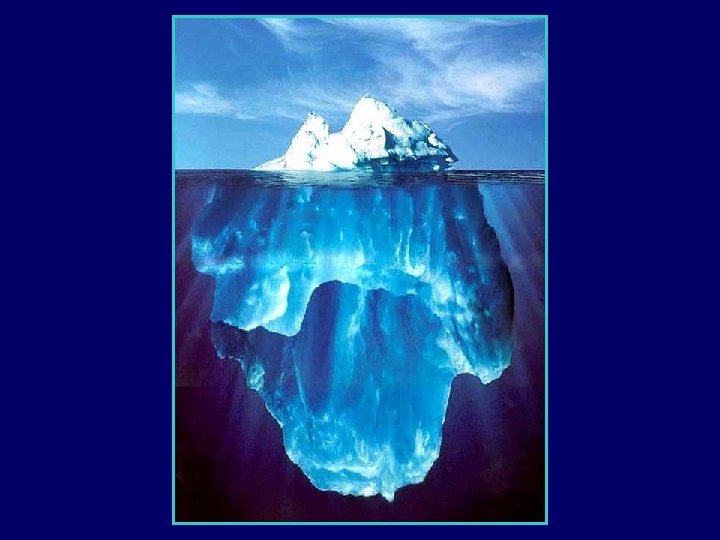
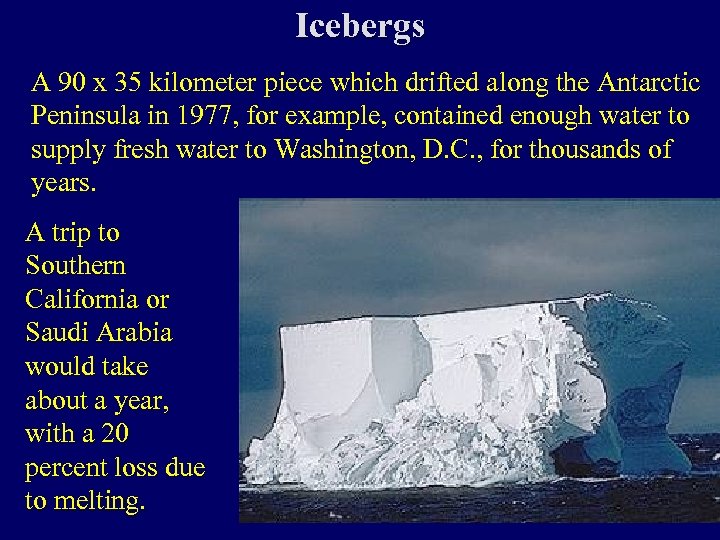 Icebergs A 90 x 35 kilometer piece which drifted along the Antarctic Peninsula in 1977, for example, contained enough water to supply fresh water to Washington, D. C. , for thousands of years. A trip to Southern California or Saudi Arabia would take about a year, with a 20 percent loss due to melting.
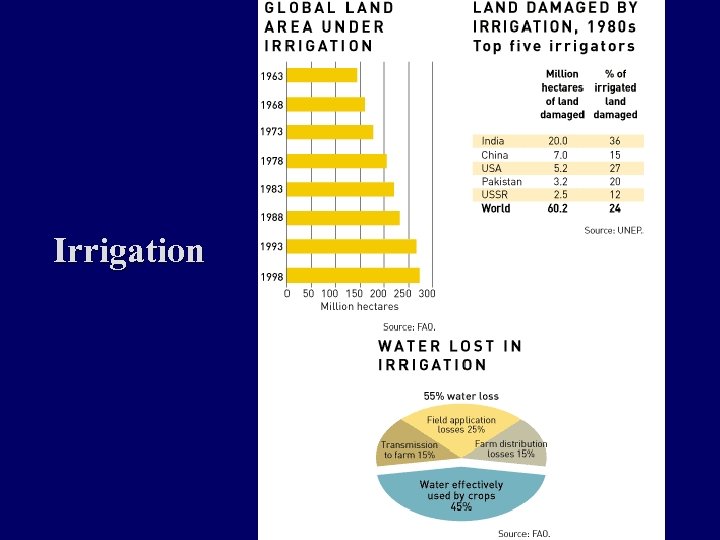 Irrigation
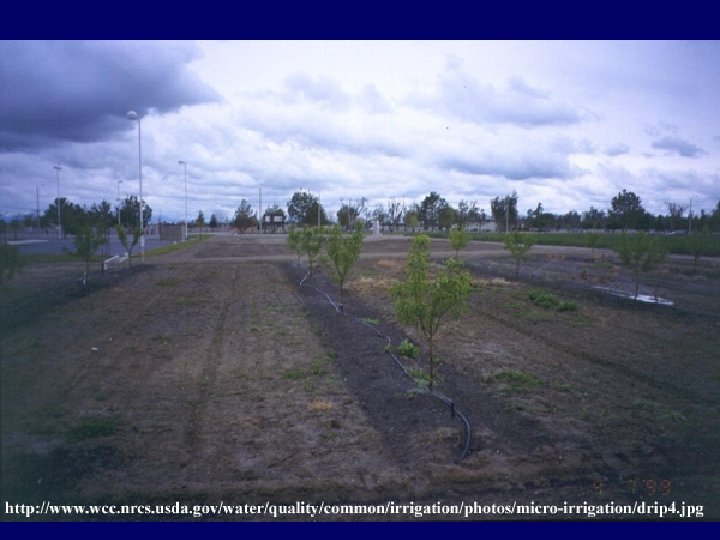
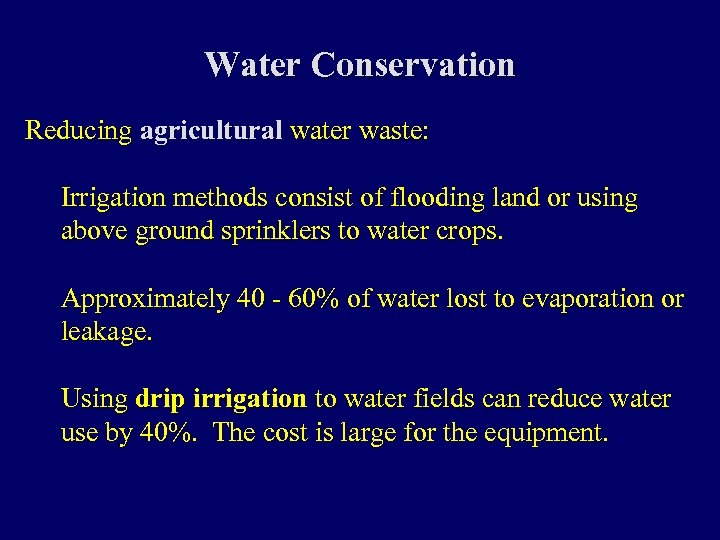 Water Conservation Reducing agricultural water waste: Irrigation methods consist of flooding land or using above ground sprinklers to water crops. Approximately 40 - 60% of water lost to evaporation or leakage. Using drip irrigation to water fields can reduce water use by 40%. The cost is large for the equipment.
 Sequential Irrigation Sequential crop irrigation farmers use agricultural drainage water from one crop, such as lettuce, to irrigate a more salt-tolerant crop, such as cotton. The water may be used once again on extremely salt-tolerant crops before the much-reduced volume of water is pumped into a comparatively small evaporation pond.
 Water Conservation Reducing industrial water waste: If returned in original quantities and without thermal shock effects. Then, use of water for cooling is a withdrawal, not consumption/degradation.
 Water Conservation Reducing residential water waste: More efficient appliances. Reduction of unneeded uses in bathing. Use of grey water Xeriscape gardening
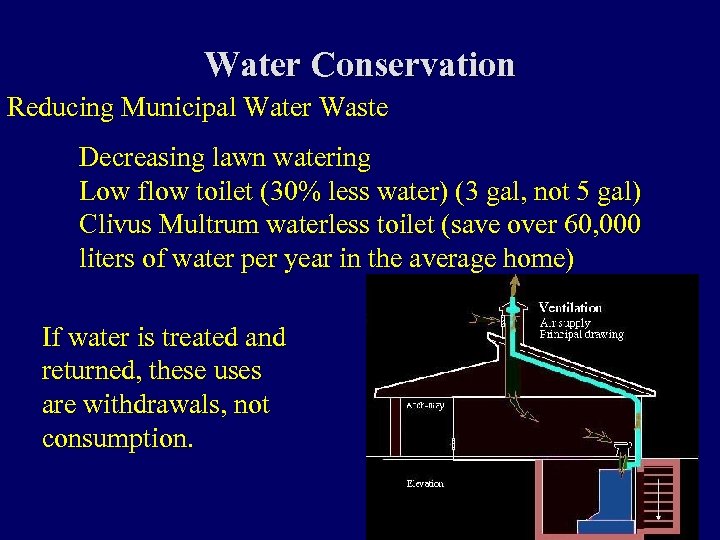 Water Conservation Reducing Municipal Water Waste Decreasing lawn watering Low flow toilet (30% less water) (3 gal, not 5 gal) Clivus Multrum waterless toilet (save over 60, 000 liters of water per year in the average home) If water is treated and returned, these uses are withdrawals, not consumption.
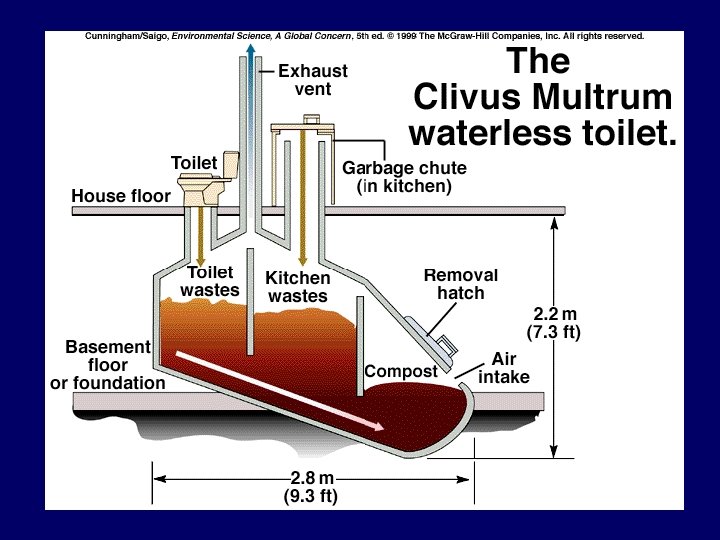
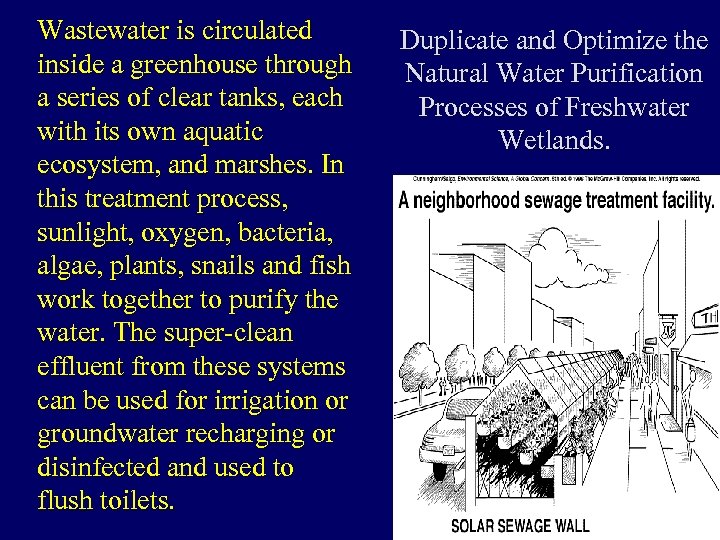 Wastewater is circulated inside a greenhouse through a series of clear tanks, each with its own aquatic ecosystem, and marshes. In this treatment process, sunlight, oxygen, bacteria, algae, plants, snails and fish work together to purify the water. The super-clean effluent from these systems can be used for irrigation or groundwater recharging or disinfected and used to flush toilets. Duplicate and Optimize the Natural Water Purification Processes of Freshwater Wetlands.
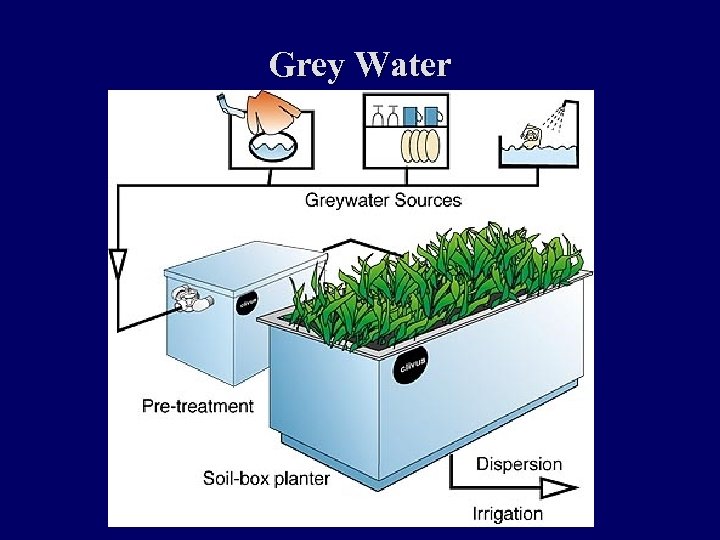 Grey Water
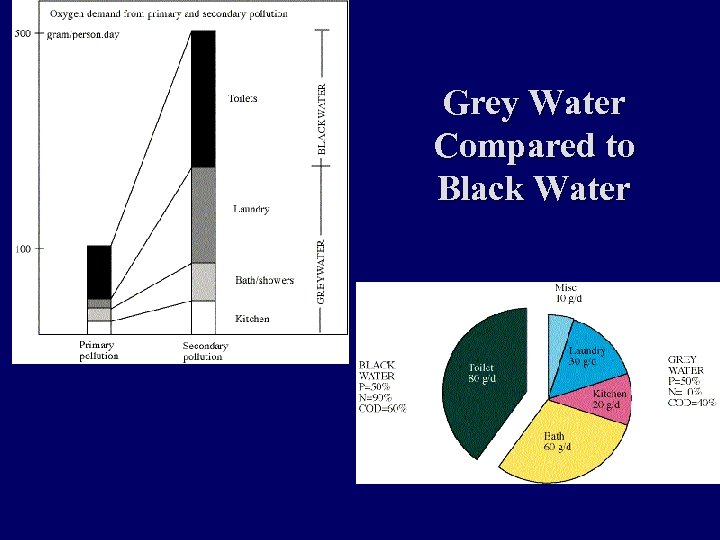 Grey Water Compared to Black Water
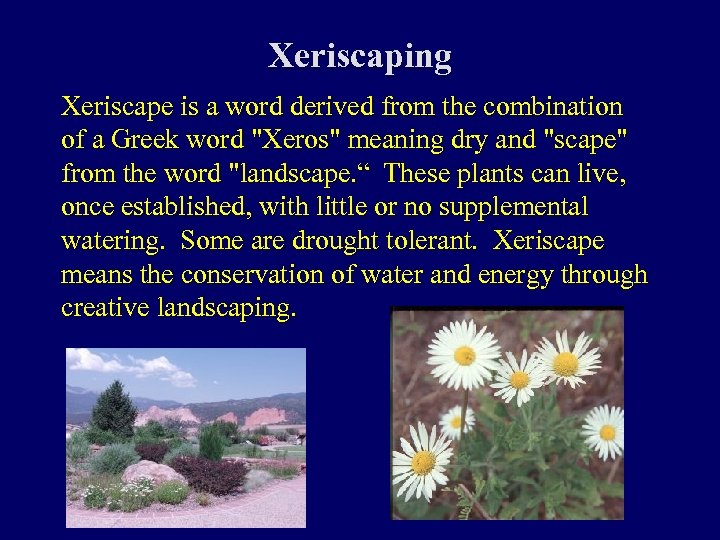 Xeriscaping Xeriscape is a word derived from the combination of a Greek word "Xeros" meaning dry and "scape" from the word "landscape. “ These plants can live, once established, with little or no supplemental watering. Some are drought tolerant. Xeriscape means the conservation of water and energy through creative landscaping.