


 Скачать презентацию Watch or warning Preferences perceptions and usage of
befb644f1ae8493be0f27372b57776d4.ppt
- Количество слайдов: 26
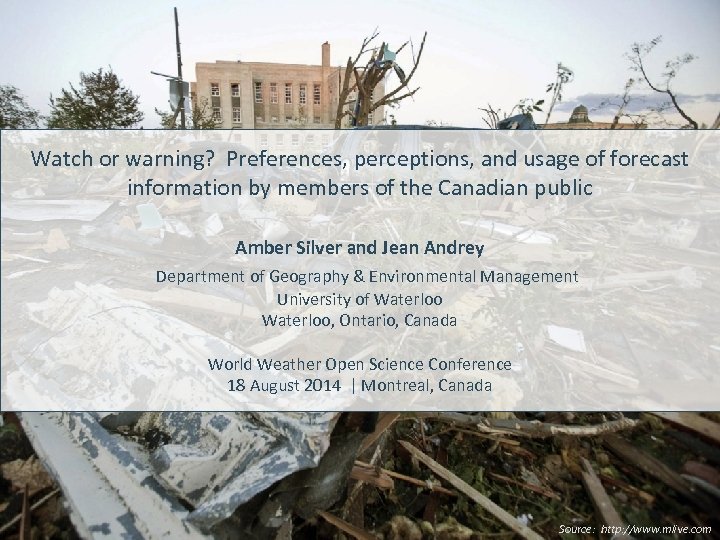 Watch or warning? Preferences, perceptions, and usage of forecast information by members of the Canadian public Amber Silver and Jean Andrey Department of Geography & Environmental Management University of Waterloo, Ontario, Canada World Weather Open Science Conference 18 August 2014 | Montreal, Canada Source: http: //www. mlive. com
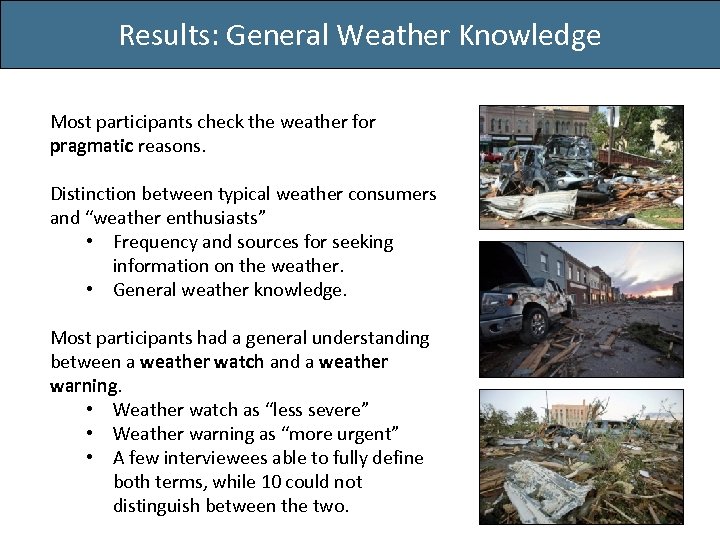
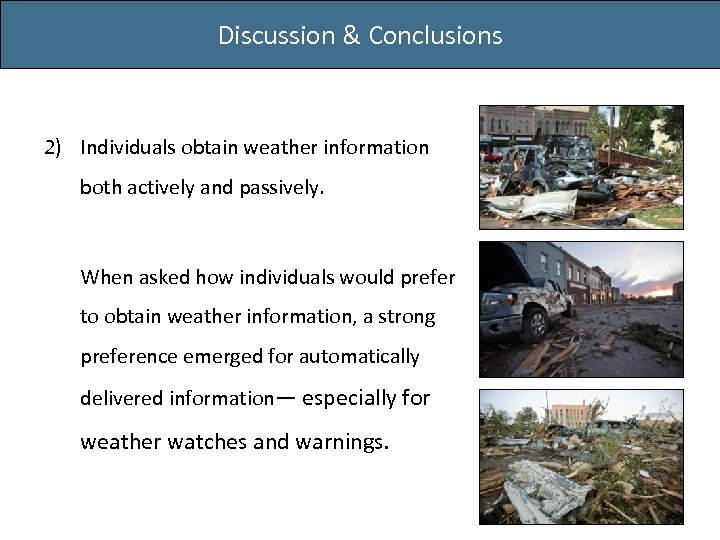
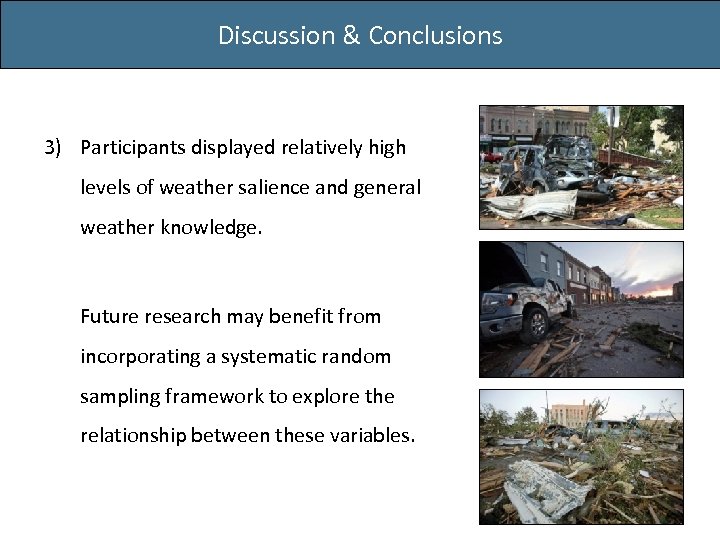
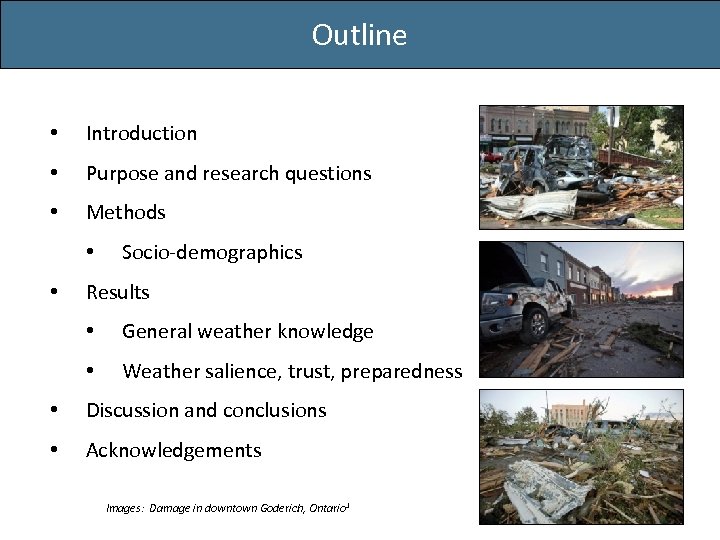 Outline • Introduction • Purpose and research questions • Methods • • Socio-demographics Results • General weather knowledge • Weather salience, trust, preparedness • Discussion and conclusions • Acknowledgements Images: Damage in downtown Goderich, Ontario 1 2
 Introduction Wide variety of weather products, including: daily forecasts, marine forecasts, special weather statements, and severe weather watches and warnings. Utilizing a complex monitoring infrastructure, forecasters develop tens of thousands of unique forecasts per day. The ultimate objective: to aid decisionmaking by end-users. 3
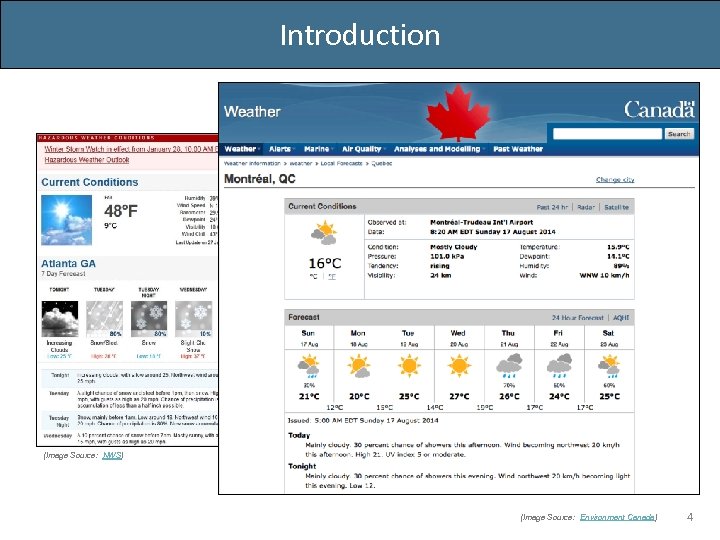 Introduction (Image Source: NWS) (Image Source: Environment Canada) 4
 Purpose & Research Questions The primary purpose of this research project was to explore the relationship between forecast perceptions, preferences, and usage. 1. From where and how often do respondents access weather information? 2. Is weather salience related to forecast perception and/or usage? 3. Are respondents typically active or passive consumers of weather information? 5
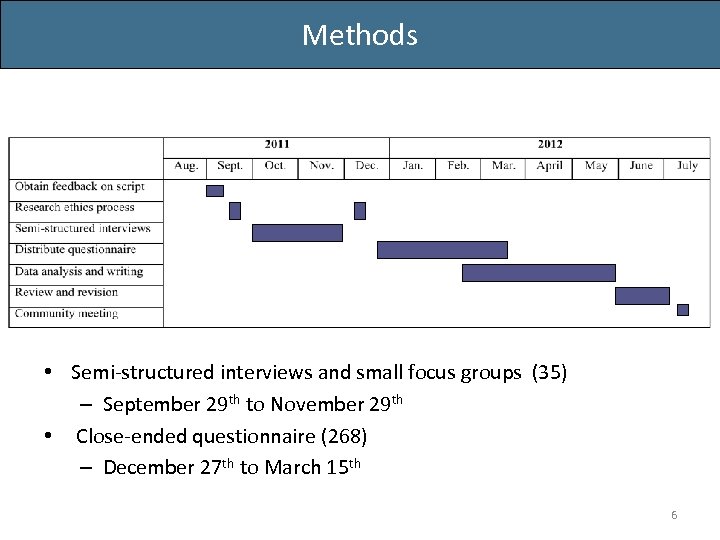 Methods • Semi-structured interviews and small focus groups (35) – September 29 th to November 29 th • Close-ended questionnaire (268) – December 27 th to March 15 th 6
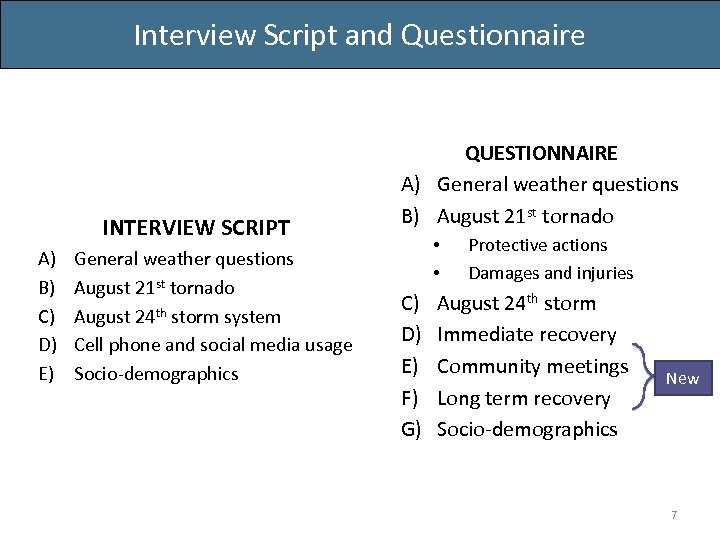 Interview Script and Questionnaire INTERVIEW SCRIPT A) B) C) D) E) General weather questions August 21 st tornado August 24 th storm system Cell phone and social media usage Socio-demographics QUESTIONNAIRE A) General weather questions B) August 21 st tornado • • C) D) E) F) G) Protective actions Damages and injuries August 24 th storm Immediate recovery Community meetings Long term recovery Socio-demographics New 7
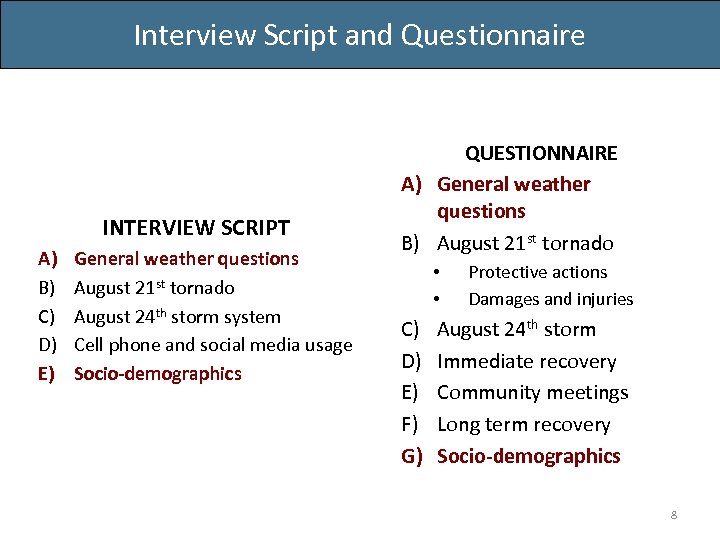 Interview Script and Questionnaire INTERVIEW SCRIPT A) B) C) D) E) General weather questions August 21 st tornado August 24 th storm system Cell phone and social media usage Socio-demographics QUESTIONNAIRE A) General weather questions B) August 21 st tornado • • C) D) E) F) G) Protective actions Damages and injuries August 24 th storm Immediate recovery Community meetings Long term recovery Socio-demographics 8
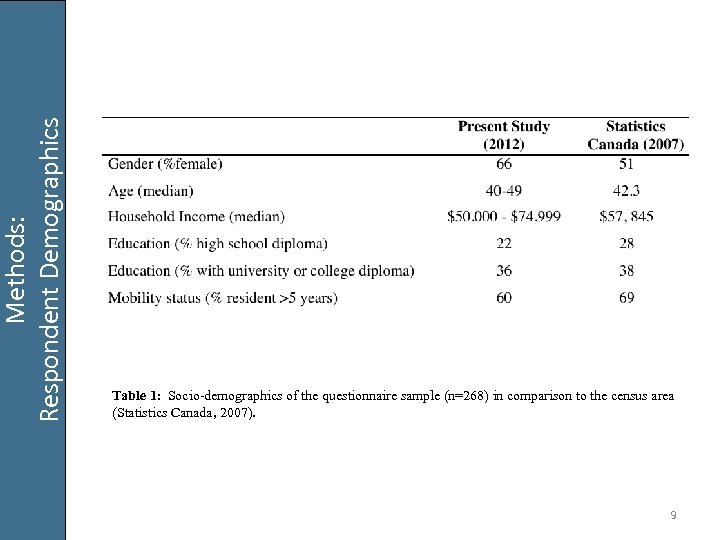 Methods: Respondent Demographics Table 1: Socio-demographics of the questionnaire sample (n=268) in comparison to the census area (Statistics Canada, 2007). 9
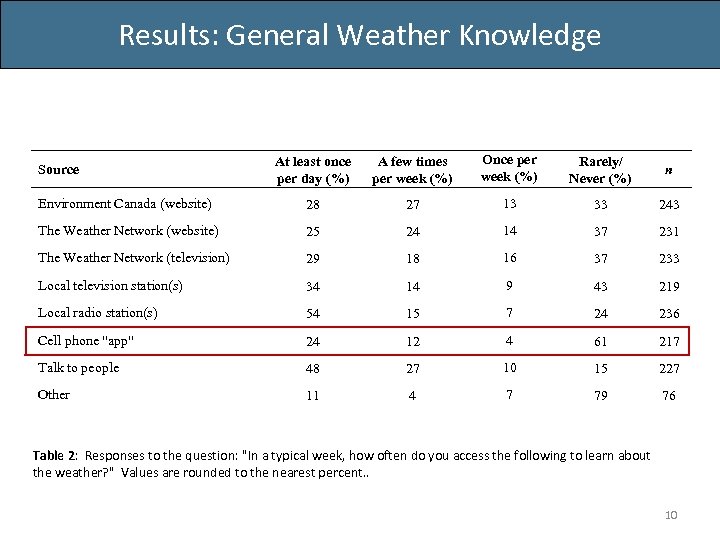 Results: General Weather Knowledge At least once per day (%) A few times per week (%) Once per week (%) Rarely/ Never (%) n Environment Canada (website) 28 27 13 33 243 The Weather Network (website) 25 24 14 37 231 The Weather Network (television) 29 18 16 37 233 Local television station(s) 34 14 9 43 219 Local radio station(s) 54 15 7 24 236 Cell phone "app" 24 12 4 61 217 Talk to people 48 27 10 15 227 Other 11 4 7 79 76 Source Table 2: Responses to the question: "In a typical week, how often do you access the following to learn about the weather? " Values are rounded to the nearest percent. . 10
 Results: General Weather Knowledge Most participants check the weather for pragmatic reasons. Distinction between typical weather consumers and “weather enthusiasts” • Frequency and sources for seeking information on the weather. • General weather knowledge. Most participants had a general understanding between a weather watch and a weather warning. • Weather watch as “less severe” • Weather warning as “more urgent” • A few interviewees able to fully define both terms, while 10 could not distinguish between the two. 11
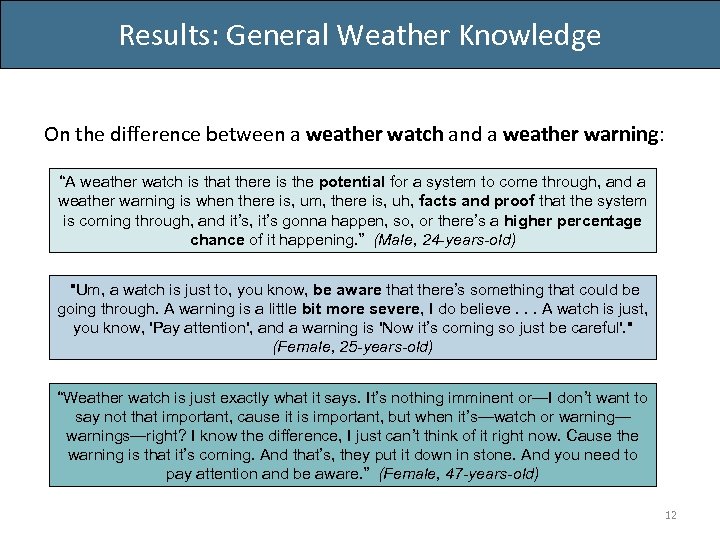 Results: General Weather Knowledge On the difference between a weather watch and a weather warning: “A weather watch is that there is the potential for a system to come through, and a weather warning is when there is, um, there is, uh, facts and proof that the system is coming through, and it’s, it’s gonna happen, so, or there’s a higher percentage chance of it happening. ” (Male, 24 -years-old) "Um, a watch is just to, you know, be aware that there’s something that could be going through. A warning is a little bit more severe, I do believe. . . A watch is just, you know, 'Pay attention', and a warning is 'Now it’s coming so just be careful'. " (Female, 25 -years-old) “Weather watch is just exactly what it says. It’s nothing imminent or—I don’t want to say not that important, cause it is important, but when it’s—watch or warning— warnings—right? I know the difference, I just can’t think of it right now. Cause the warning is that it’s coming. And that’s, they put it down in stone. And you need to pay attention and be aware. ” (Female, 47 -years-old) 12
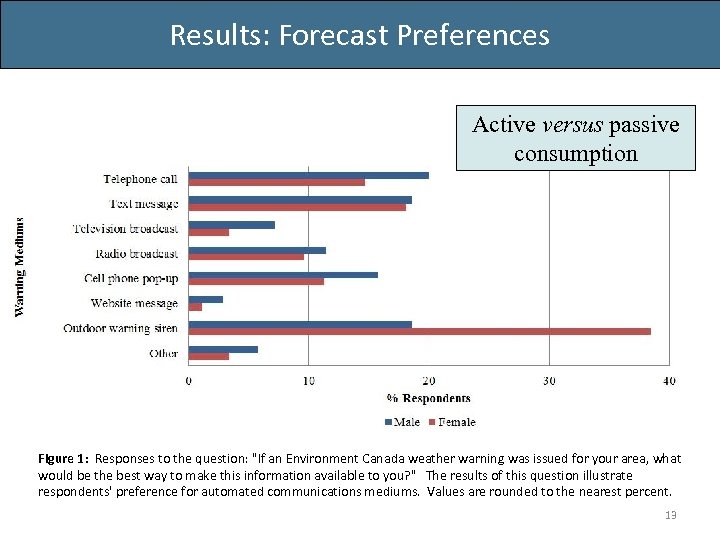 Results: Forecast Preferences Active versus passive consumption Figure 1: Responses to the question: "If an Environment Canada weather warning was issued for your area, what would be the best way to make this information available to you? " The results of this question illustrate respondents' preference for automated communications mediums. Values are rounded to the nearest percent. 13
 Results: Forecast Preferences On the best way to disseminate warning information: “So many people carry cell phones. . . There’s nothing else that in today’s society anybody carries with them, because everything else you’ve got to turn on, go seek out. If it’s a computer, you gotta turn it on or go look for it. If it’s a radio, you’ve gotta either be in your car with the radio on or, you know, in a building with that. And TV, you gotta wait for a time [that the weather is] gonna be on. A cell phone is with you no matter where you go. No matter what phone it is, [a text message] will come. " (Male, 44 -years-old) 14
 Results: Forecast Preferences On the best way to disseminate warning information: “If there was a way of bypassing with the technology we have today. Um, cell phones and phone systems, even landlines. Even televisions. If there’s a way of automatically turning a television on, even though it’s off, and I’m sure that possibility is there. And just blare a siren through the television or blare it through your landline phone. I’m sure the technology is there to do stuff like that. ” (Male, 55 -60 years old) “There’s people that are saying we should have our siren back [but] you know, I don’t agree. We can all become paranoid people and, you know, like you’re saying, get a radio that’s dedicated to Environment Canada that’s gonna tell you beep—or we can just carry on with life and deal with the blows that come, and I think we have to show some moderation on how we deal with this. ” (Female, 50 -59 years old) 15
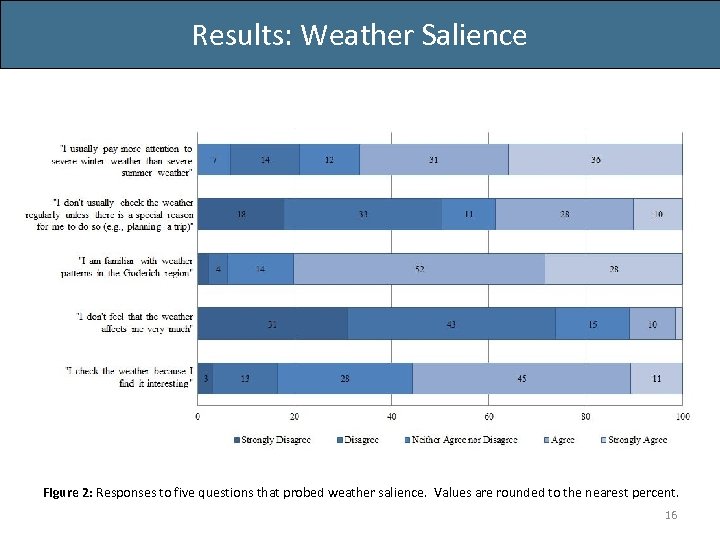 Results: Weather Salience Figure 2: Responses to five questions that probed weather salience. Values are rounded to the nearest percent. 16
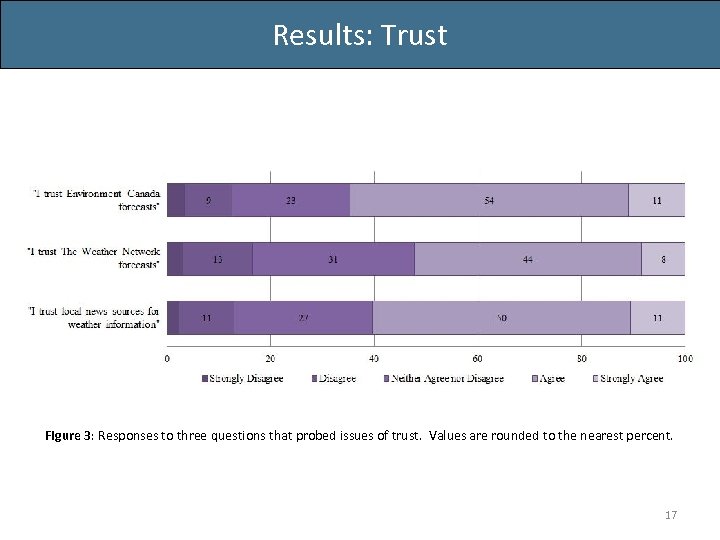 Results: Trust Figure 3: Responses to three questions that probed issues of trust. Values are rounded to the nearest percent. 17
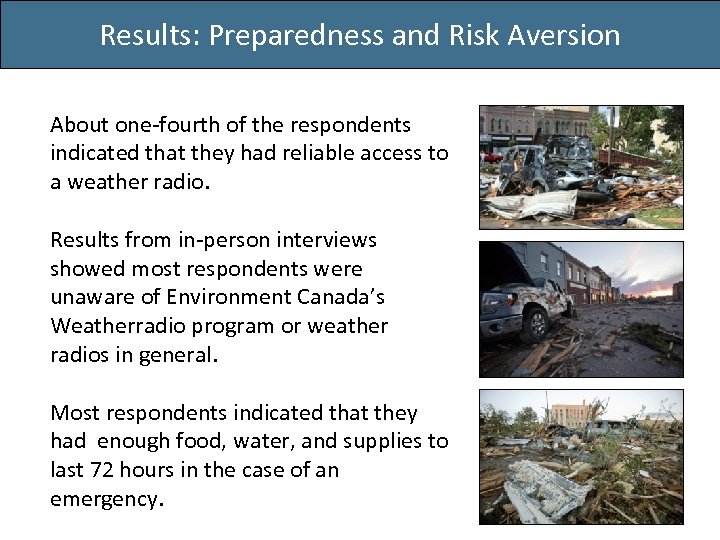 Results: Preparedness and Risk Aversion About one-fourth of the respondents indicated that they had reliable access to a weather radio. Results from in-person interviews showed most respondents were unaware of Environment Canada’s Weatherradio program or weather radios in general. Most respondents indicated that they had enough food, water, and supplies to last 72 hours in the case of an emergency. 18
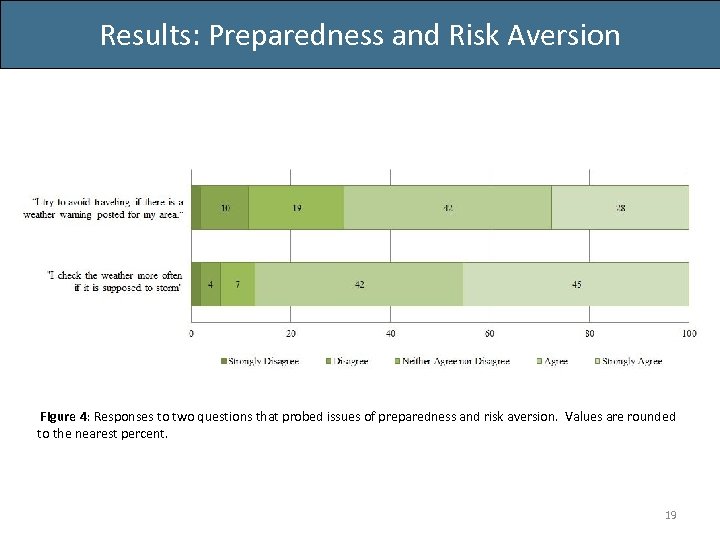 Results: Preparedness and Risk Aversion Figure 4: Responses to two questions that probed issues of preparedness and risk aversion. Values are rounded to the nearest percent. 19
 Discussion & Conclusions 1) End-users interact with weather information in a variety of complex ways. In particular, socio-demographic and contextual factors influence whether and how individuals access weather information. 20
 Discussion & Conclusions 2) Individuals obtain weather information both actively and passively. When asked how individuals would prefer to obtain weather information, a strong preference emerged for automatically delivered information— especially for weather watches and warnings. 21
 Discussion & Conclusions 3) Participants displayed relatively high levels of weather salience and general weather knowledge. Future research may benefit from incorporating a systematic random sampling framework to explore the relationship between these variables. 22
 Forthcoming Contributions Silver, A. (2014). Watch or warning? Perceptions, preferences, and usage of forecast information by members of the Canadian public. Meteorological Applications DOI: 10. 1002/met. 1452 Silver, A. and J. Andrey. (2014). The influence of previous disaster experience and socio-demographics on protective behaviors during two successive tornado events. Weather, Climate, and Society 6(1): 91 -103. Silver, A. and J. Grek-Martin. (Under review). “Now we understand what ‘community’ really means”: Exploring the positive and negative impacts of disaster on place attachments. The Journal of Environmental Psychology. 23
 Acknowledgements I would like to thank the following individuals and organizations for their generous assistance and support with this research: Goderich Public Library Goderich Ontario Tornado Victims and Support Goderich Tornado Clean-Up Hub SAVE DOWNTOWN GODERICH Goderich Trees Project 104. 9 The Beach Goderich Signal Star Newspaper Institute for Catastrophic Loss Reduction Richard Stewart Francesca Dobbyn Luke Elliott Jody Armstead 24
 Thank-you! Questions? Amber Silver a 2 silver@uwaterloo. ca 25
 References Conrad C. 2009. Severe and Hazardous Weather in Canada: the Geography of Extreme Events. Oxford University Press: Toronto. 205 pp. Environment Canada. 2011 b. Summer hazards. Accessed on-line on 1 May, 2012 at: http: //www. ec. gc. ca/ Sills, D. and A. Ashton, 2012: Examination of a remarkable Great Lakespawned tornadic supercell: the 2011 Goderich Ontario F 3 tornado event. Preprints, 26 th AMS Conference on Severe Local Storms, Nashville, TN, Amer. Meteorol. Soc. , Paper 6. 4. Stockton A. 2011. F 3 tornado aftermath in Goderich: like a war zone. Accessed on 2 May, 2012 at: http: //www. theweathernetwork. com/ 26