


 Скачать презентацию Watch Listen Learn Co-training on Captioned Images
1efdac0787b56799f592501fdf7cd10a.ppt
- Количество слайдов: 49
 Watch, Listen & Learn: Co-training on Captioned Images and Videos Sonal Gupta, Joohyun Kim, Kristen Grauman, Raymond Mooney The University of Texas at Austin, U. S. A.
 Outline Introduction Motivation Approach How does Co-training work? Experimental Evaluation Conclusions 2 The University of Texas at Austin
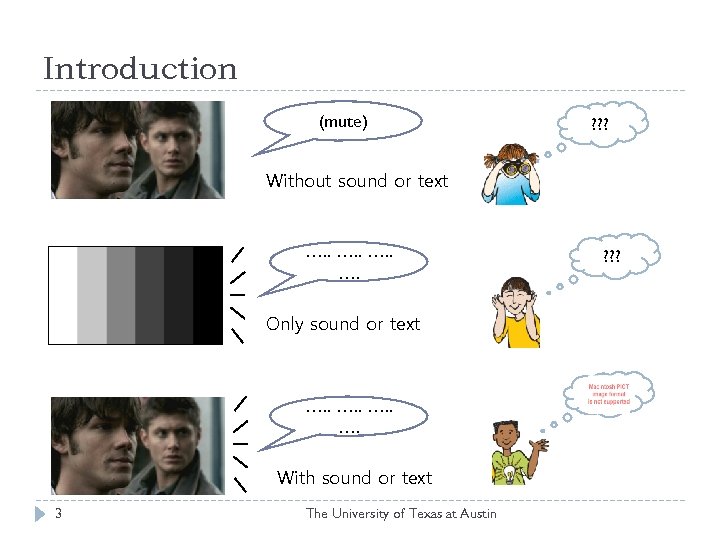 Introduction (mute) ? ? ? Without sound or text …. Only sound or text …. With sound or text 3 The University of Texas at Austin ? ? ?
 Motivation Image Recognition & Human Activity Recognition in Videos Hard to classify, ambiguous visual cues Expensive to manually label instances Often images and videos have text captions Leverage multi-modal data Use readily available unlabeled data to improve accuracy 4 The University of Texas at Austin
 Goals Classify images and videos with the help of visual information and associated text captions Use unlabeled image and video examples 5 The University of Texas at Austin
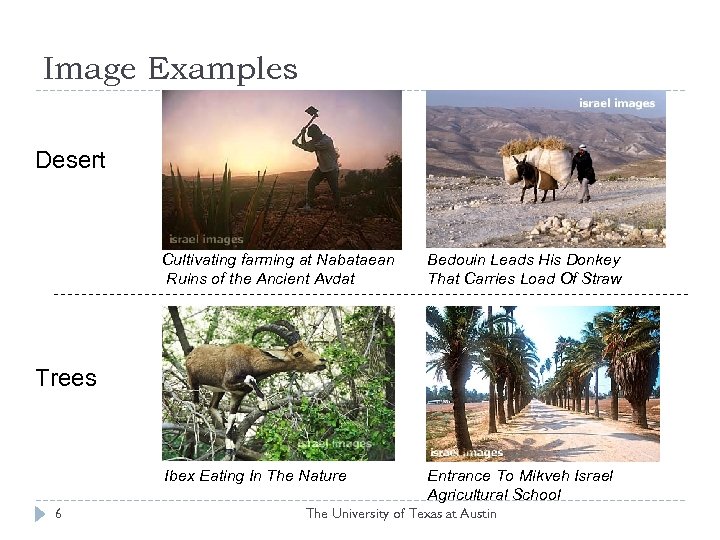 Image Examples Desert Cultivating farming at Nabataean Ruins of the Ancient Avdat Bedouin Leads His Donkey That Carries Load Of Straw Ibex Eating In The Nature Entrance To Mikveh Israel Agricultural School Trees 6 The University of Texas at Austin
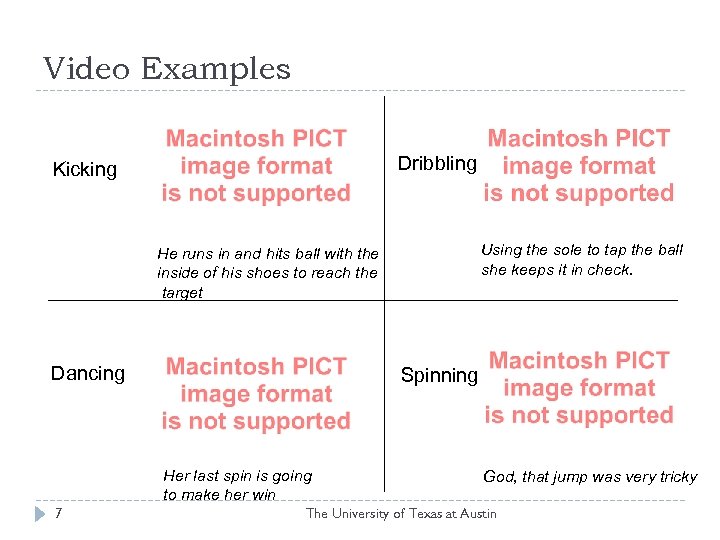 Video Examples Dribbling Kicking Using the sole to tap the ball she keeps it in check. He runs in and hits ball with the inside of his shoes to reach the target Dancing Spinning Her last spin is going to make her win 7 God, that jump was very tricky The University of Texas at Austin
 Related Work Images + Text Barnard et al. (JLMR 03) and Duygulu et al. (ECCV 02) generated models to annotate image regions with words. Bekkerman and Jeon (CVPR 07) exploited multi-modal information to cluster images with captions Quattoni et al. (CVPR 07) used unlabeled images with captions to improve learning in future image classification problems with no associated captions Videos + Text 8 Wang et al. (MIR 07) used co-training to combine visual and textual ‘concepts’ to categorize TV ads. , retrieved text using OCR and used external sources to expand the textual features. Everingham et al. (BMVC 06) used visual information, closed-captioned text, and movie scripts to annotate faces Fleischman and Roy (NAACL 07) text commentary and motion description used in baseball games to retrieve relevant video clips given text query The University of Texas at Austin
 Outline Introduction Motivation Approach How does Co-training work? Experimental Evaluation Conclusions 9 The University of Texas at Austin
 Approach Combining two views of images and videos using Co-training (Blum and Mitchell ‘ 98) learning algorithm Views: Text and Visual Text View Caption of image or video Readily available Visual View Color, texture, temporal information in image/video 10 The University of Texas at Austin
 Outline Introduction Motivation Approach How does Co-training work? Experimental Evaluation Conclusions 11 The University of Texas at Austin
 Co-training • Semi-supervised learning paradigm that exploits two mutually independent and sufficient views • Features of dataset can be divided into two sets: – – • The instance space: Each example: Proven to be effective in several domains – – 12 Web page classification (content and hyperlink) E-mail classification (header and body) The University of Texas at Austin
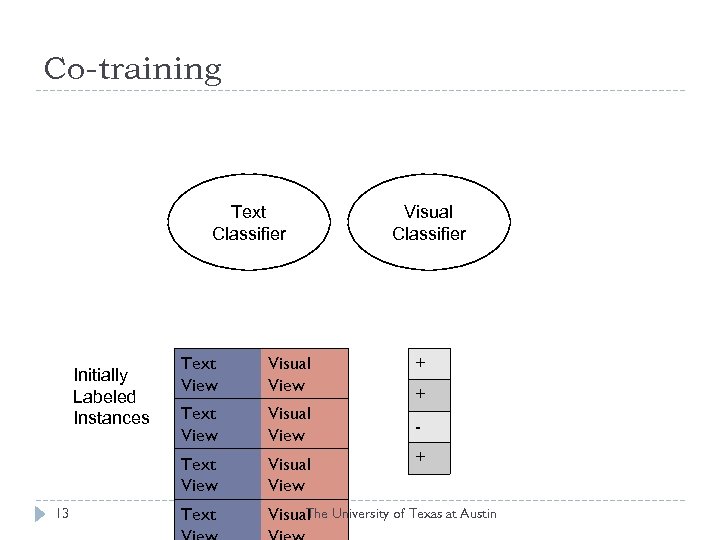 Co-training Text Classifier Visual Classifier 13 Text View Visual View Text View Initially Labeled Instances + Visual View Text The Visual University of Texas at Austin + +
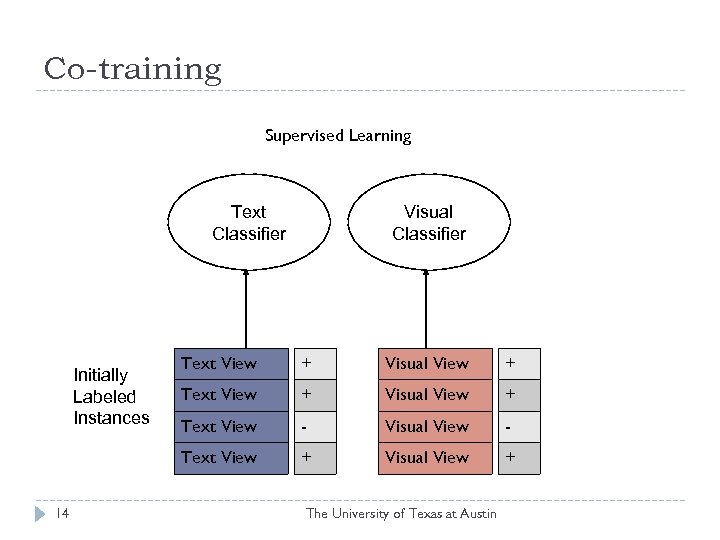 Co-training Supervised Learning Text Classifier Visual Classifier 14 Text View + Visual View + Text View - Visual View - Text View Initially Labeled Instances + Visual View + The University of Texas at Austin
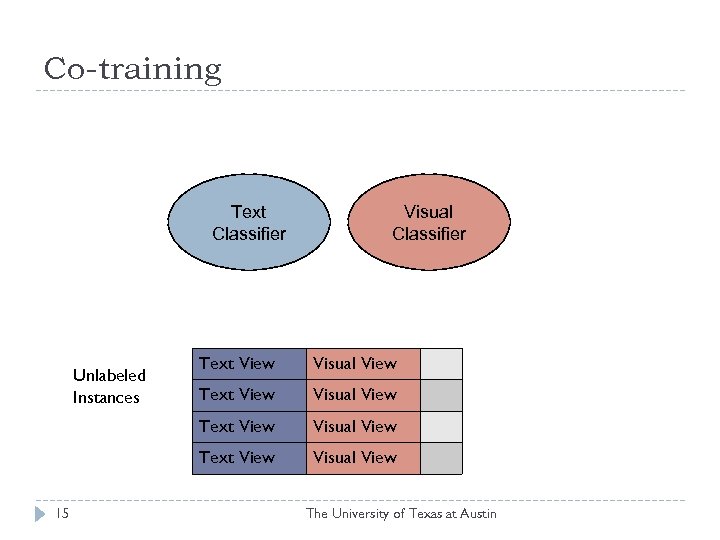 Co-training Text Classifier Visual View Text View 15 Text View Unlabeled Instances Visual View The University of Texas at Austin
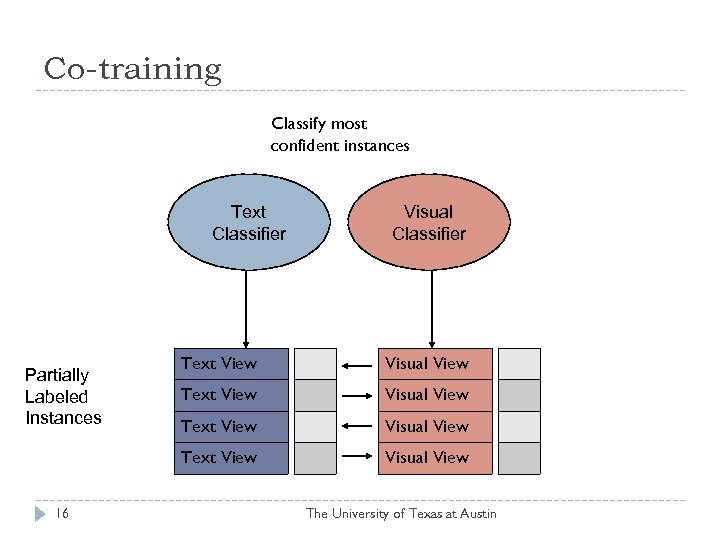 Co-training Classify most confident instances Text Classifier Partially Labeled Instances Text View Visual View + Text View 16 Visual Classifier Visual View - + Visual View The University of Texas at Austin -
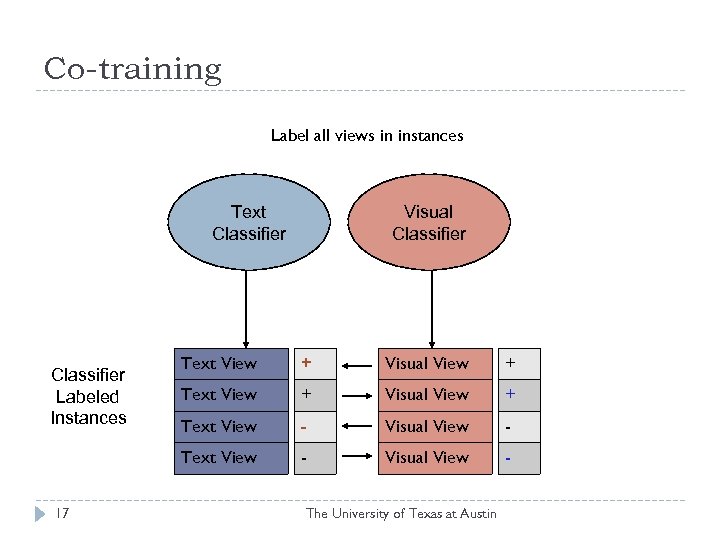 Co-training Label all views in instances Text Classifier Visual Classifier 17 Text View + Visual View + Text View - Visual View - Text View Classifier Labeled Instances - Visual View - The University of Texas at Austin
 Co-training Retrain Classifiers Text Classifier Visual Classifier Text View Visual View + Text View + Visual View + Text View - Visual View - Text View 18 + - Visual View - The University of Texas at Austin
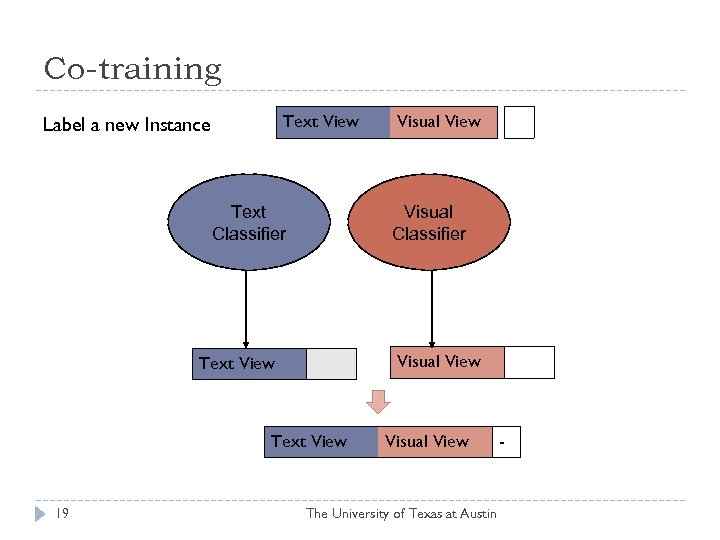 Co-training Text View Label a new Instance Text Classifier Text View Visual Classifier + - Text View 19 Visual View +- Visual View The University of Texas at Austin -
 Features Visual Features Image Features Video features Textual features 20 The University of Texas at Austin
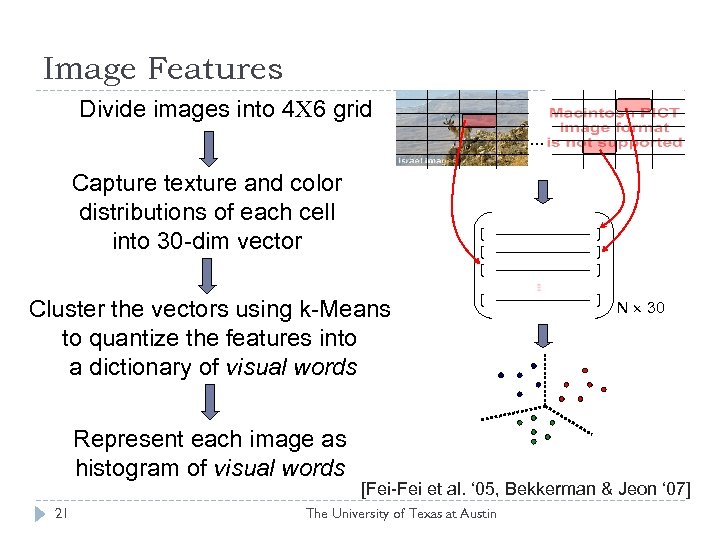 Image Features Divide images into 4 6 grid … Capture texture and color distributions of each cell into 30 -dim vector Cluster the vectors using k-Means to quantize the features into a dictionary of visual words Represent each image as histogram of visual words 21 N 30 [Fei-Fei et al. ‘ 05, Bekkerman & Jeon ‘ 07] The University of Texas at Austin
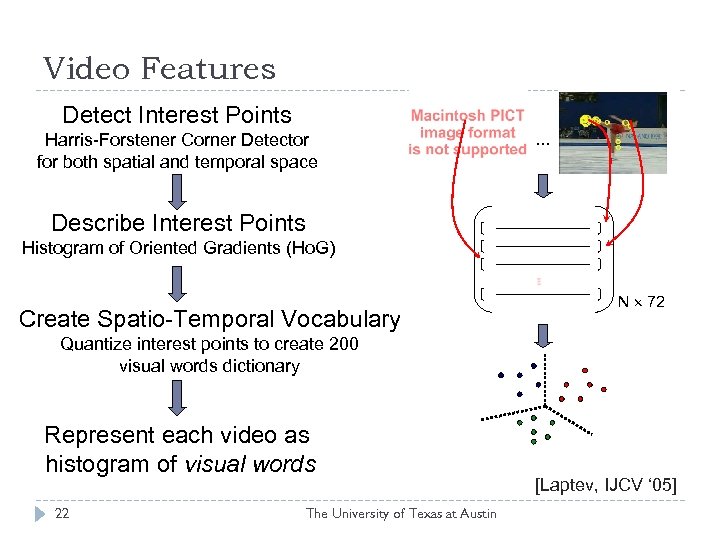 Video Features Detect Interest Points Harris-Forstener Corner Detector for both spatial and temporal space … Describe Interest Points Histogram of Oriented Gradients (Ho. G) Create Spatio-Temporal Vocabulary N 72 Quantize interest points to create 200 visual words dictionary Represent each video as histogram of visual words 22 The University of Texas at Austin [Laptev, IJCV ‘ 05]
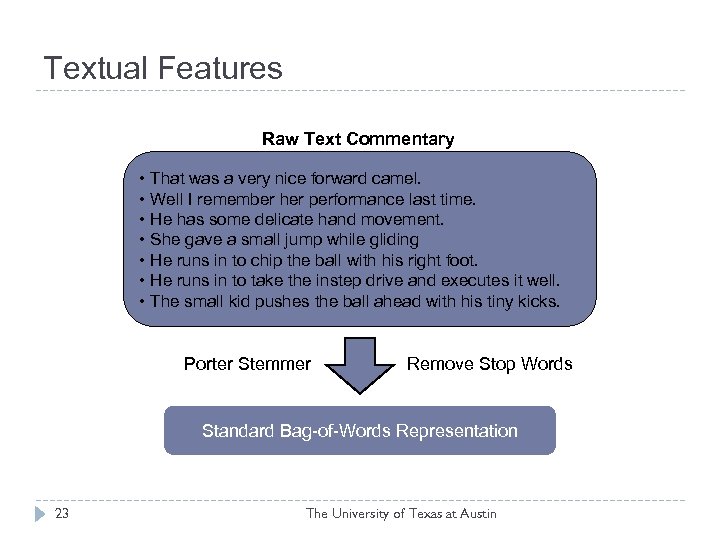 Textual Features Raw Text Commentary • That was a very nice forward camel. • Well I remember her performance last time. • He has some delicate hand movement. • She gave a small jump while gliding • He runs in to chip the ball with his right foot. • He runs in to take the instep drive and executes it well. • The small kid pushes the ball ahead with his tiny kicks. Porter Stemmer Remove Stop Words Standard Bag-of-Words Representation 23 The University of Texas at Austin
 Outline Introduction Motivation Approach How does Co-training work? Experimental Evaluation Conclusions 24 The University of Texas at Austin
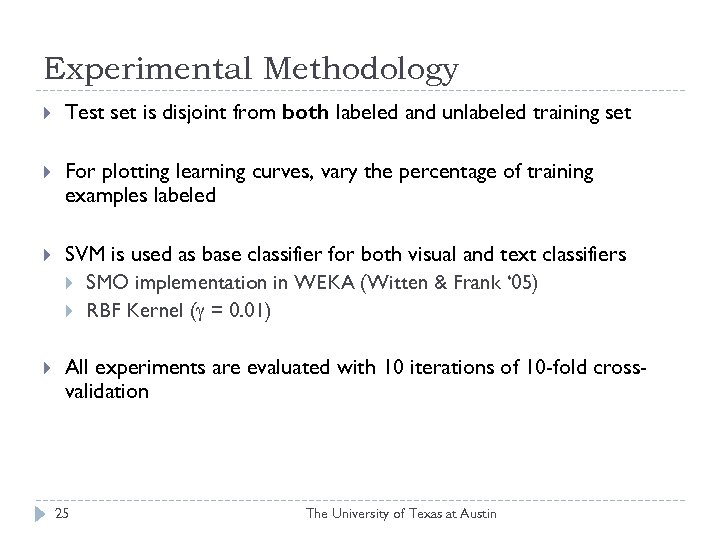 Experimental Methodology Test set is disjoint from both labeled and unlabeled training set For plotting learning curves, vary the percentage of training examples labeled SVM is used as base classifier for both visual and text classifiers SMO implementation in WEKA (Witten & Frank ‘ 05) RBF Kernel ( = 0. 01) All experiments are evaluated with 10 iterations of 10 -fold crossvalidation 25 The University of Texas at Austin
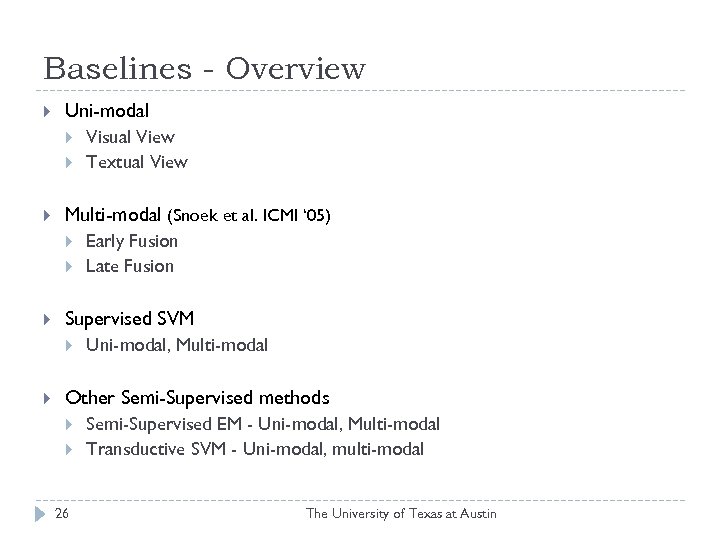 Baselines - Overview Uni-modal Multi-modal (Snoek et al. ICMI ‘ 05) Early Fusion Late Fusion Supervised SVM Visual View Textual View Uni-modal, Multi-modal Other Semi-Supervised methods 26 Semi-Supervised EM - Uni-modal, Multi-modal Transductive SVM - Uni-modal, multi-modal The University of Texas at Austin
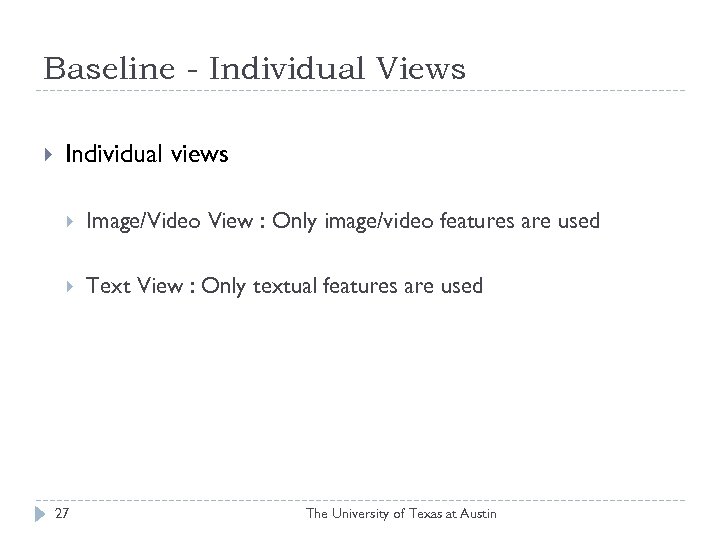 Baseline - Individual Views Individual views Image/Video View : Only image/video features are used Text View : Only textual features are used 27 The University of Texas at Austin
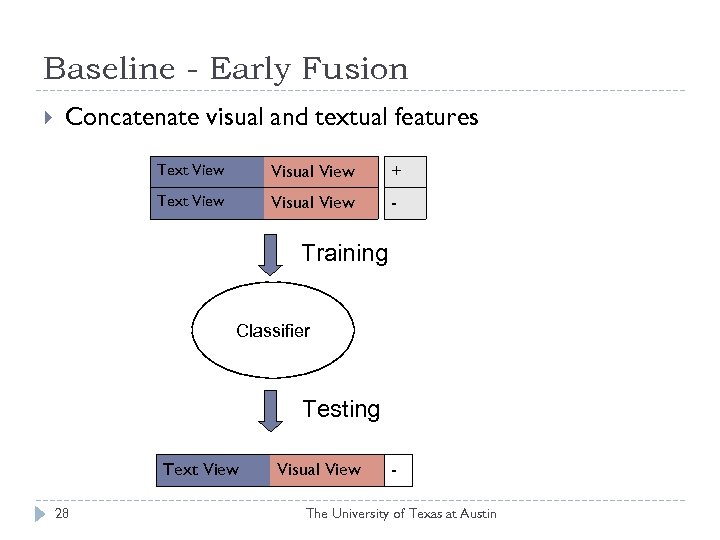 Baseline - Early Fusion Concatenate visual and textual features Text View Visual View + Text View Visual View - Training Classifier Testing Text View 28 Visual View - The University of Texas at Austin
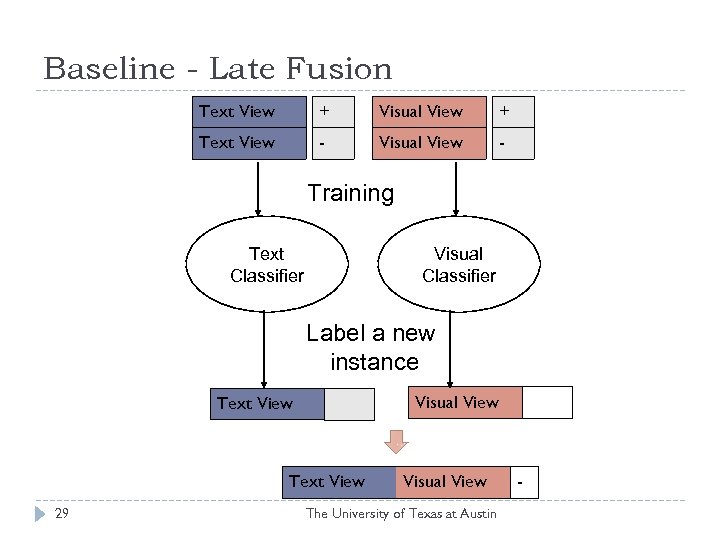 Baseline - Late Fusion Text View + Visual View + Text View - Visual View - Training Text Classifier Visual Classifier Label a new instance Text View + - Text View 29 +- Visual View The University of Texas at Austin -
 Baseline - Other Semi-Supervised Expectation Maximization (Semi. Sup EM) Introduced by Nigam et al. CIKM ‘ 00 Used Naïve bayes as the base classifier Transductive SVM in Semi-Supervised setting 30 Introduced by Joachims ICML ‘ 99, Bennett & Demiriz ANIPS ‘ 99 The University of Texas at Austin
 Image Dataset Our image data is taken from the Israel dataset & Jeon CVPR ‘ 07, www. israelimages. com) Consists of images with short text captions Used two classes, Desert and Trees A total of 362 instances 31 The University of Texas at Austin (Bekkerman
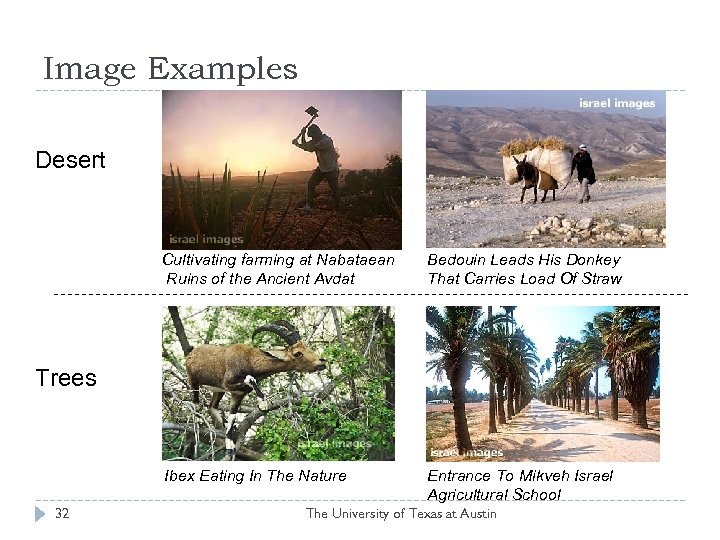 Image Examples Desert Cultivating farming at Nabataean Ruins of the Ancient Avdat Bedouin Leads His Donkey That Carries Load Of Straw Ibex Eating In The Nature Entrance To Mikveh Israel Agricultural School Trees 32 The University of Texas at Austin
 Results Co-training v. Supervised SVM Co-training. SVM Text View SVM Late Fusion SVM Image View 33 SVM Early Fusion The University of Texas at Austin
 Results Co-training v. Supervised SVM ~5% ~7% ~12% 34 The University of Texas at Austin
 Results Co-training v. Semi-Supervised EM Semi. Sup. Co-training Semi. Sup. EM Image View 35 EM Text View Semi. Sup. EM Early Fusion Semi. Sup. EM Late Fusion The University of Texas at Austin
 Results Co-training v. Semi-Supervised EM ~7% 36 The University of Texas at Austin
 Results Co-training v. Transductive SVM ~4% 37 The University of Texas at Austin
 Video Dataset Manually collected video clips of Manually commented the clips Significant variation in the size of the person across the clips Number of clips kicking and dribbling from soccer game DVDs dancing and spinning from figure skating DVDs dancing: 59, spinning: 47, dribbling: 55 and kicking: 60 The video clips 38 resized to 240 x 360 resolution length varies from 20 to 120 frames The University of Texas at Austin
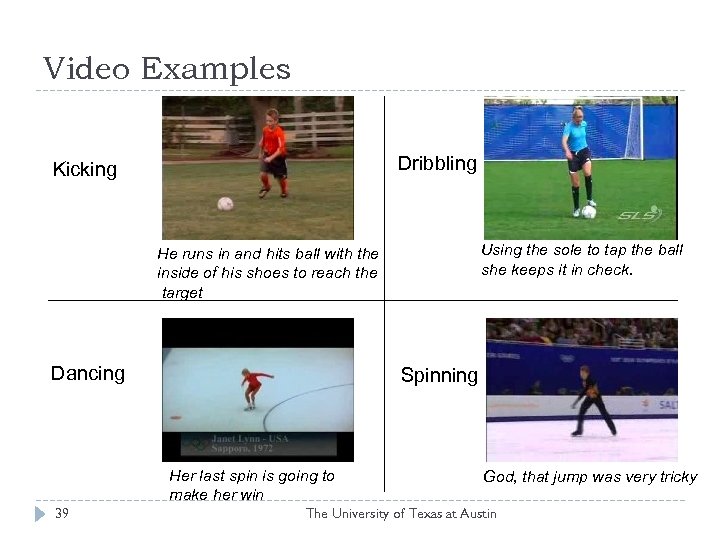 Video Examples Dribbling Kicking Using the sole to tap the ball she keeps it in check. He runs in and hits ball with the inside of his shoes to reach the target Dancing Spinning Her last spin is going to make her win 39 God, that jump was very tricky The University of Texas at Austin
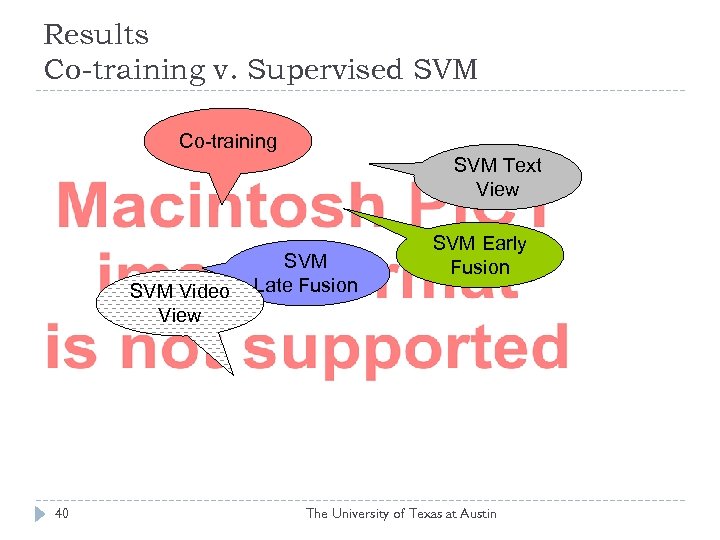 Results Co-training v. Supervised SVM Co-training SVM Text View SVM Video View 40 SVM Late Fusion SVM Early Fusion The University of Texas at Austin
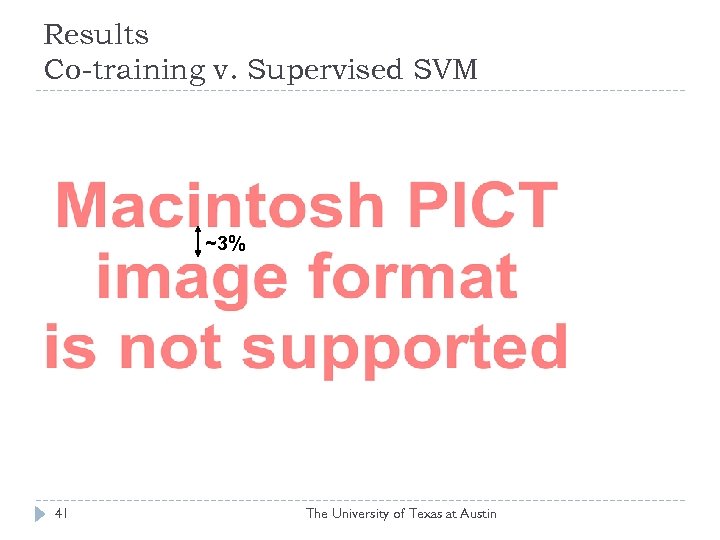 Results Co-training v. Supervised SVM ~3% 41 The University of Texas at Austin
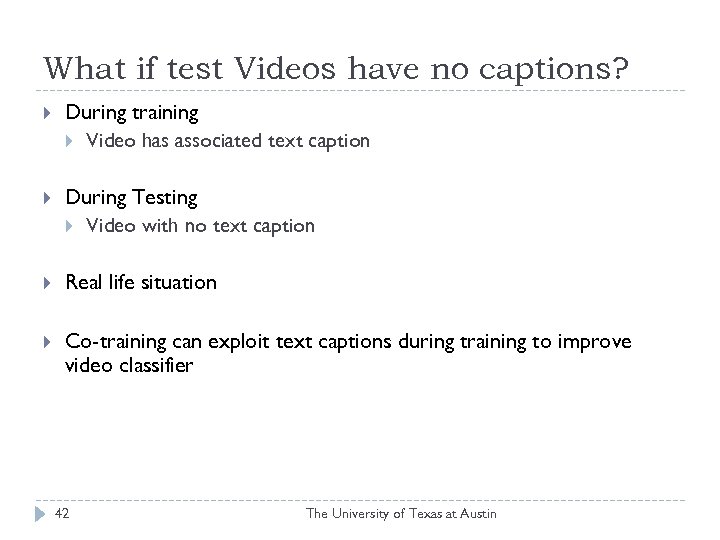 What if test Videos have no captions? During training Video has associated text caption During Testing Video with no text caption Real life situation Co-training can exploit text captions during training to improve video classifier 42 The University of Texas at Austin
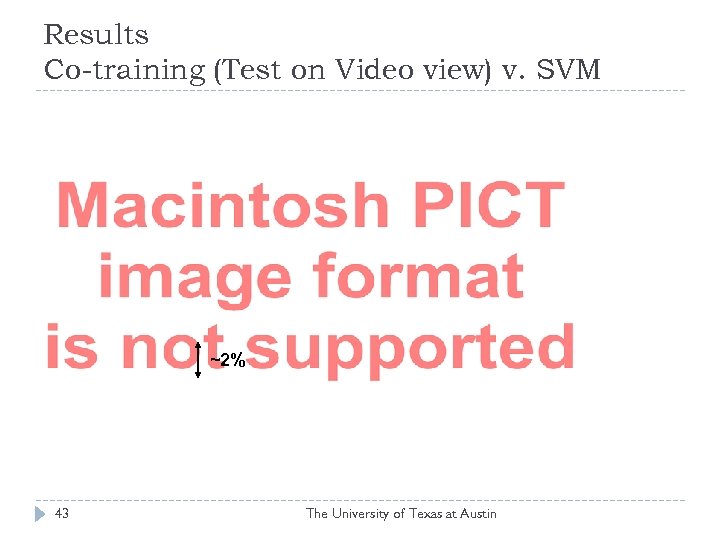 Results Co-training (Test on Video view) v. SVM ~2% 43 The University of Texas at Austin
 Conclusion Combining textual and visual features can help improve accuracy Co-training can be useful to combine textual and visual features to classify images and videos Co-training helps in reducing labeling of images and videos [More information on http: //www. cs. utexas. edu/users/ml/co-training] 44 The University of Texas at Austin
 Questions? 45 The University of Texas at Austin
 References Bekkerman et al. Multi-way distributional clustering, ICML 2005 Blum and Mitchell, Combining labeled and unlabeled data with co-training, COLT 1998 Laptev, On space-time interest points, IJCV 2005 Weka Data Mining Tool (Witten and Frank) 46 The University of Texas at Austin
 Dataset Details Image: k=25 for k-Means Number of textual features - 363 Video: 47 Most clips 20 to 40 frames k=200 in k-Means Number of textual features - 381 The University of Texas at Austin
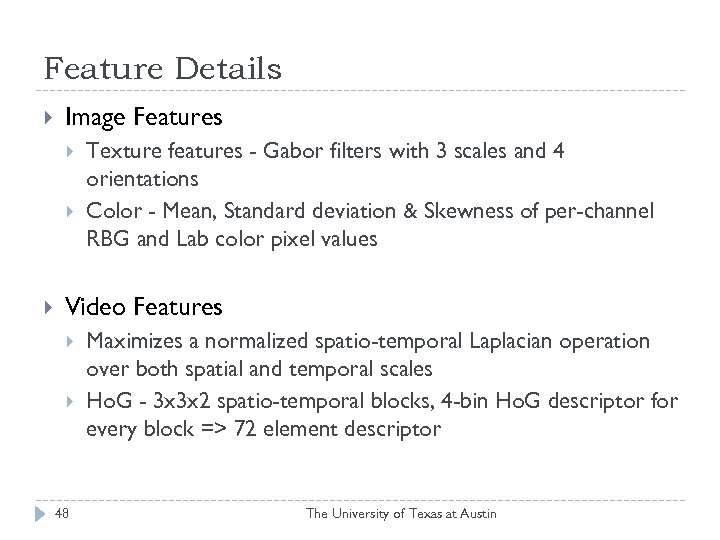 Feature Details Image Features Texture features - Gabor filters with 3 scales and 4 orientations Color - Mean, Standard deviation & Skewness of per-channel RBG and Lab color pixel values Video Features 48 Maximizes a normalized spatio-temporal Laplacian operation over both spatial and temporal scales Ho. G - 3 x 3 x 2 spatio-temporal blocks, 4 -bin Ho. G descriptor for every block => 72 element descriptor The University of Texas at Austin
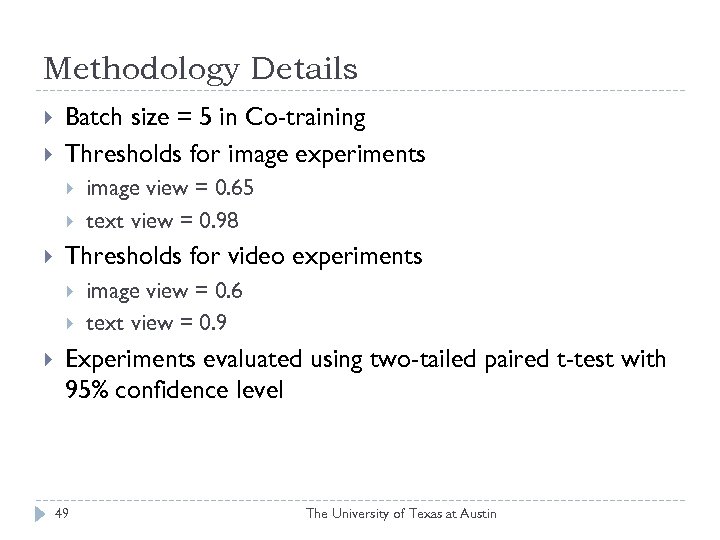 Methodology Details Batch size = 5 in Co-training Thresholds for image experiments Thresholds for video experiments image view = 0. 65 text view = 0. 98 image view = 0. 6 text view = 0. 9 Experiments evaluated using two-tailed paired t-test with 95% confidence level 49 The University of Texas at Austin