


 Скачать презентацию Wastewater Reuse International Regulations and Trends Mohamed F
ebf1dddc037a111dc4406b5d1d6d94b3.ppt
- Количество слайдов: 38
 Wastewater Reuse: International Regulations and Trends Mohamed F. Dahab Department of Civil Engineering University of Nebraska-Lincoln, USA Presented at: Water Arabia 2011 January 31 -February 2, 2011 Manama, Bahrain
 What is Wastewater Reuse? Terminology – Water reuse • The beneficial use of treated wastewater for agriculture, industry, etc. – Water reclamation • Reclamation involves all processes used to treat wastewater so that it can be beneficially reused – Water recycling • Recycling generally means reuse of wastewater back in the same cycle where it is generated.
 What is Wastewater Reuse? Categories of Water Reuse – Indirect Reuse • Reuse of wastewater within the context of natural water systems (rivers, aquifers, etc. ). The ultimate indirect reuse is through the global hydrologic cycle • Other terms: Indirect potable reuse – Direct Reuse • The direct beneficial reuse of treated wastewater for agriculture, industry, etc. • Direct potable reuse: the reuse of reclaimed water for potable uses
 Driving Factors for Water Reuse • Water Availability • Water Consumption • Water Quality
 Benefits of Water Reuse • Important element of integrated water resources utilization and management • Treated effluent is used as a water resource for many possible beneficial purposes • For many Arab coastal cities, wastewater would not be discharged to the sea thus reducing pollution to the marine environment and not creating public health issues
 REUSE and GLOBAL CLIMATE CHANGE • • Global climate change will cause significant disruptions in the world's natural hydrological cycles. These hydrological changes will have significant impacts on water quality and supply and how we manage water resources. Most affected areas in the world include the Middle East and North Africa (MENA) area. Increased acceptance and reliance on reclaimed water will play a key role in mitigating the impacts of global climate change.
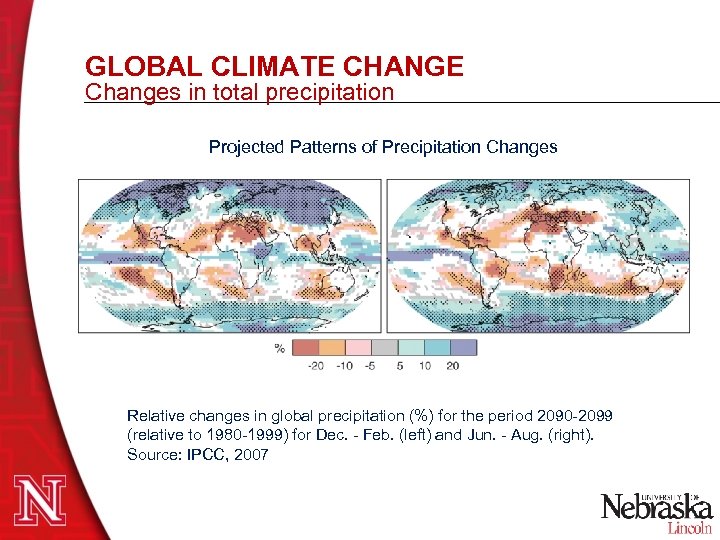 GLOBAL CLIMATE CHANGE Changes in total precipitation Projected Patterns of Precipitation Changes Relative changes in global precipitation (%) for the period 2090 -2099 (relative to 1980 -1999) for Dec. - Feb. (left) and Jun. - Aug. (right). Source: IPCC, 2007
 Considerations for Water Reuse Planning The foundation of successful water reuse programs: • Providing reliable treatment to meet water quality requirements and environmental regulations for the intended reuse. • Protection of public health and the Environment • Gaining public acceptance. • Economic viability
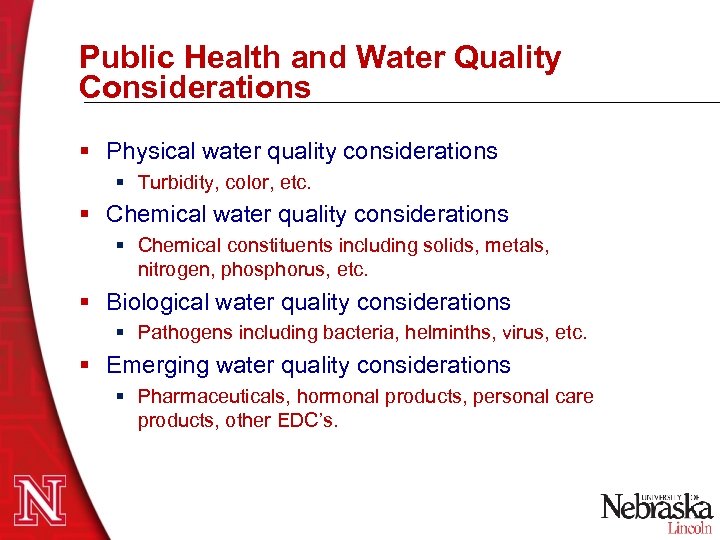 Public Health and Water Quality Considerations § Physical water quality considerations § Turbidity, color, etc. § Chemical water quality considerations § Chemical constituents including solids, metals, nitrogen, phosphorus, etc. § Biological water quality considerations § Pathogens including bacteria, helminths, virus, etc. § Emerging water quality considerations § Pharmaceuticals, hormonal products, personal care products, other EDC’s.
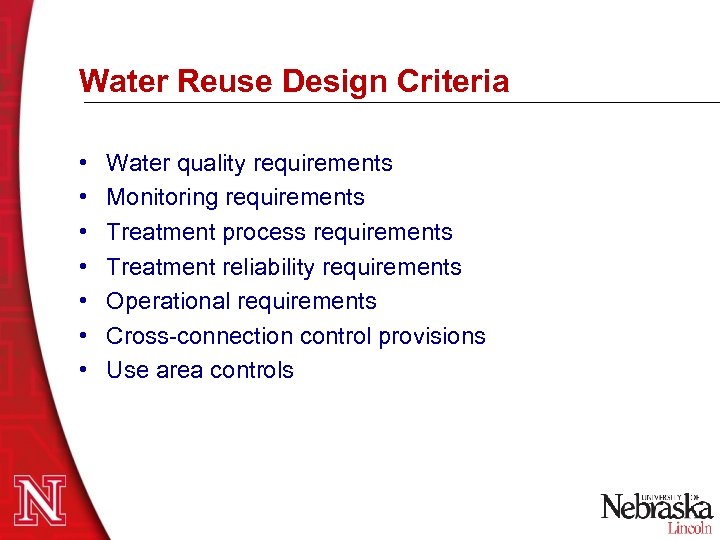 Water Reuse Design Criteria • • Water quality requirements Monitoring requirements Treatment process requirements Treatment reliability requirements Operational requirements Cross-connection control provisions Use area controls
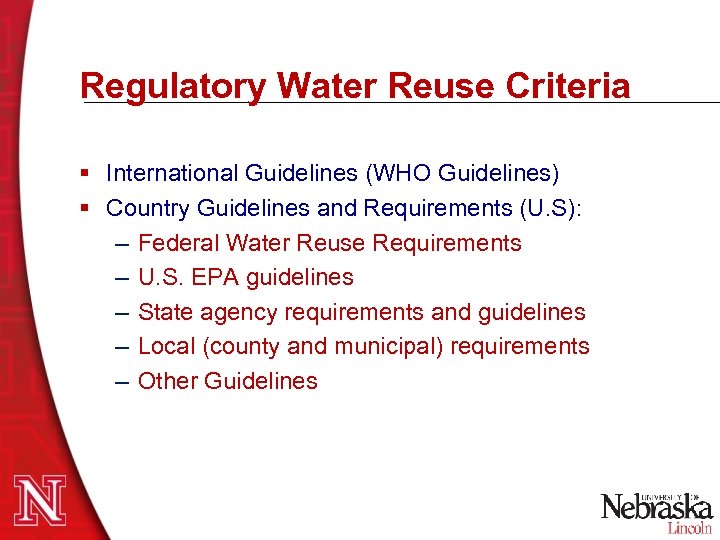 Regulatory Water Reuse Criteria § International Guidelines (WHO Guidelines) § Country Guidelines and Requirements (U. S): – Federal Water Reuse Requirements – U. S. EPA guidelines – State agency requirements and guidelines – Local (county and municipal) requirements – Other Guidelines
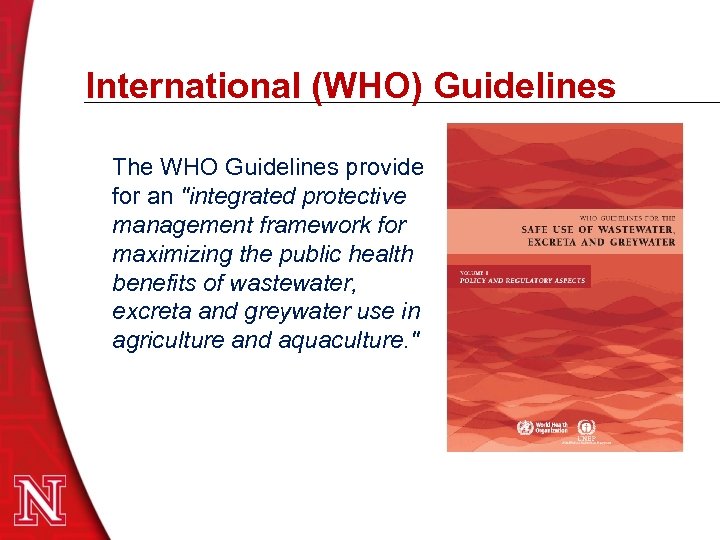 International (WHO) Guidelines The WHO Guidelines provide for an "integrated protective management framework for maximizing the public health benefits of wastewater, excreta and greywater use in agriculture and aquaculture. "
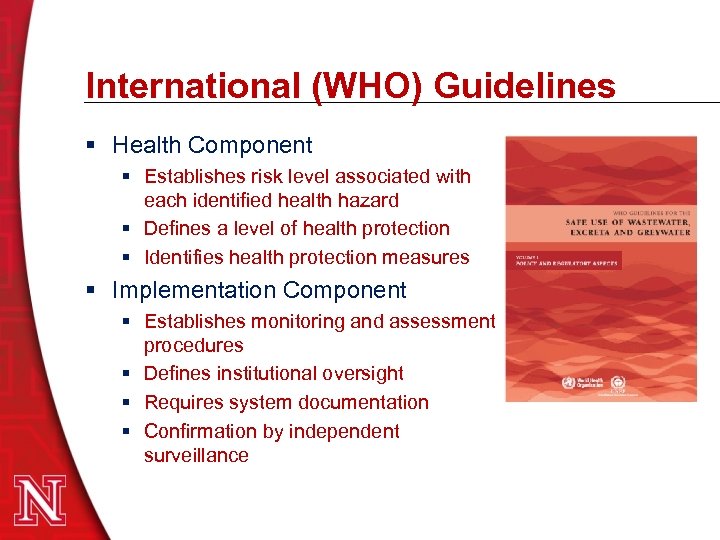 International (WHO) Guidelines § Health Component § Establishes risk level associated with each identified health hazard § Defines a level of health protection § Identifies health protection measures § Implementation Component § Establishes monitoring and assessment procedures § Defines institutional oversight § Requires system documentation § Confirmation by independent surveillance
 U. S. EPA Regulatory Guidelines • Disinfected tertiary effluents – Typical uses: urban, crop irrigation, recreational – BOD = 10 mg/L; E. C. = none, etc. • Disinfected secondary effluents – Typical uses: restricted access irrigation, landscape uses, construction, wetlands, etc. – BOD = 30 mg/L; TSS = 30 mg/L; E. C. = 200/100 m. L; etc.
 Some US Water Reuse Criteria California Department of Health: – Water Recycling – Groundwater Recharge “ …the water resources of the State (must) be put to beneficial use to the fullest extent of which they are capable, and that the waste or unreasonable use or unreasonable method of use of water be prevented, and that the conservation of such waters is to be exercised…” – Reuse goal: 1, 200 million cubic meters annually by 2010
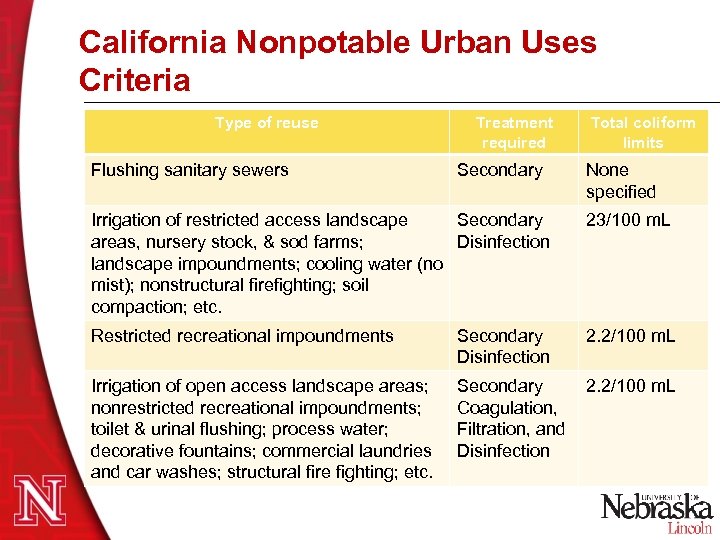 California Nonpotable Urban Uses Criteria Type of reuse Flushing sanitary sewers Treatment required Secondary Total coliform limits None specified Irrigation of restricted access landscape Secondary areas, nursery stock, & sod farms; Disinfection landscape impoundments; cooling water (no mist); nonstructural firefighting; soil compaction; etc. 23/100 m. L Restricted recreational impoundments Secondary Disinfection 2. 2/100 m. L Irrigation of open access landscape areas; nonrestricted recreational impoundments; toilet & urinal flushing; process water; decorative fountains; commercial laundries and car washes; structural fire fighting; etc. Secondary Coagulation, Filtration, and Disinfection 2. 2/100 m. L
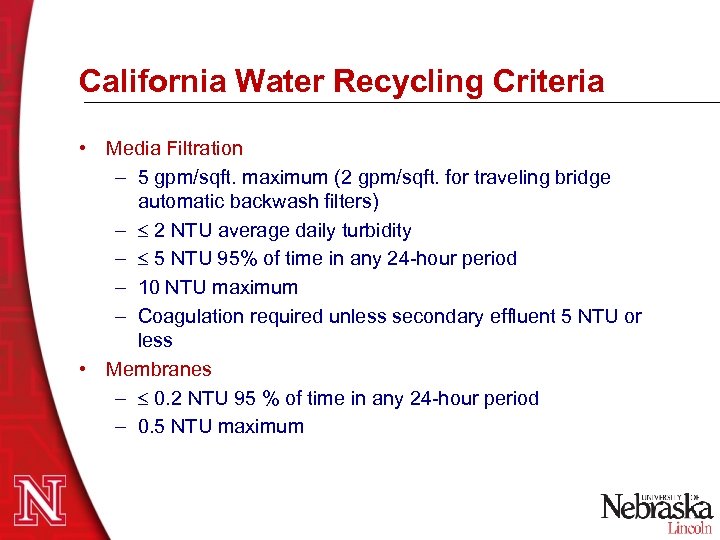 California Water Recycling Criteria • Media Filtration – 5 gpm/sqft. maximum (2 gpm/sqft. for traveling bridge automatic backwash filters) – 2 NTU average daily turbidity – 5 NTU 95% of time in any 24 -hour period – 10 NTU maximum – Coagulation required unless secondary effluent 5 NTU or less • Membranes – 0. 2 NTU 95 % of time in any 24 -hour period – 0. 5 NTU maximum
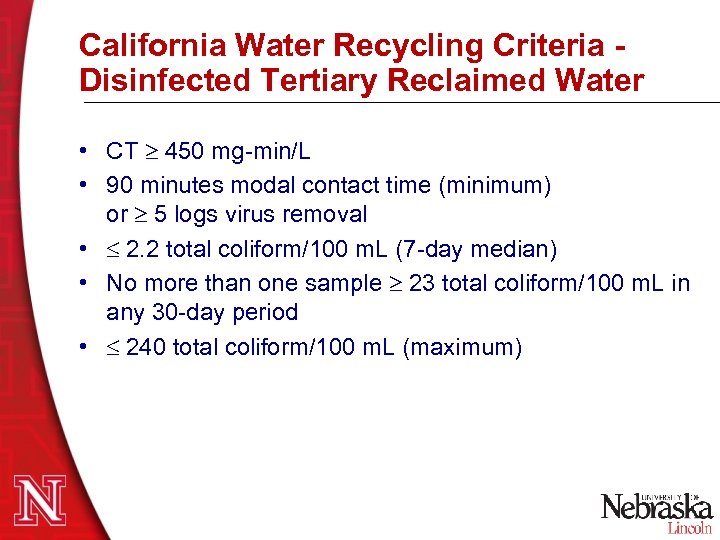 California Water Recycling Criteria Disinfected Tertiary Reclaimed Water • CT 450 mg-min/L • 90 minutes modal contact time (minimum) or 5 logs virus removal • 2. 2 total coliform/100 m. L (7 -day median) • No more than one sample 23 total coliform/100 m. L in any 30 -day period • 240 total coliform/100 m. L (maximum)
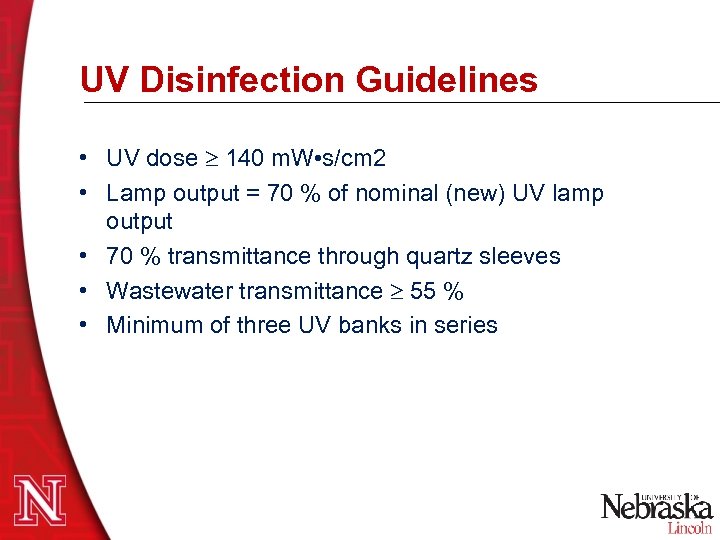 UV Disinfection Guidelines • UV dose 140 m. W • s/cm 2 • Lamp output = 70 % of nominal (new) UV lamp output • 70 % transmittance through quartz sleeves • Wastewater transmittance 55 % • Minimum of three UV banks in series
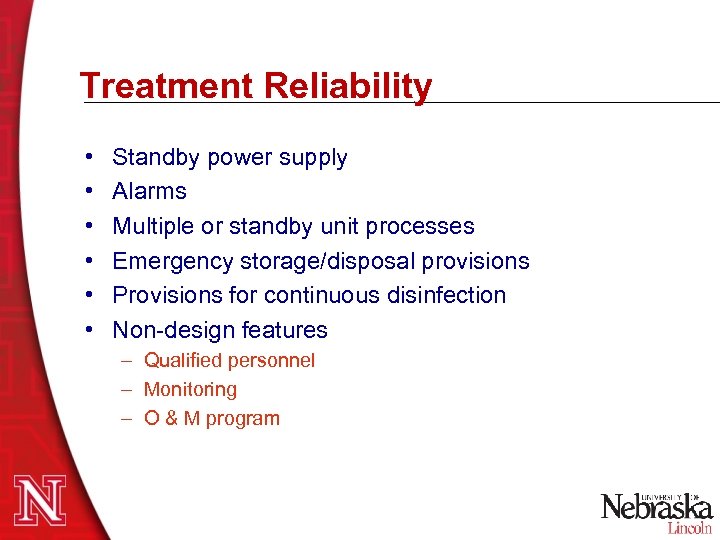 Treatment Reliability • • • Standby power supply Alarms Multiple or standby unit processes Emergency storage/disposal provisions Provisions for continuous disinfection Non-design features – Qualified personnel – Monitoring – O & M program
 Use Area Controls • • Confinement to authorized use area Minimization of public contact Cross-connection control Surveillance and monitoring Public notification Employee training Worker protection
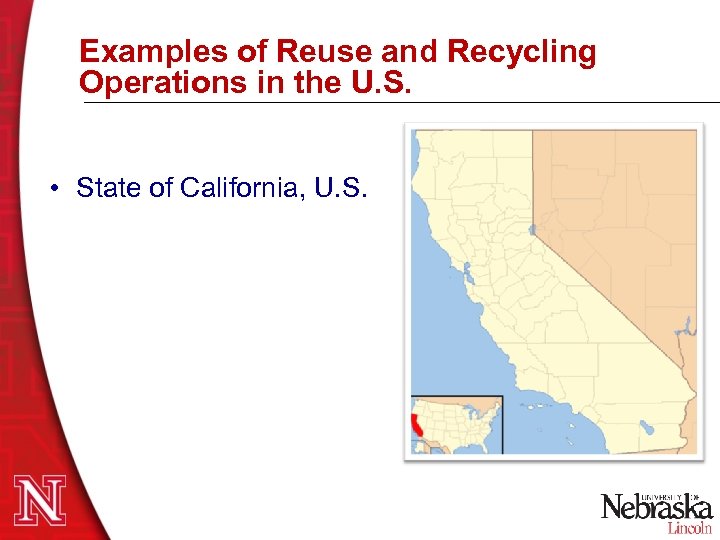 Examples of Reuse and Recycling Operations in the U. S. • State of California, U. S.
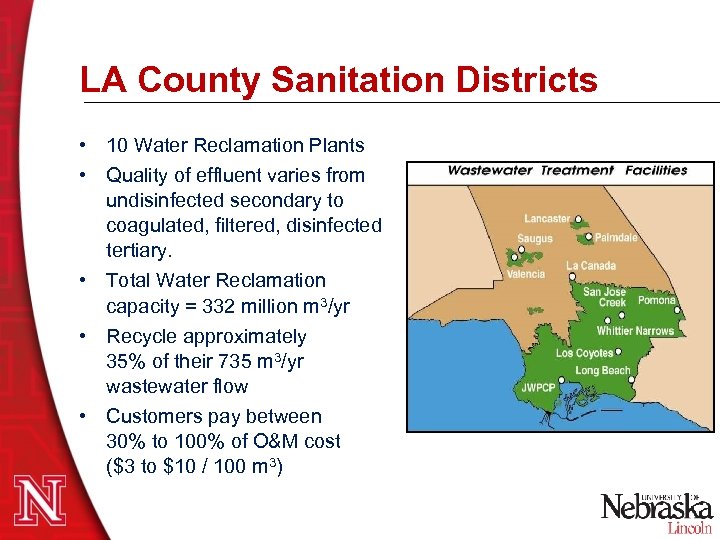 LA County Sanitation Districts • 10 Water Reclamation Plants • Quality of effluent varies from undisinfected secondary to coagulated, filtered, disinfected tertiary. • Total Water Reclamation capacity = 332 million m 3/yr • Recycle approximately 35% of their 735 m 3/yr wastewater flow • Customers pay between 30% to 100% of O&M cost ($3 to $10 / 100 m 3)
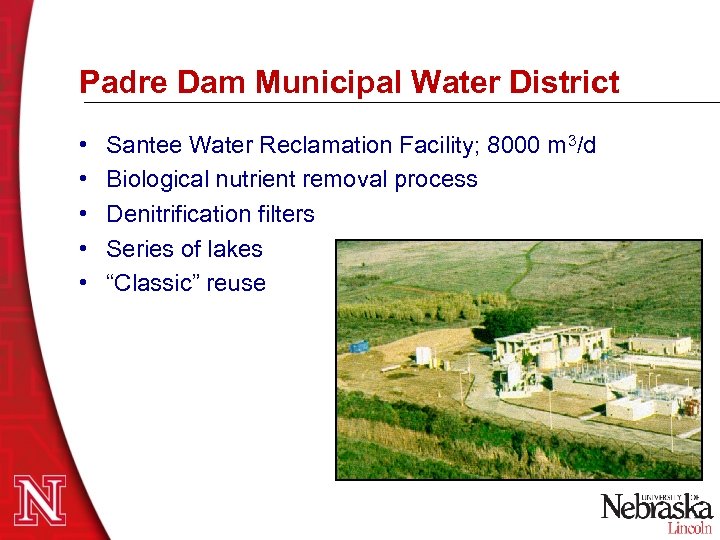 Padre Dam Municipal Water District • • • Santee Water Reclamation Facility; 8000 m 3/d Biological nutrient removal process Denitrification filters Series of lakes “Classic” reuse
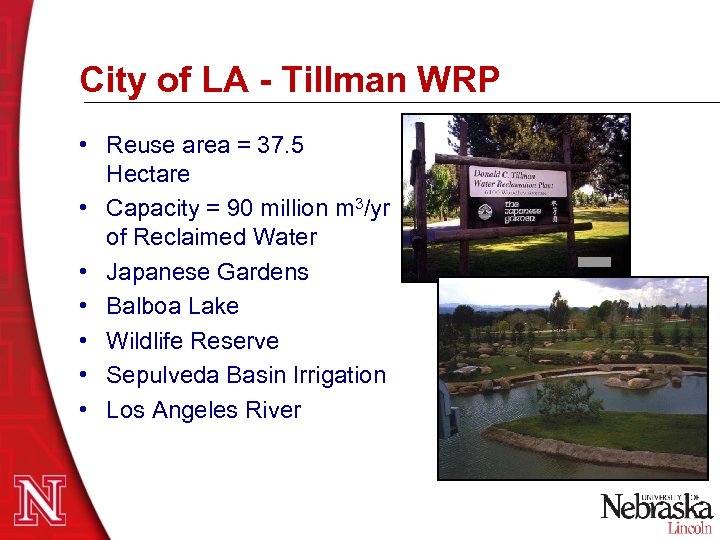 City of LA - Tillman WRP • Reuse area = 37. 5 Hectare • Capacity = 90 million m 3/yr of Reclaimed Water • Japanese Gardens • Balboa Lake • Wildlife Reserve • Sepulveda Basin Irrigation • Los Angeles River
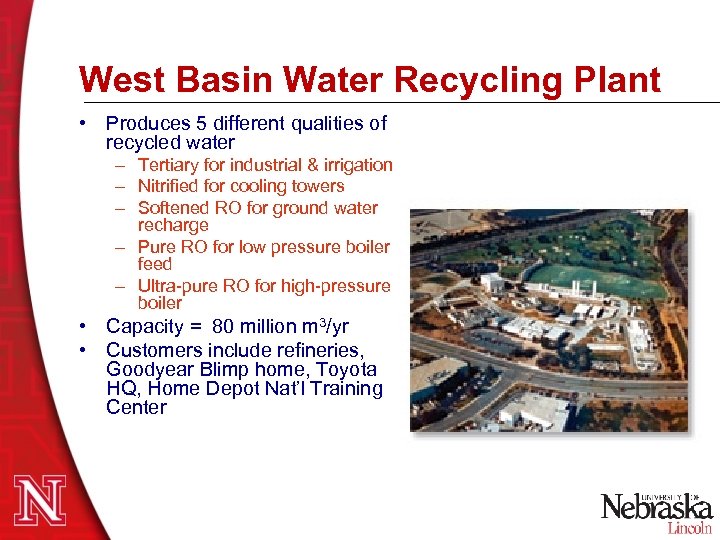 West Basin Water Recycling Plant • Produces 5 different qualities of recycled water – Tertiary for industrial & irrigation – Nitrified for cooling towers – Softened RO for ground water recharge – Pure RO for low pressure boiler feed – Ultra-pure RO for high-pressure boiler • Capacity = 80 million m 3/yr • Customers include refineries, Goodyear Blimp home, Toyota HQ, Home Depot Nat’l Training Center
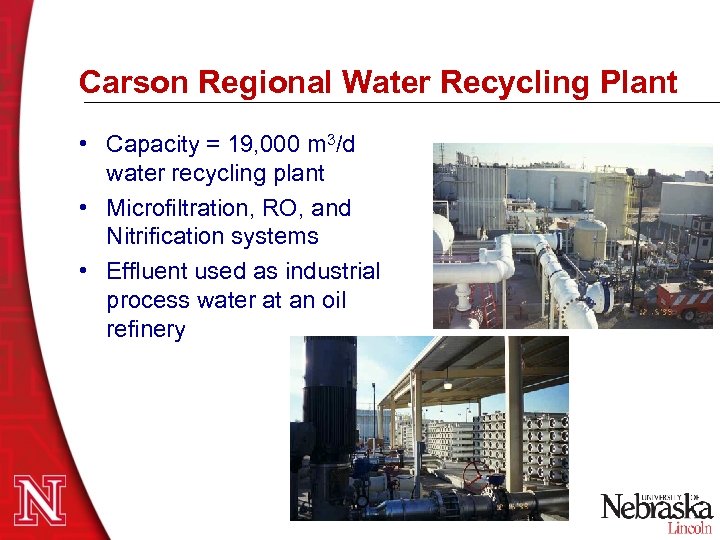 Carson Regional Water Recycling Plant • Capacity = 19, 000 m 3/d water recycling plant • Microfiltration, RO, and Nitrification systems • Effluent used as industrial process water at an oil refinery
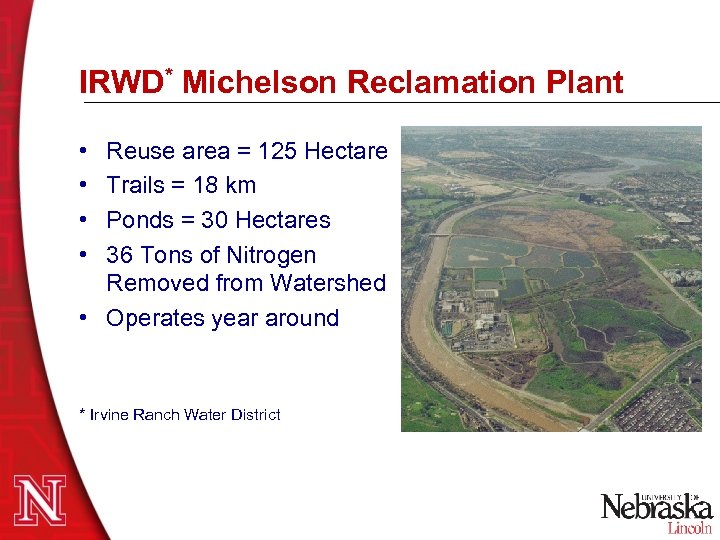 IRWD* Michelson Reclamation Plant • • Reuse area = 125 Hectare Trails = 18 km Ponds = 30 Hectares 36 Tons of Nitrogen Removed from Watershed • Operates year around * Irvine Ranch Water District
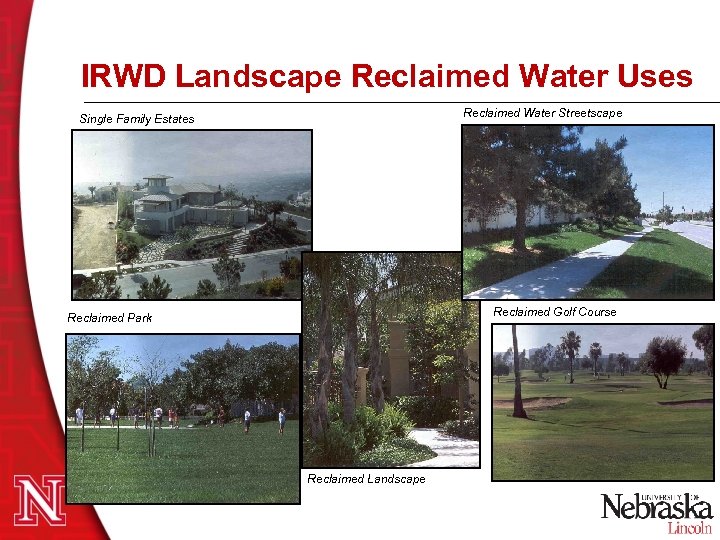 IRWD Landscape Reclaimed Water Uses Reclaimed Water Streetscape Single Family Estates Reclaimed Golf Course Reclaimed Park Reclaimed Landscape
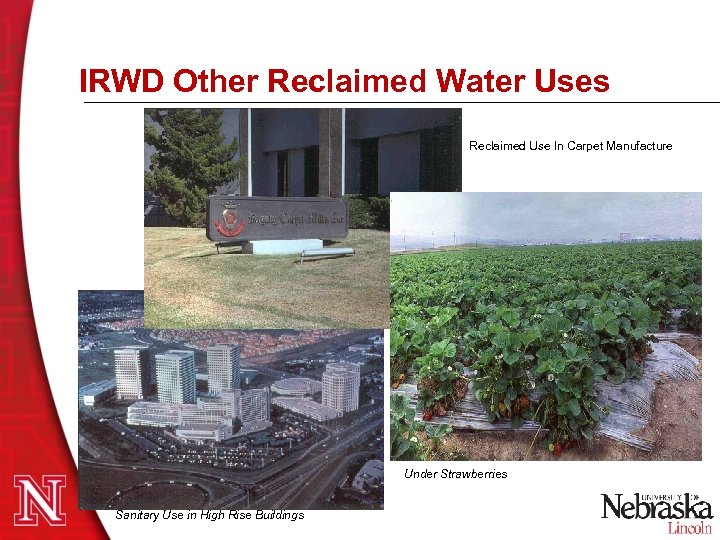 IRWD Other Reclaimed Water Uses Reclaimed Use In Carpet Manufacture Under Strawberries Sanitary Use in High Rise Buildings
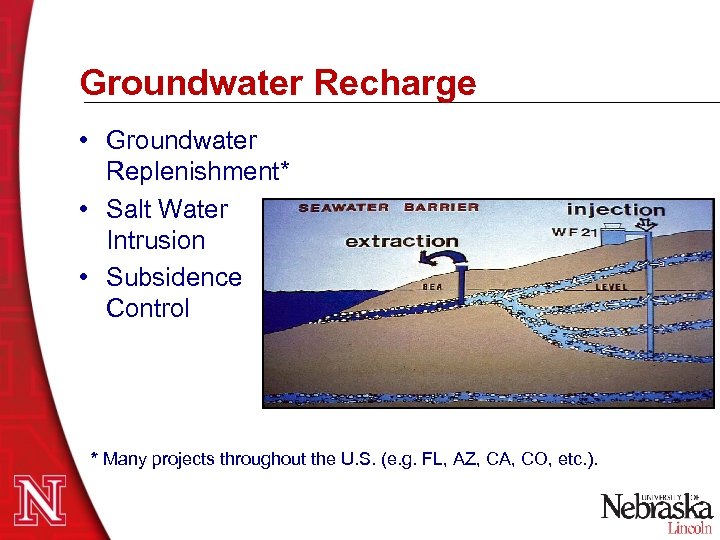 Groundwater Recharge • Groundwater Replenishment* • Salt Water Intrusion • Subsidence Control * Many projects throughout the U. S. (e. g. FL, AZ, CA, CO, etc. ).
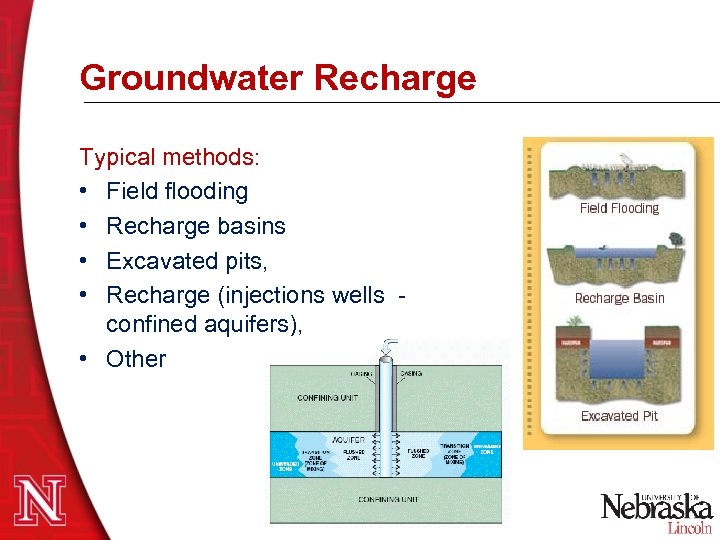 Groundwater Recharge Typical methods: • Field flooding • Recharge basins • Excavated pits, • Recharge (injections wells confined aquifers), • Other
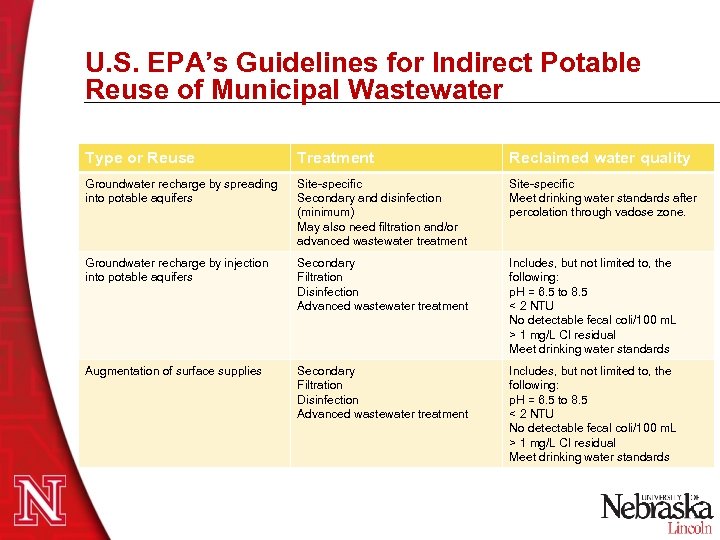 U. S. EPA’s Guidelines for Indirect Potable Reuse of Municipal Wastewater Type or Reuse Treatment Reclaimed water quality Groundwater recharge by spreading into potable aquifers Site-specific Secondary and disinfection (minimum) May also need filtration and/or advanced wastewater treatment Site-specific Meet drinking water standards after percolation through vadose zone. Groundwater recharge by injection into potable aquifers Secondary Filtration Disinfection Advanced wastewater treatment Includes, but not limited to, the following: p. H = 6. 5 to 8. 5 < 2 NTU No detectable fecal coli/100 m. L > 1 mg/L Cl residual Meet drinking water standards Augmentation of surface supplies Secondary Filtration Disinfection Advanced wastewater treatment Includes, but not limited to, the following: p. H = 6. 5 to 8. 5 < 2 NTU No detectable fecal coli/100 m. L > 1 mg/L Cl residual Meet drinking water standards
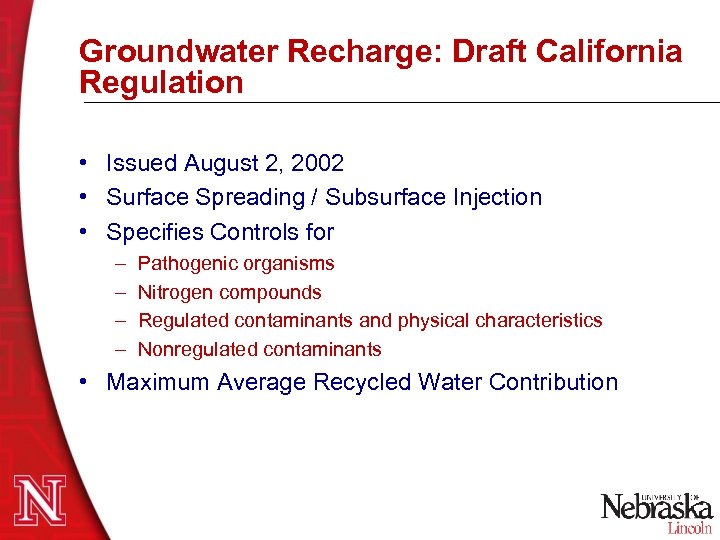 Groundwater Recharge: Draft California Regulation • Issued August 2, 2002 • Surface Spreading / Subsurface Injection • Specifies Controls for – – Pathogenic organisms Nitrogen compounds Regulated contaminants and physical characteristics Nonregulated contaminants • Maximum Average Recycled Water Contribution
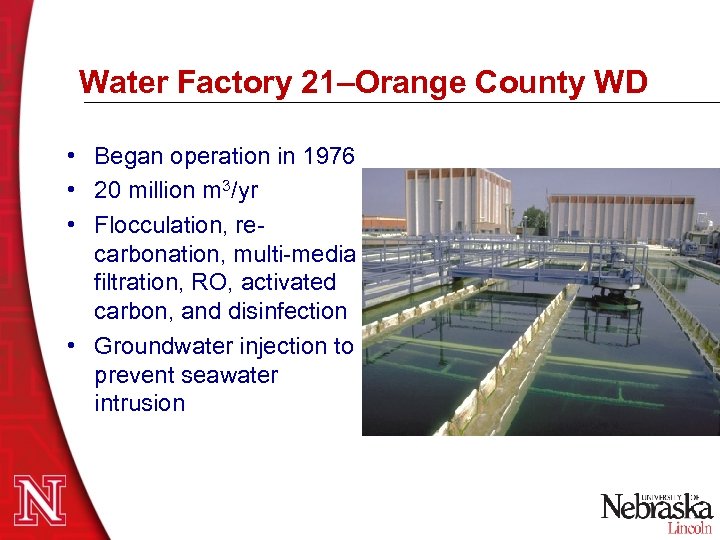 Water Factory 21–Orange County WD • Began operation in 1976 • 20 million m 3/yr • Flocculation, recarbonation, multi-media filtration, RO, activated carbon, and disinfection • Groundwater injection to prevent seawater intrusion
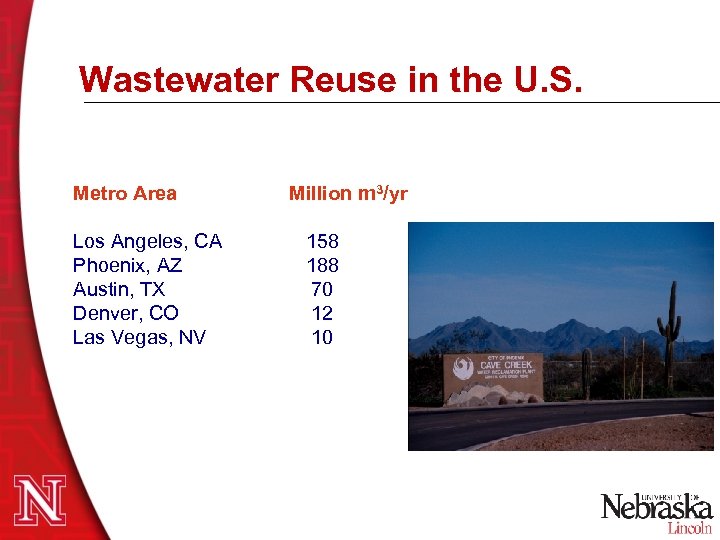 Wastewater Reuse in the U. S. Metro Area Los Angeles, CA Phoenix, AZ Austin, TX Denver, CO Las Vegas, NV Million m 3/yr 158 188 70 12 10
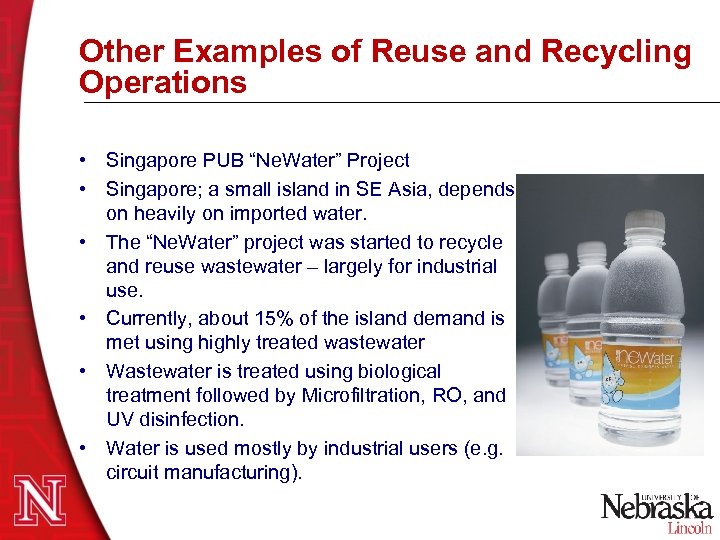 Other Examples of Reuse and Recycling Operations • Singapore PUB “Ne. Water” Project • Singapore; a small island in SE Asia, depends on heavily on imported water. • The “Ne. Water” project was started to recycle and reuse wastewater – largely for industrial use. • Currently, about 15% of the island demand is met using highly treated wastewater • Wastewater is treated using biological treatment followed by Microfiltration, RO, and UV disinfection. • Water is used mostly by industrial users (e. g. circuit manufacturing).
 Wastewater Reuse: International Regulation and Trends Thank You for Listening Mohamed F. Dahab Department of Civil Engineering University of Nebraska-Lincoln, USA